

Peptides vs Classic Heart Drugs: How GLP-3 Retatrutide and GLP-2-T Compare With Atorvastatin in Cardiometabolic Research Models
Cardiovascular disease remains the leading cause of death globally, yet the pharmacological toolkit has barely changed in three decades. Atorvastatin, introduced in 1996, still anchors most lipid-lowering protocols worldwide. Against that backdrop, the question driving cardiometabolic researchers in 2026 is pointed: can next-generation peptide agents like retatrutide redefine what "heart-protective" means in preclinical and clinical research models? The comparison of peptides vs classic heart drugs, specifically how GLP-3 retatrutide and GLP-2-T compare with atorvastatin in cardiometabolic research models, is now one of the most actively discussed topics in metabolic medicine.
Key Takeaways
- Atorvastatin targets a single enzymatic pathway (HMG-CoA reductase) to lower LDL; retatrutide acts across GLP-1, GIP, and glucagon receptors simultaneously.
- In phase 3 research models, retatrutide produced a 37% drop in triglycerides, a 51% reduction in hs-CRP, and a 17% fall in non-HDL cholesterol over 80 weeks.
- No published head-to-head trial directly compares retatrutide or GLP-2-T with atorvastatin in atherosclerotic outcome models as of 2026.
- The large TRIUMPH-OUTCOMES cardiovascular outcomes trial is underway and will provide harder endpoint data over approximately 248 weeks.
- Researchers studying synergistic metabolic effects are increasingly interested in whether peptide-statin combinations could outperform either agent alone.
How Atorvastatin Works: The Classic Statin Mechanism
Atorvastatin belongs to the statin class of drugs, which function by inhibiting HMG-CoA reductase, the rate-limiting enzyme in hepatic cholesterol synthesis. By blocking this enzyme, the liver upregulates LDL receptor expression, pulling more LDL particles from circulation. The result is a well-documented 35-55% reduction in LDL cholesterol, modest triglyceride lowering, and modest HDL elevation.
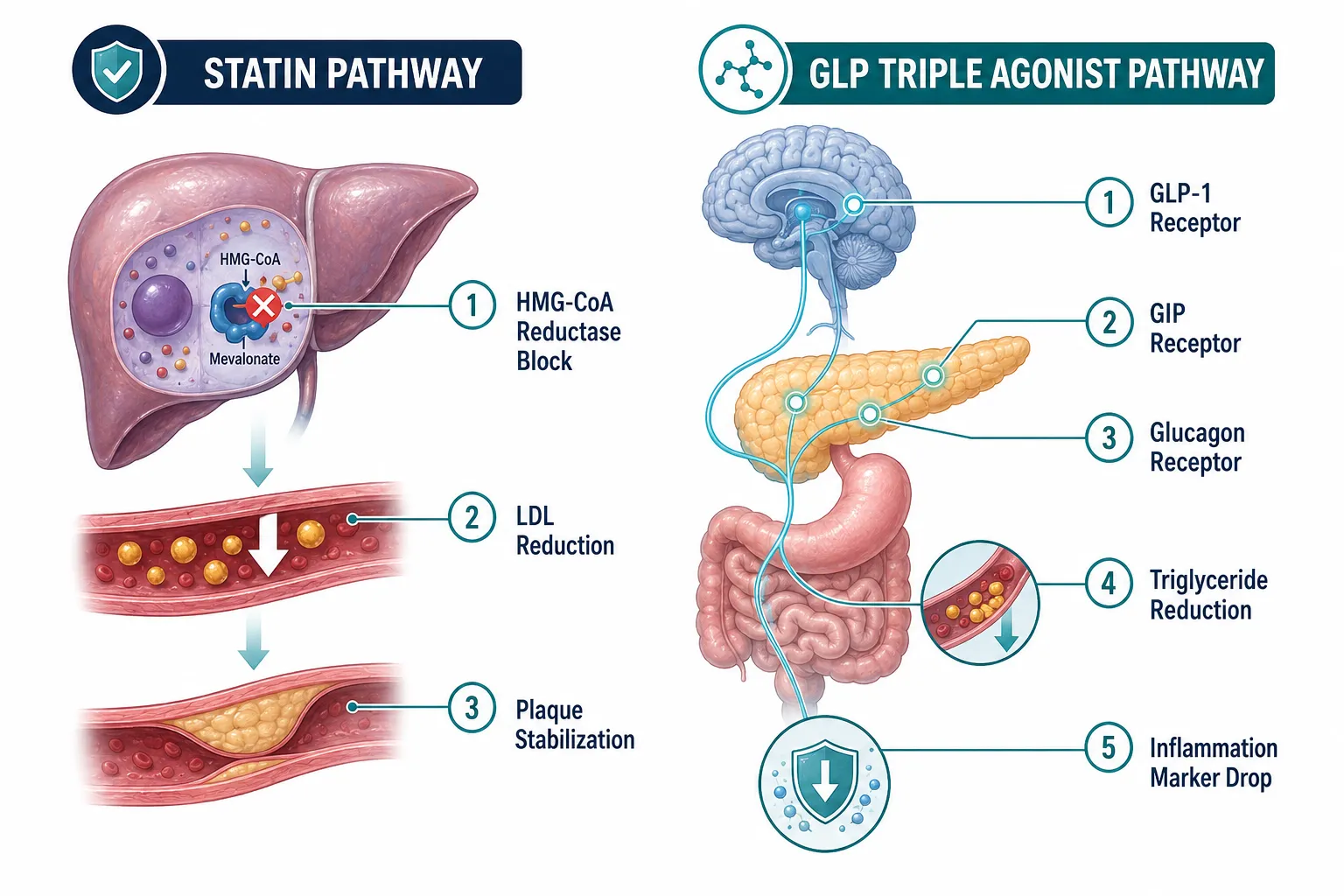
Statins also carry pleiotropic effects, anti-inflammatory, antioxidant, and endothelial-stabilizing properties, that appear to extend cardiovascular protection beyond simple LDL reduction. However, the mechanism remains fundamentally narrow: one enzyme, one primary lipid target. This single-pathway approach is highly effective for LDL management but leaves other cardiometabolic risk factors, visceral adiposity, systemic inflammation, hyperglycemia, elevated triglycerides, largely unaddressed.
"Statins changed cardiology. But they were never designed to manage obesity, insulin resistance, or the full inflammatory burden that drives modern cardiovascular risk."
Retatrutide and GLP-2-T: Multi-Receptor Peptide Mechanisms in Research Models
Retatrutide is a triple agonist that simultaneously activates GLP-1 (glucagon-like peptide-1), GIP (glucose-dependent insulinotropic polypeptide), and glucagon receptors. This multi-receptor engagement produces a cascade of cardiometabolic effects that no single classic drug replicates. Researchers exploring systemic peptide research have noted that this breadth of action is what separates the newer peptide class from statins mechanistically.
In phase 3 TRIUMPH-3 obesity research data reported in mid-2026, weekly retatrutide 12 mg over 80 weeks produced:
| Cardiometabolic Marker | Change Observed |
|---|---|
| Triglycerides | -37% |
| Non-HDL cholesterol | -17% |
| Systolic blood pressure | -9.3 mmHg |
| Waist circumference | -19 cm |
| hs-CRP (inflammation) | -51% |
A 2025 review of triple-agonist therapies noted LDL reductions of approximately 12-22% and total cholesterol reductions of 15-18%, alongside an estimated 82% reduction in hepatic steatosis. These lipid improvements exceeded those seen with dulaglutide 1.5 mg in certain comparisons.
GLP-2-T is a less-characterized agent in cardiometabolic literature. Current published reviews and trial registries through September 2026 do not describe a well-validated "GLP-2-T" compound with dedicated cardiovascular outcome data. Researchers working with therapeutic peptides should note this distinction: retatrutide has a robust and growing evidence base, while GLP-2-T remains at an earlier characterization stage in published cardiometabolic models.
Peptides vs Classic Heart Drugs: Direct Comparison in Cardiometabolic Research Models
When examining peptides vs classic heart drugs, specifically how GLP-3 retatrutide and GLP-2-T compare with atorvastatin in cardiometabolic research models, one critical fact stands out: no published head-to-head clinical or preclinical trial directly compares retatrutide with atorvastatin on atherosclerotic or cardiovascular outcome endpoints as of 2026.
What the evidence does allow is a mechanistic and biomarker-level comparison:
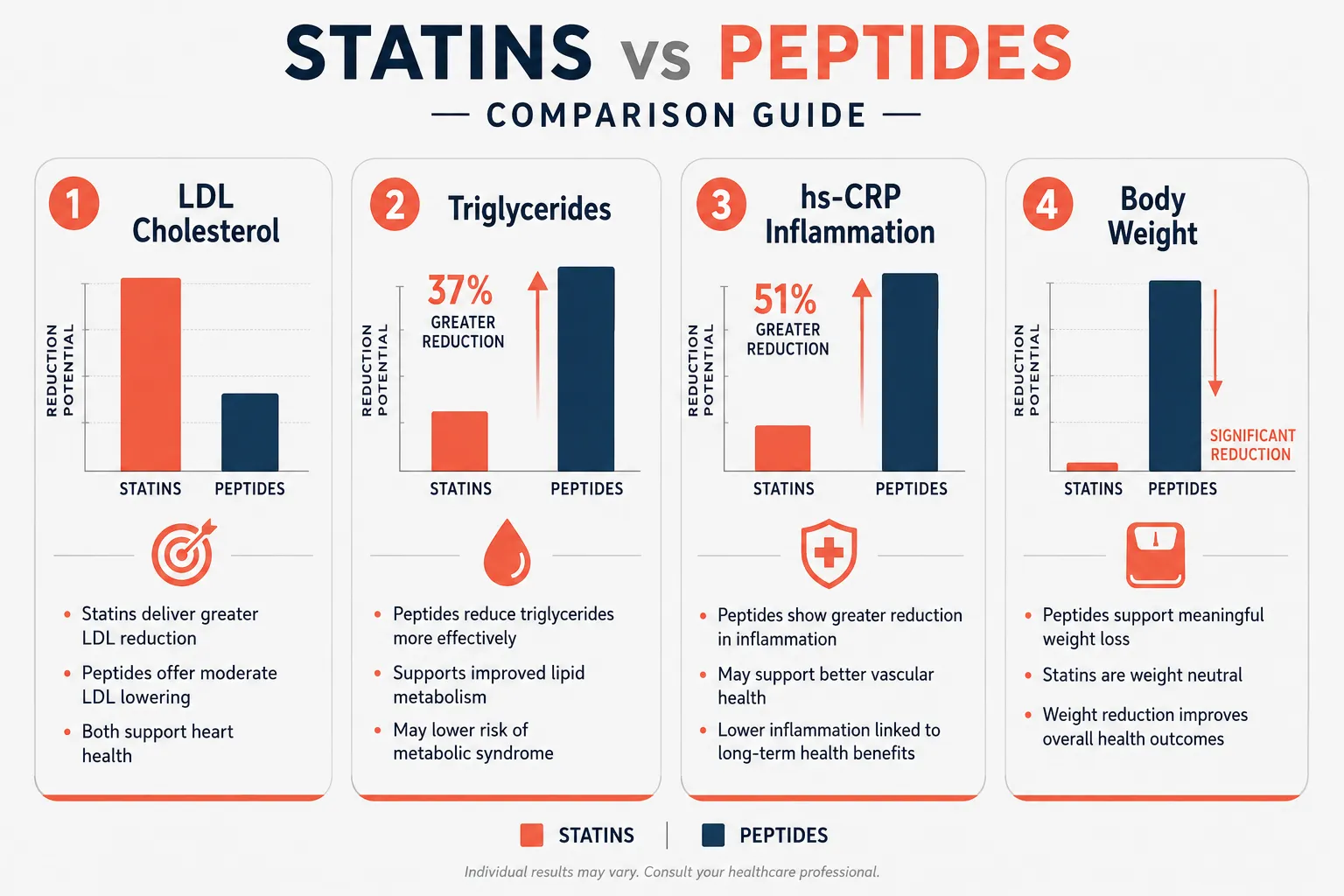
- LDL reduction: Atorvastatin leads clearly, with 35-55% reductions vs retatrutide's 12-22%. For LDL-specific endpoints, statins remain the benchmark.
- Triglycerides: Retatrutide's 35-40% reduction rivals or exceeds what statins typically achieve (15-30% in most models).
- Systemic inflammation (hs-CRP): Retatrutide's 51% hs-CRP reduction is striking. Statins produce modest hs-CRP reductions, typically 15-25%.
- Body weight and adiposity: Retatrutide produces substantial weight loss; statins have no meaningful effect on body weight.
- Hepatic steatosis: Retatrutide's estimated 82% reduction in hepatic fat has no statin equivalent.
Those interested in semaglutide vs retatrutide comparisons will find that retatrutide's multi-receptor profile produces broader cardiometabolic shifts than earlier GLP-1 mono-agonists as well.
The large TRIUMPH-OUTCOMES trial (NCT06383390) is currently underway, designed to assess time to first major cardiovascular composite endpoint, including nonfatal myocardial infarction, nonfatal stroke, cardiovascular death, and heart-failure hospitalization, over approximately 248 weeks. Commentaries on TRIUMPH-3 data acknowledge that while cardiovascular risk markers trend favorably, the trial was not statistically powered for hard outcome endpoints, and observed event counts were lower than anticipated.
Safety considerations also differ. Statins carry well-known risks of myopathy and hepatotoxicity at higher doses. Retatrutide, like other incretin-based agents, can elevate heart rate, and recent work has examined inotropic effects in isolated human atrial tissue, finding increased contractile force without a clear proarrhythmic signal at this stage. Researchers working on stress pathway research and cardiac tissue models will find this an active area of investigation.

Those designing research protocols involving metabolic peptides may also find value in reviewing tesa research as a parallel example of a peptide with documented visceral fat and lipid effects in clinical models.
Conclusion
The comparison of peptides vs classic heart drugs, examining how GLP-3 retatrutide and GLP-2-T compare with atorvastatin in cardiometabolic research models, reveals a clear pattern: these are complementary rather than competing mechanisms. Atorvastatin remains superior for LDL reduction through a proven, targeted enzymatic block. Retatrutide, by contrast, addresses the broader cardiometabolic risk cluster, triglycerides, inflammation, visceral fat, hepatic steatosis, and blood pressure, through simultaneous multi-receptor engagement.
Actionable next steps for researchers in 2026:
- Monitor TRIUMPH-OUTCOMES trial results as they emerge over the next several years for hard cardiovascular endpoint data on retatrutide.
- Design combination model studies that pair statin-class LDL lowering with peptide-mediated inflammatory and adiposity endpoints to assess additive or synergistic effects.
- Treat GLP-2-T as a hypothesis-stage comparator until dedicated cardiometabolic outcome data appears in peer-reviewed literature.
- Ensure any peptide compounds used in research meet rigorous purity standards, resources on third party peptide testing provide useful guidance on verification protocols.
- Explore single peptide vs stack research designs to understand whether multi-agonist peptides offer advantages over sequential or combined classic drug regimens.
The next chapter in cardiometabolic research will likely not be about choosing between peptides and classic drugs, it will be about understanding precisely how each fits within an integrated, multi-target approach to cardiovascular risk reduction.