Call or Text 727-513-9780
  • Shopping Cart Shopping Cart
    0Shopping Cart
Pure Tested Peptides | America's most trusted Peptides for sale online
  • Peptides for sale
    • Oral Peptides for sale
      • Peptide Capsules for sale
      • BPC 157 Capsules 1000mcg
      • SLU-PP-332 Capsules | 1000 mcg
      • 5-Amino-1MQ 50mg Capsules
      • Tesofensine 500mcg
    • All Peptides for sale
    • Peptide Sprays
      • BPC 157 Nasal Spray Kit
      • BPC-157 TB500 Nasal Spray Kit
      • Semax Nasal Spray 10mg
      • Selank – Nasal Spray Kit – 10mg
      • Epithalon 50MG Nasal Spray Kit
      • Ipamorelin 10mg Nasal Spray
      • Klow Nasal Spray (BPC-157 + TB-500 + GHK-Cu + KPV) | 80mg
      • Hulk Nasal Spray Tesa / Ipa Blend 6/3 MG
      • Klow Nasal Spray
      • NAD + 500 mg Nasal Spray
      • PT-141 Nasal Spray Kit
    • GHRH Peptides
      • Ipa Peptides
      • CJC-1295 Peptides
        • CJC-1295 with DAC 5 mg
        • CJC-1295 without DAC 5 mg
        • CJC-1295 Ipa 10mg
      • Tesa Peptides
        • Tesa Peptide
        • Tesa 20 mg
    • GHK-Cu Peptides
      • All GHK-Cu Peptides
      • GHK-Cu 100mg
      • KLOW Peptide Blend – Buy KLOW blend online
    • BPC Peptides
      • All BPC Peptides
      • BPC-157
      • BPC-157 TB-500
      • BPC 157 capsules 1000mcg
    • SLU-PP-332 Peptides
      • All SLU-PP-332 Peptides
      • SLU-PP-332 5mg
    • GLP3 Peptides
    • PT-141 Peptides
      • PT-141 Peptides for sale
      • PT-141 10mg
      • PT-141 Nasal Spray
    • CAG Peptides
      • Lipo-C Peptide Blend
      • CAG 5mg
      • CAG 10mg
    • MOTS-C Peptides
      • MOTS-C Peptides for sale
      • MOTS-c peptide
      • MOTS-c 10mg *6 pack*
    • 5 Amino 1MQ Peptides
      • 5 Amino 1MQ Peptides for sale
      • 5-Amino-1MQ 50mg Capsules
      • 5-Amino-1MQ 5mg
    • Epithalon Peptides
      • Epithalon Peptides for sale
      • Epithalon 10mg
      • Epithalon 50mg
  • Shop
    • GLPs
      • 5-Amino-1MQ 50mg Capsules
      • 5-Amino-1MQ 5mg
      • L-Carnitine 500mg/ml
      • Tesofensine 500mcg
      • SLU-PP-332 5mg
      • MOTS-c 10mg *6 pack*
    • Epithalon & BPC Peptides
      • Epithalon 10mg
      • Epithalon 50mg
      • BPC-157
      • BPC 157 capsules 1000mcg
      • BPC-157 TB-500
      • BPC-157 TB500 Nasal Spray Kit
      • BPC 157 Nasal Spray Kit
    • BPC TB-500 & NAD+ Peptides
      • NAD+ 500 mg
      • KLOW Peptide Blend – Buy KLOW blend online
      • GLOW Peptide Blend
      • TB 500 5mg
      • BPC 157 capsules 1000mcg – Supplement
      • BPC 157 Nasal Spray Kit
      • BPC-157
      • BPC-157 TB500 Nasal Spray Kit
      • BPC-157 TB-500
      • BPC 157 capsules 1000mcg
    • LL-37 Peptide
      • LL-37 10 mg
    • MOTS-C & Selank
      • MOTS-c peptide
      • Selank 10mg
    • GHK Peptides
      • GHK-Cu 100mg
      • GLOW Peptide Blend
      • KLOW Peptide Blend – Buy KLOW blend online
  • COAs
  • Wholesale
    • Wholesale Peptides for sale
  • PTP FAQ
  • Affiliates
    • Selank Peptide: Advanced Pharmacological Mechanisms Underlying Its Anxiolytic and Nootropic Effects in Research
      • 5-Amino-1MQ Peptide: Detailed Mechanisms of NNMT Inhibition and Its Impact on Cellular Metabolism Research
        • MOTS-C Peptide: Unraveling Its Role in Mitochondrial Dynamics and Energy Metabolism Research
          • Epithalon Peptide and Telomerase Regulation: Investigating Its Impact on Cellular Senescence and Lifespan Research Models
            • GLP2-T vs GLP2 Tirz Peptide: Understanding the Naming, Mechanistic Nuances, and Research Implications for Gut Health
      • Peptides and Polypeptides in Modern Pharmacology: What Research on Metoprolol, Prednisone, and Amlodipine Reveals
        • Polypeptide Peptides vs NSAIDs: What Naproxen and Diclofenac Teach Tissue-Repair Researchers About BPC‑157 and TB‑500
          • Peptides and Polypeptides in Endocrine Pharmacology: How GLP-1, GLP-2, and GLP-3 Retatrutide Differ From Classic Drugs Like Prednisone and Amlodipine
          • 5‑Amino‑1MQ Peptide and NNMT Inhibition: How It Compares With Statins Like Atorvastatin in Adipose and Lipid Metabolism Research
      • Enclomiphene, Estrogen Receptor Signaling, and Luteinizing Phase Biology: What Hormone Researchers Should Measure
        • Mesenchymal Stem Cells, BPC‑157, and GHK‑Cu: How Tissue Repair Peptides Compare With Classic NSAIDs Like Naproxen in Injury Models
          • Peptide Calculator Use Cases Beyond Growth Hormone: Working Through GLP‑3 Retatrutide, MOTS‑c, and BPC‑157 Research Dosing
        • Polypeptide Peptides in Endocrine and Metabolic Pharmacology: Lessons From Amlodipine, Prednisone, and Metoprolol
        • Peptides Calculator for Advanced Blends: Worked Examples for Tesamorelin, CJC‑1295, and Ipamorelin Stacks
          • Peptides and Polypeptides in Human Physiology: How Molecular Size Shapes Research Applications
            • Selank Peptide: Advanced Pharmacological Mechanisms Underlying Its Anxiolytic and Nootropic Effects in Research
          • 5-Amino-1MQ Peptide: Detailed Mechanisms of NNMT Inhibition and Its Impact on Cellular Metabolism Research
            • MOTS-C Peptide: Unraveling Its Role in Mitochondrial Dynamics and Energy Metabolism Research
              • Epithalon Peptide and Telomerase Regulation: Investigating Its Impact on Cellular Senescence and Lifespan Research Models
                • GLP2-T vs GLP2 Tirz Peptide: Understanding the Naming, Mechanistic Nuances, and Research Implications for Gut Health
                  • Peptides and Polypeptides in Endocrine Pharmacology: How GLP-1, GLP-2, and GLP-3 Retatrutide Differ From Classic Drugs Like Prednisone and Amlodipine
                    • Polypeptide Peptides vs NSAIDs: What Naproxen and Diclofenac Teach Tissue-Repair Researchers About BPC‑157 and TB‑500
                      • Peptides and Polypeptides in Modern Pharmacology: What Research on Metoprolol, Prednisone, and Amlodipine Reveals
                        • 5‑Amino‑1MQ Peptide and NNMT Inhibition: How It Compares With Statins Like Atorvastatin in Adipose and Lipid Metabolism Research
                        • Enclomiphene, Estrogen Receptor Signaling, and Luteinizing Phase Biology: What Hormone Researchers Should Measure
                        • Mesenchymal Stem Cells, BPC‑157, and GHK‑Cu: How Tissue Repair Peptides Compare With Classic NSAIDs Like Naproxen in Injury Models
                        • Peptide Calculator Use Cases Beyond Growth Hormone: Working Through GLP‑3 Retatrutide, MOTS‑c, and BPC‑157 Research Dosing
                        • Polypeptide Peptides in Endocrine and Metabolic Pharmacology: Lessons From Amlodipine, Prednisone, and Metoprolol
                        • Peptides Calculator for Advanced Blends: Worked Examples for Tesamorelin, CJC‑1295, and Ipamorelin Stacks
                        • Peptides and Polypeptides in Human Physiology: How Molecular Size Shapes Research Applications
                        • Selank Peptide: Advanced Pharmacological Mechanisms Underlying Its Anxiolytic and Nootropic Effects in Research
                        • MOTS-C Peptide: Unraveling Its Role in Mitochondrial Dynamics and Energy Metabolism Research
                        • Peptides and Polypeptides in Modern Pharmacology: What Research on Metoprolol, Prednisone, and Amlodipine Reveals
                        • Peptides and Polypeptides in Endocrine Pharmacology: How GLP-1, GLP-2, and GLP-3 Retatrutide Differ From Classic Drugs Like Prednisone and Amlodipine
                        • 5-Amino-1MQ Peptide: Detailed Mechanisms of NNMT Inhibition and Its Impact on Cellular Metabolism Research
                        • Mesenchymal Stem Cells, BPC‑157, and GHK‑Cu: How Tissue Repair Peptides Compare With Classic NSAIDs Like Naproxen in Injury Models
                        • Peptide Calculator Use Cases Beyond Growth Hormone: Working Through GLP‑3 Retatrutide, MOTS‑c, and BPC‑157 Research Dosing
                        • GLP2-T vs GLP2 Tirz Peptide: Understanding the Naming, Mechanistic Nuances, and Research Implications for Gut Health
                        • Polypeptide Peptides in Endocrine and Metabolic Pharmacology: Lessons From Amlodipine, Prednisone, and Metoprolol
                        • Polypeptide Peptides vs NSAIDs: What Naproxen and Diclofenac Teach Tissue-Repair Researchers About BPC‑157 and TB‑500
                        • Peptides and Polypeptides in Human Physiology: How Molecular Size Shapes Research Applications
                        • Peptides Calculator for Advanced Blends: Worked Examples for Tesamorelin, CJC‑1295, and Ipamorelin Stacks
                        • 5‑Amino‑1MQ Peptide and NNMT Inhibition: How It Compares With Statins Like Atorvastatin in Adipose and Lipid Metabolism Research
                        • Enclomiphene, Estrogen Receptor Signaling, and Luteinizing Phase Biology: What Hormone Researchers Should Measure
                        • Epithalon Peptide and Telomerase Regulation: Investigating Its Impact on Cellular Senescence and Lifespan Research Models
                        • Best research protocol Klow blend
                        • best time to take BPC-157
                        • best time to take DSIP (Delta Sleep Inducing Peptide)
                        • best time to take CJC-1295
                        • best time to take AOD-9604
                        • best time to take Follistatin 344
                        • best time to take Ipamorelin
                        • best time to take MK-677 (Ibutamoren)
                        • best time to take Ligandrol (LGD-4033) — research compound
                        • best time to take Ostarine (MK-2866) — research compound
                        • best time to take GHK-CU
                        • best time to take TB-500
                        • best time to take MOTS-c
                        • best time to take Semax
                        • best time to take RAD-140 (Testolone) — research compound
                        • best time to take Thymosin Alpha-1
                        • best time to take PEG-MGF
                        • Biolife Plasma, Octapharma Plasma, and Research Peptides: How Plasma Donation Labs Differ From Peptide Suppliers
                        • best time to take YK-11 — research compound
                        • best time to take PT-141 (Bremelanotide)
                        • Best research protocol Klow blend
                        • 5-Amino-1MQ and MOTS-C Synergy: Metabolic Signaling, Mitochondria, and Research Design
                        • BPC-157 and TB-500: Investigating Their Combined Effects on Angiogenesis and Cellular Migration in Tissue Repair Models
                        • BPC-157 Peptide: Gut Barrier Function, Inflammation, and Tissue-Recovery Research
                        • 5‑Amino‑1MQ and MOTS‑c Synergy in Metabolic Research: Designing NNMT and Mitochondrial Biogenesis Stacks
                        • CJC-1295 with DAC vs. Without DAC: Half-Life, Release Kinetics, and Research Implications
                        • CJC‑1295 with DAC vs. Without DAC: Expanding on Half‑Life Differences Using Tesamorelin and Ipamorelin Blend Case Studies
                        • Collagen Biology and Copper‑Binding Peptides: How GHK‑Cu, Glow Blend, and Klow Blend Interact with Skin and Connective Tissue
                        • Collagen Biology and Regenerative Peptides: How GHK‑Cu, Glow Blend, and Klow Blend Affect Extracellular Matrix Research
                    • DNA, Telomeres, and Longevity Peptides: Positioning Epithalon and MOTS‑c in Genetic Aging Research
                      • Enclomiphene Citrate: serm Mechanism, Testosterone Research, and Stack Compatibility
                        • Enclomiphene vs Enclomiphene Citrate: Formulation, Bioavailability, and Research Distinctions
                        • Epithalon Peptide Research: Telomerase Activation, Aging, and Pineal Gland Function
                        • Estrogen Receptor Signaling and Enclomiphene: How Selective Modulators Compare with Classic Polypeptide Hormones
                        • GHK-Cu Peptide: Advanced Mechanisms in Extracellular Matrix Remodeling and Wound Healing Research
                        • GHK-Cu Peptide: Collagen Synthesis, Wound Repair, and Skin-Barrier Research Models
                        • GLP-1 vs GLP-3 vs GLP-2: Peptide Classification and Research Applications
                        • GLP-2 Peptide Research Guide: Gut Barrier Function, Nutrient Absorption, and Intestinal Recovery Models
                        • GLP-3 Retatrutide vs. GLP-1 Drugs: What Triple-Agonist Biology Changes in Research Models
                        • Ipamorelin and Tesamorelin Combination: Synergistic GH Secretagogue Research and Dosing Protocols
                        • GLP2 Tirz Peptide: What It Is, Why the Name Exists, and How Researchers Should Interpret It
                        • Klow Blend Peptide Nasal Spray: What the Formulation Is Trying to Do in Cognitive Research
                        • Mitochondria, NNMT Inhibition, and Peptide Modulators: Where MOTS‑c and 5‑Amino‑1MQ Fit in Cellular Energy Research
                        • MOTS-c Peptide: Mitochondrial Function, Energy Metabolism, and What Researchers Measure
                        • MOTS-c vs. 5-Amino-1MQ: Which Metabolic Research Questions Each Compound Actually Answers
                        • Nasal Spray Peptides: Bioavailability, Administration, and Semax/Selank Research Applications
                        • PT-141 Peptide Research: Mechanism of Action and Melanocortin Receptor Signaling
                        • Retatrutide for Research: Mechanism, Structure, and GLP-1/GLP-3 Dual Action
                        • Retatrutide for Obesity and Type 2 Diabetes: What the Latest Trial Data Suggest
                        • Tesofensine Peptide Research: Mechanism, Appetite Suppression, and Neuropeptide Y Pathways
  • Contact
    • Contact Customer Service
    • Text Customer Support
  • About US
  • Shop all peptides
  • Affiliate Program
    • Affiliate Signup
  • Login / Register Login / Register Page Link Login / Register Page Link
  • Click to open the search input field Click to open the search input field Search
  • Menu Menu

Tag Archive for: cardiovascular risk markers

LDL Cholesterol, Triglycerides, and Non-HDL Cholesterol: Building a Complete Metabolic Peptide Readout

LDL Cholesterol, Triglycerides, and Non-HDL Cholesterol: Building a Complete Metabolic Peptide Readout

October 3, 2026/0 Comments/in Uncategorized/by

Nearly half of adults who experience a first cardiovascular event have LDL cholesterol levels that fall within the "normal" range, a sobering fact that exposes the core weakness of relying on a single lipid marker. For researchers designing metabolic peptide experiments, that gap is not a minor inconvenience; it is a fundamental flaw in study design. Building a complete metabolic peptide readout around LDL cholesterol, triglycerides, and non-HDL cholesterol closes that gap and delivers a far more accurate picture of atherogenic particle burden.

Key Takeaways

  • LDL-C alone misses a significant portion of cardiovascular risk, especially in individuals with elevated triglycerides or metabolic syndrome.
  • Non-HDL cholesterol captures all atherogenic particles, LDL plus triglyceride-rich remnants, making it a superior global risk marker.
  • Current 2026 guidelines set paired goals: LDL-C and non-HDL-C must both be assessed and treated to target.
  • A complete metabolic lipid panel includes total cholesterol, LDL-C, HDL-C, triglycerides, and non-HDL-C, with optional apolipoprotein B and Lp(a) for high-risk or complex cases.
  • Lipid results gain the most interpretive power when paired with glucose and inflammatory endpoints in peptide research protocols.

Why One Lipid Marker Is Never Enough

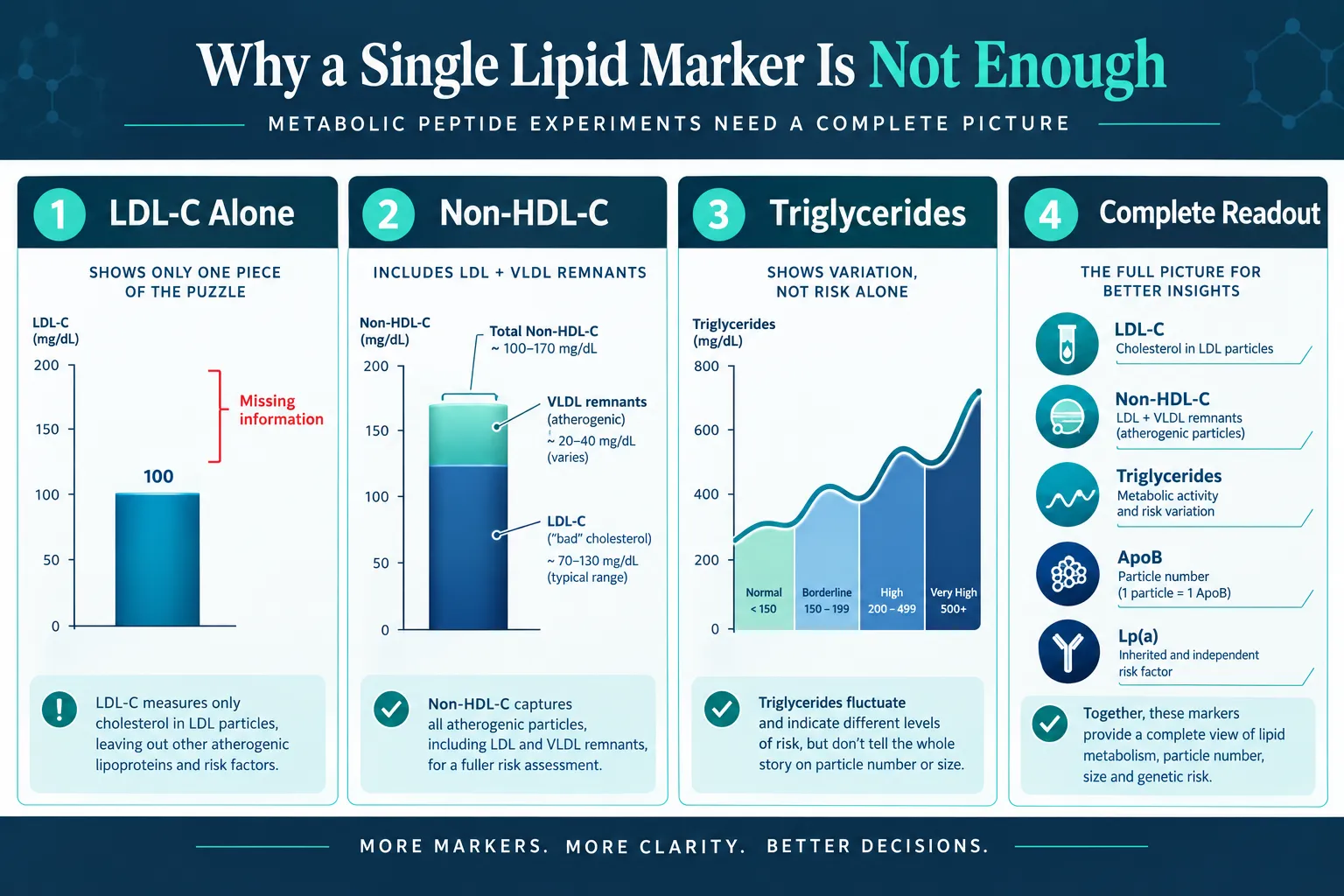
The tradition of treating LDL-C as the sole lipid target made clinical sense when it was the best available tool. In 2026, that rationale no longer holds. Researchers now understand that triglyceride-rich lipoproteins, very-low-density lipoprotein (VLDL) and its remnants, drive atherosclerotic plaque independently of LDL-C. A patient or research subject can achieve an LDL-C below 100 mg/dL and still carry a dangerous burden of remnant cholesterol that a standard LDL reading will never detect.
Why One Lipid Marker Is Never Enough

This is where non-HDL cholesterol becomes indispensable. Calculated simply as total cholesterol minus HDL cholesterol, non-HDL-C captures every atherogenic particle in circulation, LDL, VLDL, IDL, and remnants. In populations with high triglycerides, obesity, type 2 diabetes, or metabolic syndrome, non-HDL-C consistently outperforms LDL-C as a predictor of cardiovascular outcomes. Research in patients with chronic kidney disease reinforces this point: non-HDL-C and remnant cholesterol show stronger, more consistent associations with adverse events than LDL-C alone.

For metabolic peptide experiments, this distinction matters enormously. Peptides that influence insulin signaling, energy metabolism, or inflammatory pathways, such as those explored in GLP-3 peptide research or Cagrilintide peptide studies, can shift triglyceride and remnant cholesterol levels without meaningfully moving LDL-C. A readout built on LDL alone would miss those effects entirely.

Key principle: Non-HDL-C should be no more than 30 mg/dL above the LDL-C goal. For a subject with an LDL target below 100 mg/dL, the non-HDL-C goal is below 130 mg/dL.


Assay Selection, Fasting Status, and Triglyceride Categories

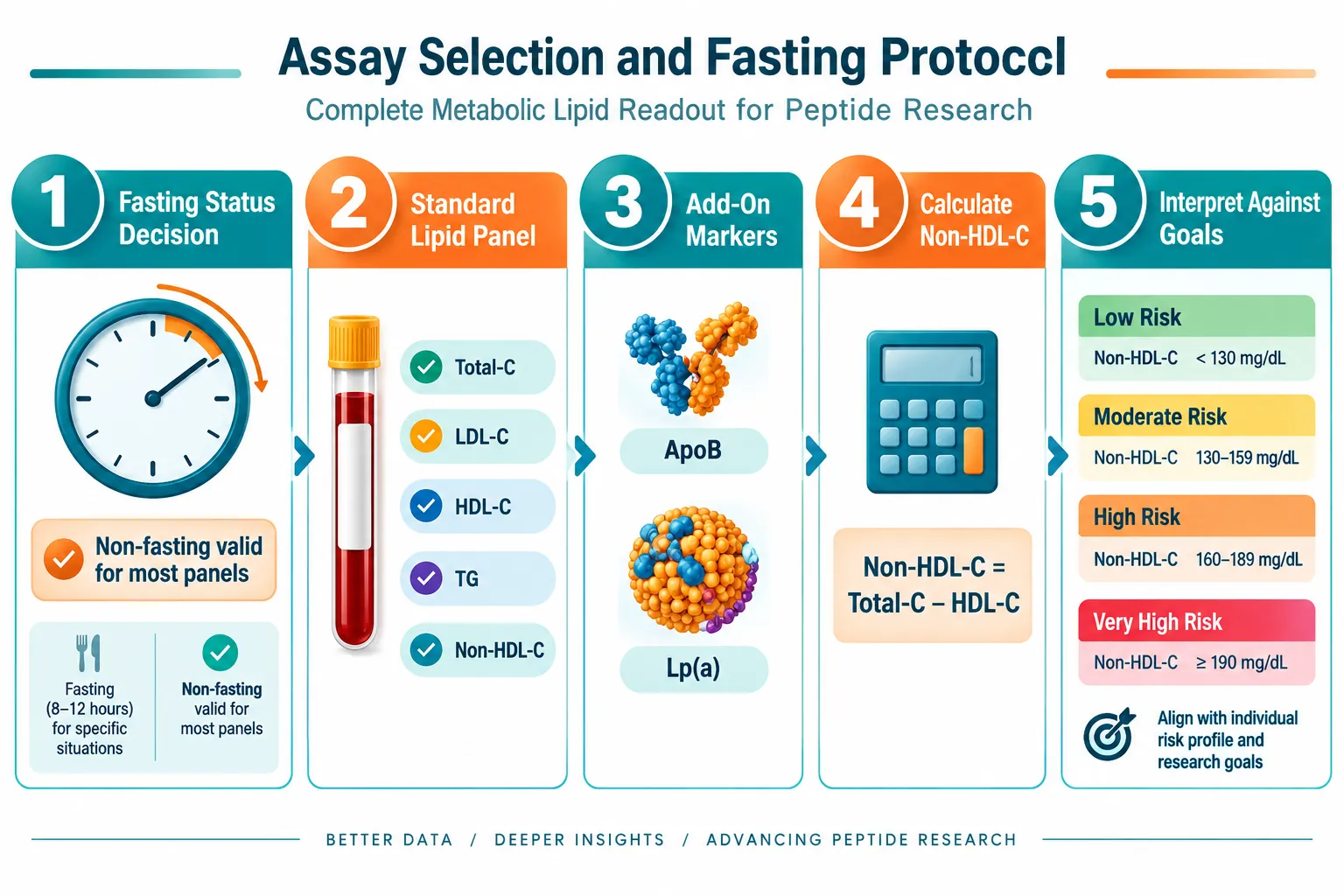
A complete metabolic lipid readout in 2026 includes five core components:

Marker What It Measures Clinical Goal (High Risk)
Total Cholesterol All cholesterol fractions Context-dependent
LDL-C Primary atherogenic particle <70 mg/dL
HDL-C Protective lipoprotein >40 mg/dL (men), >50 mg/dL (women)
Triglycerides TG-rich lipoprotein burden <150 mg/dL
Non-HDL-C All atherogenic particles <100 mg/dL

Optional add-ons, apolipoprotein B (apoB) and lipoprotein(a) [Lp(a)], are now recommended at least once in a lifetime by major guidelines and are especially valuable in metabolically complex subjects.
Assay Selection, Fasting Status, and Triglyceride Categories

Fasting status is a practical decision point. Non-fasting samples are acceptable for most lipid panels and are now endorsed by major guidelines for routine screening. However, triglyceride measurements are most accurate in a fasted state (typically 9-12 hours), and when triglycerides are the primary endpoint in a peptide study, fasting samples are strongly preferred. Researchers should document fasting status consistently across all time points.

Triglyceride categories used clinically follow ATP III criteria that remain in active use:

  • Normal: below 150 mg/dL
  • Borderline-high: 150-199 mg/dL
  • High: 200-499 mg/dL
  • Very high: 500 mg/dL or above

Triglycerides at or above 200 mg/dL automatically trigger a non-HDL-C secondary goal. Levels at or above 500 mg/dL require urgent triglyceride-lowering intervention to prevent pancreatitis, a threshold relevant when studying peptides with metabolic or lipolytic activity, including those available through Mot-C peptide research lines.

"When triglycerides are elevated, non-HDL-C becomes the more reliable guide to atherogenic risk, not LDL-C."

For researchers sourcing study compounds, working with a verified best peptide supplier ensures purity standards that support reproducible lipid endpoint data.


Pairing Lipid Results With Glucose and Inflammatory Endpoints

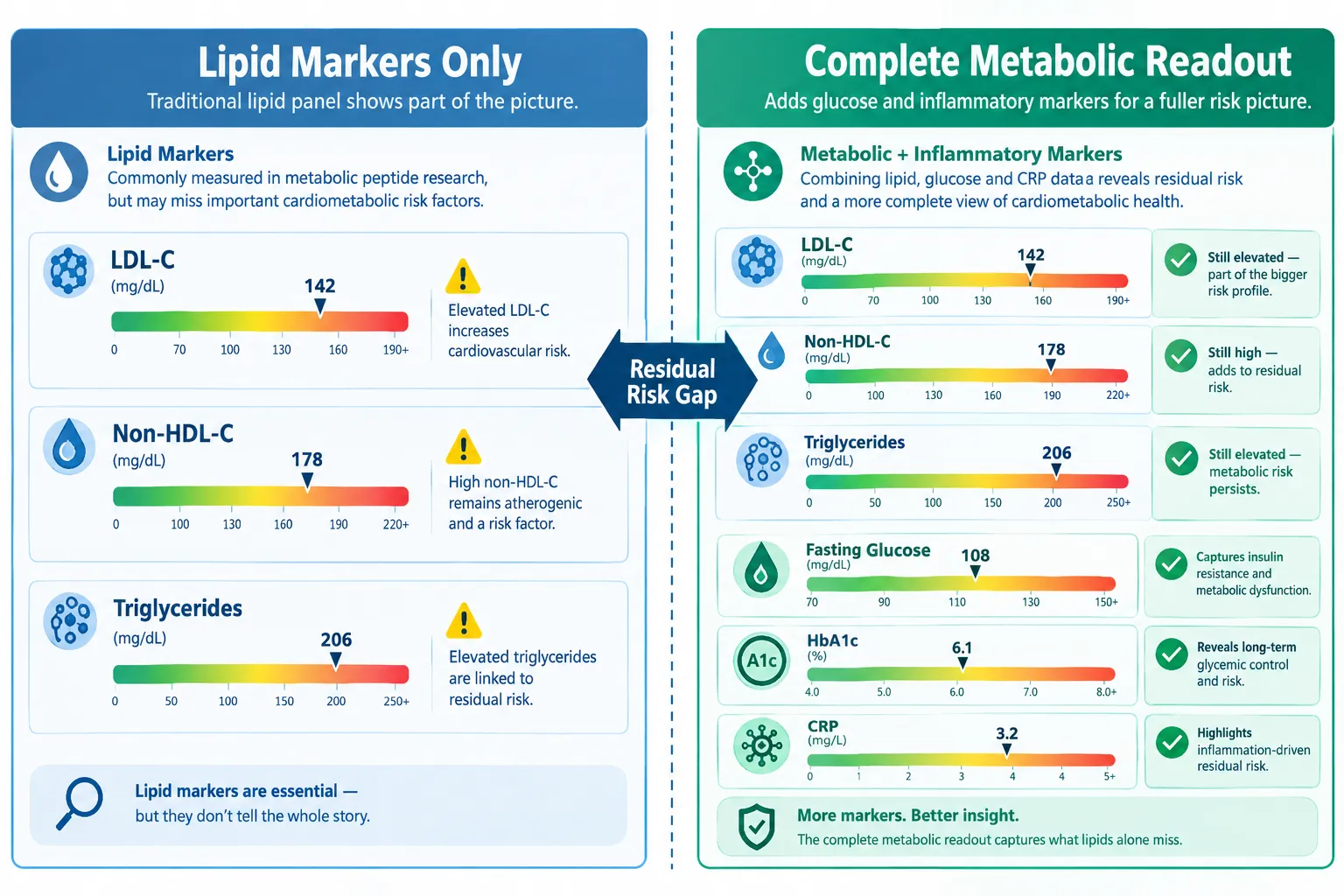
Lipid data in isolation tells only part of the metabolic story. The 2026 ACC/AHA dyslipidemia guidelines explicitly incorporate the PREVENT-ASCVD equations, which account for cardiometabolic syndrome, type 2 diabetes, and chronic kidney disease, conditions where glucose dysregulation and systemic inflammation amplify lipid-driven risk. This is directly applicable to peptide research design.
Pairing Lipid Results With Glucose and Inflammatory Endpoints

When designing a complete metabolic peptide readout, researchers should pair lipid endpoints with:

  • Fasting glucose and HbA1c, to detect insulin resistance that elevates VLDL and triglycerides
  • High-sensitivity CRP (hsCRP), a marker of vascular inflammation that interacts with remnant cholesterol pathways
  • Fasting insulin or HOMA-IR, to quantify insulin resistance independent of glucose levels

This multi-marker approach is especially relevant when studying peptides with dual metabolic and anti-inflammatory mechanisms. For example, SS31 peptide research targeting mitochondrial oxidative stress may show effects on inflammatory markers alongside lipid shifts that would be invisible in a lipid-only readout. Similarly, IPA peptides with insulin-sensitizing properties may reduce triglycerides and non-HDL-C through glucose-mediated pathways that require concurrent glucose endpoint tracking to interpret correctly.

Practical checklist for a complete metabolic peptide readout:

  1. Collect fasting lipid panel: total cholesterol, LDL-C, HDL-C, triglycerides, non-HDL-C
  2. Add apoB and Lp(a) for high-risk or metabolically complex subjects
  3. Record fasting glucose, HbA1c, and fasting insulin
  4. Measure hsCRP as an inflammatory co-endpoint
  5. Calculate non-HDL-C and compare against the LDL-C goal plus 30 mg/dL
  6. Apply risk-stratified targets: LDL-C below 55 mg/dL and non-HDL-C below 85 mg/dL for very-high-risk profiles

When a subject reaches the LDL-C target but non-HDL-C remains elevated, current guidelines direct escalation of therapy, a principle that translates directly into peptide study design: if a compound lowers LDL-C without reducing non-HDL-C, residual atherogenic burden persists and must be addressed. Researchers seeking verified compounds for such protocols can explore options through a trusted best peptide website to ensure compound integrity across multi-endpoint studies.


Conclusion

Building a complete metabolic peptide readout is not optional for rigorous research, it is the standard. LDL cholesterol, triglycerides, and non-HDL cholesterol together capture the full spectrum of atherogenic particle burden that a single marker will always underestimate. The actionable steps are clear: use a five-marker fasting lipid panel as the baseline, add apoB and Lp(a) where risk complexity warrants it, document fasting status consistently, and pair every lipid endpoint with glucose and inflammatory markers. Apply the 2026 guideline targets, LDL-C below 70 mg/dL and non-HDL-C below 100 mg/dL for high-risk profiles, and more stringent thresholds for very-high-risk subjects, as interpretive anchors. Researchers who adopt this multi-marker framework will extract more meaningful, publishable, and clinically translatable data from every metabolic peptide experiment they run.

https://www.puretestedpeptides.com/wp-content/uploads/2026/10/ldl-cholesterol-triglycerides-and-non-hdl-cholesterol-building-a-complete-metabo.webp 1024 1536 https://www.puretestedpeptides.com/wp-content/uploads/2026/01/buy-peptides-online.jpg 2026-10-03 13:04:422026-10-03 13:04:42LDL Cholesterol, Triglycerides, and Non-HDL Cholesterol: Building a Complete Metabolic Peptide Readout
×

Helpful Links

  • My account
  • Cart
  • Checkout
  • Refund and Returns Policy
  • Privacy Policy
  • SMS Privacy Policy
  • Login
  • My Account
  • Logout

USA Made Lab Tested Peptides

All products are sold for research, laboratory, or analytical purposes only, and are not for human consumption


Pure Tested Peptides is a chemical supplier. Pure Tested Peptides is not a compounding / chemical compounding facility as defined under 503A of the Federal Food, Drug, and Cosmetic act. Pure Tested Peptides is not an outsourcing facility as defined under 503B of the Federal Food, Drug, and Cosmetic act.

The statements made within this website have not been evaluated by the US Food and Drug Administration. The products we offer are not intended to diagnose, treat, cure or prevent any disease.

Human/Animal Consumption Prohibited. Laboratory/In-Vitro Experimental Use Only

Scroll to top Scroll to top Scroll to top