

LDL Cholesterol, Triglycerides, and Non-HDL Cholesterol: Building a Complete Metabolic Peptide Readout
Nearly half of adults who experience a first cardiovascular event have LDL cholesterol levels that fall within the "normal" range, a sobering fact that exposes the core weakness of relying on a single lipid marker. For researchers designing metabolic peptide experiments, that gap is not a minor inconvenience; it is a fundamental flaw in study design. Building a complete metabolic peptide readout around LDL cholesterol, triglycerides, and non-HDL cholesterol closes that gap and delivers a far more accurate picture of atherogenic particle burden.
Key Takeaways
- LDL-C alone misses a significant portion of cardiovascular risk, especially in individuals with elevated triglycerides or metabolic syndrome.
- Non-HDL cholesterol captures all atherogenic particles, LDL plus triglyceride-rich remnants, making it a superior global risk marker.
- Current 2026 guidelines set paired goals: LDL-C and non-HDL-C must both be assessed and treated to target.
- A complete metabolic lipid panel includes total cholesterol, LDL-C, HDL-C, triglycerides, and non-HDL-C, with optional apolipoprotein B and Lp(a) for high-risk or complex cases.
- Lipid results gain the most interpretive power when paired with glucose and inflammatory endpoints in peptide research protocols.
Why One Lipid Marker Is Never Enough
The tradition of treating LDL-C as the sole lipid target made clinical sense when it was the best available tool. In 2026, that rationale no longer holds. Researchers now understand that triglyceride-rich lipoproteins, very-low-density lipoprotein (VLDL) and its remnants, drive atherosclerotic plaque independently of LDL-C. A patient or research subject can achieve an LDL-C below 100 mg/dL and still carry a dangerous burden of remnant cholesterol that a standard LDL reading will never detect.
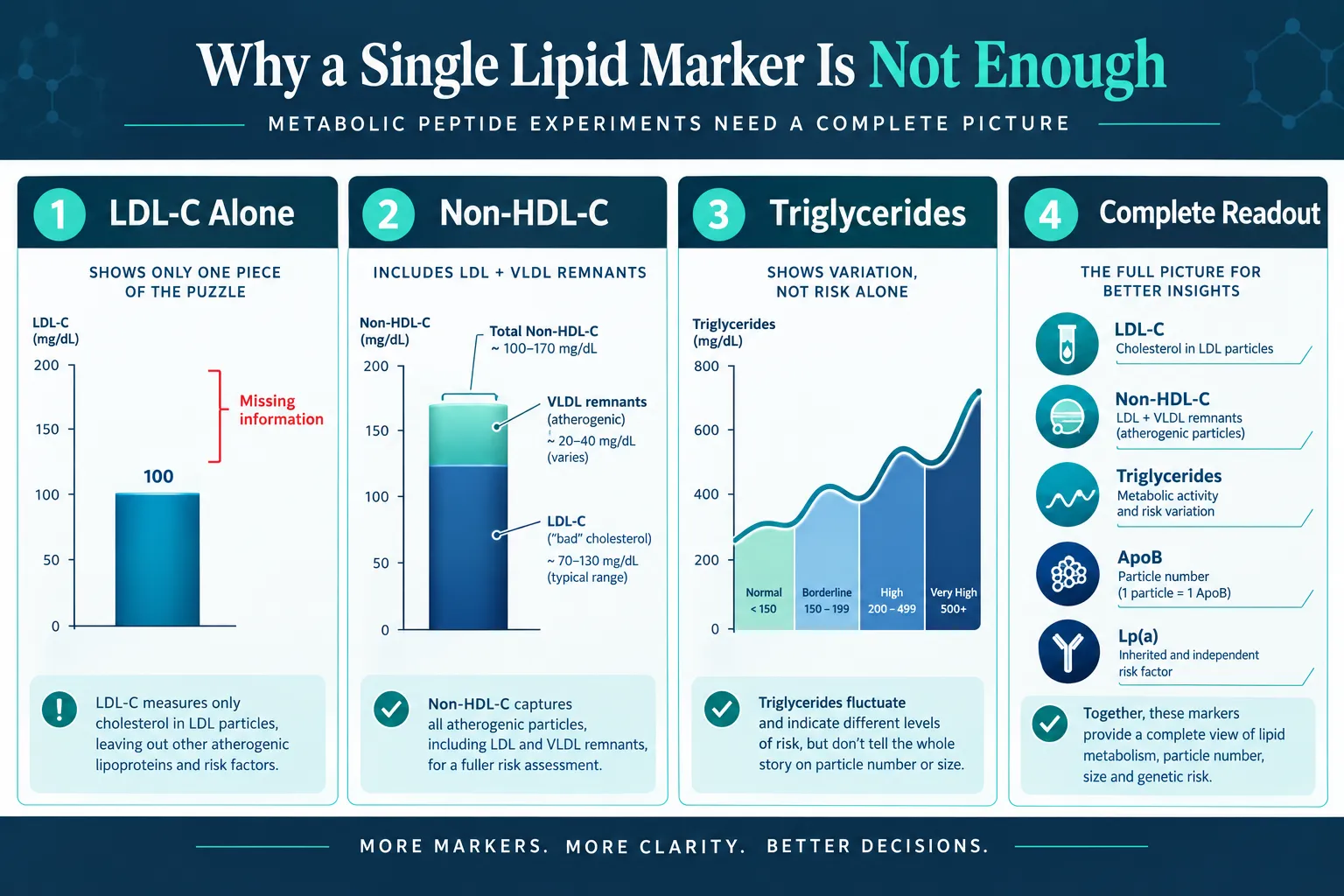
This is where non-HDL cholesterol becomes indispensable. Calculated simply as total cholesterol minus HDL cholesterol, non-HDL-C captures every atherogenic particle in circulation, LDL, VLDL, IDL, and remnants. In populations with high triglycerides, obesity, type 2 diabetes, or metabolic syndrome, non-HDL-C consistently outperforms LDL-C as a predictor of cardiovascular outcomes. Research in patients with chronic kidney disease reinforces this point: non-HDL-C and remnant cholesterol show stronger, more consistent associations with adverse events than LDL-C alone.
For metabolic peptide experiments, this distinction matters enormously. Peptides that influence insulin signaling, energy metabolism, or inflammatory pathways, such as those explored in GLP-3 peptide research or Cagrilintide peptide studies, can shift triglyceride and remnant cholesterol levels without meaningfully moving LDL-C. A readout built on LDL alone would miss those effects entirely.
Key principle: Non-HDL-C should be no more than 30 mg/dL above the LDL-C goal. For a subject with an LDL target below 100 mg/dL, the non-HDL-C goal is below 130 mg/dL.
Assay Selection, Fasting Status, and Triglyceride Categories
A complete metabolic lipid readout in 2026 includes five core components:
| Marker | What It Measures | Clinical Goal (High Risk) |
|---|---|---|
| Total Cholesterol | All cholesterol fractions | Context-dependent |
| LDL-C | Primary atherogenic particle | <70 mg/dL |
| HDL-C | Protective lipoprotein | >40 mg/dL (men), >50 mg/dL (women) |
| Triglycerides | TG-rich lipoprotein burden | <150 mg/dL |
| Non-HDL-C | All atherogenic particles | <100 mg/dL |
Optional add-ons, apolipoprotein B (apoB) and lipoprotein(a) [Lp(a)], are now recommended at least once in a lifetime by major guidelines and are especially valuable in metabolically complex subjects.
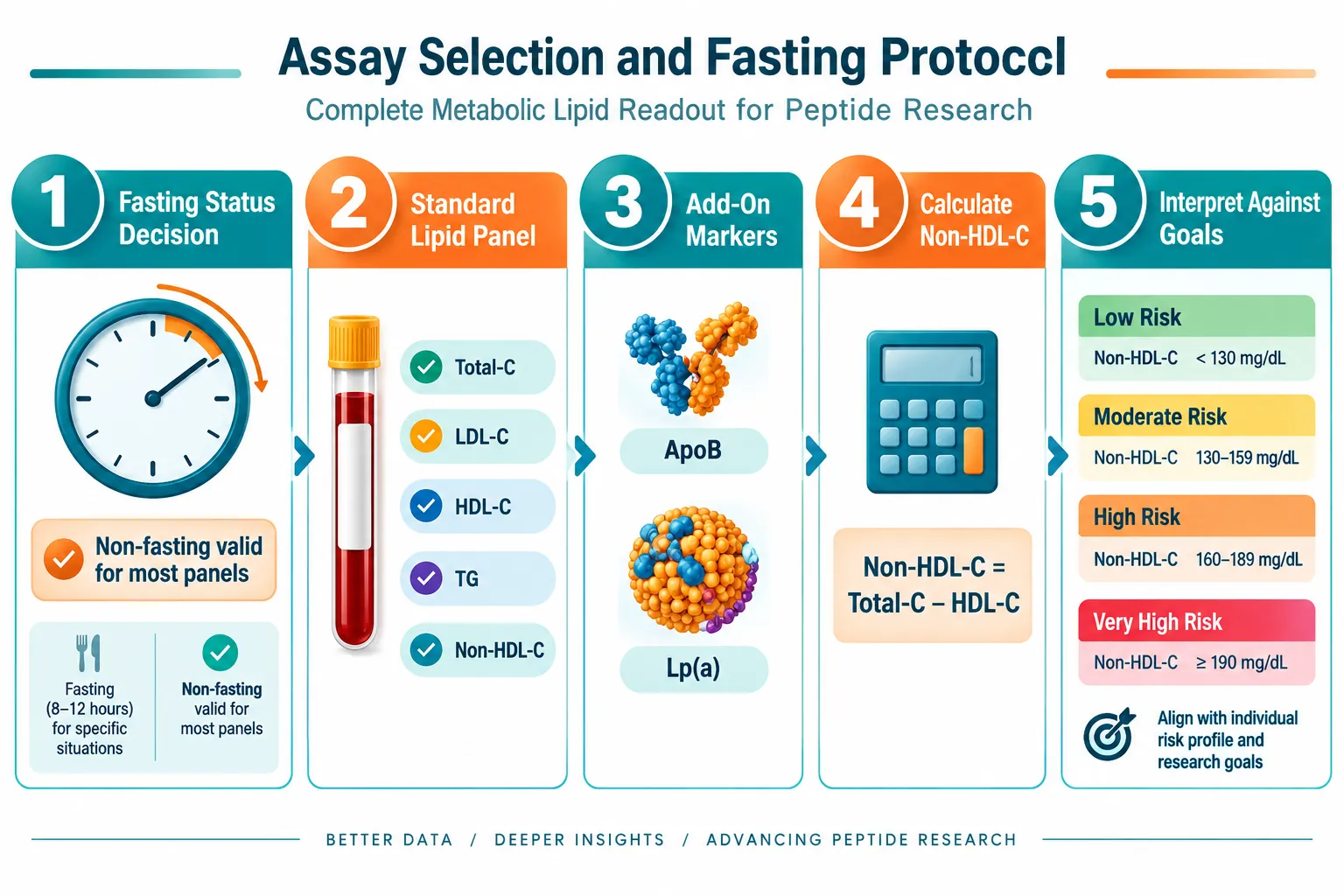
Fasting status is a practical decision point. Non-fasting samples are acceptable for most lipid panels and are now endorsed by major guidelines for routine screening. However, triglyceride measurements are most accurate in a fasted state (typically 9-12 hours), and when triglycerides are the primary endpoint in a peptide study, fasting samples are strongly preferred. Researchers should document fasting status consistently across all time points.
Triglyceride categories used clinically follow ATP III criteria that remain in active use:
- Normal: below 150 mg/dL
- Borderline-high: 150-199 mg/dL
- High: 200-499 mg/dL
- Very high: 500 mg/dL or above
Triglycerides at or above 200 mg/dL automatically trigger a non-HDL-C secondary goal. Levels at or above 500 mg/dL require urgent triglyceride-lowering intervention to prevent pancreatitis, a threshold relevant when studying peptides with metabolic or lipolytic activity, including those available through Mot-C peptide research lines.
"When triglycerides are elevated, non-HDL-C becomes the more reliable guide to atherogenic risk, not LDL-C."
For researchers sourcing study compounds, working with a verified best peptide supplier ensures purity standards that support reproducible lipid endpoint data.
Pairing Lipid Results With Glucose and Inflammatory Endpoints
Lipid data in isolation tells only part of the metabolic story. The 2026 ACC/AHA dyslipidemia guidelines explicitly incorporate the PREVENT-ASCVD equations, which account for cardiometabolic syndrome, type 2 diabetes, and chronic kidney disease, conditions where glucose dysregulation and systemic inflammation amplify lipid-driven risk. This is directly applicable to peptide research design.
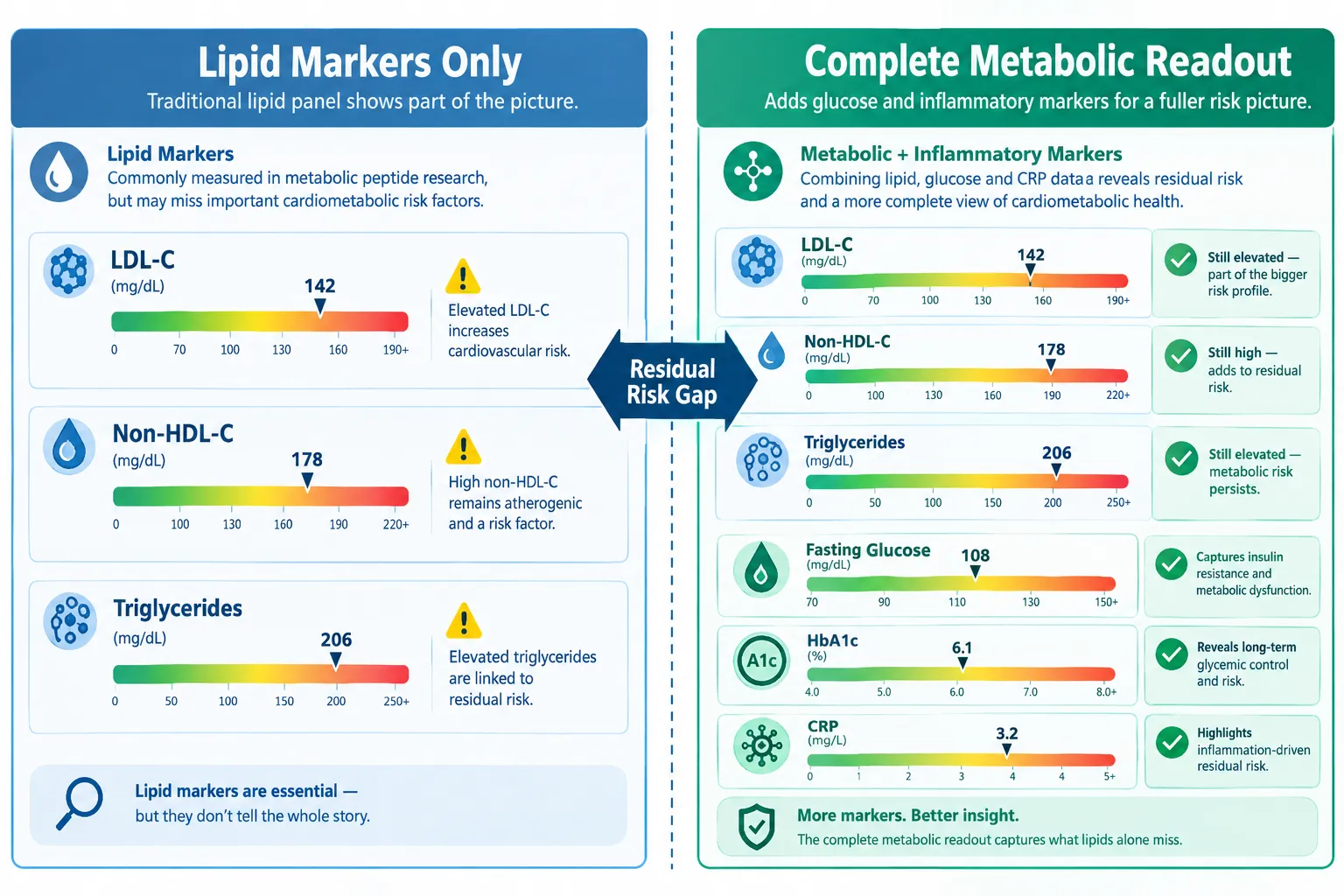
When designing a complete metabolic peptide readout, researchers should pair lipid endpoints with:
- Fasting glucose and HbA1c, to detect insulin resistance that elevates VLDL and triglycerides
- High-sensitivity CRP (hsCRP), a marker of vascular inflammation that interacts with remnant cholesterol pathways
- Fasting insulin or HOMA-IR, to quantify insulin resistance independent of glucose levels
This multi-marker approach is especially relevant when studying peptides with dual metabolic and anti-inflammatory mechanisms. For example, SS31 peptide research targeting mitochondrial oxidative stress may show effects on inflammatory markers alongside lipid shifts that would be invisible in a lipid-only readout. Similarly, IPA peptides with insulin-sensitizing properties may reduce triglycerides and non-HDL-C through glucose-mediated pathways that require concurrent glucose endpoint tracking to interpret correctly.
Practical checklist for a complete metabolic peptide readout:
- Collect fasting lipid panel: total cholesterol, LDL-C, HDL-C, triglycerides, non-HDL-C
- Add apoB and Lp(a) for high-risk or metabolically complex subjects
- Record fasting glucose, HbA1c, and fasting insulin
- Measure hsCRP as an inflammatory co-endpoint
- Calculate non-HDL-C and compare against the LDL-C goal plus 30 mg/dL
- Apply risk-stratified targets: LDL-C below 55 mg/dL and non-HDL-C below 85 mg/dL for very-high-risk profiles
When a subject reaches the LDL-C target but non-HDL-C remains elevated, current guidelines direct escalation of therapy, a principle that translates directly into peptide study design: if a compound lowers LDL-C without reducing non-HDL-C, residual atherogenic burden persists and must be addressed. Researchers seeking verified compounds for such protocols can explore options through a trusted best peptide website to ensure compound integrity across multi-endpoint studies.
Conclusion
Building a complete metabolic peptide readout is not optional for rigorous research, it is the standard. LDL cholesterol, triglycerides, and non-HDL cholesterol together capture the full spectrum of atherogenic particle burden that a single marker will always underestimate. The actionable steps are clear: use a five-marker fasting lipid panel as the baseline, add apoB and Lp(a) where risk complexity warrants it, document fasting status consistently, and pair every lipid endpoint with glucose and inflammatory markers. Apply the 2026 guideline targets, LDL-C below 70 mg/dL and non-HDL-C below 100 mg/dL for high-risk profiles, and more stringent thresholds for very-high-risk subjects, as interpretive anchors. Researchers who adopt this multi-marker framework will extract more meaningful, publishable, and clinically translatable data from every metabolic peptide experiment they run.


Leave a Reply
Want to join the discussion?Feel free to contribute!