Call or Text 727-513-9780
  • Shopping Cart Shopping Cart
    0Shopping Cart
Pure Tested Peptides | America's most trusted Peptides for sale online
  • Peptides for sale
    • Oral Peptides for sale
      • Peptide Capsules for sale
      • BPC 157 Capsules 1000mcg
      • SLU-PP-332 Capsules | 1000 mcg
      • 5-Amino-1MQ 50mg Capsules
      • Tesofensine 500mcg
    • All Peptides for sale
    • Peptide Sprays
      • BPC 157 Nasal Spray Kit
      • BPC-157 TB500 Nasal Spray Kit
      • Semax Nasal Spray 10mg
      • Selank – Nasal Spray Kit – 10mg
      • Epithalon 50MG Nasal Spray Kit
      • Ipamorelin 10mg Nasal Spray
      • Klow Nasal Spray (BPC-157 + TB-500 + GHK-Cu + KPV) | 80mg
      • Hulk Nasal Spray Tesa / Ipa Blend 6/3 MG
      • Klow Nasal Spray
      • NAD + 500 mg Nasal Spray
      • PT-141 Nasal Spray Kit
    • GHRH Peptides
      • Ipa Peptides
      • CJC-1295 Peptides
        • CJC-1295 with DAC 5 mg
        • CJC-1295 without DAC 5 mg
        • CJC-1295 Ipa 10mg
      • Tesa Peptides
        • Tesa Peptide
        • Tesa 20 mg
    • GHK-Cu Peptides
      • All GHK-Cu Peptides
      • GHK-Cu 100mg
      • KLOW Peptide Blend – Buy KLOW blend online
    • BPC Peptides
      • All BPC Peptides
      • BPC-157
      • BPC-157 TB-500
      • BPC 157 capsules 1000mcg
    • SLU-PP-332 Peptides
      • All SLU-PP-332 Peptides
      • SLU-PP-332 5mg
    • GLP3 Peptides
    • PT-141 Peptides
      • PT-141 Peptides for sale
      • PT-141 10mg
      • PT-141 Nasal Spray
    • CAG Peptides
      • Lipo-C Peptide Blend
      • CAG 5mg
      • CAG 10mg
    • MOTS-C Peptides
      • MOTS-C Peptides for sale
      • MOTS-c peptide
      • MOTS-c 10mg *6 pack*
    • 5 Amino 1MQ Peptides
      • 5 Amino 1MQ Peptides for sale
      • 5-Amino-1MQ 50mg Capsules
      • 5-Amino-1MQ 5mg
    • Epithalon Peptides
      • Epithalon Peptides for sale
      • Epithalon 10mg
      • Epithalon 50mg
  • Shop
    • GLPs
      • 5-Amino-1MQ 50mg Capsules
      • 5-Amino-1MQ 5mg
      • L-Carnitine 500mg/ml
      • Tesofensine 500mcg
      • SLU-PP-332 5mg
      • MOTS-c 10mg *6 pack*
    • Epithalon & BPC Peptides
      • Epithalon 10mg
      • Epithalon 50mg
      • BPC-157
      • BPC 157 capsules 1000mcg
      • BPC-157 TB-500
      • BPC-157 TB500 Nasal Spray Kit
      • BPC 157 Nasal Spray Kit
    • BPC TB-500 & NAD+ Peptides
      • NAD+ 500 mg
      • KLOW Peptide Blend – Buy KLOW blend online
      • GLOW Peptide Blend
      • TB 500 5mg
      • BPC 157 capsules 1000mcg – Supplement
      • BPC 157 Nasal Spray Kit
      • BPC-157
      • BPC-157 TB500 Nasal Spray Kit
      • BPC-157 TB-500
      • BPC 157 capsules 1000mcg
    • LL-37 Peptide
      • LL-37 10 mg
    • MOTS-C & Selank
      • MOTS-c peptide
      • Selank 10mg
    • GHK Peptides
      • GHK-Cu 100mg
      • GLOW Peptide Blend
      • KLOW Peptide Blend – Buy KLOW blend online
  • COAs
  • Wholesale
    • Wholesale Peptides for sale
  • PTP FAQ
  • Affiliates
    • Selank Peptide: Advanced Pharmacological Mechanisms Underlying Its Anxiolytic and Nootropic Effects in Research
      • 5-Amino-1MQ Peptide: Detailed Mechanisms of NNMT Inhibition and Its Impact on Cellular Metabolism Research
        • MOTS-C Peptide: Unraveling Its Role in Mitochondrial Dynamics and Energy Metabolism Research
          • Epithalon Peptide and Telomerase Regulation: Investigating Its Impact on Cellular Senescence and Lifespan Research Models
            • GLP2-T vs GLP2 Tirz Peptide: Understanding the Naming, Mechanistic Nuances, and Research Implications for Gut Health
      • Peptides and Polypeptides in Modern Pharmacology: What Research on Metoprolol, Prednisone, and Amlodipine Reveals
        • Polypeptide Peptides vs NSAIDs: What Naproxen and Diclofenac Teach Tissue-Repair Researchers About BPC‑157 and TB‑500
          • Peptides and Polypeptides in Endocrine Pharmacology: How GLP-1, GLP-2, and GLP-3 Retatrutide Differ From Classic Drugs Like Prednisone and Amlodipine
          • 5‑Amino‑1MQ Peptide and NNMT Inhibition: How It Compares With Statins Like Atorvastatin in Adipose and Lipid Metabolism Research
      • Enclomiphene, Estrogen Receptor Signaling, and Luteinizing Phase Biology: What Hormone Researchers Should Measure
        • Mesenchymal Stem Cells, BPC‑157, and GHK‑Cu: How Tissue Repair Peptides Compare With Classic NSAIDs Like Naproxen in Injury Models
          • Peptide Calculator Use Cases Beyond Growth Hormone: Working Through GLP‑3 Retatrutide, MOTS‑c, and BPC‑157 Research Dosing
        • Polypeptide Peptides in Endocrine and Metabolic Pharmacology: Lessons From Amlodipine, Prednisone, and Metoprolol
        • Peptides Calculator for Advanced Blends: Worked Examples for Tesamorelin, CJC‑1295, and Ipamorelin Stacks
          • Peptides and Polypeptides in Human Physiology: How Molecular Size Shapes Research Applications
            • Selank Peptide: Advanced Pharmacological Mechanisms Underlying Its Anxiolytic and Nootropic Effects in Research
          • 5-Amino-1MQ Peptide: Detailed Mechanisms of NNMT Inhibition and Its Impact on Cellular Metabolism Research
            • MOTS-C Peptide: Unraveling Its Role in Mitochondrial Dynamics and Energy Metabolism Research
              • Epithalon Peptide and Telomerase Regulation: Investigating Its Impact on Cellular Senescence and Lifespan Research Models
                • GLP2-T vs GLP2 Tirz Peptide: Understanding the Naming, Mechanistic Nuances, and Research Implications for Gut Health
                  • Peptides and Polypeptides in Endocrine Pharmacology: How GLP-1, GLP-2, and GLP-3 Retatrutide Differ From Classic Drugs Like Prednisone and Amlodipine
                    • Polypeptide Peptides vs NSAIDs: What Naproxen and Diclofenac Teach Tissue-Repair Researchers About BPC‑157 and TB‑500
                      • Peptides and Polypeptides in Modern Pharmacology: What Research on Metoprolol, Prednisone, and Amlodipine Reveals
                        • 5‑Amino‑1MQ Peptide and NNMT Inhibition: How It Compares With Statins Like Atorvastatin in Adipose and Lipid Metabolism Research
                        • Enclomiphene, Estrogen Receptor Signaling, and Luteinizing Phase Biology: What Hormone Researchers Should Measure
                        • Mesenchymal Stem Cells, BPC‑157, and GHK‑Cu: How Tissue Repair Peptides Compare With Classic NSAIDs Like Naproxen in Injury Models
                        • Peptide Calculator Use Cases Beyond Growth Hormone: Working Through GLP‑3 Retatrutide, MOTS‑c, and BPC‑157 Research Dosing
                        • Polypeptide Peptides in Endocrine and Metabolic Pharmacology: Lessons From Amlodipine, Prednisone, and Metoprolol
                        • Peptides Calculator for Advanced Blends: Worked Examples for Tesamorelin, CJC‑1295, and Ipamorelin Stacks
                        • Peptides and Polypeptides in Human Physiology: How Molecular Size Shapes Research Applications
                        • Selank Peptide: Advanced Pharmacological Mechanisms Underlying Its Anxiolytic and Nootropic Effects in Research
                        • MOTS-C Peptide: Unraveling Its Role in Mitochondrial Dynamics and Energy Metabolism Research
                        • Peptides and Polypeptides in Modern Pharmacology: What Research on Metoprolol, Prednisone, and Amlodipine Reveals
                        • Peptides and Polypeptides in Endocrine Pharmacology: How GLP-1, GLP-2, and GLP-3 Retatrutide Differ From Classic Drugs Like Prednisone and Amlodipine
                        • 5-Amino-1MQ Peptide: Detailed Mechanisms of NNMT Inhibition and Its Impact on Cellular Metabolism Research
                        • Mesenchymal Stem Cells, BPC‑157, and GHK‑Cu: How Tissue Repair Peptides Compare With Classic NSAIDs Like Naproxen in Injury Models
                        • Peptide Calculator Use Cases Beyond Growth Hormone: Working Through GLP‑3 Retatrutide, MOTS‑c, and BPC‑157 Research Dosing
                        • GLP2-T vs GLP2 Tirz Peptide: Understanding the Naming, Mechanistic Nuances, and Research Implications for Gut Health
                        • Polypeptide Peptides in Endocrine and Metabolic Pharmacology: Lessons From Amlodipine, Prednisone, and Metoprolol
                        • Polypeptide Peptides vs NSAIDs: What Naproxen and Diclofenac Teach Tissue-Repair Researchers About BPC‑157 and TB‑500
                        • Peptides and Polypeptides in Human Physiology: How Molecular Size Shapes Research Applications
                        • Peptides Calculator for Advanced Blends: Worked Examples for Tesamorelin, CJC‑1295, and Ipamorelin Stacks
                        • 5‑Amino‑1MQ Peptide and NNMT Inhibition: How It Compares With Statins Like Atorvastatin in Adipose and Lipid Metabolism Research
                        • Enclomiphene, Estrogen Receptor Signaling, and Luteinizing Phase Biology: What Hormone Researchers Should Measure
                        • Epithalon Peptide and Telomerase Regulation: Investigating Its Impact on Cellular Senescence and Lifespan Research Models
                        • Best research protocol Klow blend
                        • best time to take BPC-157
                        • best time to take DSIP (Delta Sleep Inducing Peptide)
                        • best time to take CJC-1295
                        • best time to take AOD-9604
                        • best time to take Follistatin 344
                        • best time to take Ipamorelin
                        • best time to take MK-677 (Ibutamoren)
                        • best time to take Ligandrol (LGD-4033) — research compound
                        • best time to take Ostarine (MK-2866) — research compound
                        • best time to take GHK-CU
                        • best time to take TB-500
                        • best time to take MOTS-c
                        • best time to take Semax
                        • best time to take RAD-140 (Testolone) — research compound
                        • best time to take Thymosin Alpha-1
                        • best time to take PEG-MGF
                        • Biolife Plasma, Octapharma Plasma, and Research Peptides: How Plasma Donation Labs Differ From Peptide Suppliers
                        • best time to take YK-11 — research compound
                        • best time to take PT-141 (Bremelanotide)
                        • Best research protocol Klow blend
                        • 5-Amino-1MQ and MOTS-C Synergy: Metabolic Signaling, Mitochondria, and Research Design
                        • BPC-157 and TB-500: Investigating Their Combined Effects on Angiogenesis and Cellular Migration in Tissue Repair Models
                        • BPC-157 Peptide: Gut Barrier Function, Inflammation, and Tissue-Recovery Research
                        • 5‑Amino‑1MQ and MOTS‑c Synergy in Metabolic Research: Designing NNMT and Mitochondrial Biogenesis Stacks
                        • CJC-1295 with DAC vs. Without DAC: Half-Life, Release Kinetics, and Research Implications
                        • CJC‑1295 with DAC vs. Without DAC: Expanding on Half‑Life Differences Using Tesamorelin and Ipamorelin Blend Case Studies
                        • Collagen Biology and Copper‑Binding Peptides: How GHK‑Cu, Glow Blend, and Klow Blend Interact with Skin and Connective Tissue
                        • Collagen Biology and Regenerative Peptides: How GHK‑Cu, Glow Blend, and Klow Blend Affect Extracellular Matrix Research
                    • DNA, Telomeres, and Longevity Peptides: Positioning Epithalon and MOTS‑c in Genetic Aging Research
                      • Enclomiphene Citrate: serm Mechanism, Testosterone Research, and Stack Compatibility
                        • Enclomiphene vs Enclomiphene Citrate: Formulation, Bioavailability, and Research Distinctions
                        • Epithalon Peptide Research: Telomerase Activation, Aging, and Pineal Gland Function
                        • Estrogen Receptor Signaling and Enclomiphene: How Selective Modulators Compare with Classic Polypeptide Hormones
                        • GHK-Cu Peptide: Advanced Mechanisms in Extracellular Matrix Remodeling and Wound Healing Research
                        • GHK-Cu Peptide: Collagen Synthesis, Wound Repair, and Skin-Barrier Research Models
                        • GLP-1 vs GLP-3 vs GLP-2: Peptide Classification and Research Applications
                        • GLP-2 Peptide Research Guide: Gut Barrier Function, Nutrient Absorption, and Intestinal Recovery Models
                        • GLP-3 Retatrutide vs. GLP-1 Drugs: What Triple-Agonist Biology Changes in Research Models
                        • Ipamorelin and Tesamorelin Combination: Synergistic GH Secretagogue Research and Dosing Protocols
                        • GLP2 Tirz Peptide: What It Is, Why the Name Exists, and How Researchers Should Interpret It
                        • Klow Blend Peptide Nasal Spray: What the Formulation Is Trying to Do in Cognitive Research
                        • Mitochondria, NNMT Inhibition, and Peptide Modulators: Where MOTS‑c and 5‑Amino‑1MQ Fit in Cellular Energy Research
                        • MOTS-c Peptide: Mitochondrial Function, Energy Metabolism, and What Researchers Measure
                        • MOTS-c vs. 5-Amino-1MQ: Which Metabolic Research Questions Each Compound Actually Answers
                        • Nasal Spray Peptides: Bioavailability, Administration, and Semax/Selank Research Applications
                        • PT-141 Peptide Research: Mechanism of Action and Melanocortin Receptor Signaling
                        • Retatrutide for Research: Mechanism, Structure, and GLP-1/GLP-3 Dual Action
                        • Retatrutide for Obesity and Type 2 Diabetes: What the Latest Trial Data Suggest
                        • Tesofensine Peptide Research: Mechanism, Appetite Suppression, and Neuropeptide Y Pathways
  • Contact
    • Contact Customer Service
    • Text Customer Support
  • About US
  • Shop all peptides
  • Affiliate Program
    • Affiliate Signup
  • Login / Register Login / Register Page Link Login / Register Page Link
  • Click to open the search input field Click to open the search input field Search
  • Menu Menu

Tag Archive for: ldl cholesterol

Atorvastatin, LDL Cholesterol, and Metabolic Peptides: Where MOTS-c, 5-Amino-1MQ, and GLP-3 Retatrutide Fit in Lipid Research

Atorvastatin, LDL Cholesterol, and Metabolic Peptides: Where MOTS-c, 5-Amino-1MQ, and GLP-3 Retatrutide Fit in Lipid Research

September 20, 2026/0 Comments/in Uncategorized/by

{"cover":"Professional landscape format (1536×1024) hero image with bold text overlay 'Atorvastatin, LDL Cholesterol' in crisp white modern sans-serif on a deep navy semi-transparent overlay panel, centered with 8% safe margins from every edge, no character touches the edge, two balanced lines. Background: high-resolution editorial medical illustration of a cross-section of a human artery with visible LDL cholesterol plaques, surrounded by floating molecular structures of statin compounds and peptide chains in teal and gold tones, clinical yet visually striking, magazine-cover aesthetic, sharp editorial lighting, professional 2-color palette of navy and teal with white typography.","content":["Annotated mechanism-of-action diagram (1536×1024 landscape) showing atorvastatin's HMG-CoA reductase inhibition pathway in a clean white-background infographic style. Four labeled stages arranged left to right: Stage 1 callout 'HMG-CoA Reductase Blocked' pointing to liver cell diagram, Stage 2 callout 'LDL Receptors Upregulated' with arrow to hepatocyte surface, Stage 3 callout 'LDL Cleared from Blood' showing artery cross-section, Stage 4 callout 'Target: <55 mg/dL ASCVD' with a bold threshold bar. Thin callout lines, teal-and-navy palette, numbered stages, editorial medical-guide polish, no pricing or dollar amounts.","Three-panel side-by-side comparison infographic (1536×1024 landscape) contrasting retatrutide, MOTS-c, and 5-Amino-1MQ as metabolic research agents. Left panel heading 'Retatrutide GLP-1/GIP/Glucagon' with bullet labels: Triple receptor agonist, LDL down ~15-20 percent, TG down ~40 mg/dL, Phase 3 trials. Center panel heading 'MOTS-c Mitochondrial Peptide' with bullet labels: NAD+ regulation, AMPK activation, Lipid oxidation, Preclinical stage. Right panel heading '5-Amino-1MQ NNMT Inhibitor' with bullet labels: NAD+ preservation, Lipogenesis suppressed, Fat oxidation shift, Animal models only. Clean white background, warm amber and teal accent colors, thin dividing lines, editorial infographic polish, callout lines to molecular icons per panel.","Split-screen editorial landscape image (1536×1024) illustrating layered cardiometabolic therapy concept. Left half: warm-lit clinical laboratory bench with statin pill bottles, a cholesterol panel blood report showing LDL values, and a molecular model of atorvastatin in amber studio lighting. Right half: cool-toned scientific research setting with peptide vials labeled MOTS-c and retatrutide, a digital screen showing triglyceride and metabolic pathway data, blue-white laboratory lighting. A bold center divider line with short label 'Established vs Investigational' separating the two halves. High-contrast magazine composition, deep focus, editorial quality."]
Professional landscape hero image () with a reading "Atorvastatin, LDL Cholesterol". CRITICAL TYPOGRAPHY RULES: render the

Cardiovascular disease remains the leading cause of death globally, yet only about half of high-risk patients reach their LDL-cholesterol targets even with statin therapy. That gap has driven intense research into metabolic peptides, molecules that act on mitochondrial signaling, NAD+ biology, and incretin receptors, as potential complements to classic lipid-lowering drugs. Understanding atorvastatin, LDL cholesterol, and metabolic peptides: where MOTS-c, 5-Amino-1MQ, and GLP-3 Retatrutide fit in lipid research requires a clear look at what each agent does, how the mechanisms compare, and what the current evidence actually supports.

Key Takeaways

  • Atorvastatin remains the primary pharmacological tool for reaching stringent LDL-C targets, with high-intensity dosing producing LDL reductions of 41-61%.
  • The 2026 ACC/AHA dyslipidemia guidelines set explicit LDL-C thresholds as low as less than 55 mg/dL for very-high-risk ASCVD patients.
  • Retatrutide, a triple receptor agonist targeting GLP-1, GIP, and glucagon pathways, shows meaningful lipid improvements in clinical trials but remains investigational with no regulatory approval as of 2026.
  • MOTS-c and 5-Amino-1MQ operate through mitochondrial and NAD+ pathways that influence lipid metabolism, but both remain in preclinical research stages.
  • Expert analysis increasingly frames future lipid management as layered therapy: statins for LDL targets plus metabolic peptides for residual cardiometabolic risk.

How Atorvastatin Shapes LDL-C Management in 2026

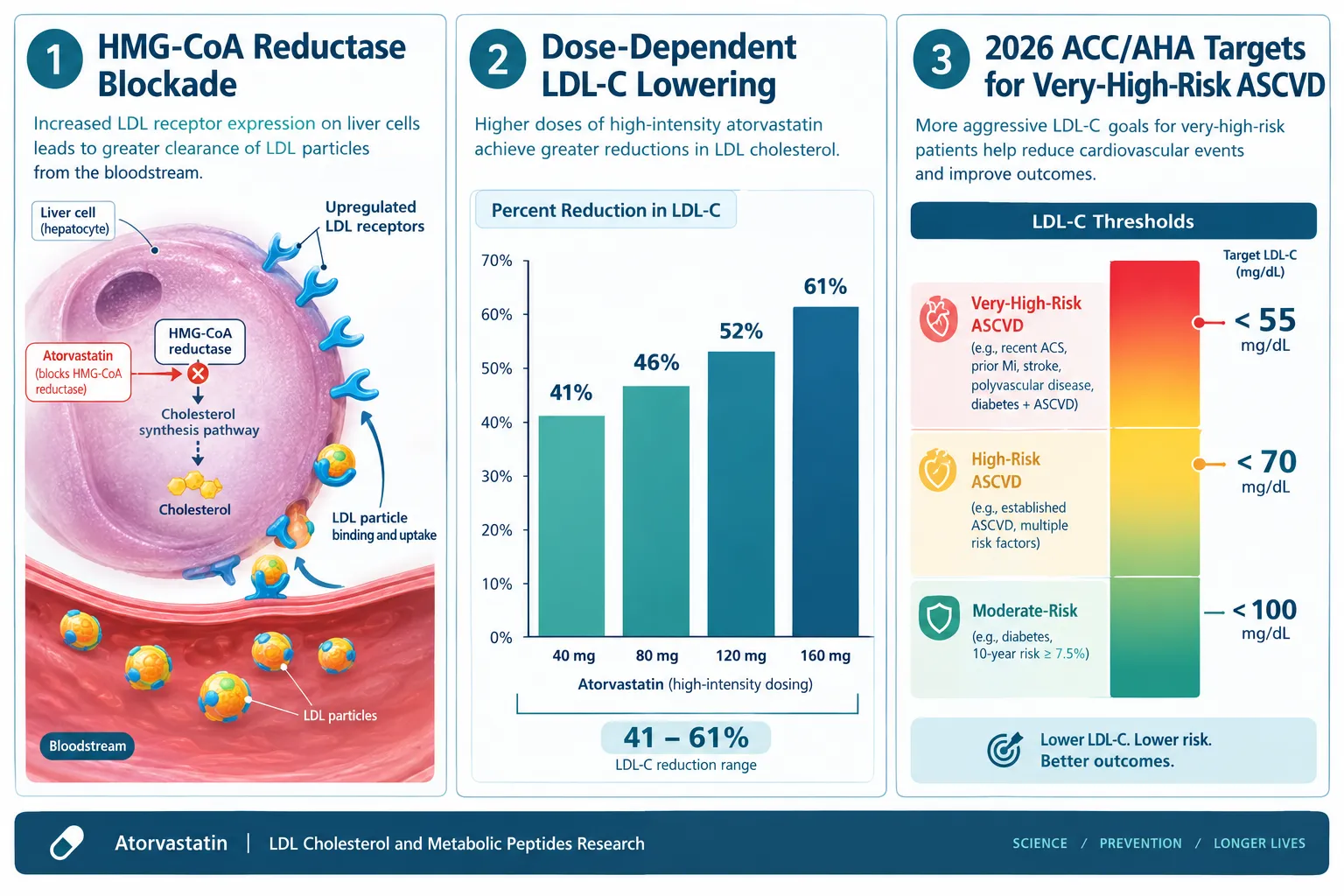
Atorvastatin works by blocking HMG-CoA reductase, the rate-limiting enzyme in hepatic cholesterol synthesis. When the liver produces less cholesterol internally, it upregulates LDL receptors on its surface, pulling more LDL particles out of circulation. The result is a dose-dependent and clinically significant reduction in atherogenic lipoproteins.
How Atorvastatin Shapes LDL-C Management in 2026

Dose, response data are well established. Depending on the dose and the patient's baseline risk profile, atorvastatin produces:

Lipid Marker Typical Reduction Range
Total Cholesterol 30-46%
LDL-C 41-61%
Triglycerides 14-33%
HDL-C Modest increase

The 2026 ACC/AHA multisociety dyslipidemia guideline has reintroduced explicit numeric LDL-C targets for the first time in over a decade. Very-high-risk ASCVD patients now have a target of less than 55 mg/dL, high-risk patients less than 70 mg/dL, and borderline-to-intermediate risk patients less than 100 mg/dL. High-intensity statins like atorvastatin are confirmed as the primary agents to reach these thresholds.

The core limitation: statins address LDL-C powerfully but leave residual risk from elevated triglycerides, visceral adiposity, insulin resistance, and inflammation. This is precisely where metabolic peptide research becomes relevant.

Retatrutide and GLP-Class Peptides: Lipid Effects Beyond Weight Loss

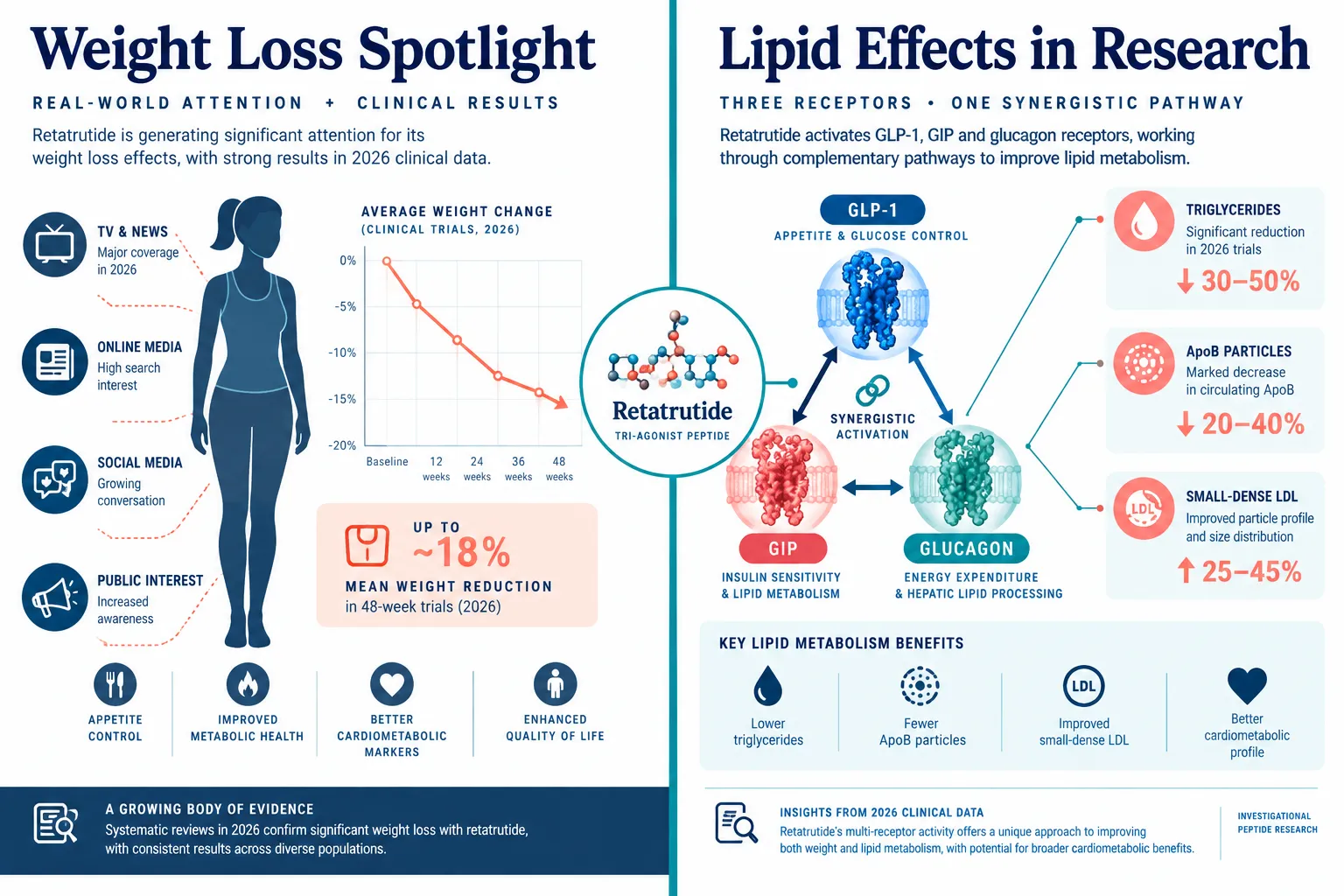
Retatrutide is a first-in-class investigational triple receptor agonist that activates GLP-1, GIP, and glucagon receptors simultaneously. While most public attention has focused on its dramatic weight loss results, its lipid effects are clinically noteworthy in their own right.

A 2026 systematic review and meta-analysis of randomized retatrutide trials found statistically significant improvements across multiple lipid markers. Total cholesterol fell by a weighted mean of approximately 21.88 mg/dL, LDL-C dropped by roughly 13.10 mg/dL, and triglycerides declined by about 40.90 mg/dL, all with p-values below 0.0001. HDL-C showed no meaningful change.

Phase 2 obesity trial data add further context. Non-HDL cholesterol fell approximately 15-17%, LDL declined around 15-20% in higher-dose regimens, and triglycerides dropped by roughly 32-44% across datasets. The mechanism appears to involve glucagon receptor agonism reducing circulating ANGPTL3 and ANGPTL8 concentrations, which in turn enhances lipoprotein lipase activity and alters hepatic lipoprotein production.

Important context: As of mid-2026, retatrutide has no approval from the FDA, EMA, or any other major regulator. Phase 3 TRIUMPH trial data are generating significant scientific interest, but retatrutide remains strictly investigational.

For researchers exploring the GLP peptide landscape, the GLP-3 peptides for sale category and retatrutide clinical trial resources provide useful context on current research-grade availability and trial status. Those interested in the broader incretin class can also review GLP-1 peptides research context for comparison.

MOTS-c and 5-Amino-1MQ: Mitochondrial Pathways in Lipid Research

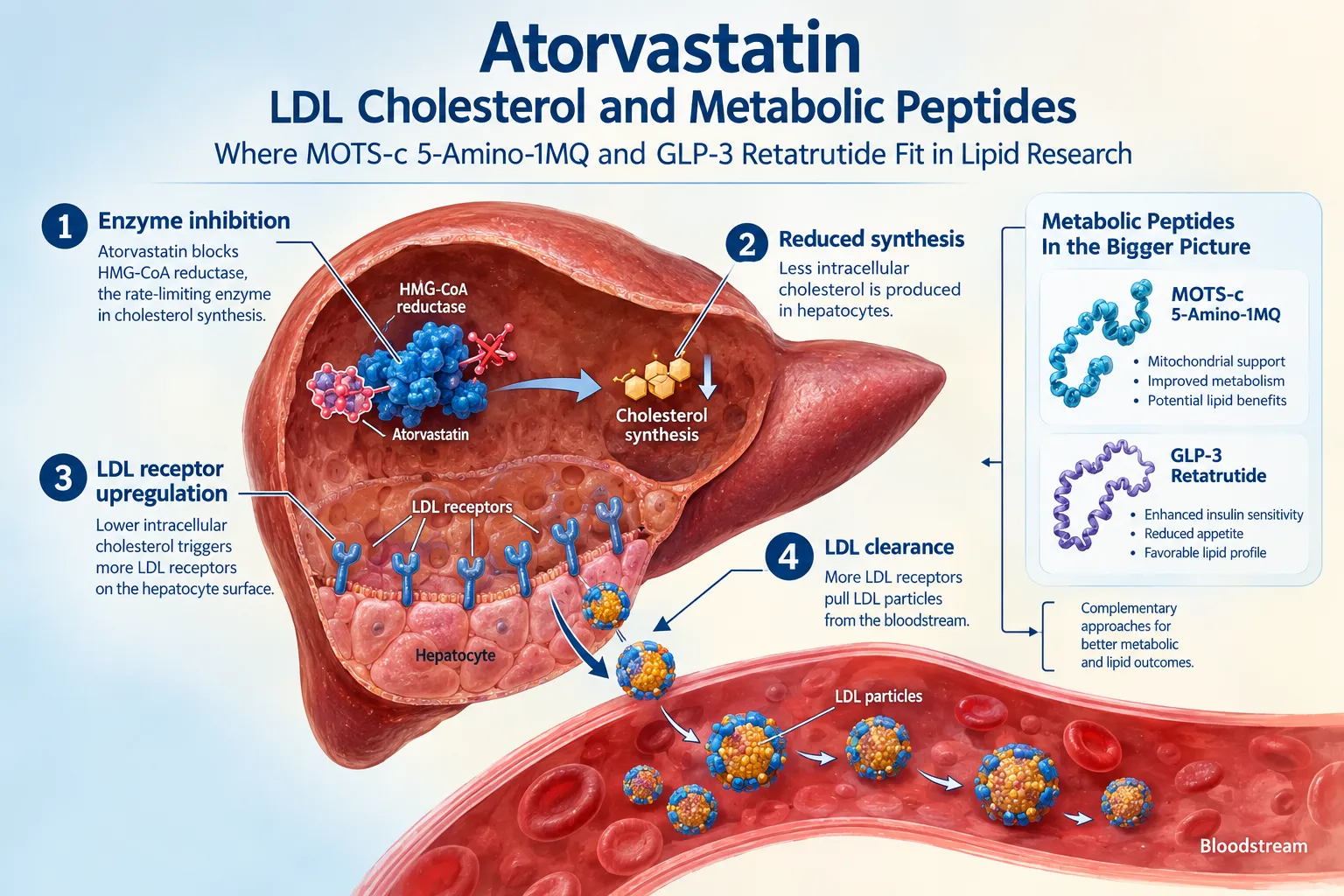
This is where the science of atorvastatin, LDL cholesterol, and metabolic peptides diverges most sharply from conventional cardiology. MOTS-c and 5-Amino-1MQ do not lower LDL-C through receptor upregulation or incretin signaling. Instead, they act on the metabolic machinery inside cells.
MOTS-c and 5-Amino-1MQ: Mitochondrial Pathways in Lipid Research

MOTS-c is a mitochondria-derived peptide encoded within the 12S rRNA region of mitochondrial DNA. Research models show it activates AMPK, regulates NAD+ metabolism, and promotes fatty acid oxidation over lipid storage. In preclinical settings, MOTS-c treatment is associated with improved insulin sensitivity and reduced lipid accumulation in metabolic tissues. For researchers, MOTS-c 10mg is available as a research-grade compound, and the broader MOTS-c peptide category provides additional options.

5-Amino-1MQ is a selective nicotinamide N-methyltransferase (NNMT) inhibitor. By blocking NNMT, it preserves intracellular NAD+ levels, decreases N1-methylnicotinamide, suppresses lipogenesis, and shifts adipocytes toward fat oxidation. In diet-induced obese mouse models, these effects translate to reduced fat mass and improved metabolic markers, with triglycerides often the most sensitive lipid marker to change.

Critical regulatory note: Neither MOTS-c nor 5-Amino-1MQ has an FDA-approved indication. 5-Amino-1MQ has no publicly documented IND or registered Phase 1-3 human trial as of 2026. All efficacy and safety data remain confined to cell culture and animal models.

No major 2025-2026 guideline integrates MOTS-c or 5-Amino-1MQ into formal LDL-cholesterol management pathways. Their role in lipid research is mechanistic and exploratory, not clinical.

For a broader grounding in how these peptide classes relate to each other mechanistically, the Peptides 101 for research-use only buyers guide covers structure, mechanisms, and classification in accessible detail.

Layered Therapy: How These Agents Complement Each Other in Research Models

The emerging framework in expert and industry analysis is one of layered cardiometabolic management:

  1. High-intensity statins (atorvastatin) address the primary LDL-C target mandated by guidelines.
  2. GLP-class investigational agents (retatrutide) tackle residual risk from weight, blood pressure, triglycerides, and glycemic status.
  3. Mitochondrial and NAD+ pathway agents (MOTS-c, 5-Amino-1MQ) represent a third layer focused on cellular metabolic efficiency, still preclinical, but scientifically compelling.
Layered Therapy: How These Agents Complement Each Other in Research Models

This layered model does not imply clinical equivalence. Atorvastatin has decades of randomized controlled trial data and guideline endorsement. Retatrutide has Phase 2 and emerging Phase 3 data. MOTS-c and 5-Amino-1MQ have preclinical data only. Researchers and clinicians must weigh evidence tiers carefully.

The intersection of atorvastatin, LDL cholesterol, and metabolic peptides: where MOTS-c, 5-Amino-1MQ, and GLP-3 Retatrutide fit in lipid research is ultimately a question about mechanism, evidence quality, and therapeutic stage, not a single unified treatment protocol.

For those exploring adjacent peptide research areas, resources on peptides and polypeptides in endocrine pharmacology provide useful mechanistic context on how different peptide classes interface with metabolic signaling systems.

Conclusion

Atorvastatin remains the cornerstone of LDL-C reduction in 2026, backed by robust dose-response data and explicit guideline targets that demand aggressive lipid lowering in high-risk patients. Retatrutide adds a meaningful investigational layer with documented lipid improvements, particularly for triglycerides, through a distinct incretin and glucagon receptor mechanism. MOTS-c and 5-Amino-1MQ represent the frontier of mitochondrial and NAD+ biology in lipid research, with scientifically interesting preclinical profiles but no clinical validation yet.

Actionable next steps for researchers:

  • Use current ACC/AHA LDL-C targets as the benchmark when designing lipid-focused research protocols.
  • Distinguish clearly between agents with clinical trial data (retatrutide) and those with only preclinical data (MOTS-c, 5-Amino-1MQ) when framing research questions.
  • Monitor Phase 3 TRIUMPH retatrutide data and ADA presentations for updated lipid endpoints.
  • Ensure all peptide compounds used in research settings are sourced from verified, high-purity suppliers with documented testing.
  • Consult regulatory guidance before any translational or human-adjacent research involving investigational peptides.

The science connecting statins, incretin-class peptides, and mitochondrial signaling molecules is evolving rapidly. Staying current with both guideline updates and preclinical mechanistic literature is essential for anyone working at this intersection.

https://www.puretestedpeptides.com/wp-content/uploads/2026/09/atorvastatin-ldl-cholesterol-and-metabolic-peptides-where-mots-c-5-amino-1mq-and.webp 1024 1536 https://www.puretestedpeptides.com/wp-content/uploads/2026/01/buy-peptides-online.jpg 2026-09-20 13:06:502026-09-20 13:06:50Atorvastatin, LDL Cholesterol, and Metabolic Peptides: Where MOTS-c, 5-Amino-1MQ, and GLP-3 Retatrutide Fit in Lipid Research
×

Helpful Links

  • My account
  • Cart
  • Checkout
  • Refund and Returns Policy
  • Privacy Policy
  • SMS Privacy Policy
  • Login
  • My Account
  • Logout

USA Made Lab Tested Peptides

All products are sold for research, laboratory, or analytical purposes only, and are not for human consumption


Pure Tested Peptides is a chemical supplier. Pure Tested Peptides is not a compounding / chemical compounding facility as defined under 503A of the Federal Food, Drug, and Cosmetic act. Pure Tested Peptides is not an outsourcing facility as defined under 503B of the Federal Food, Drug, and Cosmetic act.

The statements made within this website have not been evaluated by the US Food and Drug Administration. The products we offer are not intended to diagnose, treat, cure or prevent any disease.

Human/Animal Consumption Prohibited. Laboratory/In-Vitro Experimental Use Only

Scroll to top Scroll to top Scroll to top