

BPC-157 and TB-500 in Tendon and Muscle Models: Separating Angiogenesis, Matrix Remodeling, and Inflammation Readouts
Roughly 35 animal and in vitro studies have examined BPC-157 and TB-500 in tendon and muscle repair, yet only a single human clinical study exists across the entire combined literature. That ratio alone explains why researchers in 2026 are pushing for a more disciplined, endpoint-specific framework rather than broad claims about "healing peptides." Understanding BPC-157 and TB-500 in tendon and muscle models: separating angiogenesis, matrix remodeling, and inflammation readouts requires moving beyond stacked-peptide narratives and into the granular language of scratch assays, collagen histology, vascular markers, and mechanical testing.
Key Takeaways
- BPC-157 operates primarily through VEGFR2, Akt-eNOS, and TGF-beta pathways, making it the stronger candidate for angiogenesis and matrix remodeling endpoints in tendon models.
- TB-500 drives actin polymerization and cell migration via MAPK and FAK signaling, positioning it as a cytoskeletal and motogenic agent rather than a direct ECM organizer.
- Inflammation readouts differ: BPC-157 has detailed cytokine and NF-kB profiling in musculoskeletal models, while TB-500's anti-inflammatory data are less systematically mapped in tendon tissue.
- Combining both peptides shows early synergistic signals in rodent models, but no completed Phase 2 or Phase 3 human trials exist for either compound in tendon or muscle repair.
- Both compounds remain experimental and are banned or under regulatory scrutiny in organized sport and clinical compounding as of 2026.
Mechanistic Profiles: How Each Peptide Acts at the Tissue Level
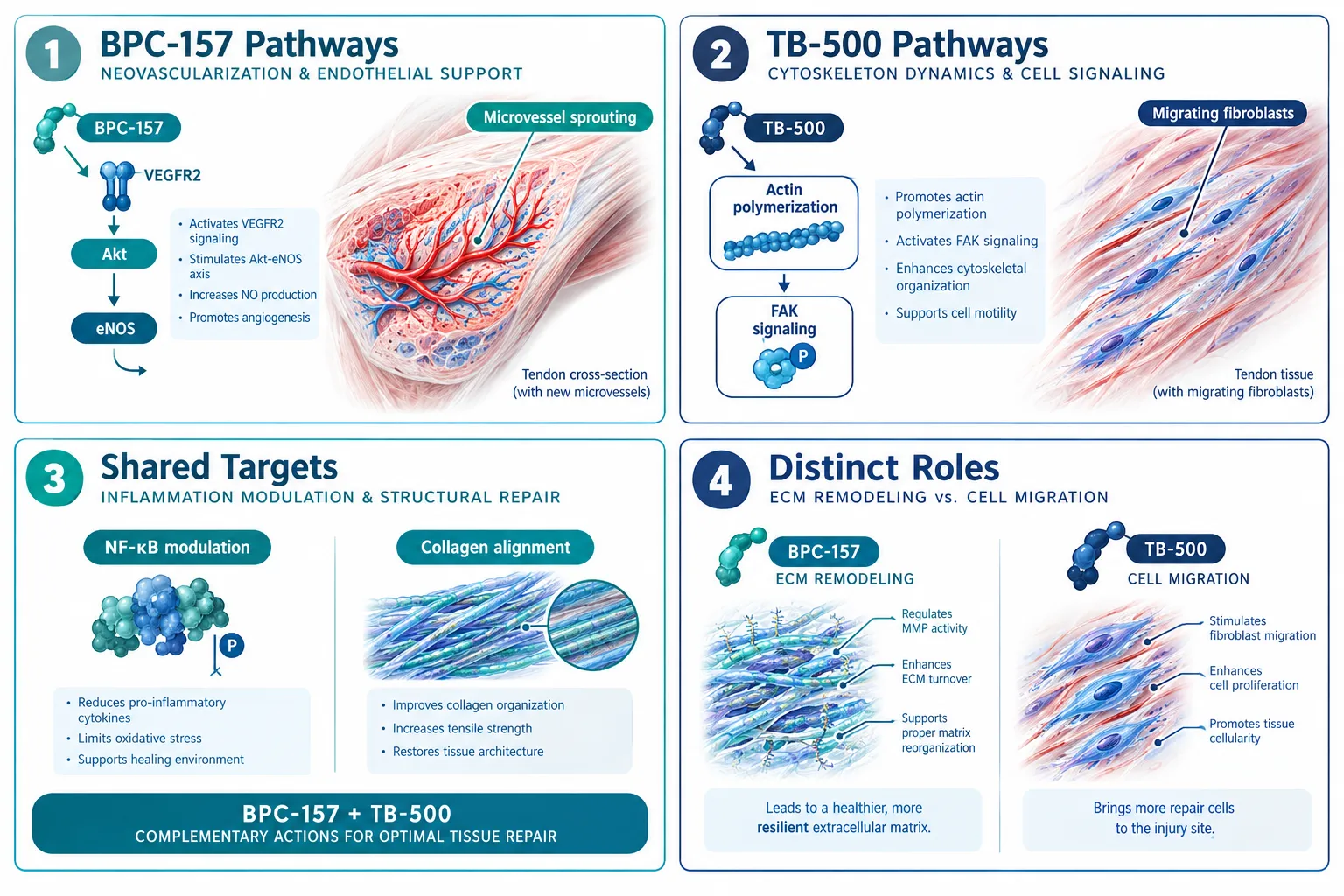
Understanding the mechanistic separation between BPC-157 and TB-500 is the foundation for interpreting any experimental readout.
BPC-157 is a synthetic pentadecapeptide derived from a gastric protein. In tendon and muscle models, it activates VEGFR2 and the Akt-eNOS nitric oxide axis, stimulates fibroblast proliferation, and engages focal adhesion kinase (FAK)-paxillin signaling. These pathways converge on three measurable outcomes: new blood vessel formation, extracellular matrix (ECM) reorganization, and inflammatory resolution. In rat Achilles tendon transection models, aggregated data report 30-40% shortening of healing time alongside improved collagen fiber organization and ultimate tensile strength versus untreated controls.
TB-500, a synthetic derivative of thymosin beta-4 (Tβ4), works through a different axis. Its core action is promoting actin polymerization and cytoskeletal stabilization, enabling rapid cell migration into injury zones. Signaling involves MAPK, NF-kB modulation, and FAK, but the tendon-specific mechanistic map is less detailed than BPC-157's. In muscle models, TB-500 has demonstrated satellite cell (Pax7+) mobilization, enhanced fibrillar regeneration, and reduced fibrosis in murine muscular dystrophy models.
| Feature | BPC-157 | TB-500 |
|---|---|---|
| Primary signaling | VEGFR2, Akt-eNOS, TGF-beta | MAPK, FAK, actin dynamics |
| Main tissue action | Angiogenesis + ECM remodeling | Cell migration + cytoskeletal repair |
| Inflammation data depth | Detailed (cytokine, NF-kB, COX-2) | Moderate (early-phase modulation) |
| Tendon-specific mapping | Extensive preclinical | Limited |
| Human trial data | Single study (non-musculoskeletal) | None in tendon/muscle |
Researchers interested in broader peptide mechanisms may also find the discussion of wound healing compounds useful for contextualizing these tissue-repair pathways.
Separating the Three Readouts: Angiogenesis, Matrix Remodeling, and Inflammation
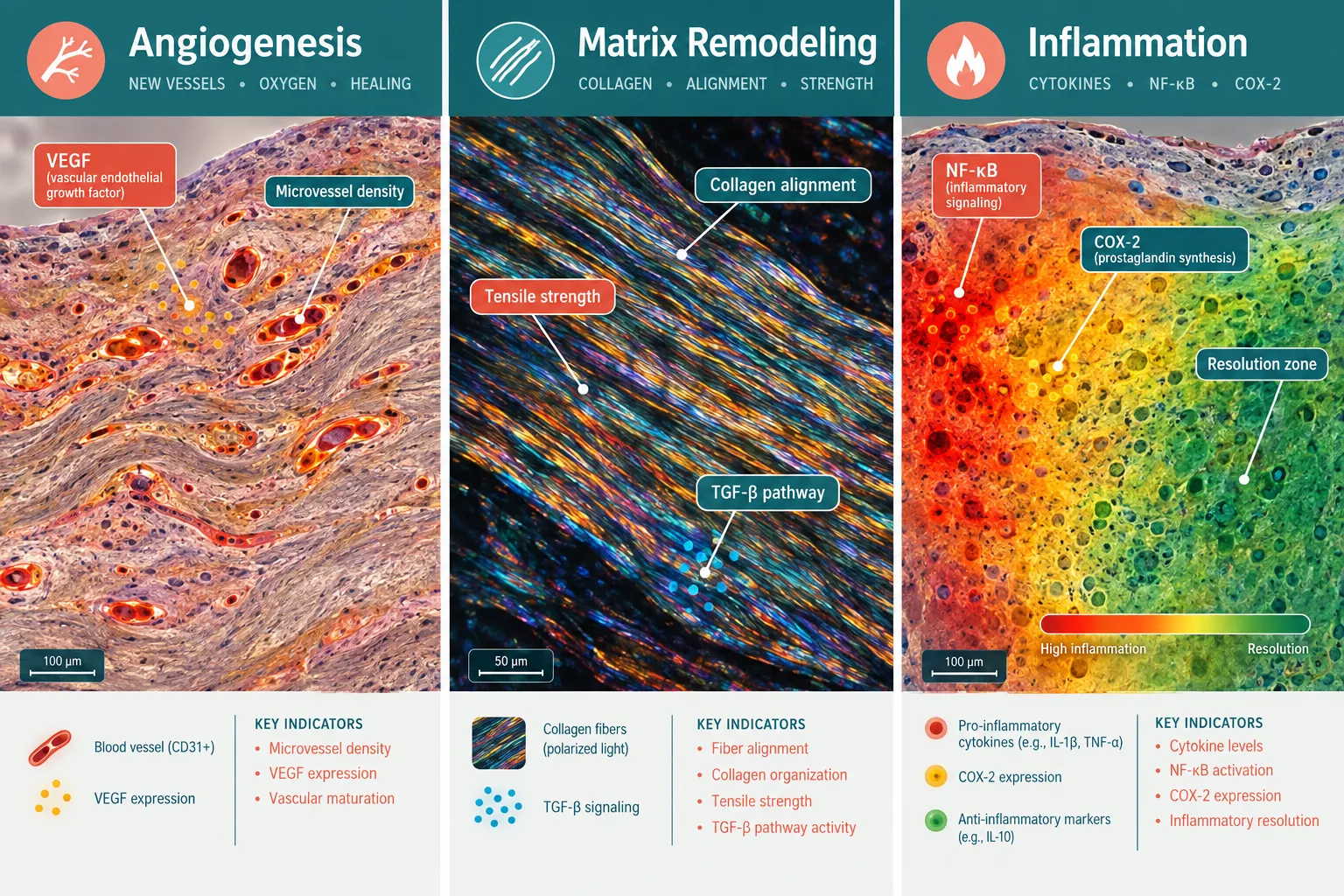
When evaluating BPC-157 and TB-500 in tendon and muscle models: separating angiogenesis, matrix remodeling, and inflammation readouts, each endpoint demands its own assay logic and interpretive standard.
Angiogenesis
BPC-157 reliably increases microvessel density and restores blood flow in ischemic hind-limb models, reflecting VEGF-driven angiogenic activity and nitric-oxide-mediated vasoregulation. Measurable outputs include CD31-positive vessel counts, laser Doppler perfusion imaging, and microvessel density scoring on histological sections.
TB-500/Tβ4 is also described as pro-angiogenic, but its angiogenesis data in orthopaedic models are summarized more broadly across wound, cardiac, and dermal contexts rather than tendon-specific dose-response curves. This makes direct comparison at the tissue level difficult without purpose-designed studies.
Matrix Remodeling
BPC-157 engages TGF-beta-linked ECM pathways, improves collagen alignment, and reduces scar formation across tendon, ligament, and muscle injuries. Polarized-light microscopy and second-harmonic generation imaging of collagen fiber organization, combined with mechanical tensile testing, are the standard readouts. Partial restoration of normal tendon collagen architecture and biomechanical strength has been reported in multiple rodent studies.
TB-500's contribution to matrix remodeling is characterized mainly as accelerating migratory infiltration of repair cells into damaged ECM rather than directly orchestrating collagen synthesis or fiber alignment. This is a meaningful distinction: TB-500 may prepare the matrix environment for remodeling without driving the structural reorganization itself.
Inflammation
BPC-157 modulates the nitric oxide system, downregulates pro-inflammatory cytokines, interacts with COX-2, and inhibits NF-kB activation. These actions produce faster resolution of the inflammatory phase in musculoskeletal injury models, with measurable reductions in IL-6, TNF-alpha, and prostaglandin markers.
TB-500 modulates the early inflammatory phase and facilitates mesenchymal stem-cell migration to injury zones, but detailed cytokine profiling in tendon and muscle models remains limited. Researchers working on wound healing endpoints should note this gap when designing comparative studies.
"BPC-157 has the widest preclinical footprint across musculoskeletal, vascular, and neurological models, while TB-500 has a more focused literature in musculoskeletal and wound healing, a distinction that matters enormously when selecting assay panels."
Combining BPC-157 and TB-500: Synergy Evidence and Research Gaps
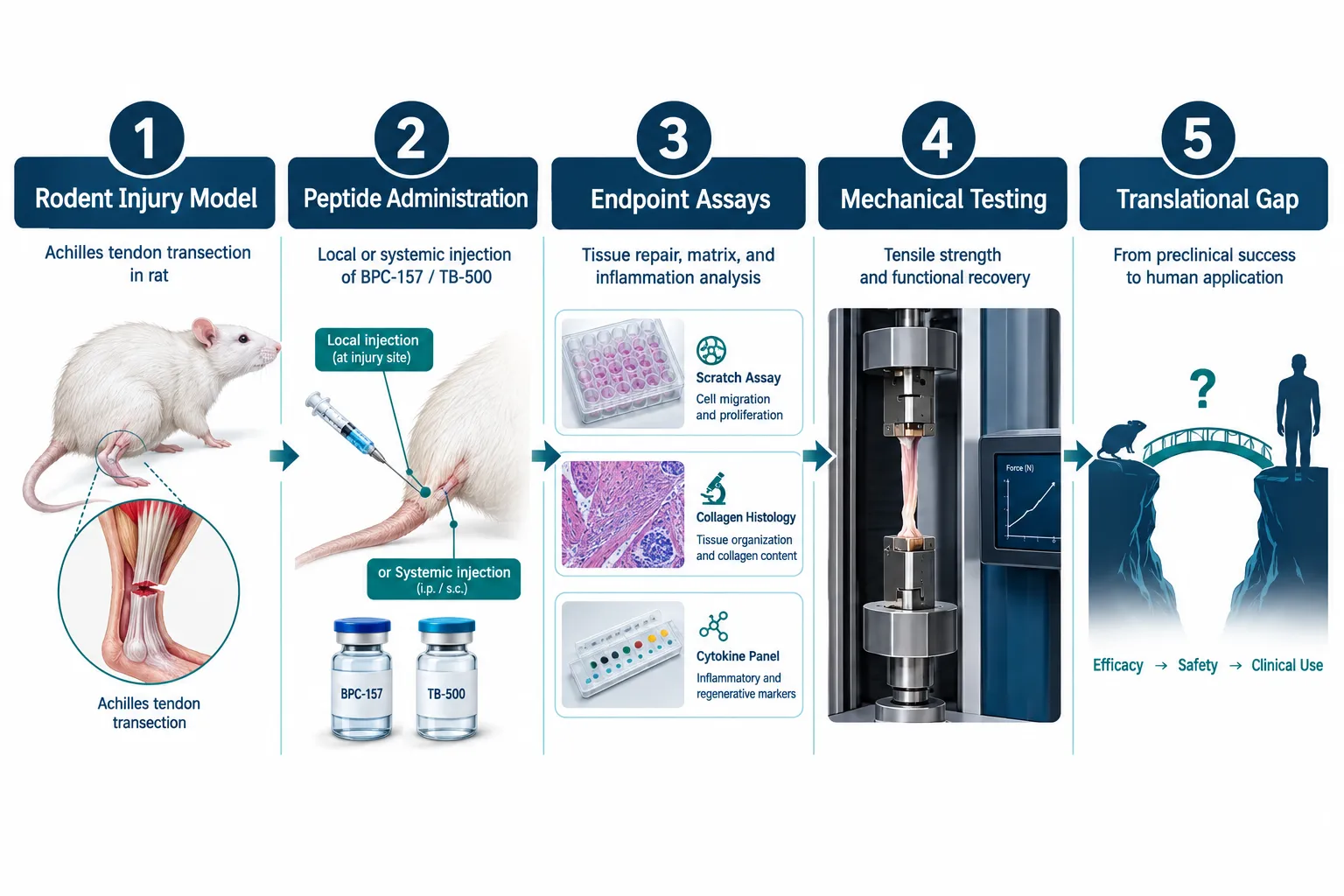
The rationale for combining BPC-157 and TB-500, sometimes called the "Wolverine stack" in research circles, rests on the idea of orthogonal mechanisms. BPC-157 provides localized angiogenesis, ECM remodeling, and inflammation control; TB-500 drives broad cell migration and cytoskeletal repair. One rat model using combined BPC-157 plus Tβ4 reported earlier restoration of contractile function than either peptide alone, supporting a synergistic interpretation.
However, these data are entirely preclinical. As of 2026:
- No completed Phase 2 or Phase 3 trials exist for injectable BPC-157 or TB-500 in tendon or muscle injuries.
- No human randomized controlled trials confirm musculoskeletal healing benefits.
- TB-500/Tβ4 remains a banned substance in organized sport.
- Regulatory discussions around BPC-157 include FDA proposals not to add it to the traditional compounding bulks list.
For researchers studying related peptide stacks, the IPA Sermorelin stack research page offers a useful parallel framework for thinking about combinatorial peptide effects in preclinical models.
Expert analyses from 2026 predict that future work will focus on mapping dose-dependent effects on discrete endpoints, vessel density, collagen architecture, tensile strength, and cytokine signatures, within standardized injury models. Any clinical adoption in orthopaedics or sports medicine will require long-term human trials demonstrating that mechanistic benefits translate into faster, safer recovery without promoting maladaptive angiogenesis or fibrosis.
Researchers exploring mitochondrial and cellular repair mechanisms alongside these peptides may find the SS-31 mitochondrial research literature relevant, as oxidative stress pathways intersect with ECM remodeling in chronic tendon injury. Similarly, those examining broader tissue repair contexts may reference LL-37 versus SS-31 benefits of each peptide for comparative mechanistic framing.
Conclusion
Properly evaluating BPC-157 and TB-500 in tendon and muscle models: separating angiogenesis, matrix remodeling, and inflammation readouts demands endpoint-specific thinking rather than generalized healing claims. BPC-157 is the stronger candidate for angiogenesis and ECM remodeling assays, with detailed VEGFR2 and TGF-beta mechanistic data and measurable improvements in collagen organization and tensile strength. TB-500 is better framed as a migration and cytoskeletal repair agent, with its most robust data in satellite cell mobilization and early-phase inflammatory modulation.
Actionable next steps for researchers and clinicians:
- Design studies with discrete endpoint panels, vessel density counts, collagen histology scoring, cytokine multiplex assays, and mechanical tensile testing, rather than composite "healing" outcomes.
- Treat combination data as hypothesis-generating only; no human trial has validated synergistic claims.
- Monitor regulatory developments closely, as both compounds face evolving restrictions in compounding and sport.
- Prioritize standardized rodent injury models (Achilles transection, muscle crush) to enable cross-study comparison before any translational step.
Both compounds remain promising but investigational. The next phase of research depends on disciplined assay design, not further stacking claims.