

5-Amino-1MQ and MOTS-c Synergy: What Combination Research Is Trying to Test in Metabolic Models
Metabolic disease research in 2026 faces a persistent problem: single-target interventions rarely replicate the complexity of conditions like obesity or insulin resistance. That gap is precisely why researchers are now designing experiments that pair 5-Amino-1MQ, a small-molecule NNMT inhibitor, with MOTS-c, a mitochondria-derived signaling peptide. The question driving this work is straightforward, does the 5-Amino-1MQ and MOTS-c synergy: what combination research is trying to test in metabolic models reveal anything that neither compound can show alone?
This article examines the mechanistic rationale behind that pairing, the hypotheses being constructed, and what meaningful synergy would actually look like in preclinical experimental settings.
Key Takeaways
- 5-Amino-1MQ inhibits NNMT, an enzyme linked to adipogenesis and reduced NAD+ availability, while MOTS-c is a mitochondrial peptide that activates AMPK and regulates glucose metabolism.
- Researchers hypothesize that these two compounds may act on complementary, non-overlapping pathways, making combination testing scientifically rational.
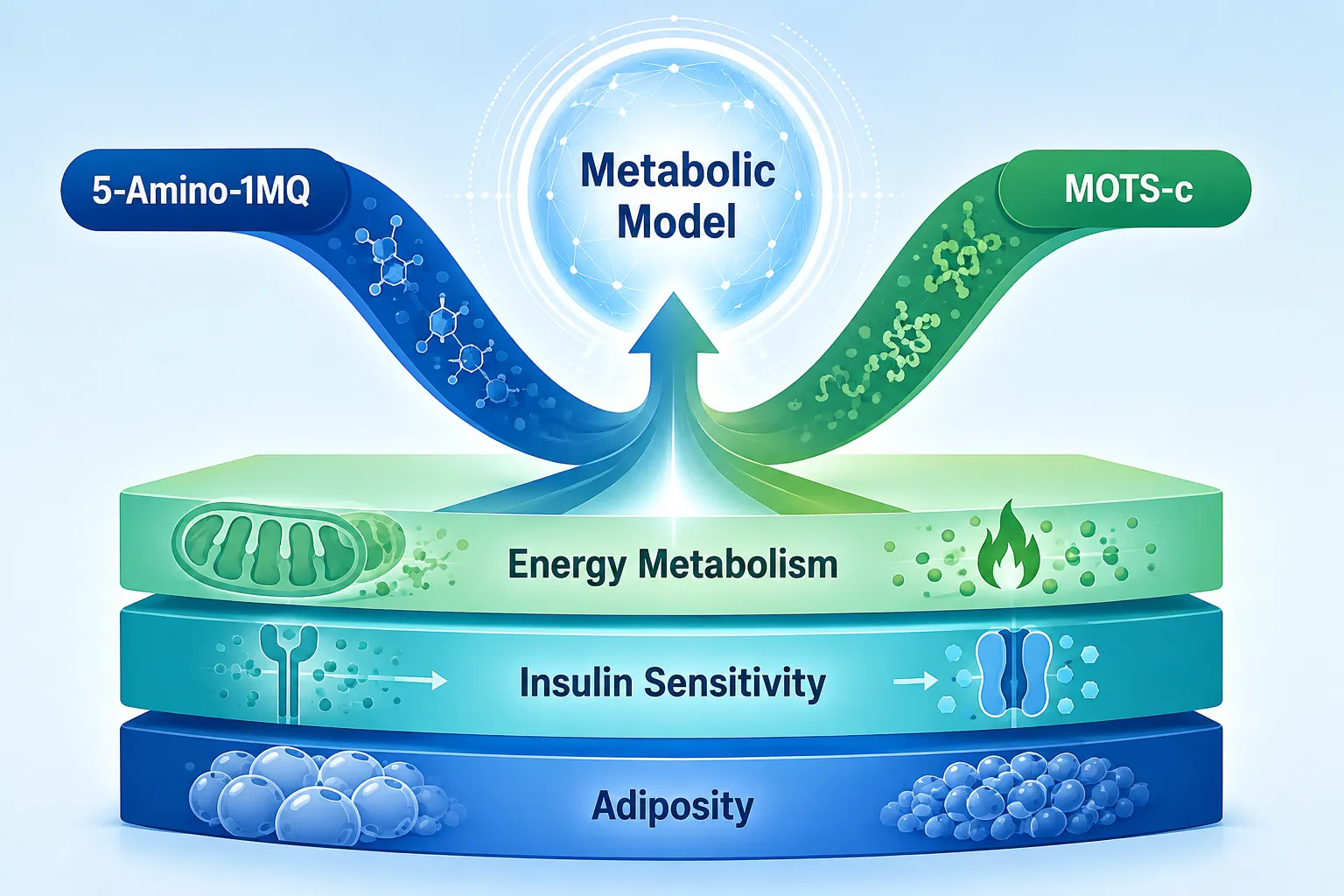
- Preclinical metabolic models are being used to probe potential synergy across three domains: adiposity reduction, insulin sensitivity, and energy expenditure.
- Synergy, in a research context, means an effect greater than the sum of each compound's individual contribution, not simply additive benefit.
- No human clinical data on this combination exists as of 2026; all discussion reflects hypothesis-driven preclinical research.
Understanding the Two Compounds Before Testing Synergy
What 5-Amino-1MQ Does in Metabolic Pathways
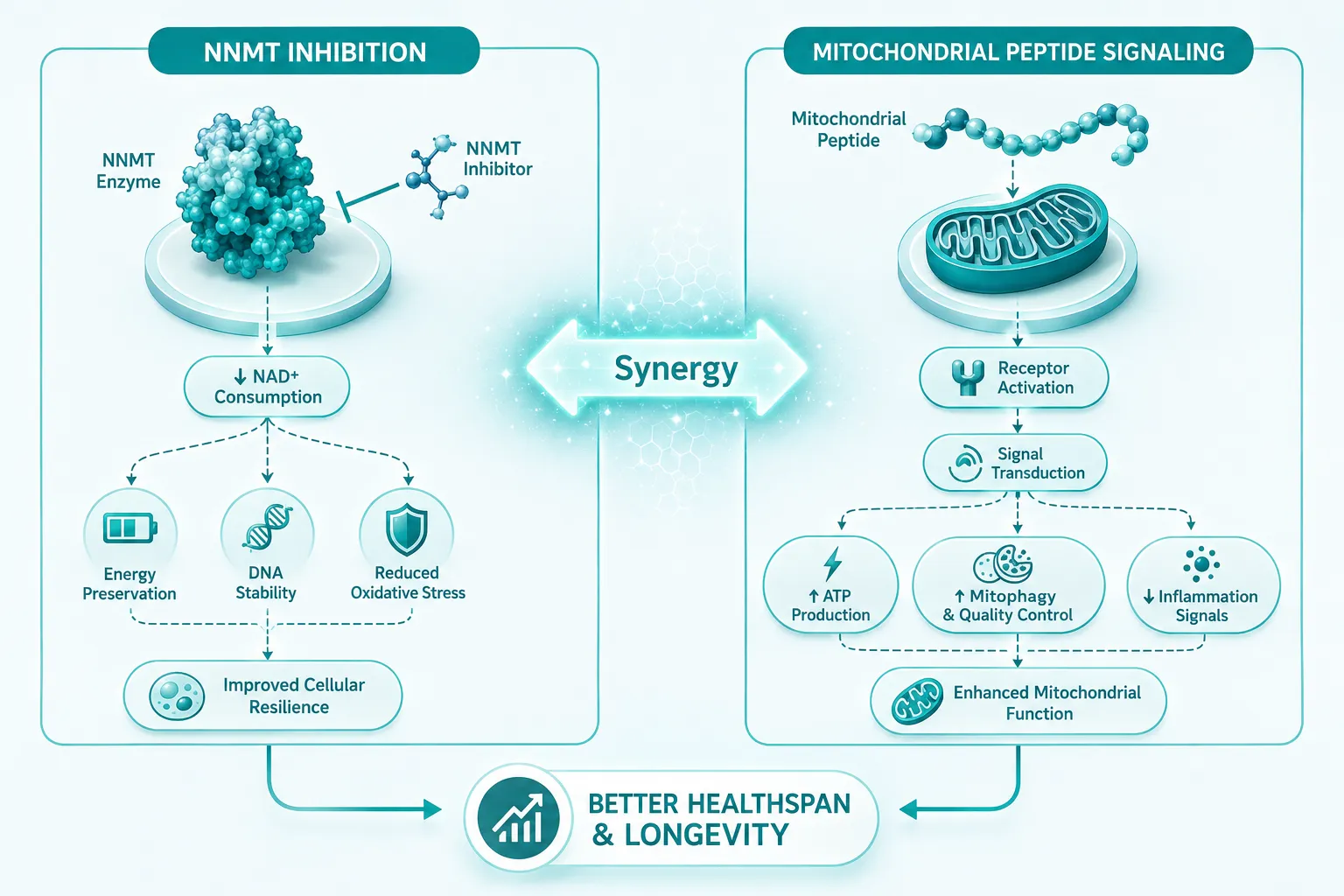
5-Amino-1MQ (5-amino-1-methylquinolinium) is a selective inhibitor of nicotinamide N-methyltransferase (NNMT), an enzyme expressed heavily in adipose tissue. NNMT consumes S-adenosylmethionine (SAM) and converts nicotinamide into 1-methylnicotinamide. When NNMT is overactive, it depletes the methyl donor pool and reduces NAD+ precursor availability, two conditions associated with increased fat storage and impaired metabolic signaling.
By blocking NNMT, 5-Amino-1MQ is hypothesized to:
- Restore SAM availability for epigenetic regulation
- Increase NAD+ precursor flux, supporting sirtuin activity
- Reduce adipocyte differentiation signals in vitro
For a deeper look at how this compound compares with classic mitochondrial pathway modulators, see the article on peptides and polypeptides in mitochondrial biology comparing MOTS-c and 5-Amino-1MQ.
What MOTS-c Does as a Mitochondrial Signal
MOTS-c is a 16-amino acid peptide encoded in the mitochondrial 12S rRNA. It functions as a retrograde signal, originating in mitochondria and traveling to the nucleus and cytoplasm to regulate gene expression. Its primary mechanism involves AMPK activation, which shifts cells toward fatty acid oxidation and glucose uptake.
Key research observations on MOTS-c include:
- Improved insulin sensitivity in high-fat diet mouse models
- Increased skeletal muscle glucose uptake independent of insulin
- Translocation to the nucleus under metabolic stress, where it modifies gene expression
For a detailed comparison of MOTS-c with related mitochondrial peptides, the MOTS-c vs Humanin mitochondrial peptide comparison provides useful context.
The Mechanistic Case for 5-Amino-1MQ and MOTS-c Synergy in Metabolic Models
The central hypothesis is that these two compounds operate on distinct but converging nodes of metabolic regulation. 5-Amino-1MQ acts primarily at the epigenetic and substrate-availability level inside adipocytes. MOTS-c acts at the energy-sensing and glucose-uptake level, primarily in muscle and liver tissue.
This non-overlap is what makes the pairing scientifically interesting. Researchers are not testing two compounds that do the same thing, they are testing whether upstream epigenetic correction (via NNMT inhibition) combined with downstream mitochondrial energy signaling (via MOTS-c) produces effects that neither achieves independently.
Three core hypotheses under investigation:
- Adiposity hypothesis: NNMT inhibition reduces fat cell formation while MOTS-c increases fat oxidation in existing adipocytes, together, they may reduce fat mass more effectively than either alone.
- Insulin sensitivity hypothesis: 5-Amino-1MQ improves the intracellular environment for insulin signaling through SAM restoration; MOTS-c independently activates AMPK-driven glucose uptake. Combined, the effect on insulin sensitivity may be additive or synergistic.
- Energy expenditure hypothesis: NAD+ restoration from NNMT inhibition supports mitochondrial biogenesis; MOTS-c directly activates AMPK. Both pathways increase energy expenditure, but through different rate-limiting steps.
This kind of multi-node targeting parallels strategies seen in other metabolic research designs. The article on cagrilintide synergy with GLP-1 illustrates how combination approaches are being applied across metabolic peptide research more broadly.

How Preclinical Models Are Designed to Test This Synergy
Model Selection and Endpoints
Most combination experiments in this space use diet-induced obesity (DIO) mouse models or db/db diabetic mice. These models allow researchers to measure:
| Endpoint | Relevance to Combination Hypothesis |
|---|---|
| Body fat percentage | Tests adiposity hypothesis |
| Fasting glucose and HOMA-IR | Tests insulin sensitivity hypothesis |
| Oxygen consumption rate | Tests energy expenditure hypothesis |
| Adiponectin and leptin levels | Tracks adipokine signaling changes |
Researchers also use in vitro adipocyte and myocyte co-culture systems to isolate cell-specific effects before moving to whole-animal models.
Defining Synergy vs. Additivity
A critical methodological point: synergy is not the same as a combined effect. In pharmacology, synergy means the combined outcome exceeds what would be predicted by adding each compound's individual effect. Researchers use the Bliss independence model or Loewe additivity framework to distinguish true synergy from simple additivity.
This distinction matters enormously for interpreting results. If both compounds reduce fasting glucose by 15% individually, and the combination reduces it by 35%, that gap of 5% beyond simple addition is where synergy claims begin.
For broader context on how peptide-based compounds are evaluated alongside small molecules in metabolic research, the top 5 research peptides for metabolic health buyer's guide covers the landscape well.
Dosing and Timing Variables
Combination research also requires careful attention to:
- Sequence of administration (simultaneous vs. staggered dosing)
- Dose-response curves for each compound alone before testing combinations
- Duration of exposure given MOTS-c's short half-life relative to 5-Amino-1MQ's small-molecule stability
These variables are not minor. The wrong dosing sequence could mask synergy or create apparent antagonism where none exists.
For additional perspective on how small molecules fit alongside peptide-based approaches in metabolic study design, see tesofensine, enclomiphene, and peptide-based approaches in metabolic research.
What Meaningful Synergy Would Indicate for Future Research
If preclinical models confirm synergy across even one of the three hypotheses above, the implications for research design are significant. It would suggest that:
- Epigenetic-level interventions (NNMT inhibition) can potentiate the effects of mitochondrial signaling peptides
- Tissue-specific targeting, adipose vs. muscle, may be more important than systemic pathway coverage
- Combination metabolic research deserves dedicated study arms rather than being treated as an afterthought
It would also raise new questions about optimal ratios, timing, and whether the synergy holds in aged or insulin-resistant models differently than in lean models. Researchers studying adjacent combination strategies, such as those reviewed in polypeptide peptides in cardiometabolic models, face similar interpretive challenges.
Conclusion
The scientific rationale for testing 5-Amino-1MQ and MOTS-c synergy: what combination research is trying to test in metabolic models is mechanistically sound. These two compounds address metabolic dysfunction through non-overlapping pathways, one at the epigenetic and substrate level, the other at the mitochondrial energy-sensing level. That complementarity is exactly what makes combination testing worthwhile.
Actionable next steps for researchers and research readers:
- Review existing single-compound dose-response data for both 5-Amino-1MQ and MOTS-c before interpreting combination results
- Apply formal synergy frameworks (Bliss or Loewe) rather than assuming combined effects equal synergy
- Track endpoint specificity, adiposity, insulin sensitivity, and energy expenditure may respond differently to the combination
- Monitor peer-reviewed literature from 2026 onward as DIO model data from combination arms begins to emerge
This is hypothesis-driven science at an early stage. The value lies not in premature conclusions, but in the quality of the questions being asked.