Call or Text 727-513-9780
  • Shopping Cart Shopping Cart
    0Shopping Cart
Pure Tested Peptides | America's most trusted Peptides for sale online
  • Peptides for sale
    • Oral Peptides for sale
      • Peptide Capsules for sale
      • BPC 157 Capsules 1000mcg
      • SLU-PP-332 Capsules | 1000 mcg
      • 5-Amino-1MQ 50mg Capsules
      • Tesofensine 500mcg
    • All Peptides for sale
    • Peptide Sprays
      • BPC 157 Nasal Spray Kit
      • BPC-157 TB500 Nasal Spray Kit
      • Semax Nasal Spray 10mg
      • Selank – Nasal Spray Kit – 10mg
      • Epithalon 50MG Nasal Spray Kit
      • Ipamorelin 10mg Nasal Spray
      • Klow Nasal Spray (BPC-157 + TB-500 + GHK-Cu + KPV) | 80mg
      • Hulk Nasal Spray Tesa / Ipa Blend 6/3 MG
      • Klow Nasal Spray
      • NAD + 500 mg Nasal Spray
      • PT-141 Nasal Spray Kit
    • GHRH Peptides
      • Ipa Peptides
      • CJC-1295 Peptides
        • CJC-1295 with DAC 5 mg
        • CJC-1295 without DAC 5 mg
        • CJC-1295 Ipa 10mg
      • Tesa Peptides
        • Tesa Peptide
        • Tesa 20 mg
    • GHK-Cu Peptides
      • All GHK-Cu Peptides
      • GHK-Cu 100mg
      • KLOW Peptide Blend – Buy KLOW blend online
    • BPC Peptides
      • All BPC Peptides
      • BPC-157
      • BPC-157 TB-500
      • BPC 157 capsules 1000mcg
    • SLU-PP-332 Peptides
      • All SLU-PP-332 Peptides
      • SLU-PP-332 5mg
    • GLP3 Peptides
      • GLP3-R
      • GLP3-R CAG 10mg
      • GLP3-R 20mg
    • PT-141 Peptides
      • PT-141 Peptides for sale
      • PT-141 10mg
      • PT-141 Nasal Spray
    • CAG Peptides
      • Lipo-C Peptide Blend
      • CAG 5mg
      • CAG 10mg
    • MOTS-C Peptides
      • MOTS-C Peptides for sale
      • MOTS-c peptide
      • MOTS-c 10mg *6 pack*
    • 5 Amino 1MQ Peptides
      • 5 Amino 1MQ Peptides for sale
      • 5-Amino-1MQ 50mg Capsules
      • 5-Amino-1MQ 5mg
    • Epithalon Peptides
      • Epithalon Peptides for sale
      • Epithalon 10mg
      • Epithalon 50mg
  • Shop
    • GLPs
      • 5-Amino-1MQ 50mg Capsules
      • 5-Amino-1MQ 5mg
      • GLP3-Reta
      • L-Carnitine 500mg/ml
      • Tesofensine 500mcg
      • SLU-PP-332 5mg
      • MOTS-c 10mg *6 pack*
    • Epithalon & BPC Peptides
      • Epithalon 10mg
      • Epithalon 50mg
      • BPC-157
      • BPC 157 capsules 1000mcg
      • BPC-157 TB-500
      • BPC-157 TB500 Nasal Spray Kit
      • BPC 157 Nasal Spray Kit
    • BPC TB-500 & NAD+ Peptides
      • NAD+ 500 mg
      • KLOW Peptide Blend – Buy KLOW blend online
      • GLOW Peptide Blend
      • TB 500 5mg
      • BPC 157 capsules 1000mcg – Supplement
      • BPC 157 Nasal Spray Kit
      • BPC-157
      • BPC-157 TB500 Nasal Spray Kit
      • BPC-157 TB-500
      • BPC 157 capsules 1000mcg
    • LL-37 Peptide
      • LL-37 10 mg
    • MOTS-C & Selank
      • MOTS-c peptide
      • Selank 10mg
    • GHK Peptides
      • GHK-Cu 100mg
      • GLOW Peptide Blend
      • KLOW Peptide Blend – Buy KLOW blend online
  • COAs
  • Wholesale
    • Wholesale Peptides for sale
  • PTP FAQ
  • Affiliates
    • Selank Peptide: Advanced Pharmacological Mechanisms Underlying Its Anxiolytic and Nootropic Effects in Research
      • 5-Amino-1MQ Peptide: Detailed Mechanisms of NNMT Inhibition and Its Impact on Cellular Metabolism Research
        • MOTS-C Peptide: Unraveling Its Role in Mitochondrial Dynamics and Energy Metabolism Research
          • Epithalon Peptide and Telomerase Regulation: Investigating Its Impact on Cellular Senescence and Lifespan Research Models
            • GLP2-T vs GLP2 Tirz Peptide: Understanding the Naming, Mechanistic Nuances, and Research Implications for Gut Health
      • Peptides and Polypeptides in Modern Pharmacology: What Research on Metoprolol, Prednisone, and Amlodipine Reveals
        • Polypeptide Peptides vs NSAIDs: What Naproxen and Diclofenac Teach Tissue-Repair Researchers About BPC‑157 and TB‑500
          • Peptides and Polypeptides in Endocrine Pharmacology: How GLP-1, GLP-2, and GLP-3 Retatrutide Differ From Classic Drugs Like Prednisone and Amlodipine
          • 5‑Amino‑1MQ Peptide and NNMT Inhibition: How It Compares With Statins Like Atorvastatin in Adipose and Lipid Metabolism Research
      • Enclomiphene, Estrogen Receptor Signaling, and Luteinizing Phase Biology: What Hormone Researchers Should Measure
        • Mesenchymal Stem Cells, BPC‑157, and GHK‑Cu: How Tissue Repair Peptides Compare With Classic NSAIDs Like Naproxen in Injury Models
          • Peptide Calculator Use Cases Beyond Growth Hormone: Working Through GLP‑3 Retatrutide, MOTS‑c, and BPC‑157 Research Dosing
        • Polypeptide Peptides in Endocrine and Metabolic Pharmacology: Lessons From Amlodipine, Prednisone, and Metoprolol
        • Peptides Calculator for Advanced Blends: Worked Examples for Tesamorelin, CJC‑1295, and Ipamorelin Stacks
          • Peptides and Polypeptides in Human Physiology: How Molecular Size Shapes Research Applications
            • Selank Peptide: Advanced Pharmacological Mechanisms Underlying Its Anxiolytic and Nootropic Effects in Research
          • 5-Amino-1MQ Peptide: Detailed Mechanisms of NNMT Inhibition and Its Impact on Cellular Metabolism Research
            • MOTS-C Peptide: Unraveling Its Role in Mitochondrial Dynamics and Energy Metabolism Research
              • Epithalon Peptide and Telomerase Regulation: Investigating Its Impact on Cellular Senescence and Lifespan Research Models
                • GLP2-T vs GLP2 Tirz Peptide: Understanding the Naming, Mechanistic Nuances, and Research Implications for Gut Health
                  • Peptides and Polypeptides in Endocrine Pharmacology: How GLP-1, GLP-2, and GLP-3 Retatrutide Differ From Classic Drugs Like Prednisone and Amlodipine
                    • Polypeptide Peptides vs NSAIDs: What Naproxen and Diclofenac Teach Tissue-Repair Researchers About BPC‑157 and TB‑500
                      • Peptides and Polypeptides in Modern Pharmacology: What Research on Metoprolol, Prednisone, and Amlodipine Reveals
                        • 5‑Amino‑1MQ Peptide and NNMT Inhibition: How It Compares With Statins Like Atorvastatin in Adipose and Lipid Metabolism Research
                        • Enclomiphene, Estrogen Receptor Signaling, and Luteinizing Phase Biology: What Hormone Researchers Should Measure
                        • Mesenchymal Stem Cells, BPC‑157, and GHK‑Cu: How Tissue Repair Peptides Compare With Classic NSAIDs Like Naproxen in Injury Models
                        • Peptide Calculator Use Cases Beyond Growth Hormone: Working Through GLP‑3 Retatrutide, MOTS‑c, and BPC‑157 Research Dosing
                        • Polypeptide Peptides in Endocrine and Metabolic Pharmacology: Lessons From Amlodipine, Prednisone, and Metoprolol
                        • Peptides Calculator for Advanced Blends: Worked Examples for Tesamorelin, CJC‑1295, and Ipamorelin Stacks
                        • Peptides and Polypeptides in Human Physiology: How Molecular Size Shapes Research Applications
                        • Selank Peptide: Advanced Pharmacological Mechanisms Underlying Its Anxiolytic and Nootropic Effects in Research
                        • MOTS-C Peptide: Unraveling Its Role in Mitochondrial Dynamics and Energy Metabolism Research
                        • Peptides and Polypeptides in Modern Pharmacology: What Research on Metoprolol, Prednisone, and Amlodipine Reveals
                        • Peptides and Polypeptides in Endocrine Pharmacology: How GLP-1, GLP-2, and GLP-3 Retatrutide Differ From Classic Drugs Like Prednisone and Amlodipine
                        • 5-Amino-1MQ Peptide: Detailed Mechanisms of NNMT Inhibition and Its Impact on Cellular Metabolism Research
                        • Mesenchymal Stem Cells, BPC‑157, and GHK‑Cu: How Tissue Repair Peptides Compare With Classic NSAIDs Like Naproxen in Injury Models
                        • Peptide Calculator Use Cases Beyond Growth Hormone: Working Through GLP‑3 Retatrutide, MOTS‑c, and BPC‑157 Research Dosing
                        • GLP2-T vs GLP2 Tirz Peptide: Understanding the Naming, Mechanistic Nuances, and Research Implications for Gut Health
                        • Polypeptide Peptides in Endocrine and Metabolic Pharmacology: Lessons From Amlodipine, Prednisone, and Metoprolol
                        • Polypeptide Peptides vs NSAIDs: What Naproxen and Diclofenac Teach Tissue-Repair Researchers About BPC‑157 and TB‑500
                        • Peptides and Polypeptides in Human Physiology: How Molecular Size Shapes Research Applications
                        • Peptides Calculator for Advanced Blends: Worked Examples for Tesamorelin, CJC‑1295, and Ipamorelin Stacks
                        • 5‑Amino‑1MQ Peptide and NNMT Inhibition: How It Compares With Statins Like Atorvastatin in Adipose and Lipid Metabolism Research
                        • Enclomiphene, Estrogen Receptor Signaling, and Luteinizing Phase Biology: What Hormone Researchers Should Measure
                        • Epithalon Peptide and Telomerase Regulation: Investigating Its Impact on Cellular Senescence and Lifespan Research Models
                        • Best research protocol Klow blend
                        • best time to take BPC-157
                        • best time to take DSIP (Delta Sleep Inducing Peptide)
                        • best time to take CJC-1295
                        • best time to take AOD-9604
                        • best time to take Follistatin 344
                        • best time to take Ipamorelin
                        • best time to take MK-677 (Ibutamoren)
                        • best time to take Ligandrol (LGD-4033) — research compound
                        • best time to take Ostarine (MK-2866) — research compound
                        • best time to take GHK-CU
                        • best time to take TB-500
                        • best time to take MOTS-c
                        • best time to take Semax
                        • best time to take RAD-140 (Testolone) — research compound
                        • best time to take Thymosin Alpha-1
                        • best time to take PEG-MGF
                        • Biolife Plasma, Octapharma Plasma, and Research Peptides: How Plasma Donation Labs Differ From Peptide Suppliers
                        • best time to take YK-11 — research compound
                        • best time to take PT-141 (Bremelanotide)
                        • Best research protocol Klow blend
                        • 5-Amino-1MQ and MOTS-C Synergy: Metabolic Signaling, Mitochondria, and Research Design
                        • BPC-157 and TB-500: Investigating Their Combined Effects on Angiogenesis and Cellular Migration in Tissue Repair Models
                        • BPC-157 Peptide: Gut Barrier Function, Inflammation, and Tissue-Recovery Research
                        • 5‑Amino‑1MQ and MOTS‑c Synergy in Metabolic Research: Designing NNMT and Mitochondrial Biogenesis Stacks
                        • CJC-1295 with DAC vs. Without DAC: Half-Life, Release Kinetics, and Research Implications
                        • CJC‑1295 with DAC vs. Without DAC: Expanding on Half‑Life Differences Using Tesamorelin and Ipamorelin Blend Case Studies
                        • Collagen Biology and Copper‑Binding Peptides: How GHK‑Cu, Glow Blend, and Klow Blend Interact with Skin and Connective Tissue
                        • Collagen Biology and Regenerative Peptides: How GHK‑Cu, Glow Blend, and Klow Blend Affect Extracellular Matrix Research
                    • DNA, Telomeres, and Longevity Peptides: Positioning Epithalon and MOTS‑c in Genetic Aging Research
                      • Enclomiphene Citrate: serm Mechanism, Testosterone Research, and Stack Compatibility
                        • Enclomiphene vs Enclomiphene Citrate: Formulation, Bioavailability, and Research Distinctions
                        • Epithalon Peptide Research: Telomerase Activation, Aging, and Pineal Gland Function
                        • Estrogen Receptor Signaling and Enclomiphene: How Selective Modulators Compare with Classic Polypeptide Hormones
                        • GHK-Cu Peptide: Advanced Mechanisms in Extracellular Matrix Remodeling and Wound Healing Research
                        • GHK-Cu Peptide: Collagen Synthesis, Wound Repair, and Skin-Barrier Research Models
                        • GLP-1 vs GLP-3 vs GLP-2: Peptide Classification and Research Applications
                        • GLP-2 Peptide Research Guide: Gut Barrier Function, Nutrient Absorption, and Intestinal Recovery Models
                        • GLP-3 Retatrutide vs. GLP-1 Drugs: What Triple-Agonist Biology Changes in Research Models
                        • Ipamorelin and Tesamorelin Combination: Synergistic GH Secretagogue Research and Dosing Protocols
                        • GLP2 Tirz Peptide: What It Is, Why the Name Exists, and How Researchers Should Interpret It
                        • Klow Blend Peptide Nasal Spray: What the Formulation Is Trying to Do in Cognitive Research
                        • Mitochondria, NNMT Inhibition, and Peptide Modulators: Where MOTS‑c and 5‑Amino‑1MQ Fit in Cellular Energy Research
                        • MOTS-c Peptide: Mitochondrial Function, Energy Metabolism, and What Researchers Measure
                        • MOTS-c vs. 5-Amino-1MQ: Which Metabolic Research Questions Each Compound Actually Answers
                        • Nasal Spray Peptides: Bioavailability, Administration, and Semax/Selank Research Applications
                        • PT-141 Peptide Research: Mechanism of Action and Melanocortin Receptor Signaling
                        • Retatrutide for Research: Mechanism, Structure, and GLP-1/GLP-3 Dual Action
                        • Retatrutide for Obesity and Type 2 Diabetes: What the Latest Trial Data Suggest
                        • Tesofensine Peptide Research: Mechanism, Appetite Suppression, and Neuropeptide Y Pathways
  • Contact
    • Contact Customer Service
    • Text Customer Support
  • About US
  • Shop all peptides
  • Affiliate Program
    • Affiliate Signup
  • Login / Register Login / Register Page Link Login / Register Page Link
  • Click to open the search input field Click to open the search input field Search
  • Menu Menu
5-Amino-1MQ and MOTS-c Synergy: What Combination Research Is Trying to Test in Metabolic Models

5-Amino-1MQ and MOTS-c Synergy: What Combination Research Is Trying to Test in Metabolic Models

August 11, 2026/0 Comments/in Uncategorized/by

Metabolic disease research in 2026 faces a persistent problem: single-target interventions rarely replicate the complexity of conditions like obesity or insulin resistance. That gap is precisely why researchers are now designing experiments that pair 5-Amino-1MQ, a small-molecule NNMT inhibitor, with MOTS-c, a mitochondria-derived signaling peptide. The question driving this work is straightforward, does the 5-Amino-1MQ and MOTS-c synergy: what combination research is trying to test in metabolic models reveal anything that neither compound can show alone?

This article examines the mechanistic rationale behind that pairing, the hypotheses being constructed, and what meaningful synergy would actually look like in preclinical experimental settings.

Key Takeaways

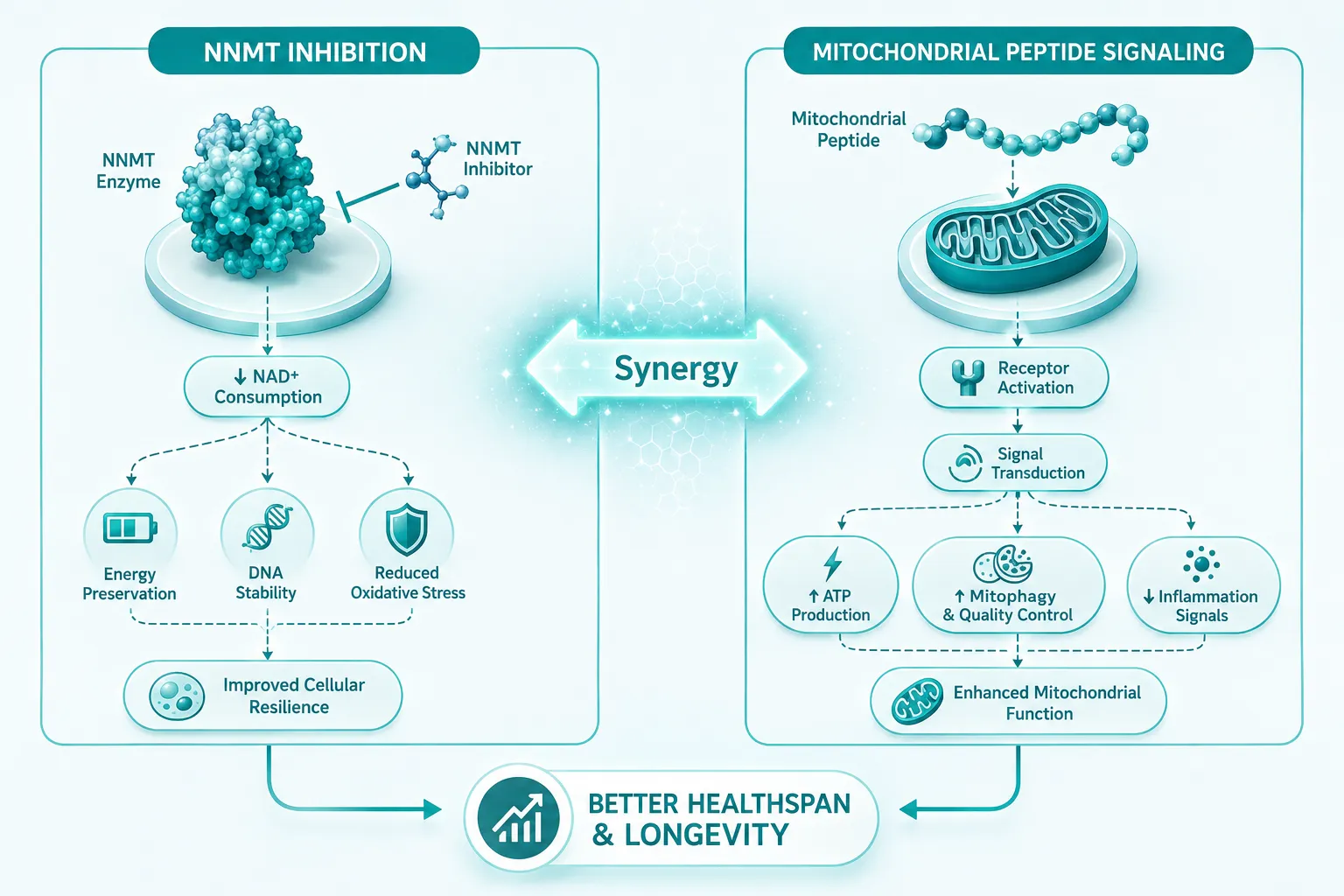
  • 5-Amino-1MQ inhibits NNMT, an enzyme linked to adipogenesis and reduced NAD+ availability, while MOTS-c is a mitochondrial peptide that activates AMPK and regulates glucose metabolism.
  • Researchers hypothesize that these two compounds may act on complementary, non-overlapping pathways, making combination testing scientifically rational.
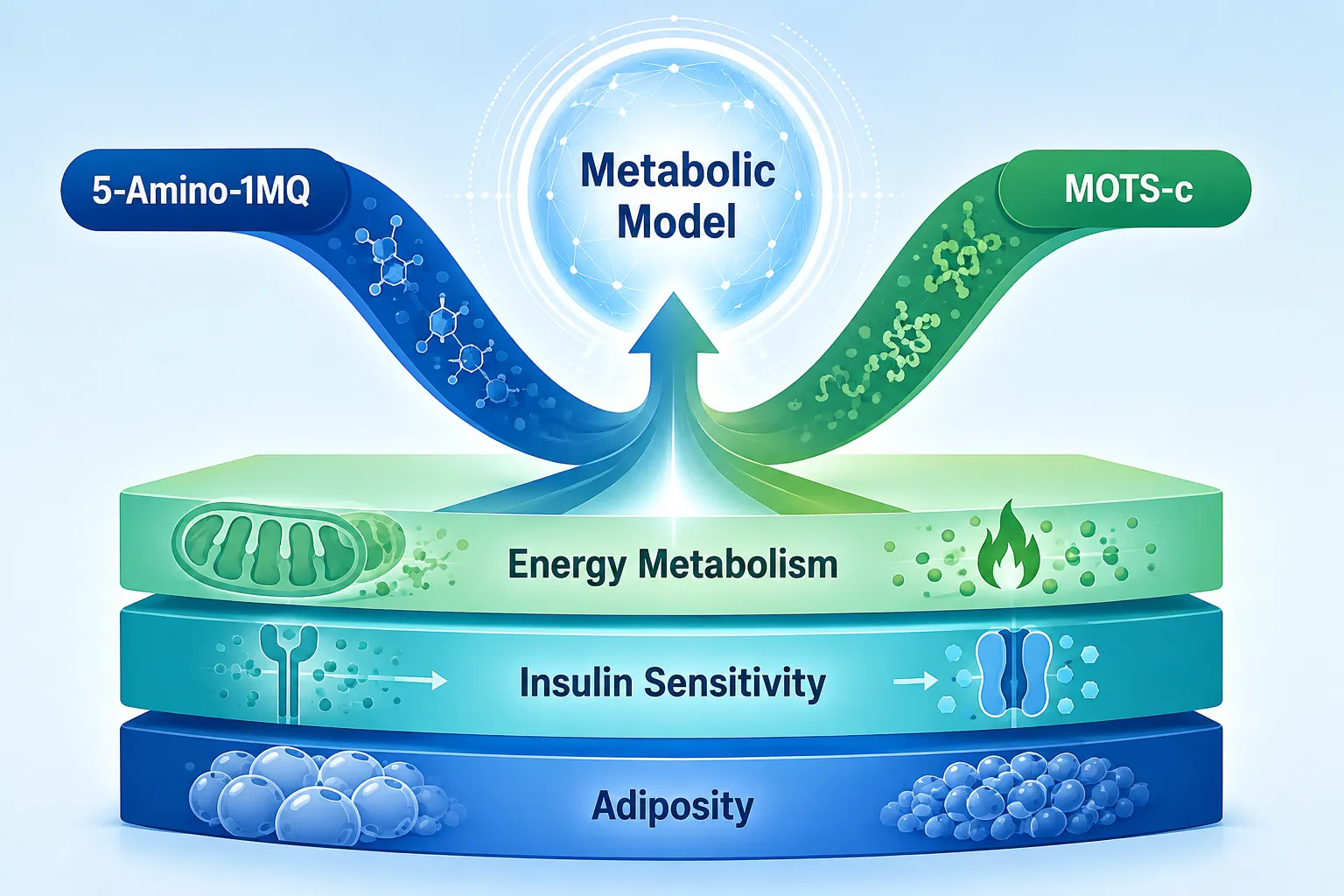
  • Preclinical metabolic models are being used to probe potential synergy across three domains: adiposity reduction, insulin sensitivity, and energy expenditure.
  • Synergy, in a research context, means an effect greater than the sum of each compound's individual contribution, not simply additive benefit.
  • No human clinical data on this combination exists as of 2026; all discussion reflects hypothesis-driven preclinical research.
Key Takeaways

Understanding the Two Compounds Before Testing Synergy

What 5-Amino-1MQ Does in Metabolic Pathways

5-Amino-1MQ (5-amino-1-methylquinolinium) is a selective inhibitor of nicotinamide N-methyltransferase (NNMT), an enzyme expressed heavily in adipose tissue. NNMT consumes S-adenosylmethionine (SAM) and converts nicotinamide into 1-methylnicotinamide. When NNMT is overactive, it depletes the methyl donor pool and reduces NAD+ precursor availability, two conditions associated with increased fat storage and impaired metabolic signaling.

By blocking NNMT, 5-Amino-1MQ is hypothesized to:

  • Restore SAM availability for epigenetic regulation
  • Increase NAD+ precursor flux, supporting sirtuin activity
  • Reduce adipocyte differentiation signals in vitro

For a deeper look at how this compound compares with classic mitochondrial pathway modulators, see the article on peptides and polypeptides in mitochondrial biology comparing MOTS-c and 5-Amino-1MQ.

What MOTS-c Does as a Mitochondrial Signal

MOTS-c is a 16-amino acid peptide encoded in the mitochondrial 12S rRNA. It functions as a retrograde signal, originating in mitochondria and traveling to the nucleus and cytoplasm to regulate gene expression. Its primary mechanism involves AMPK activation, which shifts cells toward fatty acid oxidation and glucose uptake.

Key research observations on MOTS-c include:

  • Improved insulin sensitivity in high-fat diet mouse models
  • Increased skeletal muscle glucose uptake independent of insulin
  • Translocation to the nucleus under metabolic stress, where it modifies gene expression

For a detailed comparison of MOTS-c with related mitochondrial peptides, the MOTS-c vs Humanin mitochondrial peptide comparison provides useful context.

The Mechanistic Case for 5-Amino-1MQ and MOTS-c Synergy in Metabolic Models

The central hypothesis is that these two compounds operate on distinct but converging nodes of metabolic regulation. 5-Amino-1MQ acts primarily at the epigenetic and substrate-availability level inside adipocytes. MOTS-c acts at the energy-sensing and glucose-uptake level, primarily in muscle and liver tissue.

This non-overlap is what makes the pairing scientifically interesting. Researchers are not testing two compounds that do the same thing, they are testing whether upstream epigenetic correction (via NNMT inhibition) combined with downstream mitochondrial energy signaling (via MOTS-c) produces effects that neither achieves independently.

Three core hypotheses under investigation:

  1. Adiposity hypothesis: NNMT inhibition reduces fat cell formation while MOTS-c increases fat oxidation in existing adipocytes, together, they may reduce fat mass more effectively than either alone.
  2. Insulin sensitivity hypothesis: 5-Amino-1MQ improves the intracellular environment for insulin signaling through SAM restoration; MOTS-c independently activates AMPK-driven glucose uptake. Combined, the effect on insulin sensitivity may be additive or synergistic.
  3. Energy expenditure hypothesis: NAD+ restoration from NNMT inhibition supports mitochondrial biogenesis; MOTS-c directly activates AMPK. Both pathways increase energy expenditure, but through different rate-limiting steps.

This kind of multi-node targeting parallels strategies seen in other metabolic research designs. The article on cagrilintide synergy with GLP-1 illustrates how combination approaches are being applied across metabolic peptide research more broadly.

The Mechanistic Case for 5-Amino-1MQ and MOTS-c Synergy in Metabolic Models

How Preclinical Models Are Designed to Test This Synergy

Model Selection and Endpoints

Most combination experiments in this space use diet-induced obesity (DIO) mouse models or db/db diabetic mice. These models allow researchers to measure:

Endpoint Relevance to Combination Hypothesis
Body fat percentage Tests adiposity hypothesis
Fasting glucose and HOMA-IR Tests insulin sensitivity hypothesis
Oxygen consumption rate Tests energy expenditure hypothesis
Adiponectin and leptin levels Tracks adipokine signaling changes

Researchers also use in vitro adipocyte and myocyte co-culture systems to isolate cell-specific effects before moving to whole-animal models.

Defining Synergy vs. Additivity

A critical methodological point: synergy is not the same as a combined effect. In pharmacology, synergy means the combined outcome exceeds what would be predicted by adding each compound's individual effect. Researchers use the Bliss independence model or Loewe additivity framework to distinguish true synergy from simple additivity.

This distinction matters enormously for interpreting results. If both compounds reduce fasting glucose by 15% individually, and the combination reduces it by 35%, that gap of 5% beyond simple addition is where synergy claims begin.

For broader context on how peptide-based compounds are evaluated alongside small molecules in metabolic research, the top 5 research peptides for metabolic health buyer's guide covers the landscape well.

Dosing and Timing Variables

Combination research also requires careful attention to:

  • Sequence of administration (simultaneous vs. staggered dosing)
  • Dose-response curves for each compound alone before testing combinations
  • Duration of exposure given MOTS-c's short half-life relative to 5-Amino-1MQ's small-molecule stability

These variables are not minor. The wrong dosing sequence could mask synergy or create apparent antagonism where none exists.

For additional perspective on how small molecules fit alongside peptide-based approaches in metabolic study design, see tesofensine, enclomiphene, and peptide-based approaches in metabolic research.
Dosing and Timing Variables

What Meaningful Synergy Would Indicate for Future Research

If preclinical models confirm synergy across even one of the three hypotheses above, the implications for research design are significant. It would suggest that:

  • Epigenetic-level interventions (NNMT inhibition) can potentiate the effects of mitochondrial signaling peptides
  • Tissue-specific targeting, adipose vs. muscle, may be more important than systemic pathway coverage
  • Combination metabolic research deserves dedicated study arms rather than being treated as an afterthought

It would also raise new questions about optimal ratios, timing, and whether the synergy holds in aged or insulin-resistant models differently than in lean models. Researchers studying adjacent combination strategies, such as those reviewed in polypeptide peptides in cardiometabolic models, face similar interpretive challenges.

Conclusion

The scientific rationale for testing 5-Amino-1MQ and MOTS-c synergy: what combination research is trying to test in metabolic models is mechanistically sound. These two compounds address metabolic dysfunction through non-overlapping pathways, one at the epigenetic and substrate level, the other at the mitochondrial energy-sensing level. That complementarity is exactly what makes combination testing worthwhile.

Actionable next steps for researchers and research readers:

  • Review existing single-compound dose-response data for both 5-Amino-1MQ and MOTS-c before interpreting combination results
  • Apply formal synergy frameworks (Bliss or Loewe) rather than assuming combined effects equal synergy
  • Track endpoint specificity, adiposity, insulin sensitivity, and energy expenditure may respond differently to the combination
  • Monitor peer-reviewed literature from 2026 onward as DIO model data from combination arms begins to emerge

This is hypothesis-driven science at an early stage. The value lies not in premature conclusions, but in the quality of the questions being asked.

Tags: 5-amino-1mq, adiposity, ampk activation, combination research, energy metabolism, insulin sensitivity, metabolic research, mitochondrial peptides, mots-c, nnmt inhibitor, peptide synergy, preclinical models
https://www.puretestedpeptides.com/wp-content/uploads/2026/08/5-amino-1mq-and-mots-c-synergy-what-combination-research-is-trying-to-test-in-me.webp 1024 1536 https://www.puretestedpeptides.com/wp-content/uploads/2026/01/buy-peptides-online.jpg 2026-08-11 13:05:042026-08-11 13:05:045-Amino-1MQ and MOTS-c Synergy: What Combination Research Is Trying to Test in Metabolic Models
You might also like
Where to Buy Research-Grade MOTS‑c and 5‑Amino‑1MQ: Quality Criteria for Mitochondrial Peptide Studies Where to Buy Research-Grade MOTS‑c and 5‑Amino‑1MQ: Quality Criteria for Mitochondrial Peptide Studies
Tesofensine, Enclomiphene, and Peptide-Based Approaches: How Small Molecules Fit Alongside GLP-3 and GH Secretagogues in Metabolic Research Tesofensine, Enclomiphene, and Peptide-Based Approaches: How Small Molecules Fit Alongside GLP-3 and GH Secretagogues in Metabolic Research
Tesofensine and Metabolic Research: How a Noradrenergic Appetite Modulator Compares With GLP‑3 Peptides in Study Design Tesofensine and Metabolic Research: How a Noradrenergic Appetite Modulator Compares With GLP‑3 Peptides in Study Design
Peptides Mechanism 101: From GLP‑3 Retatrutide to CJC‑1295 and MOTS‑c in Cellular and Receptor-Level Research Peptides Mechanism 101: From GLP‑3 Retatrutide to CJC‑1295 and MOTS‑c in Cellular and Receptor-Level Research
Peptides 101 for Research-Use Only Buyers: Structure, Mechanisms, and Where GLP-3, MOTS-c, and 5-Amino-1MQ Fit In Peptides 101 for Research-Use Only Buyers: Structure, Mechanisms, and Where GLP-3, MOTS-c, and 5-Amino-1MQ Fit In
DNA, Mitochondria, and Research Peptides: How MOTS-c and 5-Amino-1MQ Interface With Cellular Energy and Genomic Pathways DNA, Mitochondria, and Research Peptides: How MOTS-c and 5-Amino-1MQ Interface With Cellular Energy and Genomic Pathways
Peptides and Polypeptides Explained: Connecting DNA, Mitochondria, and Modern Research-Use Compounds Like MOTS-c and 5-Amino-1MQ Peptides and Polypeptides Explained: Connecting DNA, Mitochondria, and Modern Research-Use Compounds Like MOTS-c and 5-Amino-1MQ
Tesofensine: Mechanism, Appetite Pathways, and Research Use in Metabolic Studies Tesofensine: Mechanism, Appetite Pathways, and Research Use in Metabolic Studies
0 replies

Leave a Reply

Want to join the discussion?
Feel free to contribute!

Leave a Reply Cancel reply

Your email address will not be published. Required fields are marked *

×

Helpful Links

  • My account
  • Cart
  • Checkout
  • Refund and Returns Policy
  • Privacy Policy
  • SMS Privacy Policy
  • Login
  • My Account
  • Logout

USA Made Lab Tested Peptides

All products are sold for research, laboratory, or analytical purposes only, and are not for human consumption


Pure Tested Peptides is a chemical supplier. Pure Tested Peptides is not a compounding / chemical compounding facility as defined under 503A of the Federal Food, Drug, and Cosmetic act. Pure Tested Peptides is not an outsourcing facility as defined under 503B of the Federal Food, Drug, and Cosmetic act.

The statements made within this website have not been evaluated by the US Food and Drug Administration. The products we offer are not intended to diagnose, treat, cure or prevent any disease.

Human/Animal Consumption Prohibited. Laboratory/In-Vitro Experimental Use Only

Link to: GLP-2-T vs GLP2 Tirz Peptide: What the Naming Means and Why Researchers Confuse Them Link to: GLP-2-T vs GLP2 Tirz Peptide: What the Naming Means and Why Researchers Confuse Them GLP-2-T vs GLP2 Tirz Peptide: What the Naming Means and Why Researchers Confuse...GLP-2-T vs GLP2 Tirz Peptide: What the Naming Means and Why Researchers Confuse Them Link to: Selank vs Semax: Which Nootropic Peptide Is Better Suited to Different Research Questions? Link to: Selank vs Semax: Which Nootropic Peptide Is Better Suited to Different Research Questions? Selank vs Semax: Which Nootropic Peptide Is Better Suited to Different Research Questions?Selank vs Semax: Which Nootropic Peptide Is Better Suited to Different Research...
Scroll to top Scroll to top Scroll to top