

5-Amino-1MQ and MOTS-c in Adipocyte Models: Separating Lipolysis, Mitochondrial Stress, and Viability Effects
Researchers who conflate lipolysis with mitochondrial reprogramming routinely misinterpret their own adipocyte data, and the growing interest in 5-Amino-1MQ and MOTS-c in adipocyte models makes that confusion increasingly costly. As of 2026, neither compound fits neatly into a single mechanistic box, and the experimental readouts used to study them are not interchangeable. Properly separating lipolysis, mitochondrial stress, and viability effects requires deliberate assay design from the start.
Key Takeaways
- 5-Amino-1MQ targets NNMT to shift NAD+ metabolism and suppress lipogenesis; it is not a classical lipolytic agent.
- MOTS-c is a mitochondria-derived peptide that drives AMPK-dependent metabolic adaptation, with mitohormesis, not lipolysis, as its primary mechanism.
- Mitochondrial oxygen consumption rate (OCR) data for 5-Amino-1MQ reflects increased metabolic work, not canonical mitochondrial stress.
- Both compounds show pro-homeostatic profiles in preclinical adipocyte models, with no reported cytotoxicity at studied concentrations.
- No published study has combined 5-Amino-1MQ and MOTS-c in an adipocyte model; any synergy claims remain speculative.
How 5-Amino-1MQ Rewires Adipocyte Metabolism
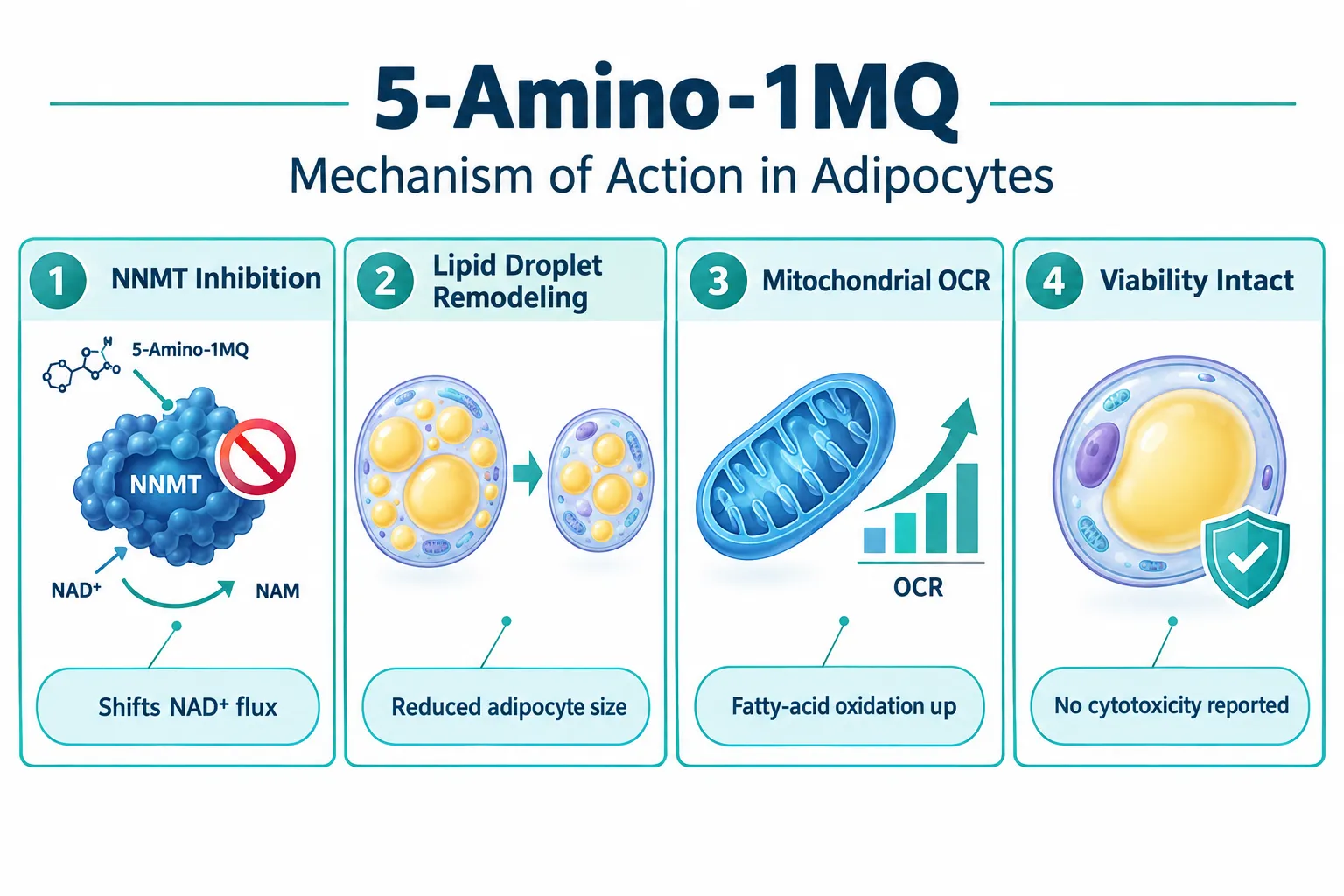
The central target of 5-Amino-1MQ is nicotinamide N-methyltransferase (NNMT), an enzyme that consumes S-adenosylmethionine and diverts nicotinamide away from NAD+ synthesis. By inhibiting NNMT, 5-Amino-1MQ effectively redirects the cell's methyl-group economy and elevates intracellular NAD+ availability. This is an enzymatic metabolic reprogramming event, not a signal to release stored triglycerides.
Preclinical data show that treated animals exhibit reduced adipose mass and smaller individual adipocyte size without changes in food intake. That pattern points to a metabolic shift in how fat cells handle energy, rather than appetite suppression or direct triglyceride hydrolysis. Researchers measuring glycerol or free fatty acid (FFA) release as a primary endpoint may therefore underestimate the compound's effect, or worse, interpret a modest lipolysis signal as a negative result.
What the OCR data actually shows: Elevated oxygen consumption rate and increased fatty-acid oxidation in 5-Amino-1MQ-treated adipocytes indicate that mitochondria are working harder, but current data do not show canonical mitochondrial stress markers such as elevated reactive oxygen species (ROS) beyond adaptive thresholds, membrane potential collapse, or cytochrome c release. The distinction matters enormously for assay selection.
| Endpoint | Expected Signal with 5-Amino-1MQ | Assay Tool |
|---|---|---|
| NNMT activity | Decreased | Enzyme activity assay |
| NAD+/NADH ratio | Increased | LC-MS or fluorescent probe |
| Lipolysis (glycerol/FFA) | Modest or absent | Colorimetric kit |
| Mitochondrial OCR | Elevated | Seahorse XF analyzer |
| Adipocyte viability | Unchanged at studied doses | MTT / LDH assay |
MOTS-c Signaling in Adipocytes: Mitohormesis, Not Lipolysis
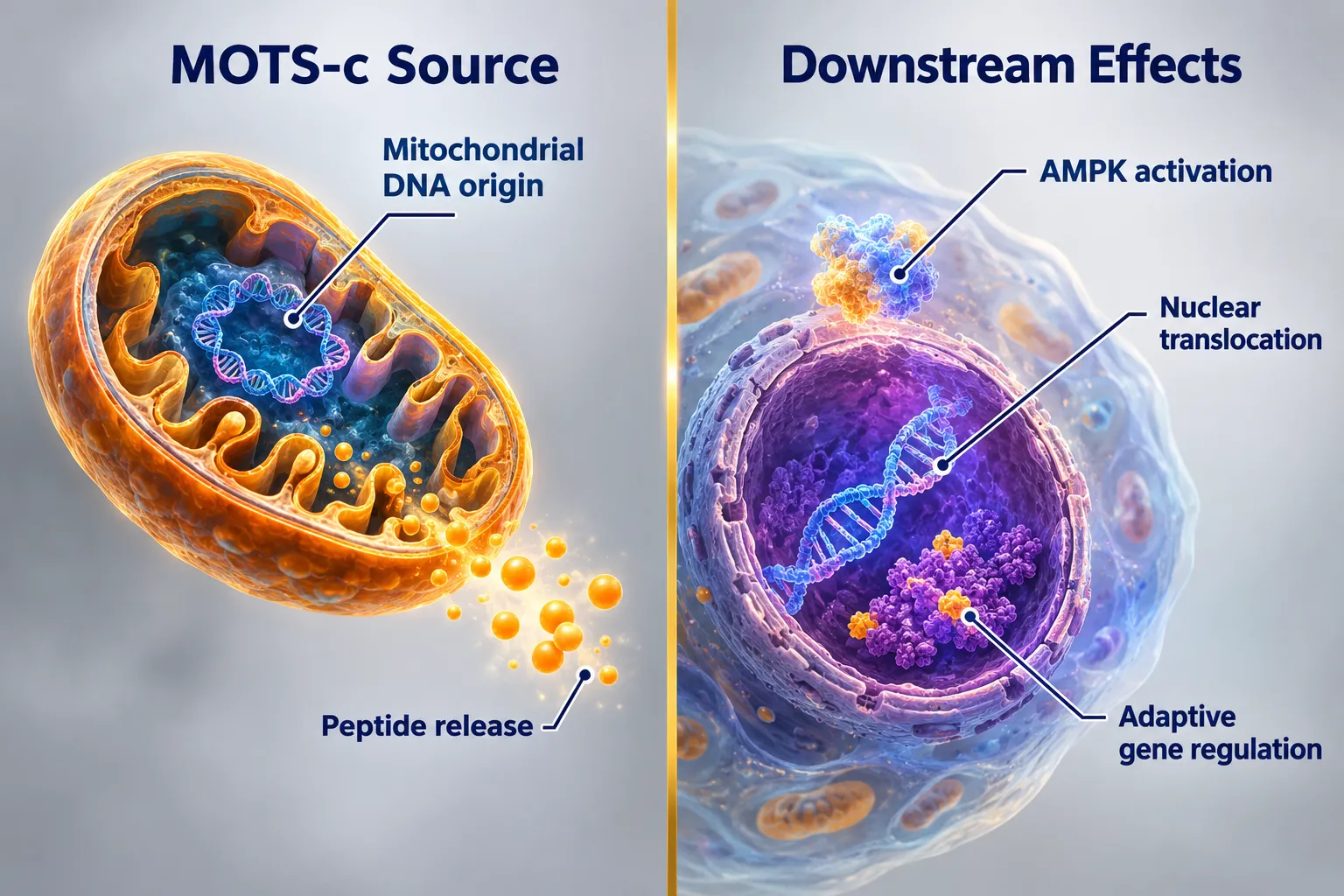
MOTS-c peptide is encoded within mitochondrial DNA and released as a peptide that acts in both autocrine and endocrine fashions. Its primary mechanism involves AMPK activation, which improves glucose uptake and fatty-acid oxidation in skeletal muscle and adipose tissue. Critically, MOTS-c also undergoes nuclear translocation under metabolic stress, where it regulates adaptive gene expression programs, a hallmark of mitohormetic signaling.
Mitohormesis refers to a process in which a low-grade mitochondrial stress signal triggers a net-beneficial adaptive response. This is mechanistically distinct from the kind of mitochondrial dysfunction that researchers typically flag as a liability in cytotoxicity studies. When evaluating MOTS-c in an adipocyte model, the relevant readouts are:
- AMPK phosphorylation status
- Mitochondrial biogenesis markers (PGC-1alpha, TFAM)
- Glucose transporter expression
- Fatty-acid oxidation gene panels
- Nuclear localization of MOTS-c itself
Classical lipolysis assays (glycerol release, hormone-sensitive lipase activity) are not the primary endpoints for MOTS-c research. Researchers who apply these assays without complementary mitochondrial readouts will generate incomplete, and potentially misleading, concentration-response curves.
Research into mitochondria-targeted peptides more broadly, including SS-31 mitochondrial research themes, reinforces the principle that mitochondrial protective signaling and lipolysis occupy separate mechanistic lanes that require separate assay strategies.
Designing Adipocyte Assays That Separate All Three Endpoints
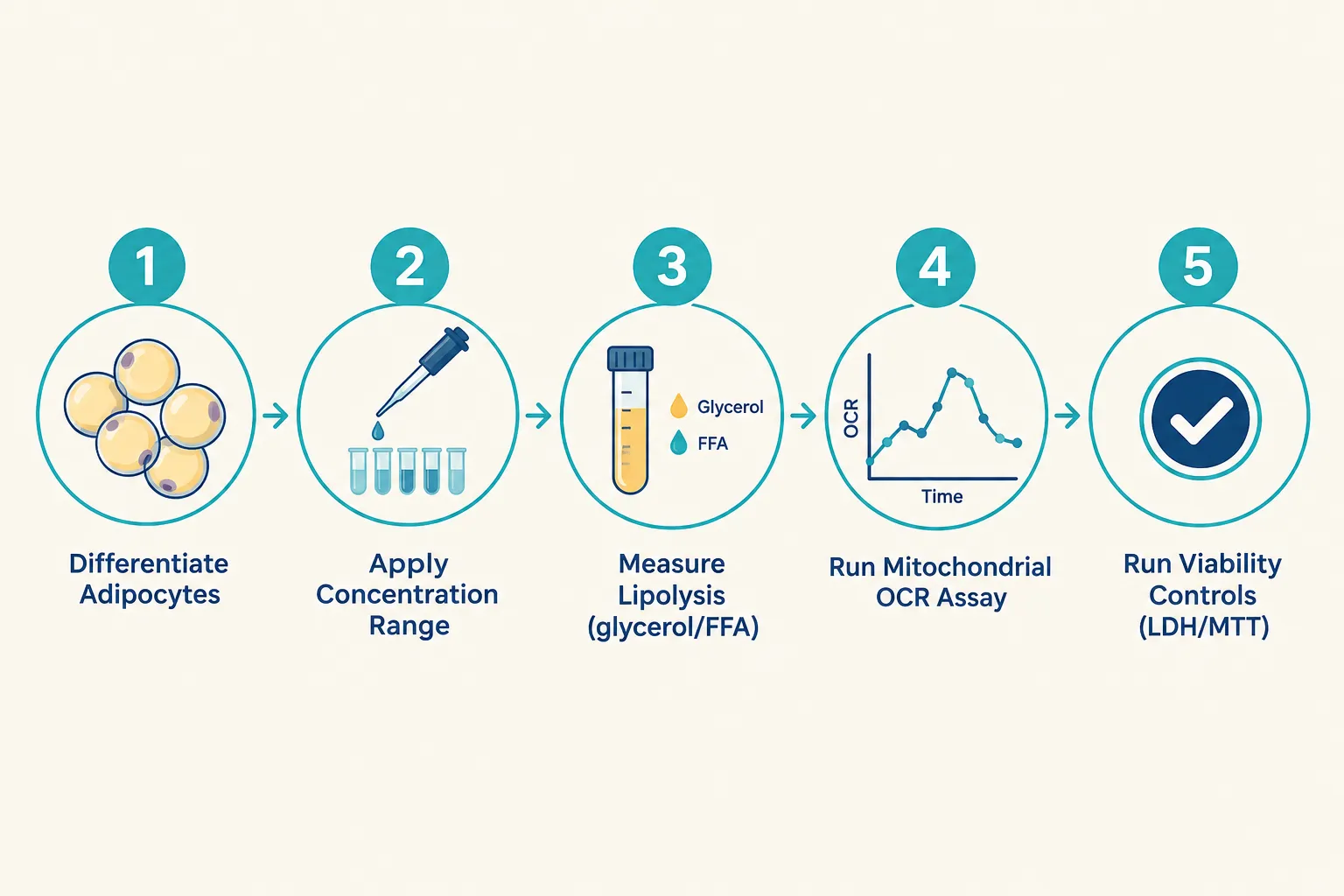
The core challenge when studying 5-Amino-1MQ and MOTS-c in adipocyte models, separating lipolysis, mitochondrial stress, and viability effects, is that standard adipocyte assay panels are rarely built to distinguish all three axes simultaneously. The following framework addresses that gap.
Step 1: Cell model selection. 3T3-L1 cells differentiated to mature adipocytes remain the workhorse model, but primary human preadipocytes differentiated in vitro offer better translational relevance for metabolic endpoints. Confirm full lipid droplet formation before treatment.
Step 2: Concentration-response design. Use at least five concentrations spanning two orders of magnitude. A single concentration cannot distinguish a true metabolic effect from a cytotoxicity artifact.
Step 3: Run lipolysis and mitochondrial assays in parallel, not sequentially. Glycerol/FFA release assays should run alongside Seahorse OCR measurements on the same passage and differentiation batch. Temporal offsets between batches introduce confounders.
Step 4: Apply orthogonal viability controls. LDH release (membrane integrity), MTT reduction (mitochondrial dehydrogenase activity), and Annexin V/PI staining (apoptosis/necrosis) each capture a different failure mode. MTT alone is insufficient when the compound of interest alters mitochondrial activity, a known confounder for both 5-Amino-1MQ and MOTS-c.
"Mitochondrial dehydrogenase-based viability assays can produce false positives or false negatives when the compound under study directly modulates mitochondrial respiration. Always pair MTT with an orthogonal membrane-integrity readout."
Step 5: Separate adaptive from pathological mitochondrial signals. Elevated ROS measured at a single time point does not confirm mitochondrial stress. Pair ROS data with mitochondrial membrane potential (JC-1 or TMRE) and ATP production rate. A compound that raises OCR and ATP output while maintaining membrane potential is driving productive work, not damage.
This multi-axis approach is especially important given that SS-31 peptide research has demonstrated how easily mitochondria-targeted compounds are misclassified when assay panels are too narrow.
Researchers planning metabolic peptide studies may also find value in reviewing CJC-1295 Ipamorelin assay planning and sourcing as a reference for structured experimental checklists.
For those exploring the broader landscape of metabolic peptides in adipose-related research, resources on what is the strongest peptide for weight loss provide useful context on how different compound classes are categorized.
Conclusion
Studying 5-Amino-1MQ and MOTS-c in adipocyte models demands more than a standard lipolysis panel. The actionable steps for researchers in 2026 are clear:
- Treat lipolysis, mitochondrial function, and viability as three independent axes, design assays that measure each one directly rather than inferring one from another.
- Interpret OCR increases for 5-Amino-1MQ as evidence of metabolic reprogramming, not mitochondrial stress, unless accompanied by membrane potential collapse or cytochrome c release.
- Apply AMPK and nuclear translocation readouts for MOTS-c rather than defaulting to glycerol release as the primary endpoint.
- Always include orthogonal viability controls, LDH plus MTT plus apoptosis staining, particularly when the compound modulates mitochondrial dehydrogenase activity.
- Treat any combined 5-Amino-1MQ and MOTS-c protocol as exploratory until published adipocyte combination data exist; design those studies to detect additive, synergistic, and antagonistic outcomes with equal rigor.
Rigorous endpoint separation is not a procedural formality. It is the difference between data that advances mechanistic understanding and data that produces another ambiguous result in an already crowded field.


Leave a Reply
Want to join the discussion?Feel free to contribute!