Call or Text 727-513-9780
  • Shopping Cart Shopping Cart
    0Shopping Cart
Pure Tested Peptides | America's most trusted Peptides for sale online
  • Peptides for sale
    • Oral Peptides for sale
      • Peptide Capsules for sale
      • BPC 157 Capsules 1000mcg
      • SLU-PP-332 Capsules | 1000 mcg
      • 5-Amino-1MQ 50mg Capsules
      • Tesofensine 500mcg
    • All Peptides for sale
    • Peptide Sprays
      • BPC 157 Nasal Spray Kit
      • BPC-157 TB500 Nasal Spray Kit
      • Semax Nasal Spray 10mg
      • Selank – Nasal Spray Kit – 10mg
      • Epithalon 50MG Nasal Spray Kit
      • Ipamorelin 10mg Nasal Spray
      • Klow Nasal Spray (BPC-157 + TB-500 + GHK-Cu + KPV) | 80mg
      • Hulk Nasal Spray Tesa / Ipa Blend 6/3 MG
      • Klow Nasal Spray
      • NAD + 500 mg Nasal Spray
      • PT-141 Nasal Spray Kit
    • GHRH Peptides
      • Ipa Peptides
      • CJC-1295 Peptides
        • CJC-1295 with DAC 5 mg
        • CJC-1295 without DAC 5 mg
        • CJC-1295 Ipa 10mg
      • Tesa Peptides
        • Tesa Peptide
        • Tesa 20 mg
    • GHK-Cu Peptides
      • All GHK-Cu Peptides
      • GHK-Cu 100mg
      • KLOW Peptide Blend – Buy KLOW blend online
    • BPC Peptides
      • All BPC Peptides
      • BPC-157
      • BPC-157 TB-500
      • BPC 157 capsules 1000mcg
    • SLU-PP-332 Peptides
      • All SLU-PP-332 Peptides
      • SLU-PP-332 5mg
    • GLP3 Peptides
    • PT-141 Peptides
      • PT-141 Peptides for sale
      • PT-141 10mg
      • PT-141 Nasal Spray
    • CAG Peptides
      • Lipo-C Peptide Blend
      • CAG 5mg
      • CAG 10mg
    • MOTS-C Peptides
      • MOTS-C Peptides for sale
      • MOTS-c peptide
      • MOTS-c 10mg *6 pack*
    • 5 Amino 1MQ Peptides
      • 5 Amino 1MQ Peptides for sale
      • 5-Amino-1MQ 50mg Capsules
      • 5-Amino-1MQ 5mg
    • Epithalon Peptides
      • Epithalon Peptides for sale
      • Epithalon 10mg
      • Epithalon 50mg
  • Shop
    • GLPs
      • 5-Amino-1MQ 50mg Capsules
      • 5-Amino-1MQ 5mg
      • L-Carnitine 500mg/ml
      • Tesofensine 500mcg
      • SLU-PP-332 5mg
      • MOTS-c 10mg *6 pack*
    • Epithalon & BPC Peptides
      • Epithalon 10mg
      • Epithalon 50mg
      • BPC-157
      • BPC 157 capsules 1000mcg
      • BPC-157 TB-500
      • BPC-157 TB500 Nasal Spray Kit
      • BPC 157 Nasal Spray Kit
    • BPC TB-500 & NAD+ Peptides
      • NAD+ 500 mg
      • KLOW Peptide Blend – Buy KLOW blend online
      • GLOW Peptide Blend
      • TB 500 5mg
      • BPC 157 capsules 1000mcg – Supplement
      • BPC 157 Nasal Spray Kit
      • BPC-157
      • BPC-157 TB500 Nasal Spray Kit
      • BPC-157 TB-500
      • BPC 157 capsules 1000mcg
    • LL-37 Peptide
      • LL-37 10 mg
    • MOTS-C & Selank
      • MOTS-c peptide
      • Selank 10mg
    • GHK Peptides
      • GHK-Cu 100mg
      • GLOW Peptide Blend
      • KLOW Peptide Blend – Buy KLOW blend online
  • COAs
  • Wholesale
    • Wholesale Peptides for sale
  • PTP FAQ
  • Affiliates
    • Selank Peptide: Advanced Pharmacological Mechanisms Underlying Its Anxiolytic and Nootropic Effects in Research
      • 5-Amino-1MQ Peptide: Detailed Mechanisms of NNMT Inhibition and Its Impact on Cellular Metabolism Research
        • MOTS-C Peptide: Unraveling Its Role in Mitochondrial Dynamics and Energy Metabolism Research
          • Epithalon Peptide and Telomerase Regulation: Investigating Its Impact on Cellular Senescence and Lifespan Research Models
            • GLP2-T vs GLP2 Tirz Peptide: Understanding the Naming, Mechanistic Nuances, and Research Implications for Gut Health
      • Peptides and Polypeptides in Modern Pharmacology: What Research on Metoprolol, Prednisone, and Amlodipine Reveals
        • Polypeptide Peptides vs NSAIDs: What Naproxen and Diclofenac Teach Tissue-Repair Researchers About BPC‑157 and TB‑500
          • Peptides and Polypeptides in Endocrine Pharmacology: How GLP-1, GLP-2, and GLP-3 Retatrutide Differ From Classic Drugs Like Prednisone and Amlodipine
          • 5‑Amino‑1MQ Peptide and NNMT Inhibition: How It Compares With Statins Like Atorvastatin in Adipose and Lipid Metabolism Research
      • Enclomiphene, Estrogen Receptor Signaling, and Luteinizing Phase Biology: What Hormone Researchers Should Measure
        • Mesenchymal Stem Cells, BPC‑157, and GHK‑Cu: How Tissue Repair Peptides Compare With Classic NSAIDs Like Naproxen in Injury Models
          • Peptide Calculator Use Cases Beyond Growth Hormone: Working Through GLP‑3 Retatrutide, MOTS‑c, and BPC‑157 Research Dosing
        • Polypeptide Peptides in Endocrine and Metabolic Pharmacology: Lessons From Amlodipine, Prednisone, and Metoprolol
        • Peptides Calculator for Advanced Blends: Worked Examples for Tesamorelin, CJC‑1295, and Ipamorelin Stacks
          • Peptides and Polypeptides in Human Physiology: How Molecular Size Shapes Research Applications
            • Selank Peptide: Advanced Pharmacological Mechanisms Underlying Its Anxiolytic and Nootropic Effects in Research
          • 5-Amino-1MQ Peptide: Detailed Mechanisms of NNMT Inhibition and Its Impact on Cellular Metabolism Research
            • MOTS-C Peptide: Unraveling Its Role in Mitochondrial Dynamics and Energy Metabolism Research
              • Epithalon Peptide and Telomerase Regulation: Investigating Its Impact on Cellular Senescence and Lifespan Research Models
                • GLP2-T vs GLP2 Tirz Peptide: Understanding the Naming, Mechanistic Nuances, and Research Implications for Gut Health
                  • Peptides and Polypeptides in Endocrine Pharmacology: How GLP-1, GLP-2, and GLP-3 Retatrutide Differ From Classic Drugs Like Prednisone and Amlodipine
                    • Polypeptide Peptides vs NSAIDs: What Naproxen and Diclofenac Teach Tissue-Repair Researchers About BPC‑157 and TB‑500
                      • Peptides and Polypeptides in Modern Pharmacology: What Research on Metoprolol, Prednisone, and Amlodipine Reveals
                        • 5‑Amino‑1MQ Peptide and NNMT Inhibition: How It Compares With Statins Like Atorvastatin in Adipose and Lipid Metabolism Research
                        • Enclomiphene, Estrogen Receptor Signaling, and Luteinizing Phase Biology: What Hormone Researchers Should Measure
                        • Mesenchymal Stem Cells, BPC‑157, and GHK‑Cu: How Tissue Repair Peptides Compare With Classic NSAIDs Like Naproxen in Injury Models
                        • Peptide Calculator Use Cases Beyond Growth Hormone: Working Through GLP‑3 Retatrutide, MOTS‑c, and BPC‑157 Research Dosing
                        • Polypeptide Peptides in Endocrine and Metabolic Pharmacology: Lessons From Amlodipine, Prednisone, and Metoprolol
                        • Peptides Calculator for Advanced Blends: Worked Examples for Tesamorelin, CJC‑1295, and Ipamorelin Stacks
                        • Peptides and Polypeptides in Human Physiology: How Molecular Size Shapes Research Applications
                        • Selank Peptide: Advanced Pharmacological Mechanisms Underlying Its Anxiolytic and Nootropic Effects in Research
                        • MOTS-C Peptide: Unraveling Its Role in Mitochondrial Dynamics and Energy Metabolism Research
                        • Peptides and Polypeptides in Modern Pharmacology: What Research on Metoprolol, Prednisone, and Amlodipine Reveals
                        • Peptides and Polypeptides in Endocrine Pharmacology: How GLP-1, GLP-2, and GLP-3 Retatrutide Differ From Classic Drugs Like Prednisone and Amlodipine
                        • 5-Amino-1MQ Peptide: Detailed Mechanisms of NNMT Inhibition and Its Impact on Cellular Metabolism Research
                        • Mesenchymal Stem Cells, BPC‑157, and GHK‑Cu: How Tissue Repair Peptides Compare With Classic NSAIDs Like Naproxen in Injury Models
                        • Peptide Calculator Use Cases Beyond Growth Hormone: Working Through GLP‑3 Retatrutide, MOTS‑c, and BPC‑157 Research Dosing
                        • GLP2-T vs GLP2 Tirz Peptide: Understanding the Naming, Mechanistic Nuances, and Research Implications for Gut Health
                        • Polypeptide Peptides in Endocrine and Metabolic Pharmacology: Lessons From Amlodipine, Prednisone, and Metoprolol
                        • Polypeptide Peptides vs NSAIDs: What Naproxen and Diclofenac Teach Tissue-Repair Researchers About BPC‑157 and TB‑500
                        • Peptides and Polypeptides in Human Physiology: How Molecular Size Shapes Research Applications
                        • Peptides Calculator for Advanced Blends: Worked Examples for Tesamorelin, CJC‑1295, and Ipamorelin Stacks
                        • 5‑Amino‑1MQ Peptide and NNMT Inhibition: How It Compares With Statins Like Atorvastatin in Adipose and Lipid Metabolism Research
                        • Enclomiphene, Estrogen Receptor Signaling, and Luteinizing Phase Biology: What Hormone Researchers Should Measure
                        • Epithalon Peptide and Telomerase Regulation: Investigating Its Impact on Cellular Senescence and Lifespan Research Models
                        • Best research protocol Klow blend
                        • best time to take BPC-157
                        • best time to take DSIP (Delta Sleep Inducing Peptide)
                        • best time to take CJC-1295
                        • best time to take AOD-9604
                        • best time to take Follistatin 344
                        • best time to take Ipamorelin
                        • best time to take MK-677 (Ibutamoren)
                        • best time to take Ligandrol (LGD-4033) — research compound
                        • best time to take Ostarine (MK-2866) — research compound
                        • best time to take GHK-CU
                        • best time to take TB-500
                        • best time to take MOTS-c
                        • best time to take Semax
                        • best time to take RAD-140 (Testolone) — research compound
                        • best time to take Thymosin Alpha-1
                        • best time to take PEG-MGF
                        • Biolife Plasma, Octapharma Plasma, and Research Peptides: How Plasma Donation Labs Differ From Peptide Suppliers
                        • best time to take YK-11 — research compound
                        • best time to take PT-141 (Bremelanotide)
                        • Best research protocol Klow blend
                        • 5-Amino-1MQ and MOTS-C Synergy: Metabolic Signaling, Mitochondria, and Research Design
                        • BPC-157 and TB-500: Investigating Their Combined Effects on Angiogenesis and Cellular Migration in Tissue Repair Models
                        • BPC-157 Peptide: Gut Barrier Function, Inflammation, and Tissue-Recovery Research
                        • 5‑Amino‑1MQ and MOTS‑c Synergy in Metabolic Research: Designing NNMT and Mitochondrial Biogenesis Stacks
                        • CJC-1295 with DAC vs. Without DAC: Half-Life, Release Kinetics, and Research Implications
                        • CJC‑1295 with DAC vs. Without DAC: Expanding on Half‑Life Differences Using Tesamorelin and Ipamorelin Blend Case Studies
                        • Collagen Biology and Copper‑Binding Peptides: How GHK‑Cu, Glow Blend, and Klow Blend Interact with Skin and Connective Tissue
                        • Collagen Biology and Regenerative Peptides: How GHK‑Cu, Glow Blend, and Klow Blend Affect Extracellular Matrix Research
                    • DNA, Telomeres, and Longevity Peptides: Positioning Epithalon and MOTS‑c in Genetic Aging Research
                      • Enclomiphene Citrate: serm Mechanism, Testosterone Research, and Stack Compatibility
                        • Enclomiphene vs Enclomiphene Citrate: Formulation, Bioavailability, and Research Distinctions
                        • Epithalon Peptide Research: Telomerase Activation, Aging, and Pineal Gland Function
                        • Estrogen Receptor Signaling and Enclomiphene: How Selective Modulators Compare with Classic Polypeptide Hormones
                        • GHK-Cu Peptide: Advanced Mechanisms in Extracellular Matrix Remodeling and Wound Healing Research
                        • GHK-Cu Peptide: Collagen Synthesis, Wound Repair, and Skin-Barrier Research Models
                        • GLP-1 vs GLP-3 vs GLP-2: Peptide Classification and Research Applications
                        • GLP-2 Peptide Research Guide: Gut Barrier Function, Nutrient Absorption, and Intestinal Recovery Models
                        • GLP-3 Retatrutide vs. GLP-1 Drugs: What Triple-Agonist Biology Changes in Research Models
                        • Ipamorelin and Tesamorelin Combination: Synergistic GH Secretagogue Research and Dosing Protocols
                        • GLP2 Tirz Peptide: What It Is, Why the Name Exists, and How Researchers Should Interpret It
                        • Klow Blend Peptide Nasal Spray: What the Formulation Is Trying to Do in Cognitive Research
                        • Mitochondria, NNMT Inhibition, and Peptide Modulators: Where MOTS‑c and 5‑Amino‑1MQ Fit in Cellular Energy Research
                        • MOTS-c Peptide: Mitochondrial Function, Energy Metabolism, and What Researchers Measure
                        • MOTS-c vs. 5-Amino-1MQ: Which Metabolic Research Questions Each Compound Actually Answers
                        • Nasal Spray Peptides: Bioavailability, Administration, and Semax/Selank Research Applications
                        • PT-141 Peptide Research: Mechanism of Action and Melanocortin Receptor Signaling
                        • Retatrutide for Research: Mechanism, Structure, and GLP-1/GLP-3 Dual Action
                        • Retatrutide for Obesity and Type 2 Diabetes: What the Latest Trial Data Suggest
                        • Tesofensine Peptide Research: Mechanism, Appetite Suppression, and Neuropeptide Y Pathways
  • Contact
    • Contact Customer Service
    • Text Customer Support
  • About US
  • Shop all peptides
  • Affiliate Program
    • Affiliate Signup
  • Login / Register Login / Register Page Link Login / Register Page Link
  • Click to open the search input field Click to open the search input field Search
  • Menu Menu

Tag Archive for: compound stability

Enclomiphene Citrate vs Enclomiphene: Stability, Storage, and Research Handling

Enclomiphene Citrate vs Enclomiphene: Stability, Storage, and Research Handling

September 15, 2026/0 Comments/in Uncategorized/by

Most researchers who order enclomiphene for laboratory work assume the citrate salt and the free base are the same compound with a different label. That assumption can compromise data, shorten shelf life, and introduce variables that are difficult to trace back to the source material. Understanding the distinctions in Enclomiphene Citrate vs Enclomiphene: Stability, Storage, and Research Handling is not a minor technical footnote, it is foundational to reproducible science.

Key Takeaways

  • Enclomiphene citrate is a salt form of enclomiphene; the citrate counterion meaningfully changes solubility, crystalline stability, and handling requirements.
  • Research-grade powder in either form is significantly more stable than aqueous or organic solutions, which degrade faster under ambient conditions.
  • Both forms are sensitive to light, moisture, and heat; amber vials, desiccants, and cold storage are non-negotiable for long-term integrity.
  • Finished formulations such as capsules and liquid suspensions show acceptable stability at or below 25 °C when properly packaged.
  • Vendor quality documentation, including certificates of analysis and HPLC purity data, is a critical checkpoint before any research use.

What the Citrate Salt Actually Changes
What the Citrate Salt Actually Changes

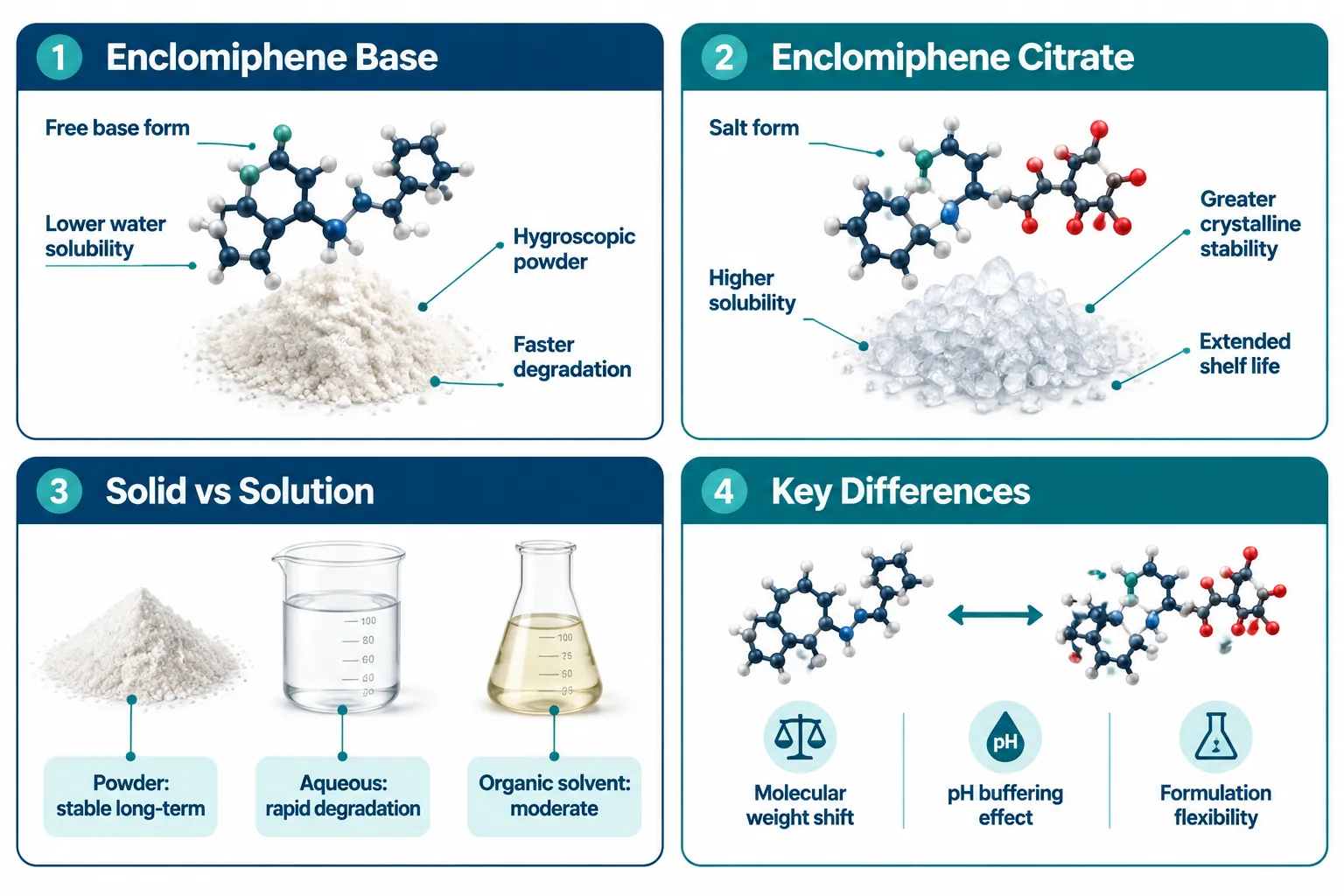
Enclomiphene is the trans-isomer of clomiphene, a selective estrogen receptor modulator with growing research interest in male reproductive endocrinology. When enclomiphene is converted to its citrate salt, a citric acid molecule pairs ionically with the enclomiphene base. This is not a cosmetic change.

The citrate counterion delivers three practical advantages:

Property Enclomiphene (Free Base) Enclomiphene Citrate
Water solubility Low Moderately higher
Crystalline stability Moderate Greater
Formulation flexibility Limited Broader
Hygroscopicity High Reduced

The increased water solubility of the citrate form matters when preparing stock solutions for in vitro work. The free base requires organic solvents such as DMSO or ethanol to dissolve reliably, and those solvents introduce their own biological variables at higher concentrations. The citrate salt can often be dissolved in aqueous buffers at research-relevant concentrations, which simplifies assay design.

"The choice between enclomiphene base and enclomiphene citrate is not arbitrary, it directly affects dissolution behavior, solution stability, and the reproducibility of downstream assays."

The molecular weight difference between the two forms is also worth noting. Enclomiphene free base has a molecular weight of approximately 406 g/mol, while the citrate salt sits closer to 598 g/mol. Researchers calculating molar concentrations must account for this difference to avoid systematic dosing errors across experiments.

This distinction mirrors well-established patterns seen with the parent compound clomiphene citrate, where the salt form has long been preferred for pharmaceutical manufacturing because of its superior stability profile and more predictable dissolution kinetics.

Stability Factors: Light, Moisture, Heat, and Form
Stability Factors: Light, Moisture, Heat, and Form

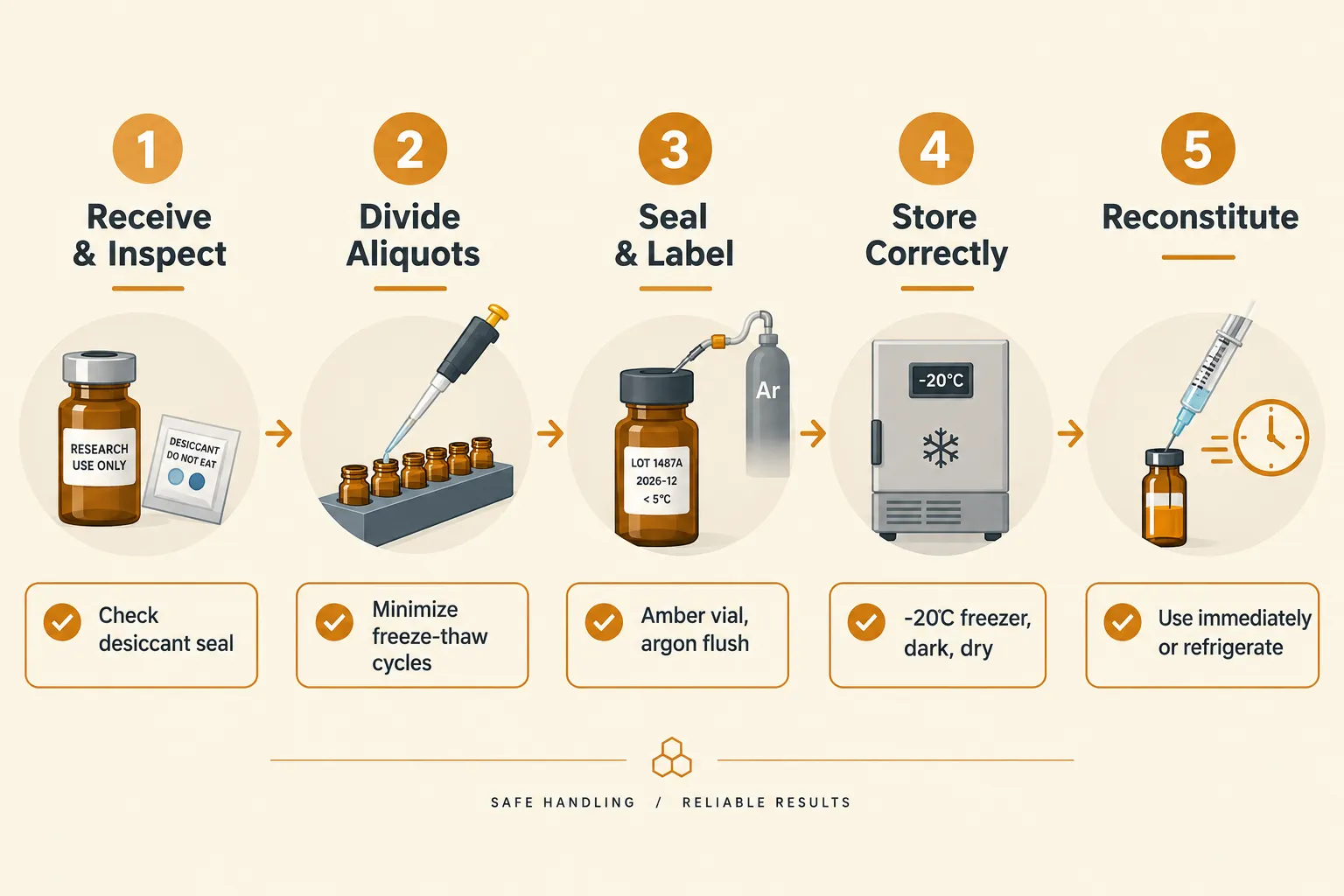
Both enclomiphene and enclomiphene citrate are susceptible to the same primary degradation drivers: ultraviolet light, ambient moisture, and elevated temperature. However, the degree of vulnerability differs between solid powder, aqueous solution, and organic solution.

Solid Powder Stability

Research-grade powder, whether free base or citrate, is the most stable form. When stored correctly, properly manufactured powder can maintain integrity for 24 months or longer. Correct storage means:

  • Temperature at or below -20 °C for long-term archival
  • Desiccant packs inside a sealed, airtight container
  • Amber or opaque vials to block UV exposure
  • Minimal handling that introduces ambient air or humidity

The citrate form benefits from reduced hygroscopicity relative to the free base. In practical terms, this means the citrate powder is less likely to absorb atmospheric moisture during brief handling windows, which is a meaningful advantage in non-controlled lab environments.

Solution Stability

Aqueous solutions of enclomiphene citrate are markedly less stable than the solid form. At room temperature, degradation can become measurable within days. Refrigerated aqueous solutions (2-8 °C) extend working life but should still be used within a short window, typically 48 to 72 hours for research applications.

Organic solvent solutions (DMSO, ethanol) offer moderate stability but are not suitable for extended storage. Freeze-thaw cycling accelerates degradation in both aqueous and organic solutions, which is why aliquoting into single-use volumes before freezing is standard practice.

Finished Formulations

Capsule and liquid suspension formulations of enclomiphene citrate demonstrate extended stability at or below 25 °C when packaged with appropriate moisture barriers. Regulatory stability expectations for finished dosage forms generally require data supporting a shelf life of 24 months under controlled conditions, and enclomiphene citrate formulations have been evaluated under those frameworks in clinical development programs.

Practical Research Handling for Enclomiphene Citrate vs Enclomiphene
Practical Research Handling for Enclomiphene Citrate vs Enclomiphene

Applying the stability science above to day-to-day laboratory practice requires a clear protocol. The following guidance applies to both forms but is especially relevant for enclomiphene citrate given its broader use in research pipelines.

Before Use

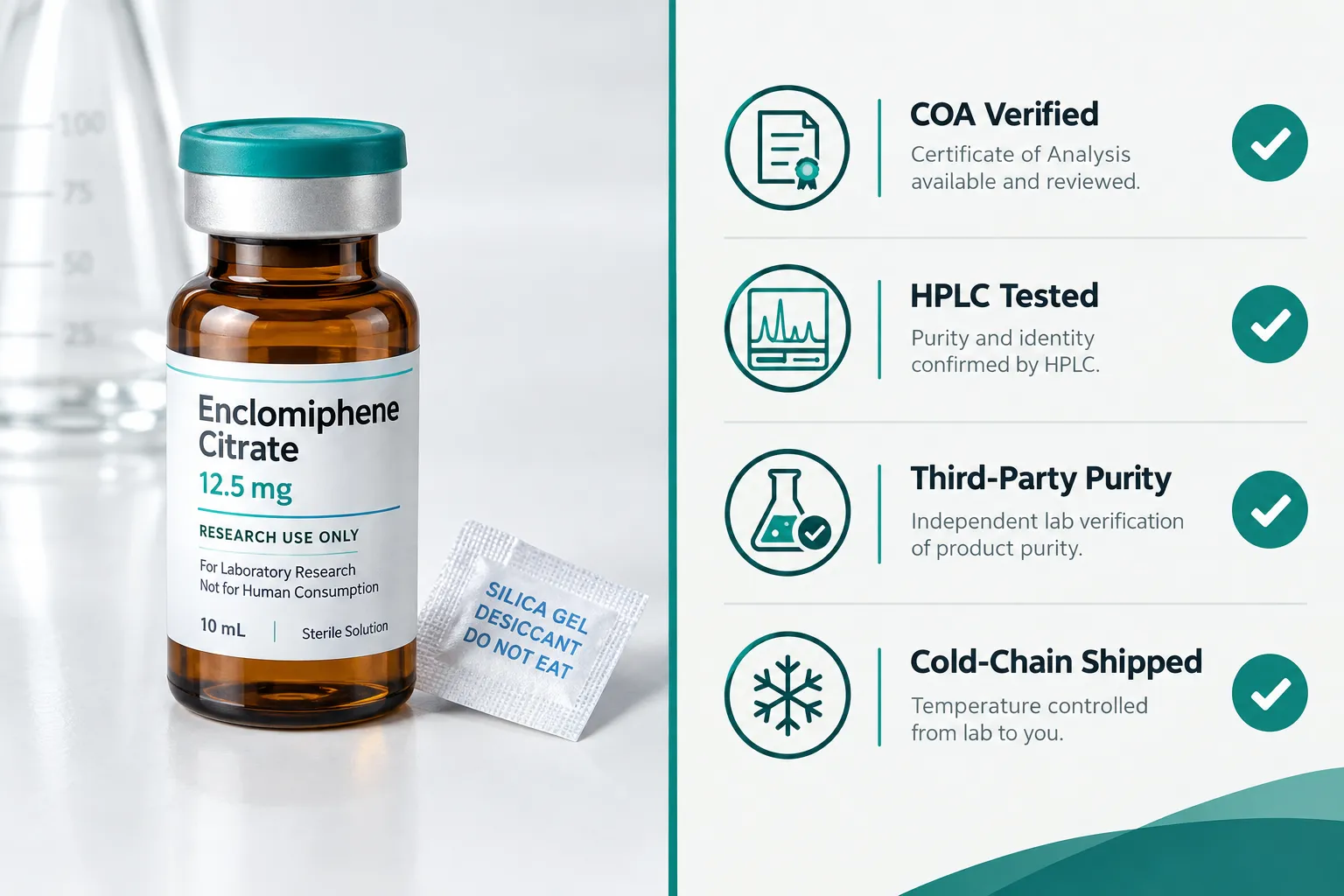
  • Verify the certificate of analysis (COA) from the supplier, confirming HPLC purity of 98% or above
  • Confirm the compound is labeled correctly as citrate salt or free base, the two are not interchangeable in concentration calculations
  • Inspect the desiccant seal; a broken seal is grounds for rejection

During Reconstitution

  • Warm sealed vials to room temperature before opening to prevent condensation on the powder
  • Use the appropriate solvent for the form: aqueous buffer for citrate, DMSO or ethanol for free base
  • Prepare only the volume needed; do not reconstitute bulk quantities

During Storage

  • Store reconstituted solutions at 2-8 °C and use within 48-72 hours
  • Store dry powder at -20 °C in amber vials with desiccant
  • Log every freeze-thaw cycle; limit to no more than two per aliquot

Researchers sourcing serms for comparative studies should apply the same handling discipline to related compounds. For those working with peptide-based research compounds alongside small-molecule serms, foundational guidance on compound classes is available in resources covering peptides 101 for research-use only buyers.

Vendor selection is equally important. A vendor scoring rubric that evaluates third-party testing, cold-chain shipping, and documentation practices will reduce the risk of receiving degraded or mislabeled material. Researchers running multi-compound protocols, for example, pairing a serm with a growth hormone secretagogue, can find relevant product context in resources such as the IPA Sermorelin stack research overview.

For those evaluating research-grade serm products specifically, the serm 10mg product page provides purity and specification details relevant to procurement decisions.

Conclusion

The distinction between enclomiphene citrate and enclomiphene free base is not semantic. The citrate salt offers measurably better crystalline stability, reduced hygroscopicity, and broader formulation options, but it also carries a different molecular weight that must be factored into every concentration calculation. Both forms demand cold, dark, dry storage in the solid state, and both degrade significantly faster once dissolved.

Actionable next steps for researchers in 2026:

  1. Audit current stock: confirm whether materials on hand are labeled as citrate salt or free base and recalculate molar concentrations accordingly.
  2. Implement single-use aliquoting before freezing to eliminate freeze-thaw degradation.
  3. Require HPLC-verified COAs from all suppliers before accepting shipments.
  4. Establish a 48-72 hour use window for all reconstituted solutions stored at 2-8 °C.
  5. Apply the same vendor documentation standards to all research compounds, not just serms.

Reproducibility in enclomiphene research depends on treating the compound form as a controlled variable, not an afterthought.

https://www.puretestedpeptides.com/wp-content/uploads/2026/09/enclomiphene-citrate-vs-enclomiphene-stability-storage-and-research-handling.webp 1024 1536 https://www.puretestedpeptides.com/wp-content/uploads/2026/01/buy-peptides-online.jpg 2026-09-15 13:04:102026-09-15 13:04:10Enclomiphene Citrate vs Enclomiphene: Stability, Storage, and Research Handling
×

Helpful Links

  • My account
  • Cart
  • Checkout
  • Refund and Returns Policy
  • Privacy Policy
  • SMS Privacy Policy
  • Login
  • My Account
  • Logout

USA Made Lab Tested Peptides

All products are sold for research, laboratory, or analytical purposes only, and are not for human consumption


Pure Tested Peptides is a chemical supplier. Pure Tested Peptides is not a compounding / chemical compounding facility as defined under 503A of the Federal Food, Drug, and Cosmetic act. Pure Tested Peptides is not an outsourcing facility as defined under 503B of the Federal Food, Drug, and Cosmetic act.

The statements made within this website have not been evaluated by the US Food and Drug Administration. The products we offer are not intended to diagnose, treat, cure or prevent any disease.

Human/Animal Consumption Prohibited. Laboratory/In-Vitro Experimental Use Only

Scroll to top Scroll to top Scroll to top