

Glow Blend Peptide: Examining Its Ingredients and Research Potential for Skin Health and Collagen Synthesis
Collagen loss accelerates by roughly 1% per year after age 25, yet the global market for peptide-based skin interventions continues to expand at double-digit rates heading into 2026. Against that backdrop, Glow Blend Peptide: Examining Its Ingredients and Research Potential for Skin Health and Collagen Synthesis has become a growing focus among dermatological researchers and formulators seeking to understand whether multi-peptide blends offer advantages over single-compound approaches. This article breaks down the typical ingredient profile, the mechanistic rationale behind each component, and what the current evidence actually supports.
Key Takeaways
- Glow Blend Peptide formulations typically combine GHK-Cu, Palmitoyl Pentapeptide-4, and supporting antioxidant peptides in a single research vial.
- Each component has individual preclinical support for collagen synthesis, wound healing, or antioxidant activity, but blend-specific human data remain limited.
- The regulatory status of Glow Blend Peptide is research-use only as of 2026; it is not approved for clinical or cosmetic use.
- Formulation variability across vendors makes direct comparison difficult and underscores the importance of sourcing from verified suppliers.
- Researchers should treat available data as hypothesis-generating rather than conclusive.
What Is Glow Blend Peptide and How Is It Typically Formulated
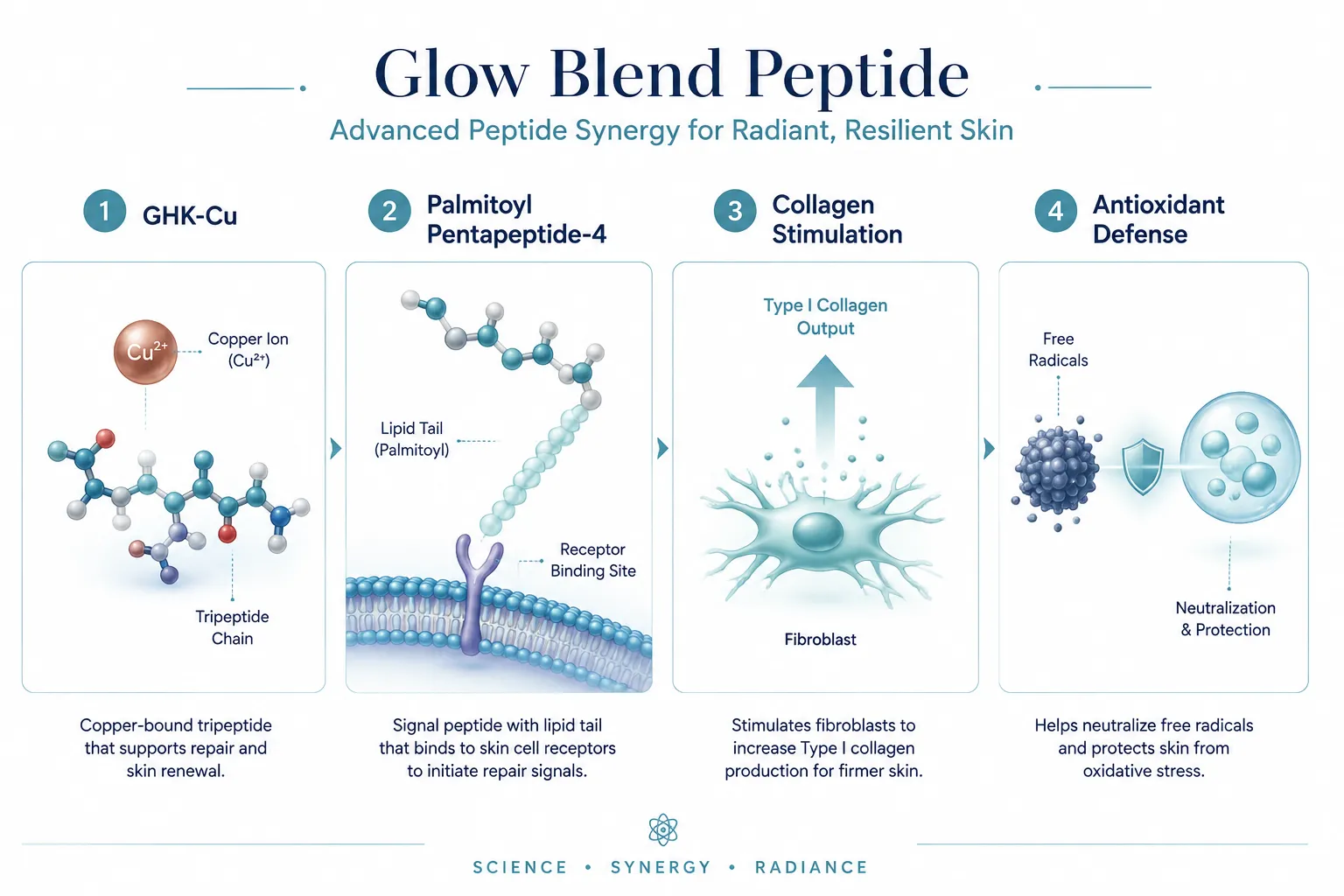
Glow Blend Peptide is a multi-component research peptide preparation that typically arrives as a lyophilized powder in vials ranging from 5 mg to 10 mg. The blend is designed to deliver several bioactive peptides simultaneously, with the stated goal of exploring synergistic effects on dermal matrix remodeling and skin barrier function.
Common components found across vendor formulations include:
| Ingredient | Primary Research Target | Typical Vial Contribution |
|---|---|---|
| GHK-Cu (Copper Tripeptide-1) | Collagen synthesis, wound healing | 30-40% of blend |
| Palmitoyl Pentapeptide-4 (Matrixyl) | Fibroblast stimulation, ECM repair | 25-35% of blend |
| Epithalon (Epitalon) | Telomere support, antioxidant activity | 15-20% of blend |
| Leuphasyl or Argireline analogs | Neuropeptide-like relaxation signaling | 10-20% of blend |
"Multi-peptide blends represent an attempt to address the multifactorial nature of skin aging through a single research vehicle, but each component still requires independent validation before synergy claims can be substantiated."
GHK-Cu is among the most studied components. Preclinical data indicate it upregulates genes associated with collagen and glycosaminoglycan synthesis while also demonstrating anti-inflammatory properties. Palmitoyl Pentapeptide-4 has been shown in cell culture models to stimulate fibroblast production of Type I and Type III collagen, fibronectin, and hyaluronic acid. For researchers exploring research peptides broadly, understanding how individual components behave before interpreting blend results is essential methodology.
Mechanistic Rationale: How Each Component May Support Collagen Synthesis
The theoretical appeal of Glow Blend Peptide: Examining Its Ingredients and Research Potential for Skin Health and Collagen Synthesis rests on the complementary pathways each ingredient is proposed to activate.
GHK-Cu and the TGF-beta Pathway
GHK-Cu is thought to interact with transforming growth factor-beta (TGF-beta) signaling, a key regulator of extracellular matrix (ECM) production. In vitro studies using human fibroblast cultures have recorded increased mRNA expression for collagen Type I following GHK-Cu exposure. The copper ion component also supports lysyl oxidase activity, an enzyme critical for cross-linking newly synthesized collagen fibers into structurally stable networks.
Palmitoyl Pentapeptide-4 and Matrikine Signaling
Palmitoyl Pentapeptide-4 functions as a matrikine, a peptide fragment that signals to fibroblasts as though the ECM has been degraded, prompting a repair response. The lipid tail (palmitoyl group) improves penetration through lipid-rich barriers in ex vivo skin models, a property relevant to topical delivery research.
Epithalon and Oxidative Stress Reduction
Epithalon, a tetrapeptide derived from the pineal gland, has been studied in animal models for its ability to reduce oxidative damage to cellular DNA and extend telomere length in certain cell lines. Reduced oxidative stress in dermal fibroblasts is theorized to preserve their collagen-synthesizing capacity over time.
Neuropeptide Analogs
Argireline-class peptides inhibit SNARE complex formation, reducing acetylcholine-mediated muscle contraction signaling in vitro. Their inclusion in skin-focused blends is based on the hypothesis that reduced repetitive micro-tension on dermal tissue may preserve collagen architecture, though direct evidence in human skin remains thin.
Researchers interested in peptide classification frameworks will find it useful to categorize these components by mechanism before designing experimental protocols.
Evidence Base, Safety Considerations, and Research Handling
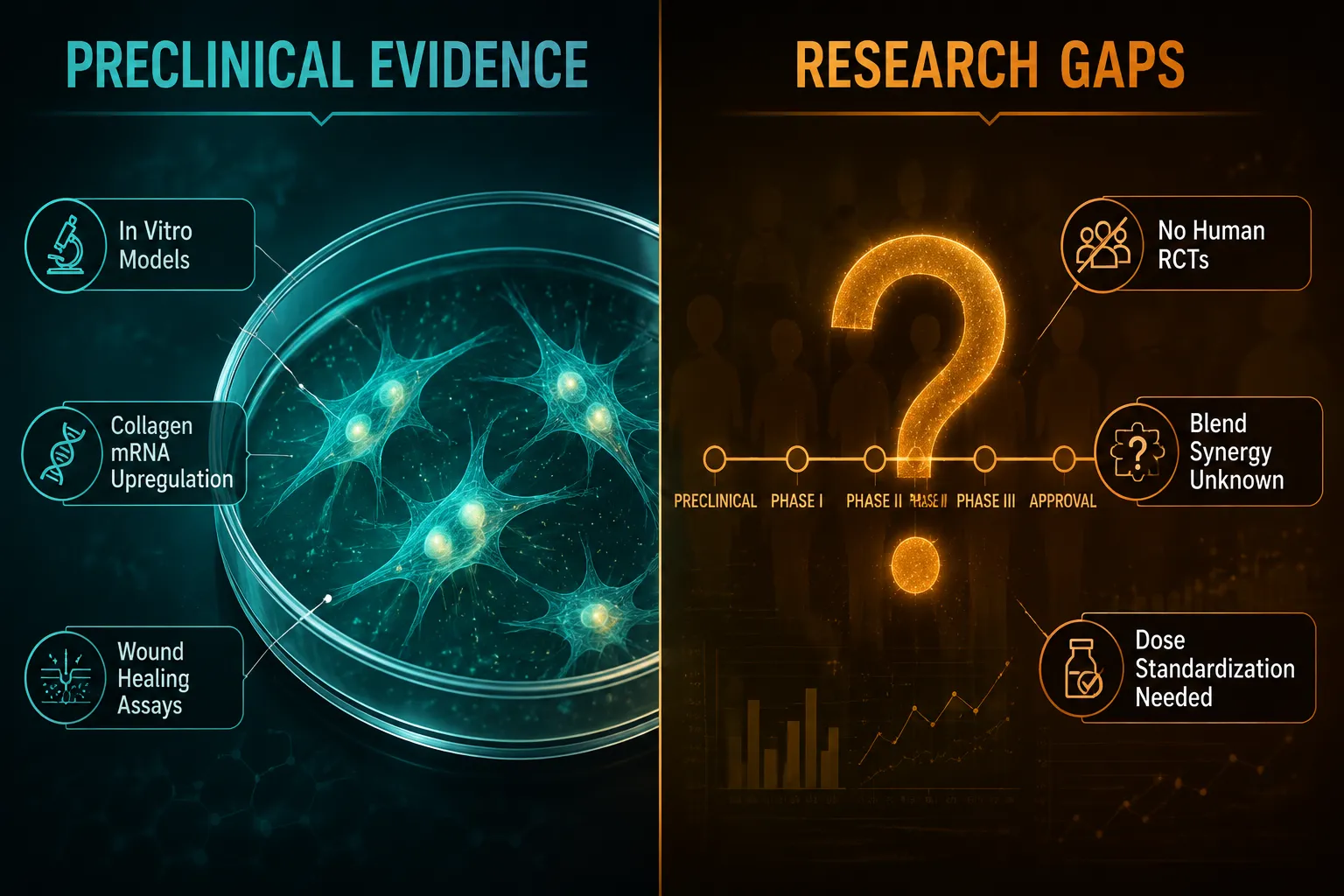
The evidence supporting Glow Blend Peptide: Examining Its Ingredients and Research Potential for Skin Health and Collagen Synthesis is primarily preclinical and component-driven. No peer-reviewed randomized controlled trials (RCTs) examining the complete blend in human subjects had been published as of mid-2026. Most available data derive from:
- In vitro fibroblast assays measuring collagen gene expression
- Ex vivo skin explant models assessing barrier integrity
- Animal wound-healing studies using individual peptide components
This evidence gap is significant. Synergistic or antagonistic interactions between blend components in a living system are not yet characterized. Researchers should note that vendor-to-vendor formulation differences, including excipient choices and peptide ratios, further complicate cross-study comparisons.
Regulatory Status in 2026
Glow Blend Peptide remains classified as a research compound only. It is not approved by the FDA, EMA, or equivalent regulatory bodies for therapeutic, cosmetic, or clinical use. Researchers sourcing this compound should prioritize suppliers who provide independent third-party certificates of analysis (COA). For guidance on evaluating supplier quality, the resource on where to buy research-grade Glow Blend Peptide: evaluating purity, copper complexes, and skin model compatibility offers detailed sourcing criteria.
Handling and Storage
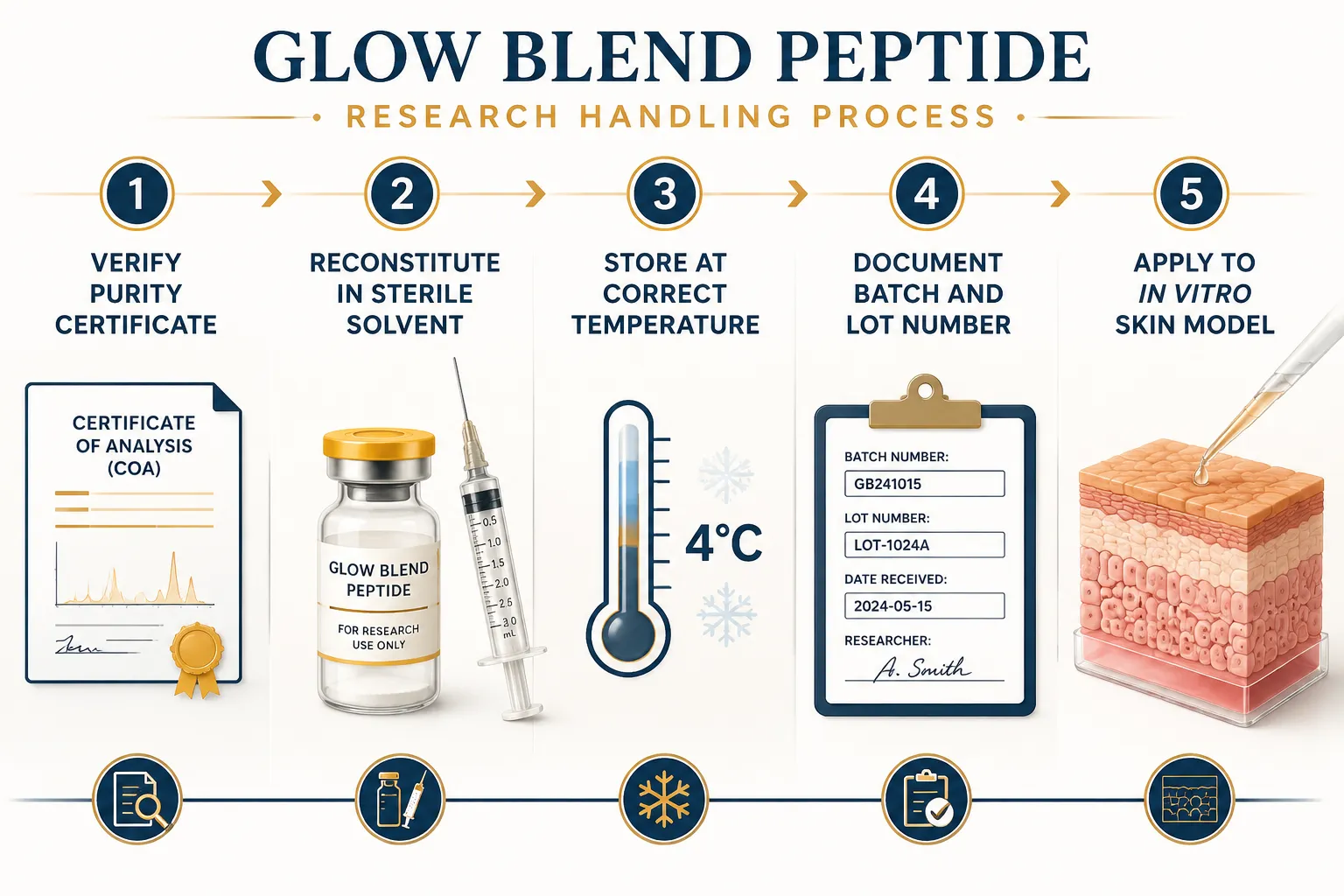
Proper research peptide handling protocols are critical for maintaining blend integrity. Key considerations include:
- Reconstitute with sterile bacteriostatic water or appropriate solvent per COA guidance
- Store lyophilized powder at -20 degrees C; reconstituted solution at 4 degrees C for short-term use
- Avoid repeated freeze-thaw cycles, which can degrade GHK-Cu and palmitoyl conjugates
- Document lot numbers and expiration dates for traceability
Researchers working with other multi-component blends may find parallel methodology guidance in resources covering Klow Blend Peptide nasal spray: research applications and bioavailability considerations and SS-31 mitochondrial research themes, both of which address multi-mechanism peptide systems.
Known Risk Considerations
- Copper accumulation risk with GHK-Cu at supraphysiological concentrations in cell models
- Potential for immune sensitization with repeated peptide exposure in animal studies
- Incomplete toxicology profiles for the combined blend
- No established safe dosing range for human application
Conclusion
Glow Blend Peptide: Examining Its Ingredients and Research Potential for Skin Health and Collagen Synthesis represents a theoretically compelling but evidence-limited area of dermatological research in 2026. Each component, particularly GHK-Cu and Palmitoyl Pentapeptide-4, carries meaningful preclinical support for collagen-related pathways. However, the blend as a unified system lacks human clinical validation, standardized dosing, and regulatory approval.
Actionable next steps for researchers:
- Begin with single-component controls before introducing the full blend to isolate individual effects.
- Use validated in vitro skin models (reconstructed human epidermis) as a first-pass screening tool.
- Source only from suppliers providing independent COA documentation with purity thresholds above 98%.
- Design experiments with appropriate vehicle controls to account for excipient contributions.
- Monitor the peer-reviewed literature closely, as blend-specific RCT data are anticipated in the coming research cycle.
The potential of multi-peptide skin health formulations is real, but rigorous methodology remains the only path from theoretical mechanism to credible research output.