

Enclomiphene vs Enclomiphene Citrate: What Researchers Need to Know Before Choosing a Formulation
Most product labels in the research supply market list "enclomiphene citrate," yet the majority of published clinical studies report doses simply as "enclomiphene." That single-word difference can quietly distort how researchers interpret dosing data, compare results across studies, and evaluate sourcing options. Understanding the distinction in Enclomiphene vs Enclomiphene Citrate: What Researchers Need to Know Before Choosing a Formulation is not a minor technical footnote, it is a foundational step in designing reproducible research.
Key Takeaways
- Enclomiphene is the active free-base molecule; enclomiphene citrate is its salt form, which contains a lower percentage of active compound per milligram.
- Dose conversions are required when comparing studies that report enclomiphene base quantities against formulations supplied as enclomiphene citrate.
- As of 2026, enclomiphene remains unapproved by the FDA, meaning all research use occurs outside a clinical approval framework.
- Compounded citrate formulations face additional regulatory scrutiny, including bulk-substance evaluation requirements.
- Researchers should always verify formulation type through a certificate of analysis (COA) before interpreting or replicating study protocols.
The Chemistry Behind the Naming Difference
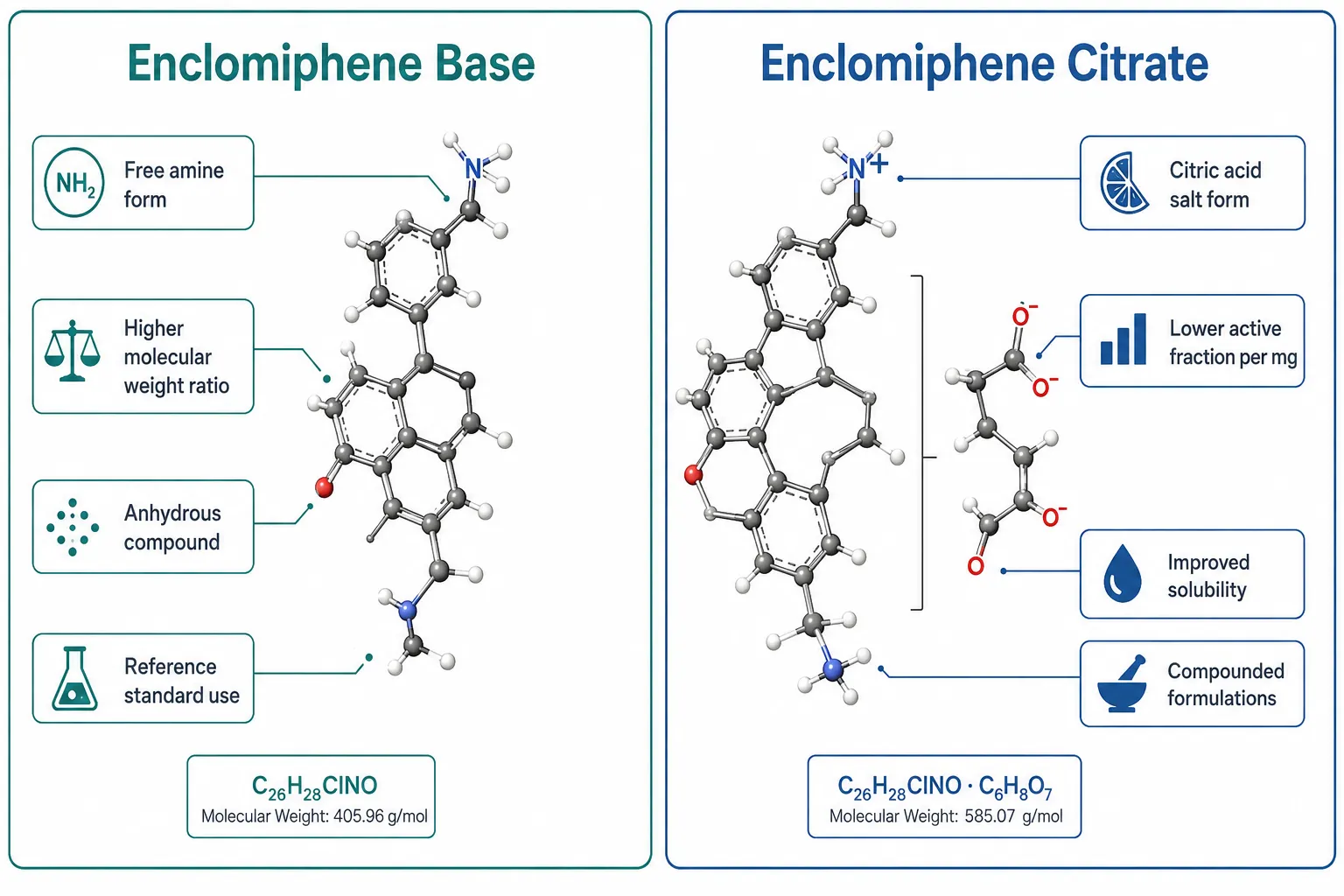
Enclomiphene is the trans-isomer of clomiphene, a selective estrogen receptor modulator (serm). In its pure form, it exists as a free base, a neutral molecule with no counterion attached. Enclomiphene citrate is a pharmaceutical salt created by combining the enclomiphene base with citric acid. This salt form is more stable and typically more water-soluble, which makes it better suited for compounding and oral formulation.
The practical consequence of this chemistry is straightforward but easy to overlook. Because citric acid adds molecular weight to the compound, a given mass of enclomiphene citrate contains less active enclomiphene than the same mass of the free base. The active fraction in enclomiphene citrate is approximately 70-75% by molecular weight, depending on the specific salt stoichiometry. A researcher reading a study that used 12.5 mg of enclomiphene base and then sourcing a citrate-form product needs to account for this difference to maintain equivalent active exposure.
"The naming convention on a product label does not automatically tell you how much active compound is present per milligram. Molecular weight math is always required."
This is one of the most common points of confusion addressed in discussions of Enclomiphene vs Enclomiphene Citrate: What Researchers Need to Know Before Choosing a Formulation, and it affects every stage of research from protocol design to data interpretation.
Regulatory Status and Compounding Considerations in 2026
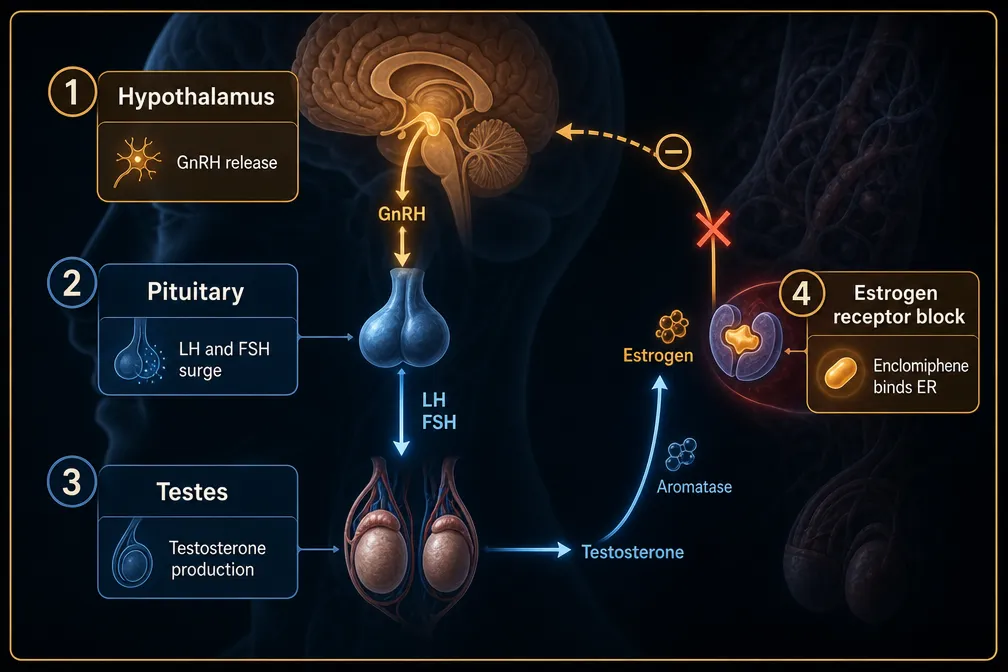
As of mid-2026, enclomiphene has not received FDA approval for any indication. It was studied extensively for male secondary hypogonadism under the investigational name Androxal, reaching Phase 3 trials before the development program was discontinued. Despite this history, the compound remains the subject of active off-label research interest, particularly for applications involving testosterone restoration with fertility preservation.
Because no approved finished-dosage product exists in the United States, researchers and compounding pharmacies working with this molecule rely on bulk active pharmaceutical ingredient (API). This is where the citrate salt form becomes especially relevant. Regulatory frameworks governing compounding, including the FDA's 503A and 503B pathways, require that any bulk substance used in compounding either appear on an approved list or undergo a formal bulk-substance evaluation. Enclomiphene citrate, as the salt form most commonly available as a bulk API, is subject to this scrutiny.
Researchers sourcing material for in vitro or preclinical work should be aware that the regulatory landscape for this compound is still evolving. Conflicting secondary listings across databases and supplier catalogs make primary-source verification essential. Always request documentation that specifies the exact chemical form, free base or citrate salt, along with a third-party COA confirming purity and identity.
For context on how regulatory complexity affects other research peptides and compounds, the discussion around GLP2-T peptide and GLP2 Tirz peptide naming confusion illustrates how labeling inconsistencies can create parallel problems in research interpretation.
Practical Formulation Guidance: Enclomiphene vs Enclomiphene Citrate for Research Use
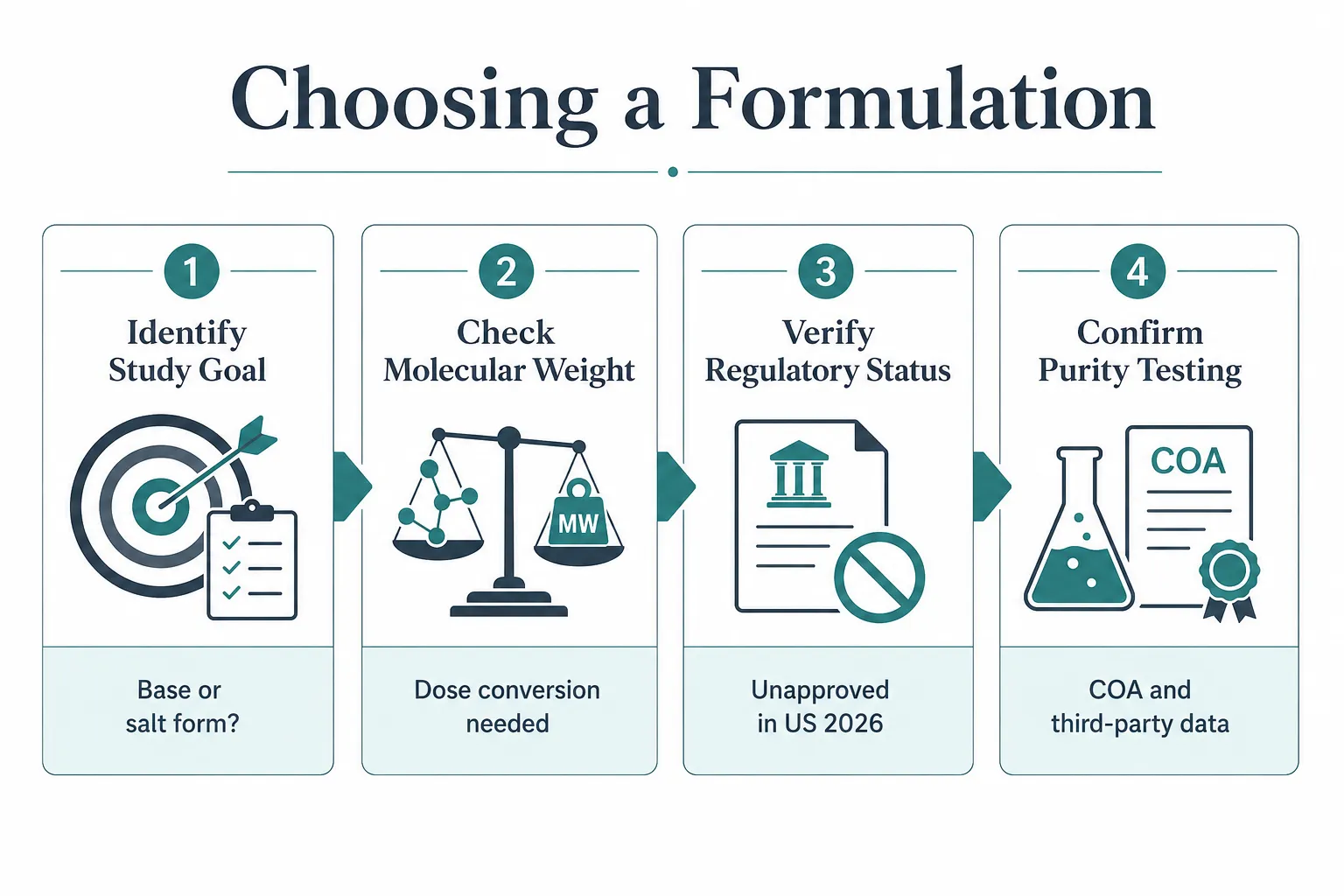
When evaluating Enclomiphene vs Enclomiphene Citrate: What Researchers Need to Know Before Choosing a Formulation, the decision framework depends on the research context.
Key comparison points:
| Factor | Enclomiphene Base | Enclomiphene Citrate |
|---|---|---|
| Active fraction per mg | Higher (~100%) | Lower (~70-75%) |
| Water solubility | Lower | Higher |
| Typical use context | Reference standards, some research | Compounded oral formulations |
| Dose conversion needed | Baseline reference | Yes, relative to base |
| Stability in solution | Variable | Generally improved |
Researchers designing protocols should also consider handling and safety requirements. Enclomiphene citrate, like all serm compounds, requires standard laboratory precautions including appropriate personal protective equipment and proper storage conditions, typically refrigerated and protected from light and moisture.
The broader evidence landscape for enclomiphene sits within the larger serm and testosterone research context. Researchers comparing enclomiphene data against clomiphene or other serm studies should note that clomiphene is a racemic mixture containing both the active trans-isomer (enclomiphene) and the less active zuclomiphene. Enclomiphene's selective profile is one reason it attracted clinical development interest. This kind of isomer-level distinction parallels the precision required in other peptide research areas, for example, understanding how SS-31 mitochondrial research themes depend on precise molecular targeting, or how TB-500 research requires accurate compound identification before drawing mechanistic conclusions.
For researchers exploring endocrine signaling more broadly, related work on Tesamorelin science and sourcing and Retatrutide and MASLD triple-agonist research demonstrates how formulation precision consistently shapes the quality of endocrine and metabolic research outcomes.
Conclusion
The distinction between enclomiphene and enclomiphene citrate is not semantic, it has direct consequences for dosing accuracy, study replication, and regulatory compliance. Researchers working with either form in 2026 should take three concrete steps before beginning any protocol.
- Confirm the exact chemical form on the COA, free base or citrate salt, and apply the appropriate molecular weight conversion before comparing doses across studies.
- Verify regulatory standing for the specific form being used, particularly if the research involves compounded material subject to bulk-substance evaluation requirements.
- Source from suppliers who provide third-party purity data and clearly disclose the chemical form on all documentation.
Precision at the formulation level is what separates reproducible research from ambiguous results. In a field where labeling inconsistencies are common, that precision starts with knowing exactly which compound is in the vial.