Call or Text 727-513-9780
  • Shopping Cart Shopping Cart
    0Shopping Cart
Pure Tested Peptides | America's most trusted Peptides for sale online
  • Peptides for sale
    • Oral Peptides for sale
      • Peptide Capsules for sale
      • BPC 157 Capsules 1000mcg
      • SLU-PP-332 Capsules | 1000 mcg
      • 5-Amino-1MQ 50mg Capsules
      • Tesofensine 500mcg
    • All Peptides for sale
    • Peptide Sprays
      • BPC 157 Nasal Spray Kit
      • BPC-157 TB500 Nasal Spray Kit
      • Semax Nasal Spray 10mg
      • Selank – Nasal Spray Kit – 10mg
      • Epithalon 50MG Nasal Spray Kit
      • Ipamorelin 10mg Nasal Spray
      • Klow Nasal Spray (BPC-157 + TB-500 + GHK-Cu + KPV) | 80mg
      • Hulk Nasal Spray Tesa / Ipa Blend 6/3 MG
      • Klow Nasal Spray
      • NAD + 500 mg Nasal Spray
      • PT-141 Nasal Spray Kit
    • GHRH Peptides
      • Ipa Peptides
      • CJC-1295 Peptides
        • CJC-1295 with DAC 5 mg
        • CJC-1295 without DAC 5 mg
        • CJC-1295 Ipa 10mg
      • Tesa Peptides
        • Tesa Peptide
        • Tesa 20 mg
    • GHK-Cu Peptides
      • All GHK-Cu Peptides
      • GHK-Cu 100mg
      • KLOW Peptide Blend – Buy KLOW blend online
    • BPC Peptides
      • All BPC Peptides
      • BPC-157
      • BPC-157 TB-500
      • BPC 157 capsules 1000mcg
    • SLU-PP-332 Peptides
      • All SLU-PP-332 Peptides
      • SLU-PP-332 5mg
    • GLP3 Peptides
      • GLP3-R
      • GLP3-R CAG 10mg
      • GLP3-R 20mg
    • PT-141 Peptides
      • PT-141 Peptides for sale
      • PT-141 10mg
      • PT-141 Nasal Spray
    • CAG Peptides
      • Lipo-C Peptide Blend
      • CAG 5mg
      • CAG 10mg
    • MOTS-C Peptides
      • MOTS-C Peptides for sale
      • MOTS-c peptide
      • MOTS-c 10mg *6 pack*
    • 5 Amino 1MQ Peptides
      • 5 Amino 1MQ Peptides for sale
      • 5-Amino-1MQ 50mg Capsules
      • 5-Amino-1MQ 5mg
    • Epithalon Peptides
      • Epithalon Peptides for sale
      • Epithalon 10mg
      • Epithalon 50mg
  • Shop
    • GLPs
      • 5-Amino-1MQ 50mg Capsules
      • 5-Amino-1MQ 5mg
      • GLP3-Reta
      • L-Carnitine 500mg/ml
      • Tesofensine 500mcg
      • SLU-PP-332 5mg
      • MOTS-c 10mg *6 pack*
    • Epithalon & BPC Peptides
      • Epithalon 10mg
      • Epithalon 50mg
      • BPC-157
      • BPC 157 capsules 1000mcg
      • BPC-157 TB-500
      • BPC-157 TB500 Nasal Spray Kit
      • BPC 157 Nasal Spray Kit
    • BPC TB-500 & NAD+ Peptides
      • NAD+ 500 mg
      • KLOW Peptide Blend – Buy KLOW blend online
      • GLOW Peptide Blend
      • TB 500 5mg
      • BPC 157 capsules 1000mcg – Supplement
      • BPC 157 Nasal Spray Kit
      • BPC-157
      • BPC-157 TB500 Nasal Spray Kit
      • BPC-157 TB-500
      • BPC 157 capsules 1000mcg
    • LL-37 Peptide
      • LL-37 10 mg
    • MOTS-C & Selank
      • MOTS-c peptide
      • Selank 10mg
    • GHK Peptides
      • GHK-Cu 100mg
      • GLOW Peptide Blend
      • KLOW Peptide Blend – Buy KLOW blend online
  • COAs
  • Wholesale
    • Wholesale Peptides for sale
  • PTP FAQ
  • Affiliates
    • Selank Peptide: Advanced Pharmacological Mechanisms Underlying Its Anxiolytic and Nootropic Effects in Research
      • 5-Amino-1MQ Peptide: Detailed Mechanisms of NNMT Inhibition and Its Impact on Cellular Metabolism Research
        • MOTS-C Peptide: Unraveling Its Role in Mitochondrial Dynamics and Energy Metabolism Research
          • Epithalon Peptide and Telomerase Regulation: Investigating Its Impact on Cellular Senescence and Lifespan Research Models
            • GLP2-T vs GLP2 Tirz Peptide: Understanding the Naming, Mechanistic Nuances, and Research Implications for Gut Health
      • Peptides and Polypeptides in Modern Pharmacology: What Research on Metoprolol, Prednisone, and Amlodipine Reveals
        • Polypeptide Peptides vs NSAIDs: What Naproxen and Diclofenac Teach Tissue-Repair Researchers About BPC‑157 and TB‑500
          • Peptides and Polypeptides in Endocrine Pharmacology: How GLP-1, GLP-2, and GLP-3 Retatrutide Differ From Classic Drugs Like Prednisone and Amlodipine
          • 5‑Amino‑1MQ Peptide and NNMT Inhibition: How It Compares With Statins Like Atorvastatin in Adipose and Lipid Metabolism Research
      • Enclomiphene, Estrogen Receptor Signaling, and Luteinizing Phase Biology: What Hormone Researchers Should Measure
        • Mesenchymal Stem Cells, BPC‑157, and GHK‑Cu: How Tissue Repair Peptides Compare With Classic NSAIDs Like Naproxen in Injury Models
          • Peptide Calculator Use Cases Beyond Growth Hormone: Working Through GLP‑3 Retatrutide, MOTS‑c, and BPC‑157 Research Dosing
        • Polypeptide Peptides in Endocrine and Metabolic Pharmacology: Lessons From Amlodipine, Prednisone, and Metoprolol
        • Peptides Calculator for Advanced Blends: Worked Examples for Tesamorelin, CJC‑1295, and Ipamorelin Stacks
          • Peptides and Polypeptides in Human Physiology: How Molecular Size Shapes Research Applications
            • Selank Peptide: Advanced Pharmacological Mechanisms Underlying Its Anxiolytic and Nootropic Effects in Research
          • 5-Amino-1MQ Peptide: Detailed Mechanisms of NNMT Inhibition and Its Impact on Cellular Metabolism Research
            • MOTS-C Peptide: Unraveling Its Role in Mitochondrial Dynamics and Energy Metabolism Research
              • Epithalon Peptide and Telomerase Regulation: Investigating Its Impact on Cellular Senescence and Lifespan Research Models
                • GLP2-T vs GLP2 Tirz Peptide: Understanding the Naming, Mechanistic Nuances, and Research Implications for Gut Health
                  • Peptides and Polypeptides in Endocrine Pharmacology: How GLP-1, GLP-2, and GLP-3 Retatrutide Differ From Classic Drugs Like Prednisone and Amlodipine
                    • Polypeptide Peptides vs NSAIDs: What Naproxen and Diclofenac Teach Tissue-Repair Researchers About BPC‑157 and TB‑500
                      • Peptides and Polypeptides in Modern Pharmacology: What Research on Metoprolol, Prednisone, and Amlodipine Reveals
                        • 5‑Amino‑1MQ Peptide and NNMT Inhibition: How It Compares With Statins Like Atorvastatin in Adipose and Lipid Metabolism Research
                        • Enclomiphene, Estrogen Receptor Signaling, and Luteinizing Phase Biology: What Hormone Researchers Should Measure
                        • Mesenchymal Stem Cells, BPC‑157, and GHK‑Cu: How Tissue Repair Peptides Compare With Classic NSAIDs Like Naproxen in Injury Models
                        • Peptide Calculator Use Cases Beyond Growth Hormone: Working Through GLP‑3 Retatrutide, MOTS‑c, and BPC‑157 Research Dosing
                        • Polypeptide Peptides in Endocrine and Metabolic Pharmacology: Lessons From Amlodipine, Prednisone, and Metoprolol
                        • Peptides Calculator for Advanced Blends: Worked Examples for Tesamorelin, CJC‑1295, and Ipamorelin Stacks
                        • Peptides and Polypeptides in Human Physiology: How Molecular Size Shapes Research Applications
                        • Selank Peptide: Advanced Pharmacological Mechanisms Underlying Its Anxiolytic and Nootropic Effects in Research
                        • MOTS-C Peptide: Unraveling Its Role in Mitochondrial Dynamics and Energy Metabolism Research
                        • Peptides and Polypeptides in Modern Pharmacology: What Research on Metoprolol, Prednisone, and Amlodipine Reveals
                        • Peptides and Polypeptides in Endocrine Pharmacology: How GLP-1, GLP-2, and GLP-3 Retatrutide Differ From Classic Drugs Like Prednisone and Amlodipine
                        • 5-Amino-1MQ Peptide: Detailed Mechanisms of NNMT Inhibition and Its Impact on Cellular Metabolism Research
                        • Mesenchymal Stem Cells, BPC‑157, and GHK‑Cu: How Tissue Repair Peptides Compare With Classic NSAIDs Like Naproxen in Injury Models
                        • Peptide Calculator Use Cases Beyond Growth Hormone: Working Through GLP‑3 Retatrutide, MOTS‑c, and BPC‑157 Research Dosing
                        • GLP2-T vs GLP2 Tirz Peptide: Understanding the Naming, Mechanistic Nuances, and Research Implications for Gut Health
                        • Polypeptide Peptides in Endocrine and Metabolic Pharmacology: Lessons From Amlodipine, Prednisone, and Metoprolol
                        • Polypeptide Peptides vs NSAIDs: What Naproxen and Diclofenac Teach Tissue-Repair Researchers About BPC‑157 and TB‑500
                        • Peptides and Polypeptides in Human Physiology: How Molecular Size Shapes Research Applications
                        • Peptides Calculator for Advanced Blends: Worked Examples for Tesamorelin, CJC‑1295, and Ipamorelin Stacks
                        • 5‑Amino‑1MQ Peptide and NNMT Inhibition: How It Compares With Statins Like Atorvastatin in Adipose and Lipid Metabolism Research
                        • Enclomiphene, Estrogen Receptor Signaling, and Luteinizing Phase Biology: What Hormone Researchers Should Measure
                        • Epithalon Peptide and Telomerase Regulation: Investigating Its Impact on Cellular Senescence and Lifespan Research Models
                        • Best research protocol Klow blend
                        • best time to take BPC-157
                        • best time to take DSIP (Delta Sleep Inducing Peptide)
                        • best time to take CJC-1295
                        • best time to take AOD-9604
                        • best time to take Follistatin 344
                        • best time to take Ipamorelin
                        • best time to take MK-677 (Ibutamoren)
                        • best time to take Ligandrol (LGD-4033) — research compound
                        • best time to take Ostarine (MK-2866) — research compound
                        • best time to take GHK-CU
                        • best time to take TB-500
                        • best time to take MOTS-c
                        • best time to take Semax
                        • best time to take RAD-140 (Testolone) — research compound
                        • best time to take Thymosin Alpha-1
                        • best time to take PEG-MGF
                        • Biolife Plasma, Octapharma Plasma, and Research Peptides: How Plasma Donation Labs Differ From Peptide Suppliers
                        • best time to take YK-11 — research compound
                        • best time to take PT-141 (Bremelanotide)
                        • Best research protocol Klow blend
                        • 5-Amino-1MQ and MOTS-C Synergy: Metabolic Signaling, Mitochondria, and Research Design
                        • BPC-157 and TB-500: Investigating Their Combined Effects on Angiogenesis and Cellular Migration in Tissue Repair Models
                        • BPC-157 Peptide: Gut Barrier Function, Inflammation, and Tissue-Recovery Research
                        • 5‑Amino‑1MQ and MOTS‑c Synergy in Metabolic Research: Designing NNMT and Mitochondrial Biogenesis Stacks
                        • CJC-1295 with DAC vs. Without DAC: Half-Life, Release Kinetics, and Research Implications
                        • CJC‑1295 with DAC vs. Without DAC: Expanding on Half‑Life Differences Using Tesamorelin and Ipamorelin Blend Case Studies
                        • Collagen Biology and Copper‑Binding Peptides: How GHK‑Cu, Glow Blend, and Klow Blend Interact with Skin and Connective Tissue
                        • Collagen Biology and Regenerative Peptides: How GHK‑Cu, Glow Blend, and Klow Blend Affect Extracellular Matrix Research
                    • DNA, Telomeres, and Longevity Peptides: Positioning Epithalon and MOTS‑c in Genetic Aging Research
                      • Enclomiphene Citrate: serm Mechanism, Testosterone Research, and Stack Compatibility
                        • Enclomiphene vs Enclomiphene Citrate: Formulation, Bioavailability, and Research Distinctions
                        • Epithalon Peptide Research: Telomerase Activation, Aging, and Pineal Gland Function
                        • Estrogen Receptor Signaling and Enclomiphene: How Selective Modulators Compare with Classic Polypeptide Hormones
                        • GHK-Cu Peptide: Advanced Mechanisms in Extracellular Matrix Remodeling and Wound Healing Research
                        • GHK-Cu Peptide: Collagen Synthesis, Wound Repair, and Skin-Barrier Research Models
                        • GLP-1 vs GLP-3 vs GLP-2: Peptide Classification and Research Applications
                        • GLP-2 Peptide Research Guide: Gut Barrier Function, Nutrient Absorption, and Intestinal Recovery Models
                        • GLP-3 Retatrutide vs. GLP-1 Drugs: What Triple-Agonist Biology Changes in Research Models
                        • Ipamorelin and Tesamorelin Combination: Synergistic GH Secretagogue Research and Dosing Protocols
                        • GLP2 Tirz Peptide: What It Is, Why the Name Exists, and How Researchers Should Interpret It
                        • Klow Blend Peptide Nasal Spray: What the Formulation Is Trying to Do in Cognitive Research
                        • Mitochondria, NNMT Inhibition, and Peptide Modulators: Where MOTS‑c and 5‑Amino‑1MQ Fit in Cellular Energy Research
                        • MOTS-c Peptide: Mitochondrial Function, Energy Metabolism, and What Researchers Measure
                        • MOTS-c vs. 5-Amino-1MQ: Which Metabolic Research Questions Each Compound Actually Answers
                        • Nasal Spray Peptides: Bioavailability, Administration, and Semax/Selank Research Applications
                        • PT-141 Peptide Research: Mechanism of Action and Melanocortin Receptor Signaling
                        • Retatrutide for Research: Mechanism, Structure, and GLP-1/GLP-3 Dual Action
                        • Retatrutide for Obesity and Type 2 Diabetes: What the Latest Trial Data Suggest
                        • Tesofensine Peptide Research: Mechanism, Appetite Suppression, and Neuropeptide Y Pathways
  • Contact
    • Contact Customer Service
    • Text Customer Support
  • About US
  • Shop all peptides
  • Affiliate Program
    • Affiliate Signup
  • Login / Register Login / Register Page Link Login / Register Page Link
  • Click to open the search input field Click to open the search input field Search
  • Menu Menu
Enclomiphene vs Enclomiphene Citrate: What Researchers Need to Know Before Choosing a Formulation

Enclomiphene vs Enclomiphene Citrate: What Researchers Need to Know Before Choosing a Formulation

August 19, 2026/0 Comments/in Uncategorized/by

Most product labels in the research supply market list "enclomiphene citrate," yet the majority of published clinical studies report doses simply as "enclomiphene." That single-word difference can quietly distort how researchers interpret dosing data, compare results across studies, and evaluate sourcing options. Understanding the distinction in Enclomiphene vs Enclomiphene Citrate: What Researchers Need to Know Before Choosing a Formulation is not a minor technical footnote, it is a foundational step in designing reproducible research.

Key Takeaways

  • Enclomiphene is the active free-base molecule; enclomiphene citrate is its salt form, which contains a lower percentage of active compound per milligram.
  • Dose conversions are required when comparing studies that report enclomiphene base quantities against formulations supplied as enclomiphene citrate.
  • As of 2026, enclomiphene remains unapproved by the FDA, meaning all research use occurs outside a clinical approval framework.
  • Compounded citrate formulations face additional regulatory scrutiny, including bulk-substance evaluation requirements.
  • Researchers should always verify formulation type through a certificate of analysis (COA) before interpreting or replicating study protocols.

The Chemistry Behind the Naming Difference
The Chemistry Behind the Naming Difference

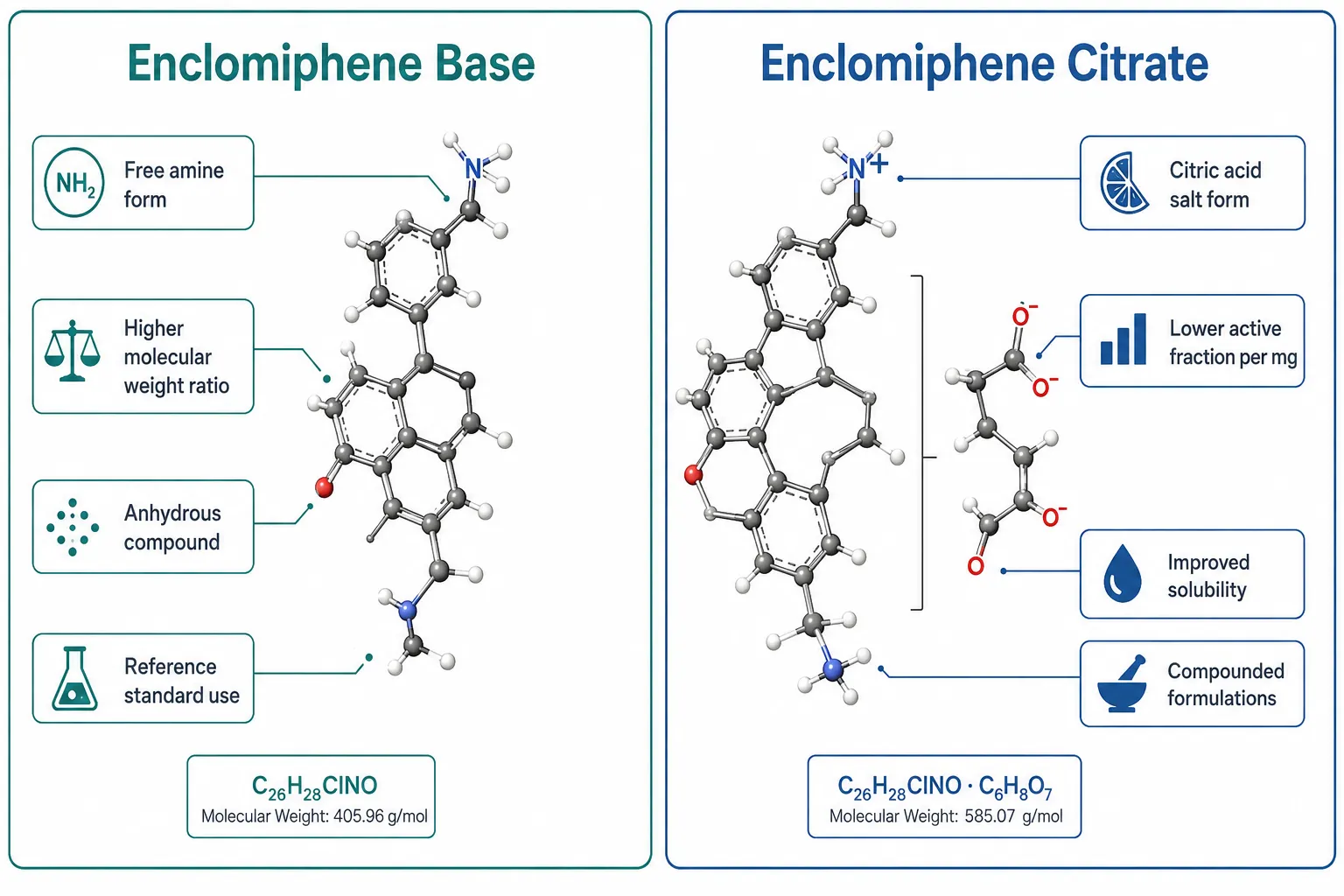
Enclomiphene is the trans-isomer of clomiphene, a selective estrogen receptor modulator (serm). In its pure form, it exists as a free base, a neutral molecule with no counterion attached. Enclomiphene citrate is a pharmaceutical salt created by combining the enclomiphene base with citric acid. This salt form is more stable and typically more water-soluble, which makes it better suited for compounding and oral formulation.

The practical consequence of this chemistry is straightforward but easy to overlook. Because citric acid adds molecular weight to the compound, a given mass of enclomiphene citrate contains less active enclomiphene than the same mass of the free base. The active fraction in enclomiphene citrate is approximately 70-75% by molecular weight, depending on the specific salt stoichiometry. A researcher reading a study that used 12.5 mg of enclomiphene base and then sourcing a citrate-form product needs to account for this difference to maintain equivalent active exposure.

"The naming convention on a product label does not automatically tell you how much active compound is present per milligram. Molecular weight math is always required."

This is one of the most common points of confusion addressed in discussions of Enclomiphene vs Enclomiphene Citrate: What Researchers Need to Know Before Choosing a Formulation, and it affects every stage of research from protocol design to data interpretation.

Regulatory Status and Compounding Considerations in 2026
Regulatory Status and Compounding Considerations in 2026

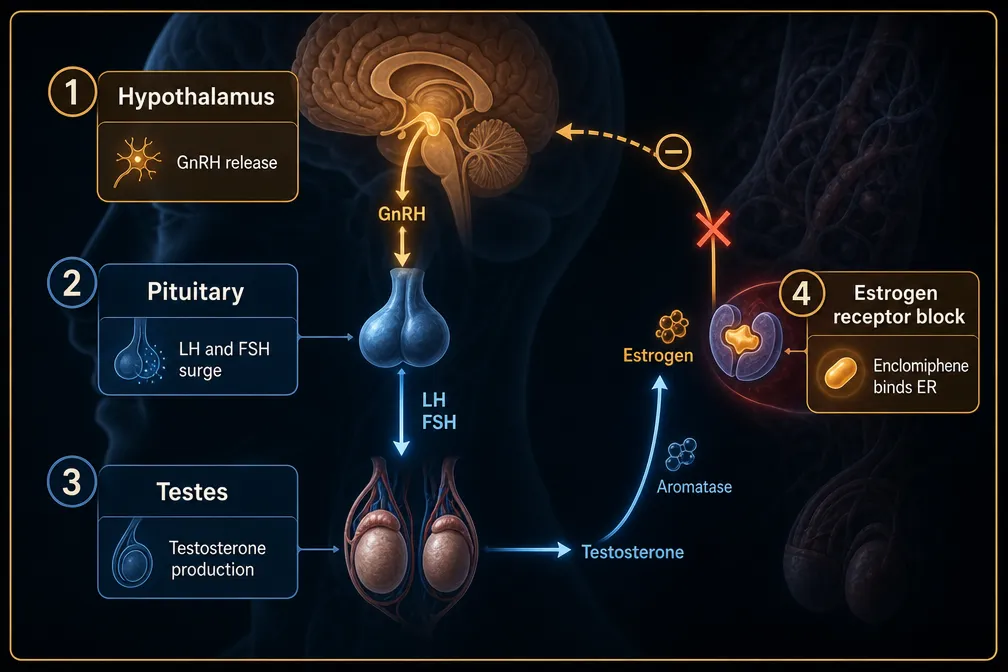
As of mid-2026, enclomiphene has not received FDA approval for any indication. It was studied extensively for male secondary hypogonadism under the investigational name Androxal, reaching Phase 3 trials before the development program was discontinued. Despite this history, the compound remains the subject of active off-label research interest, particularly for applications involving testosterone restoration with fertility preservation.

Because no approved finished-dosage product exists in the United States, researchers and compounding pharmacies working with this molecule rely on bulk active pharmaceutical ingredient (API). This is where the citrate salt form becomes especially relevant. Regulatory frameworks governing compounding, including the FDA's 503A and 503B pathways, require that any bulk substance used in compounding either appear on an approved list or undergo a formal bulk-substance evaluation. Enclomiphene citrate, as the salt form most commonly available as a bulk API, is subject to this scrutiny.

Researchers sourcing material for in vitro or preclinical work should be aware that the regulatory landscape for this compound is still evolving. Conflicting secondary listings across databases and supplier catalogs make primary-source verification essential. Always request documentation that specifies the exact chemical form, free base or citrate salt, along with a third-party COA confirming purity and identity.

For context on how regulatory complexity affects other research peptides and compounds, the discussion around GLP2-T peptide and GLP2 Tirz peptide naming confusion illustrates how labeling inconsistencies can create parallel problems in research interpretation.

Practical Formulation Guidance: Enclomiphene vs Enclomiphene Citrate for Research Use
Practical Formulation Guidance: Enclomiphene vs Enclomiphene Citrate for Research Use

When evaluating Enclomiphene vs Enclomiphene Citrate: What Researchers Need to Know Before Choosing a Formulation, the decision framework depends on the research context.

Key comparison points:

Factor Enclomiphene Base Enclomiphene Citrate
Active fraction per mg Higher (~100%) Lower (~70-75%)
Water solubility Lower Higher
Typical use context Reference standards, some research Compounded oral formulations
Dose conversion needed Baseline reference Yes, relative to base
Stability in solution Variable Generally improved

Researchers designing protocols should also consider handling and safety requirements. Enclomiphene citrate, like all serm compounds, requires standard laboratory precautions including appropriate personal protective equipment and proper storage conditions, typically refrigerated and protected from light and moisture.

The broader evidence landscape for enclomiphene sits within the larger serm and testosterone research context. Researchers comparing enclomiphene data against clomiphene or other serm studies should note that clomiphene is a racemic mixture containing both the active trans-isomer (enclomiphene) and the less active zuclomiphene. Enclomiphene's selective profile is one reason it attracted clinical development interest. This kind of isomer-level distinction parallels the precision required in other peptide research areas, for example, understanding how SS-31 mitochondrial research themes depend on precise molecular targeting, or how TB-500 research requires accurate compound identification before drawing mechanistic conclusions.

For researchers exploring endocrine signaling more broadly, related work on Tesamorelin science and sourcing and Retatrutide and MASLD triple-agonist research demonstrates how formulation precision consistently shapes the quality of endocrine and metabolic research outcomes.

Conclusion

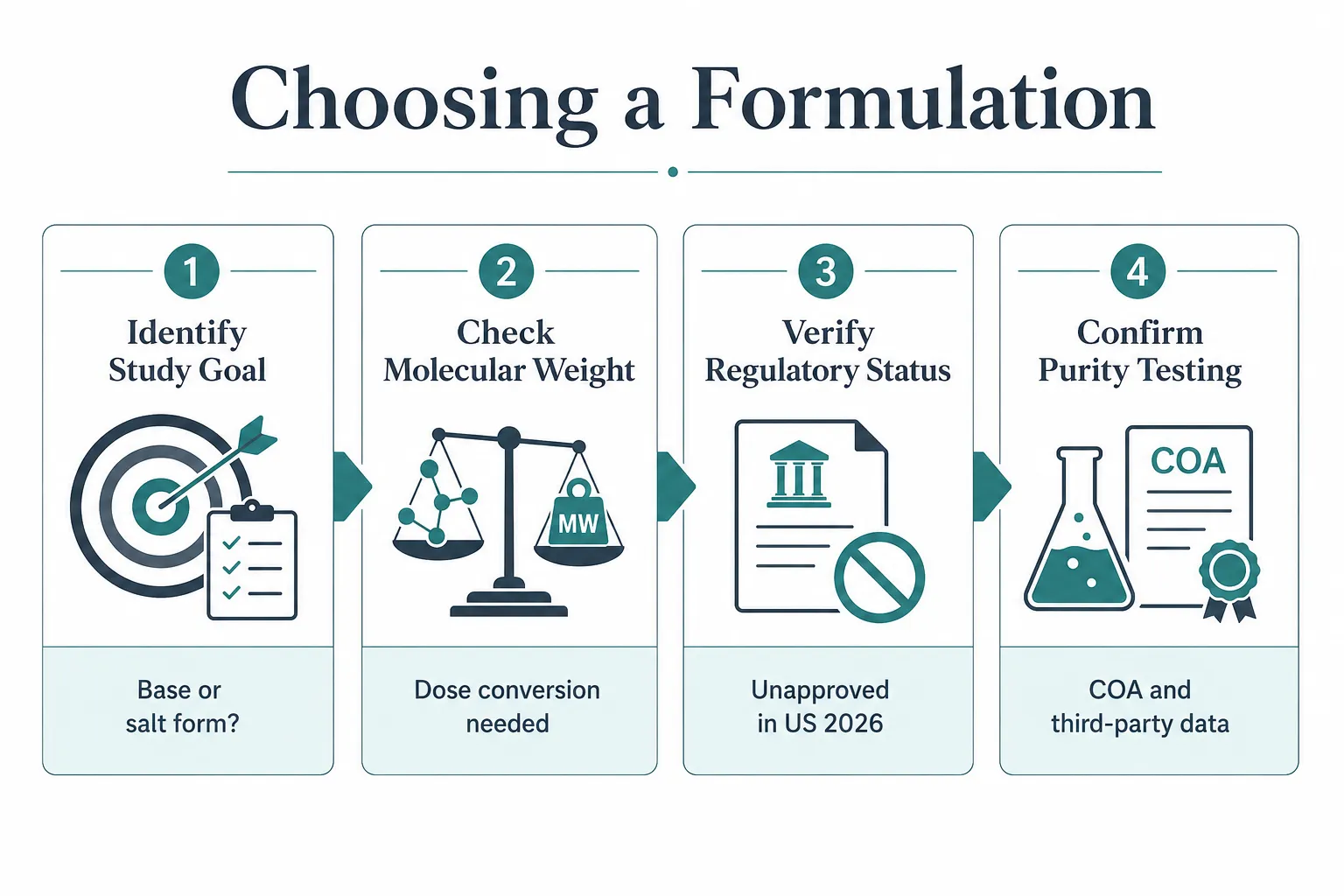
The distinction between enclomiphene and enclomiphene citrate is not semantic, it has direct consequences for dosing accuracy, study replication, and regulatory compliance. Researchers working with either form in 2026 should take three concrete steps before beginning any protocol.

  1. Confirm the exact chemical form on the COA, free base or citrate salt, and apply the appropriate molecular weight conversion before comparing doses across studies.
  2. Verify regulatory standing for the specific form being used, particularly if the research involves compounded material subject to bulk-substance evaluation requirements.
  3. Source from suppliers who provide third-party purity data and clearly disclose the chemical form on all documentation.

Precision at the formulation level is what separates reproducible research from ambiguous results. In a field where labeling inconsistencies are common, that precision starts with knowing exactly which compound is in the vial.

Tags: clomiphene isomers, compounding regulations, enclomiphene, enclomiphene citrate, enclomiphene formulation, enclomiphene vs enclomiphene citrate, endocrine research, male hypogonadism research, pharmaceutical salt forms, research compound sourcing, research peptides, serm research
https://www.puretestedpeptides.com/wp-content/uploads/2026/08/enclomiphene-vs-enclomiphene-citrate-what-researchers-need-to-know-before-choosi.webp 1024 1536 https://www.puretestedpeptides.com/wp-content/uploads/2026/01/buy-peptides-online.jpg 2026-08-19 13:04:512026-08-19 13:04:51Enclomiphene vs Enclomiphene Citrate: What Researchers Need to Know Before Choosing a Formulation
You might also like
The Fundamental Difference: Peptides vs. Polypeptides in Research and Their Distinct Applications The Fundamental Difference: Peptides vs. Polypeptides in Research and Their Distinct Applications
Peptides and Polypeptides in Modern Research: How Molecular Size Shapes Function, Stability, and Experimental Design Peptides and Polypeptides in Modern Research: How Molecular Size Shapes Function, Stability, and Experimental Design
Top 5 Research Peptides for Metabolic Health: An Updated Buyer's Guide Top 5 Research Peptides for Metabolic Health: An Updated Buyer’s Guide
Polypeptide Peptides Explained: Structure, Function, and Research Applications Polypeptide Peptides Explained: Structure, Function, and Research Applications
Semax Peptide Nasal Spray: Administration, Dosing Concepts, and Research Applications Semax Peptide Nasal Spray: Administration, Dosing Concepts, and Research Applications
Tesamorelin, Ipamorelin, and CJC-1295 With DAC: How Different GHRH Mimetic Profiles Shape Growth Hormone Study Outcomes Tesamorelin, Ipamorelin, and CJC-1295 With DAC: How Different GHRH Mimetic Profiles Shape Growth Hormone Study Outcomes
Semax Peptide Nasal Spray: Cognitive Enhancement, Neuroprotection, and Research Protocols Semax Peptide Nasal Spray: Cognitive Enhancement, Neuroprotection, and Research Protocols
The Broad Spectrum of Peptides: A Comprehensive Guide to Their Structure, Synthesis, and Diverse Research Applications The Broad Spectrum of Peptides: A Comprehensive Guide to Their Structure, Synthesis, and Diverse Research Applications
0 replies

Leave a Reply

Want to join the discussion?
Feel free to contribute!

Leave a Reply Cancel reply

Your email address will not be published. Required fields are marked *

×

Helpful Links

  • My account
  • Cart
  • Checkout
  • Refund and Returns Policy
  • Privacy Policy
  • SMS Privacy Policy
  • Login
  • My Account
  • Logout

USA Made Lab Tested Peptides

All products are sold for research, laboratory, or analytical purposes only, and are not for human consumption


Pure Tested Peptides is a chemical supplier. Pure Tested Peptides is not a compounding / chemical compounding facility as defined under 503A of the Federal Food, Drug, and Cosmetic act. Pure Tested Peptides is not an outsourcing facility as defined under 503B of the Federal Food, Drug, and Cosmetic act.

The statements made within this website have not been evaluated by the US Food and Drug Administration. The products we offer are not intended to diagnose, treat, cure or prevent any disease.

Human/Animal Consumption Prohibited. Laboratory/In-Vitro Experimental Use Only

Link to: Tesofensine vs GLP Peptides: Appetite Research Pathways Compared for Lab Buyers Link to: Tesofensine vs GLP Peptides: Appetite Research Pathways Compared for Lab Buyers Tesofensine vs GLP Peptides: Appetite Research Pathways Compared for Lab Bu...Tesofensine vs GLP Peptides: Appetite Research Pathways Compared for Lab Buyers Link to: Understanding Polypeptide Peptides: Mechanism of Action in Research Applications Link to: Understanding Polypeptide Peptides: Mechanism of Action in Research Applications Understanding Polypeptide Peptides: Mechanism of Action in Research ApplicationsUnderstanding Polypeptide Peptides: Mechanism of Action in Research Applica...
Scroll to top Scroll to top Scroll to top