

Tesofensine vs GLP Peptides: Appetite Research Pathways Compared for Lab Buyers
Only one in three obesity drug candidates that enters Phase 2 trials ever reaches approval, a statistic that makes the diverging fates of tesofensine and GLP-based peptides all the more instructive for researchers choosing where to direct their experimental budgets. The comparison of Tesofensine vs GLP Peptides: Appetite Research Pathways Compared for Lab Buyers is not simply a question of which compound produces more weight loss. It is a question of which neural circuit a lab wants to interrogate, which safety profile a protocol can accommodate, and which pipeline has the momentum to generate publishable, fundable science in 2026.
Key Takeaways
- Tesofensine targets monoamine reuptake and hypothalamic GABA neurons; GLP-based peptides act through incretin receptors and gut-brain signaling.
- GLP-1 agonists and dual/triple agonists dominate the current obesity pipeline, but tesofensine retains a distinct niche in monoamine-focused appetite research.
- Efficacy data favor newer dual and triple agonists for raw weight-loss magnitude; tesofensine's Phase 3 data from Mexico show meaningful but narrower results.
- Safety profiles differ substantially: tesofensine carries cardiovascular and stimulant-class risks; GLP peptides carry gastrointestinal tolerability concerns.
- Lab buyers should match compound selection to research question, not to headline weight-loss numbers alone.
Mechanism Deep Dive: How Each Pathway Controls Appetite
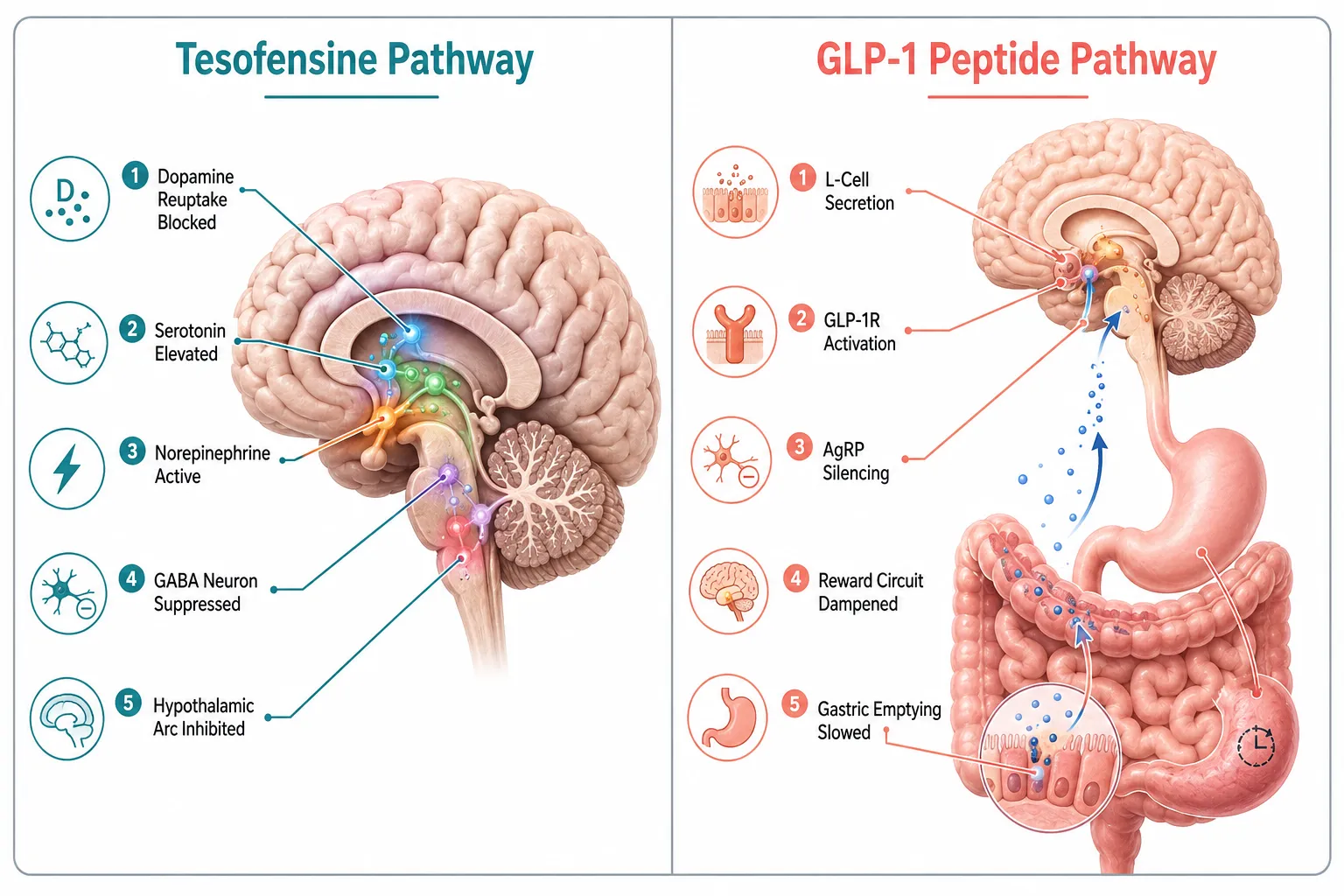
Understanding the biology is the first step in any rigorous comparison of Tesofensine vs GLP Peptides: Appetite Research Pathways Compared for Lab Buyers.
Tesofensine is a small-molecule triple monoamine reuptake inhibitor. It blocks the reuptake of dopamine, serotonin, and norepinephrine simultaneously. This elevates synaptic concentrations of all three neurotransmitters in regions that regulate energy balance. Critically, animal and human data indicate that tesofensine also suppresses a specific population of hypothalamic GABA neurons in the lateral hypothalamus, neurons that normally promote feeding. The result is a dual action: central stimulant-like appetite suppression combined with reduced reward salience for food.
GLP-1 peptides work through an entirely different axis. Glucagon-like peptide-1 is secreted by intestinal L-cells after eating. It binds GLP-1 receptors in the gut, pancreas, and brain. In the hypothalamus, GLP-1 receptor activation silences AgRP (agouti-related protein) neurons, the primary hunger-promoting neurons in the arcuate nucleus. GLP-1 also slows gastric emptying and modulates the mesolimbic reward circuit, reducing the motivational drive to eat. For a thorough breakdown of the GLP peptide family, see this researcher's guide to GLP-3, GLP-1, and GLP-2.
Dual agonists (GLP-1/GIP) and triple agonists add glucose-dependent insulinotropic polypeptide and glucagon receptor activity to the mix, amplifying both peripheral metabolic effects and central appetite suppression. Researchers tracking this frontier should review Retatrutide Phase 3 and beyond for the latest multi-agonist trial data.
Key distinction: Tesofensine answers questions about monoamine circuits and GABA-mediated feeding control. GLP peptides answer questions about incretin signaling, AgRP regulation, and gut-brain crosstalk. These are complementary, not interchangeable, research tools.
Efficacy and Safety: What the Data Show
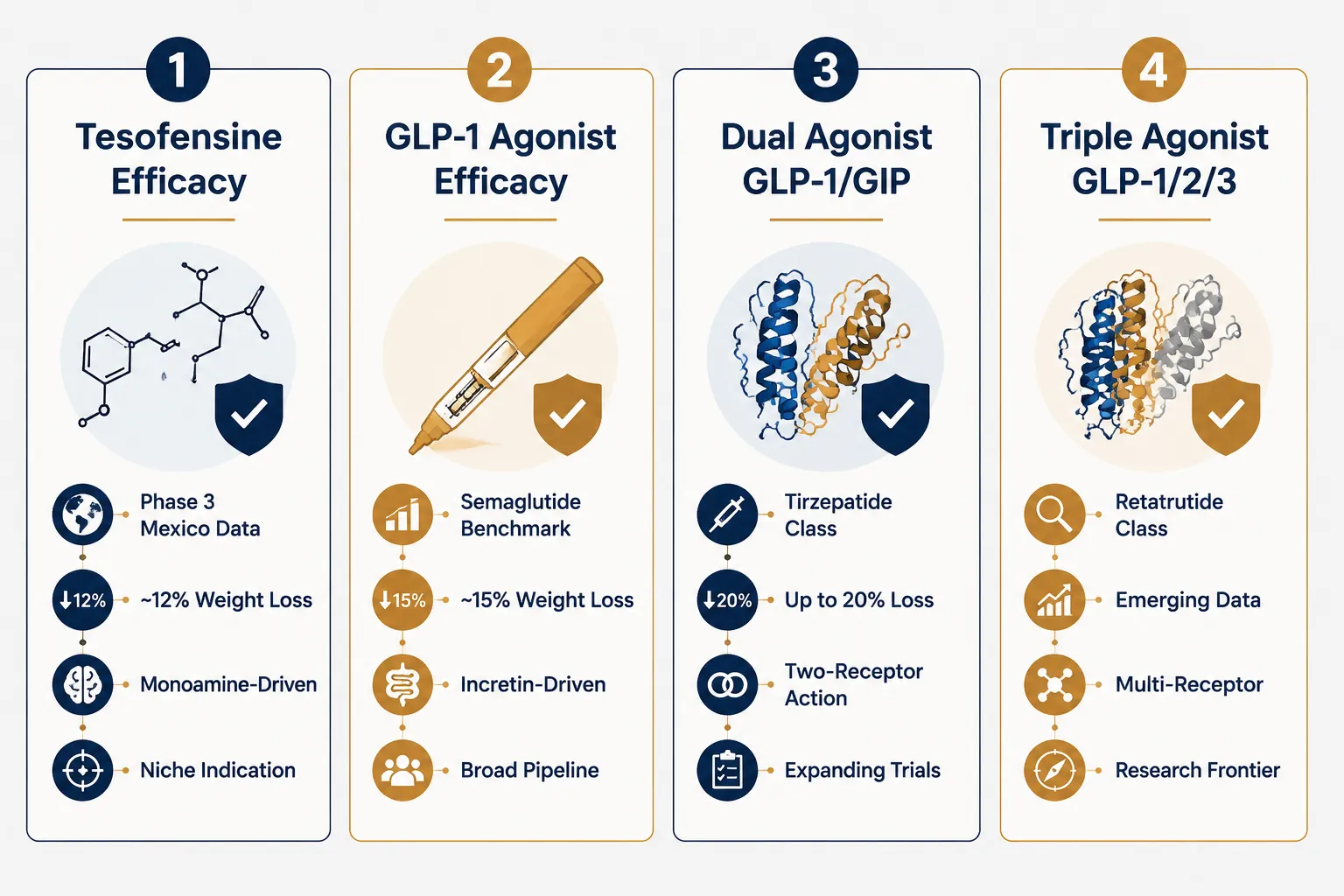
Weight-Loss Efficacy Compared
| Compound Class | Mechanism | Approximate Weight Loss (Trial Data) |
|---|---|---|
| Tesofensine | Triple monoamine reuptake inhibitor | ~10-12% body weight |
| GLP-1 agonist (semaglutide class) | GLP-1R agonism | ~15% body weight |
| Dual agonist (GLP-1/GIP) | GLP-1R + GIPR agonism | ~18-20% body weight |
| Triple agonist (retatrutide class) | GLP-1R + GIPR + GcgR | Up to 24% body weight |
Tesofensine's Phase 3 program, conducted primarily through a Mexican regulatory pathway, has confirmed meaningful weight reduction in obese adults. However, the magnitude sits below that of current GLP-1-based standards. This does not diminish tesofensine's research value, it simply frames where the compound fits. Labs studying monoaminergic contributions to appetite, or researching Parkinson's disease and obesity comorbidities, will find tesofensine's mechanism irreplaceable.
Safety Profiles: A Practical Comparison
Tesofensine risks to model in protocols:
- Elevated heart rate and blood pressure (sympathomimetic effect)
- Insomnia and dry mouth (monoamine elevation)
- Potential for abuse liability in dopaminergic circuits
- Contraindicated profiles overlap with stimulant-class compounds
GLP peptide risks to model in protocols:
- Nausea, vomiting, and diarrhea (dose-dependent, typically transient)
- Rare pancreatitis signals requiring monitoring
- Injection-site reactions for subcutaneous formulations
- Emerging data on muscle mass preservation with newer agonists
Labs sourcing GLP-1 compounds for in vitro or animal model work can explore GLP-1 peptides for research to compare available formats. Those evaluating hormone research protocols will also find relevant context for designing metabolic studies.
Strategic Considerations for Lab Buyers in 2026

The practical question for lab buyers is not "which is better" but "which answers my research question." Here is a structured decision framework:
Choose tesofensine when the research question involves:
- Monoamine reuptake inhibition and appetite regulation
- Hypothalamic GABA neuron activity
- Comparison of small-molecule vs peptide-based appetite suppression
- Neurological comorbidities (Parkinson's, Alzheimer's metabolic overlap)
Choose GLP peptides when the research question involves:
- Incretin signaling and pancreatic beta-cell function
- AgRP/NPY neuron suppression models
- Gut-brain axis communication
- Multi-receptor metabolic synergy (dual/triple agonist models)
For labs exploring next-generation metabolic peptides, the GLP-3 and retatrutide research overview provides critical context on where the triple-agonist pipeline is heading. Labs that need oral delivery formats should also review oral peptides for sale to assess formulation compatibility with their protocols.
Sourcing Quality: A Non-Negotiable Variable
Regardless of which pathway a lab chooses, purity and documentation are paramount. Monoamine studies require compounds free of serotonergic contaminants; GLP receptor binding assays are sensitive to aggregation artifacts. Reviewing high purity peptide sourcing standards before procurement prevents confounded results and wasted budget.
When comparing vendors, peptide supplier comparisons offer a practical framework for evaluating certificate-of-analysis standards across the market.
Conclusion
The Tesofensine vs GLP Peptides: Appetite Research Pathways Compared for Lab Buyers decision ultimately maps onto mechanism, not marketing. Tesofensine remains the compound of choice for monoamine-circuit research and specialized neurological-metabolic crossover studies. GLP-based peptides, particularly dual and triple agonists, command the broader pipeline and offer richer incretin and gut-brain research opportunities.
Actionable next steps for lab buyers:
- Define the primary neural circuit or receptor system under investigation before selecting a compound.
- Review the latest Phase 3 safety data for both compound classes and model contraindicated profiles into your protocol design.
- Audit supplier purity documentation; demand HPLC and mass spectrometry certificates for every lot.
- Consider running parallel mechanistic arms, one monoamine-focused, one incretin-focused, to generate comparative data within a single study design.
- Monitor the triple-agonist pipeline closely; retatrutide-class compounds are reshaping the research landscape faster than most procurement cycles can adapt.
Matching compound to question, and sourcing to standard, is what separates publishable science from inconclusive data.


Leave a Reply
Want to join the discussion?Feel free to contribute!