CJC-1295 With DAC Half-Life and Dosing Frequency: Why Formulation Matters in GH Research
A single chemical modification, the addition of a Drug Affinity Complex tail, extends a peptide's active window from roughly 30 minutes to approximately eight days. That gap is not a minor pharmacokinetic footnote; it fundamentally changes how growth hormone research is designed, how dosing schedules are structured, and what biological outcomes investigators can realistically expect. Understanding CJC-1295 With DAC Half-Life and Dosing Frequency: Why Formulation Matters in GH Research is therefore not optional background reading, it is the starting point for any rigorous GH study protocol in 2026.
Key Takeaways
- CJC-1295 with DAC achieves an estimated half-life of 6-8 days through albumin binding, enabling once- or twice-weekly dosing in research settings.
- The DAC modification is the sole structural reason for the extended half-life; removing it collapses the active window to roughly 30 minutes.
- Sustained GH elevation ("GH bleed") differs meaningfully from physiologic pulsatile release, a distinction that shapes research endpoint selection.
- Formulation choice, with or without DAC, is a primary design variable, not a secondary procurement decision.
- Nomenclature errors and mislabeling remain a documented problem in the 2026 peptide supply chain, making third-party verification essential.
The DAC Mechanism: How One Modification Changes Everything
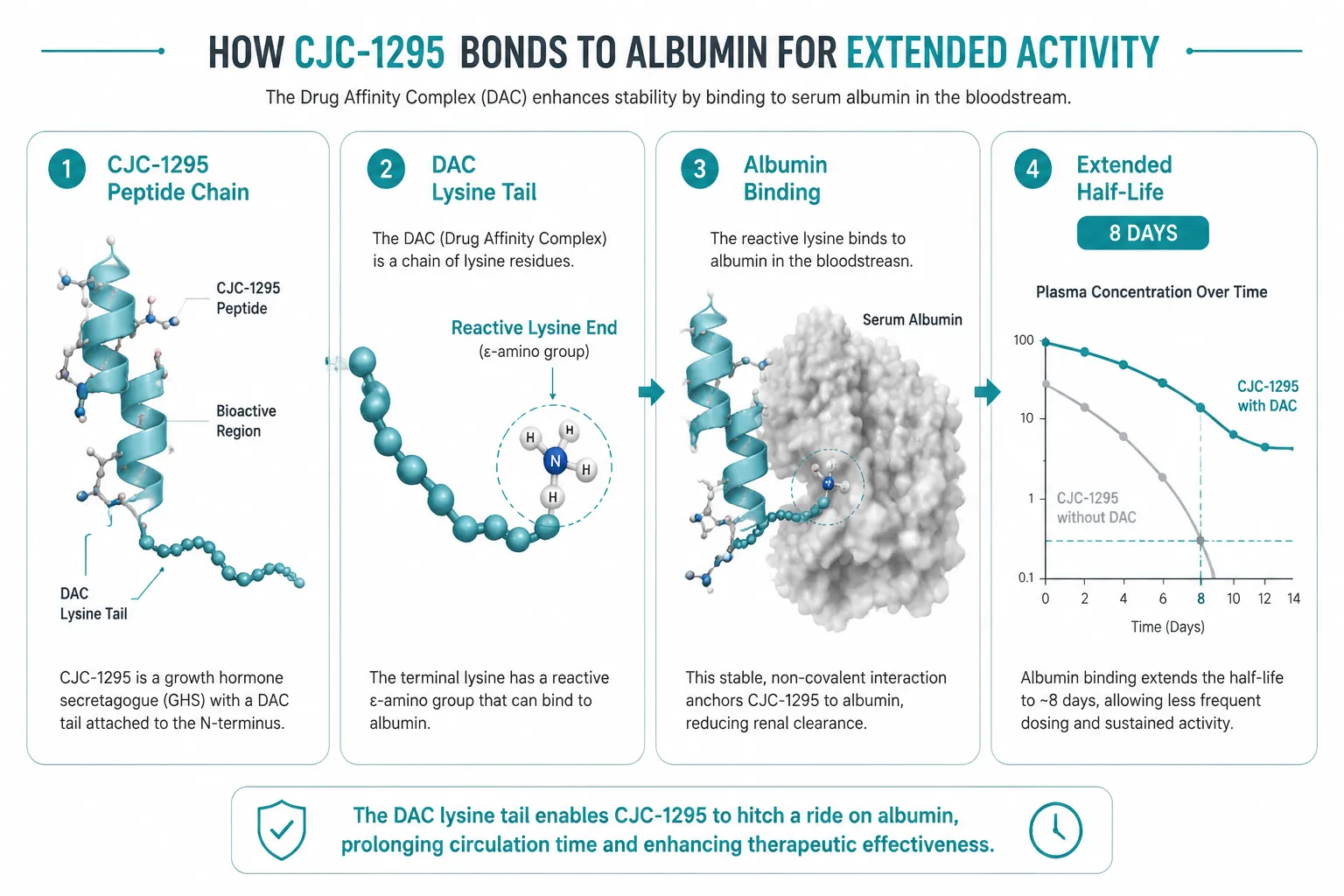
CJC-1295 is a synthetic analogue of growth hormone-releasing hormone (GHRH). In its base form, commonly called CJC-1295 without DAC or Modified GRF 1-29, the peptide stimulates the pituitary to release GH in a sharp, short burst before enzymatic degradation clears it from circulation. For a deeper look at how that shorter-acting version behaves, the article on CJC-1295 without DAC and why half-life matters in growth hormone research provides a useful parallel reference.
The DAC version adds a maleimidoproprionic acid-lysine linker, the Drug Affinity Complex, to the C-terminus of the peptide. This reactive group forms a covalent bond with cysteine-34 on circulating serum albumin. Because albumin has a natural half-life of roughly 19 days and is protected from renal filtration by its molecular weight, any peptide hitching a ride on albumin inherits a dramatically extended residence time.
The result: CJC-1295 with DAC achieves a documented half-life of approximately 6-8 days in preclinical and early human pharmacokinetic studies, compared to the 30-minute window of the no-DAC formulation. This is not a marginal improvement, it represents a roughly 300-fold increase in active exposure per dose.
"The DAC tail converts a transient GHRH mimetic into a sustained-release depot, fundamentally altering the pharmacodynamic profile and the entire research design logic that follows."
Dosing Frequency Implications: Once-Weekly vs. Twice-Weekly Patterns
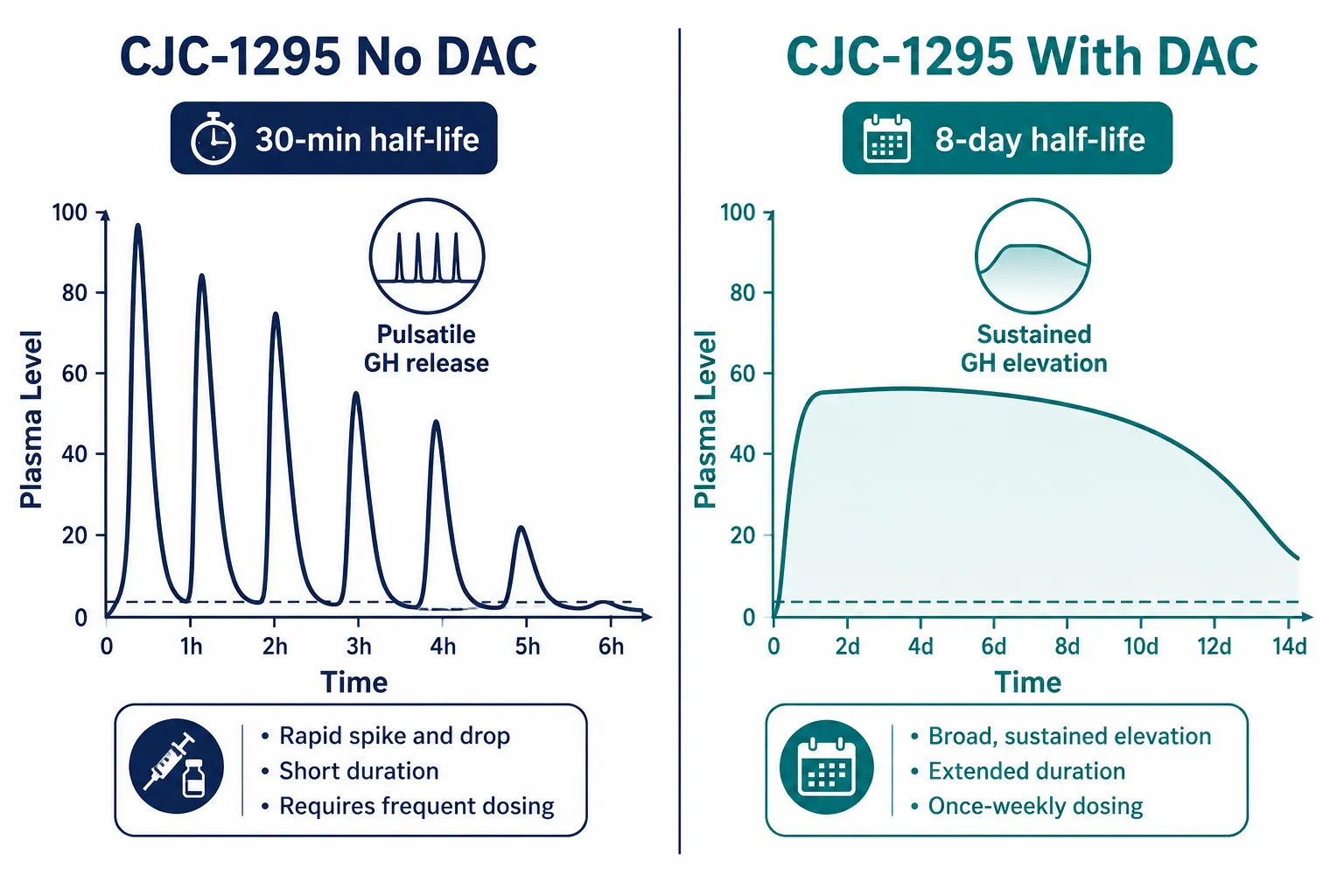
The extended half-life of CJC-1295 with DAC directly determines practical dosing intervals in research settings. Because plasma concentrations remain therapeutically relevant for approximately 7 days after a single administration, once-weekly dosing is the most commonly reported schedule in published research protocols. Some investigators use a twice-weekly schedule during initial loading phases to accelerate steady-state accumulation, then reduce to weekly maintenance.
Typical research dosing patterns observed in the literature:
| Schedule | Rationale | Common Research Context |
|---|---|---|
| Once weekly | Matches approximate half-life | Steady-state GH/IGF-1 elevation studies |
| Twice weekly | Faster steady-state accumulation | Short-duration loading protocols |
| Every 10-14 days | Conservative washout buffer | Safety or tolerability assessments |
This contrasts sharply with the no-DAC formulation, which requires daily or even multiple-daily administrations to maintain meaningful GH stimulation. Researchers exploring hormone research protocols should treat this dosing gap as a core variable when comparing outcomes across studies that used different formulations.
Washout and clearance also follow the extended half-life logic. Near-complete clearance of CJC-1295 with DAC requires approximately 2-4 weeks after the last dose, a window that must be factored into crossover study designs and endpoint timing.
GH Bleed vs. Physiologic Pulses: A Critical Research Design Distinction
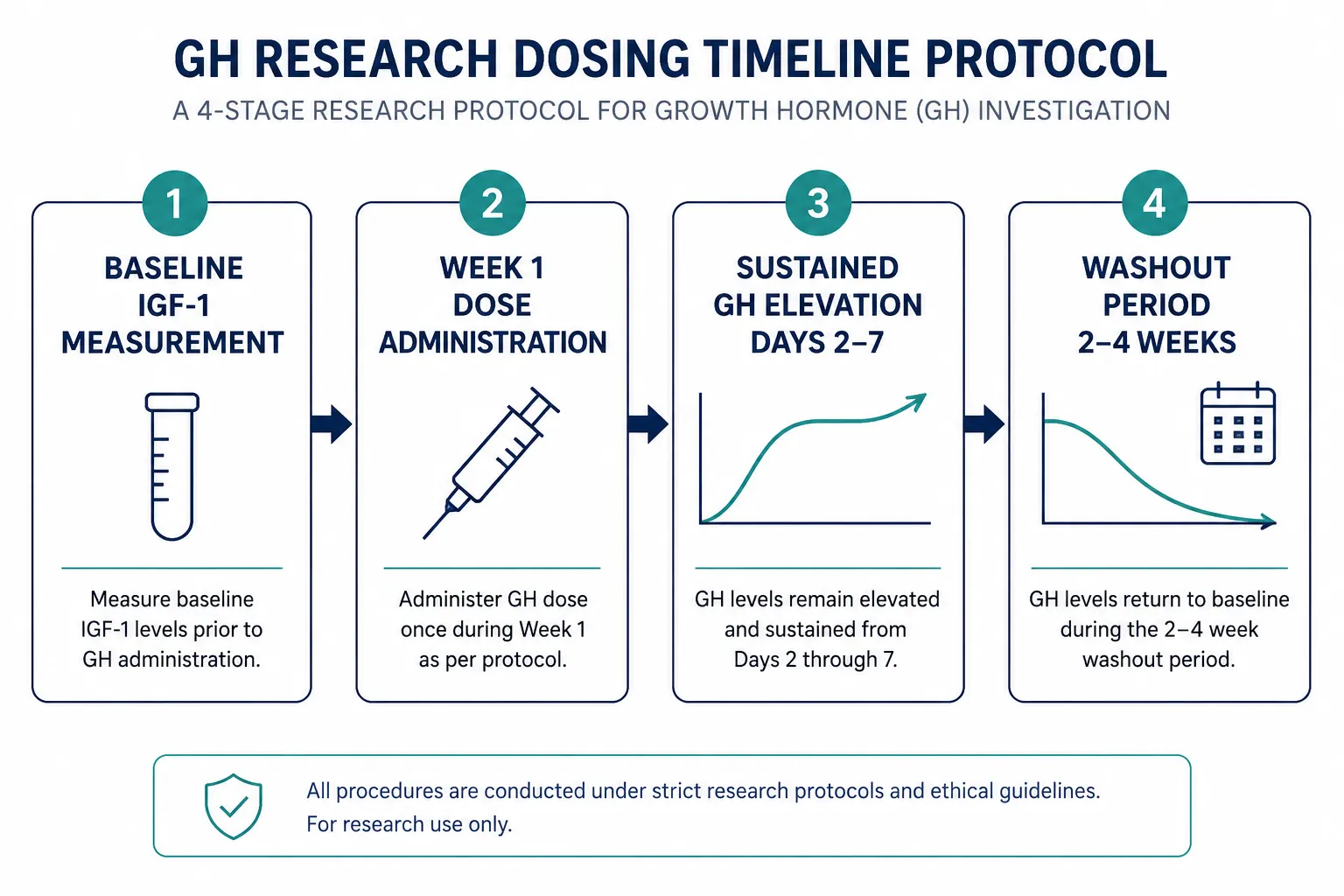
One of the most actively debated topics in 2026 GH research circles is the difference between the "GH bleed" pattern produced by CJC-1295 with DAC and the pulsatile GH release that characterizes normal physiology.
Natural GH secretion occurs in discrete pulses, primarily during slow-wave sleep, with trough levels near zero between peaks. CJC-1295 with DAC, by contrast, produces a sustained, relatively flat elevation of GH and downstream IGF-1 over days. This pattern has both advantages and limitations depending on research objectives:
Advantages of sustained GH elevation in research:
- Consistent IGF-1 elevation allows cleaner dose-response measurements
- Reduced intra-subject variability in GH readings
- Simpler blood sampling schedules
Limitations and considerations:
- Does not replicate the physiologic pulsatile pattern
- Prolonged GH exposure may confound endpoints sensitive to GH pulse amplitude
- Longer washout periods complicate crossover designs
Researchers studying metabolic outcomes or body composition changes may find the sustained profile advantageous. Those focused on neuroendocrine signaling or sleep architecture may prefer the pulsatile dynamics of the no-DAC version or combination approaches. Blend formulations that combine multiple peptides, such as those explored in Tesamorelin/CJC-1295/Ipamorelin 12mg blend research, add further complexity by layering GHRP activity onto the GHRH backbone.
For broader context on growth hormone research design principles, the sustained vs. pulsatile distinction is increasingly recognized as a primary variable rather than a secondary consideration.
Formulation Integrity and Nomenclature Challenges in 2026
The phrase "CJC-1295 With DAC Half-Life and Dosing Frequency: Why Formulation Matters in GH Research" carries a practical warning embedded in its title: formulation identity must be verified, not assumed. A 2026 market analysis of peptide supply chains identified persistent mislabeling between CJC-1295 with DAC and Modified GRF 1-29 (no DAC). Because the two compounds look identical in lyophilized powder form and share similar molecular weights, visual inspection cannot distinguish them.
Verification best practices for research procurement:
- Require certificate of analysis (CoA) from an independent third-party laboratory
- Confirm mass spectrometry data matches the expected molecular weight for the DAC-conjugated form
- Cross-reference HPLC purity data against published reference standards
- Source from suppliers with documented quality control processes
This is not a theoretical concern. A researcher who believes they are administering a once-weekly sustained-release compound but is actually using the no-DAC version will see dramatically different GH kinetics, potentially invalidating the study's conclusions. Similar quality-verification principles apply across the broader peptide research space, as discussed in resources like the BPC-157 core peptides documentation first research guide and MOTS-C peptide and mitochondrial biogenesis research.
Researchers working with multi-peptide stacks that include Sermorelin or Ipamorelin alongside CJC-1295 should also consult formulation-specific documentation, such as the Sermorelin/Ipamorelin/CJC-1295 combination reference.
Conclusion
The pharmacokinetic profile of CJC-1295 with DAC is not a background detail, it is the central design parameter around which every other element of a GH research protocol should be built. The 6-8 day half-life, driven by albumin binding through the DAC modification, enables once-weekly dosing, produces sustained IGF-1 elevation, and requires a 2-4 week washout window. Each of these characteristics creates both opportunities and constraints that differ fundamentally from the no-DAC formulation.
Actionable next steps for researchers in 2026:
- Clarify the research objective first. If pulsatile GH dynamics are relevant to the endpoint, the no-DAC formulation may be more appropriate. If sustained IGF-1 elevation is the goal, the DAC version offers a cleaner signal.
- Verify formulation identity independently. Do not rely on labeling alone; require third-party mass spectrometry and HPLC data before initiating a protocol.
- Design washout periods around the actual half-life. A minimum of 2-4 weeks is necessary for near-complete clearance, and crossover designs must account for this window explicitly.
- Document the formulation used in all published outputs. Ambiguous nomenclature in the literature contributes to reproducibility failures; specifying "with DAC" or "without DAC" in every reference prevents downstream confusion.
Formulation choice is a research lever. Using it deliberately, with a clear understanding of the pharmacokinetics involved, is what separates rigorous GH research from inconclusive data.