Call or Text 727-513-9780
  • Shopping Cart Shopping Cart
    0Shopping Cart
Pure Tested Peptides | America's most trusted Peptides for sale online
  • Peptides for sale
    • Oral Peptides for sale
      • Peptide Capsules for sale
      • BPC 157 Capsules 1000mcg
      • SLU-PP-332 Capsules | 1000 mcg
      • 5-Amino-1MQ 50mg Capsules
      • Tesofensine 500mcg
    • All Peptides for sale
    • Peptide Sprays
      • BPC 157 Nasal Spray Kit
      • BPC-157 TB500 Nasal Spray Kit
      • Semax Nasal Spray 10mg
      • Selank – Nasal Spray Kit – 10mg
      • Epithalon 50MG Nasal Spray Kit
      • Ipamorelin 10mg Nasal Spray
      • Klow Nasal Spray (BPC-157 + TB-500 + GHK-Cu + KPV) | 80mg
      • Hulk Nasal Spray Tesa / Ipa Blend 6/3 MG
      • Klow Nasal Spray
      • NAD + 500 mg Nasal Spray
      • PT-141 Nasal Spray Kit
    • GHRH Peptides
      • Ipa Peptides
      • CJC-1295 Peptides
        • CJC-1295 with DAC 5 mg
        • CJC-1295 without DAC 5 mg
        • CJC-1295 Ipa 10mg
      • Tesa Peptides
        • Tesa Peptide
        • Tesa 20 mg
    • GHK-Cu Peptides
      • All GHK-Cu Peptides
      • GHK-Cu 100mg
      • KLOW Peptide Blend – Buy KLOW blend online
    • BPC Peptides
      • All BPC Peptides
      • BPC-157
      • BPC-157 TB-500
      • BPC 157 capsules 1000mcg
    • SLU-PP-332 Peptides
      • All SLU-PP-332 Peptides
      • SLU-PP-332 5mg
    • GLP3 Peptides
    • PT-141 Peptides
      • PT-141 Peptides for sale
      • PT-141 10mg
      • PT-141 Nasal Spray
    • CAG Peptides
      • Lipo-C Peptide Blend
      • CAG 5mg
      • CAG 10mg
    • MOTS-C Peptides
      • MOTS-C Peptides for sale
      • MOTS-c peptide
      • MOTS-c 10mg *6 pack*
    • 5 Amino 1MQ Peptides
      • 5 Amino 1MQ Peptides for sale
      • 5-Amino-1MQ 50mg Capsules
      • 5-Amino-1MQ 5mg
    • Epithalon Peptides
      • Epithalon Peptides for sale
      • Epithalon 10mg
      • Epithalon 50mg
  • Shop
    • GLPs
      • 5-Amino-1MQ 50mg Capsules
      • 5-Amino-1MQ 5mg
      • L-Carnitine 500mg/ml
      • Tesofensine 500mcg
      • SLU-PP-332 5mg
      • MOTS-c 10mg *6 pack*
    • Epithalon & BPC Peptides
      • Epithalon 10mg
      • Epithalon 50mg
      • BPC-157
      • BPC 157 capsules 1000mcg
      • BPC-157 TB-500
      • BPC-157 TB500 Nasal Spray Kit
      • BPC 157 Nasal Spray Kit
    • BPC TB-500 & NAD+ Peptides
      • NAD+ 500 mg
      • KLOW Peptide Blend – Buy KLOW blend online
      • GLOW Peptide Blend
      • TB 500 5mg
      • BPC 157 capsules 1000mcg – Supplement
      • BPC 157 Nasal Spray Kit
      • BPC-157
      • BPC-157 TB500 Nasal Spray Kit
      • BPC-157 TB-500
      • BPC 157 capsules 1000mcg
    • LL-37 Peptide
      • LL-37 10 mg
    • MOTS-C & Selank
      • MOTS-c peptide
      • Selank 10mg
    • GHK Peptides
      • GHK-Cu 100mg
      • GLOW Peptide Blend
      • KLOW Peptide Blend – Buy KLOW blend online
  • COAs
  • Wholesale
    • Wholesale Peptides for sale
  • PTP FAQ
  • Affiliates
    • Selank Peptide: Advanced Pharmacological Mechanisms Underlying Its Anxiolytic and Nootropic Effects in Research
      • 5-Amino-1MQ Peptide: Detailed Mechanisms of NNMT Inhibition and Its Impact on Cellular Metabolism Research
        • MOTS-C Peptide: Unraveling Its Role in Mitochondrial Dynamics and Energy Metabolism Research
          • Epithalon Peptide and Telomerase Regulation: Investigating Its Impact on Cellular Senescence and Lifespan Research Models
            • GLP2-T vs GLP2 Tirz Peptide: Understanding the Naming, Mechanistic Nuances, and Research Implications for Gut Health
      • Peptides and Polypeptides in Modern Pharmacology: What Research on Metoprolol, Prednisone, and Amlodipine Reveals
        • Polypeptide Peptides vs NSAIDs: What Naproxen and Diclofenac Teach Tissue-Repair Researchers About BPC‑157 and TB‑500
          • Peptides and Polypeptides in Endocrine Pharmacology: How GLP-1, GLP-2, and GLP-3 Retatrutide Differ From Classic Drugs Like Prednisone and Amlodipine
          • 5‑Amino‑1MQ Peptide and NNMT Inhibition: How It Compares With Statins Like Atorvastatin in Adipose and Lipid Metabolism Research
      • Enclomiphene, Estrogen Receptor Signaling, and Luteinizing Phase Biology: What Hormone Researchers Should Measure
        • Mesenchymal Stem Cells, BPC‑157, and GHK‑Cu: How Tissue Repair Peptides Compare With Classic NSAIDs Like Naproxen in Injury Models
          • Peptide Calculator Use Cases Beyond Growth Hormone: Working Through GLP‑3 Retatrutide, MOTS‑c, and BPC‑157 Research Dosing
        • Polypeptide Peptides in Endocrine and Metabolic Pharmacology: Lessons From Amlodipine, Prednisone, and Metoprolol
        • Peptides Calculator for Advanced Blends: Worked Examples for Tesamorelin, CJC‑1295, and Ipamorelin Stacks
          • Peptides and Polypeptides in Human Physiology: How Molecular Size Shapes Research Applications
            • Selank Peptide: Advanced Pharmacological Mechanisms Underlying Its Anxiolytic and Nootropic Effects in Research
          • 5-Amino-1MQ Peptide: Detailed Mechanisms of NNMT Inhibition and Its Impact on Cellular Metabolism Research
            • MOTS-C Peptide: Unraveling Its Role in Mitochondrial Dynamics and Energy Metabolism Research
              • Epithalon Peptide and Telomerase Regulation: Investigating Its Impact on Cellular Senescence and Lifespan Research Models
                • GLP2-T vs GLP2 Tirz Peptide: Understanding the Naming, Mechanistic Nuances, and Research Implications for Gut Health
                  • Peptides and Polypeptides in Endocrine Pharmacology: How GLP-1, GLP-2, and GLP-3 Retatrutide Differ From Classic Drugs Like Prednisone and Amlodipine
                    • Polypeptide Peptides vs NSAIDs: What Naproxen and Diclofenac Teach Tissue-Repair Researchers About BPC‑157 and TB‑500
                      • Peptides and Polypeptides in Modern Pharmacology: What Research on Metoprolol, Prednisone, and Amlodipine Reveals
                        • 5‑Amino‑1MQ Peptide and NNMT Inhibition: How It Compares With Statins Like Atorvastatin in Adipose and Lipid Metabolism Research
                        • Enclomiphene, Estrogen Receptor Signaling, and Luteinizing Phase Biology: What Hormone Researchers Should Measure
                        • Mesenchymal Stem Cells, BPC‑157, and GHK‑Cu: How Tissue Repair Peptides Compare With Classic NSAIDs Like Naproxen in Injury Models
                        • Peptide Calculator Use Cases Beyond Growth Hormone: Working Through GLP‑3 Retatrutide, MOTS‑c, and BPC‑157 Research Dosing
                        • Polypeptide Peptides in Endocrine and Metabolic Pharmacology: Lessons From Amlodipine, Prednisone, and Metoprolol
                        • Peptides Calculator for Advanced Blends: Worked Examples for Tesamorelin, CJC‑1295, and Ipamorelin Stacks
                        • Peptides and Polypeptides in Human Physiology: How Molecular Size Shapes Research Applications
                        • Selank Peptide: Advanced Pharmacological Mechanisms Underlying Its Anxiolytic and Nootropic Effects in Research
                        • MOTS-C Peptide: Unraveling Its Role in Mitochondrial Dynamics and Energy Metabolism Research
                        • Peptides and Polypeptides in Modern Pharmacology: What Research on Metoprolol, Prednisone, and Amlodipine Reveals
                        • Peptides and Polypeptides in Endocrine Pharmacology: How GLP-1, GLP-2, and GLP-3 Retatrutide Differ From Classic Drugs Like Prednisone and Amlodipine
                        • 5-Amino-1MQ Peptide: Detailed Mechanisms of NNMT Inhibition and Its Impact on Cellular Metabolism Research
                        • Mesenchymal Stem Cells, BPC‑157, and GHK‑Cu: How Tissue Repair Peptides Compare With Classic NSAIDs Like Naproxen in Injury Models
                        • Peptide Calculator Use Cases Beyond Growth Hormone: Working Through GLP‑3 Retatrutide, MOTS‑c, and BPC‑157 Research Dosing
                        • GLP2-T vs GLP2 Tirz Peptide: Understanding the Naming, Mechanistic Nuances, and Research Implications for Gut Health
                        • Polypeptide Peptides in Endocrine and Metabolic Pharmacology: Lessons From Amlodipine, Prednisone, and Metoprolol
                        • Polypeptide Peptides vs NSAIDs: What Naproxen and Diclofenac Teach Tissue-Repair Researchers About BPC‑157 and TB‑500
                        • Peptides and Polypeptides in Human Physiology: How Molecular Size Shapes Research Applications
                        • Peptides Calculator for Advanced Blends: Worked Examples for Tesamorelin, CJC‑1295, and Ipamorelin Stacks
                        • 5‑Amino‑1MQ Peptide and NNMT Inhibition: How It Compares With Statins Like Atorvastatin in Adipose and Lipid Metabolism Research
                        • Enclomiphene, Estrogen Receptor Signaling, and Luteinizing Phase Biology: What Hormone Researchers Should Measure
                        • Epithalon Peptide and Telomerase Regulation: Investigating Its Impact on Cellular Senescence and Lifespan Research Models
                        • Best research protocol Klow blend
                        • best time to take BPC-157
                        • best time to take DSIP (Delta Sleep Inducing Peptide)
                        • best time to take CJC-1295
                        • best time to take AOD-9604
                        • best time to take Follistatin 344
                        • best time to take Ipamorelin
                        • best time to take MK-677 (Ibutamoren)
                        • best time to take Ligandrol (LGD-4033) — research compound
                        • best time to take Ostarine (MK-2866) — research compound
                        • best time to take GHK-CU
                        • best time to take TB-500
                        • best time to take MOTS-c
                        • best time to take Semax
                        • best time to take RAD-140 (Testolone) — research compound
                        • best time to take Thymosin Alpha-1
                        • best time to take PEG-MGF
                        • Biolife Plasma, Octapharma Plasma, and Research Peptides: How Plasma Donation Labs Differ From Peptide Suppliers
                        • best time to take YK-11 — research compound
                        • best time to take PT-141 (Bremelanotide)
                        • Best research protocol Klow blend
                        • 5-Amino-1MQ and MOTS-C Synergy: Metabolic Signaling, Mitochondria, and Research Design
                        • BPC-157 and TB-500: Investigating Their Combined Effects on Angiogenesis and Cellular Migration in Tissue Repair Models
                        • BPC-157 Peptide: Gut Barrier Function, Inflammation, and Tissue-Recovery Research
                        • 5‑Amino‑1MQ and MOTS‑c Synergy in Metabolic Research: Designing NNMT and Mitochondrial Biogenesis Stacks
                        • CJC-1295 with DAC vs. Without DAC: Half-Life, Release Kinetics, and Research Implications
                        • CJC‑1295 with DAC vs. Without DAC: Expanding on Half‑Life Differences Using Tesamorelin and Ipamorelin Blend Case Studies
                        • Collagen Biology and Copper‑Binding Peptides: How GHK‑Cu, Glow Blend, and Klow Blend Interact with Skin and Connective Tissue
                        • Collagen Biology and Regenerative Peptides: How GHK‑Cu, Glow Blend, and Klow Blend Affect Extracellular Matrix Research
                    • DNA, Telomeres, and Longevity Peptides: Positioning Epithalon and MOTS‑c in Genetic Aging Research
                      • Enclomiphene Citrate: serm Mechanism, Testosterone Research, and Stack Compatibility
                        • Enclomiphene vs Enclomiphene Citrate: Formulation, Bioavailability, and Research Distinctions
                        • Epithalon Peptide Research: Telomerase Activation, Aging, and Pineal Gland Function
                        • Estrogen Receptor Signaling and Enclomiphene: How Selective Modulators Compare with Classic Polypeptide Hormones
                        • GHK-Cu Peptide: Advanced Mechanisms in Extracellular Matrix Remodeling and Wound Healing Research
                        • GHK-Cu Peptide: Collagen Synthesis, Wound Repair, and Skin-Barrier Research Models
                        • GLP-1 vs GLP-3 vs GLP-2: Peptide Classification and Research Applications
                        • GLP-2 Peptide Research Guide: Gut Barrier Function, Nutrient Absorption, and Intestinal Recovery Models
                        • GLP-3 Retatrutide vs. GLP-1 Drugs: What Triple-Agonist Biology Changes in Research Models
                        • Ipamorelin and Tesamorelin Combination: Synergistic GH Secretagogue Research and Dosing Protocols
                        • GLP2 Tirz Peptide: What It Is, Why the Name Exists, and How Researchers Should Interpret It
                        • Klow Blend Peptide Nasal Spray: What the Formulation Is Trying to Do in Cognitive Research
                        • Mitochondria, NNMT Inhibition, and Peptide Modulators: Where MOTS‑c and 5‑Amino‑1MQ Fit in Cellular Energy Research
                        • MOTS-c Peptide: Mitochondrial Function, Energy Metabolism, and What Researchers Measure
                        • MOTS-c vs. 5-Amino-1MQ: Which Metabolic Research Questions Each Compound Actually Answers
                        • Nasal Spray Peptides: Bioavailability, Administration, and Semax/Selank Research Applications
                        • PT-141 Peptide Research: Mechanism of Action and Melanocortin Receptor Signaling
                        • Retatrutide for Research: Mechanism, Structure, and GLP-1/GLP-3 Dual Action
                        • Retatrutide for Obesity and Type 2 Diabetes: What the Latest Trial Data Suggest
                        • Tesofensine Peptide Research: Mechanism, Appetite Suppression, and Neuropeptide Y Pathways
  • Contact
    • Contact Customer Service
    • Text Customer Support
  • About US
  • Shop all peptides
  • Affiliate Program
    • Affiliate Signup
  • Login / Register Login / Register Page Link Login / Register Page Link
  • Click to open the search input field Click to open the search input field Search
  • Menu Menu
Tesofensine Research Guide: Appetite, Dopamine, and Noradrenergic Pathways Explained

Tesofensine Research Guide: Appetite, Dopamine, and Noradrenergic Pathways Explained

September 19, 2026/0 Comments/in Uncategorized/by

Fewer than a handful of investigational compounds have demonstrated double-digit percentage body weight reductions in Phase II trials, tesofensine is one of them. That single fact has kept researchers, clinicians, and metabolic scientists engaged with this molecule for well over a decade, even as its regulatory path has remained unresolved. This Tesofensine Research Guide: Appetite, Dopamine, and Noradrenergic Pathways Explained breaks down the core neuroscience, the clinical data landscape, and the open research questions that make tesofensine a compelling subject in 2026.

Key Takeaways

  • Tesofensine simultaneously inhibits dopamine, norepinephrine, and serotonin reuptake, producing appetite suppression and increased energy expenditure through central pathways.
  • Phase II obesity trials showed dose-dependent weight loss significantly greater than most contemporary comparators, but no Phase III obesity program is currently active.
  • The noradrenergic pathway is central to appetite regulation; blocking the norepinephrine transporter (NET) reduces hunger signaling in the hypothalamus.
  • The most active clinical application as of 2026 is Tesomet, a tesofensine-metformin combination targeting hypothalamic obesity.
  • Cardiovascular monitoring, particularly heart rate elevation, remains a key safety consideration, with metoprolol co-administration used in some protocols.

How Tesofensine Works: Triple Monoamine Reuptake Inhibition

Tesofensine belongs to a class called triple monoamine reuptake inhibitors (TRIs). It blocks three transporter proteins simultaneously: the dopamine transporter (DAT), the norepinephrine transporter (NET), and the serotonin transporter (SERT). By preventing these transporters from recycling their respective neurotransmitters back into the presynaptic neuron, tesofensine raises synaptic concentrations of all three monoamines at once.
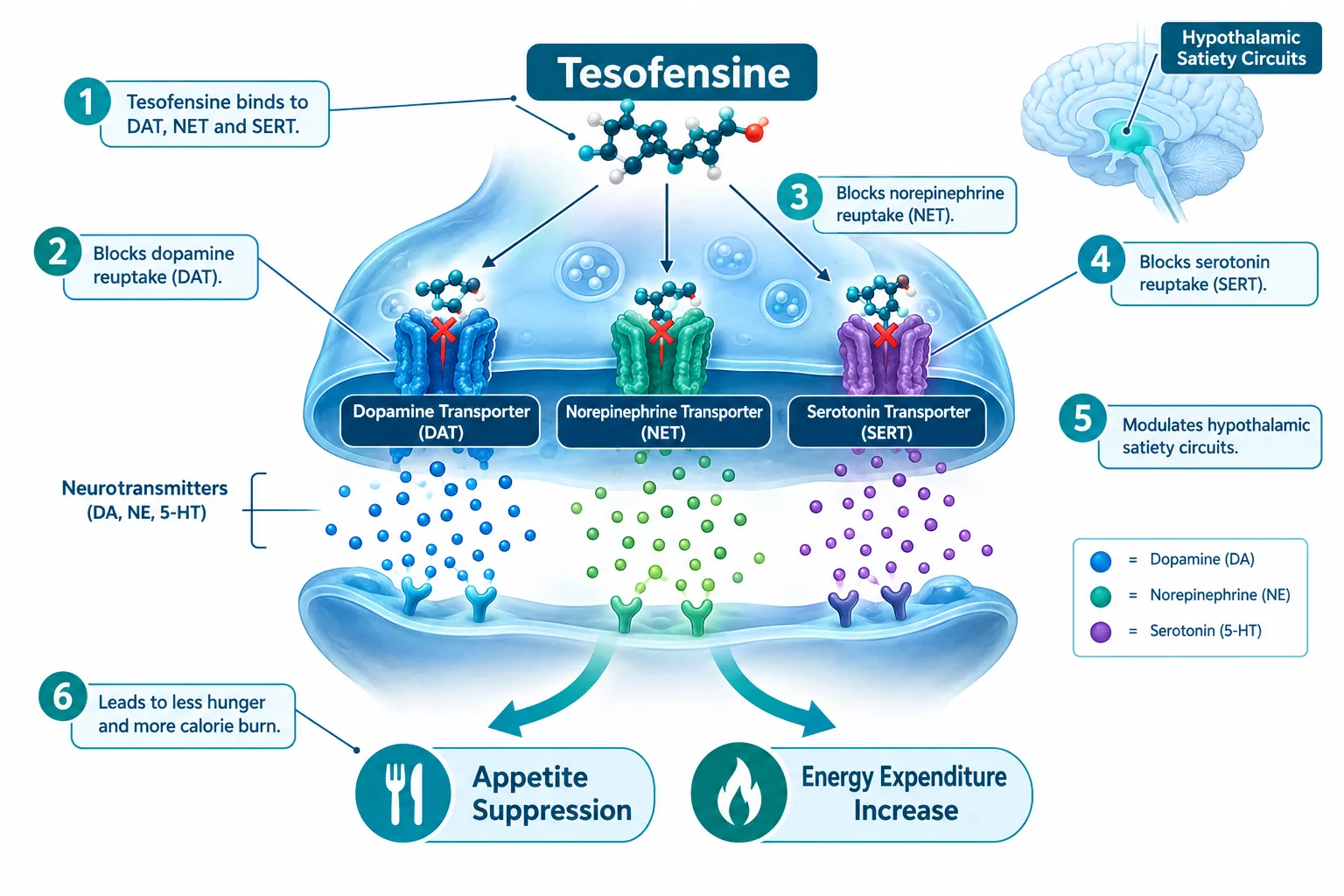
How Tesofensine Works: Triple Monoamine Reuptake Inhibition

This is mechanistically distinct from older agents. Sibutramine, for example, also inhibited monoamine reuptake but carried significant cardiovascular liabilities that led to its market withdrawal. Tesofensine's receptor selectivity profile differs in ways that researchers believe may translate to a more favorable risk-benefit ratio, though this remains under active investigation.

Why does blocking all three transporters matter for appetite?

Each monoamine contributes differently to energy balance:

Neurotransmitter Primary Role in Appetite Regulation
Dopamine Reward signaling, motivation to eat, food-seeking behavior
Norepinephrine Hypothalamic satiety signaling, metabolic rate modulation
Serotonin Meal termination, carbohydrate preference reduction

Raising all three simultaneously creates a synergistic effect on satiety that neither dopaminergic nor noradrenergic agents achieve alone. For researchers comparing small-molecule approaches to newer incretin-based therapies, understanding this distinction is essential. A detailed look at how tesofensine compares to GLP-class polypeptide drugs provides important mechanistic context.

The Noradrenergic Pathway in Detail

The norepinephrine transporter is arguably the most critical target for tesofensine's appetite-suppressing effects. NET blockade increases norepinephrine availability in the hypothalamus, specifically in regions like the arcuate nucleus and the paraventricular nucleus. These areas integrate peripheral hunger signals, including leptin and ghrelin, and translate them into behavioral responses.

Elevated norepinephrine in these circuits suppresses neuropeptide Y (NPY) release, a potent hunger-driving peptide. It also activates pro-opiomelanocortin (POMC) neurons, which promote satiety. The result is a dual action: hunger signals are dampened while fullness signals are amplified.

Research note: Noradrenergic agents have historically been used as appetite suppressants, but their cardiovascular side effects, elevated blood pressure and heart rate, have limited their clinical utility. Tesofensine's profile in this regard is discussed further in the safety section below.

Clinical Research Landscape: Phase II Data and the Tesomet Program

The most cited evidence base for tesofensine comes from a 24-week Phase II randomized controlled trial in adults with obesity. Participants receiving 0.5 mg daily lost approximately 10% of body weight on average, compared to roughly 2% in the placebo group. The 1.0 mg dose produced even greater weight loss, though with a corresponding increase in cardiovascular signals including elevated heart rate.
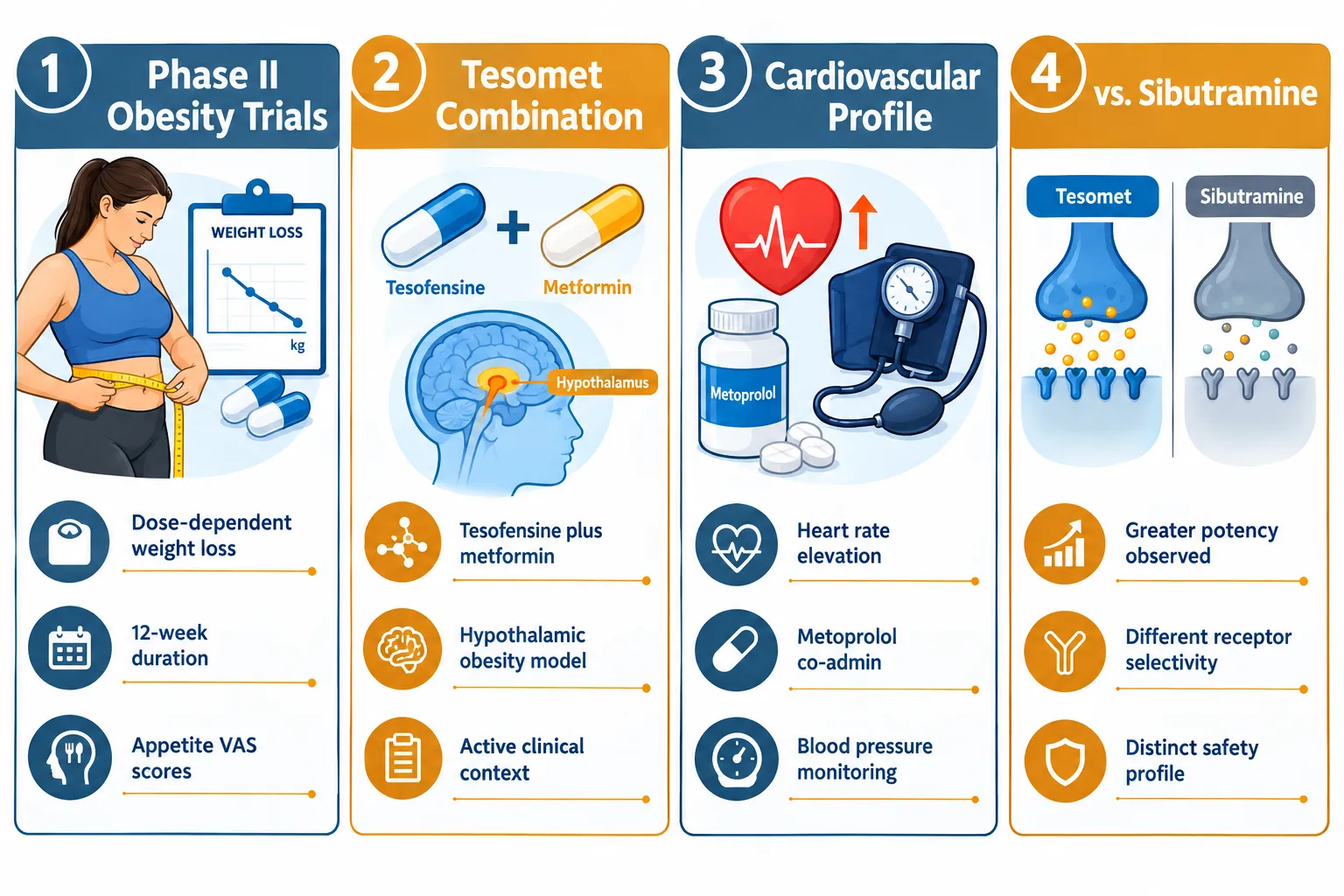
Clinical Research Landscape: Phase II Data and the Tesomet Program

These results positioned tesofensine among the most efficacious small-molecule weight-loss compounds studied at that time. However, the cardiovascular signals observed, particularly increased heart rate, slowed progression to Phase III for the obesity indication.

Key findings from Phase II obesity research:

  • Dose-dependent weight loss: higher doses produced greater reductions
  • Significant reductions in appetite scores measured by visual analog scales (VAS)
  • Improvements in waist circumference, triglycerides, and fasting glucose
  • Heart rate increases of approximately 7-8 beats per minute at therapeutic doses
  • No significant blood pressure elevation at the 0.5 mg dose in most subjects

Tesomet: The Active Clinical Context in 2026

The most clinically active tesofensine program as of 2026 is Tesomet, a fixed-dose combination of tesofensine and metformin. The primary target population is hypothalamic obesity, a condition caused by damage to hypothalamic appetite-regulating circuits, often following craniopharyngioma surgery. This population has extremely limited treatment options, which makes Tesomet's mechanism particularly relevant.

Metformin is included partly for its metabolic benefits and partly because it may offset some of the cardiovascular effects associated with tesofensine. Researchers studying this combination are also examining whether the metformin component improves insulin sensitivity in ways that complement tesofensine's central appetite effects.

For context on how combination peptide and small-molecule approaches work in research models, the IPA Sermorelin stack research overview offers a useful parallel for understanding synergistic compound strategies.

Neurocircuitry, Safety, and Research Design Considerations

This section of the Tesofensine Research Guide: Appetite, Dopamine, and Noradrenergic Pathways Explained addresses the broader neurological context and practical considerations for researchers.
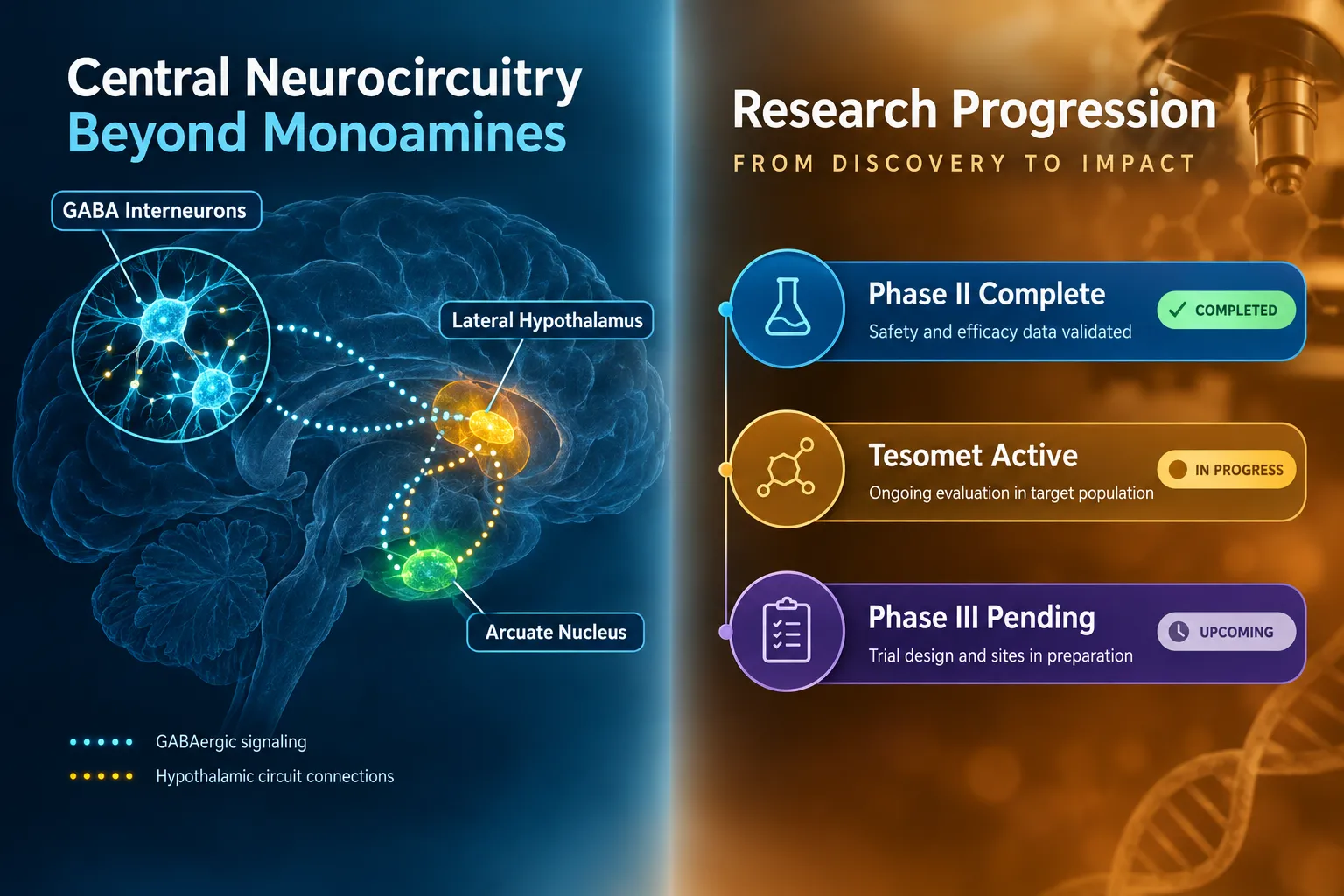
Neurocircuitry, Safety, and Research Design Considerations

Tesofensine's effects extend beyond the three monoamine transporters. Downstream, elevated dopamine and norepinephrine modulate GABAergic interneurons within the lateral hypothalamus. These interneurons gate the activity of orexin neurons, which regulate arousal and feeding motivation. This means tesofensine's appetite effects involve a multi-layer circuit, not simply a direct receptor interaction.

Broader neurocircuitry targets identified in preclinical research:

  • Arcuate nucleus POMC/AgRP neuron balance
  • Lateral hypothalamic orexin circuit modulation via GABAergic interneurons
  • Mesolimbic dopamine pathway (reward and food motivation)
  • Prefrontal cortical inputs to hypothalamic satiety circuits

Cardiovascular Safety and Metoprolol Co-Administration

The heart rate elevation associated with NET blockade is the primary cardiovascular concern in tesofensine research. In several clinical protocols, the beta-blocker metoprolol has been co-administered to attenuate this effect without significantly reducing the weight-loss efficacy. This approach is notable because it suggests the cardiovascular signal is pharmacologically manageable rather than intrinsic to the compound's mechanism of efficacy.

Researchers designing tesofensine studies in 2026 should include:

  1. Baseline cardiovascular assessment including resting heart rate and blood pressure
  2. Electrocardiographic monitoring at dose escalation points
  3. Pre-specified stopping rules for sustained tachycardia
  4. Consideration of beta-blocker co-administration protocols

Positioning Versus GLP-1 and Incretin Therapies

The rise of GLP-1 receptor agonists and multi-incretin drugs has reshaped the obesity treatment landscape significantly. Tesofensine operates through a fundamentally different mechanism, central monoaminergic rather than peripheral hormonal, which means the two approaches are not necessarily competitive. Some researchers have proposed that central monoaminergic agents could complement incretin therapies by addressing reward-driven eating behaviors that GLP-1 agents do not directly target.

For researchers exploring the incretin side of this comparison, resources on GLP-3 and retatrutide research models provide useful mechanistic contrast. Understanding peptide fundamentals is also well-covered in the Peptides 101 for research-use-only buyers guide.

Regulatory status as of mid-2026: Tesofensine has not received approval from any major regulatory agency for any indication. There is no active Phase III program for the obesity indication. The Tesomet combination remains in clinical development for hypothalamic obesity and related conditions.

Conclusion

The Tesofensine Research Guide: Appetite, Dopamine, and Noradrenergic Pathways Explained reveals a compound with a well-characterized mechanism, compelling Phase II efficacy data, and a nuanced safety profile that has shaped, but not ended, its clinical development. For researchers in 2026, the actionable next steps are clear:

  • Understand the mechanism fully before designing experiments: triple reuptake inhibition creates multi-pathway effects that require multi-endpoint study designs.
  • Monitor cardiovascular parameters rigorously and consider metoprolol co-administration protocols when heart rate elevation is a concern.
  • Contextualize tesofensine within the broader metabolic research landscape, particularly relative to GLP-1 and incretin-based approaches, to identify where its central monoaminergic mechanism adds unique value.
  • Follow the Tesomet program as the most active clinical signal for tesofensine's near-term research relevance.
  • Distinguish speculation from evidence: Phase III data for obesity does not yet exist, and extrapolating from Phase II results requires careful qualification.

Tesofensine remains one of the most pharmacologically interesting small molecules in appetite and metabolic research. Its dopaminergic, noradrenergic, and serotonergic mechanisms offer a distinct window into central appetite regulation that neither peptide-based nor incretin-based approaches fully replicate.

Tags: appetite suppression research, dopamine appetite regulation, hypothalamic obesity, monoamine transporters, noradrenergic pathways, tesofensine research, tesomet clinical trial, triple reuptake inhibitor
https://www.puretestedpeptides.com/wp-content/uploads/2026/09/tesofensine-research-guide-appetite-dopamine-and-noradrenergic-pathways-explaine.webp 1024 1536 https://www.puretestedpeptides.com/wp-content/uploads/2026/01/buy-peptides-online.jpg 2026-09-19 13:04:082026-09-19 13:04:08Tesofensine Research Guide: Appetite, Dopamine, and Noradrenergic Pathways Explained
You might also like
Tesofensine Mechanism in Appetite Research: Where Noradrenergic Modulation Fits Alongside GLP Peptides Tesofensine Mechanism in Appetite Research: Where Noradrenergic Modulation Fits Alongside GLP Peptides
Tesofensine: Mechanism, Appetite Pathways, and Research Use in Metabolic Studies Tesofensine: Mechanism, Appetite Pathways, and Research Use in Metabolic Studies
Tesofensine vs GLP-3 Peptides in Metabolic Research: How Labs Decide Which Compounds to Order Tesofensine vs GLP-3 Peptides in Metabolic Research: How Labs Decide Which Compounds to Order
Tesofensine Mechanism Explained: Noradrenergic Appetite Modulation vs Incretin-Based GLP‑3 and GLP‑1 Pathways Tesofensine Mechanism Explained: Noradrenergic Appetite Modulation vs Incretin-Based GLP‑3 and GLP‑1 Pathways
Tesofensine vs GLP‑3 Retatrutide vs Classic Appetite Drugs: Which Pathways Researchers Model for Weight‑Related Studies Tesofensine vs GLP‑3 Retatrutide vs Classic Appetite Drugs: Which Pathways Researchers Model for Weight‑Related Studies
Tesofensine vs GLP Peptides: Appetite Research Pathways Compared for Lab Buyers Tesofensine vs GLP Peptides: Appetite Research Pathways Compared for Lab Buyers
Best Research-Use GLP-3, GLP-2-T, and Tesofensine Stacks: How Labs Compare Metabolic Peptide Combinations for Appetite and Weight Models Best Research-Use GLP-3, GLP-2-T, and Tesofensine Stacks: How Labs Compare Metabolic Peptide Combinations for Appetite and Weight Models
0 replies

Leave a Reply

Want to join the discussion?
Feel free to contribute!

Leave a Reply Cancel reply

Your email address will not be published. Required fields are marked *

×

Helpful Links

  • My account
  • Cart
  • Checkout
  • Refund and Returns Policy
  • Privacy Policy
  • SMS Privacy Policy
  • Login
  • My Account
  • Logout

USA Made Lab Tested Peptides

All products are sold for research, laboratory, or analytical purposes only, and are not for human consumption


Pure Tested Peptides is a chemical supplier. Pure Tested Peptides is not a compounding / chemical compounding facility as defined under 503A of the Federal Food, Drug, and Cosmetic act. Pure Tested Peptides is not an outsourcing facility as defined under 503B of the Federal Food, Drug, and Cosmetic act.

The statements made within this website have not been evaluated by the US Food and Drug Administration. The products we offer are not intended to diagnose, treat, cure or prevent any disease.

Human/Animal Consumption Prohibited. Laboratory/In-Vitro Experimental Use Only

Link to: GLP2-T and GLP2 Tirz Peptide Differentiation: Receptor Binding Affinity and Intestinal Epithelial Growth Pathways Link to: GLP2-T and GLP2 Tirz Peptide Differentiation: Receptor Binding Affinity and Intestinal Epithelial Growth Pathways GLP2-T and GLP2 Tirz Peptide Differentiation: Receptor Binding Affinity and...GLP2-T and GLP2 Tirz Peptide Differentiation: Receptor Binding Affinity and Intestinal Epithelial Growth Pathways Link to: Klow Blend Peptide Nasal Spray: Formulation Questions, Carrier Systems, and Research Use Cases Link to: Klow Blend Peptide Nasal Spray: Formulation Questions, Carrier Systems, and Research Use Cases Klow Blend Peptide Nasal Spray: Formulation Questions, Carrier Systems, and Research Use CasesKlow Blend Peptide Nasal Spray: Formulation Questions, Carrier Systems, and...
Scroll to top Scroll to top Scroll to top