

GLP-3 Retatrutide and Oral GLP-1 Concepts: How Researchers Should Compare Exposure, Gastric Emptying, and Bioavailability
}
Fewer than one percent of an oral GLP-1 molecule typically survives the journey from stomach to systemic circulation, a stark contrast to the near-complete absorption seen with subcutaneous peptides. That single pharmacokinetic fact reshapes every study design attempting to compare retatrutide with oral GLP-1 agents. Understanding GLP-3 Retatrutide and Oral GLP-1 Concepts: How Researchers Should Compare Exposure, Gastric Emptying, and Bioavailability is not merely a matter of route preference; it demands rigorous attention to exposure matching, assay selection, and formulation controls before any meaningful head-to-head conclusion can be drawn.
Key Takeaways
- Retatrutide is a triple agonist (GLP-1, GIP, and glucagon receptors), giving it a fundamentally different receptor profile than single-target oral GLP-1 agents.
- Subcutaneous retatrutide achieves near-complete bioavailability; oral GLP-1 formulations typically reach less than 1%, requiring careful dose-normalization in comparative studies.
- Gastric emptying slows significantly with retatrutide, but the effect attenuates over time, a tolerance pattern researchers must account for in endpoint timing.
- Exposure matching via AUC and Cmax normalization is the critical first step before comparing pharmacodynamic outcomes across routes.
- Study designs must control for formulation variables (e.g., SNAC absorption enhancers in oral agents) that independently affect gastric physiology.
Retatrutide's Molecular Profile and Why Route Matters
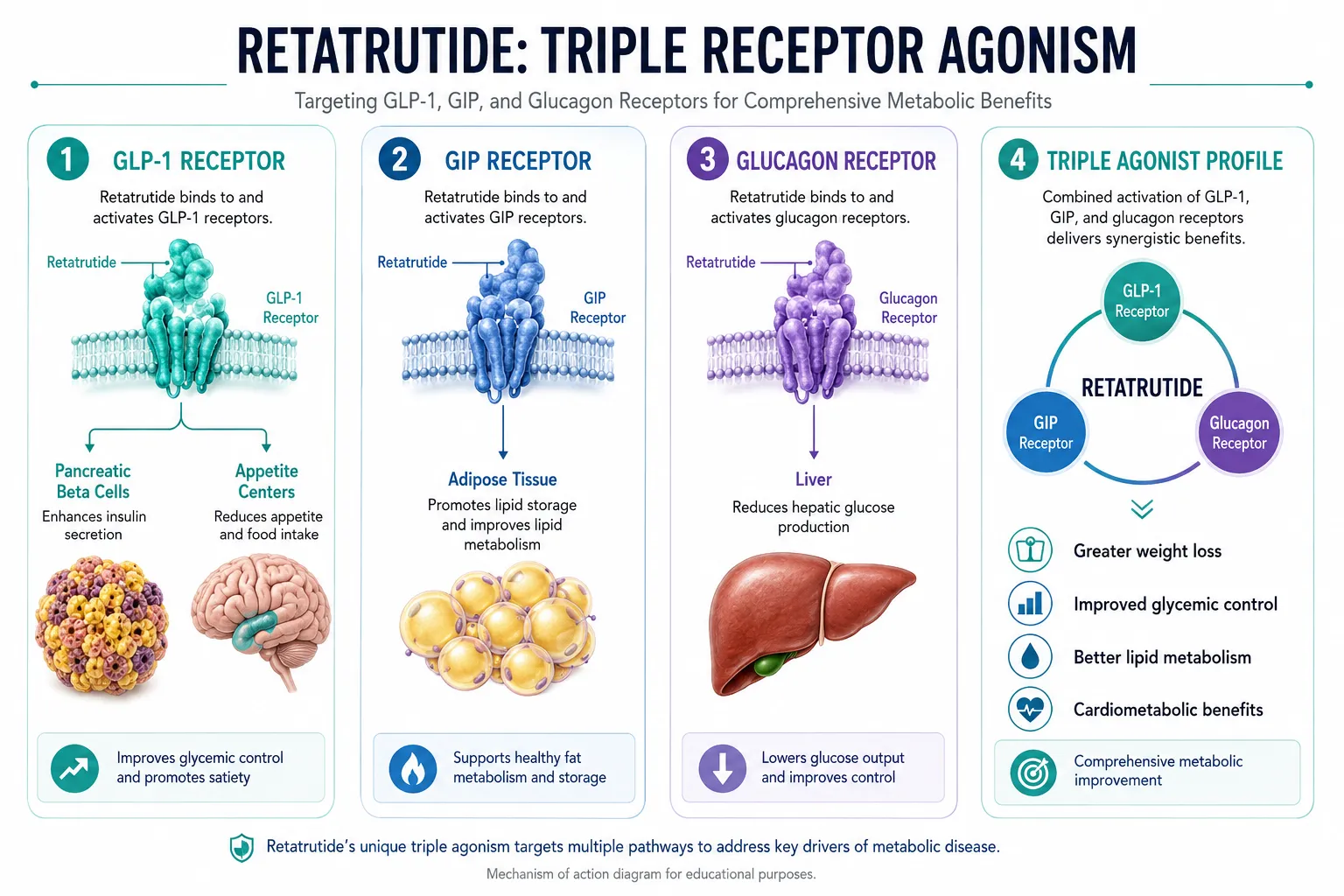
Retatrutide is a long-acting peptide that simultaneously activates GLP-1, GIP (glucose-dependent insulinotropic polypeptide), and glucagon receptors. This triple-agonist architecture sets it apart from oral GLP-1 receptor agonists, which typically target only the GLP-1 pathway. Researchers exploring GLP-1 Retatrutide mechanisms should note that the glucagon receptor component drives additional hepatic glucose output modulation and energy expenditure, effects absent from most oral comparators.
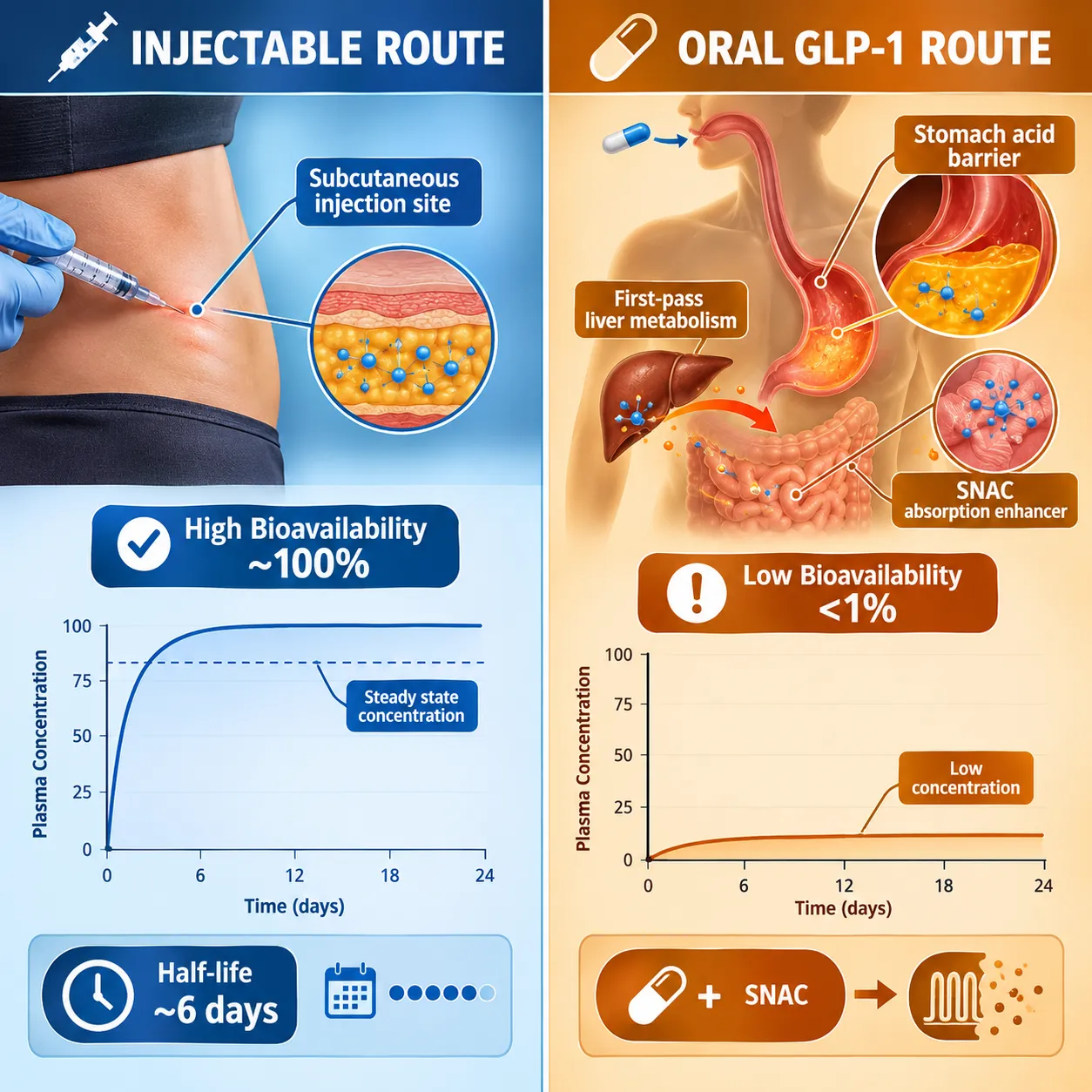
Administered subcutaneously, retatrutide displays a half-life of approximately six days, enabling once-weekly dosing and predictable steady-state accumulation. Its bioavailability via this route approaches 100%. Oral GLP-1 agents, by contrast, face sequential degradation barriers: gastric acid, peptidase activity in the intestinal lumen, and extensive hepatic first-pass metabolism. Even with absorption enhancers such as sodium N-[8-(2-hydroxybenzoyl)amino]caprylate (SNAC), systemic exposure remains a fraction of the administered dose.
This gap is not a minor technical detail. It fundamentally changes what "equivalent dose" means across routes, and it is the first problem any comparative study design must solve.
Comparing Exposure: AUC Matching and Normalization Strategies
When researchers set out to apply GLP-3 Retatrutide and Oral GLP-1 Concepts: How Researchers Should Compare Exposure, Gastric Emptying, and Bioavailability to actual protocols, exposure normalization is the non-negotiable starting point. The standard approach uses area under the concentration-time curve (AUC) and peak plasma concentration (Cmax) as anchors.
| Parameter | Subcutaneous Retatrutide | Oral GLP-1 Agent |
|---|---|---|
| Bioavailability | ~100% | <1% |
| Half-life | ~6 days | 12-14 hours (semaglutide oral) |
| Dosing frequency | Once weekly | Once daily |
| Steady-state variability | Low | Moderate-to-high |
Key normalization steps for researchers:
- Calculate molar AUC at steady state for each agent under study conditions.
- Adjust oral doses iteratively until systemic AUC overlaps with the injectable comparator.
- Document intra-subject variability in oral absorption, which is substantially higher than subcutaneous routes.
- Account for food-state dependency: oral GLP-1 absorption drops sharply when taken with meals, while subcutaneous absorption is largely food-independent.
For labs sourcing materials, detailed product specifications for GLP-3 peptide (10mg, 99% pure, third-party tested) provide purity benchmarks that affect in vitro exposure calculations.
Gastric Emptying: Endpoints, Timing, and Tolerance
Gastric emptying slowing is a shared pharmacodynamic effect across GLP-1 class agents, but the magnitude, onset, and durability differ considerably between retatrutide and oral formulations.
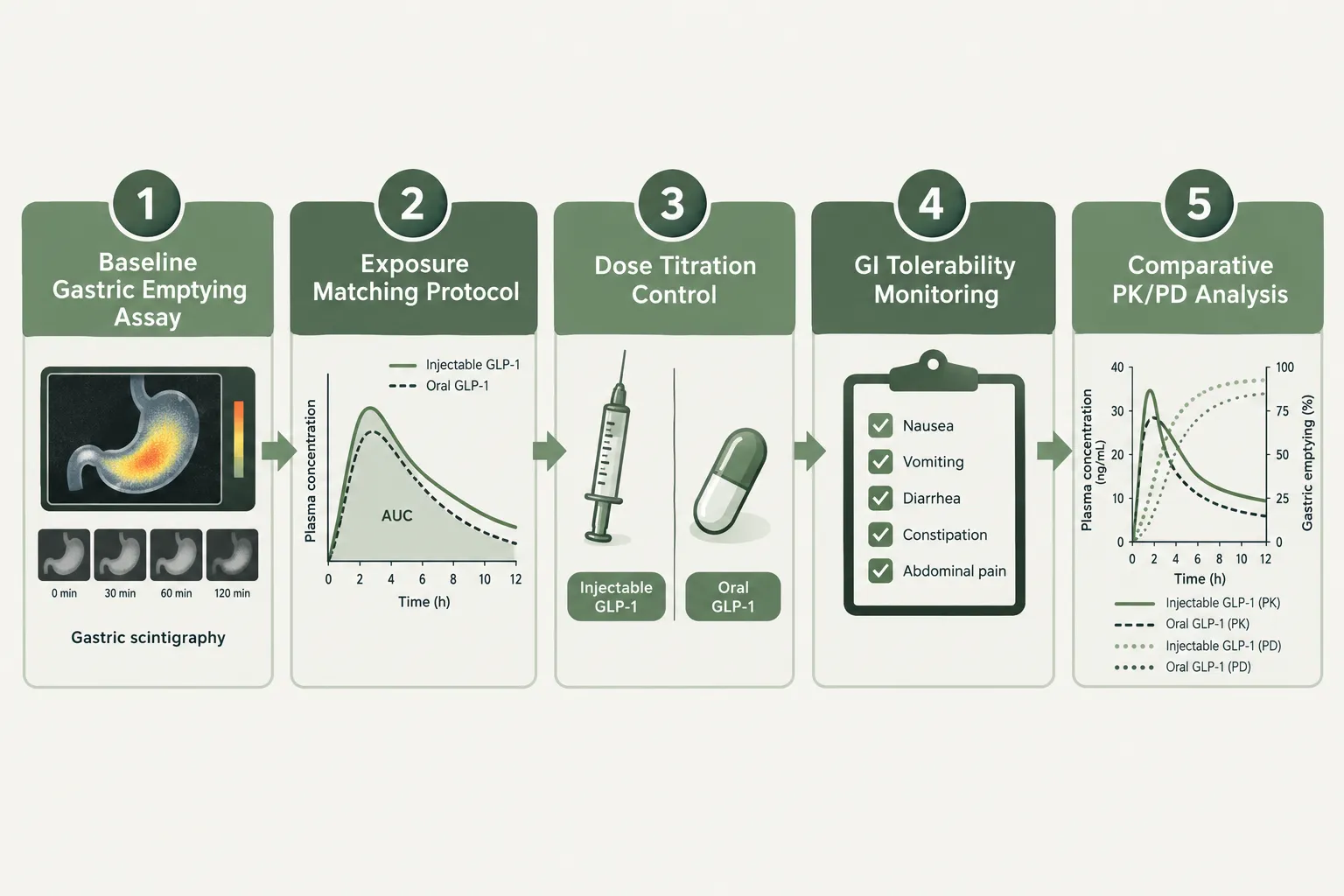
With retatrutide, gastric emptying slows markedly in early treatment weeks. Scintigraphic studies show significant retention of gastric contents at four hours post-meal during dose escalation. Critically, this effect attenuates with continued exposure, a tolerance pattern driven by receptor desensitization and adaptive autonomic responses. By weeks 12 to 16 of continuous dosing, gastric emptying rates partially recover toward baseline even as plasma drug concentrations remain at steady state.
With oral GLP-1 agents, the gastric emptying effect is present but often less pronounced at clinically achievable systemic exposures. The SNAC excipient itself may exert local gastric effects independent of GLP-1 receptor activation, complicating interpretation of gastric emptying endpoints in oral-agent studies.
"Researchers who measure gastric emptying only at peak effect risk attributing a transient pharmacodynamic response to a sustained mechanism, a design flaw that inflates apparent potency differences between routes."
For comparative studies, the recommended approach is serial gastric emptying assessment at weeks 2, 8, and 16, capturing both peak effect and tolerance development. Acetaminophen absorption tests offer a practical surrogate when scintigraphy is unavailable.
Study Design Guidance for Comparing Routes
Applying GLP-3 Retatrutide and Oral GLP-1 Concepts: How Researchers Should Compare Exposure, Gastric Emptying, and Bioavailability to a rigorous protocol requires several additional controls beyond exposure matching.
Formulation controls: SNAC and similar permeation enhancers alter gastric pH and mucosal permeability. Studies must include SNAC-only control arms to isolate GLP-1 receptor-mediated gastric effects from excipient-mediated ones.
Receptor specificity controls: Because retatrutide activates glucagon receptors, which independently influence gastric motility and hepatic metabolism, researchers comparing it to GLP-1-only oral agents should include receptor-selective antagonist arms where feasible.
GI tolerability endpoints: Nausea and vomiting rates differ across routes partly because of absorption rate differences. Subcutaneous delivery produces a slower Cmax rise than an oral bolus, which may translate to better early tolerability. Capturing time-to-event GI data alongside exposure metrics strengthens mechanistic interpretation.
Beyond obesity endpoints: Emerging research on metabolic dysfunction-associated steatotic liver disease (MASLD) and cardiometabolic markers requires longer observation windows. Researchers sourcing materials for extended studies can review options including GLP-3 Reta 20mg and GLP-3 Reta 30mg formats to support multi-week preclinical protocols.
For foundational background on peptide mechanisms relevant to this class, the Peptides 101 for Research-Use Only Buyers resource covers structure and receptor interaction concepts that inform study design. Researchers also comparing oral versus injectable delivery formats more broadly may find the Slupp332 Oral Versus Injectable Research analysis a useful methodological reference.
Conclusion
The comparison between retatrutide and oral GLP-1 agents is only as valid as the study design supporting it. Researchers in 2026 who treat route of administration as a secondary variable, rather than a primary pharmacokinetic determinant, risk generating data that cannot be meaningfully interpreted or replicated.
Actionable next steps for research teams:
- Begin every comparative protocol with AUC-matched exposure normalization, not nominal dose equivalence.
- Use serial gastric emptying assessments (weeks 2, 8, and 16 minimum) to capture tolerance development.
- Include SNAC-only control arms in any oral GLP-1 study measuring gastric endpoints.
- Pre-specify receptor-specificity controls when comparing multi-agonist injectables to single-agonist oral agents.
- Source verified, high-purity research materials, such as those available through the Buy Retatrutide Peptide catalog, to ensure compound integrity does not introduce confounding variables.
Rigorous attention to these pharmacokinetic and pharmacodynamic fundamentals is what separates publishable comparative data from inconclusive noise.