Call or Text 727-513-9780
  • Shopping Cart Shopping Cart
    0Shopping Cart
Pure Tested Peptides | America's most trusted Peptides for sale online
  • Peptides for sale
    • Oral Peptides for sale
      • Peptide Capsules for sale
      • BPC 157 Capsules 1000mcg
      • SLU-PP-332 Capsules | 1000 mcg
      • 5-Amino-1MQ 50mg Capsules
      • Tesofensine 500mcg
    • All Peptides for sale
    • Peptide Sprays
      • BPC 157 Nasal Spray Kit
      • BPC-157 TB500 Nasal Spray Kit
      • Semax Nasal Spray 10mg
      • Selank – Nasal Spray Kit – 10mg
      • Epithalon 50MG Nasal Spray Kit
      • Ipamorelin 10mg Nasal Spray
      • Klow Nasal Spray (BPC-157 + TB-500 + GHK-Cu + KPV) | 80mg
      • Hulk Nasal Spray Tesa / Ipa Blend 6/3 MG
      • Klow Nasal Spray
      • NAD + 500 mg Nasal Spray
      • PT-141 Nasal Spray Kit
    • GHRH Peptides
      • Ipa Peptides
      • CJC-1295 Peptides
        • CJC-1295 with DAC 5 mg
        • CJC-1295 without DAC 5 mg
        • CJC-1295 Ipa 10mg
      • Tesa Peptides
        • Tesa Peptide
        • Tesa 20 mg
    • GHK-Cu Peptides
      • All GHK-Cu Peptides
      • GHK-Cu 100mg
      • KLOW Peptide Blend – Buy KLOW blend online
    • BPC Peptides
      • All BPC Peptides
      • BPC-157
      • BPC-157 TB-500
      • BPC 157 capsules 1000mcg
    • SLU-PP-332 Peptides
      • All SLU-PP-332 Peptides
      • SLU-PP-332 5mg
    • GLP3 Peptides
    • PT-141 Peptides
      • PT-141 Peptides for sale
      • PT-141 10mg
      • PT-141 Nasal Spray
    • CAG Peptides
      • Lipo-C Peptide Blend
      • CAG 5mg
      • CAG 10mg
    • MOTS-C Peptides
      • MOTS-C Peptides for sale
      • MOTS-c peptide
      • MOTS-c 10mg *6 pack*
    • 5 Amino 1MQ Peptides
      • 5 Amino 1MQ Peptides for sale
      • 5-Amino-1MQ 50mg Capsules
      • 5-Amino-1MQ 5mg
    • Epithalon Peptides
      • Epithalon Peptides for sale
      • Epithalon 10mg
      • Epithalon 50mg
  • Shop
    • GLPs
      • 5-Amino-1MQ 50mg Capsules
      • 5-Amino-1MQ 5mg
      • L-Carnitine 500mg/ml
      • Tesofensine 500mcg
      • SLU-PP-332 5mg
      • MOTS-c 10mg *6 pack*
    • Epithalon & BPC Peptides
      • Epithalon 10mg
      • Epithalon 50mg
      • BPC-157
      • BPC 157 capsules 1000mcg
      • BPC-157 TB-500
      • BPC-157 TB500 Nasal Spray Kit
      • BPC 157 Nasal Spray Kit
    • BPC TB-500 & NAD+ Peptides
      • NAD+ 500 mg
      • KLOW Peptide Blend – Buy KLOW blend online
      • GLOW Peptide Blend
      • TB 500 5mg
      • BPC 157 capsules 1000mcg – Supplement
      • BPC 157 Nasal Spray Kit
      • BPC-157
      • BPC-157 TB500 Nasal Spray Kit
      • BPC-157 TB-500
      • BPC 157 capsules 1000mcg
    • LL-37 Peptide
      • LL-37 10 mg
    • MOTS-C & Selank
      • MOTS-c peptide
      • Selank 10mg
    • GHK Peptides
      • GHK-Cu 100mg
      • GLOW Peptide Blend
      • KLOW Peptide Blend – Buy KLOW blend online
  • COAs
  • Wholesale
    • Wholesale Peptides for sale
  • PTP FAQ
  • Affiliates
    • Selank Peptide: Advanced Pharmacological Mechanisms Underlying Its Anxiolytic and Nootropic Effects in Research
      • 5-Amino-1MQ Peptide: Detailed Mechanisms of NNMT Inhibition and Its Impact on Cellular Metabolism Research
        • MOTS-C Peptide: Unraveling Its Role in Mitochondrial Dynamics and Energy Metabolism Research
          • Epithalon Peptide and Telomerase Regulation: Investigating Its Impact on Cellular Senescence and Lifespan Research Models
            • GLP2-T vs GLP2 Tirz Peptide: Understanding the Naming, Mechanistic Nuances, and Research Implications for Gut Health
      • Peptides and Polypeptides in Modern Pharmacology: What Research on Metoprolol, Prednisone, and Amlodipine Reveals
        • Polypeptide Peptides vs NSAIDs: What Naproxen and Diclofenac Teach Tissue-Repair Researchers About BPC‑157 and TB‑500
          • Peptides and Polypeptides in Endocrine Pharmacology: How GLP-1, GLP-2, and GLP-3 Retatrutide Differ From Classic Drugs Like Prednisone and Amlodipine
          • 5‑Amino‑1MQ Peptide and NNMT Inhibition: How It Compares With Statins Like Atorvastatin in Adipose and Lipid Metabolism Research
      • Enclomiphene, Estrogen Receptor Signaling, and Luteinizing Phase Biology: What Hormone Researchers Should Measure
        • Mesenchymal Stem Cells, BPC‑157, and GHK‑Cu: How Tissue Repair Peptides Compare With Classic NSAIDs Like Naproxen in Injury Models
          • Peptide Calculator Use Cases Beyond Growth Hormone: Working Through GLP‑3 Retatrutide, MOTS‑c, and BPC‑157 Research Dosing
        • Polypeptide Peptides in Endocrine and Metabolic Pharmacology: Lessons From Amlodipine, Prednisone, and Metoprolol
        • Peptides Calculator for Advanced Blends: Worked Examples for Tesamorelin, CJC‑1295, and Ipamorelin Stacks
          • Peptides and Polypeptides in Human Physiology: How Molecular Size Shapes Research Applications
            • Selank Peptide: Advanced Pharmacological Mechanisms Underlying Its Anxiolytic and Nootropic Effects in Research
          • 5-Amino-1MQ Peptide: Detailed Mechanisms of NNMT Inhibition and Its Impact on Cellular Metabolism Research
            • MOTS-C Peptide: Unraveling Its Role in Mitochondrial Dynamics and Energy Metabolism Research
              • Epithalon Peptide and Telomerase Regulation: Investigating Its Impact on Cellular Senescence and Lifespan Research Models
                • GLP2-T vs GLP2 Tirz Peptide: Understanding the Naming, Mechanistic Nuances, and Research Implications for Gut Health
                  • Peptides and Polypeptides in Endocrine Pharmacology: How GLP-1, GLP-2, and GLP-3 Retatrutide Differ From Classic Drugs Like Prednisone and Amlodipine
                    • Polypeptide Peptides vs NSAIDs: What Naproxen and Diclofenac Teach Tissue-Repair Researchers About BPC‑157 and TB‑500
                      • Peptides and Polypeptides in Modern Pharmacology: What Research on Metoprolol, Prednisone, and Amlodipine Reveals
                        • 5‑Amino‑1MQ Peptide and NNMT Inhibition: How It Compares With Statins Like Atorvastatin in Adipose and Lipid Metabolism Research
                        • Enclomiphene, Estrogen Receptor Signaling, and Luteinizing Phase Biology: What Hormone Researchers Should Measure
                        • Mesenchymal Stem Cells, BPC‑157, and GHK‑Cu: How Tissue Repair Peptides Compare With Classic NSAIDs Like Naproxen in Injury Models
                        • Peptide Calculator Use Cases Beyond Growth Hormone: Working Through GLP‑3 Retatrutide, MOTS‑c, and BPC‑157 Research Dosing
                        • Polypeptide Peptides in Endocrine and Metabolic Pharmacology: Lessons From Amlodipine, Prednisone, and Metoprolol
                        • Peptides Calculator for Advanced Blends: Worked Examples for Tesamorelin, CJC‑1295, and Ipamorelin Stacks
                        • Peptides and Polypeptides in Human Physiology: How Molecular Size Shapes Research Applications
                        • Selank Peptide: Advanced Pharmacological Mechanisms Underlying Its Anxiolytic and Nootropic Effects in Research
                        • MOTS-C Peptide: Unraveling Its Role in Mitochondrial Dynamics and Energy Metabolism Research
                        • Peptides and Polypeptides in Modern Pharmacology: What Research on Metoprolol, Prednisone, and Amlodipine Reveals
                        • Peptides and Polypeptides in Endocrine Pharmacology: How GLP-1, GLP-2, and GLP-3 Retatrutide Differ From Classic Drugs Like Prednisone and Amlodipine
                        • 5-Amino-1MQ Peptide: Detailed Mechanisms of NNMT Inhibition and Its Impact on Cellular Metabolism Research
                        • Mesenchymal Stem Cells, BPC‑157, and GHK‑Cu: How Tissue Repair Peptides Compare With Classic NSAIDs Like Naproxen in Injury Models
                        • Peptide Calculator Use Cases Beyond Growth Hormone: Working Through GLP‑3 Retatrutide, MOTS‑c, and BPC‑157 Research Dosing
                        • GLP2-T vs GLP2 Tirz Peptide: Understanding the Naming, Mechanistic Nuances, and Research Implications for Gut Health
                        • Polypeptide Peptides in Endocrine and Metabolic Pharmacology: Lessons From Amlodipine, Prednisone, and Metoprolol
                        • Polypeptide Peptides vs NSAIDs: What Naproxen and Diclofenac Teach Tissue-Repair Researchers About BPC‑157 and TB‑500
                        • Peptides and Polypeptides in Human Physiology: How Molecular Size Shapes Research Applications
                        • Peptides Calculator for Advanced Blends: Worked Examples for Tesamorelin, CJC‑1295, and Ipamorelin Stacks
                        • 5‑Amino‑1MQ Peptide and NNMT Inhibition: How It Compares With Statins Like Atorvastatin in Adipose and Lipid Metabolism Research
                        • Enclomiphene, Estrogen Receptor Signaling, and Luteinizing Phase Biology: What Hormone Researchers Should Measure
                        • Epithalon Peptide and Telomerase Regulation: Investigating Its Impact on Cellular Senescence and Lifespan Research Models
                        • Best research protocol Klow blend
                        • best time to take BPC-157
                        • best time to take DSIP (Delta Sleep Inducing Peptide)
                        • best time to take CJC-1295
                        • best time to take AOD-9604
                        • best time to take Follistatin 344
                        • best time to take Ipamorelin
                        • best time to take MK-677 (Ibutamoren)
                        • best time to take Ligandrol (LGD-4033) — research compound
                        • best time to take Ostarine (MK-2866) — research compound
                        • best time to take GHK-CU
                        • best time to take TB-500
                        • best time to take MOTS-c
                        • best time to take Semax
                        • best time to take RAD-140 (Testolone) — research compound
                        • best time to take Thymosin Alpha-1
                        • best time to take PEG-MGF
                        • Biolife Plasma, Octapharma Plasma, and Research Peptides: How Plasma Donation Labs Differ From Peptide Suppliers
                        • best time to take YK-11 — research compound
                        • best time to take PT-141 (Bremelanotide)
                        • Best research protocol Klow blend
                        • 5-Amino-1MQ and MOTS-C Synergy: Metabolic Signaling, Mitochondria, and Research Design
                        • BPC-157 and TB-500: Investigating Their Combined Effects on Angiogenesis and Cellular Migration in Tissue Repair Models
                        • BPC-157 Peptide: Gut Barrier Function, Inflammation, and Tissue-Recovery Research
                        • 5‑Amino‑1MQ and MOTS‑c Synergy in Metabolic Research: Designing NNMT and Mitochondrial Biogenesis Stacks
                        • CJC-1295 with DAC vs. Without DAC: Half-Life, Release Kinetics, and Research Implications
                        • CJC‑1295 with DAC vs. Without DAC: Expanding on Half‑Life Differences Using Tesamorelin and Ipamorelin Blend Case Studies
                        • Collagen Biology and Copper‑Binding Peptides: How GHK‑Cu, Glow Blend, and Klow Blend Interact with Skin and Connective Tissue
                        • Collagen Biology and Regenerative Peptides: How GHK‑Cu, Glow Blend, and Klow Blend Affect Extracellular Matrix Research
                    • DNA, Telomeres, and Longevity Peptides: Positioning Epithalon and MOTS‑c in Genetic Aging Research
                      • Enclomiphene Citrate: serm Mechanism, Testosterone Research, and Stack Compatibility
                        • Enclomiphene vs Enclomiphene Citrate: Formulation, Bioavailability, and Research Distinctions
                        • Epithalon Peptide Research: Telomerase Activation, Aging, and Pineal Gland Function
                        • Estrogen Receptor Signaling and Enclomiphene: How Selective Modulators Compare with Classic Polypeptide Hormones
                        • GHK-Cu Peptide: Advanced Mechanisms in Extracellular Matrix Remodeling and Wound Healing Research
                        • GHK-Cu Peptide: Collagen Synthesis, Wound Repair, and Skin-Barrier Research Models
                        • GLP-1 vs GLP-3 vs GLP-2: Peptide Classification and Research Applications
                        • GLP-2 Peptide Research Guide: Gut Barrier Function, Nutrient Absorption, and Intestinal Recovery Models
                        • GLP-3 Retatrutide vs. GLP-1 Drugs: What Triple-Agonist Biology Changes in Research Models
                        • Ipamorelin and Tesamorelin Combination: Synergistic GH Secretagogue Research and Dosing Protocols
                        • GLP2 Tirz Peptide: What It Is, Why the Name Exists, and How Researchers Should Interpret It
                        • Klow Blend Peptide Nasal Spray: What the Formulation Is Trying to Do in Cognitive Research
                        • Mitochondria, NNMT Inhibition, and Peptide Modulators: Where MOTS‑c and 5‑Amino‑1MQ Fit in Cellular Energy Research
                        • MOTS-c Peptide: Mitochondrial Function, Energy Metabolism, and What Researchers Measure
                        • MOTS-c vs. 5-Amino-1MQ: Which Metabolic Research Questions Each Compound Actually Answers
                        • Nasal Spray Peptides: Bioavailability, Administration, and Semax/Selank Research Applications
                        • PT-141 Peptide Research: Mechanism of Action and Melanocortin Receptor Signaling
                        • Retatrutide for Research: Mechanism, Structure, and GLP-1/GLP-3 Dual Action
                        • Retatrutide for Obesity and Type 2 Diabetes: What the Latest Trial Data Suggest
                        • Tesofensine Peptide Research: Mechanism, Appetite Suppression, and Neuropeptide Y Pathways
  • Contact
    • Contact Customer Service
    • Text Customer Support
  • About US
  • Shop all peptides
  • Affiliate Program
    • Affiliate Signup
  • Login / Register Login / Register Page Link Login / Register Page Link
  • Click to open the search input field Click to open the search input field Search
  • Menu Menu

Tag Archive for: fertility endpoints

Enclomiphene Research in Male Hormone Models: Choosing Testosterone, LH, FSH, Estradiol, and Fertility Endpoints

Enclomiphene Research in Male Hormone Models: Choosing Testosterone, LH, FSH, Estradiol, and Fertility Endpoints

October 11, 2026/0 Comments/in Uncategorized/by

{"cover":"Professional landscape format (1536×1024) hero image with bold text overlay 'Enclomiphene Research in Male Hormone' in crisp white modern sans-serif on a deep navy semi-transparent overlay panel, centered with 8% safe margins from every edge. Background: macro editorial photograph of a laboratory hormone assay panel showing glass vials labeled testosterone, LH, FSH, and estradiol arranged on a clean white lab bench with soft cool studio lighting, teal and navy color palette, medical research magazine cover aesthetic, high contrast, editorial quality.","content":["Numbered four-step annotated mechanism diagram illustrating the hypothalamic-pituitary-gonadal axis response to enclomiphene in a male hormone model. Step 1 labeled 'Hypothalamus: GnRH Release' with callout arrow, Step 2 labeled 'Pituitary: LH and FSH Rise' with upward arrow, Step 3 labeled 'Testes: Testosterone Synthesis' with callout, Step 4 labeled 'Estradiol Monitoring Point' with a side callout box. Clean white background, teal and charcoal palette, thin callout lines, bold step numbers, editorial medical-illustration style, landscape 1536×1024.","Split-screen landscape comparison (1536×1024) infographic: left panel labeled 'Testosterone Gel' showing a downward-pointing arrow for LH and FSH with callout 'Gonadotropin Suppression' and a sperm icon with label 'Spermatogenesis Impaired'; right panel labeled 'Enclomiphene' showing upward arrows for LH, FSH, Testosterone with callout 'Gonadotropin Preserved' and a sperm icon labeled 'Spermatogenesis Maintained'. Bold panel headings, teal-and-amber palette, thin dividing line, clean white background, editorial clinical-comparison style.","Annotated timeline infographic landscape (1536×1024) showing a horizontal research protocol timeline for enclomiphene male hormone studies: five labeled milestone cards, Baseline (Week 0): Testosterone, LH, FSH, Estradiol, Sperm Count; Early Response (Week 3): LH and FSH surge callout; Mid-Trial (Week 6): Testosterone normalization callout; Extended (Week 12-16): Sperm concentration endpoint callout; Final (Week 16+): Composite endpoint card labeled Testosterone plus Sperm greater than 10M/mL. Teal and slate color scheme, short callout labels, bold card headings, clean editorial infographic style."]
Professional landscape hero image () with a reading "Enclomiphene Research in Male Hormone". CRITICAL TYPOGRAPHY RULES:

Fewer than half of men with secondary hypogonadism who receive conventional testosterone therapy retain adequate sperm production, a clinical trade-off that has pushed researchers toward selective estrogen receptor modulators (serms) as a mechanistically distinct alternative. Enclomiphene research in male hormone models: choosing testosterone, LH, FSH, estradiol, and fertility endpoints is now a structured discipline, with phase II and III trial data, systematic meta-analyses, and 2026 clinical guidance all converging on a defined set of biomarkers and measurement protocols. This article provides a practical endpoint-selection guide for investigators designing or evaluating enclomiphene studies in male endocrine models.


Key Takeaways

  • Enclomiphene raises total testosterone by stimulating LH and FSH rather than suppressing the hypothalamic-pituitary-gonadal (HPG) axis, making gonadotropin measurement essential in any study design.
  • Estradiol monitoring is a critical safety endpoint; enclomiphene produces significantly smaller estradiol increases than clomiphene, and this distinction matters for adverse-effect interpretation.
  • Composite endpoints combining testosterone normalization (300-1,040 ng/dL) with sperm concentration above 10×10^6/mL are now considered the regulatory standard for fertility-preserving research.
  • Pregnancy and live-birth data remain absent from existing randomized trials; "fertility-preserving potential" is the appropriate framing until conception endpoints are reported.
  • Temporal sampling strategy, particularly early gonadotropin measurement at weeks 3-6, is as important as endpoint selection itself.

The HPG Axis as the Primary Research Framework
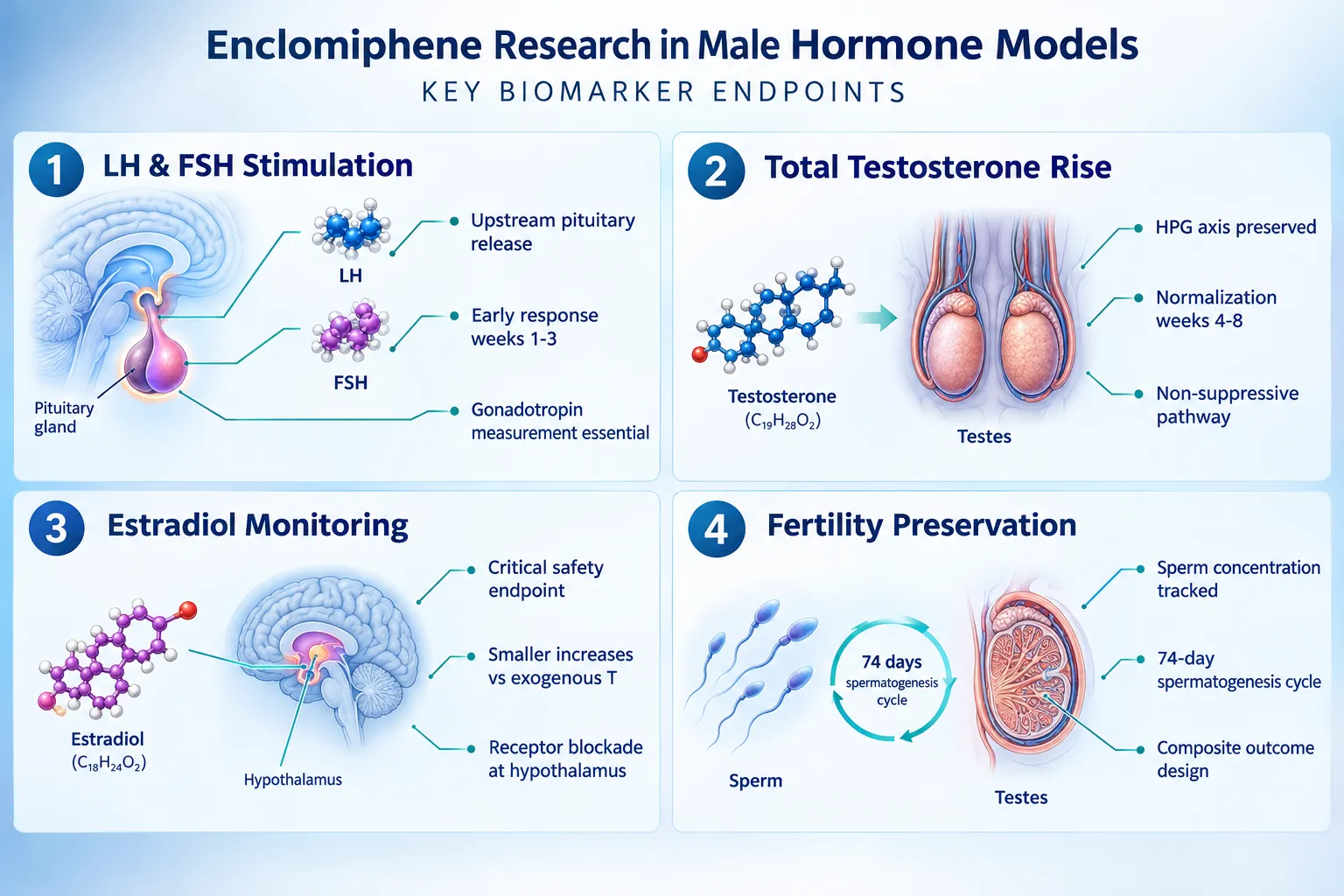
The HPG Axis as the Primary Research Framework

Enclomiphene blocks estrogen receptors at the hypothalamus, reducing negative feedback and prompting the pituitary to release more LH and FSH. This upstream mechanism is what separates it from exogenous testosterone, which suppresses the same axis. Any male hormone model that omits gonadotropin measurement is therefore incomplete.

Phase III data in secondary hypogonadism (men with baseline testosterone at or below 300 ng/dL) show that a 25 mg daily dose raised mean LH from approximately 5.3 to 11.9 mIU/mL and FSH from 9.4 to 14.9 mIU/mL over six weeks, while mean testosterone climbed to roughly 604 ng/dL. These numbers establish the expected magnitude of response and serve as calibration benchmarks when designing new studies.

Recommended baseline panel before any enclomiphene intervention:

Biomarker Rationale
Total testosterone Primary efficacy endpoint
LH Confirms secondary hypogonadism; tracks HPG activation
FSH Spermatogenesis support; distinguishes primary from secondary deficiency
Estradiol (E2) Safety monitoring; tracks serm-related estrogenic activity
Sperm concentration Fertility-related endpoint; composite outcome anchor
Hematocrit Adverse-effect screen

For researchers exploring related peptide-based hormonal research, the IPA Sermorelin Stack Research resource offers useful context on multi-compound endocrine protocols.


Enclomiphene Research in Male Hormone Models: Temporal Sampling and Gonadotropin Interpretation
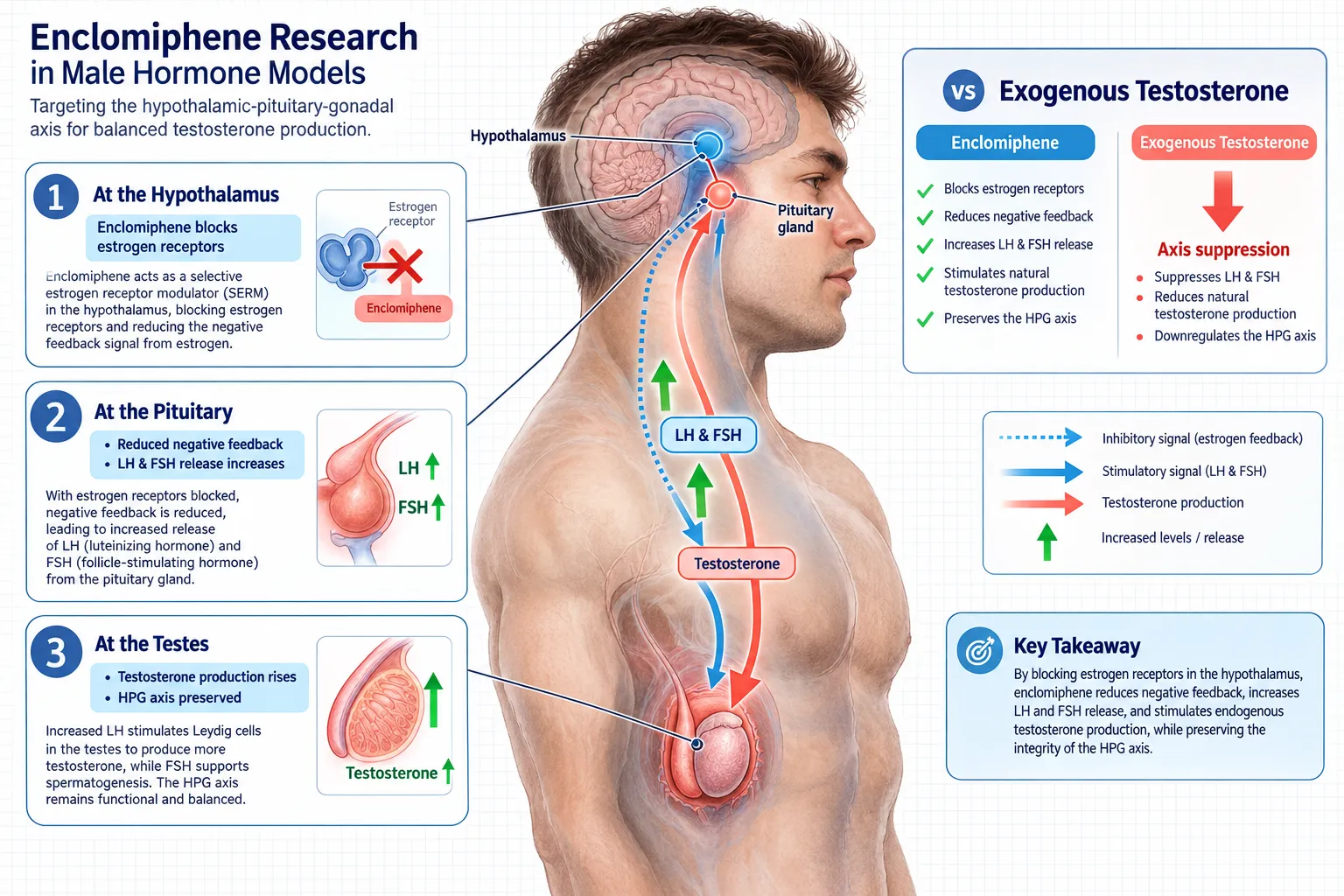
Enclomiphene Research in Male Hormone Models: Temporal Sampling and Gonadotropin Interpretation

Timing is where many study designs underperform. Gonadotropin responses appear early, often within the first two to three weeks, while testosterone normalization consolidates between weeks four and eight. Sperm concentration, which reflects spermatogenesis cycles of approximately 74 days, requires sampling at three months or later to be interpretable.

A 2025 systematic review and meta-analysis of ten randomized controlled trials (819 men with functional hypogonadism) found that serm therapy including enclomiphene raised total testosterone by a mean of 273.76 ng/dL versus placebo. Critically, the same analysis showed no significant difference in total testosterone between enclomiphene and testosterone gel, yet enclomiphene preserved or improved sperm concentration while testosterone gel suppressed gonadotropins below normal range. This contrast is only detectable when LH and FSH are measured at both early (week 3-6) and late (week 12-16) timepoints.

Recommended sampling schedule:

  • Week 0: Full baseline panel (see table above)
  • Week 3-6: LH, FSH, total testosterone, captures early gonadotropin surge
  • Week 12: Total testosterone, estradiol, sperm concentration, mid-trial safety and efficacy check
  • Week 16+: Composite endpoint assessment, testosterone normalization plus sperm concentration

"Gonadotropin suppression in the testosterone gel group versus preservation in the enclomiphene group is only visible when both arms are sampled at the same early timepoint, this design detail determines whether the study can answer its core question."

A 2024 comparative study of 66 men reinforces the importance of estradiol timing. Enclomiphene produced a median testosterone increase of 166 ng/dL versus 98 ng/dL with clomiphene, but the estradiol change was markedly different: -5.92 pg/mL with enclomiphene versus +17.50 pg/mL with clomiphene (p=0.001). This gap is a product-identity distinction, not just a safety signal, it confirms that enclomiphene and clomiphene are not interchangeable in research models.

Investigators working with broader research-grade compound sourcing may find the Peptides 101 for Research-Use Only Buyers guide helpful for understanding purity and identity verification standards that apply across endocrine research compounds.


Enclomiphene Research in Male Hormone Models: Fertility Endpoints and Composite Outcome Design
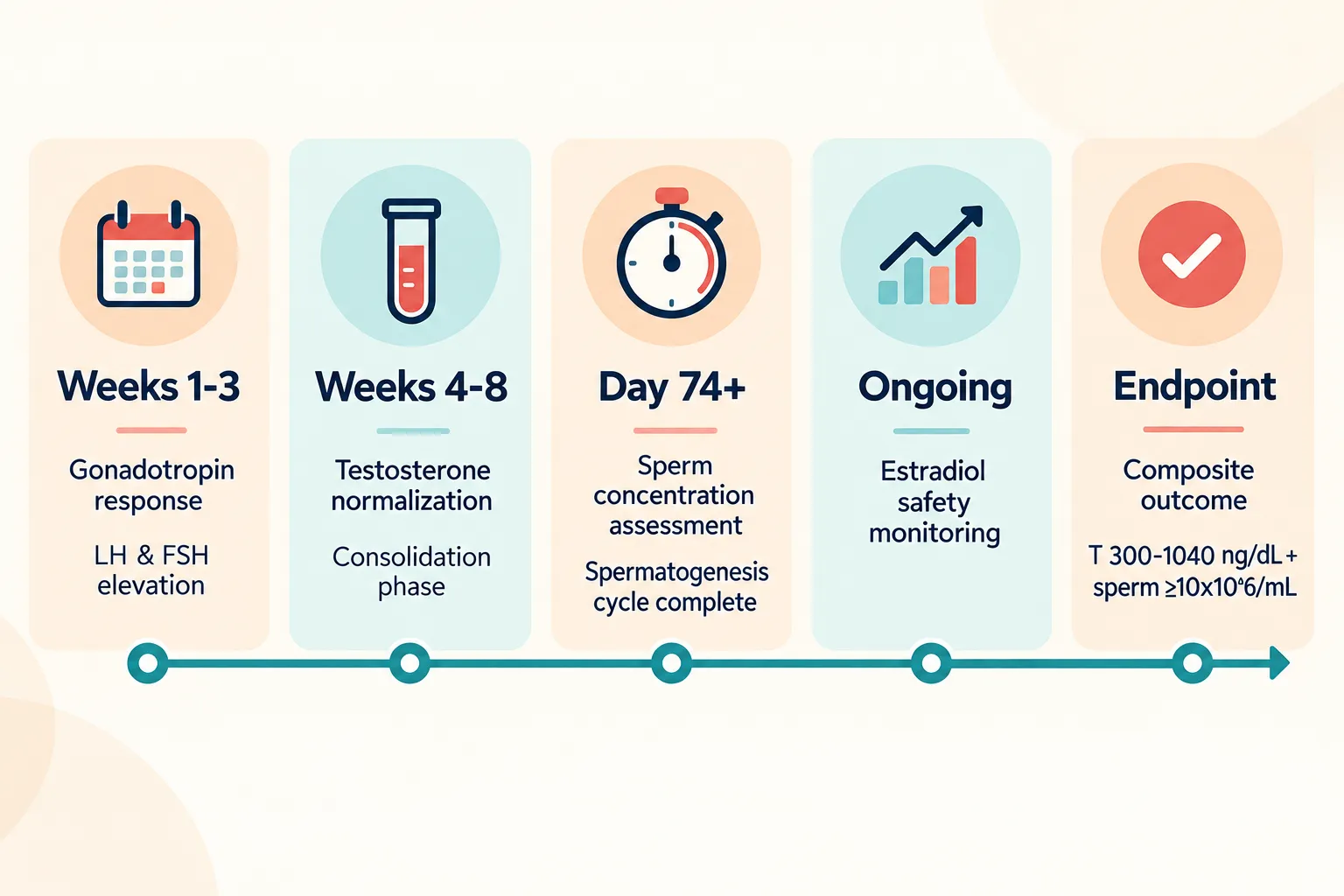
Enclomiphene Research in Male Hormone Models: Fertility Endpoints and Composite Outcome Design

The regulatory standard for fertility-preserving therapy now centers on a composite primary endpoint: total testosterone within the normal range (300-1,040 ng/dL) and sperm concentration at or above 10×10^6/mL. This dual requirement reflects the clinical reality that testosterone normalization alone does not confirm preserved reproductive function.

Phase III pivotal trial data (256 overweight men, aged 18-60) show enclomiphene raised mean testosterone from approximately 205 ng/dL to 413-446 ng/dL at 16 weeks versus placebo, while maintaining sperm concentration. Across the broader serm meta-analysis, LH rose by approximately 4.66 IU/L and FSH by 4.59 IU/L, both statistically significant versus placebo.

Key fertility endpoint categories for enclomiphene studies:

  • Semen parameters: Sperm concentration, motility, morphology (minimum 3-month sampling window)
  • Gonadotropin activity: LH and FSH as proxies for spermatogenesis support
  • Hormonal composite: Testosterone normalization concurrent with gonadotropin preservation
  • Downstream outcomes: Conception and live-birth rates (currently absent from all published RCTs)

The absence of pregnancy and live-birth data is the field's most significant gap. Current evidence supports "fertility-preserving potential", a mechanistically grounded but clinically unconfirmed claim. Future trial designs should incorporate conception endpoints wherever feasible.

The British Society for Sexual Medicine's 2026 position statement endorses testosterone, LH, FSH, and semen parameters as central endpoints, while also flagging routine monitoring of estradiol, hematocrit, libido changes, and fatigue as standard safety measures.

For researchers investigating metabolic co-variables that may interact with HPG axis function, the Visceral Fat Research resource addresses adiposity-driven hormonal suppression, a relevant confounder in overweight male cohorts.


Conclusion

Enclomiphene research in male hormone models: choosing testosterone, LH, FSH, estradiol, and fertility endpoints requires a structured, multi-biomarker approach built around the HPG axis mechanism. The following steps represent the current best-practice framework for 2026 study design:

  1. Establish a full baseline panel including total testosterone, LH, FSH, estradiol, sperm concentration, and hematocrit before any intervention.
  2. Sample gonadotropins early (weeks 3-6) to capture the LH and FSH surge that distinguishes enclomiphene from testosterone replacement.
  3. Use a composite primary endpoint that combines testosterone normalization with sperm concentration above 10×10^6/mL for any fertility-focused model.
  4. Monitor estradiol as a safety and product-identity endpoint, not merely an afterthought, the enclomiphene-versus-clomiphene estradiol differential is a mechanistically meaningful distinction.
  5. Plan for 12-16 week minimum duration to allow spermatogenesis endpoints to reach interpretable values.
  6. Acknowledge the live-birth gap in any fertility claim and design future trials to include conception endpoints.

Rigorous endpoint selection is what converts a hormone-level study into actionable clinical evidence. The data infrastructure now exists; the next priority is applying it with the temporal precision and composite outcome design that the field requires.

https://www.puretestedpeptides.com/wp-content/uploads/2026/10/enclomiphene-research-in-male-hormone-models-choosing-testosterone-lh-fsh-estrad.webp 1024 1536 https://www.puretestedpeptides.com/wp-content/uploads/2026/01/buy-peptides-online.jpg 2026-10-11 13:03:492026-10-11 13:03:49Enclomiphene Research in Male Hormone Models: Choosing Testosterone, LH, FSH, Estradiol, and Fertility Endpoints
×

Helpful Links

  • My account
  • Cart
  • Checkout
  • Refund and Returns Policy
  • Privacy Policy
  • SMS Privacy Policy
  • Login
  • My Account
  • Logout

USA Made Lab Tested Peptides

All products are sold for research, laboratory, or analytical purposes only, and are not for human consumption


Pure Tested Peptides is a chemical supplier. Pure Tested Peptides is not a compounding / chemical compounding facility as defined under 503A of the Federal Food, Drug, and Cosmetic act. Pure Tested Peptides is not an outsourcing facility as defined under 503B of the Federal Food, Drug, and Cosmetic act.

The statements made within this website have not been evaluated by the US Food and Drug Administration. The products we offer are not intended to diagnose, treat, cure or prevent any disease.

Human/Animal Consumption Prohibited. Laboratory/In-Vitro Experimental Use Only

Scroll to top Scroll to top Scroll to top