

GHK-Cu Peptide: Collagen Synthesis, Tissue Repair, and Longevity Research Applications
A single copper ion can change how a peptide behaves at the molecular level. That principle sits at the heart of GHK-Cu research, a tripeptide-copper complex that has attracted serious scientific attention since Loren Pickart first isolated it from human plasma in 1973. Today, GHK-Cu peptide: collagen synthesis, tissue repair, and longevity research applications represent one of the more mechanistically rich areas in peptide biology, drawing interest from researchers working across dermatology, wound healing, and aging science.
Key Takeaways
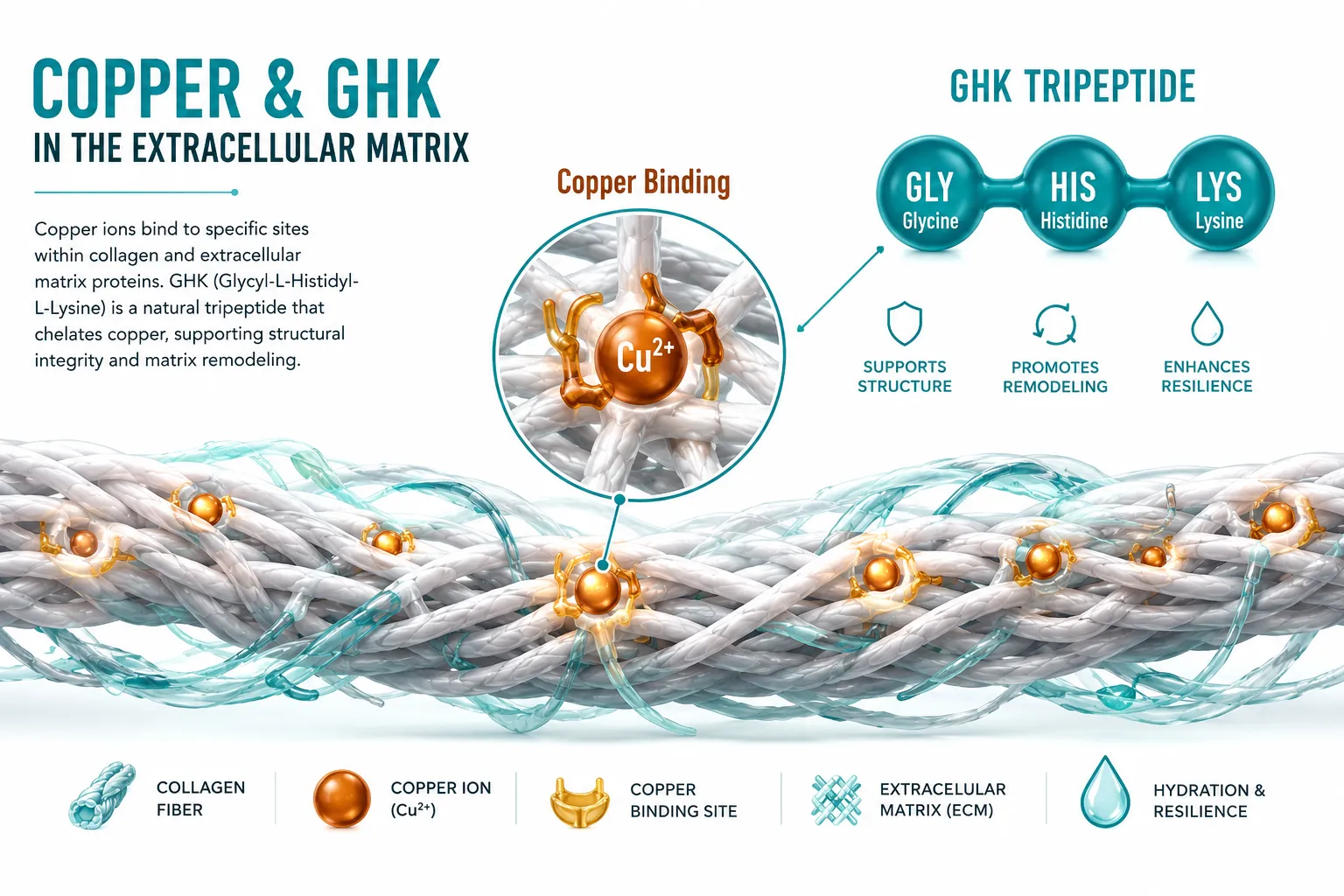
- GHK-Cu is a naturally occurring tripeptide (glycine-histidine-lysine) that binds copper(II) ions, enabling a wide range of biological signaling functions.
- Research shows GHK-Cu upregulates collagen, elastin, and glycosaminoglycan synthesis by activating fibroblast activity in the extracellular matrix.
- Beyond skin biology, GHK-Cu has demonstrated tissue-repair activity in wound models, nerve tissue, and lung fibrosis research.
- Longevity researchers have identified GHK-Cu as a potential gene-expression modulator, with studies linking it to reversal of aging-associated transcriptional changes.
- GHK-Cu is frequently studied alongside other repair-focused peptides such as BPC-157 and TB-500 in multi-compound research protocols.
The Copper-Binding Biology Behind GHK-Cu
The letters in GHK stand for the three amino acids that form this tripeptide: glycine, histidine, and lysine. What makes GHK-Cu distinct from many other short peptides is its high-affinity binding to copper(II) ions. This copper-chelating property is not incidental, it is central to the compound's biological activity.
Copper is a trace element involved in over 30 enzymatic reactions in the human body. Enzymes like lysyl oxidase (which crosslinks collagen and elastin fibers) and superoxide dismutase (an antioxidant enzyme) depend on copper as a cofactor. When GHK binds copper, it acts as a bioavailable copper-delivery vehicle, shuttling the ion to sites where these enzymes are active.
To understand how short peptides like GHK-Cu function within broader molecular frameworks, the polypeptide peptides explained: structure, function, and research resource provides useful foundational context.
Key copper-dependent processes relevant to GHK-Cu research:
| Process | Relevant Enzyme | Role in Tissue Biology |
|---|---|---|
| Collagen crosslinking | Lysyl oxidase | Structural integrity of ECM |
| Antioxidant defense | Superoxide dismutase | Reduces oxidative damage |
| Angiogenesis | Ceruloplasmin | New blood vessel formation |
| Melanin synthesis | Tyrosinase | Pigmentation and skin repair |
Beyond copper delivery, GHK itself appears to function as a signaling molecule. In vitro studies have shown it can activate pathways associated with TGF-beta (transforming growth factor beta), a cytokine that drives fibroblast proliferation and matrix remodeling.
GHK-Cu Peptide: Collagen Synthesis and Extracellular Matrix Remodeling
The extracellular matrix (ECM) is the structural scaffold that surrounds cells in connective tissue. It is composed primarily of collagen fibers, elastin, fibronectin, and glycosaminoglycans (GAGs). Maintaining ECM integrity is critical for wound healing, organ function, and tissue resilience.
Research into GHK-Cu peptide: collagen synthesis, tissue repair, and longevity research applications has consistently pointed to fibroblast activation as a primary mechanism. Fibroblasts are the cells responsible for producing and maintaining ECM components. Studies have shown that GHK-Cu:
- Increases collagen synthesis, particularly types I and III, the most abundant structural collagens
- Upregulates elastin production, improving tissue elasticity
- Stimulates GAG synthesis, including hyaluronic acid and dermatan sulfate, which support hydration and structural spacing in the ECM
- Activates matrix metalloproteinases (MMPs), enzymes that break down damaged or disorganized collagen, enabling remodeling
This dual action, promoting new matrix synthesis while clearing old or damaged matrix, makes GHK-Cu particularly relevant to wound repair models. Researchers studying multi-peptide repair protocols often pair GHK-Cu with other compounds; the Skin Repair Stack (BPC-157 + TB-500 + GHK-Cu) is one documented example of this combinatorial approach in research contexts.
For broader comparison of tissue-repair peptides, the BPC-157 vs TB-500 complete research comparison guide offers useful mechanistic contrasts.
Tissue Repair, Nerve Regeneration, and Organ-Level Research
GHK-Cu research extends well beyond skin biology. Several preclinical studies have examined its effects in:
Wound Healing Models
Animal wound models have shown accelerated closure rates and improved tensile strength in GHK-Cu-treated tissue compared to controls. The mechanism appears to involve both fibroblast recruitment and enhanced angiogenesis, the formation of new blood vessels that supply healing tissue with oxygen and nutrients.
Lung and Organ Fibrosis
Research by Pickart and colleagues identified GHK-Cu as a potential modulator of fibrotic processes in lung tissue. Rather than promoting uncontrolled fibrosis, GHK-Cu appears to support organized matrix remodeling, a distinction that has made it relevant to pulmonary research.
Nerve Tissue
Some studies have examined GHK-Cu in nerve repair contexts, with findings suggesting it may support Schwann cell activity and axonal regrowth. This aligns with its broader role in activating growth factors associated with neural tissue maintenance.
Researchers interested in mitochondrial and cellular longevity mechanisms may find it useful to compare GHK-Cu's gene-expression profile with that of other compounds; the MOTS-C mitochondrial research themes article covers complementary cellular pathways.
For foundational context on how peptides interact with biological systems at the research level, peptides 101 for research-use only buyers: structure, mechanisms, and applications provides a strong primer.
GHK-Cu Peptide: Longevity Research Applications and Gene Expression
Perhaps the most compelling recent dimension of GHK-Cu peptide: collagen synthesis, tissue repair, and longevity research applications is its potential role in gene expression modulation.
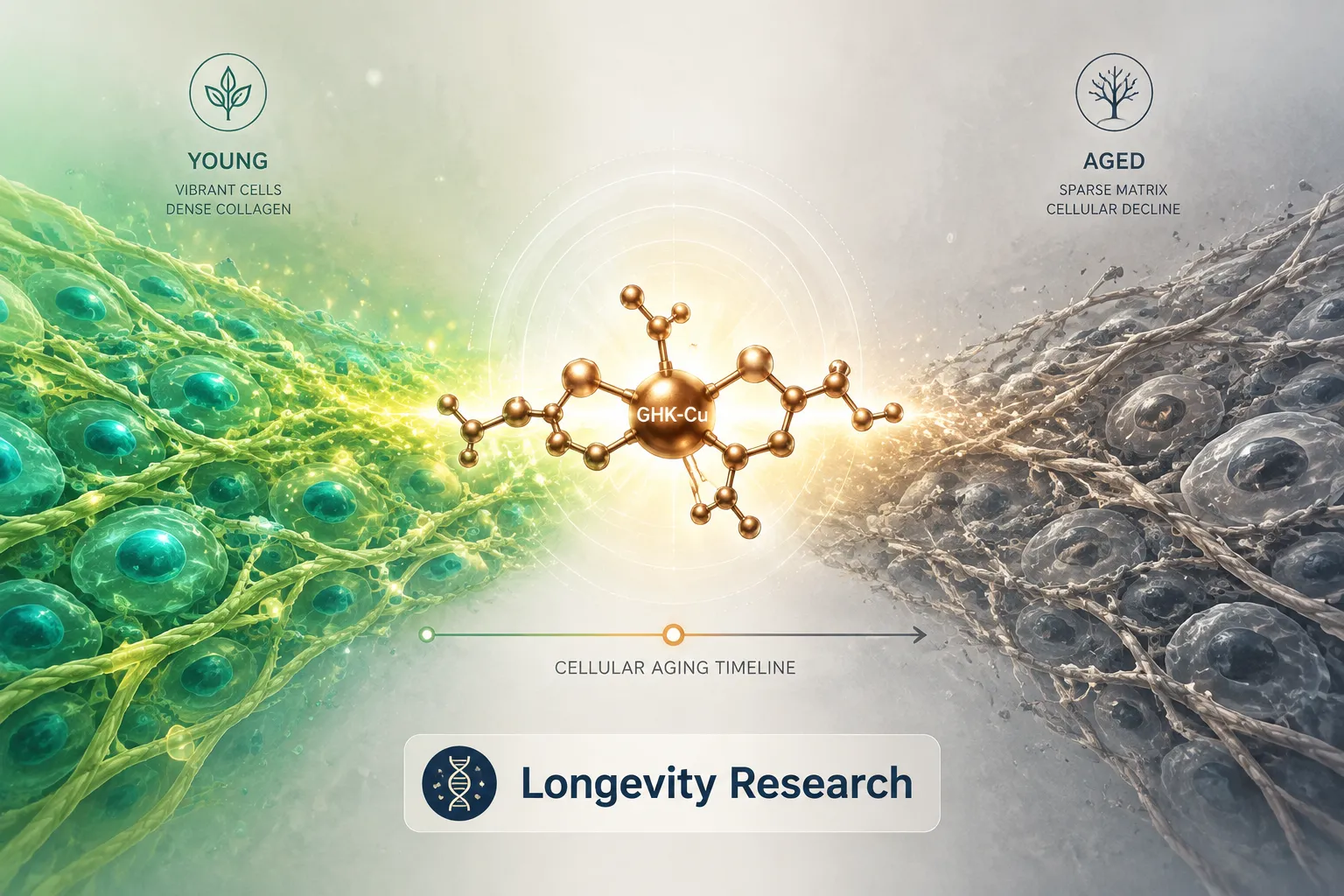
In 2010, Pickart and Margolina published analysis suggesting that GHK-Cu could reset gene expression patterns in aged human fibroblasts toward a younger phenotype. A 2014 study using the Broad Institute's Connectivity Map database found that GHK-Cu gene expression signatures overlapped with the reversal of multiple aging-associated transcriptional changes, including genes related to inflammation, oxidative stress, and DNA repair.
Key findings from longevity-focused GHK-Cu research include:
- Downregulation of genes associated with chronic inflammation (including several NF-kB pathway genes)
- Upregulation of DNA repair and antioxidant defense genes
- Potential interaction with VEGF (vascular endothelial growth factor) pathways, relevant to tissue vascularization in aging
- Modulation of p53 pathway genes, which govern cellular senescence and apoptosis
These findings position GHK-Cu as a candidate for research into biological aging mechanisms, not merely as a cosmetic ingredient, but as a compound with plausible systemic relevance. Researchers exploring quality standards for such compounds can review Bachem and reference standards: building robust peptide benchmarks for guidance on sourcing and verification.
The BPC-157 core peptides documentation first research guide also offers a useful model for how documentation standards apply to repair-focused peptide research.
Conclusion
GHK-Cu occupies a mechanistically distinct position in the peptide research landscape. Its copper-binding biology connects it directly to enzymatic processes governing collagen crosslinking, antioxidant defense, and angiogenesis. Its fibroblast-activating properties make it relevant to ECM remodeling and wound repair research. And its emerging role in gene expression modulation places it at the intersection of tissue biology and longevity science.
Actionable next steps for researchers in 2026:
- Review primary literature from Pickart and Margolina alongside the 2014 Connectivity Map analysis before designing GHK-Cu protocols.
- Consider combinatorial study designs pairing GHK-Cu with complementary repair peptides, using documented stacks as a reference point.
- Verify peptide purity through third-party testing and reference standards before any experimental use.
- Distinguish between topical and systemic delivery contexts when interpreting existing data, as bioavailability profiles differ significantly.
- Monitor emerging longevity research for updates on GHK-Cu's gene-expression findings, particularly in the context of senescence and oxidative stress models.
References
- Pickart, L. (1973). "A tripeptide from human serum which prolongs survival of normal liver cells." Journal of Theoretical Biology, 39(2), 373-382.
- Pickart, L., & Margolina, A. (2010). "Regenerative and protective actions of the GHK-Cu peptide in the light of the new gene data." International Journal of Molecular Sciences, 11(10), 4010-4028.
- Pickart, L., Vasquez-Soltero, J. M., & Margolina, A. (2015). "GHK peptide as a natural modulator of multiple cellular pathways in skin regeneration." BioMed Research International, 2015, 648108.
- Pickart, L., & Margolina, A. (2018). "Regenerative and protective actions of the GHK-Cu peptide in the light of the new gene data." International Journal of Molecular Sciences, 19(7), 1987.
- Lamb, J., et al. (2006). "The Connectivity Map: using gene-expression signatures to connect small molecules, genes, and disease." Science, 313(5795), 1929-1935.