Call or Text 727-513-9780
  • Shopping Cart Shopping Cart
    0Shopping Cart
Pure Tested Peptides | America's most trusted Peptides for sale online
  • Peptides for sale
    • Oral Peptides for sale
      • Peptide Capsules for sale
      • BPC 157 Capsules 1000mcg
      • SLU-PP-332 Capsules | 1000 mcg
      • 5-Amino-1MQ 50mg Capsules
      • Tesofensine 500mcg
    • All Peptides for sale
    • Peptide Sprays
      • BPC 157 Nasal Spray Kit
      • BPC-157 TB500 Nasal Spray Kit
      • Semax Nasal Spray 10mg
      • Selank – Nasal Spray Kit – 10mg
      • Epithalon 50MG Nasal Spray Kit
      • Ipamorelin 10mg Nasal Spray
      • Klow Nasal Spray (BPC-157 + TB-500 + GHK-Cu + KPV) | 80mg
      • Hulk Nasal Spray Tesa / Ipa Blend 6/3 MG
      • Klow Nasal Spray
      • NAD + 500 mg Nasal Spray
      • PT-141 Nasal Spray Kit
    • GHRH Peptides
      • Ipa Peptides
      • CJC-1295 Peptides
        • CJC-1295 with DAC 5 mg
        • CJC-1295 without DAC 5 mg
        • CJC-1295 Ipa 10mg
      • Tesa Peptides
        • Tesa Peptide
        • Tesa 20 mg
    • GHK-Cu Peptides
      • All GHK-Cu Peptides
      • GHK-Cu 100mg
      • KLOW Peptide Blend – Buy KLOW blend online
    • BPC Peptides
      • All BPC Peptides
      • BPC-157
      • BPC-157 TB-500
      • BPC 157 capsules 1000mcg
    • SLU-PP-332 Peptides
      • All SLU-PP-332 Peptides
      • SLU-PP-332 5mg
    • GLP3 Peptides
    • PT-141 Peptides
      • PT-141 Peptides for sale
      • PT-141 10mg
      • PT-141 Nasal Spray
    • CAG Peptides
      • Lipo-C Peptide Blend
      • CAG 5mg
      • CAG 10mg
    • MOTS-C Peptides
      • MOTS-C Peptides for sale
      • MOTS-c peptide
      • MOTS-c 10mg *6 pack*
    • 5 Amino 1MQ Peptides
      • 5 Amino 1MQ Peptides for sale
      • 5-Amino-1MQ 50mg Capsules
      • 5-Amino-1MQ 5mg
    • Epithalon Peptides
      • Epithalon Peptides for sale
      • Epithalon 10mg
      • Epithalon 50mg
  • Shop
    • GLPs
      • 5-Amino-1MQ 50mg Capsules
      • 5-Amino-1MQ 5mg
      • L-Carnitine 500mg/ml
      • Tesofensine 500mcg
      • SLU-PP-332 5mg
      • MOTS-c 10mg *6 pack*
    • Epithalon & BPC Peptides
      • Epithalon 10mg
      • Epithalon 50mg
      • BPC-157
      • BPC 157 capsules 1000mcg
      • BPC-157 TB-500
      • BPC-157 TB500 Nasal Spray Kit
      • BPC 157 Nasal Spray Kit
    • BPC TB-500 & NAD+ Peptides
      • NAD+ 500 mg
      • KLOW Peptide Blend – Buy KLOW blend online
      • GLOW Peptide Blend
      • TB 500 5mg
      • BPC 157 capsules 1000mcg – Supplement
      • BPC 157 Nasal Spray Kit
      • BPC-157
      • BPC-157 TB500 Nasal Spray Kit
      • BPC-157 TB-500
      • BPC 157 capsules 1000mcg
    • LL-37 Peptide
      • LL-37 10 mg
    • MOTS-C & Selank
      • MOTS-c peptide
      • Selank 10mg
    • GHK Peptides
      • GHK-Cu 100mg
      • GLOW Peptide Blend
      • KLOW Peptide Blend – Buy KLOW blend online
  • COAs
  • Wholesale
    • Wholesale Peptides for sale
  • PTP FAQ
  • Affiliates
    • Selank Peptide: Advanced Pharmacological Mechanisms Underlying Its Anxiolytic and Nootropic Effects in Research
      • 5-Amino-1MQ Peptide: Detailed Mechanisms of NNMT Inhibition and Its Impact on Cellular Metabolism Research
        • MOTS-C Peptide: Unraveling Its Role in Mitochondrial Dynamics and Energy Metabolism Research
          • Epithalon Peptide and Telomerase Regulation: Investigating Its Impact on Cellular Senescence and Lifespan Research Models
            • GLP2-T vs GLP2 Tirz Peptide: Understanding the Naming, Mechanistic Nuances, and Research Implications for Gut Health
      • Peptides and Polypeptides in Modern Pharmacology: What Research on Metoprolol, Prednisone, and Amlodipine Reveals
        • Polypeptide Peptides vs NSAIDs: What Naproxen and Diclofenac Teach Tissue-Repair Researchers About BPC‑157 and TB‑500
          • Peptides and Polypeptides in Endocrine Pharmacology: How GLP-1, GLP-2, and GLP-3 Retatrutide Differ From Classic Drugs Like Prednisone and Amlodipine
          • 5‑Amino‑1MQ Peptide and NNMT Inhibition: How It Compares With Statins Like Atorvastatin in Adipose and Lipid Metabolism Research
      • Enclomiphene, Estrogen Receptor Signaling, and Luteinizing Phase Biology: What Hormone Researchers Should Measure
        • Mesenchymal Stem Cells, BPC‑157, and GHK‑Cu: How Tissue Repair Peptides Compare With Classic NSAIDs Like Naproxen in Injury Models
          • Peptide Calculator Use Cases Beyond Growth Hormone: Working Through GLP‑3 Retatrutide, MOTS‑c, and BPC‑157 Research Dosing
        • Polypeptide Peptides in Endocrine and Metabolic Pharmacology: Lessons From Amlodipine, Prednisone, and Metoprolol
        • Peptides Calculator for Advanced Blends: Worked Examples for Tesamorelin, CJC‑1295, and Ipamorelin Stacks
          • Peptides and Polypeptides in Human Physiology: How Molecular Size Shapes Research Applications
            • Selank Peptide: Advanced Pharmacological Mechanisms Underlying Its Anxiolytic and Nootropic Effects in Research
          • 5-Amino-1MQ Peptide: Detailed Mechanisms of NNMT Inhibition and Its Impact on Cellular Metabolism Research
            • MOTS-C Peptide: Unraveling Its Role in Mitochondrial Dynamics and Energy Metabolism Research
              • Epithalon Peptide and Telomerase Regulation: Investigating Its Impact on Cellular Senescence and Lifespan Research Models
                • GLP2-T vs GLP2 Tirz Peptide: Understanding the Naming, Mechanistic Nuances, and Research Implications for Gut Health
                  • Peptides and Polypeptides in Endocrine Pharmacology: How GLP-1, GLP-2, and GLP-3 Retatrutide Differ From Classic Drugs Like Prednisone and Amlodipine
                    • Polypeptide Peptides vs NSAIDs: What Naproxen and Diclofenac Teach Tissue-Repair Researchers About BPC‑157 and TB‑500
                      • Peptides and Polypeptides in Modern Pharmacology: What Research on Metoprolol, Prednisone, and Amlodipine Reveals
                        • 5‑Amino‑1MQ Peptide and NNMT Inhibition: How It Compares With Statins Like Atorvastatin in Adipose and Lipid Metabolism Research
                        • Enclomiphene, Estrogen Receptor Signaling, and Luteinizing Phase Biology: What Hormone Researchers Should Measure
                        • Mesenchymal Stem Cells, BPC‑157, and GHK‑Cu: How Tissue Repair Peptides Compare With Classic NSAIDs Like Naproxen in Injury Models
                        • Peptide Calculator Use Cases Beyond Growth Hormone: Working Through GLP‑3 Retatrutide, MOTS‑c, and BPC‑157 Research Dosing
                        • Polypeptide Peptides in Endocrine and Metabolic Pharmacology: Lessons From Amlodipine, Prednisone, and Metoprolol
                        • Peptides Calculator for Advanced Blends: Worked Examples for Tesamorelin, CJC‑1295, and Ipamorelin Stacks
                        • Peptides and Polypeptides in Human Physiology: How Molecular Size Shapes Research Applications
                        • Selank Peptide: Advanced Pharmacological Mechanisms Underlying Its Anxiolytic and Nootropic Effects in Research
                        • MOTS-C Peptide: Unraveling Its Role in Mitochondrial Dynamics and Energy Metabolism Research
                        • Peptides and Polypeptides in Modern Pharmacology: What Research on Metoprolol, Prednisone, and Amlodipine Reveals
                        • Peptides and Polypeptides in Endocrine Pharmacology: How GLP-1, GLP-2, and GLP-3 Retatrutide Differ From Classic Drugs Like Prednisone and Amlodipine
                        • 5-Amino-1MQ Peptide: Detailed Mechanisms of NNMT Inhibition and Its Impact on Cellular Metabolism Research
                        • Mesenchymal Stem Cells, BPC‑157, and GHK‑Cu: How Tissue Repair Peptides Compare With Classic NSAIDs Like Naproxen in Injury Models
                        • Peptide Calculator Use Cases Beyond Growth Hormone: Working Through GLP‑3 Retatrutide, MOTS‑c, and BPC‑157 Research Dosing
                        • GLP2-T vs GLP2 Tirz Peptide: Understanding the Naming, Mechanistic Nuances, and Research Implications for Gut Health
                        • Polypeptide Peptides in Endocrine and Metabolic Pharmacology: Lessons From Amlodipine, Prednisone, and Metoprolol
                        • Polypeptide Peptides vs NSAIDs: What Naproxen and Diclofenac Teach Tissue-Repair Researchers About BPC‑157 and TB‑500
                        • Peptides and Polypeptides in Human Physiology: How Molecular Size Shapes Research Applications
                        • Peptides Calculator for Advanced Blends: Worked Examples for Tesamorelin, CJC‑1295, and Ipamorelin Stacks
                        • 5‑Amino‑1MQ Peptide and NNMT Inhibition: How It Compares With Statins Like Atorvastatin in Adipose and Lipid Metabolism Research
                        • Enclomiphene, Estrogen Receptor Signaling, and Luteinizing Phase Biology: What Hormone Researchers Should Measure
                        • Epithalon Peptide and Telomerase Regulation: Investigating Its Impact on Cellular Senescence and Lifespan Research Models
                        • Best research protocol Klow blend
                        • best time to take BPC-157
                        • best time to take DSIP (Delta Sleep Inducing Peptide)
                        • best time to take CJC-1295
                        • best time to take AOD-9604
                        • best time to take Follistatin 344
                        • best time to take Ipamorelin
                        • best time to take MK-677 (Ibutamoren)
                        • best time to take Ligandrol (LGD-4033) — research compound
                        • best time to take Ostarine (MK-2866) — research compound
                        • best time to take GHK-CU
                        • best time to take TB-500
                        • best time to take MOTS-c
                        • best time to take Semax
                        • best time to take RAD-140 (Testolone) — research compound
                        • best time to take Thymosin Alpha-1
                        • best time to take PEG-MGF
                        • Biolife Plasma, Octapharma Plasma, and Research Peptides: How Plasma Donation Labs Differ From Peptide Suppliers
                        • best time to take YK-11 — research compound
                        • best time to take PT-141 (Bremelanotide)
                        • Best research protocol Klow blend
                        • 5-Amino-1MQ and MOTS-C Synergy: Metabolic Signaling, Mitochondria, and Research Design
                        • BPC-157 and TB-500: Investigating Their Combined Effects on Angiogenesis and Cellular Migration in Tissue Repair Models
                        • BPC-157 Peptide: Gut Barrier Function, Inflammation, and Tissue-Recovery Research
                        • 5‑Amino‑1MQ and MOTS‑c Synergy in Metabolic Research: Designing NNMT and Mitochondrial Biogenesis Stacks
                        • CJC-1295 with DAC vs. Without DAC: Half-Life, Release Kinetics, and Research Implications
                        • CJC‑1295 with DAC vs. Without DAC: Expanding on Half‑Life Differences Using Tesamorelin and Ipamorelin Blend Case Studies
                        • Collagen Biology and Copper‑Binding Peptides: How GHK‑Cu, Glow Blend, and Klow Blend Interact with Skin and Connective Tissue
                        • Collagen Biology and Regenerative Peptides: How GHK‑Cu, Glow Blend, and Klow Blend Affect Extracellular Matrix Research
                    • DNA, Telomeres, and Longevity Peptides: Positioning Epithalon and MOTS‑c in Genetic Aging Research
                      • Enclomiphene Citrate: serm Mechanism, Testosterone Research, and Stack Compatibility
                        • Enclomiphene vs Enclomiphene Citrate: Formulation, Bioavailability, and Research Distinctions
                        • Epithalon Peptide Research: Telomerase Activation, Aging, and Pineal Gland Function
                        • Estrogen Receptor Signaling and Enclomiphene: How Selective Modulators Compare with Classic Polypeptide Hormones
                        • GHK-Cu Peptide: Advanced Mechanisms in Extracellular Matrix Remodeling and Wound Healing Research
                        • GHK-Cu Peptide: Collagen Synthesis, Wound Repair, and Skin-Barrier Research Models
                        • GLP-1 vs GLP-3 vs GLP-2: Peptide Classification and Research Applications
                        • GLP-2 Peptide Research Guide: Gut Barrier Function, Nutrient Absorption, and Intestinal Recovery Models
                        • GLP-3 Retatrutide vs. GLP-1 Drugs: What Triple-Agonist Biology Changes in Research Models
                        • Ipamorelin and Tesamorelin Combination: Synergistic GH Secretagogue Research and Dosing Protocols
                        • GLP2 Tirz Peptide: What It Is, Why the Name Exists, and How Researchers Should Interpret It
                        • Klow Blend Peptide Nasal Spray: What the Formulation Is Trying to Do in Cognitive Research
                        • Mitochondria, NNMT Inhibition, and Peptide Modulators: Where MOTS‑c and 5‑Amino‑1MQ Fit in Cellular Energy Research
                        • MOTS-c Peptide: Mitochondrial Function, Energy Metabolism, and What Researchers Measure
                        • MOTS-c vs. 5-Amino-1MQ: Which Metabolic Research Questions Each Compound Actually Answers
                        • Nasal Spray Peptides: Bioavailability, Administration, and Semax/Selank Research Applications
                        • PT-141 Peptide Research: Mechanism of Action and Melanocortin Receptor Signaling
                        • Retatrutide for Research: Mechanism, Structure, and GLP-1/GLP-3 Dual Action
                        • Retatrutide for Obesity and Type 2 Diabetes: What the Latest Trial Data Suggest
                        • Tesofensine Peptide Research: Mechanism, Appetite Suppression, and Neuropeptide Y Pathways
  • Contact
    • Contact Customer Service
    • Text Customer Support
  • About US
  • Shop all peptides
  • Affiliate Program
    • Affiliate Signup
  • Login / Register Login / Register Page Link Login / Register Page Link
  • Click to open the search input field Click to open the search input field Search
  • Menu Menu

Tag Archive for: gh release profile

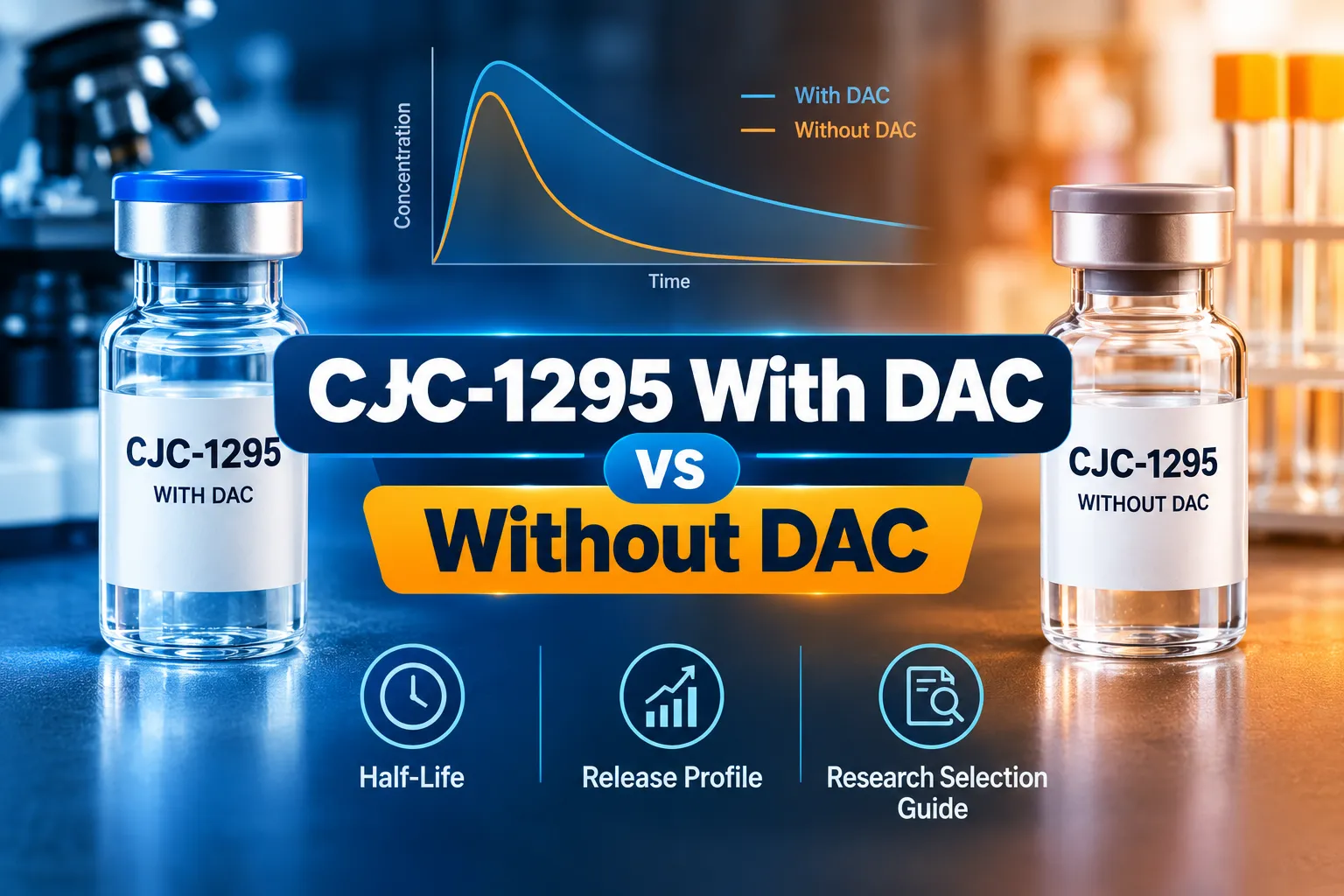
CJC-1295 With DAC vs Without DAC: Half-Life, Release Profile, and Research Selection Guide

CJC-1295 With DAC vs Without DAC: Half-Life, Release Profile, and Research Selection Guide

September 15, 2026/0 Comments/in Uncategorized/by

{"cover":"Professional landscape format (1536×1024) hero image with bold text overlay 'CJC-1295 With DAC vs Without DAC' in crisp white sans-serif on a deep navy semi-transparent overlay panel, centered with 8% safe margins from every edge. Background: high-resolution editorial split composition showing two glass laboratory vials side by side on a clean white lab bench, one labeled DAC and one labeled No DAC, soft studio lighting with cool blue and teal tones, shallow depth of field, molecular structure silhouettes faintly visible in background, pharmaceutical research magazine cover aesthetic, professional 2-color palette of navy and teal.","content":["Annotated mechanism diagram (1536×1024) illustrating half-life extension: left panel titled 'Without DAC, Mod GRF 1-29' shows a short curved arrow labeled '30 min half-life' with callout lines pointing to 'rapid clearance', 'pulsatile GH spike', and 'enzyme degradation sites'; right panel titled 'With DAC' shows a long curved arc labeled '6-8 day half-life' with callout lines pointing to 'albumin binding site', 'sustained GH elevation', and 'DAC moiety attachment point'; clean white background, teal and navy palette, thin callout lines, editorial medical-diagram polish, landscape 1536×1024.","Four-panel labelled comparison guide (1536×1024) for GH release profiles: Panel 1 heading 'Pulsatile Release' with bullet labels 'sharp GH peak', 'mimics natural rhythm', 'short dosing window'; Panel 2 heading 'Sustained Release' with bullet labels 'blunted peak', 'prolonged elevation', 'less frequent dosing'; Panel 3 heading 'Research Use: No DAC' with bullet labels 'stack flexibility', 'timing control', 'GHRP pairing'; Panel 4 heading 'Research Use: With DAC' with bullet labels 'once-weekly dosing', 'steady baseline', 'trough monitoring'; bright clinical white background, coral and navy accent colors, thin panel dividers, editorial infographic polish, landscape format.","Numbered step-by-step research selection flow diagram (1536×1024) titled 'Selecting the Right CJC-1295 Form': Step 1 labeled 'Define Research Goal' with sub-label 'pulsatile vs steady GH'; Step 2 labeled 'Assess Dosing Frequency' with sub-label 'daily vs weekly protocol'; Step 3 labeled 'Consider Stack Partners' with sub-label 'GHRP, ipamorelin, tesa'; Step 4 labeled 'Evaluate Safety Profile' with sub-label 'tachyphylaxis risk, DAC caution'; Step 5 labeled 'Source Verified Peptide' with sub-label 'purity testing required'; connected by bold directional arrows on a clean slate-gray background, teal step nodes, white label boxes, professional research-guide aesthetic, landscape 1536×1024."]
Professional landscape hero image () with a reading "CJC-1295 With DAC vs Without DAC". CRITICAL TYPOGRAPHY RULES: render

Two peptides share nearly identical names, yet their pharmacokinetic behavior is so different that swapping one for the other in a research protocol can produce completely opposite GH release patterns. Understanding the CJC-1295 with DAC vs without DAC distinction, including half-life, release profile, and research selection, is one of the most practically important decisions in growth hormone secretagogue research today.

Key Takeaways

  • CJC-1295 without DAC (also called Mod GRF 1-29) has a half-life of roughly 30 minutes, producing a sharp, pulsatile GH spike.
  • CJC-1295 with DAC binds to albumin in plasma, extending its half-life to approximately 6-8 days and producing a sustained, blunted GH elevation.
  • The two variants are not interchangeable; each suits different research designs and stacking strategies.
  • Nomenclature confusion is common, "CJC-1295 no DAC" and "Mod GRF 1-29" refer to the same peptide.
  • Both remain research-only compounds in 2026, with no approved clinical indications.

What Is CJC-1295 and Why Does DAC Change Everything

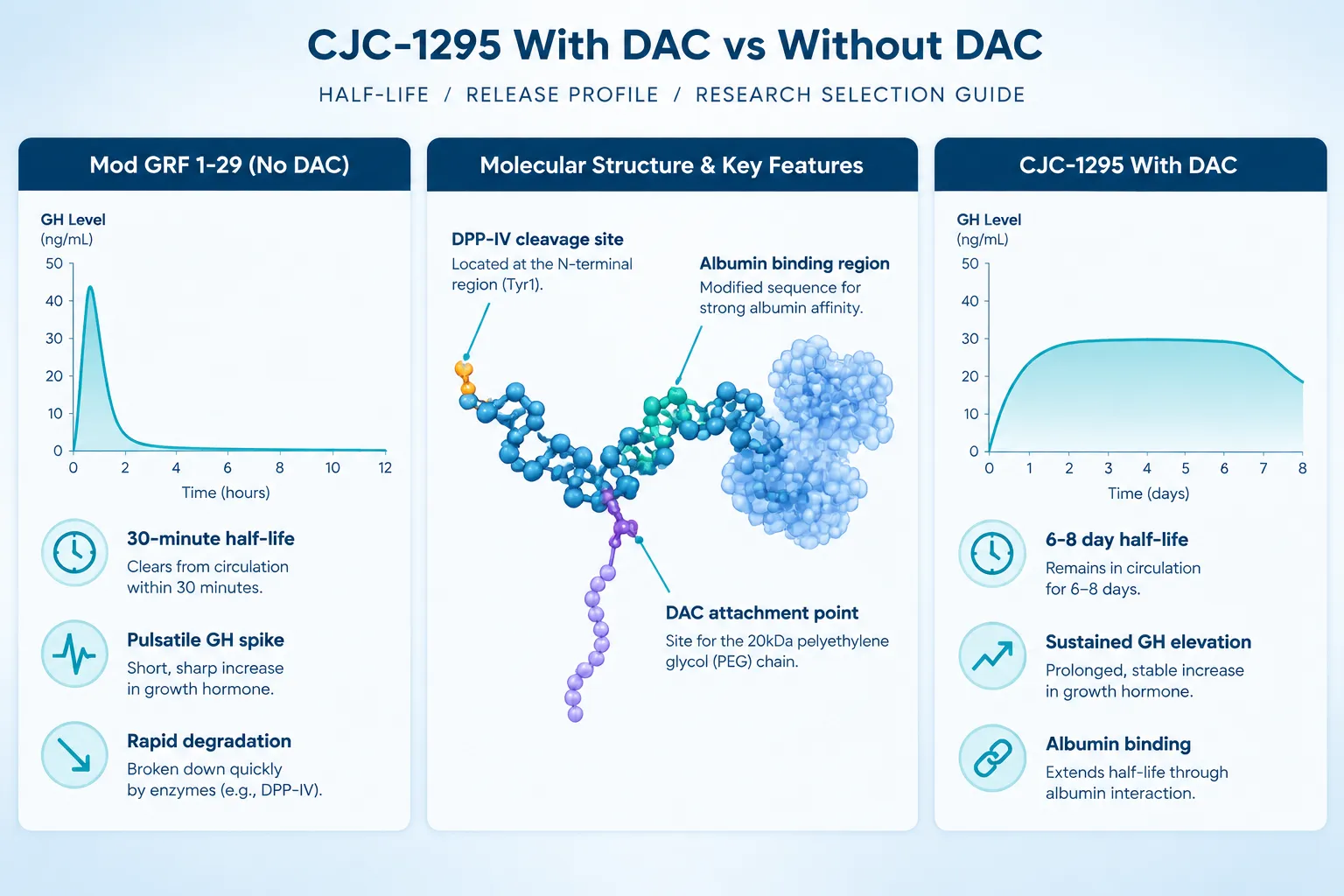
CJC-1295 is a synthetic analogue of growth hormone-releasing hormone (GHRH). Native GHRH is rapidly degraded by dipeptidyl peptidase IV (DPP-IV) enzymes in plasma, giving it a half-life of only a few minutes. Early modifications produced Mod GRF 1-29, a stabilized 29-amino-acid fragment with a half-life extended to roughly 30 minutes. This version is widely sold as "CJC-1295 without DAC" or simply "CJC-1295 no DAC."

The Drug Affinity Complex (DAC) technology takes stabilization a step further. A lysine residue is modified with a maleimidoproprionic acid group that forms a covalent bond with circulating albumin. Because albumin itself has a half-life of roughly 19 days, the DAC-conjugated peptide is shielded from clearance, extending its effective half-life to approximately 6-8 days in research models.

For a deeper look at the structural and pharmacokinetic differences between these two forms, the CJC-1295 with and without DAC mechanism and pharmacokinetic comparison covers the underlying science in detail.
What Is CJC-1295 and Why Does DAC Change Everything

The core structural difference:

Feature Mod GRF 1-29 (No DAC) CJC-1295 With DAC
Half-life ~30 minutes ~6-8 days
Albumin binding No Yes (covalent)
GH release pattern Pulsatile spike Sustained elevation
Dosing frequency Daily or per-session Once or twice weekly
DPP-IV resistance Partial High

Release Profile: Pulsatile vs Sustained GH Stimulation

The half-life gap between these two variants directly determines their GH release profiles, and this distinction sits at the heart of the CJC-1295 with DAC vs without DAC research selection guide.

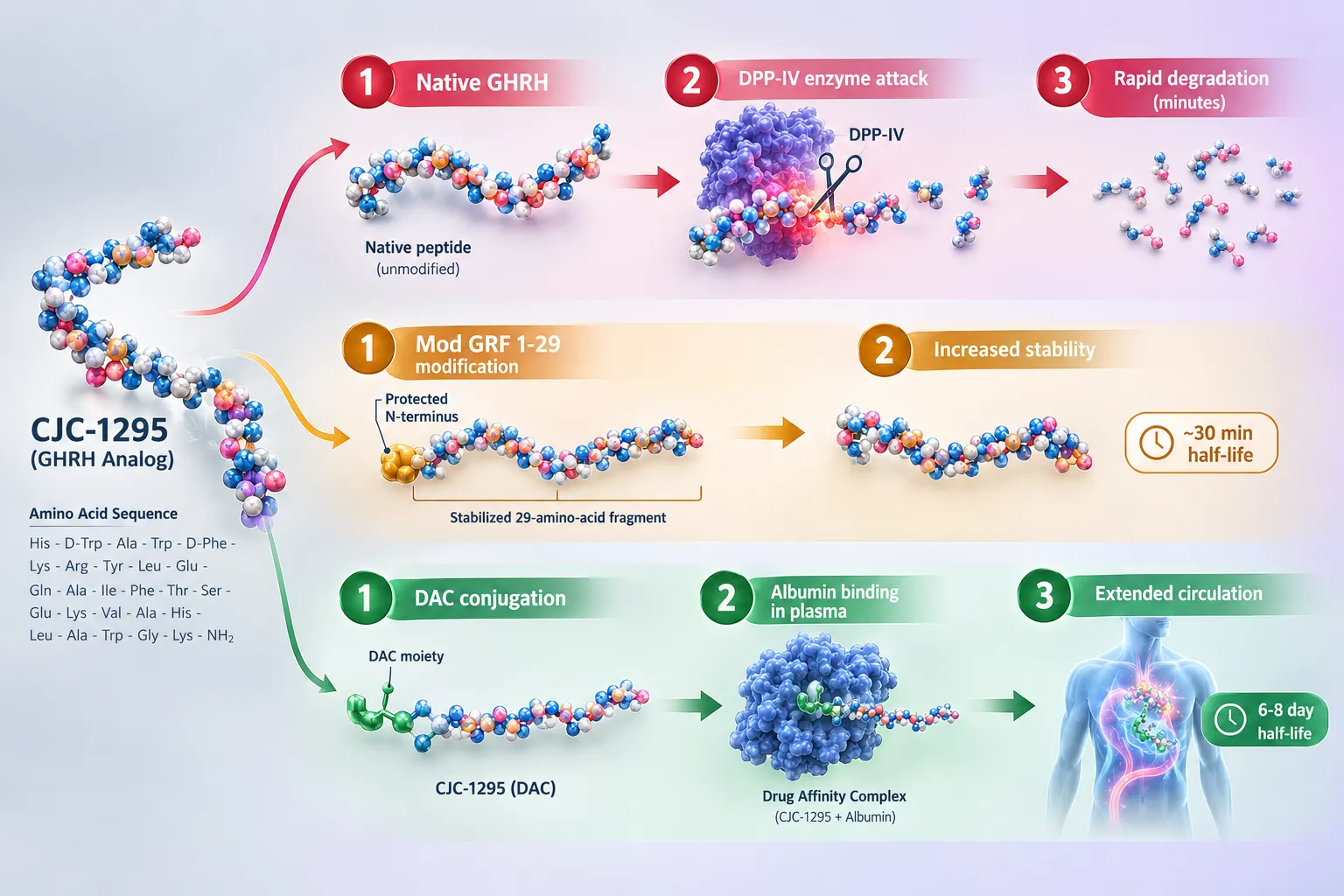
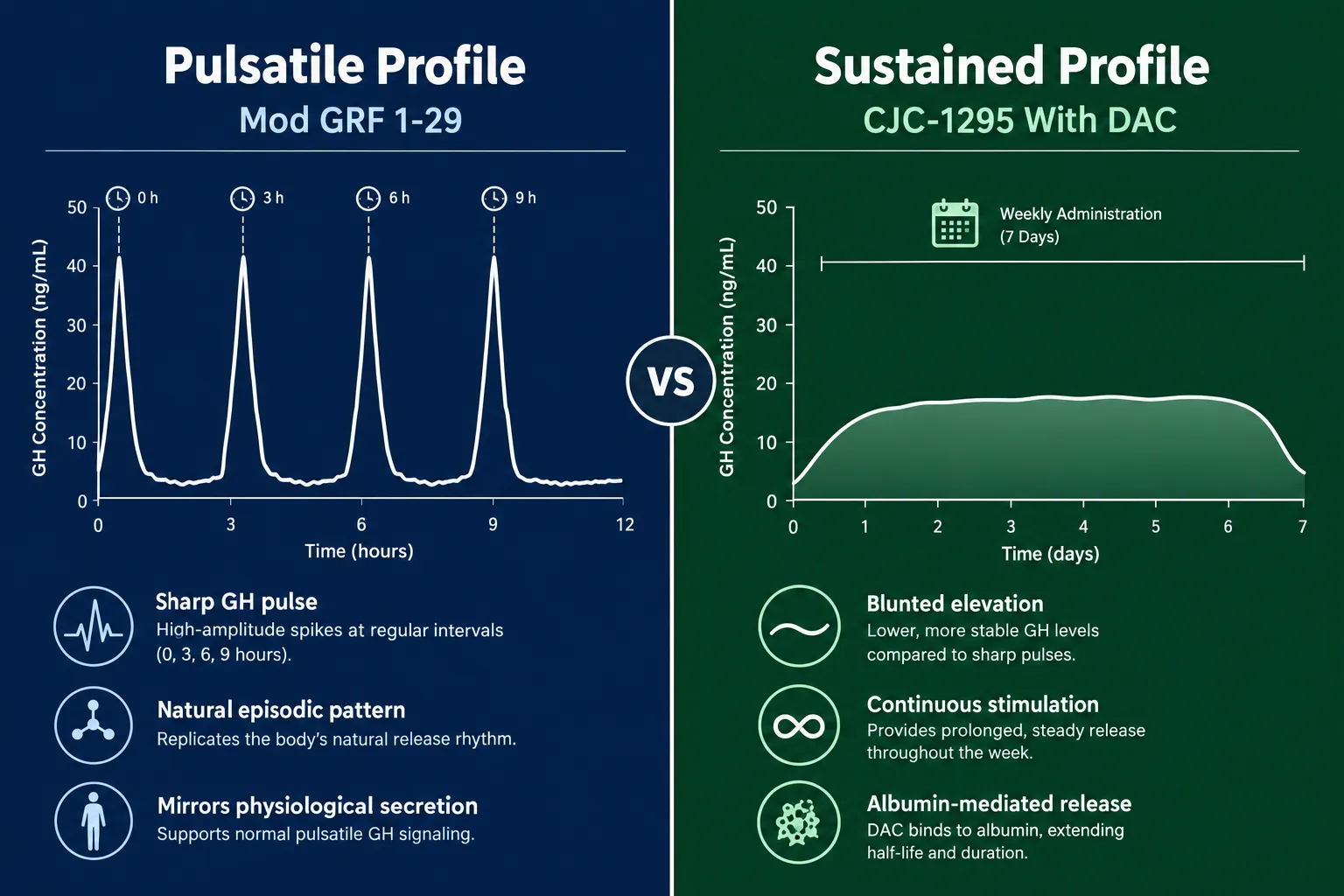
Mod GRF 1-29 (no DAC) produces a sharp, high-amplitude GH pulse that mirrors the body's natural episodic secretion pattern. Peak GH levels appear within 15-30 minutes of administration and return to baseline within a few hours. This pulsatile pattern is considered physiologically favorable by many researchers because it preserves the natural on-off rhythm of the somatotropic axis. It also offers precise timing control, making it easier to pair with ghrelin mimetics like ipamorelin or GHRP-2 for synergistic GH release.

Researchers studying GH secretagogue stacks often combine Mod GRF 1-29 with ipamorelin, as explored in resources on sermorelin, ipamorelin, and CJC-1295 combination protocols.

CJC-1295 with DAC produces a blunted but prolonged GH elevation. The Teichman 2006 Phase 1 study remains the most-cited pharmacokinetic anchor for this variant, demonstrating dose-dependent increases in IGF-1 lasting several days after a single injection. This sustained profile reduces the need for daily dosing but also raises concerns about tachyphylaxis, a desensitization of pituitary receptors caused by continuous GHRH stimulation rather than intermittent pulses.

"A sustained GH elevation is not automatically superior to a pulsatile one. The research question determines which profile is appropriate."
Release Profile: Pulsatile vs Sustained GH Stimulation

Researchers interested in body composition outcomes, including visceral fat reduction, may find relevant context in visceral fat research protocols that examine GH secretagogue effects on adipose tissue.

Research Selection Guide: Choosing Between CJC-1295 With DAC vs Without DAC

Selecting the correct variant depends on three primary research variables: the desired GH release pattern, the dosing schedule, and the peptide stack being used.

Choose Mod GRF 1-29 (no DAC) when:

  • The protocol requires mimicking natural pulsatile GH secretion
  • Daily or per-session administration is feasible
  • The peptide will be stacked with a GHRP or ipamorelin for amplified pulse height
  • Researchers want fine-grained control over timing and amplitude

Choose CJC-1295 with DAC when:

  • The protocol benefits from less frequent dosing (once or twice weekly)
  • A sustained IGF-1 elevation is the primary endpoint
  • The research design does not require precise pulse timing
  • Stacking with other secretagogues is not a primary concern

For multi-peptide research designs, blended formulations such as tesa, CJC-1295, and ipamorelin combination protocols offer an alternative approach worth reviewing.

Researchers should also note that the DAC variant carries a more cautious safety profile in 2026 consensus literature. Continuous GHRH receptor stimulation raises questions about receptor downregulation, and some protocols now include structured off-weeks when using the DAC form. The no-DAC variant's short half-life makes receptor rest automatic between doses.

For context on how other peptide classes interact with endocrine pathways, the overview of peptides and polypeptides in endocrine pharmacology provides useful background on receptor biology.
Research Selection Guide: Choosing Between CJC-1295 With DAC vs Without DAC

Nomenclature note: The label "CJC-1295 no DAC" is a vendor convention, not an official chemical name. The correct scientific designation is Modified GRF 1-29 (Mod GRF 1-29). Researchers sourcing peptides should confirm which compound is actually present, as mislabeling remains a documented issue in the research peptide supply chain.

Both compounds remain strictly research-use-only substances in 2026 with no approved human therapeutic applications.

Conclusion

The CJC-1295 with DAC vs without DAC comparison is not a question of which peptide is better, it is a question of which release profile matches the research objective. Mod GRF 1-29 delivers a short, sharp GH pulse ideal for pulsatile protocols and multi-peptide stacks. CJC-1295 with DAC delivers sustained GH elevation suited to low-frequency dosing designs, but demands greater attention to receptor desensitization risk.

Actionable next steps for researchers in 2026:

  1. Confirm the exact compound identity before designing any protocol, verify whether the supplier is providing Mod GRF 1-29 or the DAC-conjugated form.
  2. Match the release profile to the research endpoint: pulsatile for physiological mimicry, sustained for steady IGF-1 elevation studies.
  3. Review stacking compatibility before combining either variant with GHRPs or other secretagogues.
  4. Source only from suppliers with documented third-party purity testing to ensure compound integrity.
  5. Monitor current literature, as mid-2026 consensus continues to favor the no-DAC variant for most stacked research designs due to its more controllable pharmacokinetic profile.
https://www.puretestedpeptides.com/wp-content/uploads/2026/09/cjc-1295-with-dac-vs-without-dac-half-life-release-profile-and-research-selectio.webp 1024 1536 https://www.puretestedpeptides.com/wp-content/uploads/2026/01/buy-peptides-online.jpg 2026-09-15 13:05:092026-09-15 13:05:09CJC-1295 With DAC vs Without DAC: Half-Life, Release Profile, and Research Selection Guide
×

Helpful Links

  • My account
  • Cart
  • Checkout
  • Refund and Returns Policy
  • Privacy Policy
  • SMS Privacy Policy
  • Login
  • My Account
  • Logout

USA Made Lab Tested Peptides

All products are sold for research, laboratory, or analytical purposes only, and are not for human consumption


Pure Tested Peptides is a chemical supplier. Pure Tested Peptides is not a compounding / chemical compounding facility as defined under 503A of the Federal Food, Drug, and Cosmetic act. Pure Tested Peptides is not an outsourcing facility as defined under 503B of the Federal Food, Drug, and Cosmetic act.

The statements made within this website have not been evaluated by the US Food and Drug Administration. The products we offer are not intended to diagnose, treat, cure or prevent any disease.

Human/Animal Consumption Prohibited. Laboratory/In-Vitro Experimental Use Only

Scroll to top Scroll to top Scroll to top