Call or Text 727-513-9780
  • Shopping Cart Shopping Cart
    0Shopping Cart
Pure Tested Peptides | America's most trusted Peptides for sale online
  • Peptides for sale
    • Oral Peptides for sale
      • Peptide Capsules for sale
      • BPC 157 Capsules 1000mcg
      • SLU-PP-332 Capsules | 1000 mcg
      • 5-Amino-1MQ 50mg Capsules
      • Tesofensine 500mcg
    • All Peptides for sale
    • Peptide Sprays
      • BPC 157 Nasal Spray Kit
      • BPC-157 TB500 Nasal Spray Kit
      • Semax Nasal Spray 10mg
      • Selank – Nasal Spray Kit – 10mg
      • Epithalon 50MG Nasal Spray Kit
      • Ipamorelin 10mg Nasal Spray
      • Klow Nasal Spray (BPC-157 + TB-500 + GHK-Cu + KPV) | 80mg
      • Hulk Nasal Spray Tesa / Ipa Blend 6/3 MG
      • Klow Nasal Spray
      • NAD + 500 mg Nasal Spray
      • PT-141 Nasal Spray Kit
    • GHRH Peptides
      • Ipa Peptides
      • CJC-1295 Peptides
        • CJC-1295 with DAC 5 mg
        • CJC-1295 without DAC 5 mg
        • CJC-1295 Ipa 10mg
      • Tesa Peptides
        • Tesa Peptide
        • Tesa 20 mg
    • GHK-Cu Peptides
      • All GHK-Cu Peptides
      • GHK-Cu 100mg
      • KLOW Peptide Blend – Buy KLOW blend online
    • BPC Peptides
      • All BPC Peptides
      • BPC-157
      • BPC-157 TB-500
      • BPC 157 capsules 1000mcg
    • SLU-PP-332 Peptides
      • All SLU-PP-332 Peptides
      • SLU-PP-332 5mg
    • GLP3 Peptides
      • GLP3-R
      • GLP3-R CAG 10mg
      • GLP3-R 20mg
    • PT-141 Peptides
      • PT-141 Peptides for sale
      • PT-141 10mg
      • PT-141 Nasal Spray
    • CAG Peptides
      • Lipo-C Peptide Blend
      • CAG 5mg
      • CAG 10mg
    • MOTS-C Peptides
      • MOTS-C Peptides for sale
      • MOTS-c peptide
      • MOTS-c 10mg *6 pack*
    • 5 Amino 1MQ Peptides
      • 5 Amino 1MQ Peptides for sale
      • 5-Amino-1MQ 50mg Capsules
      • 5-Amino-1MQ 5mg
    • Epithalon Peptides
      • Epithalon Peptides for sale
      • Epithalon 10mg
      • Epithalon 50mg
  • Shop
    • GLPs
      • 5-Amino-1MQ 50mg Capsules
      • 5-Amino-1MQ 5mg
      • GLP3-Reta
      • L-Carnitine 500mg/ml
      • Tesofensine 500mcg
      • SLU-PP-332 5mg
      • MOTS-c 10mg *6 pack*
    • Epithalon & BPC Peptides
      • Epithalon 10mg
      • Epithalon 50mg
      • BPC-157
      • BPC 157 capsules 1000mcg
      • BPC-157 TB-500
      • BPC-157 TB500 Nasal Spray Kit
      • BPC 157 Nasal Spray Kit
    • BPC TB-500 & NAD+ Peptides
      • NAD+ 500 mg
      • KLOW Peptide Blend – Buy KLOW blend online
      • GLOW Peptide Blend
      • TB 500 5mg
      • BPC 157 capsules 1000mcg – Supplement
      • BPC 157 Nasal Spray Kit
      • BPC-157
      • BPC-157 TB500 Nasal Spray Kit
      • BPC-157 TB-500
      • BPC 157 capsules 1000mcg
    • LL-37 Peptide
      • LL-37 10 mg
    • MOTS-C & Selank
      • MOTS-c peptide
      • Selank 10mg
    • GHK Peptides
      • GHK-Cu 100mg
      • GLOW Peptide Blend
      • KLOW Peptide Blend – Buy KLOW blend online
  • COAs
  • Wholesale
    • Wholesale Peptides for sale
  • PTP FAQ
  • Affiliates
    • Selank Peptide: Advanced Pharmacological Mechanisms Underlying Its Anxiolytic and Nootropic Effects in Research
      • 5-Amino-1MQ Peptide: Detailed Mechanisms of NNMT Inhibition and Its Impact on Cellular Metabolism Research
        • MOTS-C Peptide: Unraveling Its Role in Mitochondrial Dynamics and Energy Metabolism Research
          • Epithalon Peptide and Telomerase Regulation: Investigating Its Impact on Cellular Senescence and Lifespan Research Models
            • GLP2-T vs GLP2 Tirz Peptide: Understanding the Naming, Mechanistic Nuances, and Research Implications for Gut Health
      • Peptides and Polypeptides in Modern Pharmacology: What Research on Metoprolol, Prednisone, and Amlodipine Reveals
        • Polypeptide Peptides vs NSAIDs: What Naproxen and Diclofenac Teach Tissue-Repair Researchers About BPC‑157 and TB‑500
          • Peptides and Polypeptides in Endocrine Pharmacology: How GLP-1, GLP-2, and GLP-3 Retatrutide Differ From Classic Drugs Like Prednisone and Amlodipine
          • 5‑Amino‑1MQ Peptide and NNMT Inhibition: How It Compares With Statins Like Atorvastatin in Adipose and Lipid Metabolism Research
      • Enclomiphene, Estrogen Receptor Signaling, and Luteinizing Phase Biology: What Hormone Researchers Should Measure
        • Mesenchymal Stem Cells, BPC‑157, and GHK‑Cu: How Tissue Repair Peptides Compare With Classic NSAIDs Like Naproxen in Injury Models
          • Peptide Calculator Use Cases Beyond Growth Hormone: Working Through GLP‑3 Retatrutide, MOTS‑c, and BPC‑157 Research Dosing
        • Polypeptide Peptides in Endocrine and Metabolic Pharmacology: Lessons From Amlodipine, Prednisone, and Metoprolol
        • Peptides Calculator for Advanced Blends: Worked Examples for Tesamorelin, CJC‑1295, and Ipamorelin Stacks
          • Peptides and Polypeptides in Human Physiology: How Molecular Size Shapes Research Applications
            • Selank Peptide: Advanced Pharmacological Mechanisms Underlying Its Anxiolytic and Nootropic Effects in Research
          • 5-Amino-1MQ Peptide: Detailed Mechanisms of NNMT Inhibition and Its Impact on Cellular Metabolism Research
            • MOTS-C Peptide: Unraveling Its Role in Mitochondrial Dynamics and Energy Metabolism Research
              • Epithalon Peptide and Telomerase Regulation: Investigating Its Impact on Cellular Senescence and Lifespan Research Models
                • GLP2-T vs GLP2 Tirz Peptide: Understanding the Naming, Mechanistic Nuances, and Research Implications for Gut Health
                  • Peptides and Polypeptides in Endocrine Pharmacology: How GLP-1, GLP-2, and GLP-3 Retatrutide Differ From Classic Drugs Like Prednisone and Amlodipine
                    • Polypeptide Peptides vs NSAIDs: What Naproxen and Diclofenac Teach Tissue-Repair Researchers About BPC‑157 and TB‑500
                      • Peptides and Polypeptides in Modern Pharmacology: What Research on Metoprolol, Prednisone, and Amlodipine Reveals
                        • 5‑Amino‑1MQ Peptide and NNMT Inhibition: How It Compares With Statins Like Atorvastatin in Adipose and Lipid Metabolism Research
                        • Enclomiphene, Estrogen Receptor Signaling, and Luteinizing Phase Biology: What Hormone Researchers Should Measure
                        • Mesenchymal Stem Cells, BPC‑157, and GHK‑Cu: How Tissue Repair Peptides Compare With Classic NSAIDs Like Naproxen in Injury Models
                        • Peptide Calculator Use Cases Beyond Growth Hormone: Working Through GLP‑3 Retatrutide, MOTS‑c, and BPC‑157 Research Dosing
                        • Polypeptide Peptides in Endocrine and Metabolic Pharmacology: Lessons From Amlodipine, Prednisone, and Metoprolol
                        • Peptides Calculator for Advanced Blends: Worked Examples for Tesamorelin, CJC‑1295, and Ipamorelin Stacks
                        • Peptides and Polypeptides in Human Physiology: How Molecular Size Shapes Research Applications
                        • Selank Peptide: Advanced Pharmacological Mechanisms Underlying Its Anxiolytic and Nootropic Effects in Research
                        • MOTS-C Peptide: Unraveling Its Role in Mitochondrial Dynamics and Energy Metabolism Research
                        • Peptides and Polypeptides in Modern Pharmacology: What Research on Metoprolol, Prednisone, and Amlodipine Reveals
                        • Peptides and Polypeptides in Endocrine Pharmacology: How GLP-1, GLP-2, and GLP-3 Retatrutide Differ From Classic Drugs Like Prednisone and Amlodipine
                        • 5-Amino-1MQ Peptide: Detailed Mechanisms of NNMT Inhibition and Its Impact on Cellular Metabolism Research
                        • Mesenchymal Stem Cells, BPC‑157, and GHK‑Cu: How Tissue Repair Peptides Compare With Classic NSAIDs Like Naproxen in Injury Models
                        • Peptide Calculator Use Cases Beyond Growth Hormone: Working Through GLP‑3 Retatrutide, MOTS‑c, and BPC‑157 Research Dosing
                        • GLP2-T vs GLP2 Tirz Peptide: Understanding the Naming, Mechanistic Nuances, and Research Implications for Gut Health
                        • Polypeptide Peptides in Endocrine and Metabolic Pharmacology: Lessons From Amlodipine, Prednisone, and Metoprolol
                        • Polypeptide Peptides vs NSAIDs: What Naproxen and Diclofenac Teach Tissue-Repair Researchers About BPC‑157 and TB‑500
                        • Peptides and Polypeptides in Human Physiology: How Molecular Size Shapes Research Applications
                        • Peptides Calculator for Advanced Blends: Worked Examples for Tesamorelin, CJC‑1295, and Ipamorelin Stacks
                        • 5‑Amino‑1MQ Peptide and NNMT Inhibition: How It Compares With Statins Like Atorvastatin in Adipose and Lipid Metabolism Research
                        • Enclomiphene, Estrogen Receptor Signaling, and Luteinizing Phase Biology: What Hormone Researchers Should Measure
                        • Epithalon Peptide and Telomerase Regulation: Investigating Its Impact on Cellular Senescence and Lifespan Research Models
                        • Best research protocol Klow blend
                        • best time to take BPC-157
                        • best time to take DSIP (Delta Sleep Inducing Peptide)
                        • best time to take CJC-1295
                        • best time to take AOD-9604
                        • best time to take Follistatin 344
                        • best time to take Ipamorelin
                        • best time to take MK-677 (Ibutamoren)
                        • best time to take Ligandrol (LGD-4033) — research compound
                        • best time to take Ostarine (MK-2866) — research compound
                        • best time to take GHK-CU
                        • best time to take TB-500
                        • best time to take MOTS-c
                        • best time to take Semax
                        • best time to take RAD-140 (Testolone) — research compound
                        • best time to take Thymosin Alpha-1
                        • best time to take PEG-MGF
                        • Biolife Plasma, Octapharma Plasma, and Research Peptides: How Plasma Donation Labs Differ From Peptide Suppliers
                        • best time to take YK-11 — research compound
                        • best time to take PT-141 (Bremelanotide)
                        • Best research protocol Klow blend
                        • 5-Amino-1MQ and MOTS-C Synergy: Metabolic Signaling, Mitochondria, and Research Design
                        • BPC-157 and TB-500: Investigating Their Combined Effects on Angiogenesis and Cellular Migration in Tissue Repair Models
                        • BPC-157 Peptide: Gut Barrier Function, Inflammation, and Tissue-Recovery Research
                        • 5‑Amino‑1MQ and MOTS‑c Synergy in Metabolic Research: Designing NNMT and Mitochondrial Biogenesis Stacks
                        • CJC-1295 with DAC vs. Without DAC: Half-Life, Release Kinetics, and Research Implications
                        • CJC‑1295 with DAC vs. Without DAC: Expanding on Half‑Life Differences Using Tesamorelin and Ipamorelin Blend Case Studies
                        • Collagen Biology and Copper‑Binding Peptides: How GHK‑Cu, Glow Blend, and Klow Blend Interact with Skin and Connective Tissue
                        • Collagen Biology and Regenerative Peptides: How GHK‑Cu, Glow Blend, and Klow Blend Affect Extracellular Matrix Research
                    • DNA, Telomeres, and Longevity Peptides: Positioning Epithalon and MOTS‑c in Genetic Aging Research
                      • Enclomiphene Citrate: serm Mechanism, Testosterone Research, and Stack Compatibility
                        • Enclomiphene vs Enclomiphene Citrate: Formulation, Bioavailability, and Research Distinctions
                        • Epithalon Peptide Research: Telomerase Activation, Aging, and Pineal Gland Function
                        • Estrogen Receptor Signaling and Enclomiphene: How Selective Modulators Compare with Classic Polypeptide Hormones
                        • GHK-Cu Peptide: Advanced Mechanisms in Extracellular Matrix Remodeling and Wound Healing Research
                        • GHK-Cu Peptide: Collagen Synthesis, Wound Repair, and Skin-Barrier Research Models
                        • GLP-1 vs GLP-3 vs GLP-2: Peptide Classification and Research Applications
                        • GLP-2 Peptide Research Guide: Gut Barrier Function, Nutrient Absorption, and Intestinal Recovery Models
                        • GLP-3 Retatrutide vs. GLP-1 Drugs: What Triple-Agonist Biology Changes in Research Models
                        • Ipamorelin and Tesamorelin Combination: Synergistic GH Secretagogue Research and Dosing Protocols
                        • GLP2 Tirz Peptide: What It Is, Why the Name Exists, and How Researchers Should Interpret It
                        • Klow Blend Peptide Nasal Spray: What the Formulation Is Trying to Do in Cognitive Research
                        • Mitochondria, NNMT Inhibition, and Peptide Modulators: Where MOTS‑c and 5‑Amino‑1MQ Fit in Cellular Energy Research
                        • MOTS-c Peptide: Mitochondrial Function, Energy Metabolism, and What Researchers Measure
                        • MOTS-c vs. 5-Amino-1MQ: Which Metabolic Research Questions Each Compound Actually Answers
                        • Nasal Spray Peptides: Bioavailability, Administration, and Semax/Selank Research Applications
                        • PT-141 Peptide Research: Mechanism of Action and Melanocortin Receptor Signaling
                        • Retatrutide for Research: Mechanism, Structure, and GLP-1/GLP-3 Dual Action
                        • Retatrutide for Obesity and Type 2 Diabetes: What the Latest Trial Data Suggest
                        • Tesofensine Peptide Research: Mechanism, Appetite Suppression, and Neuropeptide Y Pathways
  • Contact
    • Contact Customer Service
    • Text Customer Support
  • About US
  • Shop all peptides
  • Affiliate Program
    • Affiliate Signup
  • Login / Register Login / Register Page Link Login / Register Page Link
  • Click to open the search input field Click to open the search input field Search
  • Menu Menu

Tag Archive for: ghrh mimetics

Tesamorelin, Ipamorelin, and CJC-1295 With DAC: How Different GHRH Mimetic Profiles Shape Growth Hormone Study Outcomes

Tesamorelin, Ipamorelin, and CJC-1295 With DAC: How Different GHRH Mimetic Profiles Shape Growth Hormone Study Outcomes

August 6, 2026/0 Comments/in Uncategorized/by

Growth hormone secretagogue research has expanded rapidly, yet fewer than 15% of preclinical labs systematically account for half-life differences when designing GH pulse studies, a gap that skews IGF-1 readouts and muddies cross-study comparisons. Understanding how Tesamorelin, Ipamorelin, and CJC-1295 With DAC: How Different GHRH Mimetic Profiles Shape Growth Hormone Study Outcomes differ at the receptor, pulse, and IGF-1 level is now a foundational requirement for any serious research protocol.

Key Takeaways

  • Tesamorelin is a full-length GHRH analog with FDA-validated receptor fidelity and a short half-life suited to acute pulse studies.
  • Ipamorelin is a selective ghrelin-receptor agonist that drives clean GH pulses without significant cortisol or prolactin co-stimulation.
  • CJC-1295 with DAC uses albumin binding to achieve a 6-8 day effective half-life, fundamentally changing the exposure profile compared to short-acting analogs.
  • Receptor target, pulse shape, and IGF-1 trajectory each vary meaningfully across the three peptides, making protocol design critical.
  • Combination blends can leverage complementary mechanisms, but require careful assay planning to interpret outcomes correctly.

Receptor Targets and Mechanistic Profiles

The first variable that separates these three compounds is where they act.

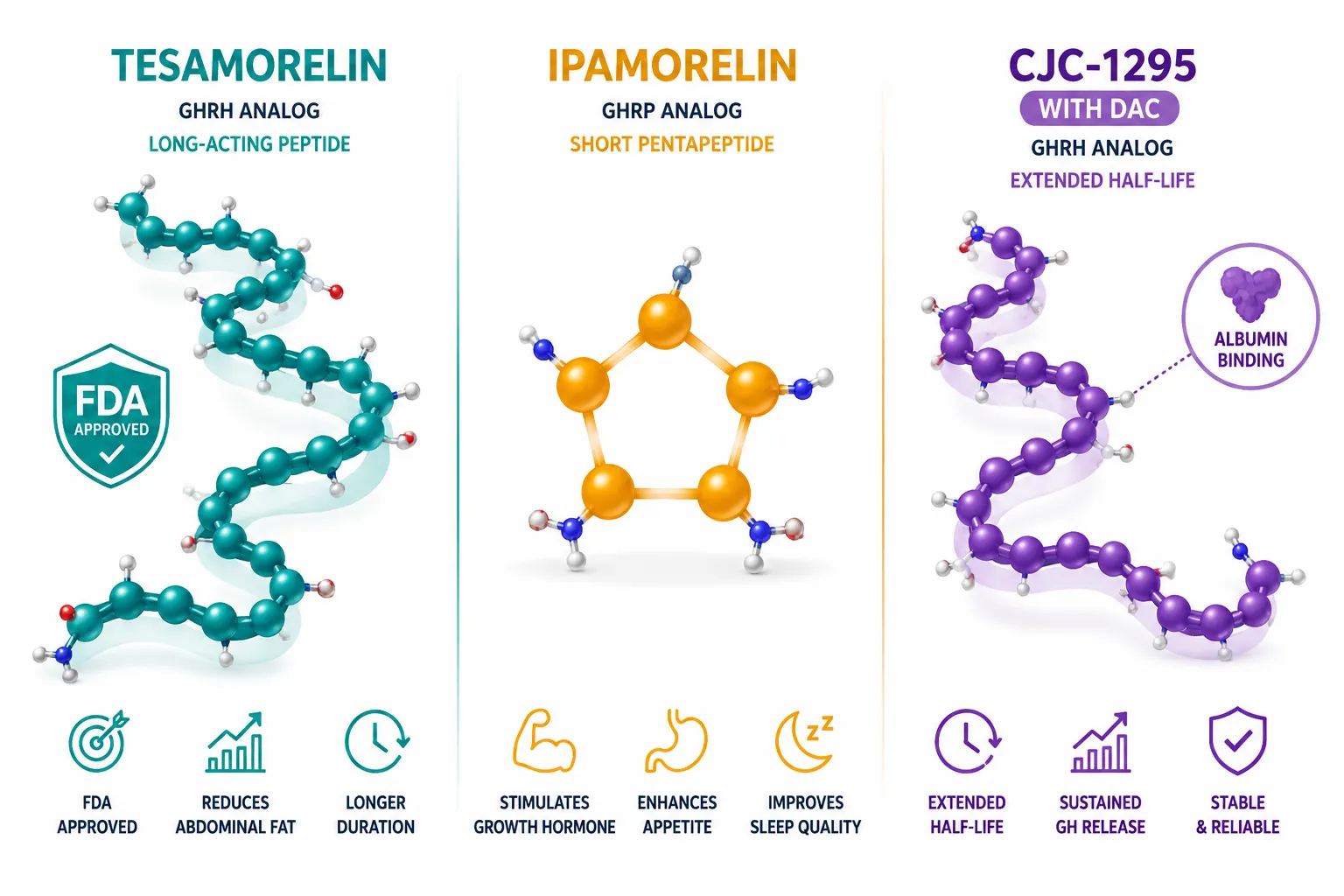
Tesamorelin is a stabilized synthetic analog of endogenous growth hormone-releasing hormone (GHRH). It binds selectively to the GHRH receptor on pituitary somatotrophs, mimicking the natural signal with high fidelity. Because it preserves the full 44-amino-acid structure of native GHRH, its downstream signaling closely parallels physiological GH release. Researchers exploring what Tesamorelin is and how it works will find it is the closest available analog to endogenous GHRH in terms of receptor engagement.

Ipamorelin operates through an entirely different pathway. As a selective ghrelin receptor (GHS-R1a) agonist, it stimulates GH release via the ghrelin axis rather than the GHRH receptor. Critically, Ipamorelin shows high selectivity, it does not meaningfully elevate cortisol, prolactin, or ACTH at research-relevant doses. This selectivity makes it a preferred tool when investigators need clean GH data without adrenal confounders. A detailed comparison of Ipamorelin vs Tesamorelin highlights how these distinct receptor pathways produce overlapping yet distinct downstream effects.

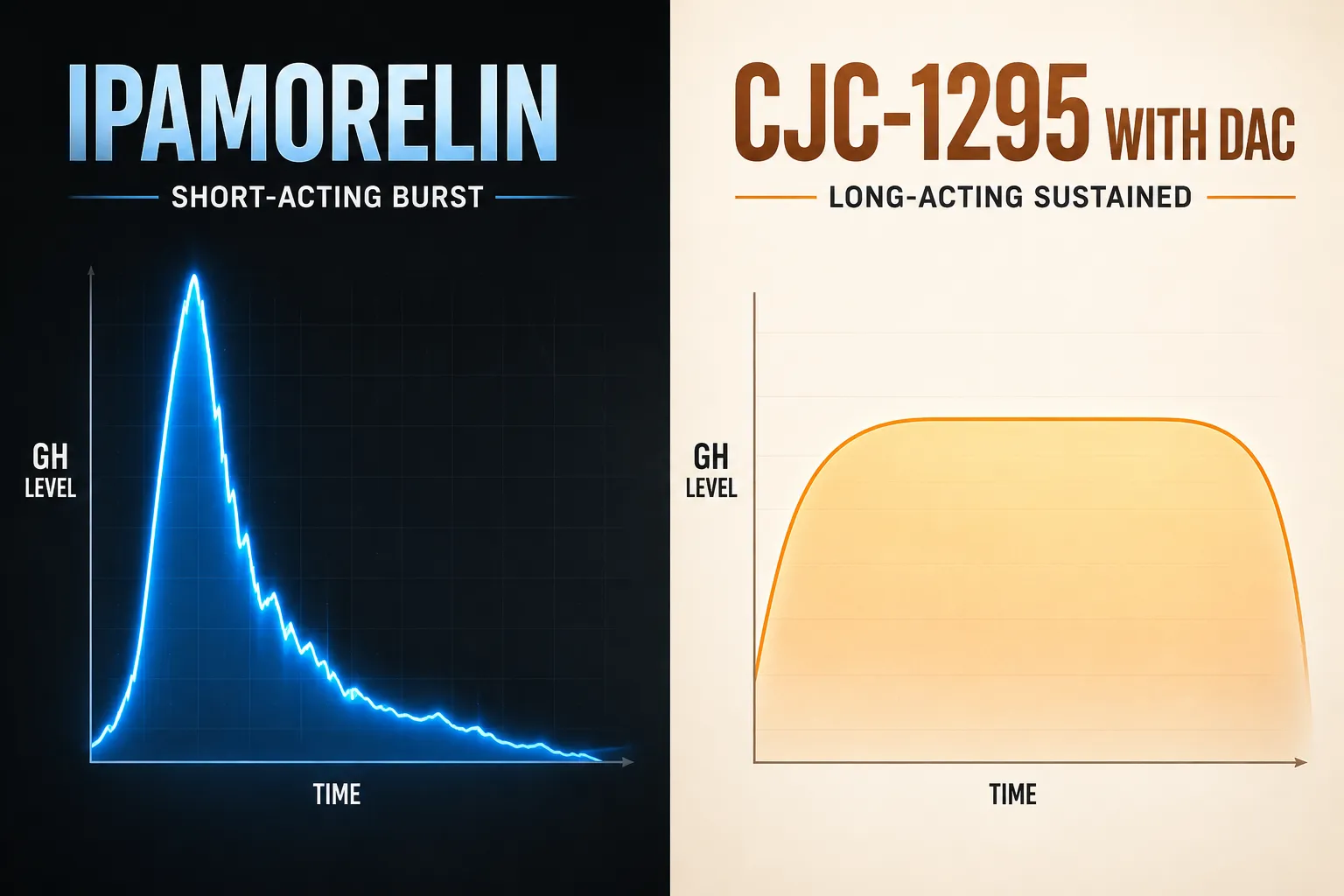
CJC-1295 with DAC is a GHRH receptor agonist like Tesamorelin, but its Drug Affinity Complex (DAC) modification enables covalent albumin binding in circulation. This single structural change transforms the molecule's pharmacokinetic profile entirely, extending the effective half-life to approximately 6-8 days versus the roughly 30-minute half-life of unmodified GHRH analogs. The result is sustained, tonic GH and IGF-1 elevation rather than discrete pulses.

How Pulse Characteristics and IGF-1 Responses Differ Across Protocols
How Pulse Characteristics and IGF-1 Responses Differ Across Protocols

The pharmacokinetic differences above translate directly into measurable differences in study outcomes. The table below summarizes the key parameters researchers should account for when designing protocols.

Parameter Tesamorelin Ipamorelin CJC-1295 with DAC
Receptor target GHRH-R GHS-R1a GHRH-R
Half-life ~30 min ~2 hours 6-8 days
GH pulse shape Sharp, physiological Sharp, selective Broad, sustained
IGF-1 trajectory Moderate elevation Moderate elevation Prolonged elevation
Dosing frequency Daily Daily or BID Weekly

"The DAC modification does not simply extend duration, it fundamentally changes the nature of GH secretion from pulsatile to tonic, which has downstream consequences for IGF-1 kinetics and receptor sensitivity."

Tesamorelin produces sharp, physiologically patterned GH pulses when dosed daily. Its IGF-1 response is consistent and well-characterized, making it ideal for studies requiring predictable, repeatable GH stimulation. Researchers can explore Tesamorelin peptide benefits and Tesamorelin dosage per day considerations when planning acute or subchronic protocols.

Ipamorelin generates similarly sharp pulses but through the ghrelin axis. Because its mechanism is independent of GHRH-R, it can be combined with GHRH analogs for synergistic GH release, a common rationale behind combination blends. Dosing guidance for CJC-1295 Ipamorelin dosage protocols reflects this synergistic design logic.

CJC-1295 with DAC drives sustained IGF-1 elevation that persists across the dosing interval. Weekly dosing designs are both practical and sufficient, but researchers must account for the tonic GH environment when interpreting anabolic or metabolic endpoints. The prolonged exposure also raises considerations around somatostatin feedback that do not apply to short-acting analogs.

Choosing the Right Peptide or Combination for Your Research Design

Choosing the Right Peptide or Combination for Your Research Design
Choosing the Right Peptide or Combination for Your Research Design

Selecting among these three compounds, or combining them, depends on the specific research question.

For acute GH pulse studies: Tesamorelin or Ipamorelin are the better choices. Their short half-lives allow investigators to control timing precisely and measure discrete pulse amplitude and frequency.

For sustained IGF-1 elevation studies: CJC-1295 with DAC is the logical candidate. Its weekly dosing simplifies long-duration protocols and reduces injection frequency as a confounding variable.

For combination protocols: Pairing Ipamorelin (GHS-R1a) with a GHRH-R agonist (Tesamorelin or CJC-1295 with DAC) leverages dual-axis stimulation. Researchers planning such designs should consult an assay planning and sourcing checklist for CJC-1295 Ipamorelin before finalizing their protocol. Multi-peptide blends such as the Tesamorelin CJC-1295 Ipamorelin 12mg blend are increasingly used in research settings where dual-axis stimulation is the experimental goal.

Key protocol considerations include:

  • Sampling windows: Short-acting peptides require frequent sampling (every 15-30 minutes post-dose); CJC-1295 with DAC allows wider intervals.
  • IGF-1 measurement timing: Tonic GH from DAC formulations elevates baseline IGF-1 continuously; acute studies need pre-dose baselines reset between sessions.
  • Somatostatin feedback: Prolonged GH stimulation may upregulate somatostatin tone, potentially blunting peak responses in extended DAC studies.
  • Assay interference: Cortisol and prolactin co-measurements are more critical in protocols using non-selective secretagogues.

Conclusion

The distinctions among Tesamorelin, Ipamorelin, and CJC-1295 With DAC in shaping growth hormone study outcomes are not subtle, they are mechanistically fundamental. Tesamorelin offers physiological GHRH-R fidelity with acute pulse control. Ipamorelin delivers selective ghrelin-axis stimulation without adrenal noise. CJC-1295 with DAC redefines the exposure profile entirely through albumin binding, converting pulsatile release into sustained tonic elevation.

Actionable next steps for research teams in 2026:

  1. Define the primary endpoint first, acute pulse amplitude, sustained IGF-1 elevation, or dual-axis synergy, then select the compound that matches that endpoint mechanistically.
  2. Review CJC-1295 Ipamorelin cycle design principles to align dosing intervals with the chosen compound's half-life.
  3. Use a Tesamorelin dosage calculator when standardizing per-subject dosing in Tesamorelin-inclusive protocols.
  4. Document the pharmacokinetic rationale for compound selection in all study reports to improve cross-lab reproducibility.

Matching the right GHRH mimetic profile to the right research question is the single most impactful decision a lab can make before the first assay runs.

https://www.puretestedpeptides.com/wp-content/uploads/2026/08/tesa-ipamorelin-and-cjc-1295-with-dac-how-different-ghrh-mimetic-profiles.webp 1024 1536 https://www.puretestedpeptides.com/wp-content/uploads/2026/01/buy-peptides-online.jpg 2026-08-06 13:04:112026-08-06 13:04:11Tesamorelin, Ipamorelin, and CJC-1295 With DAC: How Different GHRH Mimetic Profiles Shape Growth Hormone Study Outcomes
×

Helpful Links

  • My account
  • Cart
  • Checkout
  • Refund and Returns Policy
  • Privacy Policy
  • SMS Privacy Policy
  • Login
  • My Account
  • Logout

USA Made Lab Tested Peptides

All products are sold for research, laboratory, or analytical purposes only, and are not for human consumption


Pure Tested Peptides is a chemical supplier. Pure Tested Peptides is not a compounding / chemical compounding facility as defined under 503A of the Federal Food, Drug, and Cosmetic act. Pure Tested Peptides is not an outsourcing facility as defined under 503B of the Federal Food, Drug, and Cosmetic act.

The statements made within this website have not been evaluated by the US Food and Drug Administration. The products we offer are not intended to diagnose, treat, cure or prevent any disease.

Human/Animal Consumption Prohibited. Laboratory/In-Vitro Experimental Use Only

Scroll to top Scroll to top Scroll to top