

Tesamorelin, Ipamorelin, and CJC-1295 With DAC: How Different GHRH Mimetic Profiles Shape Growth Hormone Study Outcomes
Growth hormone secretagogue research has expanded rapidly, yet fewer than 15% of preclinical labs systematically account for half-life differences when designing GH pulse studies, a gap that skews IGF-1 readouts and muddies cross-study comparisons. Understanding how Tesamorelin, Ipamorelin, and CJC-1295 With DAC: How Different GHRH Mimetic Profiles Shape Growth Hormone Study Outcomes differ at the receptor, pulse, and IGF-1 level is now a foundational requirement for any serious research protocol.
Key Takeaways
- Tesamorelin is a full-length GHRH analog with FDA-validated receptor fidelity and a short half-life suited to acute pulse studies.
- Ipamorelin is a selective ghrelin-receptor agonist that drives clean GH pulses without significant cortisol or prolactin co-stimulation.
- CJC-1295 with DAC uses albumin binding to achieve a 6-8 day effective half-life, fundamentally changing the exposure profile compared to short-acting analogs.
- Receptor target, pulse shape, and IGF-1 trajectory each vary meaningfully across the three peptides, making protocol design critical.
- Combination blends can leverage complementary mechanisms, but require careful assay planning to interpret outcomes correctly.
Receptor Targets and Mechanistic Profiles
The first variable that separates these three compounds is where they act.
Tesamorelin is a stabilized synthetic analog of endogenous growth hormone-releasing hormone (GHRH). It binds selectively to the GHRH receptor on pituitary somatotrophs, mimicking the natural signal with high fidelity. Because it preserves the full 44-amino-acid structure of native GHRH, its downstream signaling closely parallels physiological GH release. Researchers exploring what Tesamorelin is and how it works will find it is the closest available analog to endogenous GHRH in terms of receptor engagement.
Ipamorelin operates through an entirely different pathway. As a selective ghrelin receptor (GHS-R1a) agonist, it stimulates GH release via the ghrelin axis rather than the GHRH receptor. Critically, Ipamorelin shows high selectivity, it does not meaningfully elevate cortisol, prolactin, or ACTH at research-relevant doses. This selectivity makes it a preferred tool when investigators need clean GH data without adrenal confounders. A detailed comparison of Ipamorelin vs Tesamorelin highlights how these distinct receptor pathways produce overlapping yet distinct downstream effects.
CJC-1295 with DAC is a GHRH receptor agonist like Tesamorelin, but its Drug Affinity Complex (DAC) modification enables covalent albumin binding in circulation. This single structural change transforms the molecule's pharmacokinetic profile entirely, extending the effective half-life to approximately 6-8 days versus the roughly 30-minute half-life of unmodified GHRH analogs. The result is sustained, tonic GH and IGF-1 elevation rather than discrete pulses.
How Pulse Characteristics and IGF-1 Responses Differ Across Protocols
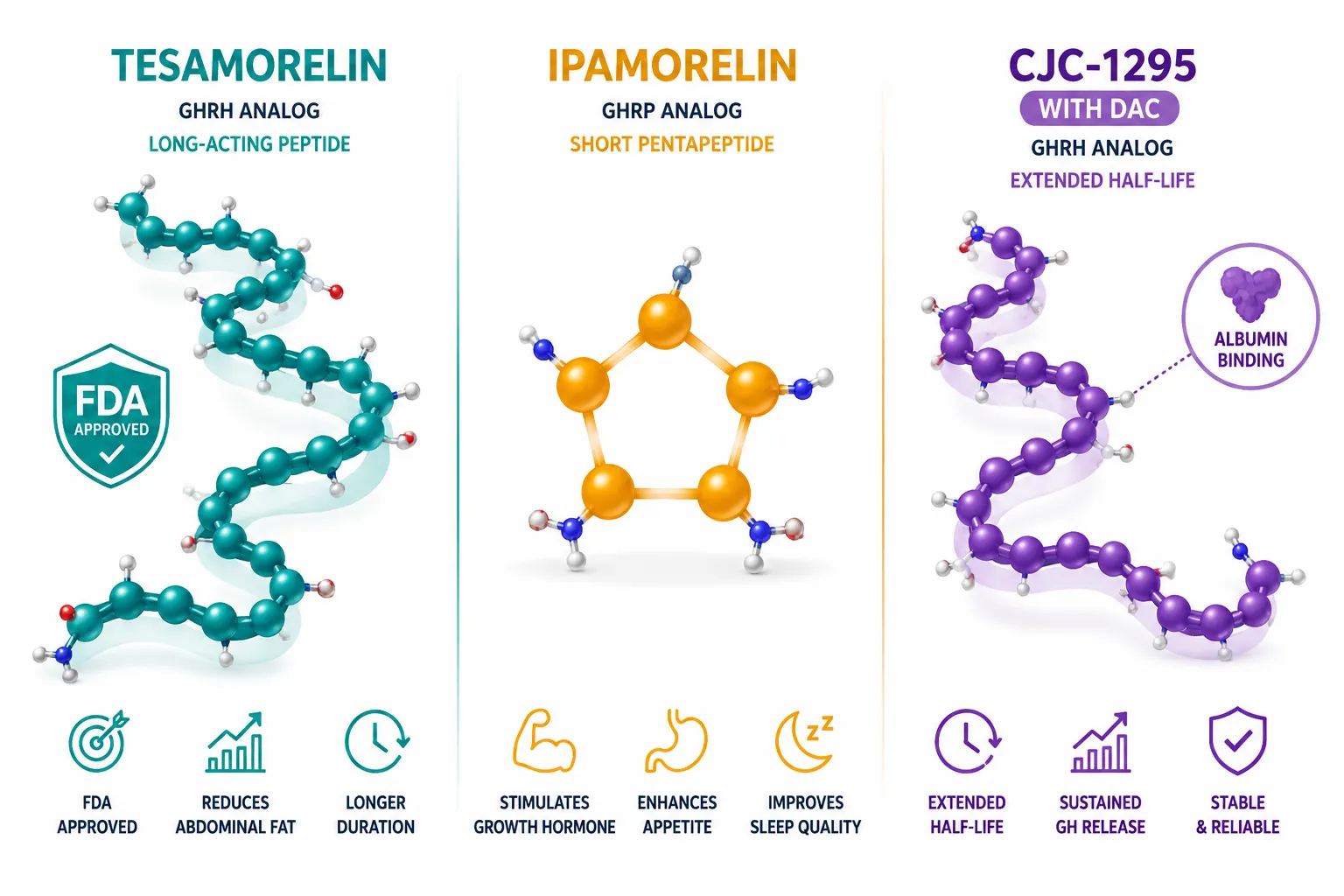
The pharmacokinetic differences above translate directly into measurable differences in study outcomes. The table below summarizes the key parameters researchers should account for when designing protocols.
| Parameter | Tesamorelin | Ipamorelin | CJC-1295 with DAC |
|---|---|---|---|
| Receptor target | GHRH-R | GHS-R1a | GHRH-R |
| Half-life | ~30 min | ~2 hours | 6-8 days |
| GH pulse shape | Sharp, physiological | Sharp, selective | Broad, sustained |
| IGF-1 trajectory | Moderate elevation | Moderate elevation | Prolonged elevation |
| Dosing frequency | Daily | Daily or BID | Weekly |
"The DAC modification does not simply extend duration, it fundamentally changes the nature of GH secretion from pulsatile to tonic, which has downstream consequences for IGF-1 kinetics and receptor sensitivity."
Tesamorelin produces sharp, physiologically patterned GH pulses when dosed daily. Its IGF-1 response is consistent and well-characterized, making it ideal for studies requiring predictable, repeatable GH stimulation. Researchers can explore Tesamorelin peptide benefits and Tesamorelin dosage per day considerations when planning acute or subchronic protocols.
Ipamorelin generates similarly sharp pulses but through the ghrelin axis. Because its mechanism is independent of GHRH-R, it can be combined with GHRH analogs for synergistic GH release, a common rationale behind combination blends. Dosing guidance for CJC-1295 Ipamorelin dosage protocols reflects this synergistic design logic.
CJC-1295 with DAC drives sustained IGF-1 elevation that persists across the dosing interval. Weekly dosing designs are both practical and sufficient, but researchers must account for the tonic GH environment when interpreting anabolic or metabolic endpoints. The prolonged exposure also raises considerations around somatostatin feedback that do not apply to short-acting analogs.
Choosing the Right Peptide or Combination for Your Research Design

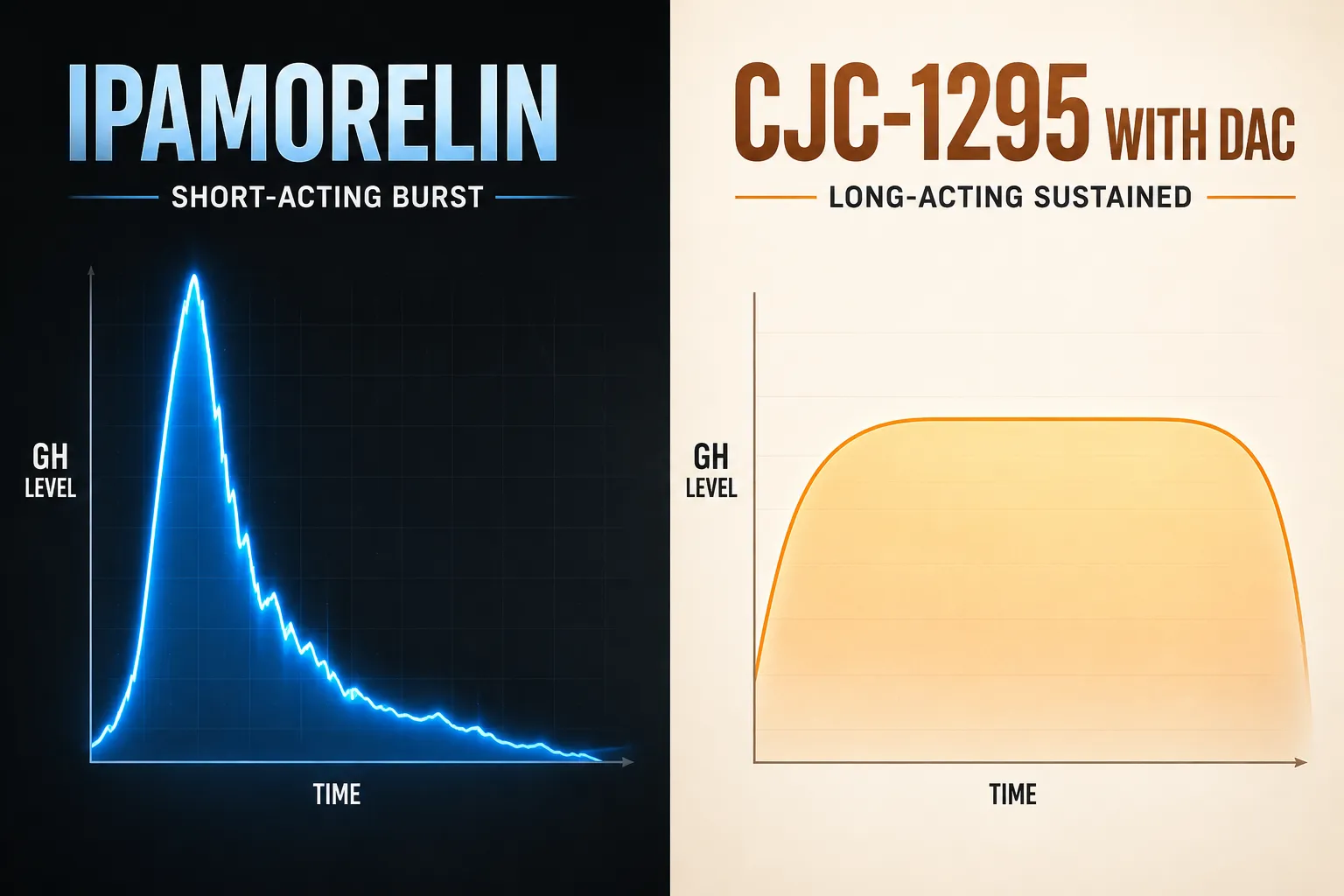
Selecting among these three compounds, or combining them, depends on the specific research question.
For acute GH pulse studies: Tesamorelin or Ipamorelin are the better choices. Their short half-lives allow investigators to control timing precisely and measure discrete pulse amplitude and frequency.
For sustained IGF-1 elevation studies: CJC-1295 with DAC is the logical candidate. Its weekly dosing simplifies long-duration protocols and reduces injection frequency as a confounding variable.
For combination protocols: Pairing Ipamorelin (GHS-R1a) with a GHRH-R agonist (Tesamorelin or CJC-1295 with DAC) leverages dual-axis stimulation. Researchers planning such designs should consult an assay planning and sourcing checklist for CJC-1295 Ipamorelin before finalizing their protocol. Multi-peptide blends such as the Tesamorelin CJC-1295 Ipamorelin 12mg blend are increasingly used in research settings where dual-axis stimulation is the experimental goal.
Key protocol considerations include:
- Sampling windows: Short-acting peptides require frequent sampling (every 15-30 minutes post-dose); CJC-1295 with DAC allows wider intervals.
- IGF-1 measurement timing: Tonic GH from DAC formulations elevates baseline IGF-1 continuously; acute studies need pre-dose baselines reset between sessions.
- Somatostatin feedback: Prolonged GH stimulation may upregulate somatostatin tone, potentially blunting peak responses in extended DAC studies.
- Assay interference: Cortisol and prolactin co-measurements are more critical in protocols using non-selective secretagogues.
Conclusion
The distinctions among Tesamorelin, Ipamorelin, and CJC-1295 With DAC in shaping growth hormone study outcomes are not subtle, they are mechanistically fundamental. Tesamorelin offers physiological GHRH-R fidelity with acute pulse control. Ipamorelin delivers selective ghrelin-axis stimulation without adrenal noise. CJC-1295 with DAC redefines the exposure profile entirely through albumin binding, converting pulsatile release into sustained tonic elevation.
Actionable next steps for research teams in 2026:
- Define the primary endpoint first, acute pulse amplitude, sustained IGF-1 elevation, or dual-axis synergy, then select the compound that matches that endpoint mechanistically.
- Review CJC-1295 Ipamorelin cycle design principles to align dosing intervals with the chosen compound's half-life.
- Use a Tesamorelin dosage calculator when standardizing per-subject dosing in Tesamorelin-inclusive protocols.
- Document the pharmacokinetic rationale for compound selection in all study reports to improve cross-lab reproducibility.
Matching the right GHRH mimetic profile to the right research question is the single most impactful decision a lab can make before the first assay runs.


Leave a Reply
Want to join the discussion?Feel free to contribute!