

CJC-1295 With Ipamorelin: How to Separate Additive GH-Pulse Effects From Blend and Timing Artifacts
Clinic-based reports consistently describe 3- to 5-fold increases in GH pulse amplitude when CJC-1295 is paired with ipamorelin, yet as of 2026, not a single published randomized controlled trial has tested the combination in humans. That gap between widespread clinical use and rigorous experimental evidence is not a minor footnote. It means that nearly every claim about "synergistic" or "additive" GH pulses from this blend is built on data that cannot cleanly distinguish true pharmacodynamic interaction from artifacts of dosing schedule, peptide form, meal timing, and background GH status.
Understanding CJC-1295 with ipamorelin: how to separate additive GH-pulse effects from blend and timing artifacts requires a disciplined study-design framework, one that treats synergy as a hypothesis to test, not a starting assumption.
Key Takeaways
- No RCT has directly tested the CJC-1295 plus ipamorelin combination; all GH-pulse data are clinic-based or extrapolated from single-agent studies.
- Using CJC-1295 with DAC creates a sustained GH elevation lasting days, which can masquerade as pulse synergy and must be avoided in pulse-focused research.
- A 2×2 factorial design with vehicle controls is the minimum study architecture needed to isolate true additive GH-pulse effects from timing and exposure artifacts.
- Fasted pre-sleep dosing and consistent circadian phase-locking reduce meal- and sleep-related variability that inflates apparent pulse amplitude.
- Staggered dosing intervals (CJC-1295 first, ipamorelin 15-30 minutes later) versus simultaneous injection offer a practical within-subject comparison of pulse shape and kinetics.
Why the Peptide Form Changes Everything
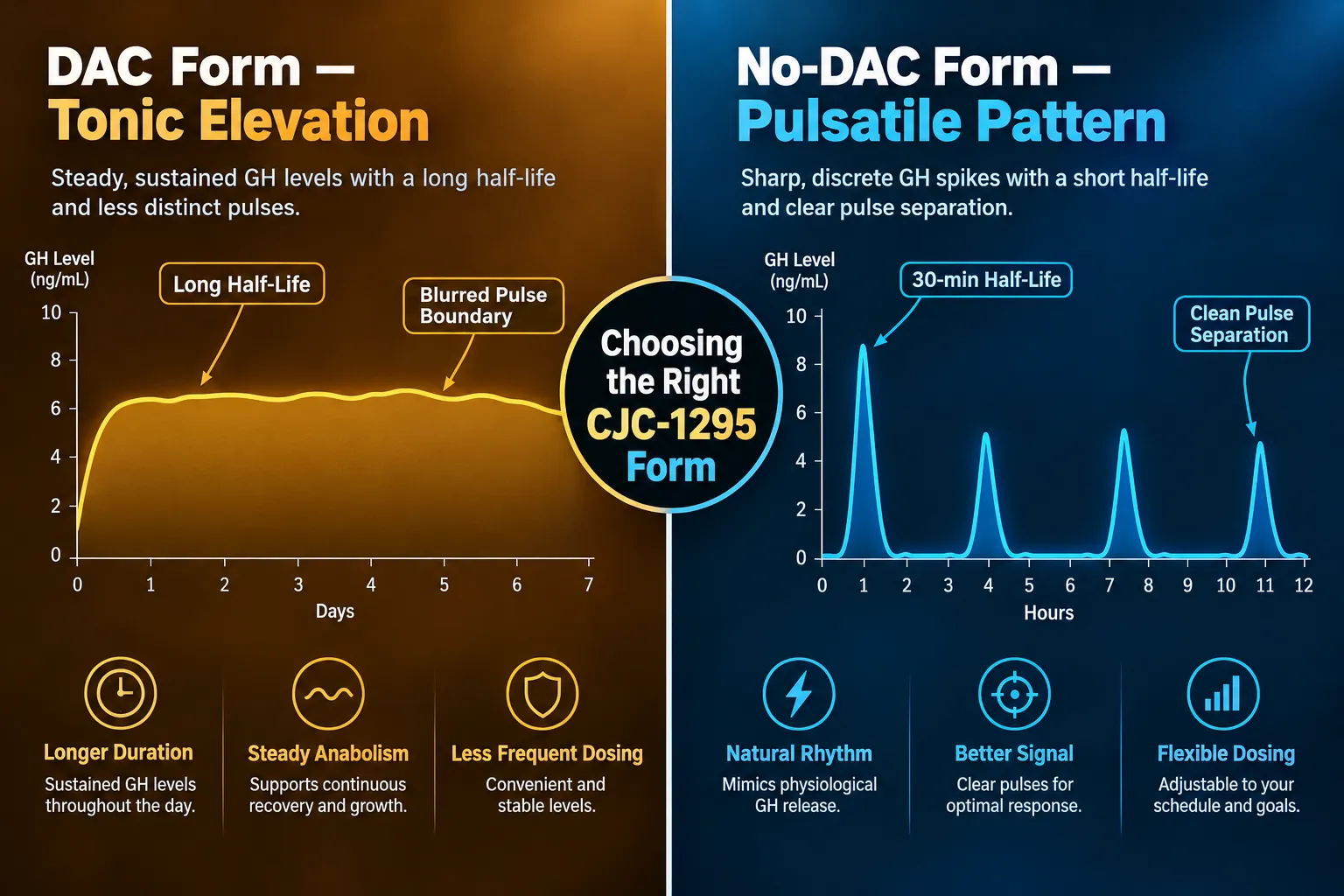
The first design decision, and the most consequential, is which form of CJC-1295 is used. The DAC (Drug Affinity Complex) version binds albumin after injection, extending its half-life to several days. Single subcutaneous doses have produced 2- to 10-fold increases in mean plasma GH lasting six or more days, with IGF-1 elevations persisting 9-11 days. That pharmacokinetic profile is incompatible with pulsatile GH research. When baseline GH is elevated for nearly two weeks, any ipamorelin-triggered spike departs from an already-raised platform, making the combined peak appear larger than it actually is relative to a true resting state.
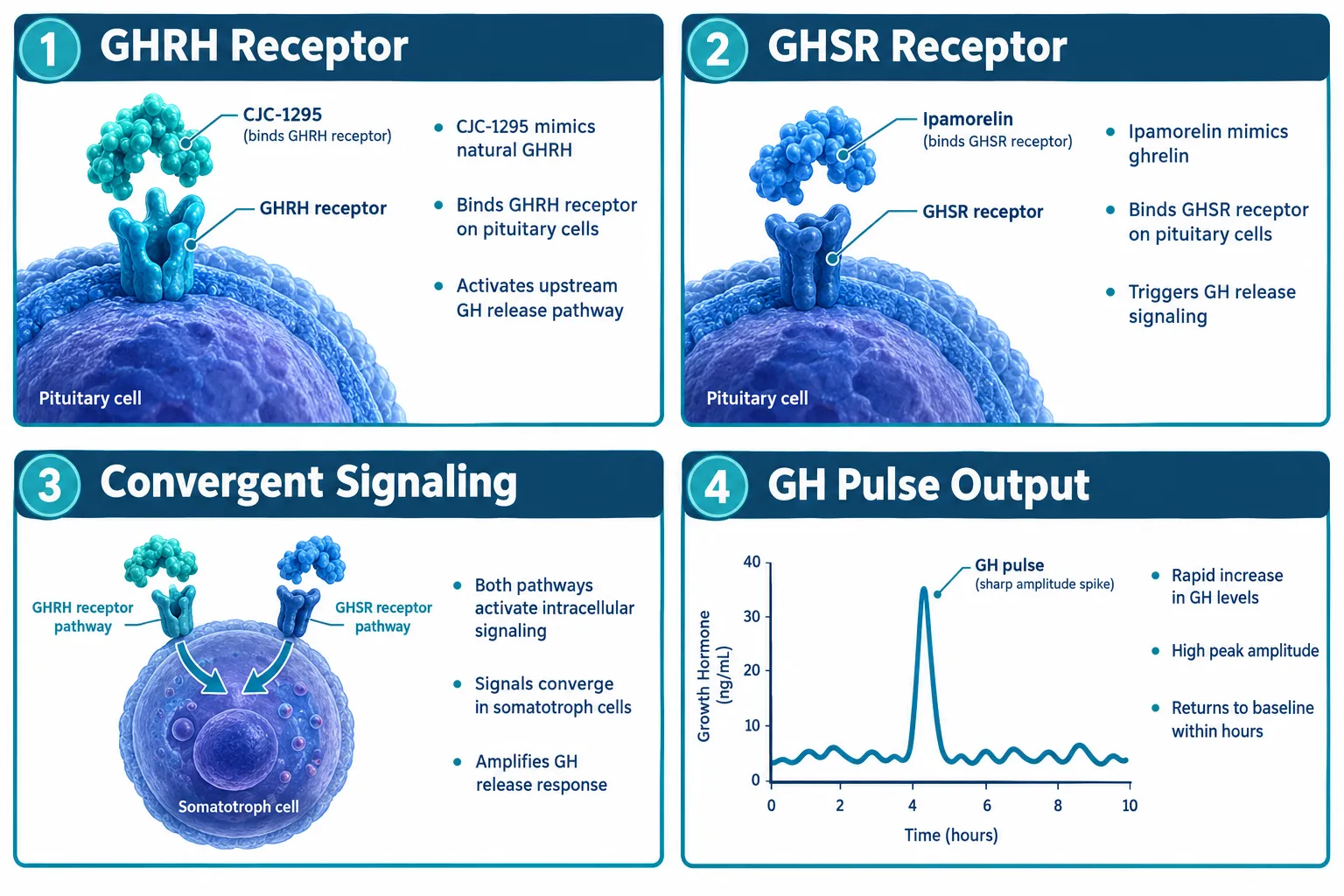
CJC-1295 no-DAC (mod-GRF 1-29) solves this problem. Its reported half-life is roughly 30 minutes. Ipamorelin's half-life is approximately 2 hours. Co-administering the two creates a short, overlapping signaling window that preserves a discrete pulsatile pattern. The GHRH receptor (targeted by CJC-1295) and the growth hormone secretagogue receptor (targeted by ipamorelin) are distinct but convergent pathways at the somatotroph cell. Activating both simultaneously amplifies GH release beyond what either agent achieves alone, but only the no-DAC form keeps that interaction measurable as a clean pulse rather than a tonic elevation.
Anyone exploring the Tesamorelin CJC-1295 Ipamorelin 12mg blend should understand this distinction before interpreting any GH data from a multi-peptide formulation.
A Factorial Study Design for CJC-1295 With Ipamorelin: How to Separate Additive GH-Pulse Effects From Blend and Timing Artifacts
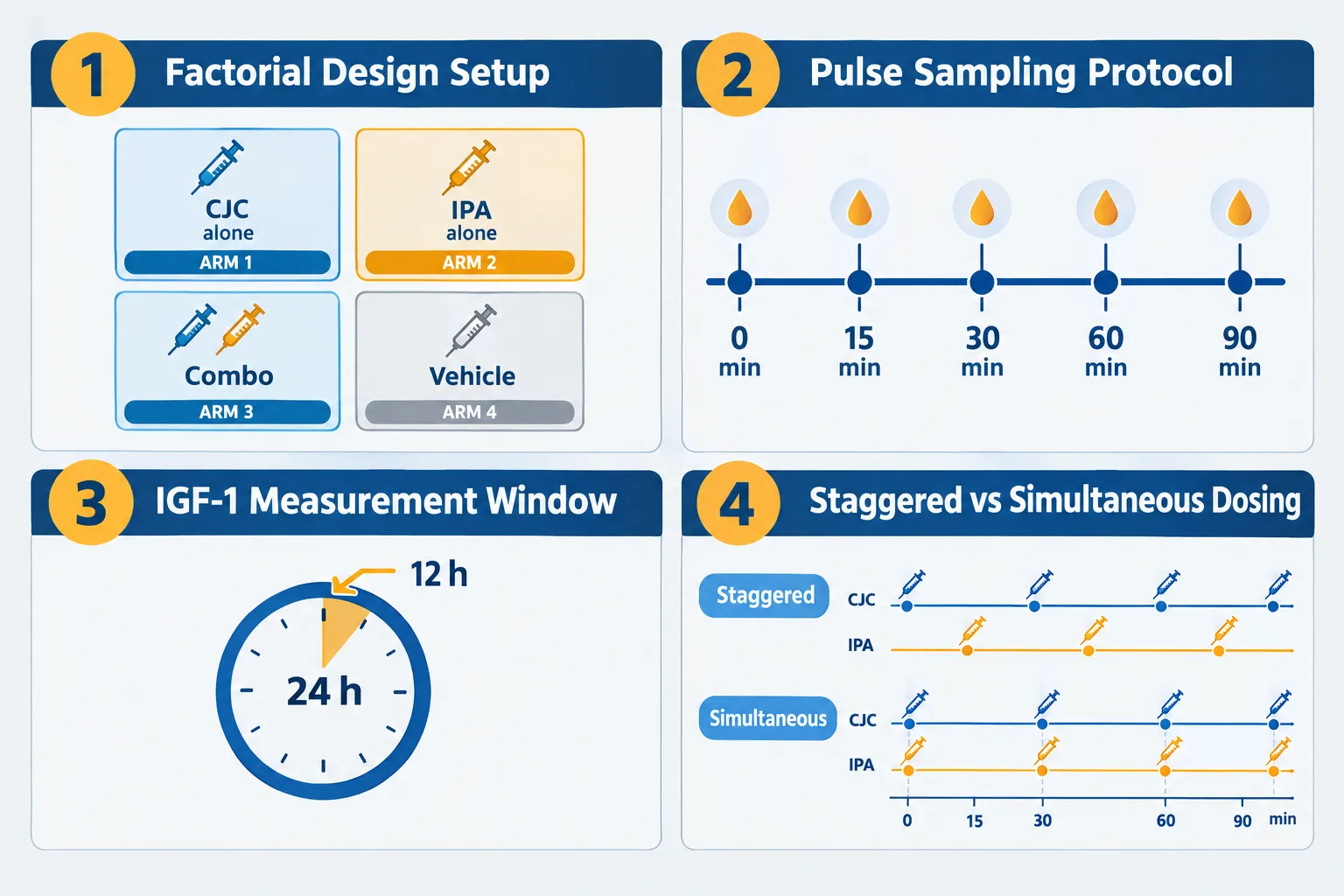
The minimum credible architecture for testing this combination is a 2×2 factorial design with four arms:
| Arm | CJC-1295 no-DAC | Ipamorelin |
|---|---|---|
| 1 | Active | Placebo |
| 2 | Placebo | Active |
| 3 | Active | Active |
| 4 | Placebo | Placebo |
This structure separates three distinct effects: the CJC-1295 main effect, the ipamorelin main effect, and the interaction term. If the combination arm (Arm 3) produces a GH pulse significantly larger than the sum of Arms 1 and 2 above the vehicle baseline (Arm 4), that constitutes evidence of true synergy. If it simply equals the sum, the effect is additive. If it falls short, there is antagonism or receptor saturation.
Pulse Sampling Protocol
Frequent blood sampling is non-negotiable. A practical schedule draws samples at 0, 15, 30, 45, 60, 90, and 120 minutes post-injection. This captures peak GH amplitude, time-to-peak, and pulse duration, three variables that can each shift independently depending on which agent is used.
IGF-1 timing adds a second layer. Because IGF-1 responds to cumulative GH exposure over 12-24 hours rather than to individual pulses, it should be measured at a fixed interval (typically 12 hours post-injection) across all arms. Comparing IGF-1 across arms that differ only in injection timing, without standardizing this window, is one of the most common sources of artifact in clinic-based data.
Vehicle Controls and Blinding
Vehicle controls (the diluent used for reconstitution, without active peptide) must match the injection volume and subcutaneous route of the active arms. For those reviewing reconstitution protocols for blend formulations, the vehicle composition matters: bacteriostatic water alone versus a buffered saline vehicle can affect subcutaneous absorption rate and therefore pulse timing.
Timing Artifacts and How to Control Them
Timing is the single largest source of non-pharmacodynamic artifact in GH-pulse studies with this combination. Three variables dominate:
1. Meal timing and insulin. Elevated insulin suppresses GH secretion. Guides updated through late 2026 consistently recommend injecting at least 2 hours after the last meal, particularly after carbohydrate intake. Pre-sleep fasted dosing is the standard recommendation because it aligns with the endogenous nocturnal GH surge and removes meal variability from the equation.
2. Circadian phase-locking. Dosing CJC-1295 no-DAC with ipamorelin in the early evening (roughly 18:00-20:00) can generate a GH spike near 01:00 that mirrors the body's natural GHRH-driven nocturnal surge. When all subjects receive the blend at the same circadian phase, observed differences in pulse amplitude between arms are more likely attributable to receptor co-activation than to random variation in sleep onset or meal timing.
3. Staggered versus simultaneous injection. Because GHRH receptor signaling and GHSR signaling have different kinetic profiles, injecting CJC-1295 no-DAC first and ipamorelin 15-30 minutes later can alter peak height and pulse width compared to a simultaneous injection. Analyzing these patterns within the same subject, a crossover element embedded in the factorial design, is one of the few practical methods currently available to distinguish true additive GH-pulse effects from artifacts of an arbitrary "both-at-once" schedule.
"Synergy claims for this blend rely on modeled receptor interactions and clinic experience rather than direct pulse-profiling RCTs, a distinction that matters enormously for interpreting amplitude data."
Practical dosing ranges reported in protocol literature run from 100 to 300 mcg of each peptide per injection, with titration every 1-2 weeks starting near 100 mcg. Cycles of 8-12 weeks followed by approximately 4 weeks off help preserve receptor sensitivity, a relevant consideration because receptor desensitization between cycles can alter baseline GH and create pseudo-synergy in later measurements. Researchers interested in ipamorelin sourcing can review available ipamorelin products and IPA 10mg formulations for reference-grade material.
For broader context on how ipamorelin compares to other growth hormone secretagogues, the Tesamorelin vs Ipamorelin comparison and Tesamorelin benefits overview provide useful mechanistic background. Those evaluating multi-peptide stacks can also reference Tesamorelin CJC-1295 blend dosage guidance for formulation-specific considerations.
Regulatory Context in 2026
Neither CJC-1295 nor ipamorelin is FDA-approved. Both peptides have been nominated and subsequently withdrawn from the 503A compounding list, meaning the combination is not permitted as a standard compounded product in the U.S. as of 2026. An FDA advisory committee specifically voted against allowing either peptide in routine compounding. This regulatory status reinforces that any GH-pulse data with the blend come from research or off-label clinic use, not from approved therapeutic programs, which further underscores the need for rigorous experimental controls when interpreting those data.
Conclusion
The central challenge with CJC-1295 with ipamorelin, how to separate additive GH-pulse effects from blend and timing artifacts, is fundamentally a study-design problem, not just a dosing question. The actionable steps are clear:
- Use CJC-1295 no-DAC, not the DAC form, to preserve discrete pulsatile kinetics and prevent sustained baseline elevation from inflating apparent synergy.
- Implement a 2×2 factorial design with vehicle controls so that main effects and the interaction term can be estimated independently.
- Standardize timing by phase-locking injections to a consistent circadian window and enforcing a minimum 2-hour post-meal fast before every injection.
- Sample frequently (at least seven time points over 120 minutes) and measure IGF-1 at a fixed 12-hour interval across all arms.
- Test staggered versus simultaneous dosing within subjects to characterize how GHRH and GHSR kinetics interact across different injection intervals.
Until a registered trial applies this framework, the 3- to 5-fold pulse amplitude figures circulating in clinic literature should be treated as directional signals rather than confirmed pharmacodynamic facts. The combination may well be synergistic, but proving it requires separating the biology from the schedule.