Call or Text 727-513-9780
  • Shopping Cart Shopping Cart
    0Shopping Cart
Pure Tested Peptides | America's most trusted Peptides for sale online
  • Peptides for sale
    • Oral Peptides for sale
      • Peptide Capsules for sale
      • BPC 157 Capsules 1000mcg
      • SLU-PP-332 Capsules | 1000 mcg
      • 5-Amino-1MQ 50mg Capsules
      • Tesofensine 500mcg
    • All Peptides for sale
    • Peptide Sprays
      • BPC 157 Nasal Spray Kit
      • BPC-157 TB500 Nasal Spray Kit
      • Semax Nasal Spray 10mg
      • Selank – Nasal Spray Kit – 10mg
      • Epithalon 50MG Nasal Spray Kit
      • Ipamorelin 10mg Nasal Spray
      • Klow Nasal Spray (BPC-157 + TB-500 + GHK-Cu + KPV) | 80mg
      • Hulk Nasal Spray Tesa / Ipa Blend 6/3 MG
      • Klow Nasal Spray
      • NAD + 500 mg Nasal Spray
      • PT-141 Nasal Spray Kit
    • GHRH Peptides
      • Ipa Peptides
      • CJC-1295 Peptides
        • CJC-1295 with DAC 5 mg
        • CJC-1295 without DAC 5 mg
        • CJC-1295 Ipa 10mg
      • Tesa Peptides
        • Tesa Peptide
        • Tesa 20 mg
    • GHK-Cu Peptides
      • All GHK-Cu Peptides
      • GHK-Cu 100mg
      • KLOW Peptide Blend – Buy KLOW blend online
    • BPC Peptides
      • All BPC Peptides
      • BPC-157
      • BPC-157 TB-500
      • BPC 157 capsules 1000mcg
    • SLU-PP-332 Peptides
      • All SLU-PP-332 Peptides
      • SLU-PP-332 5mg
    • GLP3 Peptides
      • GLP3-R
      • GLP3-R CAG 10mg
      • GLP3-R 20mg
    • PT-141 Peptides
      • PT-141 Peptides for sale
      • PT-141 10mg
      • PT-141 Nasal Spray
    • CAG Peptides
      • Lipo-C Peptide Blend
      • CAG 5mg
      • CAG 10mg
    • MOTS-C Peptides
      • MOTS-C Peptides for sale
      • MOTS-c peptide
      • MOTS-c 10mg *6 pack*
    • 5 Amino 1MQ Peptides
      • 5 Amino 1MQ Peptides for sale
      • 5-Amino-1MQ 50mg Capsules
      • 5-Amino-1MQ 5mg
    • Epithalon Peptides
      • Epithalon Peptides for sale
      • Epithalon 10mg
      • Epithalon 50mg
  • Shop
    • GLPs
      • 5-Amino-1MQ 50mg Capsules
      • 5-Amino-1MQ 5mg
      • GLP3-Reta
      • L-Carnitine 500mg/ml
      • Tesofensine 500mcg
      • SLU-PP-332 5mg
      • MOTS-c 10mg *6 pack*
    • Epithalon & BPC Peptides
      • Epithalon 10mg
      • Epithalon 50mg
      • BPC-157
      • BPC 157 capsules 1000mcg
      • BPC-157 TB-500
      • BPC-157 TB500 Nasal Spray Kit
      • BPC 157 Nasal Spray Kit
    • BPC TB-500 & NAD+ Peptides
      • NAD+ 500 mg
      • KLOW Peptide Blend – Buy KLOW blend online
      • GLOW Peptide Blend
      • TB 500 5mg
      • BPC 157 capsules 1000mcg – Supplement
      • BPC 157 Nasal Spray Kit
      • BPC-157
      • BPC-157 TB500 Nasal Spray Kit
      • BPC-157 TB-500
      • BPC 157 capsules 1000mcg
    • LL-37 Peptide
      • LL-37 10 mg
    • MOTS-C & Selank
      • MOTS-c peptide
      • Selank 10mg
    • GHK Peptides
      • GHK-Cu 100mg
      • GLOW Peptide Blend
      • KLOW Peptide Blend – Buy KLOW blend online
  • COAs
  • Wholesale
    • Wholesale Peptides for sale
  • PTP FAQ
  • Affiliates
    • Selank Peptide: Advanced Pharmacological Mechanisms Underlying Its Anxiolytic and Nootropic Effects in Research
      • 5-Amino-1MQ Peptide: Detailed Mechanisms of NNMT Inhibition and Its Impact on Cellular Metabolism Research
        • MOTS-C Peptide: Unraveling Its Role in Mitochondrial Dynamics and Energy Metabolism Research
          • Epithalon Peptide and Telomerase Regulation: Investigating Its Impact on Cellular Senescence and Lifespan Research Models
            • GLP2-T vs GLP2 Tirz Peptide: Understanding the Naming, Mechanistic Nuances, and Research Implications for Gut Health
      • Peptides and Polypeptides in Modern Pharmacology: What Research on Metoprolol, Prednisone, and Amlodipine Reveals
        • Polypeptide Peptides vs NSAIDs: What Naproxen and Diclofenac Teach Tissue-Repair Researchers About BPC‑157 and TB‑500
          • Peptides and Polypeptides in Endocrine Pharmacology: How GLP-1, GLP-2, and GLP-3 Retatrutide Differ From Classic Drugs Like Prednisone and Amlodipine
          • 5‑Amino‑1MQ Peptide and NNMT Inhibition: How It Compares With Statins Like Atorvastatin in Adipose and Lipid Metabolism Research
      • Enclomiphene, Estrogen Receptor Signaling, and Luteinizing Phase Biology: What Hormone Researchers Should Measure
        • Mesenchymal Stem Cells, BPC‑157, and GHK‑Cu: How Tissue Repair Peptides Compare With Classic NSAIDs Like Naproxen in Injury Models
          • Peptide Calculator Use Cases Beyond Growth Hormone: Working Through GLP‑3 Retatrutide, MOTS‑c, and BPC‑157 Research Dosing
        • Polypeptide Peptides in Endocrine and Metabolic Pharmacology: Lessons From Amlodipine, Prednisone, and Metoprolol
        • Peptides Calculator for Advanced Blends: Worked Examples for Tesamorelin, CJC‑1295, and Ipamorelin Stacks
          • Peptides and Polypeptides in Human Physiology: How Molecular Size Shapes Research Applications
            • Selank Peptide: Advanced Pharmacological Mechanisms Underlying Its Anxiolytic and Nootropic Effects in Research
          • 5-Amino-1MQ Peptide: Detailed Mechanisms of NNMT Inhibition and Its Impact on Cellular Metabolism Research
            • MOTS-C Peptide: Unraveling Its Role in Mitochondrial Dynamics and Energy Metabolism Research
              • Epithalon Peptide and Telomerase Regulation: Investigating Its Impact on Cellular Senescence and Lifespan Research Models
                • GLP2-T vs GLP2 Tirz Peptide: Understanding the Naming, Mechanistic Nuances, and Research Implications for Gut Health
                  • Peptides and Polypeptides in Endocrine Pharmacology: How GLP-1, GLP-2, and GLP-3 Retatrutide Differ From Classic Drugs Like Prednisone and Amlodipine
                    • Polypeptide Peptides vs NSAIDs: What Naproxen and Diclofenac Teach Tissue-Repair Researchers About BPC‑157 and TB‑500
                      • Peptides and Polypeptides in Modern Pharmacology: What Research on Metoprolol, Prednisone, and Amlodipine Reveals
                        • 5‑Amino‑1MQ Peptide and NNMT Inhibition: How It Compares With Statins Like Atorvastatin in Adipose and Lipid Metabolism Research
                        • Enclomiphene, Estrogen Receptor Signaling, and Luteinizing Phase Biology: What Hormone Researchers Should Measure
                        • Mesenchymal Stem Cells, BPC‑157, and GHK‑Cu: How Tissue Repair Peptides Compare With Classic NSAIDs Like Naproxen in Injury Models
                        • Peptide Calculator Use Cases Beyond Growth Hormone: Working Through GLP‑3 Retatrutide, MOTS‑c, and BPC‑157 Research Dosing
                        • Polypeptide Peptides in Endocrine and Metabolic Pharmacology: Lessons From Amlodipine, Prednisone, and Metoprolol
                        • Peptides Calculator for Advanced Blends: Worked Examples for Tesamorelin, CJC‑1295, and Ipamorelin Stacks
                        • Peptides and Polypeptides in Human Physiology: How Molecular Size Shapes Research Applications
                        • Selank Peptide: Advanced Pharmacological Mechanisms Underlying Its Anxiolytic and Nootropic Effects in Research
                        • MOTS-C Peptide: Unraveling Its Role in Mitochondrial Dynamics and Energy Metabolism Research
                        • Peptides and Polypeptides in Modern Pharmacology: What Research on Metoprolol, Prednisone, and Amlodipine Reveals
                        • Peptides and Polypeptides in Endocrine Pharmacology: How GLP-1, GLP-2, and GLP-3 Retatrutide Differ From Classic Drugs Like Prednisone and Amlodipine
                        • 5-Amino-1MQ Peptide: Detailed Mechanisms of NNMT Inhibition and Its Impact on Cellular Metabolism Research
                        • Mesenchymal Stem Cells, BPC‑157, and GHK‑Cu: How Tissue Repair Peptides Compare With Classic NSAIDs Like Naproxen in Injury Models
                        • Peptide Calculator Use Cases Beyond Growth Hormone: Working Through GLP‑3 Retatrutide, MOTS‑c, and BPC‑157 Research Dosing
                        • GLP2-T vs GLP2 Tirz Peptide: Understanding the Naming, Mechanistic Nuances, and Research Implications for Gut Health
                        • Polypeptide Peptides in Endocrine and Metabolic Pharmacology: Lessons From Amlodipine, Prednisone, and Metoprolol
                        • Polypeptide Peptides vs NSAIDs: What Naproxen and Diclofenac Teach Tissue-Repair Researchers About BPC‑157 and TB‑500
                        • Peptides and Polypeptides in Human Physiology: How Molecular Size Shapes Research Applications
                        • Peptides Calculator for Advanced Blends: Worked Examples for Tesamorelin, CJC‑1295, and Ipamorelin Stacks
                        • 5‑Amino‑1MQ Peptide and NNMT Inhibition: How It Compares With Statins Like Atorvastatin in Adipose and Lipid Metabolism Research
                        • Enclomiphene, Estrogen Receptor Signaling, and Luteinizing Phase Biology: What Hormone Researchers Should Measure
                        • Epithalon Peptide and Telomerase Regulation: Investigating Its Impact on Cellular Senescence and Lifespan Research Models
                        • Best research protocol Klow blend
                        • best time to take BPC-157
                        • best time to take DSIP (Delta Sleep Inducing Peptide)
                        • best time to take CJC-1295
                        • best time to take AOD-9604
                        • best time to take Follistatin 344
                        • best time to take Ipamorelin
                        • best time to take MK-677 (Ibutamoren)
                        • best time to take Ligandrol (LGD-4033) — research compound
                        • best time to take Ostarine (MK-2866) — research compound
                        • best time to take GHK-CU
                        • best time to take TB-500
                        • best time to take MOTS-c
                        • best time to take Semax
                        • best time to take RAD-140 (Testolone) — research compound
                        • best time to take Thymosin Alpha-1
                        • best time to take PEG-MGF
                        • Biolife Plasma, Octapharma Plasma, and Research Peptides: How Plasma Donation Labs Differ From Peptide Suppliers
                        • best time to take YK-11 — research compound
                        • best time to take PT-141 (Bremelanotide)
                        • Best research protocol Klow blend
  • Contact
    • Contact Customer Service
    • Text Customer Support
  • About US
  • Shop all peptides
  • Affiliate Program
    • Affiliate Signup
  • Login / Register Login / Register Page Link Login / Register Page Link
  • Click to open the search input field Click to open the search input field Search
  • Menu Menu

Tag Archive for: glucagon-like peptide

GLP-1 vs GLP-3 vs GLP-2: Peptide Classification and Research Applications

GLP-1 vs GLP-3 vs GLP-2: Peptide Classification and Research Applications

July 23, 2026/0 Comments/in Uncategorized/by

Three peptides share the same family name yet serve completely different roles in the body, a distinction that matters enormously for researchers navigating the fast-moving field of metabolic science. Understanding GLP-1 vs GLP-3 vs GLP-2: Peptide Classification and Research Applications is not just a matter of nomenclature. It shapes how research protocols are designed, which receptor pathways are targeted, and what therapeutic outcomes investigators are pursuing in 2026.

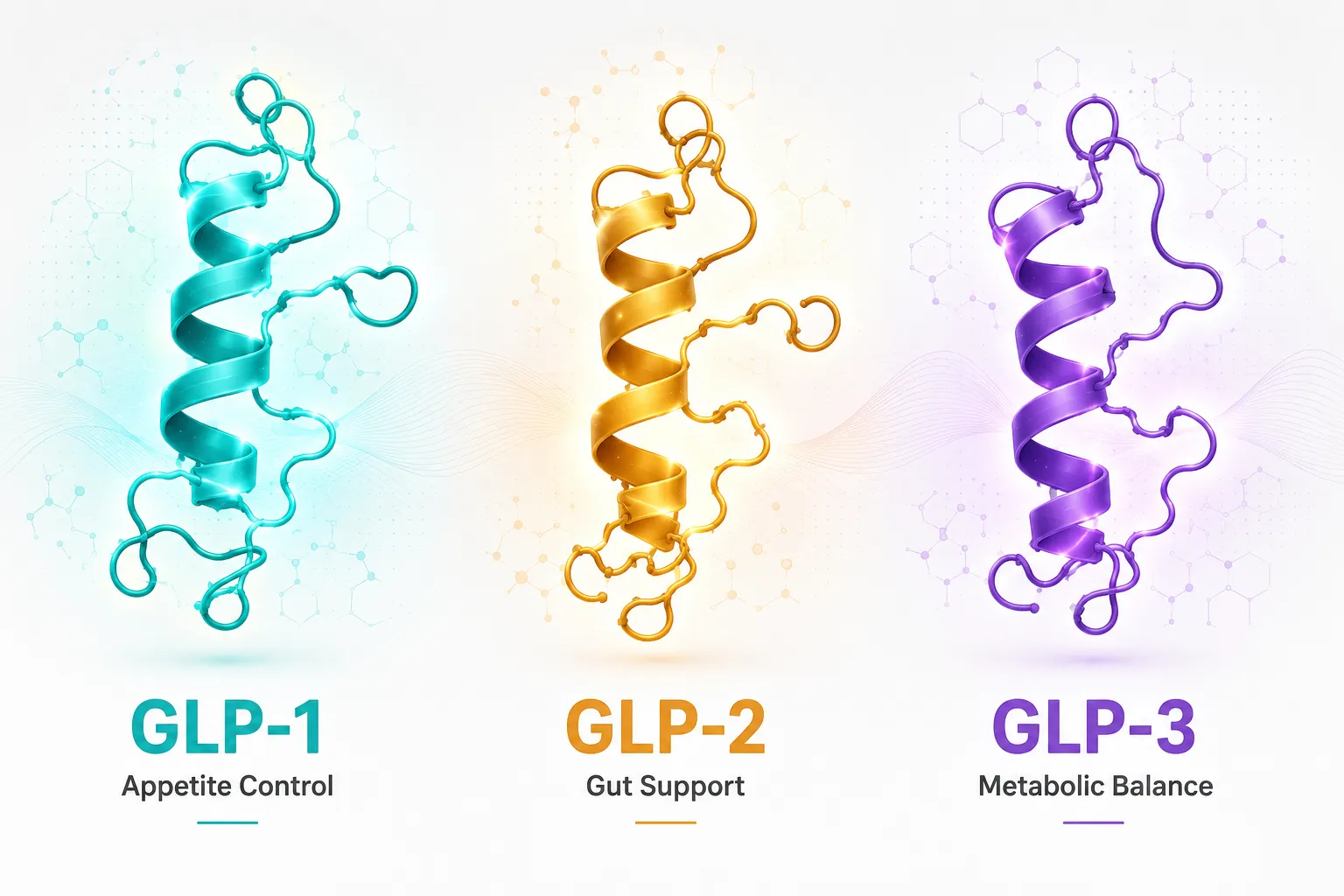
Bright editorial infographic-style landscape (): Three distinct glowing peptide ribbon structures side by side — one labeled

Key Takeaways

  • GLP-1, GLP-2, and GLP-3 are not interchangeable terms, each refers to a distinct biological entity or research concept with unique mechanisms.
  • GLP-1 is a well-characterized gut hormone central to insulin regulation and appetite control, with approved clinical applications.
  • GLP-2 is produced alongside GLP-1 but focuses on intestinal growth and gut integrity rather than metabolic weight regulation.
  • "GLP-3" is an informal nickname for retatrutide, a triple agonist compound targeting GLP-1, GIP, and glucagon receptors simultaneously.
  • Researchers exploring incretin-based peptides should understand receptor specificity before designing or sourcing compounds for study.

Understanding the GLP Peptide Family

The glucagon-like peptides (GLPs) originate from the same precursor protein, proglucagon, which is processed differently depending on the tissue. In the gut, intestinal L-cells cleave proglucagon to produce both GLP-1 and GLP-2. Despite this shared origin, the two peptides bind to entirely different receptors and produce distinct physiological effects.

GLP-1 is released after food intake and triggers a cascade of metabolic responses: it stimulates insulin secretion from the pancreas, suppresses glucagon release, slows gastric emptying, and signals satiety to the brain. These properties made GLP-1 receptor agonists like semaglutide, sold under brand names Ozempic and Wegovy, among the most discussed compounds in modern medicine for type 2 diabetes and obesity management.

GLP-2, released at the same time as GLP-1, acts primarily on the intestinal lining. Its main functions include promoting intestinal cell growth, enhancing nutrient absorption, and maintaining the structural integrity of the gut barrier. GLP-2 does not play a meaningful role in weight regulation. Its clinical relevance is centered on gastrointestinal disorders, particularly short bowel syndrome, where teduglutide (brand name Gattex) is the FDA-approved GLP-2 analog.

Peptide Primary Source Main Target Key Research Area
GLP-1 Intestinal L-cells Pancreas, Brain Metabolic disease, obesity
GLP-2 Intestinal L-cells Intestinal lining Gut health, nutrient absorption
GLP-3 (informal) Synthetic / investigational GLP-1, GIP, Glucagon receptors Obesity, metabolic disorders

Researchers exploring metabolic peptides may also find value in reviewing MOTS-c and metabolic flexibility research themes, which offer complementary insights into mitochondrial and energy regulation pathways.

What Is GLP-3 and Why the Naming Confusion

The term "GLP-3" does not refer to a naturally occurring hormone. It is an informal label, not a recognized scientific classification, that has been applied to retatrutide, an investigational compound currently in clinical trials. Dr. Absalon Gutierrez, an endocrinologist at UTHealth Houston, has explicitly noted that "GLP-3" is sometimes inaccurately used to describe triple hormone receptor agonists rather than a distinct peptide class.

Retatrutide is a triple agonist, meaning it simultaneously activates three receptors:

  • GLP-1 receptor, drives insulin secretion and appetite suppression
  • GIP (glucose-dependent insulinotropic polypeptide) receptor, enhances insulin response and may support fat metabolism
  • Glucagon receptor, increases energy expenditure

This triple receptor activation represents a significant step beyond single agonists like semaglutide and dual agonists like tirzepatide (which targets GLP-1 and GIP). Each additional receptor engagement is associated with incremental metabolic benefits, particularly in the areas of weight reduction and glucose control.

For a deeper look at retatrutide's research profile, the GLP-3 retatrutide incretin research themes page provides a useful overview of current investigational directions.

Preliminary clinical trial data for retatrutide suggests that triple agonism may produce greater weight loss outcomes than either single or dual receptor approaches. However, retatrutide is not yet FDA-approved, and ongoing trials continue to assess its long-term safety and efficacy profile.

What Is GLP-3 and Why the Naming Confusion

Research Applications Across GLP-1 vs GLP-3 vs GLP-2: Peptide Classification and Research Applications

Understanding the distinct roles of each peptide directly informs how researchers design studies and select compounds. Here is a breakdown of current research applications by peptide type.

GLP-1 Research Applications

  • Insulin secretion dynamics and beta-cell function studies
  • Appetite regulation and central nervous system signaling
  • Cardiovascular risk reduction in metabolic disease models
  • Combination peptide protocols examining synergistic effects

Researchers working with growth hormone-related peptides may also find relevant context in tesa peptide research, particularly where visceral fat reduction and metabolic outcomes overlap with GLP-1 mechanisms.

GLP-2 Research Applications

  • Intestinal mucosal repair and gut barrier function
  • Short bowel syndrome and malabsorption models
  • Nutrient transport and absorption efficiency studies
  • Inflammatory bowel disease-adjacent research

GLP-3 (Retatrutide) Research Applications

  • Triple receptor agonism and energy expenditure modeling
  • Comparative efficacy studies against single and dual agonists
  • Obesity pharmacology and body composition research
  • Metabolic syndrome intervention protocols

For researchers building broader incretin-focused protocols, the GLP-3 retatrutide compound page offers sourcing and documentation resources. Additionally, those interested in how newer triple agonist compounds fit into the evolving peptide landscape can review GLP-3: the newest GLP-1 triple agonist for a broader context.

Key distinction: GLP-1 and GLP-2 are endogenous hormones with well-established physiological roles. GLP-3 is a colloquial term for a synthetic investigational compound with a fundamentally different mechanism of action.

Researchers looking for complementary peptide compounds with documented quality standards should also consult the BPC-157 core peptides research guide as a reference for documentation-first sourcing practices.

GLP-3 (Retatrutide) Research Applications

Conclusion

The distinctions within GLP-1 vs GLP-3 vs GLP-2: Peptide Classification and Research Applications are foundational for any serious researcher working in metabolic, gastrointestinal, or obesity-related science. GLP-1 governs insulin and appetite signaling. GLP-2 supports gut health and nutrient absorption. And GLP-3, properly understood as retatrutide, represents an emerging class of triple agonist compounds that may redefine how metabolic disorders are studied and treated.

Actionable next steps for researchers:

  1. Clarify which receptor pathway is relevant to the study objective before selecting a compound.
  2. Review current clinical trial data on retatrutide to understand where triple agonism stands in the research pipeline.
  3. Source compounds only from suppliers that provide verified certificates of analysis and quality testing documentation.
  4. Cross-reference GLP-based protocols with complementary peptide research, including growth hormone axis and gut-repair compounds, for a complete metabolic picture.

Staying precise about peptide classification is not just good science, it is the foundation of reproducible, credible research.

https://www.puretestedpeptides.com/wp-content/uploads/2026/07/glp-1-vs-glp-3-vs-glp-2-peptide-classification-and-research-applications.webp 1024 1536 https://www.puretestedpeptides.com/wp-content/uploads/2026/01/buy-peptides-online.jpg 2026-07-23 13:06:472026-07-23 13:06:47GLP-1 vs GLP-3 vs GLP-2: Peptide Classification and Research Applications
×

Helpful Links

  • My account
  • Cart
  • Checkout
  • Refund and Returns Policy
  • Privacy Policy
  • SMS Privacy Policy
  • Login
  • My Account
  • Logout

USA Made Lab Tested Peptides

All products are sold for research, laboratory, or analytical purposes only, and are not for human consumption


Pure Tested Peptides is a chemical supplier. Pure Tested Peptides is not a compounding / chemical compounding facility as defined under 503A of the Federal Food, Drug, and Cosmetic act. Pure Tested Peptides is not an outsourcing facility as defined under 503B of the Federal Food, Drug, and Cosmetic act.

The statements made within this website have not been evaluated by the US Food and Drug Administration. The products we offer are not intended to diagnose, treat, cure or prevent any disease.

Human/Animal Consumption Prohibited. Laboratory/In-Vitro Experimental Use Only

Scroll to top Scroll to top Scroll to top