

What Is GLP3 Peptide? How Researchers Distinguish It From Retatrutide in Search Intent and Lab Context
A growing number of researchers type "GLP3 peptide" into search engines expecting to find a specific compound, and instead encounter a confusing mix of receptor biology, drug pipeline news, and marketing shorthand. Understanding what is GLP3 peptide, how researchers distinguish it from retatrutide in search intent and lab context, and why the naming gap matters is essential for anyone navigating peptide research in 2026.
Key Takeaways
- "GLP3 peptide" is not an established scientific compound name; it is informal shorthand that often refers to retatrutide, a triple-agonist drug candidate.
- GLP-3 as a biological entity refers to a proglucagon-derived peptide fragment, distinct from GLP-1 and GLP-2.
- Retatrutide targets three receptors, GIP, GLP-1, and glucagon, earning it the informal "triple agonist" or "GLP3" label in online discourse.
- Researchers must distinguish between search intent (finding retatrutide information) and lab context (actual GLP-3 receptor science).
- Verified, lab-tested peptides and reliable sourcing remain critical when working with any peptide compound.
The Biology Behind GLP-3: What the Term Actually Means
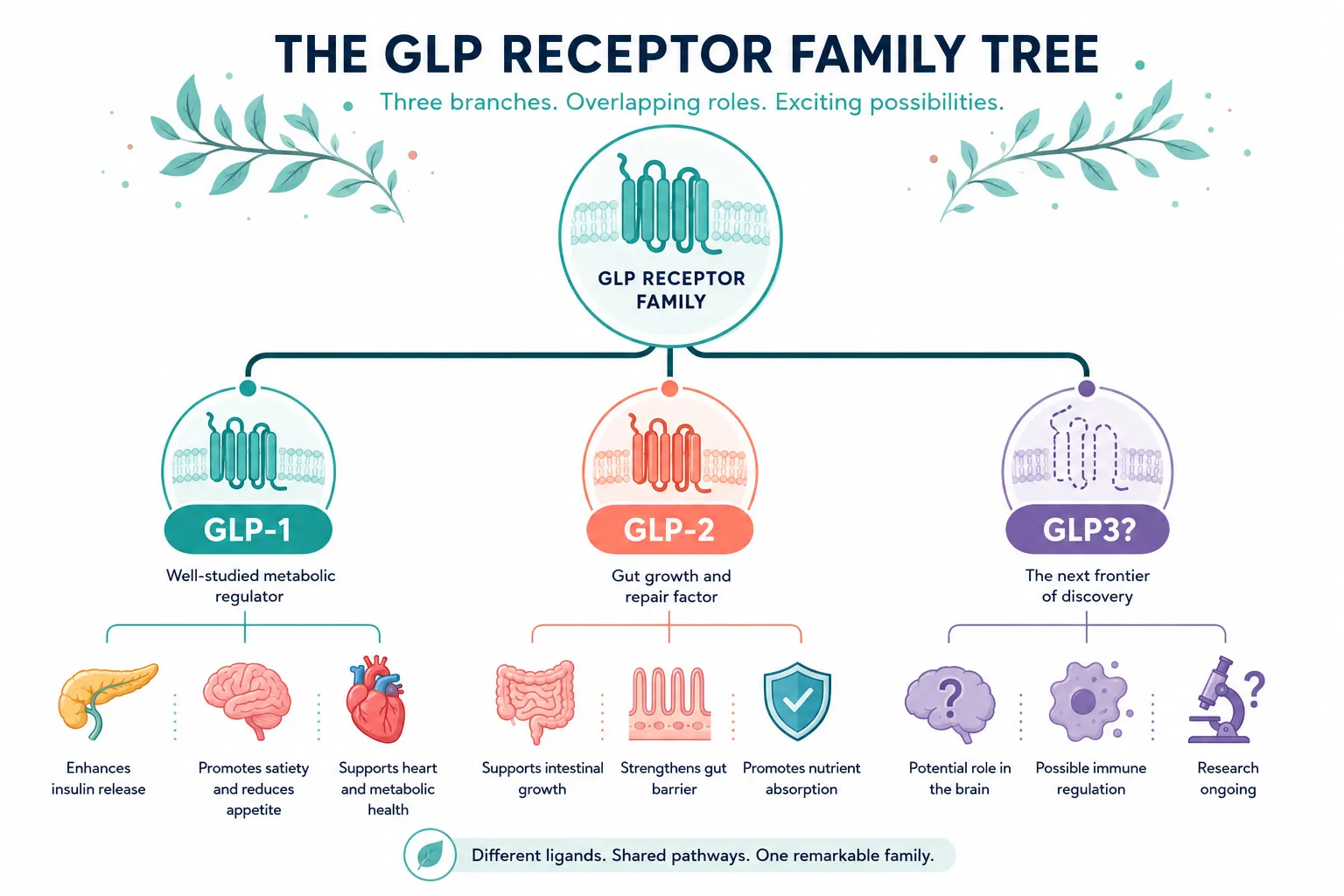
Glucagon-like peptides are produced when the proglucagon gene is processed in different tissues. Most researchers are familiar with GLP-1 (glucagon-like peptide-1), which stimulates insulin secretion and slows gastric emptying, and GLP-2, which promotes intestinal growth. Fewer are aware that a third proglucagon-derived fragment exists.
GLP-3 in strict biochemical terms refers to a short peptide fragment encoded within the proglucagon gene sequence. Unlike GLP-1 and GLP-2, GLP-3 does not have a well-characterized, dedicated receptor system with confirmed physiological roles in humans as of current published literature. It is considered an orphan fragment, identified structurally but not yet assigned a clear biological function.
This distinction is critical. When a researcher searches for "GLP3 peptide" expecting receptor agonist data or dosing protocols, they are almost certainly not looking for this obscure proglucagon fragment. They are looking for something else entirely.
"Naming ambiguity in peptide research is not a minor inconvenience, it can redirect a researcher toward the wrong compound, the wrong literature, and potentially the wrong experimental design."

How Researchers Distinguish GLP3 Peptide From Retatrutide in Search Intent and Lab Context
Understanding what is GLP3 peptide, how researchers distinguish it from retatrutide in search intent and lab context, requires separating two very different conversations happening simultaneously online.
The Search Intent Layer
In online communities, forums, and even some research blogs, "GLP3" has become informal shorthand for retatrutide, an investigational compound developed by Eli Lilly. The logic is straightforward: retatrutide acts as a triple agonist, targeting three receptors:
| Receptor | Full Name | Primary Role |
|---|---|---|
| GIP-R | Glucose-dependent insulinotropic polypeptide receptor | Insulin secretion, fat storage |
| GLP-1R | Glucagon-like peptide-1 receptor | Insulin release, appetite suppression |
| GCGR | Glucagon receptor | Hepatic glucose output, energy expenditure |
Because it hits three receptor systems, and because GLP-1 agonists dominate the cultural conversation, users began calling it "GLP-3" as a numeric shorthand for the third generation or the triple mechanism. This is not a pharmacological classification; it is community-generated nomenclature.
The Lab Context Layer
In a formal research setting, no compound is catalogued or sourced under the name "GLP3 peptide." Scientists working with retatrutide reference it by its INN (International Nonproprietary Name) or its Eli Lilly development code LY3437943. Researchers working with actual proglucagon fragments reference specific sequence designations.
This gap creates real friction. A researcher sourcing peptides through a peptide store who searches "GLP3 peptide" may not find what they need, or worse, may find mislabeled products. Precision in terminology protects experimental integrity.
Why This Matters for High-Intent Researchers
Researchers arriving at "GLP3 peptide" searches are typically high-intent, they want mechanistic data, sourcing options, or protocol comparisons. Redirecting that intent accurately serves both the researcher and the scientific community. For context on how other peptides with naming ambiguity are handled, reviewing resources on compounds like Selank or Tesamorelin illustrates how proper nomenclature guides better research outcomes.

Retatrutide's Mechanism and Why It Earned the "Triple" Label
Retatrutide's triple-agonist profile is genuinely novel. Most GLP-1 receptor agonists on the market or in trials target one or two receptors. Adding glucagon receptor agonism introduces thermogenic and hepatic effects that single or dual agonists do not provide.
Key mechanistic features of retatrutide:
- Stimulates insulin secretion via GIP-R and GLP-1R pathways
- Suppresses appetite through central GLP-1R signaling
- Increases energy expenditure via glucagon receptor activation
- Demonstrates significant body weight reduction in Phase 2 trials
This three-pronged mechanism is why the "GLP3" label stuck in lay and semi-professional research communities. It is a memorable, if scientifically imprecise, shorthand.
For researchers exploring adjacent peptide mechanisms, particularly those involving metabolic pathways, compounds like Tesamorelin and Adipotide FTPP offer relevant comparative context within the metabolic peptide landscape.
Researchers interested in broader peptide categories should also consider reviewing wholesale peptide sourcing options to ensure supply chain reliability when working with investigational compounds.
Practical Steps for Researchers Navigating GLP3 Terminology
When encountering "GLP3 peptide" in any research context, apply this verification framework:
- Confirm the source's nomenclature, Is the author using "GLP3" to mean retatrutide, a proglucagon fragment, or something else entirely?
- Cross-reference the receptor targets, Triple-agonist compounds targeting GIP-R, GLP-1R, and GCGR are retatrutide-class; single-receptor fragments are distinct biology.
- Check supplier documentation, Reputable suppliers will list compounds by verified chemical names, not informal shorthand. Sourcing from verified peptide suppliers reduces the risk of receiving mislabeled material.
- Review primary literature, PubMed searches for "retatrutide" or "LY3437943" will return peer-reviewed data; searches for "GLP3 peptide" will return mixed results.
- Distinguish research-grade from clinical, Retatrutide remains investigational; researchers should treat it accordingly and not conflate its mechanism with approved GLP-1 therapies.
Conclusion
The question of what is GLP3 peptide, and how researchers distinguish it from retatrutide in search intent and lab context, ultimately comes down to a naming convention that outpaced scientific taxonomy. "GLP3" as a search term reflects genuine research curiosity about triple-agonist mechanisms, but it does not correspond to a catalogued compound in formal biochemistry.
Actionable next steps for researchers:
- Use "retatrutide" or "LY3437943" when searching peer-reviewed databases for triple-agonist data.
- Reserve "GLP-3" for discussions of proglucagon-derived peptide fragments in receptor biology.
- Vet all peptide suppliers for third-party testing documentation before sourcing any compound.
- Explore related metabolic peptide research, including resources on Tesamorelin science, to build a fuller picture of the metabolic peptide landscape.
Precision in language is not pedantry in research, it is the foundation of reproducible science.


Leave a Reply
Want to join the discussion?Feel free to contribute!