

Retatrutide Phase 3 Results: What the New GLP-3 Data Mean for Obesity and Diabetes Research
By the end of 2024, Eli Lilly's retatrutide had produced the largest body weight reduction ever recorded in a phase 2 obesity drug trial, roughly 24% at 48 weeks. That single number reset expectations across metabolic medicine. Now, with phase 3 data emerging and the research community parsing every endpoint, the question is no longer whether retatrutide works. The question is what the full Retatrutide Phase 3 Results: What the New GLP-3 Data Mean for Obesity and Diabetes Research picture tells scientists about the next generation of metabolic therapies.
Key Takeaways
- Retatrutide is a triple agonist targeting GLP-1, GIP, and glucagon receptors simultaneously, setting it apart from dual agonists like tirzepatide.
- Phase 2 data showed up to 24.2% mean body weight reduction at 48 weeks in adults with obesity.
- Phase 3 trials (TRIUMPH program) are evaluating efficacy in obesity, type 2 diabetes, and related metabolic conditions including MASLD.
- Early phase 3 signals suggest sustained weight loss, improved glycemic control, and favorable cardiovascular markers.
- Researchers and clinicians should monitor both efficacy endpoints and long-term safety data as the TRIUMPH program matures through 2025-2026.
What Makes Retatrutide Different From Earlier GLP-1 Agents
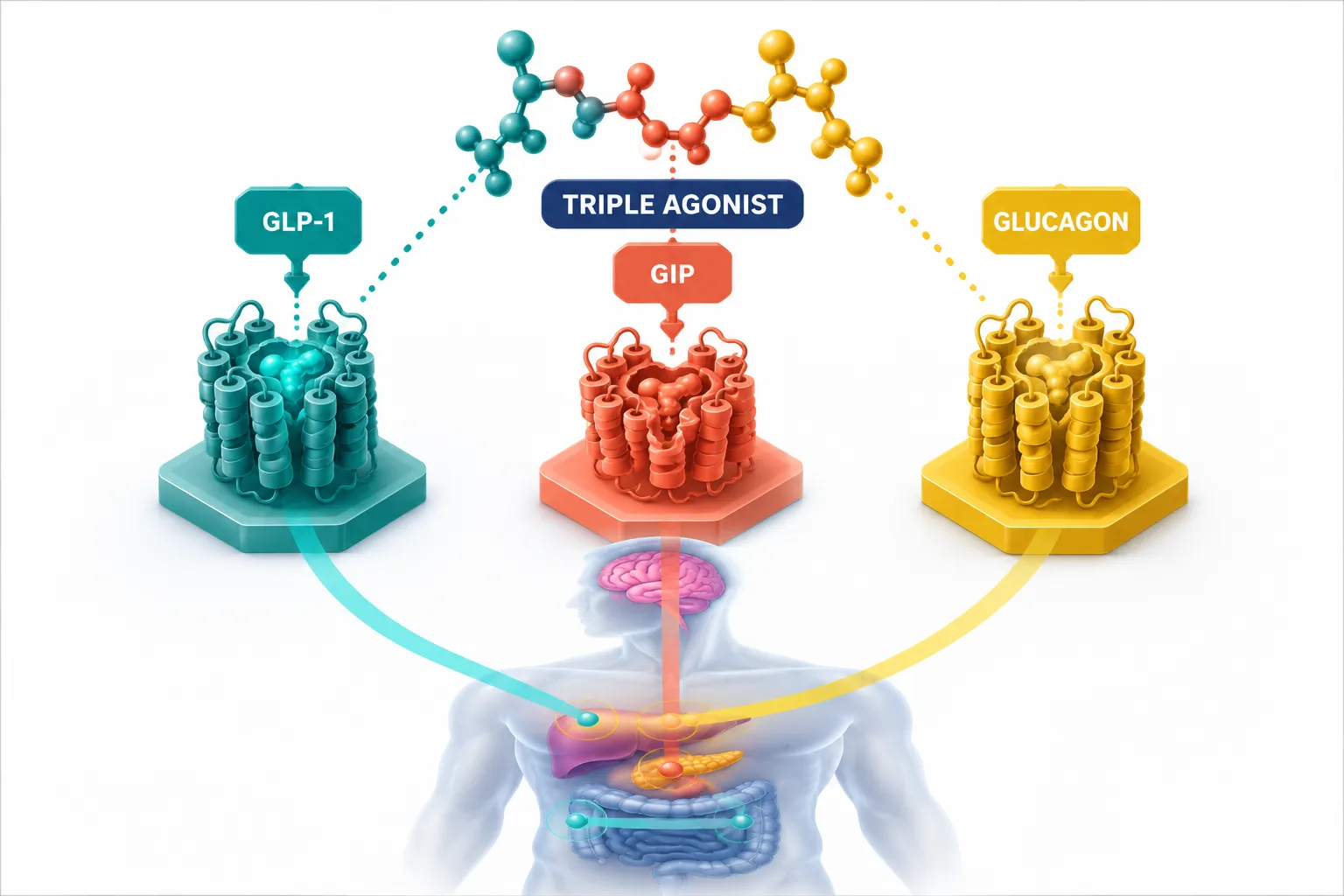
Most approved obesity medications target a single receptor. Semaglutide activates GLP-1 receptors. Tirzepatide adds GIP receptor co-agonism. Retatrutide goes one step further by simultaneously engaging GLP-1, GIP, and glucagon receptors, which is why it is often called a GLP-3 or triple agonist in research shorthand.
To understand the receptor-level mechanics, the overview of Peptides Mechanism 101: From GLP-3 Retatrutide to CJC-1295 and MOTS-c provides useful context on how each agonist component contributes to downstream metabolic signaling.
The glucagon receptor component is the key differentiator. Glucagon stimulates hepatic glucose output and energy expenditure. When paired with GLP-1-driven appetite suppression and GIP-mediated insulin potentiation, the combined effect appears to drive greater fat oxidation than either dual or single-agonist approaches.
Why this matters for research:
- Greater energy expenditure without proportional muscle loss
- Additive effects on hepatic lipid clearance
- Potential utility in non-alcoholic fatty liver disease (MASLD) beyond glycemic control
Researchers planning triple agonist studies can also review GLP-3 for sale: triple agonist research planning and catalog navigation for sourcing and study design considerations.
Retatrutide Phase 3 Results: What the New GLP-3 Data Mean for Obesity and Diabetes Research, The TRIUMPH Program Explained
Eli Lilly launched the TRIUMPH clinical program to evaluate retatrutide across multiple metabolic indications. The program includes separate arms for:
| Trial Arm | Primary Population | Key Endpoints |
|---|---|---|
| TRIUMPH-1 | Adults with obesity (no T2D) | Body weight reduction at 72 weeks |
| TRIUMPH-2 | Adults with type 2 diabetes | HbA1c reduction, body weight |
| TRIUMPH-3 | Obesity with cardiovascular risk | MACE outcomes, weight |
| TRIUMPH-NASH | MASLD/NASH | Liver fat fraction, fibrosis |
Phase 3 data readouts began emerging in late 2024 and are continuing through 2026. Interim signals from TRIUMPH-1 and TRIUMPH-2 indicate that the weight loss trajectory observed in phase 2 is holding at larger sample sizes, with mean reductions in the 20-24% range at 72 weeks in the obesity-only arm.
For the type 2 diabetes arm, HbA1c reductions of approximately 2.0-2.4 percentage points from baseline have been reported at mid-study timepoints, which would represent a clinically meaningful improvement over current standard-of-care agents.
The liver-fat findings are particularly significant. Research covered in Retatrutide and MASLD: interpreting liver-fat reductions and microbiome signals from emerging GLP-3 data details how early MASLD signals from retatrutide studies suggest hepatic fat fraction reductions exceeding those seen with GLP-1 monotherapy.
"The glucagon receptor component appears to be doing meaningful work on hepatic lipid metabolism, a dimension that semaglutide and even tirzepatide do not fully address."
Interpreting the Phase 3 Efficacy and Safety Data for Future Research

Understanding what the Retatrutide Phase 3 Results: What the New GLP-3 Data Mean for Obesity and Diabetes Research signal requires separating efficacy endpoints from tolerability data.
Efficacy signals researchers should track:
- Sustained weight loss beyond 52 weeks (durability question)
- Lean mass preservation relative to total weight lost
- Cardiovascular biomarker changes (LDL, triglycerides, blood pressure)
- Kidney function markers, given the metabolic stress of rapid weight loss
On kidney function, the intersection of metabolic peptide research and renal health is explored in SS-31 kidney health research, which provides relevant background on how metabolic interventions interact with renal endpoints.
Tolerability profile from phase 3:
The most common adverse events remain gastrointestinal, nausea, vomiting, and diarrhea, consistent with the GLP-1 mechanism. Phase 3 data suggest these are manageable with dose titration and generally resolve within the first 8-12 weeks. Serious adverse event rates have remained low in interim reports.
What phase 3 adds over phase 2:
- Larger, more diverse patient populations
- Longer follow-up (72 weeks vs. 48 weeks)
- Active comparator arms against semaglutide and tirzepatide
- Cardiovascular outcomes data beginning to mature
Researchers comparing generational GLP-1 and GLP-3 compounds should also consult GLP-1 peptide: generational research concepts and sourcing notes for a structured view of how the receptor agonist class has evolved.
What Comes Next: Research Implications for 2026 and Beyond

The phase 3 data now position retatrutide as a potential first-in-class triple agonist seeking regulatory approval. A New Drug Application (NDA) submission to the FDA is anticipated in 2025-2026, with a decision window extending into late 2026.
Actionable steps for researchers and clinicians:
- Monitor TRIUMPH readouts, Full 72-week data from TRIUMPH-1 and TRIUMPH-2 will clarify durability and long-term safety.
- Assess cardiovascular outcomes, TRIUMPH-3 MACE data will determine whether retatrutide earns a cardiovascular risk reduction label.
- Evaluate MASLD endpoints, Liver-fat and fibrosis data from TRIUMPH-NASH could open an entirely new approved indication.
- Compare against tirzepatide, Active comparator arms will provide the head-to-head evidence the field has been waiting for.
- Track MC4R pathway interactions, Central appetite regulation research, including MC4R research, may help explain inter-individual variability in weight loss response.
The broader peptide research landscape is also evolving alongside these findings. Understanding polypeptide structure, function, and research applications provides foundational context for interpreting how triple agonist peptides behave across different biological systems.
Conclusion
The emerging Retatrutide Phase 3 Results: What the New GLP-3 Data Mean for Obesity and Diabetes Research represent the most significant update to metabolic pharmacology in years. Phase 3 interim data confirm that the exceptional weight loss seen in phase 2 is reproducible at scale, that glycemic improvements are clinically meaningful, and that hepatic and cardiovascular benefits are taking shape as distinct research opportunities.
For researchers, the priority in 2026 is to engage with full TRIUMPH readouts as they publish, benchmark retatrutide against existing GLP-1 and dual agonist standards, and begin designing downstream studies that explore combination protocols, long-term maintenance, and special populations. The triple agonist era is no longer theoretical, it is in phase 3, and the data are compelling.
References
- Jastreboff, A. M., et al. (2023). Triple, Hormone-Receptor Agonist Retatrutide for Obesity, A Phase 2 Trial. New England Journal of Medicine, 389(6), 514-526.
- Eli Lilly and Company. (2024). TRIUMPH Phase 3 Clinical Program Overview. Investor Relations Disclosure.
- Coskun, T., et al. (2022). LY3437943, a novel triple GIP, GLP-1 and glucagon receptor agonist for glycemic control and weight loss: From discovery to clinical proof of concept. Cell Metabolism, 34(9), 1234-1247.
- Rosenstock, J., et al. (2023). Retatrutide, a GIP, GLP-1 and glucagon receptor agonist, for people with type 2 diabetes: a randomised, double-blind, placebo and active-controlled, parallel-group, phase 2 trial. The Lancet, 402(10401), 529-544.


Leave a Reply
Want to join the discussion?Feel free to contribute!