Call or Text 727-513-9780
  • Shopping Cart Shopping Cart
    0Shopping Cart
Pure Tested Peptides | America's most trusted Peptides for sale online
  • Peptides for sale
    • Oral Peptides for sale
      • Peptide Capsules for sale
      • BPC 157 Capsules 1000mcg
      • SLU-PP-332 Capsules | 1000 mcg
      • 5-Amino-1MQ 50mg Capsules
      • Tesofensine 500mcg
    • All Peptides for sale
    • Peptide Sprays
      • BPC 157 Nasal Spray Kit
      • BPC-157 TB500 Nasal Spray Kit
      • Semax Nasal Spray 10mg
      • Selank – Nasal Spray Kit – 10mg
      • Epithalon 50MG Nasal Spray Kit
      • Ipamorelin 10mg Nasal Spray
      • Klow Nasal Spray (BPC-157 + TB-500 + GHK-Cu + KPV) | 80mg
      • Hulk Nasal Spray Tesa / Ipa Blend 6/3 MG
      • Klow Nasal Spray
      • NAD + 500 mg Nasal Spray
      • PT-141 Nasal Spray Kit
    • GHRH Peptides
      • Ipa Peptides
      • CJC-1295 Peptides
        • CJC-1295 with DAC 5 mg
        • CJC-1295 without DAC 5 mg
        • CJC-1295 Ipa 10mg
      • Tesa Peptides
        • Tesa Peptide
        • Tesa 20 mg
    • GHK-Cu Peptides
      • All GHK-Cu Peptides
      • GHK-Cu 100mg
      • KLOW Peptide Blend – Buy KLOW blend online
    • BPC Peptides
      • All BPC Peptides
      • BPC-157
      • BPC-157 TB-500
      • BPC 157 capsules 1000mcg
    • SLU-PP-332 Peptides
      • All SLU-PP-332 Peptides
      • SLU-PP-332 5mg
    • GLP3 Peptides
      • GLP3-R
      • GLP3-R CAG 10mg
      • GLP3-R 20mg
    • PT-141 Peptides
      • PT-141 Peptides for sale
      • PT-141 10mg
      • PT-141 Nasal Spray
    • CAG Peptides
      • Lipo-C Peptide Blend
      • CAG 5mg
      • CAG 10mg
    • MOTS-C Peptides
      • MOTS-C Peptides for sale
      • MOTS-c peptide
      • MOTS-c 10mg *6 pack*
    • 5 Amino 1MQ Peptides
      • 5 Amino 1MQ Peptides for sale
      • 5-Amino-1MQ 50mg Capsules
      • 5-Amino-1MQ 5mg
    • Epithalon Peptides
      • Epithalon Peptides for sale
      • Epithalon 10mg
      • Epithalon 50mg
  • Shop
    • GLPs
      • 5-Amino-1MQ 50mg Capsules
      • 5-Amino-1MQ 5mg
      • GLP3-Reta
      • L-Carnitine 500mg/ml
      • Tesofensine 500mcg
      • SLU-PP-332 5mg
      • MOTS-c 10mg *6 pack*
    • Epithalon & BPC Peptides
      • Epithalon 10mg
      • Epithalon 50mg
      • BPC-157
      • BPC 157 capsules 1000mcg
      • BPC-157 TB-500
      • BPC-157 TB500 Nasal Spray Kit
      • BPC 157 Nasal Spray Kit
    • BPC TB-500 & NAD+ Peptides
      • NAD+ 500 mg
      • KLOW Peptide Blend – Buy KLOW blend online
      • GLOW Peptide Blend
      • TB 500 5mg
      • BPC 157 capsules 1000mcg – Supplement
      • BPC 157 Nasal Spray Kit
      • BPC-157
      • BPC-157 TB500 Nasal Spray Kit
      • BPC-157 TB-500
      • BPC 157 capsules 1000mcg
    • LL-37 Peptide
      • LL-37 10 mg
    • MOTS-C & Selank
      • MOTS-c peptide
      • Selank 10mg
    • GHK Peptides
      • GHK-Cu 100mg
      • GLOW Peptide Blend
      • KLOW Peptide Blend – Buy KLOW blend online
  • COAs
  • Wholesale
    • Wholesale Peptides for sale
  • PTP FAQ
  • Affiliates
    • Selank Peptide: Advanced Pharmacological Mechanisms Underlying Its Anxiolytic and Nootropic Effects in Research
      • 5-Amino-1MQ Peptide: Detailed Mechanisms of NNMT Inhibition and Its Impact on Cellular Metabolism Research
        • MOTS-C Peptide: Unraveling Its Role in Mitochondrial Dynamics and Energy Metabolism Research
          • Epithalon Peptide and Telomerase Regulation: Investigating Its Impact on Cellular Senescence and Lifespan Research Models
            • GLP2-T vs GLP2 Tirz Peptide: Understanding the Naming, Mechanistic Nuances, and Research Implications for Gut Health
      • Peptides and Polypeptides in Modern Pharmacology: What Research on Metoprolol, Prednisone, and Amlodipine Reveals
        • Polypeptide Peptides vs NSAIDs: What Naproxen and Diclofenac Teach Tissue-Repair Researchers About BPC‑157 and TB‑500
          • Peptides and Polypeptides in Endocrine Pharmacology: How GLP-1, GLP-2, and GLP-3 Retatrutide Differ From Classic Drugs Like Prednisone and Amlodipine
          • 5‑Amino‑1MQ Peptide and NNMT Inhibition: How It Compares With Statins Like Atorvastatin in Adipose and Lipid Metabolism Research
      • Enclomiphene, Estrogen Receptor Signaling, and Luteinizing Phase Biology: What Hormone Researchers Should Measure
        • Mesenchymal Stem Cells, BPC‑157, and GHK‑Cu: How Tissue Repair Peptides Compare With Classic NSAIDs Like Naproxen in Injury Models
          • Peptide Calculator Use Cases Beyond Growth Hormone: Working Through GLP‑3 Retatrutide, MOTS‑c, and BPC‑157 Research Dosing
        • Polypeptide Peptides in Endocrine and Metabolic Pharmacology: Lessons From Amlodipine, Prednisone, and Metoprolol
        • Peptides Calculator for Advanced Blends: Worked Examples for Tesamorelin, CJC‑1295, and Ipamorelin Stacks
          • Peptides and Polypeptides in Human Physiology: How Molecular Size Shapes Research Applications
            • Selank Peptide: Advanced Pharmacological Mechanisms Underlying Its Anxiolytic and Nootropic Effects in Research
          • 5-Amino-1MQ Peptide: Detailed Mechanisms of NNMT Inhibition and Its Impact on Cellular Metabolism Research
            • MOTS-C Peptide: Unraveling Its Role in Mitochondrial Dynamics and Energy Metabolism Research
              • Epithalon Peptide and Telomerase Regulation: Investigating Its Impact on Cellular Senescence and Lifespan Research Models
                • GLP2-T vs GLP2 Tirz Peptide: Understanding the Naming, Mechanistic Nuances, and Research Implications for Gut Health
                  • Peptides and Polypeptides in Endocrine Pharmacology: How GLP-1, GLP-2, and GLP-3 Retatrutide Differ From Classic Drugs Like Prednisone and Amlodipine
                    • Polypeptide Peptides vs NSAIDs: What Naproxen and Diclofenac Teach Tissue-Repair Researchers About BPC‑157 and TB‑500
                      • Peptides and Polypeptides in Modern Pharmacology: What Research on Metoprolol, Prednisone, and Amlodipine Reveals
                        • 5‑Amino‑1MQ Peptide and NNMT Inhibition: How It Compares With Statins Like Atorvastatin in Adipose and Lipid Metabolism Research
                        • Enclomiphene, Estrogen Receptor Signaling, and Luteinizing Phase Biology: What Hormone Researchers Should Measure
                        • Mesenchymal Stem Cells, BPC‑157, and GHK‑Cu: How Tissue Repair Peptides Compare With Classic NSAIDs Like Naproxen in Injury Models
                        • Peptide Calculator Use Cases Beyond Growth Hormone: Working Through GLP‑3 Retatrutide, MOTS‑c, and BPC‑157 Research Dosing
                        • Polypeptide Peptides in Endocrine and Metabolic Pharmacology: Lessons From Amlodipine, Prednisone, and Metoprolol
                        • Peptides Calculator for Advanced Blends: Worked Examples for Tesamorelin, CJC‑1295, and Ipamorelin Stacks
                        • Peptides and Polypeptides in Human Physiology: How Molecular Size Shapes Research Applications
                        • Selank Peptide: Advanced Pharmacological Mechanisms Underlying Its Anxiolytic and Nootropic Effects in Research
                        • MOTS-C Peptide: Unraveling Its Role in Mitochondrial Dynamics and Energy Metabolism Research
                        • Peptides and Polypeptides in Modern Pharmacology: What Research on Metoprolol, Prednisone, and Amlodipine Reveals
                        • Peptides and Polypeptides in Endocrine Pharmacology: How GLP-1, GLP-2, and GLP-3 Retatrutide Differ From Classic Drugs Like Prednisone and Amlodipine
                        • 5-Amino-1MQ Peptide: Detailed Mechanisms of NNMT Inhibition and Its Impact on Cellular Metabolism Research
                        • Mesenchymal Stem Cells, BPC‑157, and GHK‑Cu: How Tissue Repair Peptides Compare With Classic NSAIDs Like Naproxen in Injury Models
                        • Peptide Calculator Use Cases Beyond Growth Hormone: Working Through GLP‑3 Retatrutide, MOTS‑c, and BPC‑157 Research Dosing
                        • GLP2-T vs GLP2 Tirz Peptide: Understanding the Naming, Mechanistic Nuances, and Research Implications for Gut Health
                        • Polypeptide Peptides in Endocrine and Metabolic Pharmacology: Lessons From Amlodipine, Prednisone, and Metoprolol
                        • Polypeptide Peptides vs NSAIDs: What Naproxen and Diclofenac Teach Tissue-Repair Researchers About BPC‑157 and TB‑500
                        • Peptides and Polypeptides in Human Physiology: How Molecular Size Shapes Research Applications
                        • Peptides Calculator for Advanced Blends: Worked Examples for Tesamorelin, CJC‑1295, and Ipamorelin Stacks
                        • 5‑Amino‑1MQ Peptide and NNMT Inhibition: How It Compares With Statins Like Atorvastatin in Adipose and Lipid Metabolism Research
                        • Enclomiphene, Estrogen Receptor Signaling, and Luteinizing Phase Biology: What Hormone Researchers Should Measure
                        • Epithalon Peptide and Telomerase Regulation: Investigating Its Impact on Cellular Senescence and Lifespan Research Models
                        • Best research protocol Klow blend
                        • best time to take BPC-157
                        • best time to take DSIP (Delta Sleep Inducing Peptide)
                        • best time to take CJC-1295
                        • best time to take AOD-9604
                        • best time to take Follistatin 344
                        • best time to take Ipamorelin
                        • best time to take MK-677 (Ibutamoren)
                        • best time to take Ligandrol (LGD-4033) — research compound
                        • best time to take Ostarine (MK-2866) — research compound
                        • best time to take GHK-CU
                        • best time to take TB-500
                        • best time to take MOTS-c
                        • best time to take Semax
                        • best time to take RAD-140 (Testolone) — research compound
                        • best time to take Thymosin Alpha-1
                        • best time to take PEG-MGF
                        • Biolife Plasma, Octapharma Plasma, and Research Peptides: How Plasma Donation Labs Differ From Peptide Suppliers
                        • best time to take YK-11 — research compound
                        • best time to take PT-141 (Bremelanotide)
                        • Best research protocol Klow blend
  • Contact
    • Contact Customer Service
    • Text Customer Support
  • About US
  • Shop all peptides
  • Affiliate Program
    • Affiliate Signup
  • Login / Register Login / Register Page Link Login / Register Page Link
  • Click to open the search input field Click to open the search input field Search
  • Menu Menu

Tag Archive for: peptide nomenclature

GLP-2-T and GLP2 Tirz Peptides: Naming Confusion, Mechanistic Differences, and Research Use Cases

GLP-2-T and GLP2 Tirz Peptides: Naming Confusion, Mechanistic Differences, and Research Use Cases

July 13, 2026/0 Comments/by Pure Tested

GLP-2-T vs GLP2 Tirz Peptides cover image

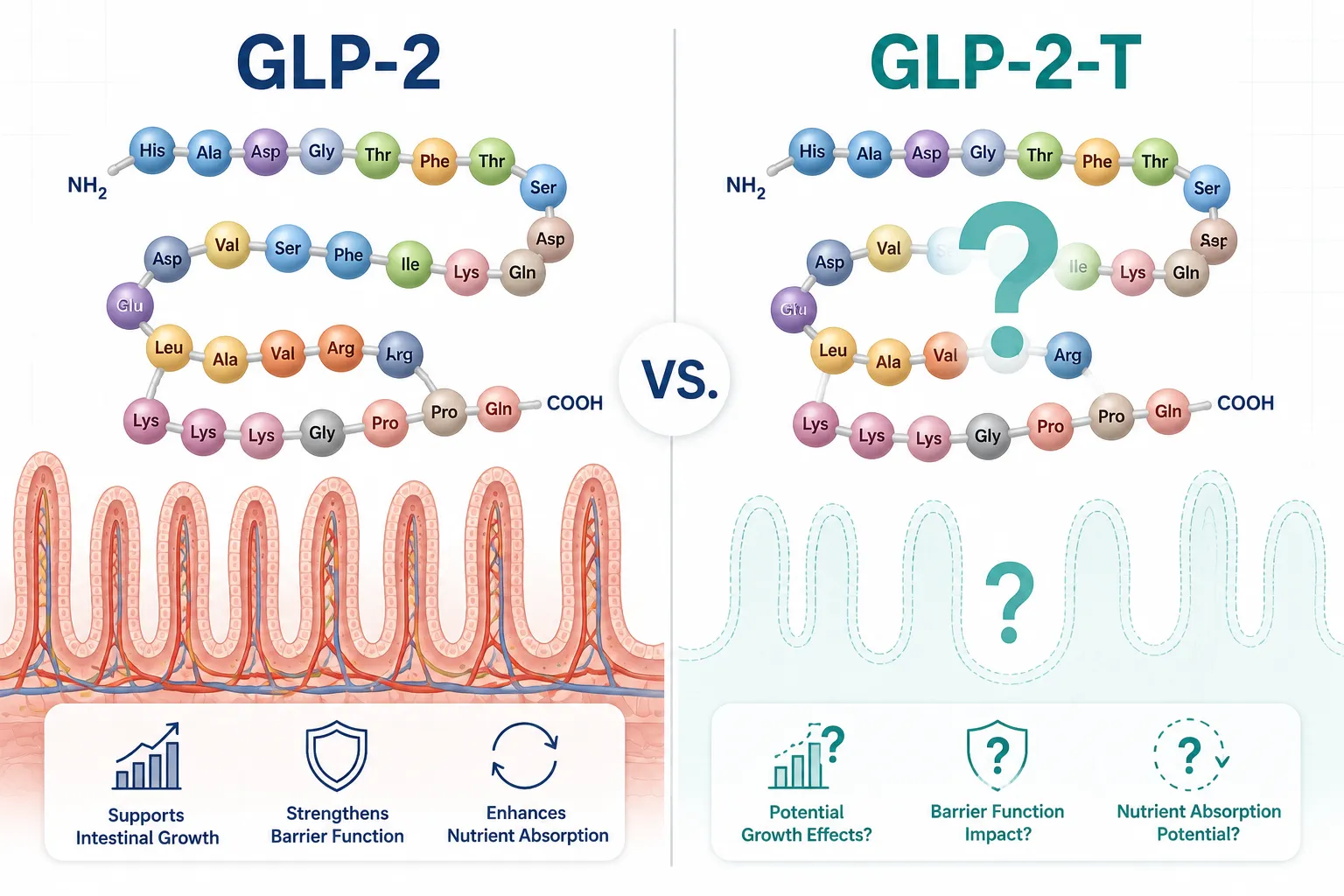
Researchers searching for "GLP-2 Tirz" in 2026 frequently land on content about tirzepatide, a dual incretin agonist, when they actually need information about GLP-2-T, a modified analog of glucagon-like peptide-2 studied for gut barrier biology. That single naming overlap can derail an entire literature review. Understanding GLP-2-T and GLP2 Tirz Peptides: Naming Confusion, Mechanistic Differences, and Research Use Cases is therefore not just an academic exercise; it directly shapes which experimental model a researcher selects and which receptor pathways they target.

Key Takeaways

  • "GLP-2 Tirz" is an informal, technically inaccurate label for tirzepatide, a GLP-1/GIP dual agonist with no direct GLP-2 pathway activity.
  • GLP-2-T is a research-grade, stability-enhanced analog of the endogenous peptide GLP-2, focused on intestinal mucosal biology.
  • The two compounds act on completely different receptors and serve distinct research purposes.
  • Informal generational numbering (GLP-2, GLP-3) for incretin drugs creates systematic confusion in the research community.
  • Selecting the correct compound requires understanding both receptor targets and the biological systems under study.

Where the Naming Confusion Originates

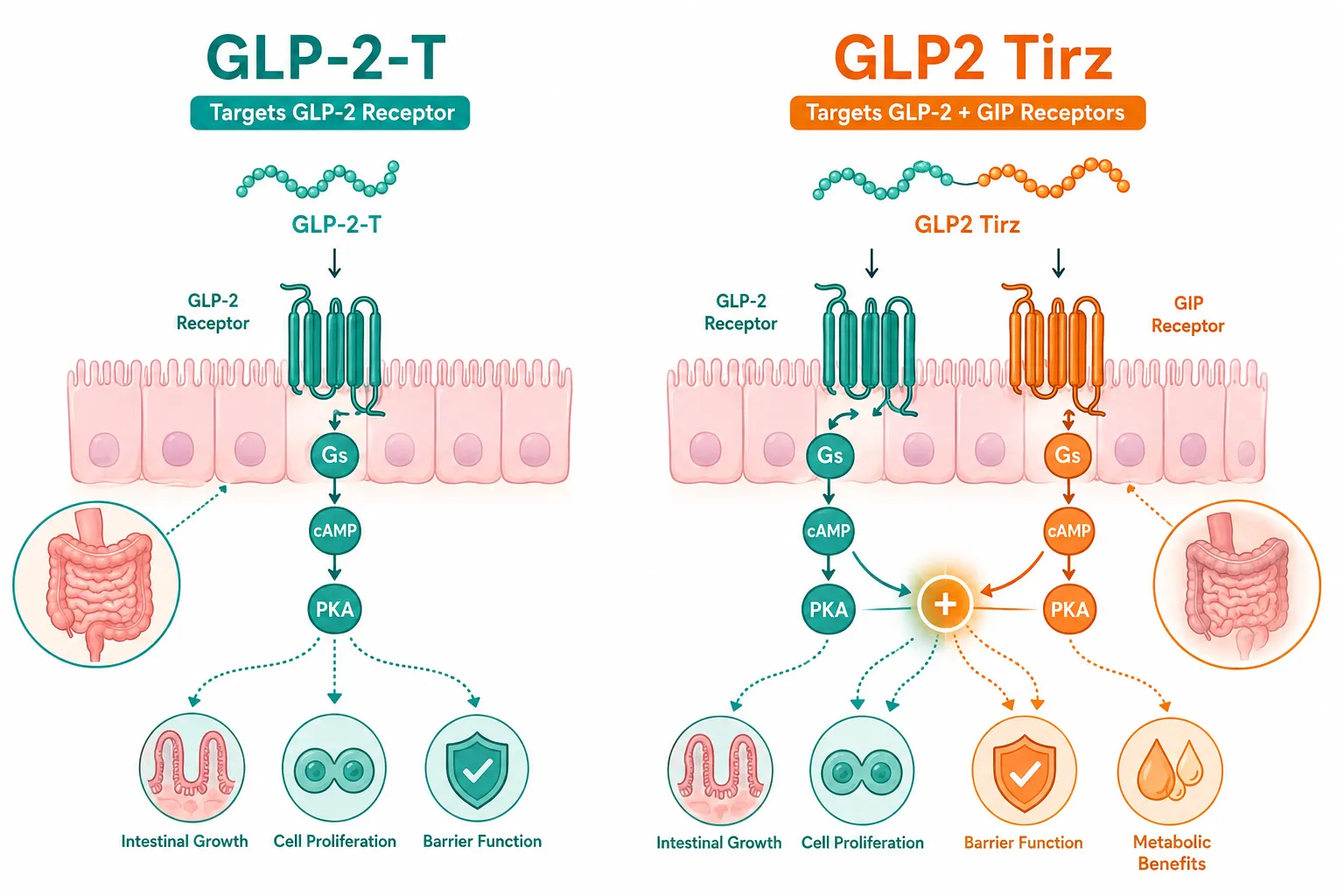
Split diagram comparing GLP-2-T and Tirzepatide molecular pathways

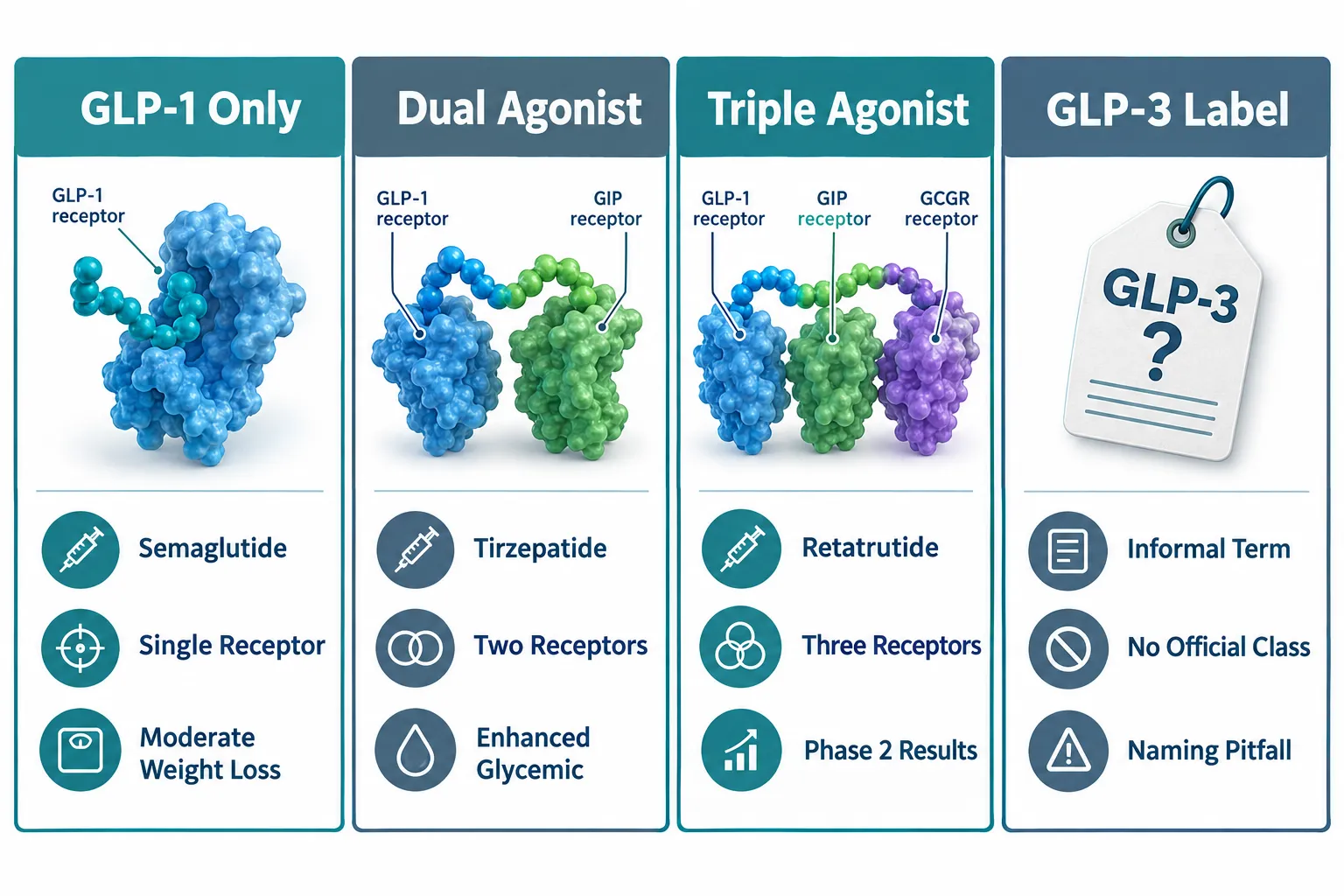
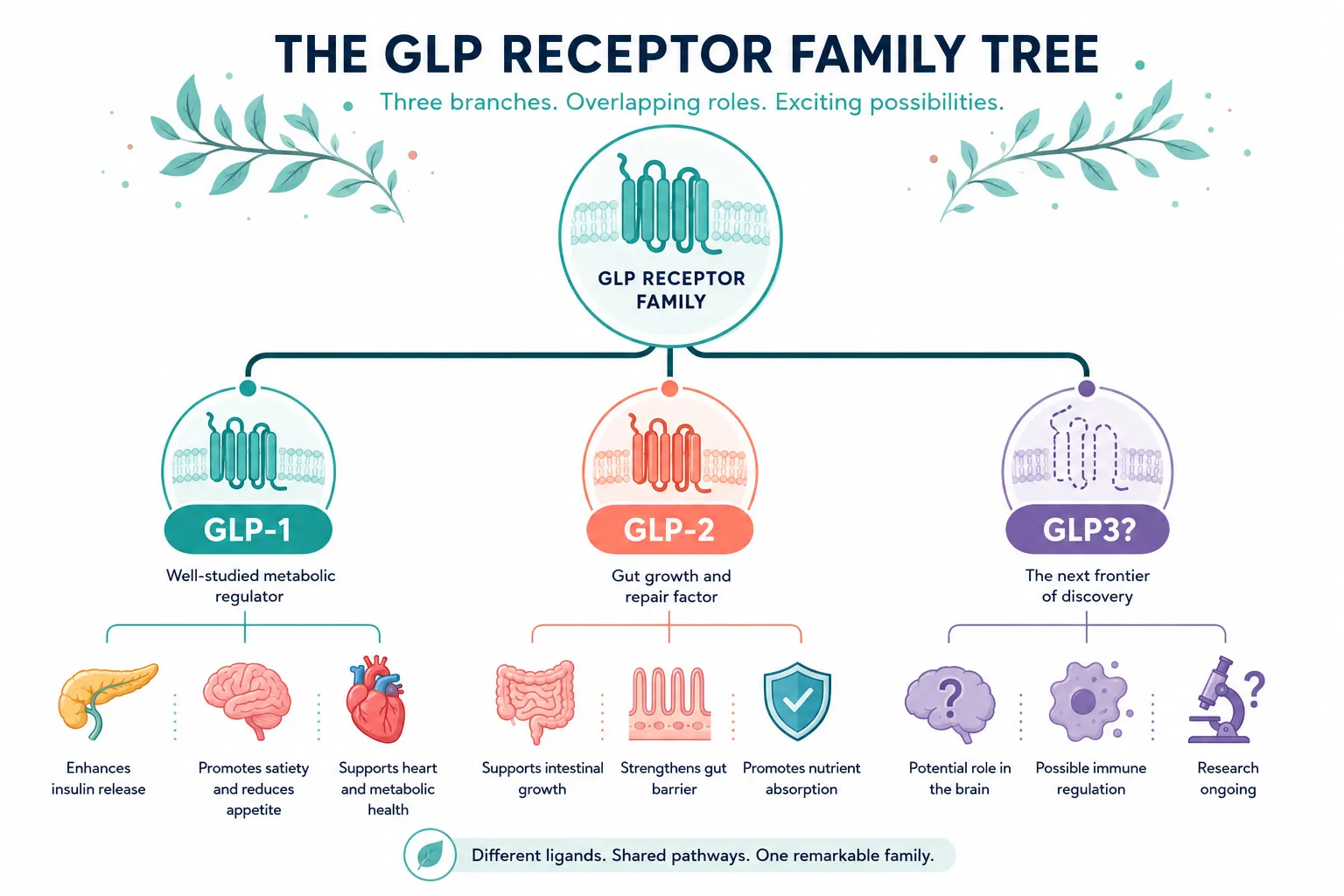
The confusion around GLP-2-T and GLP2 Tirz Peptides stems from an informal numbering convention that circulates in research blogs, supplement forums, and even some vendor catalogs. In this system, semaglutide is called "GLP-1," tirzepatide is called "GLP-2," and retatrutide is called "GLP-3." The logic follows the number of receptor targets each drug engages.

The problem: these numbers already belong to real, endogenous peptides.

  • GLP-1 (glucagon-like peptide-1): a well-characterized incretin hormone.
  • GLP-2 (glucagon-like peptide-2): a 33-amino acid hormone secreted by intestinal L-cells, primarily involved in gut mucosal growth and barrier function.
  • GLP-3: not a recognized endogenous hormone; "retatrutide" is its informal nickname, targeting GLP-1, GIP, and glucagon receptors.

The World Health Organization's International Nonproprietary Names system designates the generic name tirzepatide, with the stem "-tirz-" signaling its dual incretin activity. Calling tirzepatide "GLP-2 Tirz" blends an endogenous peptide name with a drug suffix, producing a label that implies receptor overlap where none exists.

For researchers exploring incretin-based metabolic research, the GLP-1-T incretin research themes page provides a useful parallel on how GLP-1 analogs are properly categorized. Similarly, the GLP-3 Reta research page illustrates how the triple-agonist space is being studied without conflating it with endogenous peptide families.


Mechanistic Differences: Two Compounds, Two Entirely Different Systems

Researcher's lab bench with peptide vials and pathway research cards

The core issue in the GLP-2-T and GLP2 Tirz Peptides naming confusion is that these compounds act through fundamentally separate biological systems.

How GLP-2 and GLP-2-T Work

GLP-2 is co-released with GLP-1 from enteroendocrine L-cells after nutrient intake. Its primary roles include:

  • Promoting intestinal mucosal growth and villus elongation
  • Supporting tight junction regulation and gut barrier integrity
  • Modulating enteric nervous system signaling

Critically, the GLP-2 receptor is expressed in the enteric nervous system rather than directly on intestinal epithelial cells, which means GLP-2 acts through an indirect mechanism involving neural intermediaries.

GLP-2-T is a modified, stability-enhanced analog of this endogenous peptide. Its structural modifications extend its half-life, allowing researchers to study longer-lasting gut mucosal effects without repeated peptide dosing in experimental setups. This makes it a practical tool for intestinal barrier and villus growth models.

How Tirzepatide (Informally "GLP-2 Tirz") Works

Tirzepatide is a dual agonist at the GLP-1 receptor and the glucose-dependent insulinotropic polypeptide (GIP) receptor. Its research-relevant actions include:

  • Stimulating glucose-dependent insulin secretion
  • Suppressing appetite via central GLP-1 receptor pathways
  • Modulating fat metabolism through GIP receptor activity

Tirzepatide has no direct activity at the GLP-2 receptor. Placing it under a "GLP-2" label is therefore mechanistically misleading. Researchers interested in dual incretin signaling may also find value in reviewing cagrilintide synergy with GLP-1 to understand how complementary peptide combinations are studied in metabolic contexts.

Feature GLP-2-T Tirzepatide ("GLP-2 Tirz")
Receptor target GLP-2 receptor GLP-1 + GIP receptors
Primary system Intestinal/gut mucosal Metabolic/pancreatic
Research focus Gut barrier, villi growth Insulin secretion, appetite
Endogenous basis GLP-2 analog Synthetic dual agonist

Research Use Cases: Selecting the Right Compound

GLP-2-T research use cases infographic with four key application icons

Understanding GLP-2-T and GLP2 Tirz Peptides: Naming Confusion, Mechanistic Differences, and Research Use Cases becomes most practical when deciding which compound belongs in a specific experimental design.

GLP-2-T Research Applications

GLP-2-T is primarily examined in preclinical gut biology models for:

  1. Intestinal villi growth and maintenance, studying how mucosal architecture responds to GLP-2 receptor stimulation
  2. Gut barrier permeability models, examining tight junction proteins and paracellular transport
  3. Enteric nervous system signaling, probing how GLP-2 receptor activation translates into epithelial responses via neural intermediaries
  4. Metabolic gut hub research, because the gut functions as a metabolic signaling organ, GLP-2-T is increasingly discussed alongside metabolic peptides

Recent research directions have also explored long-acting GLP-2 analogs through lipidation strategies, which enhance half-life and gut-tropic efficacy in rodent models, a design principle that informs GLP-2-T's structural modifications.

For researchers building multi-peptide protocols, longevity peptide research and MOTS-C mechanism and research offer context on how gut-metabolic signaling intersects with broader longevity pathways.

Tirzepatide Research Applications

Tirzepatide is studied for:

  • Glucose homeostasis and beta-cell function models
  • Adipose tissue metabolism via GIP receptor pathways
  • Appetite regulation through central GLP-1 receptor mechanisms

These are entirely separate research domains from GLP-2-T's intestinal focus. Researchers who require verified, lab-tested compounds for either pathway should consult resources on peptide purity testing to ensure compound integrity before experimental use.

Key distinction: If the research question involves gut mucosal biology, tight junctions, or intestinal villi, GLP-2-T is the relevant compound. If the question involves insulin secretion, appetite, or dual incretin signaling, tirzepatide is the appropriate subject, and it should be referred to by its correct INN name.


Conclusion

The naming overlap between GLP-2-T and "GLP-2 Tirz" (tirzepatide) is not a minor stylistic issue, it represents a mechanistic mismatch that can send researchers down the wrong experimental path. GLP-2-T targets the GLP-2 receptor and serves gut mucosal biology research. Tirzepatide targets GLP-1 and GIP receptors and belongs to metabolic and incretin research. They share no receptor overlap, no shared biological system, and no interchangeable research applications.

Actionable next steps for researchers:

  • Use the WHO-designated INN name "tirzepatide" in all literature and protocols, not the informal "GLP-2 Tirz" label.
  • Confirm receptor targets before selecting a compound for any experimental model.
  • Cross-reference vendor catalogs against peer-reviewed receptor pharmacology data.
  • Explore the all peptides for sale resource for context on how research-grade peptides are classified and combined.
  • Review innovative peptide delivery systems for updates on stability-enhancing modifications relevant to GLP-2-T analog design.

Precise nomenclature is the foundation of reproducible science. Resolving this naming confusion is the first step toward cleaner experimental design and more reliable results.

https://www.puretestedpeptides.com/wp-content/uploads/2026/07/glp-2-t-and-glp2-tirz-peptides-naming-confusion-mechanistic-differences-and-rese-1.png 1024 1536 Pure Tested https://www.puretestedpeptides.com/wp-content/uploads/2026/01/buy-peptides-online.jpg Pure Tested2026-07-13 13:18:122026-07-20 15:00:12GLP-2-T and GLP2 Tirz Peptides: Naming Confusion, Mechanistic Differences, and Research Use Cases
GLP3 Peptide vs. Retatrutide: Understanding the Nomenclature and Research Implications

GLP3 Peptide vs. Retatrutide: Understanding the Nomenclature and Research Implications

July 12, 2026/0 Comments/by Pure Tested

Researchers searching for "GLP3 peptide" in 2026 are often looking for the same compound, yet the terminology they use can lead them to entirely different bodies of literature, products, and regulatory contexts. The conversation around GLP3 Peptide vs. Retatrutide: Understanding the Nomenclature and Research Implications matters because imprecise language in peptide science does not just cause confusion; it can distort research intent, misalign sourcing decisions, and obscure a compound's actual clinical standing.

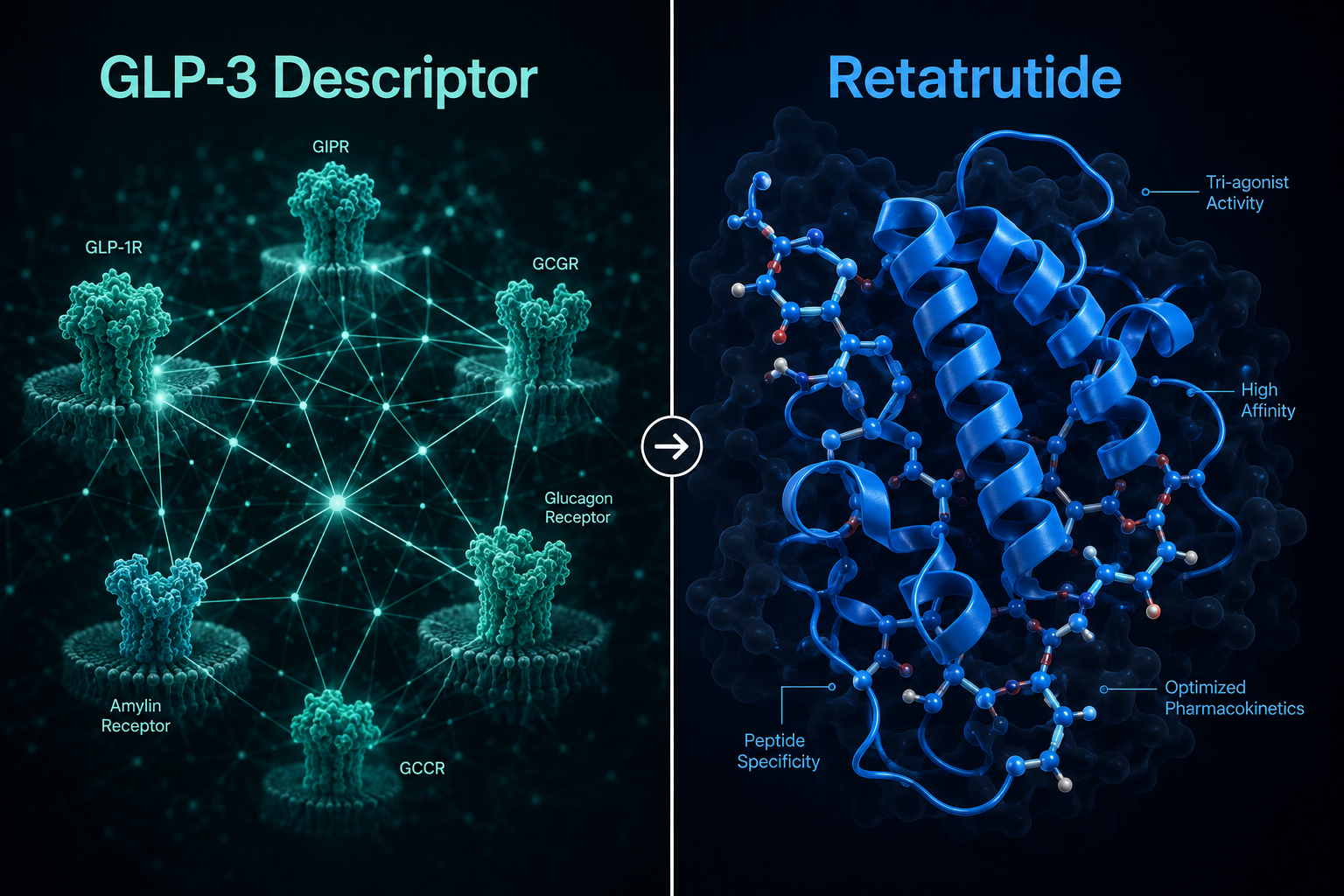
Editorial () showing a conceptual split-screen illustration: left half features the text label 'GLP-3 Descriptor' in over an

Key Takeaways

  • "GLP-3" is an informal, community-driven descriptor, not an official scientific classification for retatrutide.
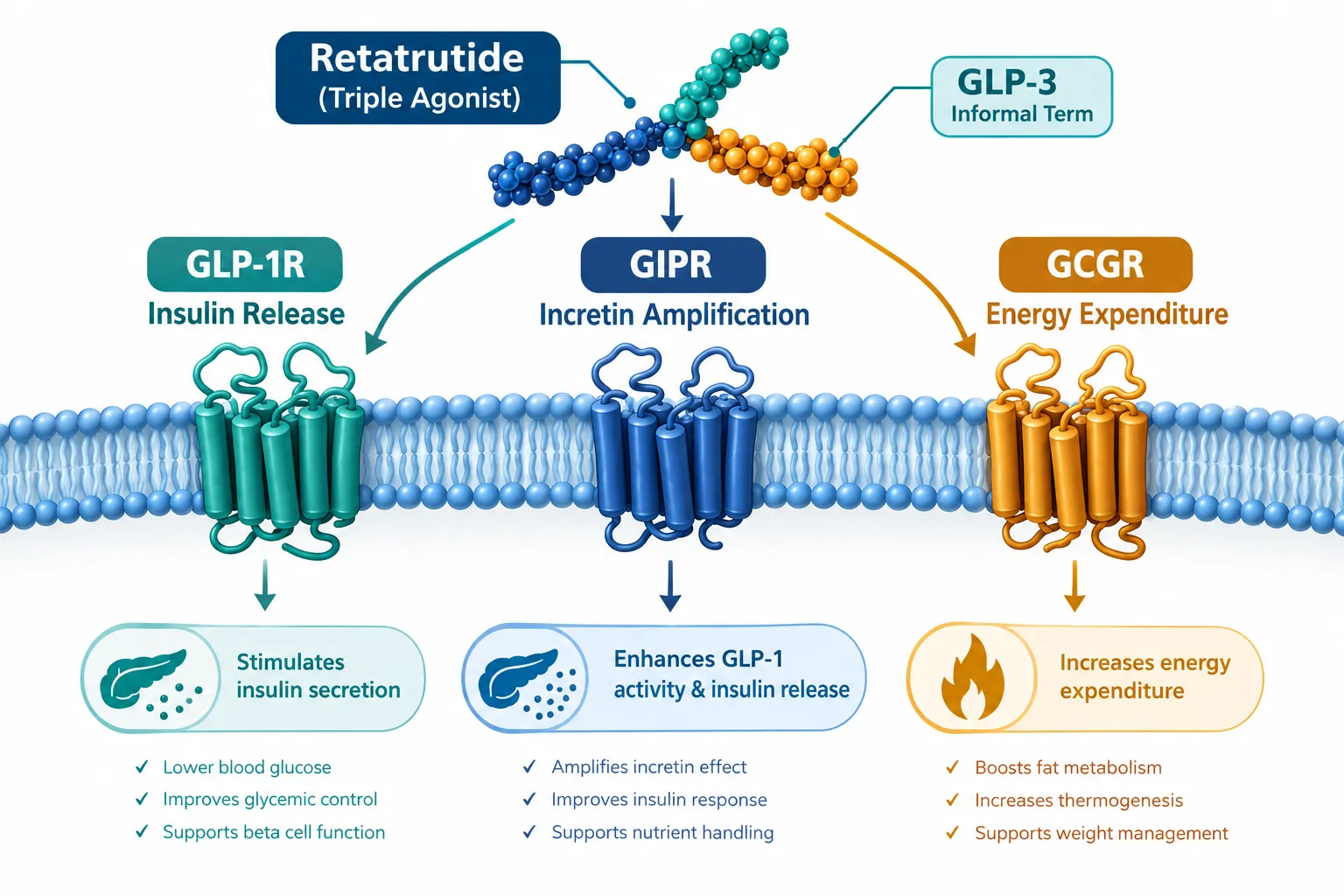
  • Retatrutide is a specific triple agonist targeting GLP-1, GIP, and glucagon receptors, developed by Eli Lilly.
  • Phase 3 trials show up to 28.7% mean body weight reduction over approximately 68 weeks.
  • As of 2026, retatrutide has not received FDA approval and carries no official brand name.
  • Understanding this nomenclature gap is critical for accurate research, sourcing, and clinical interpretation.

What "GLP-3" Actually Means, and What It Does Not

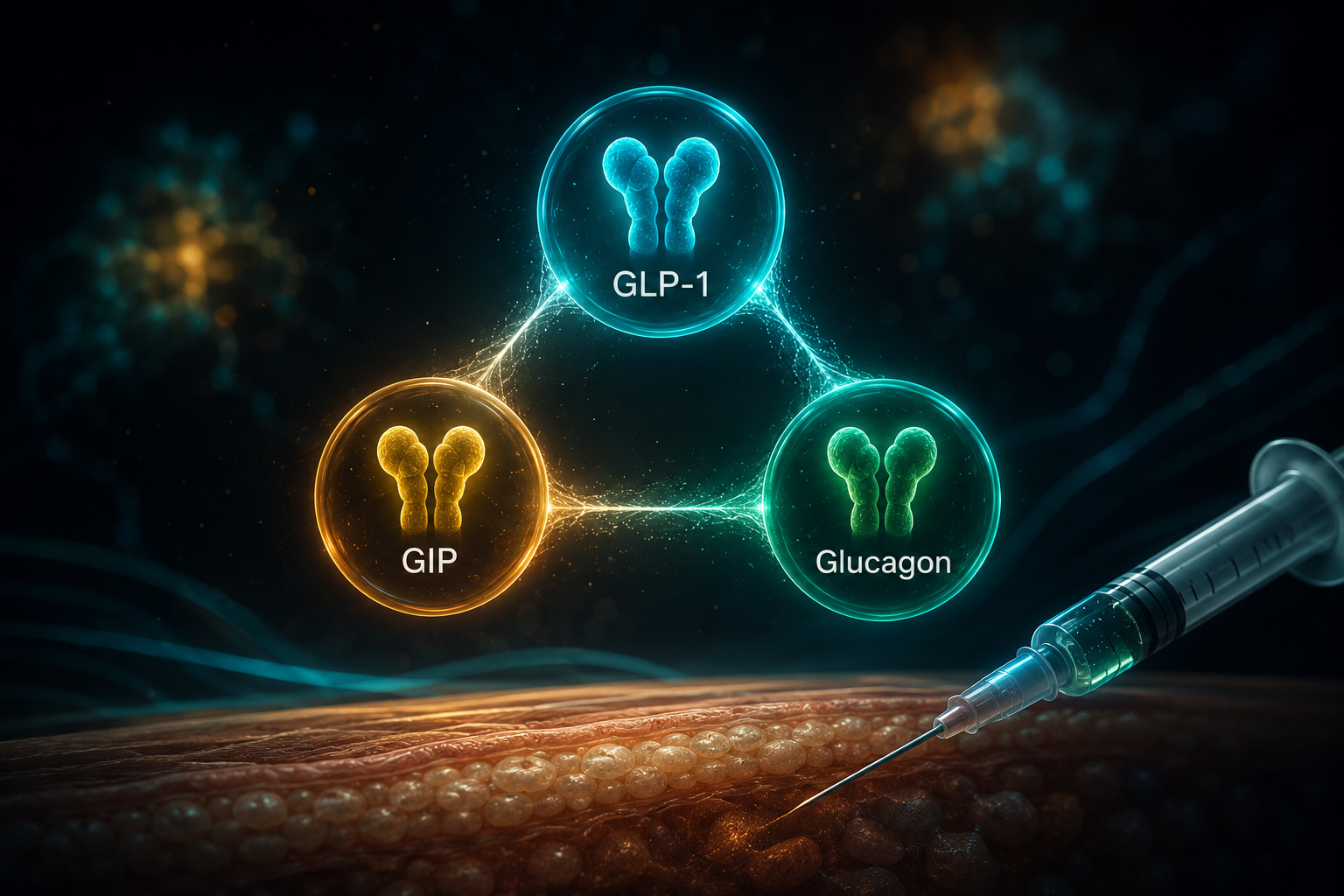
The label "GLP-3" did not originate in a peer-reviewed journal or a regulatory filing. It emerged organically in biohacking communities and research forums as shorthand for retatrutide's triple-receptor mechanism, activating glucagon-like peptide-1 (GLP-1), glucose-dependent insulinotropic polypeptide (GIP), and glucagon receptors simultaneously.

This is a meaningful distinction. GLP-1 and GLP-2 are actual endogenous peptides with defined biological roles. There is no naturally occurring "GLP-3" in human physiology. When researchers or enthusiasts use the term, they are borrowing the naming convention to signal a step beyond dual agonists like tirzepatide, not describing a distinct peptide family.

"GLP-3" functions as a category label born from search behavior, not from biochemistry.

For anyone exploring the newest GLP-1 triple agonist research, recognizing this distinction prevents conflating informal community terminology with peer-reviewed compound classifications. Related resources on GLP-3 and Retatrutide provide further context on how this terminology has evolved in the research space.


Retatrutide: The Compound Behind the Label

Retatrutide is a once-weekly subcutaneous injection developed by Eli Lilly. Its mechanism is what drives the "GLP-3" nickname, by activating three metabolic receptors at once, it amplifies both appetite suppression and energy expenditure beyond what single or dual agonists can achieve.

Clinical trial results have been striking:

  • Phase 2 trials demonstrated a mean body weight reduction of 24.2% at 48 weeks using a 12 mg dose.
  • Phase 3 data from the TRIUMPH program reported up to 28.7% weight loss over approximately 68 weeks.
  • These figures surpass outcomes associated with semaglutide (Ozempic/Wegovy) and tirzepatide (Mounjaro/Zepbound).

Common side effects observed in trials include:

  • Nausea
  • Diarrhea
  • Vomiting
  • Constipation

Discontinuation rates at higher doses ranged from roughly 12-18%, compared to approximately 4% for placebo, a consideration for any research protocol design.

As of 2026, retatrutide remains in Phase 3 trials and has not been approved by the FDA. Eli Lilly is expected to pursue approval pending successful trial completion, possibly by the end of 2026. It currently carries no official brand name.

For researchers interested in how metabolic peptides interact with broader longevity pathways, the longevity peptide research overview offers relevant context. Those examining synergistic mechanisms may also find value in reviewing cagrilintide synergy with GLP-1 as a comparative framework.

Retatrutide: The Compound Behind the Label


Why the Nomenclature Gap Has Real Research Implications

Understanding GLP3 Peptide vs. Retatrutide: Understanding the Nomenclature and Research Implications is not purely academic. The terminology used when sourcing, citing, or designing studies around this compound has downstream consequences.

Three key implications stand out:

  1. Search intent misalignment, Researchers querying "GLP-3 peptide" may encounter products or literature that conflate the informal term with unrelated compounds, creating sourcing errors.
  2. Regulatory blind spots, Because retatrutide has no approved brand name yet, informal labels like "GLP-3" or "Reta" circulate in research communities without the traceability that official nomenclature provides.
  3. Comparative analysis errors, Treating "GLP-3" as equivalent to "triple agonist" as a class, rather than as a nickname for one specific molecule, can skew meta-analyses or literature reviews.

Researchers working with metabolic peptides should cross-reference compound identifiers carefully. Resources covering NAD research and where to buy peptides online illustrate how sourcing decisions intersect with nomenclature clarity in the broader peptide research space.

For those tracking the full pipeline of investigational metabolic compounds, reviewing tesofensine peptide research and MOTS-c mitochondrial research themes provides useful comparative framing for how novel compounds acquire informal labels before formal approval.

Why the Nomenclature Gap Has Real Research Implications


Conclusion

The debate around GLP3 Peptide vs. Retatrutide: Understanding the Nomenclature and Research Implications ultimately comes down to precision. Retatrutide is a well-defined, clinically investigated compound with Phase 3 data supporting extraordinary weight loss outcomes. "GLP-3" is a useful shorthand, but only when both parties in a research conversation understand it as informal nomenclature, not a recognized scientific category.

Actionable next steps for researchers and practitioners:

  • Always use "retatrutide" as the primary identifier in formal documentation, protocols, and sourcing requests.
  • Treat "GLP-3" and "Reta" as search and community terms, helpful for discovery, unreliable for precision.
  • Monitor the TRIUMPH Phase 3 program and FDA submission timelines, as approval could reshape how the compound is officially labeled and referenced.
  • Cross-reference any sourced material against verified compound identifiers to avoid conflation with unrelated peptides.

Clarity in nomenclature is not a minor detail, in peptide research, it is the foundation of reproducible, credible science.

https://www.puretestedpeptides.com/wp-content/uploads/2026/07/glp3-peptide-vs-retatrutide-understanding-the-nomenclature-and-research-implicat.png 1024 1536 Pure Tested https://www.puretestedpeptides.com/wp-content/uploads/2026/01/buy-peptides-online.jpg Pure Tested2026-07-12 13:02:542026-07-20 15:00:16GLP3 Peptide vs. Retatrutide: Understanding the Nomenclature and Research Implications

Peptides vs Polypeptides: Structural Differences, Chain Length, and Why the Distinction Matters in Research

July 9, 2026/0 Comments/by Pure Tested

Cover Image

The difference between a peptide and a polypeptide is not just a matter of naming preference, it directly shapes how researchers design experiments, interpret published data, and source compounds for study. Understanding Peptides vs Polypeptides: Structural Differences, Chain Length, and Why the Distinction Matters in Research is foundational chemistry knowledge that every serious investigator should have locked down before reviewing literature or ordering compounds.

Key Takeaways

  • Peptides are short amino acid chains, typically 2-50 residues; polypeptides contain 51 or more residues.
  • Oligopeptides (fewer than roughly 10 residues) behave differently in solution than longer chains.
  • The naming boundary is not universally fixed, so context and the source authority matter.
  • Structural length drives folding behavior, receptor binding specificity, and synthesis complexity.
  • Misidentifying a compound as a peptide or polypeptide can lead to flawed experimental design.

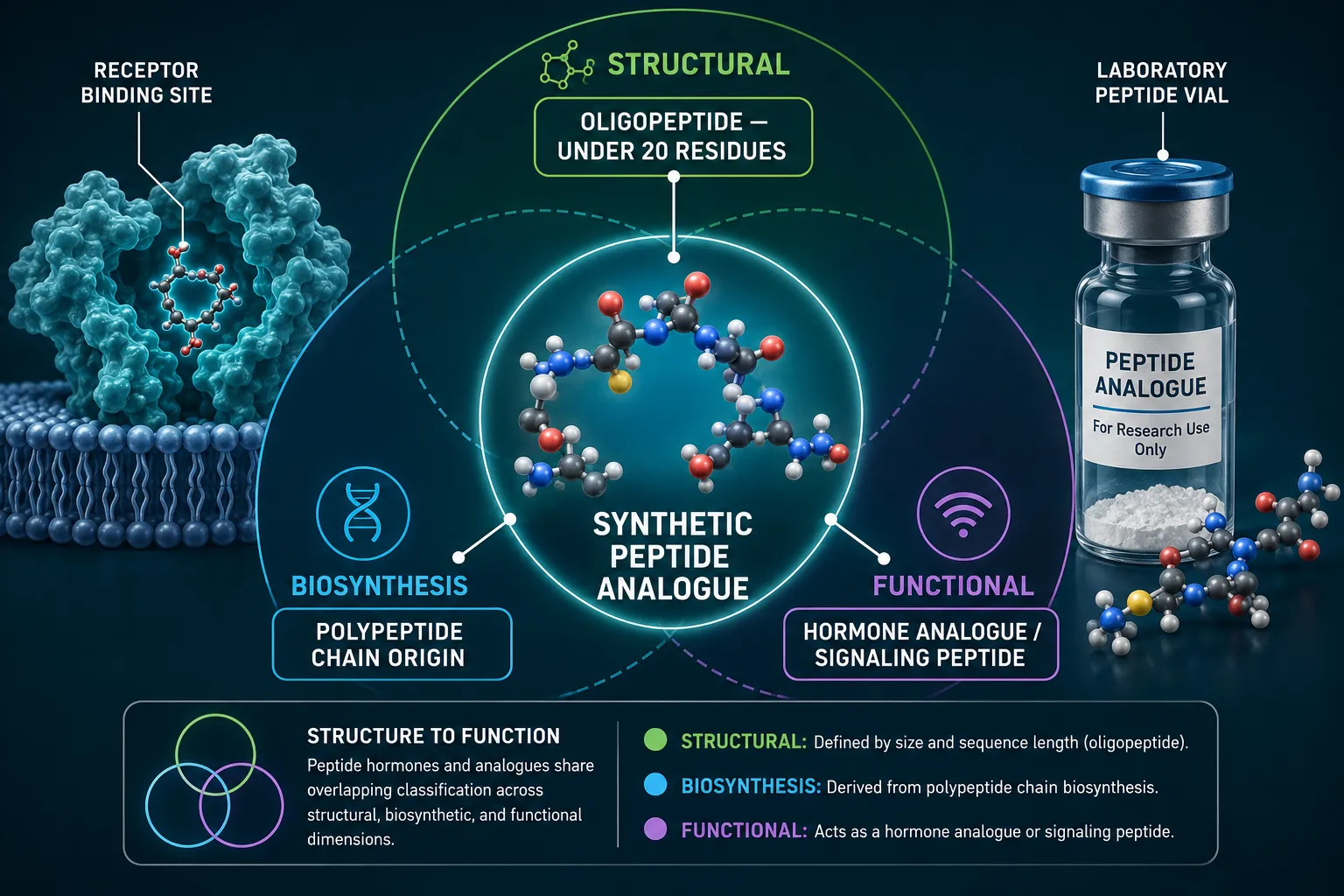
Side-by-side molecular comparison of peptide and polypeptide chain lengths

Defining the Terms: Amino Acids, Peptides, and Polypeptides

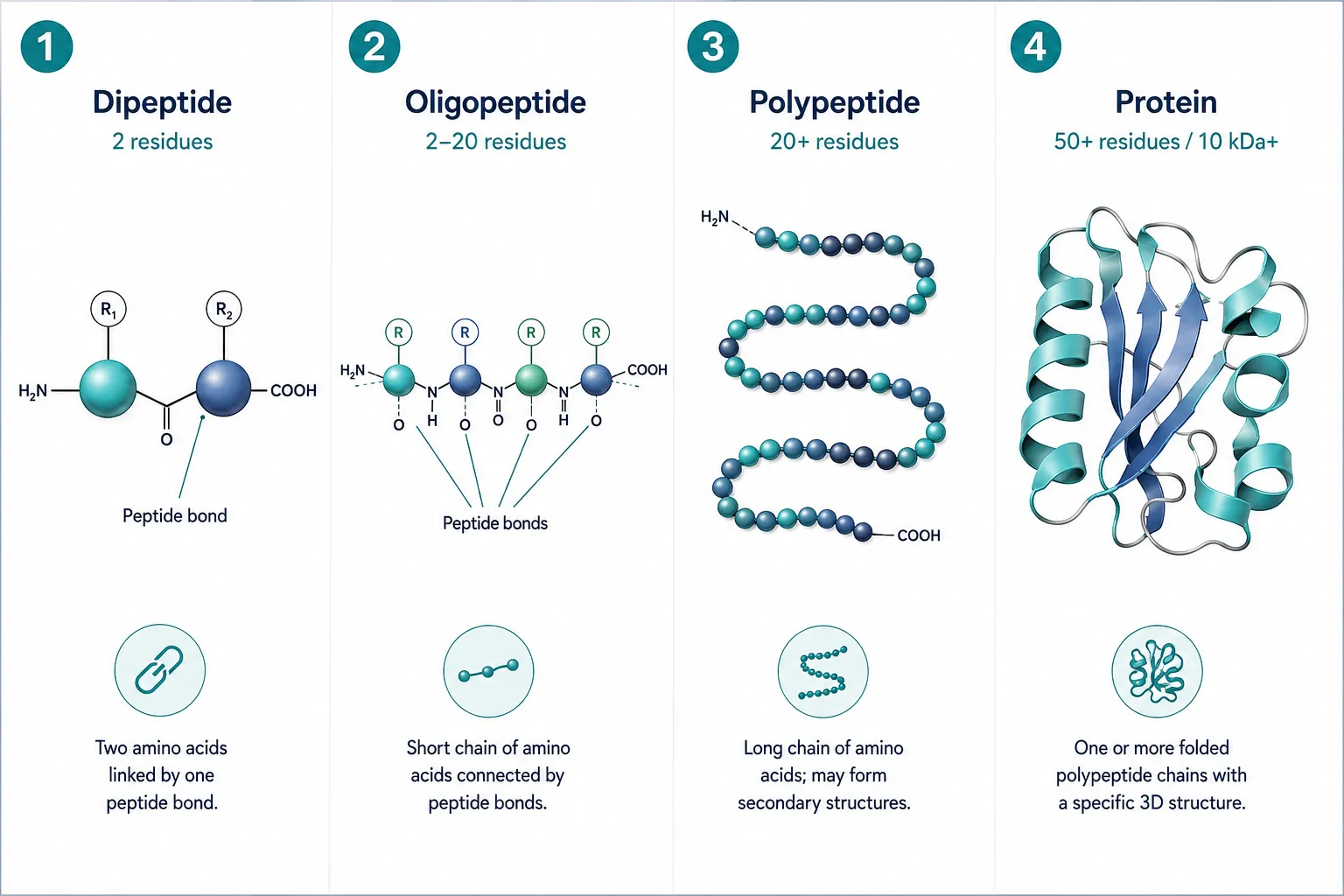
Every protein-based molecule begins with the same building block: an amino acid. When two amino acids join through a peptide bond, a covalent link between the carboxyl group of one and the amino group of another, the result is a dipeptide. Add a third residue and it becomes a tripeptide. This sequential assembly is the foundation of all peptide and polypeptide chemistry.

The NIH Genome.gov genetics glossary uses a widely accepted operational cutoff: a peptide is a chain of 2-50 amino acids, while a polypeptide contains 51 or more. IUPAC guidelines further subdivide the peptide category:

Term Residue Range Typical Behavior
Oligopeptide 2-10 Highly soluble, minimal folding
Peptide 2-50 Moderate folding, receptor-active
Polypeptide 51+ Complex folding, structural roles
Protein 100+ (functional) Tertiary/quaternary structure

It is worth noting that no single governing body has set an absolute, universally enforced cutoff. Some biochemistry texts place the peptide/polypeptide boundary at 100 residues. Researchers should always check which convention the source publication follows before drawing comparisons.


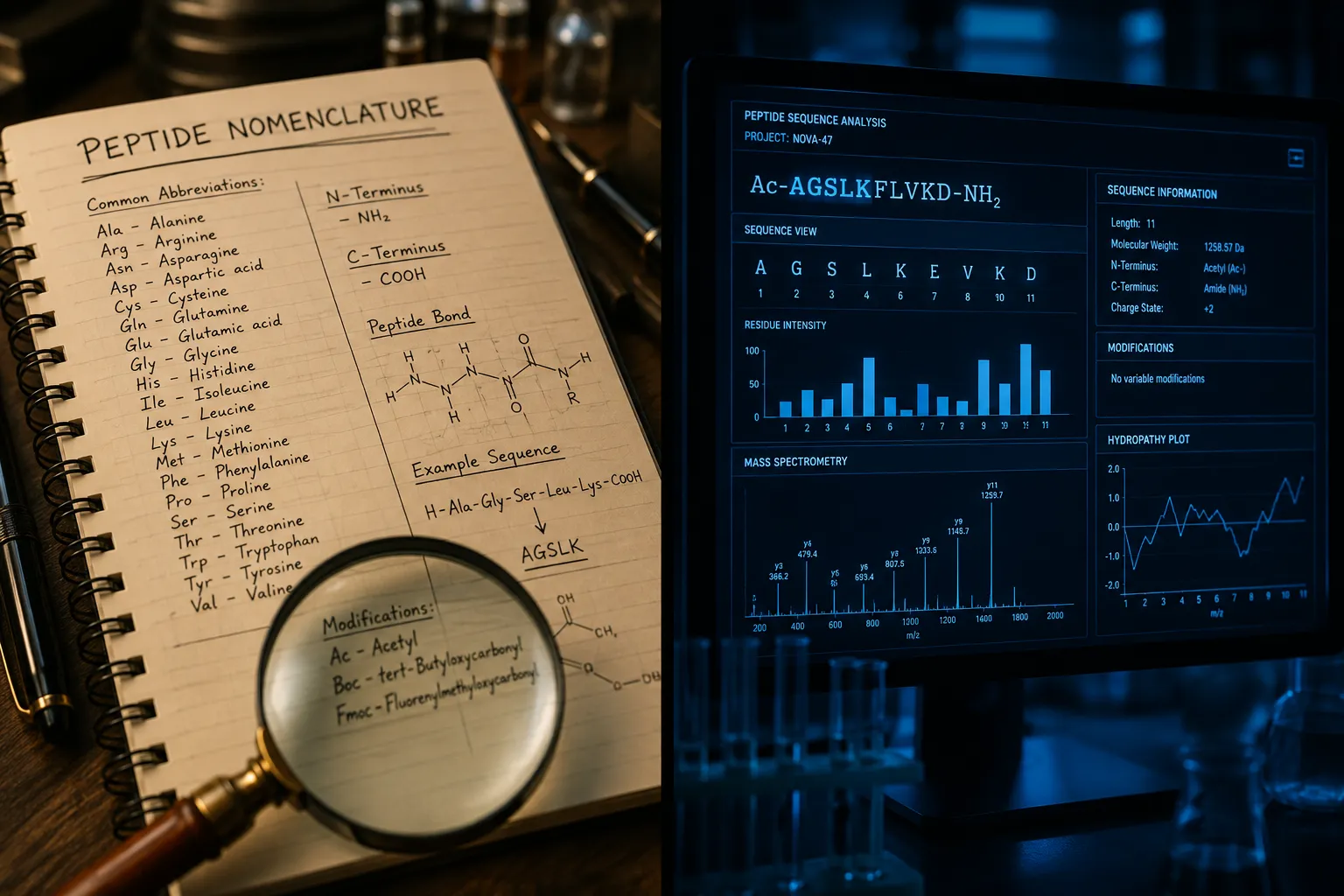
Research laboratory bench with peptide nomenclature journals and molecular models

Structural Differences and Chain Length: What Changes as Residues Increase

Chain length is not just a counting exercise, it governs physical and biological properties in measurable ways.

Short peptides (oligopeptides, 2-10 residues) tend to remain largely unstructured in solution. Their small size allows rapid diffusion and high bioavailability in certain delivery contexts. Compounds like KPV and Selank and Semax fall into this short-chain category and are studied precisely because their compact size enables targeted receptor interactions without the steric bulk of larger molecules.

Medium peptides (10-50 residues) begin to adopt partial secondary structures, alpha helices or beta sheets, that influence receptor binding geometry. Many growth hormone secretagogues, including those explored in CJC-1295 research, sit in this range. The GHK-Cu peptide is a well-known tripeptide-copper complex studied for tissue remodeling applications.

Polypeptides (51+ residues) fold into defined three-dimensional conformations. This folding is driven by hydrophobic interactions, hydrogen bonds, and disulfide bridges. The resulting shape is what determines enzyme activity, structural support, or hormonal signaling. Somatotropin (growth hormone), for example, is a polypeptide of approximately 191 residues, a useful reference point discussed in resources on what somatotropin is.

Key insight: A polypeptide is not simply a "bigger peptide." Its folded architecture creates functional properties that short peptides cannot replicate, and vice versa.


Why the Distinction Matters in Research

Researcher examining peptide compound with polypeptide structural model on screen

Conflating peptides with polypeptides introduces real errors at multiple stages of a research workflow.

Literature interpretation: A paper reporting results for a "peptide" using a 120-residue compound is using the term loosely. Recognizing this prevents researchers from applying those findings to short-chain analogs without proper justification.

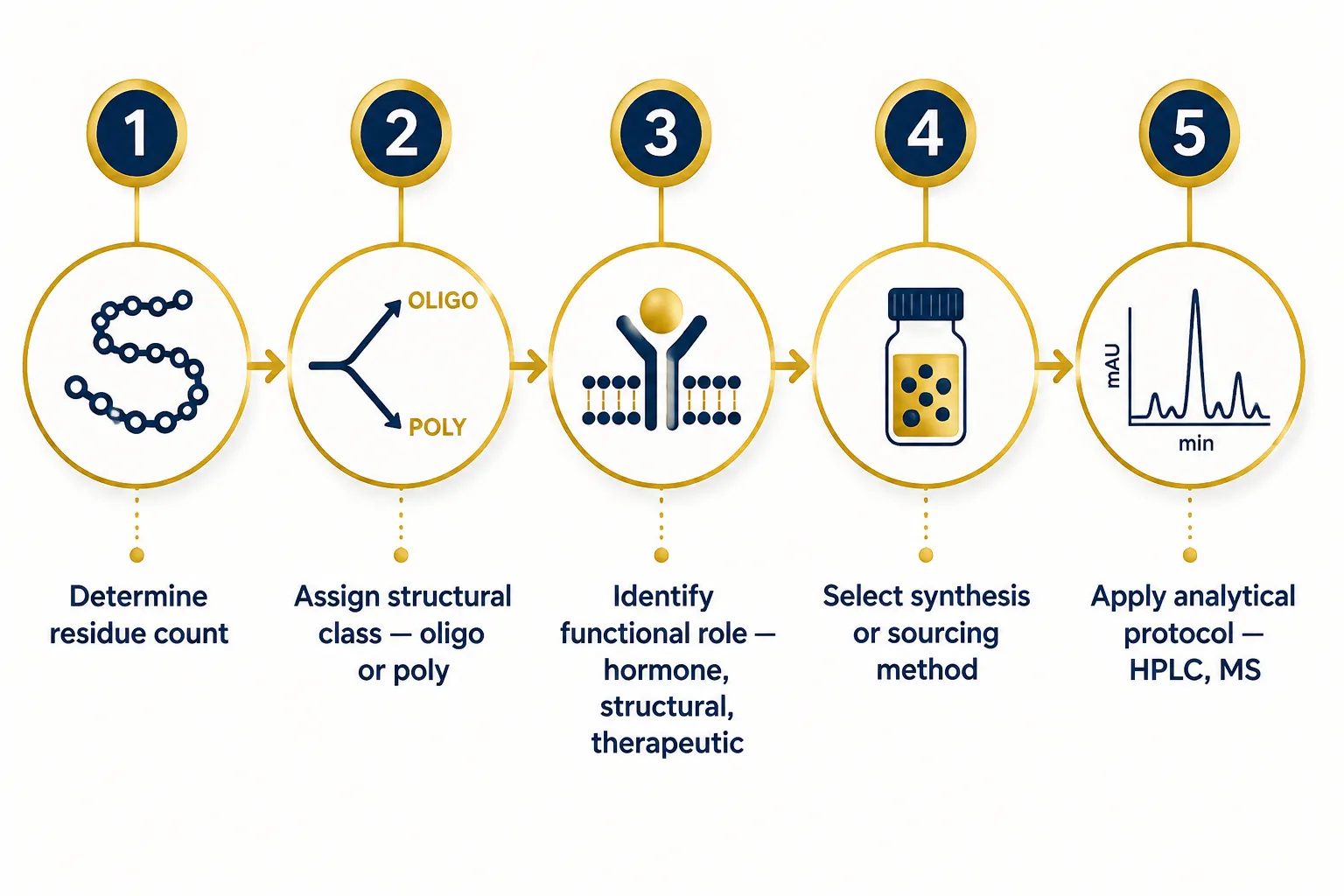
Synthesis and sourcing: Short peptides are synthesized via solid-phase peptide synthesis (SPPS), a well-standardized process. Polypeptides often require recombinant expression systems. Understanding this distinction helps researchers evaluate supplier credibility. Reviewing peptide supplier comparisons and understanding reference standards becomes far more meaningful when the researcher understands what chain length implies about production complexity.

Stability and storage: Shorter peptides are generally more stable under standard lyophilized storage conditions. Polypeptides are more susceptible to aggregation and denaturation. This has direct implications for lab-tested peptide procurement and handling protocols.

Regulatory and ethical framing: In research contexts, compounds are often categorized differently based on molecular weight and chain length. Knowing whether a compound is technically a peptide or polypeptide affects how it is classified in study documentation.

For researchers exploring the broader landscape of chain-length-specific compounds, the complete peptides for sale catalog offers a useful reference for understanding how different molecules are positioned in active research programs.


Conclusion

The distinction between peptides and polypeptides is not academic hairsplitting. Chain length drives folding behavior, synthesis method, receptor specificity, storage requirements, and how results should be interpreted across studies. The most reliable operational boundary, 2-50 residues for peptides, 51 or more for polypeptides, provides a working framework, but researchers must always verify which convention a given publication applies.

Actionable next steps:

  • Before citing a study, confirm the chain length of the compound used and verify the author's definition of "peptide" versus "polypeptide."
  • When sourcing compounds, request certificates of analysis that specify molecular weight and sequence length.
  • Cross-reference supplier claims against established reference standards to ensure compound identity.
  • Use chain length as a first filter when evaluating whether findings from one compound class can be extrapolated to another.

Building this foundational clarity will sharpen experimental design, reduce misinterpretation of published data, and strengthen the overall quality of peptide research in 2026 and beyond.

https://www.puretestedpeptides.com/wp-content/uploads/2026/01/buy-peptides-online.jpg 0 0 Pure Tested https://www.puretestedpeptides.com/wp-content/uploads/2026/01/buy-peptides-online.jpg Pure Tested2026-07-09 13:18:122026-07-20 15:00:32Peptides vs Polypeptides: Structural Differences, Chain Length, and Why the Distinction Matters in Research

Peptides vs Polypeptides: Structural Differences, Chain Length, and Why the Distinction Matters in Research

July 9, 2026/0 Comments/by Pure Tested

Cover Image

The difference between a peptide and a polypeptide is not just a matter of naming preference, it directly shapes how researchers design experiments, interpret published data, and source compounds for study. Understanding Peptides vs Polypeptides: Structural Differences, Chain Length, and Why the Distinction Matters in Research is foundational chemistry knowledge that every serious investigator should have locked down before reviewing literature or ordering compounds.

Key Takeaways

  • Peptides are short amino acid chains, typically 2-50 residues; polypeptides contain 51 or more residues.
  • Oligopeptides (fewer than roughly 10 residues) behave differently in solution than longer chains.
  • The naming boundary is not universally fixed, so context and the source authority matter.
  • Structural length drives folding behavior, receptor binding specificity, and synthesis complexity.
  • Misidentifying a compound as a peptide or polypeptide can lead to flawed experimental design.

Side-by-side molecular comparison of peptide and polypeptide chain lengths

Defining the Terms: Amino Acids, Peptides, and Polypeptides

Every protein-based molecule begins with the same building block: an amino acid. When two amino acids join through a peptide bond, a covalent link between the carboxyl group of one and the amino group of another, the result is a dipeptide. Add a third residue and it becomes a tripeptide. This sequential assembly is the foundation of all peptide and polypeptide chemistry.

The NIH Genome.gov genetics glossary uses a widely accepted operational cutoff: a peptide is a chain of 2-50 amino acids, while a polypeptide contains 51 or more. IUPAC guidelines further subdivide the peptide category:

Term Residue Range Typical Behavior
Oligopeptide 2-10 Highly soluble, minimal folding
Peptide 2-50 Moderate folding, receptor-active
Polypeptide 51+ Complex folding, structural roles
Protein 100+ (functional) Tertiary/quaternary structure

It is worth noting that no single governing body has set an absolute, universally enforced cutoff. Some biochemistry texts place the peptide/polypeptide boundary at 100 residues. Researchers should always check which convention the source publication follows before drawing comparisons.


Research laboratory bench with peptide nomenclature journals and molecular models

Structural Differences and Chain Length: What Changes as Residues Increase

Chain length is not just a counting exercise, it governs physical and biological properties in measurable ways.

Short peptides (oligopeptides, 2-10 residues) tend to remain largely unstructured in solution. Their small size allows rapid diffusion and high bioavailability in certain delivery contexts. Compounds like KPV and Selank and Semax fall into this short-chain category and are studied precisely because their compact size enables targeted receptor interactions without the steric bulk of larger molecules.

Medium peptides (10-50 residues) begin to adopt partial secondary structures, alpha helices or beta sheets, that influence receptor binding geometry. Many growth hormone secretagogues, including those explored in CJC-1295 research, sit in this range. The GHK-Cu peptide is a well-known tripeptide-copper complex studied for tissue remodeling applications.

Polypeptides (51+ residues) fold into defined three-dimensional conformations. This folding is driven by hydrophobic interactions, hydrogen bonds, and disulfide bridges. The resulting shape is what determines enzyme activity, structural support, or hormonal signaling. Somatotropin (growth hormone), for example, is a polypeptide of approximately 191 residues, a useful reference point discussed in resources on what somatotropin is.

Key insight: A polypeptide is not simply a "bigger peptide." Its folded architecture creates functional properties that short peptides cannot replicate, and vice versa.


Why the Distinction Matters in Research

Researcher examining peptide compound with polypeptide structural model on screen

Conflating peptides with polypeptides introduces real errors at multiple stages of a research workflow.

Literature interpretation: A paper reporting results for a "peptide" using a 120-residue compound is using the term loosely. Recognizing this prevents researchers from applying those findings to short-chain analogs without proper justification.

Synthesis and sourcing: Short peptides are synthesized via solid-phase peptide synthesis (SPPS), a well-standardized process. Polypeptides often require recombinant expression systems. Understanding this distinction helps researchers evaluate supplier credibility. Reviewing peptide supplier comparisons and understanding reference standards becomes far more meaningful when the researcher understands what chain length implies about production complexity.

Stability and storage: Shorter peptides are generally more stable under standard lyophilized storage conditions. Polypeptides are more susceptible to aggregation and denaturation. This has direct implications for lab-tested peptide procurement and handling protocols.

Regulatory and ethical framing: In research contexts, compounds are often categorized differently based on molecular weight and chain length. Knowing whether a compound is technically a peptide or polypeptide affects how it is classified in study documentation.

For researchers exploring the broader landscape of chain-length-specific compounds, the complete peptides for sale catalog offers a useful reference for understanding how different molecules are positioned in active research programs.


Conclusion

The distinction between peptides and polypeptides is not academic hairsplitting. Chain length drives folding behavior, synthesis method, receptor specificity, storage requirements, and how results should be interpreted across studies. The most reliable operational boundary, 2-50 residues for peptides, 51 or more for polypeptides, provides a working framework, but researchers must always verify which convention a given publication applies.

Actionable next steps:

  • Before citing a study, confirm the chain length of the compound used and verify the author's definition of "peptide" versus "polypeptide."
  • When sourcing compounds, request certificates of analysis that specify molecular weight and sequence length.
  • Cross-reference supplier claims against established reference standards to ensure compound identity.
  • Use chain length as a first filter when evaluating whether findings from one compound class can be extrapolated to another.

Building this foundational clarity will sharpen experimental design, reduce misinterpretation of published data, and strengthen the overall quality of peptide research in 2026 and beyond.

https://www.puretestedpeptides.com/wp-content/uploads/2026/01/buy-peptides-online.jpg 0 0 Pure Tested https://www.puretestedpeptides.com/wp-content/uploads/2026/01/buy-peptides-online.jpg Pure Tested2026-07-09 13:18:102026-07-20 15:00:33Peptides vs Polypeptides: Structural Differences, Chain Length, and Why the Distinction Matters in Research
×

Helpful Links

  • My account
  • Cart
  • Checkout
  • Refund and Returns Policy
  • Privacy Policy
  • SMS Privacy Policy
  • Login
  • My Account
  • Logout

USA Made Lab Tested Peptides

All products are sold for research, laboratory, or analytical purposes only, and are not for human consumption


Pure Tested Peptides is a chemical supplier. Pure Tested Peptides is not a compounding / chemical compounding facility as defined under 503A of the Federal Food, Drug, and Cosmetic act. Pure Tested Peptides is not an outsourcing facility as defined under 503B of the Federal Food, Drug, and Cosmetic act.

The statements made within this website have not been evaluated by the US Food and Drug Administration. The products we offer are not intended to diagnose, treat, cure or prevent any disease.

Human/Animal Consumption Prohibited. Laboratory/In-Vitro Experimental Use Only

Scroll to top Scroll to top Scroll to top