Call or Text 727-513-9780
  • Shopping Cart Shopping Cart
    0Shopping Cart
Pure Tested Peptides | America's most trusted Peptides for sale online
  • Peptides for sale
    • Oral Peptides for sale
      • Peptide Capsules for sale
      • BPC 157 Capsules 1000mcg
      • SLU-PP-332 Capsules | 1000 mcg
      • 5-Amino-1MQ 50mg Capsules
      • Tesofensine 500mcg
    • All Peptides for sale
    • Peptide Sprays
      • BPC 157 Nasal Spray Kit
      • BPC-157 TB500 Nasal Spray Kit
      • Semax Nasal Spray 10mg
      • Selank – Nasal Spray Kit – 10mg
      • Epithalon 50MG Nasal Spray Kit
      • Ipamorelin 10mg Nasal Spray
      • Klow Nasal Spray (BPC-157 + TB-500 + GHK-Cu + KPV) | 80mg
      • Hulk Nasal Spray Tesa / Ipa Blend 6/3 MG
      • Klow Nasal Spray
      • NAD + 500 mg Nasal Spray
      • PT-141 Nasal Spray Kit
    • GHRH Peptides
      • Ipa Peptides
      • CJC-1295 Peptides
        • CJC-1295 with DAC 5 mg
        • CJC-1295 without DAC 5 mg
        • CJC-1295 Ipa 10mg
      • Tesa Peptides
        • Tesa Peptide
        • Tesa 20 mg
    • GHK-Cu Peptides
      • All GHK-Cu Peptides
      • GHK-Cu 100mg
      • KLOW Peptide Blend – Buy KLOW blend online
    • BPC Peptides
      • All BPC Peptides
      • BPC-157
      • BPC-157 TB-500
      • BPC 157 capsules 1000mcg
    • SLU-PP-332 Peptides
      • All SLU-PP-332 Peptides
      • SLU-PP-332 5mg
    • GLP3 Peptides
    • PT-141 Peptides
      • PT-141 Peptides for sale
      • PT-141 10mg
      • PT-141 Nasal Spray
    • CAG Peptides
      • Lipo-C Peptide Blend
      • CAG 5mg
      • CAG 10mg
    • MOTS-C Peptides
      • MOTS-C Peptides for sale
      • MOTS-c peptide
      • MOTS-c 10mg *6 pack*
    • 5 Amino 1MQ Peptides
      • 5 Amino 1MQ Peptides for sale
      • 5-Amino-1MQ 50mg Capsules
      • 5-Amino-1MQ 5mg
    • Epithalon Peptides
      • Epithalon Peptides for sale
      • Epithalon 10mg
      • Epithalon 50mg
  • Shop
    • GLPs
      • 5-Amino-1MQ 50mg Capsules
      • 5-Amino-1MQ 5mg
      • L-Carnitine 500mg/ml
      • Tesofensine 500mcg
      • SLU-PP-332 5mg
      • MOTS-c 10mg *6 pack*
    • Epithalon & BPC Peptides
      • Epithalon 10mg
      • Epithalon 50mg
      • BPC-157
      • BPC 157 capsules 1000mcg
      • BPC-157 TB-500
      • BPC-157 TB500 Nasal Spray Kit
      • BPC 157 Nasal Spray Kit
    • BPC TB-500 & NAD+ Peptides
      • NAD+ 500 mg
      • KLOW Peptide Blend – Buy KLOW blend online
      • GLOW Peptide Blend
      • TB 500 5mg
      • BPC 157 capsules 1000mcg – Supplement
      • BPC 157 Nasal Spray Kit
      • BPC-157
      • BPC-157 TB500 Nasal Spray Kit
      • BPC-157 TB-500
      • BPC 157 capsules 1000mcg
    • LL-37 Peptide
      • LL-37 10 mg
    • MOTS-C & Selank
      • MOTS-c peptide
      • Selank 10mg
    • GHK Peptides
      • GHK-Cu 100mg
      • GLOW Peptide Blend
      • KLOW Peptide Blend – Buy KLOW blend online
  • COAs
  • Wholesale
    • Wholesale Peptides for sale
  • PTP FAQ
  • Affiliates
    • Selank Peptide: Advanced Pharmacological Mechanisms Underlying Its Anxiolytic and Nootropic Effects in Research
      • 5-Amino-1MQ Peptide: Detailed Mechanisms of NNMT Inhibition and Its Impact on Cellular Metabolism Research
        • MOTS-C Peptide: Unraveling Its Role in Mitochondrial Dynamics and Energy Metabolism Research
          • Epithalon Peptide and Telomerase Regulation: Investigating Its Impact on Cellular Senescence and Lifespan Research Models
            • GLP2-T vs GLP2 Tirz Peptide: Understanding the Naming, Mechanistic Nuances, and Research Implications for Gut Health
      • Peptides and Polypeptides in Modern Pharmacology: What Research on Metoprolol, Prednisone, and Amlodipine Reveals
        • Polypeptide Peptides vs NSAIDs: What Naproxen and Diclofenac Teach Tissue-Repair Researchers About BPC‑157 and TB‑500
          • Peptides and Polypeptides in Endocrine Pharmacology: How GLP-1, GLP-2, and GLP-3 Retatrutide Differ From Classic Drugs Like Prednisone and Amlodipine
          • 5‑Amino‑1MQ Peptide and NNMT Inhibition: How It Compares With Statins Like Atorvastatin in Adipose and Lipid Metabolism Research
      • Enclomiphene, Estrogen Receptor Signaling, and Luteinizing Phase Biology: What Hormone Researchers Should Measure
        • Mesenchymal Stem Cells, BPC‑157, and GHK‑Cu: How Tissue Repair Peptides Compare With Classic NSAIDs Like Naproxen in Injury Models
          • Peptide Calculator Use Cases Beyond Growth Hormone: Working Through GLP‑3 Retatrutide, MOTS‑c, and BPC‑157 Research Dosing
        • Polypeptide Peptides in Endocrine and Metabolic Pharmacology: Lessons From Amlodipine, Prednisone, and Metoprolol
        • Peptides Calculator for Advanced Blends: Worked Examples for Tesamorelin, CJC‑1295, and Ipamorelin Stacks
          • Peptides and Polypeptides in Human Physiology: How Molecular Size Shapes Research Applications
            • Selank Peptide: Advanced Pharmacological Mechanisms Underlying Its Anxiolytic and Nootropic Effects in Research
          • 5-Amino-1MQ Peptide: Detailed Mechanisms of NNMT Inhibition and Its Impact on Cellular Metabolism Research
            • MOTS-C Peptide: Unraveling Its Role in Mitochondrial Dynamics and Energy Metabolism Research
              • Epithalon Peptide and Telomerase Regulation: Investigating Its Impact on Cellular Senescence and Lifespan Research Models
                • GLP2-T vs GLP2 Tirz Peptide: Understanding the Naming, Mechanistic Nuances, and Research Implications for Gut Health
                  • Peptides and Polypeptides in Endocrine Pharmacology: How GLP-1, GLP-2, and GLP-3 Retatrutide Differ From Classic Drugs Like Prednisone and Amlodipine
                    • Polypeptide Peptides vs NSAIDs: What Naproxen and Diclofenac Teach Tissue-Repair Researchers About BPC‑157 and TB‑500
                      • Peptides and Polypeptides in Modern Pharmacology: What Research on Metoprolol, Prednisone, and Amlodipine Reveals
                        • 5‑Amino‑1MQ Peptide and NNMT Inhibition: How It Compares With Statins Like Atorvastatin in Adipose and Lipid Metabolism Research
                        • Enclomiphene, Estrogen Receptor Signaling, and Luteinizing Phase Biology: What Hormone Researchers Should Measure
                        • Mesenchymal Stem Cells, BPC‑157, and GHK‑Cu: How Tissue Repair Peptides Compare With Classic NSAIDs Like Naproxen in Injury Models
                        • Peptide Calculator Use Cases Beyond Growth Hormone: Working Through GLP‑3 Retatrutide, MOTS‑c, and BPC‑157 Research Dosing
                        • Polypeptide Peptides in Endocrine and Metabolic Pharmacology: Lessons From Amlodipine, Prednisone, and Metoprolol
                        • Peptides Calculator for Advanced Blends: Worked Examples for Tesamorelin, CJC‑1295, and Ipamorelin Stacks
                        • Peptides and Polypeptides in Human Physiology: How Molecular Size Shapes Research Applications
                        • Selank Peptide: Advanced Pharmacological Mechanisms Underlying Its Anxiolytic and Nootropic Effects in Research
                        • MOTS-C Peptide: Unraveling Its Role in Mitochondrial Dynamics and Energy Metabolism Research
                        • Peptides and Polypeptides in Modern Pharmacology: What Research on Metoprolol, Prednisone, and Amlodipine Reveals
                        • Peptides and Polypeptides in Endocrine Pharmacology: How GLP-1, GLP-2, and GLP-3 Retatrutide Differ From Classic Drugs Like Prednisone and Amlodipine
                        • 5-Amino-1MQ Peptide: Detailed Mechanisms of NNMT Inhibition and Its Impact on Cellular Metabolism Research
                        • Mesenchymal Stem Cells, BPC‑157, and GHK‑Cu: How Tissue Repair Peptides Compare With Classic NSAIDs Like Naproxen in Injury Models
                        • Peptide Calculator Use Cases Beyond Growth Hormone: Working Through GLP‑3 Retatrutide, MOTS‑c, and BPC‑157 Research Dosing
                        • GLP2-T vs GLP2 Tirz Peptide: Understanding the Naming, Mechanistic Nuances, and Research Implications for Gut Health
                        • Polypeptide Peptides in Endocrine and Metabolic Pharmacology: Lessons From Amlodipine, Prednisone, and Metoprolol
                        • Polypeptide Peptides vs NSAIDs: What Naproxen and Diclofenac Teach Tissue-Repair Researchers About BPC‑157 and TB‑500
                        • Peptides and Polypeptides in Human Physiology: How Molecular Size Shapes Research Applications
                        • Peptides Calculator for Advanced Blends: Worked Examples for Tesamorelin, CJC‑1295, and Ipamorelin Stacks
                        • 5‑Amino‑1MQ Peptide and NNMT Inhibition: How It Compares With Statins Like Atorvastatin in Adipose and Lipid Metabolism Research
                        • Enclomiphene, Estrogen Receptor Signaling, and Luteinizing Phase Biology: What Hormone Researchers Should Measure
                        • Epithalon Peptide and Telomerase Regulation: Investigating Its Impact on Cellular Senescence and Lifespan Research Models
                        • Best research protocol Klow blend
                        • best time to take BPC-157
                        • best time to take DSIP (Delta Sleep Inducing Peptide)
                        • best time to take CJC-1295
                        • best time to take AOD-9604
                        • best time to take Follistatin 344
                        • best time to take Ipamorelin
                        • best time to take MK-677 (Ibutamoren)
                        • best time to take Ligandrol (LGD-4033) — research compound
                        • best time to take Ostarine (MK-2866) — research compound
                        • best time to take GHK-CU
                        • best time to take TB-500
                        • best time to take MOTS-c
                        • best time to take Semax
                        • best time to take RAD-140 (Testolone) — research compound
                        • best time to take Thymosin Alpha-1
                        • best time to take PEG-MGF
                        • Biolife Plasma, Octapharma Plasma, and Research Peptides: How Plasma Donation Labs Differ From Peptide Suppliers
                        • best time to take YK-11 — research compound
                        • best time to take PT-141 (Bremelanotide)
                        • Best research protocol Klow blend
                        • 5-Amino-1MQ and MOTS-C Synergy: Metabolic Signaling, Mitochondria, and Research Design
                        • BPC-157 and TB-500: Investigating Their Combined Effects on Angiogenesis and Cellular Migration in Tissue Repair Models
                        • BPC-157 Peptide: Gut Barrier Function, Inflammation, and Tissue-Recovery Research
                        • 5‑Amino‑1MQ and MOTS‑c Synergy in Metabolic Research: Designing NNMT and Mitochondrial Biogenesis Stacks
                        • CJC-1295 with DAC vs. Without DAC: Half-Life, Release Kinetics, and Research Implications
                        • CJC‑1295 with DAC vs. Without DAC: Expanding on Half‑Life Differences Using Tesamorelin and Ipamorelin Blend Case Studies
                        • Collagen Biology and Copper‑Binding Peptides: How GHK‑Cu, Glow Blend, and Klow Blend Interact with Skin and Connective Tissue
                        • Collagen Biology and Regenerative Peptides: How GHK‑Cu, Glow Blend, and Klow Blend Affect Extracellular Matrix Research
                    • DNA, Telomeres, and Longevity Peptides: Positioning Epithalon and MOTS‑c in Genetic Aging Research
                      • Enclomiphene Citrate: serm Mechanism, Testosterone Research, and Stack Compatibility
                        • Enclomiphene vs Enclomiphene Citrate: Formulation, Bioavailability, and Research Distinctions
                        • Epithalon Peptide Research: Telomerase Activation, Aging, and Pineal Gland Function
                        • Estrogen Receptor Signaling and Enclomiphene: How Selective Modulators Compare with Classic Polypeptide Hormones
                        • GHK-Cu Peptide: Advanced Mechanisms in Extracellular Matrix Remodeling and Wound Healing Research
                        • GHK-Cu Peptide: Collagen Synthesis, Wound Repair, and Skin-Barrier Research Models
                        • GLP-1 vs GLP-3 vs GLP-2: Peptide Classification and Research Applications
                        • GLP-2 Peptide Research Guide: Gut Barrier Function, Nutrient Absorption, and Intestinal Recovery Models
                        • GLP-3 Retatrutide vs. GLP-1 Drugs: What Triple-Agonist Biology Changes in Research Models
                        • Ipamorelin and Tesamorelin Combination: Synergistic GH Secretagogue Research and Dosing Protocols
                        • GLP2 Tirz Peptide: What It Is, Why the Name Exists, and How Researchers Should Interpret It
                        • Klow Blend Peptide Nasal Spray: What the Formulation Is Trying to Do in Cognitive Research
                        • Mitochondria, NNMT Inhibition, and Peptide Modulators: Where MOTS‑c and 5‑Amino‑1MQ Fit in Cellular Energy Research
                        • MOTS-c Peptide: Mitochondrial Function, Energy Metabolism, and What Researchers Measure
                        • MOTS-c vs. 5-Amino-1MQ: Which Metabolic Research Questions Each Compound Actually Answers
                        • Nasal Spray Peptides: Bioavailability, Administration, and Semax/Selank Research Applications
                        • PT-141 Peptide Research: Mechanism of Action and Melanocortin Receptor Signaling
                        • Retatrutide for Research: Mechanism, Structure, and GLP-1/GLP-3 Dual Action
                        • Retatrutide for Obesity and Type 2 Diabetes: What the Latest Trial Data Suggest
                        • Tesofensine Peptide Research: Mechanism, Appetite Suppression, and Neuropeptide Y Pathways
  • Contact
    • Contact Customer Service
    • Text Customer Support
  • About US
  • Shop all peptides
  • Affiliate Program
    • Affiliate Signup
  • Login / Register Login / Register Page Link Login / Register Page Link
  • Click to open the search input field Click to open the search input field Search
  • Menu Menu

Tag Archive for: hyperkalemia

Spironolactone and GLP or Growth-Hormone Peptide Models: A Practical Aldosterone, Potassium, and Fluid-Status Framework

Spironolactone and GLP or Growth-Hormone Peptide Models: A Practical Aldosterone, Potassium, and Fluid-Status Framework

October 25, 2026/0 Comments/in Uncategorized/by

{"cover":"Professional landscape format (1536×1024) hero image with bold text overlay 'Spironolactone and GLP or Growth-Hormone' in crisp white sans-serif on a deep navy semi-transparent overlay panel, centered with 8% safe margins, two balanced lines, no character near any edge. Background: clean editorial medical illustration showing kidney cross-section with aldosterone signaling arrows, potassium ion symbols, and molecular structure silhouettes in teal and gold on a dark navy field. Magazine-quality medical editorial aesthetic, high contrast, pharmaceutical research tone.","content":["Annotated mechanism-of-action diagram, landscape format (1536×1024), showing the mineralocorticoid receptor pathway in the distal convoluted tubule: four labeled stages left to right, 'Aldosterone Binds Receptor', 'Spironolactone Blocks Site', 'Sodium Excretion Rises', 'Potassium Retained', with thin callout arrows pointing to each stage, illustrated cross-section of renal tubule cells in center, teal-and-white palette on a light gray background, clean medical editorial style, no pricing or checkmarks.","Three-panel labeled comparison guide, landscape format (1536×1024), comparing potassium monitoring timelines: Panel 1 labeled 'Week 1 Check' showing a blood draw vial icon with '5.0 mmol/L threshold' callout; Panel 2 labeled 'Monthly x3 Months' with a calendar icon and 'Creatinine + K+' callout; Panel 3 labeled 'Quarterly Then 6-Monthly' with a line graph icon and 'Renin Target' callout. Navy, teal, and amber palette on white background, clinical infographic style, bold panel headings, short bullet labels only.","Split-screen editorial illustration, landscape format (1536×1024): left half shows a GLP-1 receptor agonist pathway diagram with labeled nodes, 'Incretin Effect', 'Plasma Volume Drop', 'NT-proBNP Reduction', 'Weight Loss', connected by flow arrows in green and slate; right half shows a spironolactone aldosterone-blockade pathway with labeled nodes, 'MRA Blockade', 'Fluid Offloading', 'BP Normalization', 'K+ Rise Risk', in teal and navy. Center dividing line with label 'Integrated Cardiometabolic Framework'. Clean white background, bold callout lines, medical editorial polish.","Numbered step-by-step process flow diagram, landscape format (1536×1024), showing five horizontal stages of a combined spironolactone plus GLP-peptide monitoring protocol: Step 1 'Baseline Labs: K+, eGFR, Renin, Aldo'; Step 2 'Start or Titrate Spiro'; Step 3 'Day 3-5: Adjust K+ Supplements'; Step 4 'Week 1: Recheck K+ and Creatinine'; Step 5 'Month 2-3: Reassess Renin, NT-proBNP'. Each step in a rounded card, connected by bold directional arrows, teal-to-navy gradient across cards, amber warning badge on Step 4, clean sans-serif labels, white background, clinical protocol aesthetic."]
Professional landscape hero image () with a reading "Spironolactone and GLP or Growth-Hormone". CRITICAL TYPOGRAPHY RULES:

Fewer drugs in clinical medicine carry as many overlapping metabolic consequences as spironolactone, a potassium-sparing diuretic that simultaneously lowers blood pressure, reshapes fluid distribution, and alters how every co-administered agent affects renal electrolyte handling. As research into GLP-1 receptor agonists and growth-hormone peptides expands into cardiometabolic territory, the intersection with mineralocorticoid receptor antagonism (MRA) has become impossible to ignore. Understanding the Spironolactone and GLP or Growth-Hormone Peptide Models: A Practical Aldosterone, Potassium, and Fluid-Status Framework is increasingly essential for clinicians and researchers navigating this overlapping landscape.

Key Takeaways

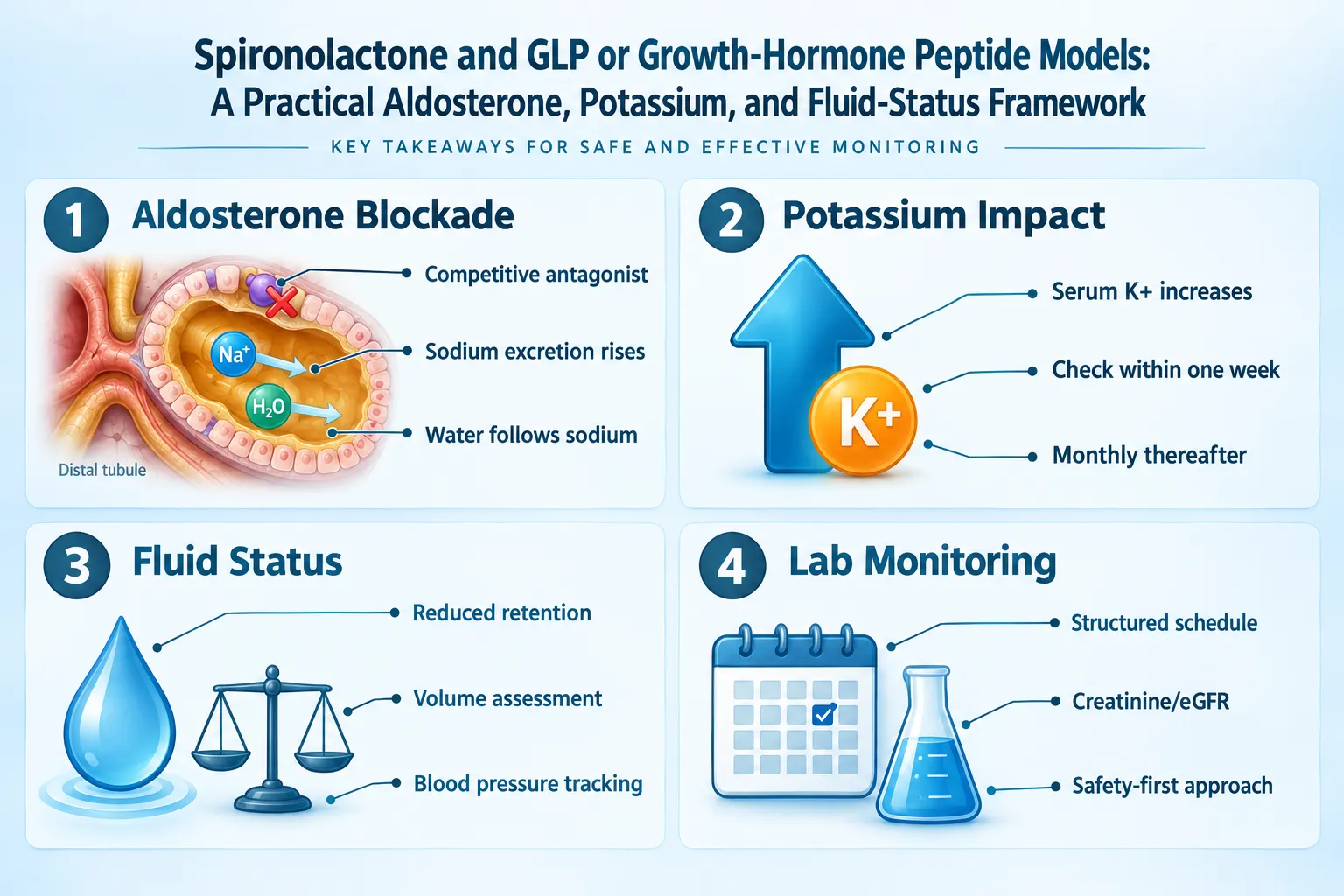
  • Spironolactone competitively blocks aldosterone at the distal tubule, raising serum potassium and reducing sodium and water retention, effects that require structured laboratory monitoring.
  • Potassium must be checked within one week of starting or up-titrating spironolactone, then monthly for three months, quarterly for a year, and every six months thereafter.
  • GLP-1 and dual incretin agonists produce early plasma volume reductions and NT-proBNP decreases that can compound or mask fluid changes from mineralocorticoid blockade.
  • No formal co-therapy guideline currently covers combined spironolactone and GLP or growth-hormone peptide use; any integrated framework is built by extrapolating from MRA, primary aldosteronism, and heart failure evidence.
  • Renin is the primary biochemical titration target for spironolactone in aldosterone-excess states; potassium serves as both a safety marker and a key interpretive variable.

How Spironolactone Changes Aldosterone, Potassium, and Fluid Status
How Spironolactone Changes Aldosterone, Potassium, and Fluid Status

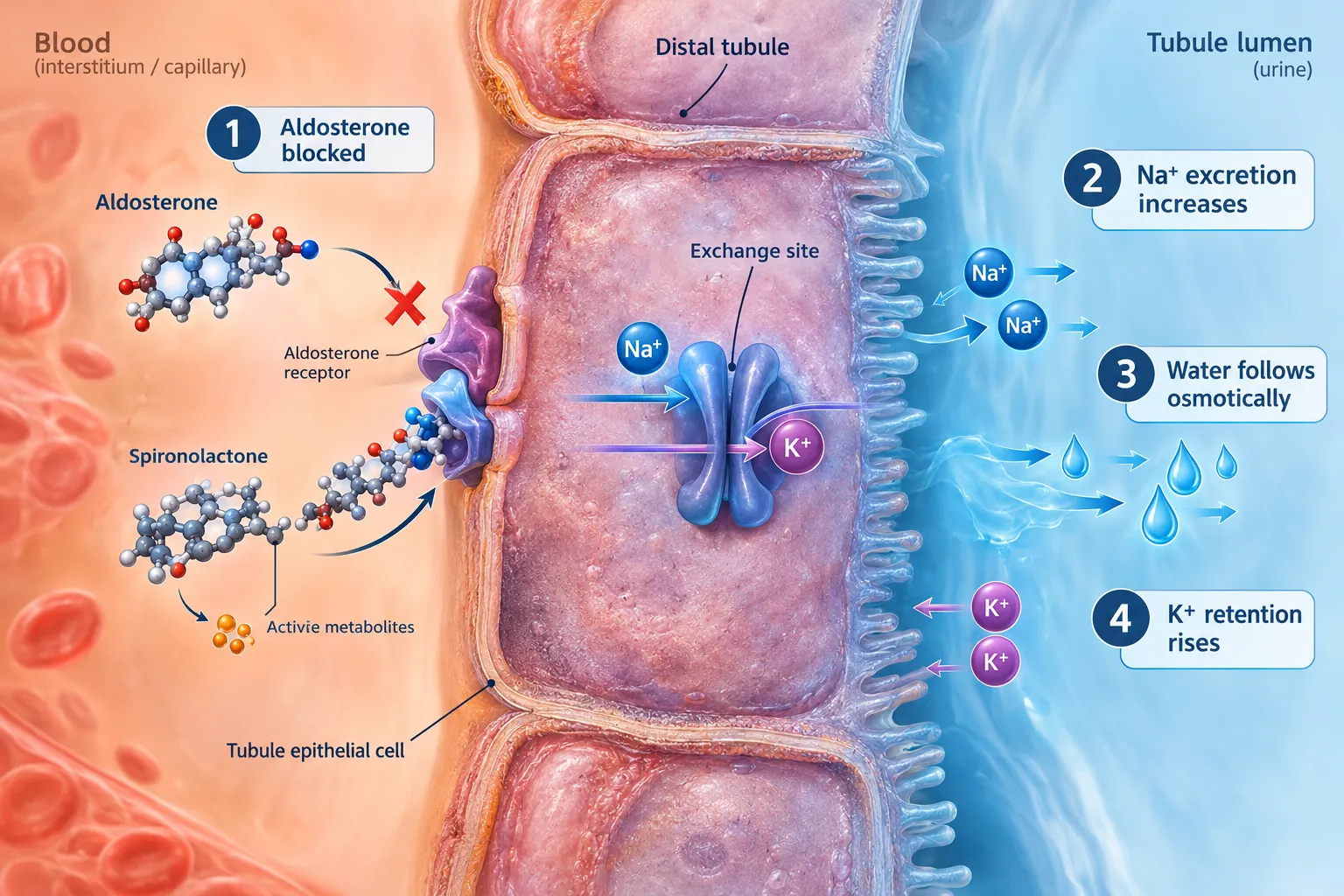
Spironolactone's pharmacology is specific and mechanistically clean. It and its active metabolites act as competitive antagonists at the aldosterone-dependent sodium-potassium exchange site in the distal convoluted tubule. When aldosterone is blocked, sodium excretion rises, water follows, and, critically, potassium is retained rather than excreted.

This mechanism explains why the drug is first-line medical therapy for primary aldosteronism, resistant hypertension, and heart failure with reduced ejection fraction. In aldosterone-excess states, starting spironolactone at 12.5-25 mg daily with careful titration typically normalizes serum potassium within three to five days. That rapid shift means potassium supplements already being taken by the patient often need reduction or discontinuation by days two to four to prevent rebound hyperkalemia.

Why Potassium Is Both a Safety Marker and a Diagnostic Variable

Potassium's role in a spironolactone framework goes beyond safety. Low serum potassium can artificially lower measured aldosterone, potentially misleading diagnosis or obscuring the true degree of aldosterone excess. As a result, potassium must be corrected and then tracked alongside renin and aldosterone throughout therapy, not just checked once at baseline.

The treatment target in primary aldosteronism is an unsuppressed renin, which signals adequate mineralocorticoid receptor blockade. This renin-centered titration strategy is a cornerstone of the broader Spironolactone and GLP or Growth-Hormone Peptide Models: A Practical Aldosterone, Potassium, and Fluid-Status Framework when applied to aldosterone-driven conditions.

"Renin normalization is the biochemical proof of adequate mineralocorticoid blockade, potassium is the safety guardrail."


The Monitoring Schedule That Anchors Any Practical Framework
The Monitoring Schedule That Anchors Any Practical Framework

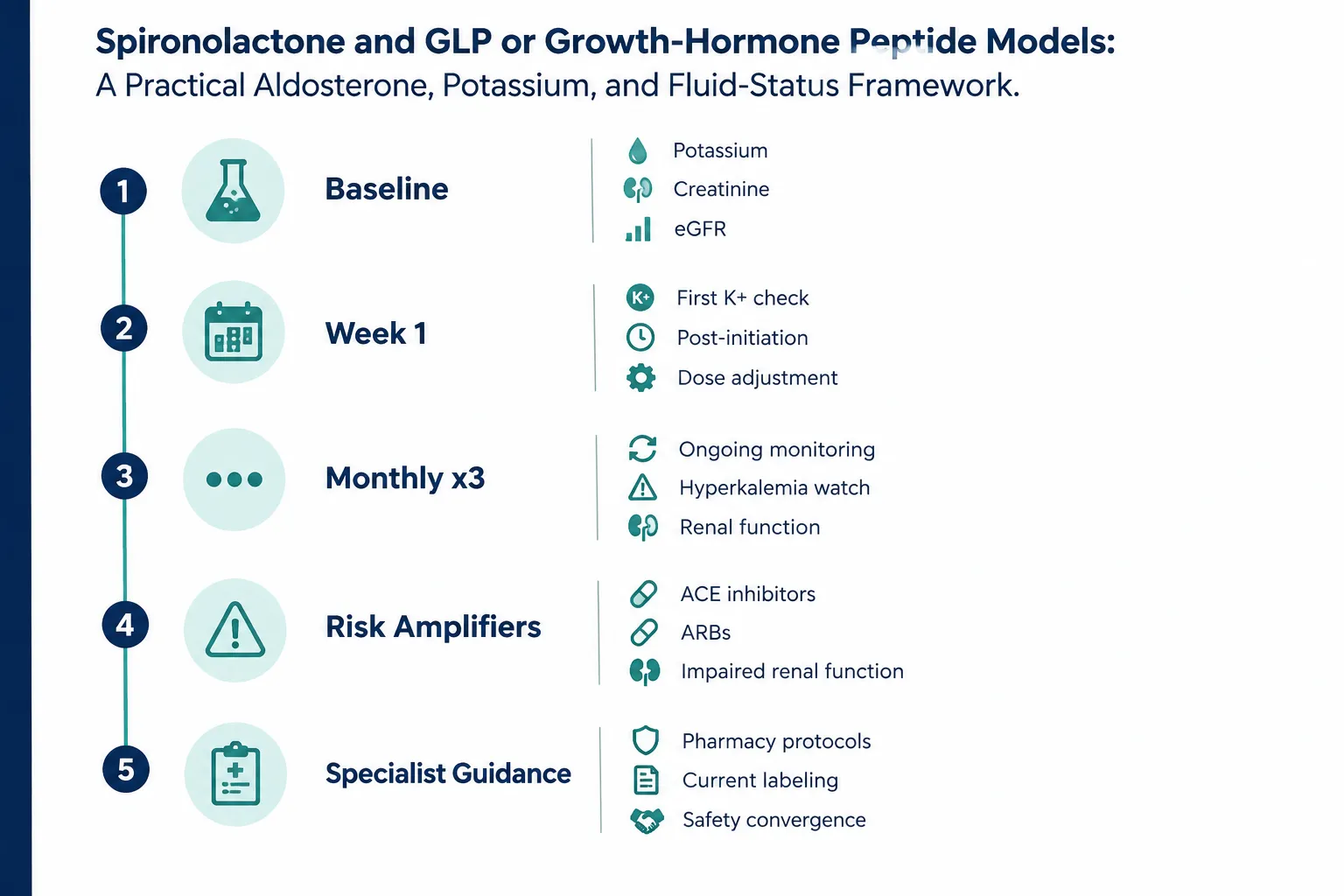
Hyperkalemia is the central safety concern with spironolactone. Risk amplifies with impaired renal function, concurrent ACE inhibitors, ARBs, and any agent that independently raises potassium. Current labeling and specialist pharmacy guidance converge on a structured monitoring schedule:

Timepoint Parameters to Check
Baseline Potassium, creatinine/eGFR, blood pressure, renin, aldosterone
1 week after starting or dose change Potassium, creatinine
Monthly for first 3 months Potassium, creatinine
Every 3 months, months 3-12 Potassium, creatinine
Every 6 months thereafter Potassium, creatinine
2-3 months after initiation Renin (to assess titration adequacy)

Action thresholds are equally important:

  • Potassium above 5.0 mmol/L at baseline: spironolactone is contraindicated.
  • Potassium 5.5-6.0 mmol/L during therapy: reduce dose or hold temporarily.
  • Potassium above 6.5 mEq/L: emergency intervention required.
  • Creatinine above approximately 4 mg/dL: consider discontinuation.

This schedule forms the operational backbone of any aldosterone, potassium, and fluid-status model regardless of what co-therapies are layered on top.


Where GLP and Growth-Hormone Peptide Models Intersect
Where GLP and Growth-Hormone Peptide Models Intersect

The connection between incretin-based therapies and spironolactone is not arbitrary. A 2026 network meta-analysis on obstructive sleep apnea found both spironolactone and the dual GLP-1/GIP agonist tirzepatide among the most effective interventions for reducing apnea-hypopnea index, a finding that highlights converging cardiometabolic benefits across MRA and incretin pathways.

GLP-1 receptor agonists also produce measurable early reductions in plasma volume and NT-proBNP before significant weight loss occurs, suggesting cardiac-specific and potentially volume-modulating effects. When these agents run concurrently with spironolactone, several interactions become clinically relevant:

  • Volume depletion risk: Both drug classes reduce fluid retention through distinct pathways. Combined use may produce greater blood pressure reduction and orthostatic symptoms than either agent alone.
  • NT-proBNP interpretation: GLP-1-driven NT-proBNP reductions can obscure the fluid-status signal that clinicians use to assess heart failure trajectory on MRA therapy.
  • Weight and blood pressure reassessment: Significant weight loss from GLP or growth-hormone peptide protocols reduces aldosterone secretion independently, which can shift the spironolactone dose requirement downward over time.

Research into GLP-3 peptide signaling pathways and related GLP-3 peptide products is increasingly part of this evolving framework, as investigators examine how incretin-family peptides modulate fluid and metabolic endpoints beyond classical glucoregulation. Similarly, mitochondrial-targeted agents such as the SS-31 peptide and research around SS-31 peptide benefits suggest additional cardiorenal pathways that may eventually intersect with MRA therapy in translational models.

It is important to state clearly: as of 2026, no dedicated guideline or randomized trial directly addresses a formalized protocol for combined spironolactone and GLP-1 or growth-hormone peptide co-therapy. Any integrated model must extrapolate from well-established MRA monitoring schedules, incretin-related volume data, and cardiometabolic risk frameworks.


Building a Practical Combined Protocol

A synthesized, non-official practical protocol for the Spironolactone and GLP or Growth-Hormone Peptide Models: A Practical Aldosterone, Potassium, and Fluid-Status Framework would include:

  1. Baseline panel: Blood pressure, volume status assessment, potassium, creatinine/eGFR, renin, aldosterone, NT-proBNP, and body weight before initiating or up-titrating spironolactone.
  2. Early potassium management: Expect potassium normalization within three to five days; reduce or stop potassium supplements by days two to four with close monitoring.
  3. Week-one check: Recheck potassium and creatinine; adjust dose if thresholds are approached.
  4. Monthly monitoring: Continue for the first three months; include symptom-based fluid assessment, weight trends, edema, orthostatic symptoms.
  5. Renin reassessment at two to three months: Titrate spironolactone toward an unsuppressed renin while tracking potassium and creatinine.
  6. GLP/peptide-specific additions: Track NT-proBNP and weight trajectory; reassess spironolactone dose if significant weight loss alters aldosterone secretion; watch for additive volume depletion.

Researchers following this area may also find value in reviewing lab-tested peptides standards and emerging data on combination agents like cagrilinitide peptide, which represents dual-mechanism incretin modulation relevant to the cardiometabolic overlap with MRA therapy.


Conclusion

The Spironolactone and GLP or Growth-Hormone Peptide Models: A Practical Aldosterone, Potassium, and Fluid-Status Framework is not yet a formal guideline construct, but the clinical need for one is real and growing. Spironolactone's well-characterized effects on aldosterone, potassium, and fluid balance provide a rigorous structural foundation. Layering GLP-1 or growth-hormone peptide effects on top requires extending that foundation to include volume-depletion vigilance, NT-proBNP trending, and weight-driven reassessment of MRA dosing.

Actionable next steps for clinicians and researchers:

  • Apply the structured potassium and creatinine monitoring schedule from established MRA labeling as a non-negotiable baseline.
  • Add NT-proBNP and weight trending when any incretin-class or growth-hormone peptide is co-administered.
  • Reassess renin at two to three months and recalibrate spironolactone dose if body weight changes significantly.
  • Treat potassium simultaneously as a safety guardrail and a diagnostic variable when interpreting aldosterone status.
  • Continue monitoring the emerging literature, this intersection will likely produce dedicated guidance as GLP-based co-therapy becomes more common across cardiometabolic practice.
https://www.puretestedpeptides.com/wp-content/uploads/2026/10/spironolactone-and-glp-or-growth-hormone-peptide-models-a-practical-aldosterone.webp 1024 1536 https://www.puretestedpeptides.com/wp-content/uploads/2026/01/buy-peptides-online.jpg 2026-10-25 13:03:542026-10-25 13:03:54Spironolactone and GLP or Growth-Hormone Peptide Models: A Practical Aldosterone, Potassium, and Fluid-Status Framework
×

Helpful Links

  • My account
  • Cart
  • Checkout
  • Refund and Returns Policy
  • Privacy Policy
  • SMS Privacy Policy
  • Login
  • My Account
  • Logout

USA Made Lab Tested Peptides

All products are sold for research, laboratory, or analytical purposes only, and are not for human consumption


Pure Tested Peptides is a chemical supplier. Pure Tested Peptides is not a compounding / chemical compounding facility as defined under 503A of the Federal Food, Drug, and Cosmetic act. Pure Tested Peptides is not an outsourcing facility as defined under 503B of the Federal Food, Drug, and Cosmetic act.

The statements made within this website have not been evaluated by the US Food and Drug Administration. The products we offer are not intended to diagnose, treat, cure or prevent any disease.

Human/Animal Consumption Prohibited. Laboratory/In-Vitro Experimental Use Only

Scroll to top Scroll to top Scroll to top