Call or Text 727-513-9780
  • Shopping Cart Shopping Cart
    0Shopping Cart
Pure Tested Peptides | America's most trusted Peptides for sale online
  • Peptides for sale
    • Oral Peptides for sale
      • Peptide Capsules for sale
      • BPC 157 Capsules 1000mcg
      • SLU-PP-332 Capsules | 1000 mcg
      • 5-Amino-1MQ 50mg Capsules
      • Tesofensine 500mcg
    • All Peptides for sale
    • Peptide Sprays
      • BPC 157 Nasal Spray Kit
      • BPC-157 TB500 Nasal Spray Kit
      • Semax Nasal Spray 10mg
      • Selank – Nasal Spray Kit – 10mg
      • Epithalon 50MG Nasal Spray Kit
      • Ipamorelin 10mg Nasal Spray
      • Klow Nasal Spray (BPC-157 + TB-500 + GHK-Cu + KPV) | 80mg
      • Hulk Nasal Spray Tesa / Ipa Blend 6/3 MG
      • Klow Nasal Spray
      • NAD + 500 mg Nasal Spray
      • PT-141 Nasal Spray Kit
    • GHRH Peptides
      • Ipa Peptides
      • CJC-1295 Peptides
        • CJC-1295 with DAC 5 mg
        • CJC-1295 without DAC 5 mg
        • CJC-1295 Ipa 10mg
      • Tesa Peptides
        • Tesa Peptide
        • Tesa 20 mg
    • GHK-Cu Peptides
      • All GHK-Cu Peptides
      • GHK-Cu 100mg
      • KLOW Peptide Blend – Buy KLOW blend online
    • BPC Peptides
      • All BPC Peptides
      • BPC-157
      • BPC-157 TB-500
      • BPC 157 capsules 1000mcg
    • SLU-PP-332 Peptides
      • All SLU-PP-332 Peptides
      • SLU-PP-332 5mg
    • GLP3 Peptides
    • PT-141 Peptides
      • PT-141 Peptides for sale
      • PT-141 10mg
      • PT-141 Nasal Spray
    • CAG Peptides
      • Lipo-C Peptide Blend
      • CAG 5mg
      • CAG 10mg
    • MOTS-C Peptides
      • MOTS-C Peptides for sale
      • MOTS-c peptide
      • MOTS-c 10mg *6 pack*
    • 5 Amino 1MQ Peptides
      • 5 Amino 1MQ Peptides for sale
      • 5-Amino-1MQ 50mg Capsules
      • 5-Amino-1MQ 5mg
    • Epithalon Peptides
      • Epithalon Peptides for sale
      • Epithalon 10mg
      • Epithalon 50mg
  • Shop
    • GLPs
      • 5-Amino-1MQ 50mg Capsules
      • 5-Amino-1MQ 5mg
      • L-Carnitine 500mg/ml
      • Tesofensine 500mcg
      • SLU-PP-332 5mg
      • MOTS-c 10mg *6 pack*
    • Epithalon & BPC Peptides
      • Epithalon 10mg
      • Epithalon 50mg
      • BPC-157
      • BPC 157 capsules 1000mcg
      • BPC-157 TB-500
      • BPC-157 TB500 Nasal Spray Kit
      • BPC 157 Nasal Spray Kit
    • BPC TB-500 & NAD+ Peptides
      • NAD+ 500 mg
      • KLOW Peptide Blend – Buy KLOW blend online
      • GLOW Peptide Blend
      • TB 500 5mg
      • BPC 157 capsules 1000mcg – Supplement
      • BPC 157 Nasal Spray Kit
      • BPC-157
      • BPC-157 TB500 Nasal Spray Kit
      • BPC-157 TB-500
      • BPC 157 capsules 1000mcg
    • LL-37 Peptide
      • LL-37 10 mg
    • MOTS-C & Selank
      • MOTS-c peptide
      • Selank 10mg
    • GHK Peptides
      • GHK-Cu 100mg
      • GLOW Peptide Blend
      • KLOW Peptide Blend – Buy KLOW blend online
  • COAs
  • Wholesale
    • Wholesale Peptides for sale
  • PTP FAQ
  • Affiliates
    • Selank Peptide: Advanced Pharmacological Mechanisms Underlying Its Anxiolytic and Nootropic Effects in Research
      • 5-Amino-1MQ Peptide: Detailed Mechanisms of NNMT Inhibition and Its Impact on Cellular Metabolism Research
        • MOTS-C Peptide: Unraveling Its Role in Mitochondrial Dynamics and Energy Metabolism Research
          • Epithalon Peptide and Telomerase Regulation: Investigating Its Impact on Cellular Senescence and Lifespan Research Models
            • GLP2-T vs GLP2 Tirz Peptide: Understanding the Naming, Mechanistic Nuances, and Research Implications for Gut Health
      • Peptides and Polypeptides in Modern Pharmacology: What Research on Metoprolol, Prednisone, and Amlodipine Reveals
        • Polypeptide Peptides vs NSAIDs: What Naproxen and Diclofenac Teach Tissue-Repair Researchers About BPC‑157 and TB‑500
          • Peptides and Polypeptides in Endocrine Pharmacology: How GLP-1, GLP-2, and GLP-3 Retatrutide Differ From Classic Drugs Like Prednisone and Amlodipine
          • 5‑Amino‑1MQ Peptide and NNMT Inhibition: How It Compares With Statins Like Atorvastatin in Adipose and Lipid Metabolism Research
      • Enclomiphene, Estrogen Receptor Signaling, and Luteinizing Phase Biology: What Hormone Researchers Should Measure
        • Mesenchymal Stem Cells, BPC‑157, and GHK‑Cu: How Tissue Repair Peptides Compare With Classic NSAIDs Like Naproxen in Injury Models
          • Peptide Calculator Use Cases Beyond Growth Hormone: Working Through GLP‑3 Retatrutide, MOTS‑c, and BPC‑157 Research Dosing
        • Polypeptide Peptides in Endocrine and Metabolic Pharmacology: Lessons From Amlodipine, Prednisone, and Metoprolol
        • Peptides Calculator for Advanced Blends: Worked Examples for Tesamorelin, CJC‑1295, and Ipamorelin Stacks
          • Peptides and Polypeptides in Human Physiology: How Molecular Size Shapes Research Applications
            • Selank Peptide: Advanced Pharmacological Mechanisms Underlying Its Anxiolytic and Nootropic Effects in Research
          • 5-Amino-1MQ Peptide: Detailed Mechanisms of NNMT Inhibition and Its Impact on Cellular Metabolism Research
            • MOTS-C Peptide: Unraveling Its Role in Mitochondrial Dynamics and Energy Metabolism Research
              • Epithalon Peptide and Telomerase Regulation: Investigating Its Impact on Cellular Senescence and Lifespan Research Models
                • GLP2-T vs GLP2 Tirz Peptide: Understanding the Naming, Mechanistic Nuances, and Research Implications for Gut Health
                  • Peptides and Polypeptides in Endocrine Pharmacology: How GLP-1, GLP-2, and GLP-3 Retatrutide Differ From Classic Drugs Like Prednisone and Amlodipine
                    • Polypeptide Peptides vs NSAIDs: What Naproxen and Diclofenac Teach Tissue-Repair Researchers About BPC‑157 and TB‑500
                      • Peptides and Polypeptides in Modern Pharmacology: What Research on Metoprolol, Prednisone, and Amlodipine Reveals
                        • 5‑Amino‑1MQ Peptide and NNMT Inhibition: How It Compares With Statins Like Atorvastatin in Adipose and Lipid Metabolism Research
                        • Enclomiphene, Estrogen Receptor Signaling, and Luteinizing Phase Biology: What Hormone Researchers Should Measure
                        • Mesenchymal Stem Cells, BPC‑157, and GHK‑Cu: How Tissue Repair Peptides Compare With Classic NSAIDs Like Naproxen in Injury Models
                        • Peptide Calculator Use Cases Beyond Growth Hormone: Working Through GLP‑3 Retatrutide, MOTS‑c, and BPC‑157 Research Dosing
                        • Polypeptide Peptides in Endocrine and Metabolic Pharmacology: Lessons From Amlodipine, Prednisone, and Metoprolol
                        • Peptides Calculator for Advanced Blends: Worked Examples for Tesamorelin, CJC‑1295, and Ipamorelin Stacks
                        • Peptides and Polypeptides in Human Physiology: How Molecular Size Shapes Research Applications
                        • Selank Peptide: Advanced Pharmacological Mechanisms Underlying Its Anxiolytic and Nootropic Effects in Research
                        • MOTS-C Peptide: Unraveling Its Role in Mitochondrial Dynamics and Energy Metabolism Research
                        • Peptides and Polypeptides in Modern Pharmacology: What Research on Metoprolol, Prednisone, and Amlodipine Reveals
                        • Peptides and Polypeptides in Endocrine Pharmacology: How GLP-1, GLP-2, and GLP-3 Retatrutide Differ From Classic Drugs Like Prednisone and Amlodipine
                        • 5-Amino-1MQ Peptide: Detailed Mechanisms of NNMT Inhibition and Its Impact on Cellular Metabolism Research
                        • Mesenchymal Stem Cells, BPC‑157, and GHK‑Cu: How Tissue Repair Peptides Compare With Classic NSAIDs Like Naproxen in Injury Models
                        • Peptide Calculator Use Cases Beyond Growth Hormone: Working Through GLP‑3 Retatrutide, MOTS‑c, and BPC‑157 Research Dosing
                        • GLP2-T vs GLP2 Tirz Peptide: Understanding the Naming, Mechanistic Nuances, and Research Implications for Gut Health
                        • Polypeptide Peptides in Endocrine and Metabolic Pharmacology: Lessons From Amlodipine, Prednisone, and Metoprolol
                        • Polypeptide Peptides vs NSAIDs: What Naproxen and Diclofenac Teach Tissue-Repair Researchers About BPC‑157 and TB‑500
                        • Peptides and Polypeptides in Human Physiology: How Molecular Size Shapes Research Applications
                        • Peptides Calculator for Advanced Blends: Worked Examples for Tesamorelin, CJC‑1295, and Ipamorelin Stacks
                        • 5‑Amino‑1MQ Peptide and NNMT Inhibition: How It Compares With Statins Like Atorvastatin in Adipose and Lipid Metabolism Research
                        • Enclomiphene, Estrogen Receptor Signaling, and Luteinizing Phase Biology: What Hormone Researchers Should Measure
                        • Epithalon Peptide and Telomerase Regulation: Investigating Its Impact on Cellular Senescence and Lifespan Research Models
                        • Best research protocol Klow blend
                        • best time to take BPC-157
                        • best time to take DSIP (Delta Sleep Inducing Peptide)
                        • best time to take CJC-1295
                        • best time to take AOD-9604
                        • best time to take Follistatin 344
                        • best time to take Ipamorelin
                        • best time to take MK-677 (Ibutamoren)
                        • best time to take Ligandrol (LGD-4033) — research compound
                        • best time to take Ostarine (MK-2866) — research compound
                        • best time to take GHK-CU
                        • best time to take TB-500
                        • best time to take MOTS-c
                        • best time to take Semax
                        • best time to take RAD-140 (Testolone) — research compound
                        • best time to take Thymosin Alpha-1
                        • best time to take PEG-MGF
                        • Biolife Plasma, Octapharma Plasma, and Research Peptides: How Plasma Donation Labs Differ From Peptide Suppliers
                        • best time to take YK-11 — research compound
                        • best time to take PT-141 (Bremelanotide)
                        • Best research protocol Klow blend
                        • 5-Amino-1MQ and MOTS-C Synergy: Metabolic Signaling, Mitochondria, and Research Design
                        • BPC-157 and TB-500: Investigating Their Combined Effects on Angiogenesis and Cellular Migration in Tissue Repair Models
                        • BPC-157 Peptide: Gut Barrier Function, Inflammation, and Tissue-Recovery Research
                        • 5‑Amino‑1MQ and MOTS‑c Synergy in Metabolic Research: Designing NNMT and Mitochondrial Biogenesis Stacks
                        • CJC-1295 with DAC vs. Without DAC: Half-Life, Release Kinetics, and Research Implications
                        • CJC‑1295 with DAC vs. Without DAC: Expanding on Half‑Life Differences Using Tesamorelin and Ipamorelin Blend Case Studies
                        • Collagen Biology and Copper‑Binding Peptides: How GHK‑Cu, Glow Blend, and Klow Blend Interact with Skin and Connective Tissue
                        • Collagen Biology and Regenerative Peptides: How GHK‑Cu, Glow Blend, and Klow Blend Affect Extracellular Matrix Research
                    • DNA, Telomeres, and Longevity Peptides: Positioning Epithalon and MOTS‑c in Genetic Aging Research
                      • Enclomiphene Citrate: serm Mechanism, Testosterone Research, and Stack Compatibility
                        • Enclomiphene vs Enclomiphene Citrate: Formulation, Bioavailability, and Research Distinctions
                        • Epithalon Peptide Research: Telomerase Activation, Aging, and Pineal Gland Function
                        • Estrogen Receptor Signaling and Enclomiphene: How Selective Modulators Compare with Classic Polypeptide Hormones
                        • GHK-Cu Peptide: Advanced Mechanisms in Extracellular Matrix Remodeling and Wound Healing Research
                        • GHK-Cu Peptide: Collagen Synthesis, Wound Repair, and Skin-Barrier Research Models
                        • GLP-1 vs GLP-3 vs GLP-2: Peptide Classification and Research Applications
                        • GLP-2 Peptide Research Guide: Gut Barrier Function, Nutrient Absorption, and Intestinal Recovery Models
                        • GLP-3 Retatrutide vs. GLP-1 Drugs: What Triple-Agonist Biology Changes in Research Models
                        • Ipamorelin and Tesamorelin Combination: Synergistic GH Secretagogue Research and Dosing Protocols
                        • GLP2 Tirz Peptide: What It Is, Why the Name Exists, and How Researchers Should Interpret It
                        • Klow Blend Peptide Nasal Spray: What the Formulation Is Trying to Do in Cognitive Research
                        • Mitochondria, NNMT Inhibition, and Peptide Modulators: Where MOTS‑c and 5‑Amino‑1MQ Fit in Cellular Energy Research
                        • MOTS-c Peptide: Mitochondrial Function, Energy Metabolism, and What Researchers Measure
                        • MOTS-c vs. 5-Amino-1MQ: Which Metabolic Research Questions Each Compound Actually Answers
                        • Nasal Spray Peptides: Bioavailability, Administration, and Semax/Selank Research Applications
                        • PT-141 Peptide Research: Mechanism of Action and Melanocortin Receptor Signaling
                        • Retatrutide for Research: Mechanism, Structure, and GLP-1/GLP-3 Dual Action
                        • Retatrutide for Obesity and Type 2 Diabetes: What the Latest Trial Data Suggest
                        • Tesofensine Peptide Research: Mechanism, Appetite Suppression, and Neuropeptide Y Pathways
  • Contact
    • Contact Customer Service
    • Text Customer Support
  • About US
  • Shop all peptides
  • Affiliate Program
    • Affiliate Signup
  • Login / Register Login / Register Page Link Login / Register Page Link
  • Click to open the search input field Click to open the search input field Search
  • Menu Menu

Tag Archive for: ich stability guidelines

Research-Use Peptide Storage and Stability: A Quality-Control Checklist for Lyophilized, Liquid, and Intranasal Materials

Research-Use Peptide Storage and Stability: A Quality-Control Checklist for Lyophilized, Liquid, and Intranasal Materials

October 20, 2026/0 Comments/in Uncategorized/by

A single temperature excursion, a freezer door left ajar overnight, can reduce a research-grade peptide's effective purity faster than months of routine use. Yet storage failures remain one of the most underreported sources of experimental variability in peptide research. This guide provides a practical framework for Research-Use Peptide Storage and Stability: A Quality-Control Checklist for Lyophilized, Liquid, and Intranasal Materials, targeting researchers who need to compare materials across identity, purity, aliquoting strategy, container, closure integrity, freeze, thaw exposure, and post-reconstitution stability.

Key Takeaways

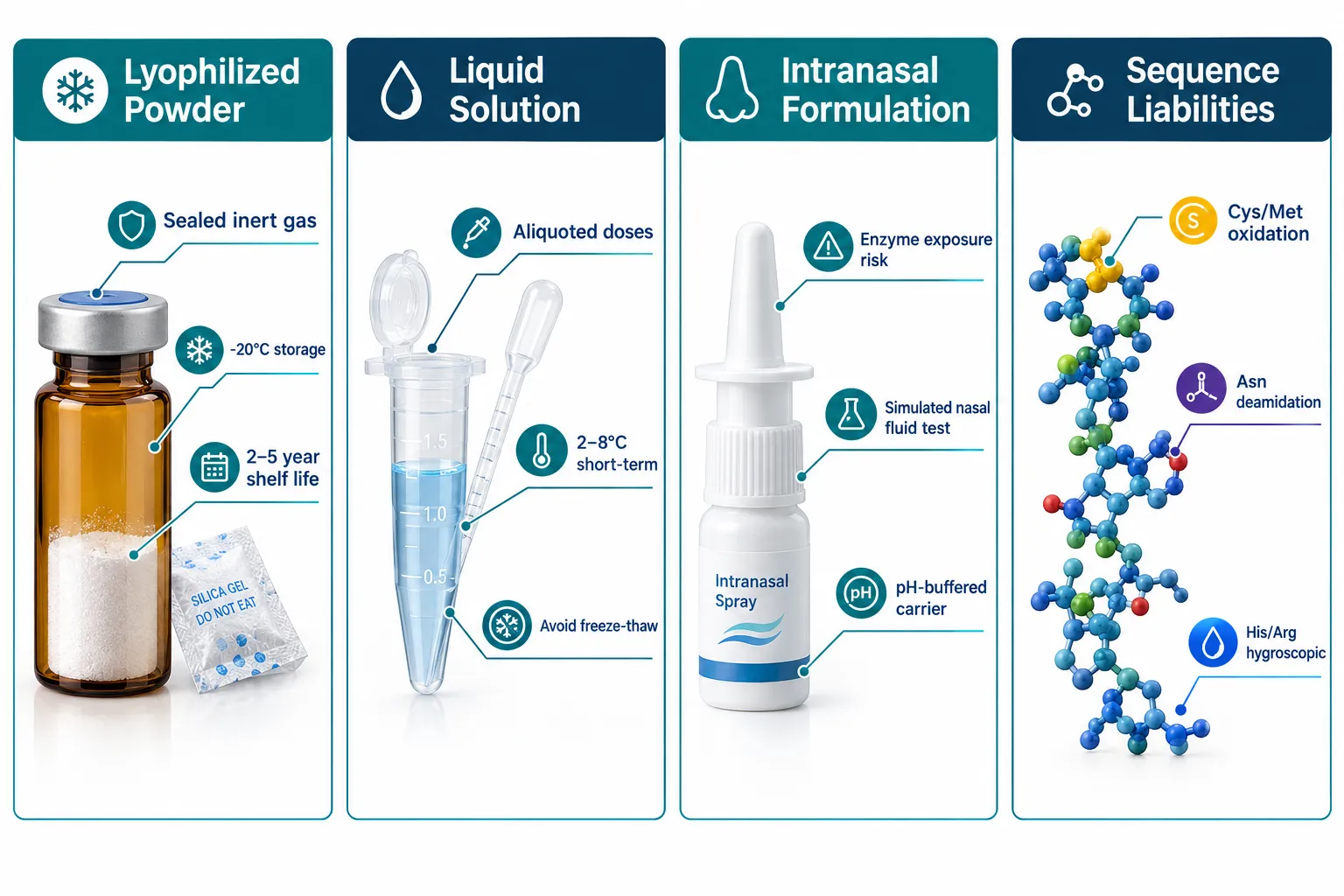
  • Lyophilized peptides stored at -20°C or below in sealed, desiccated containers can remain stable for two to five years; liquid solutions degrade far faster and require aliquoting.
  • Sequence-specific liabilities, oxidation-prone Cys/Met/Trp residues, hygroscopic Asp/Glu/Lys/Arg/His residues, and deamidation-prone Asn, demand tailored storage conditions beyond generic guidelines.
  • Intranasal peptide materials face unique enzymatic and mucosal degradation risks that require in-vitro stability studies in simulated nasal fluid before formulation.
  • A written QC checklist that documents identity verification, storage temperature logs, retest dates, and freeze, thaw cycle counts is as important as the storage conditions themselves.
  • Regulatory frameworks (ICH Q1, Q5, Q6B) increasingly shape expectations for research-grade peptide stability programs, not just clinical drug substances.

Understanding Why Peptide Formulation Type Determines Storage Strategy
Understanding Why Peptide Formulation Type Determines Storage Strategy

Peptides are chemically diverse, relatively small molecules, but they are far more labile than small-molecule drugs. Their amino acid sequences create unique degradation profiles: oxidation, deamidation, hydrolysis, aggregation, and disulfide scrambling can each erode purity without any visible change in a vial's appearance.

The formulation type is the first variable any QC checklist must address.

Lyophilized (freeze-dried) powders are the gold standard for research storage. Removing water dramatically slows hydrolytic degradation. Stored at -20°C in sealed, amber vials with a desiccant, most high-purity lyophilized peptides remain usable for two to three years, and well-characterized sequences often exceed five years under ideal conditions. For detailed storage and traceability notes on a specific peptide, the AOD 9604 sale research method notes on storage and traceability page offers a useful model.

Liquid solutions are inherently less stable. Once reconstituted, most peptides in aqueous buffer should be stored at 2-8°C and used within days to weeks, or aliquoted into single-use volumes and frozen at -20°C or -80°C. Repeated freeze, thaw cycles introduce mechanical stress, concentration gradients, and oxidation events that progressively degrade the compound.

Intranasal formulations carry additional complexity. Nasal mucosa contains peptidases and nucleases. Any peptide intended for intranasal research must be evaluated for enzymatic stability in simulated nasal fluid and tissue homogenates, and formulation strategies, permeation enhancers, enzyme inhibitors, pH-buffered carriers, must be validated before storage parameters can be finalized.

"Storage format is not just a logistics decision; it is a scientific variable that directly affects the data quality of every downstream experiment."


A QC Checklist for Research-Use Peptide Storage and Stability Across All Three Material Types
A QC Checklist for Research-Use Peptide Storage and Stability Across All Three Material Types

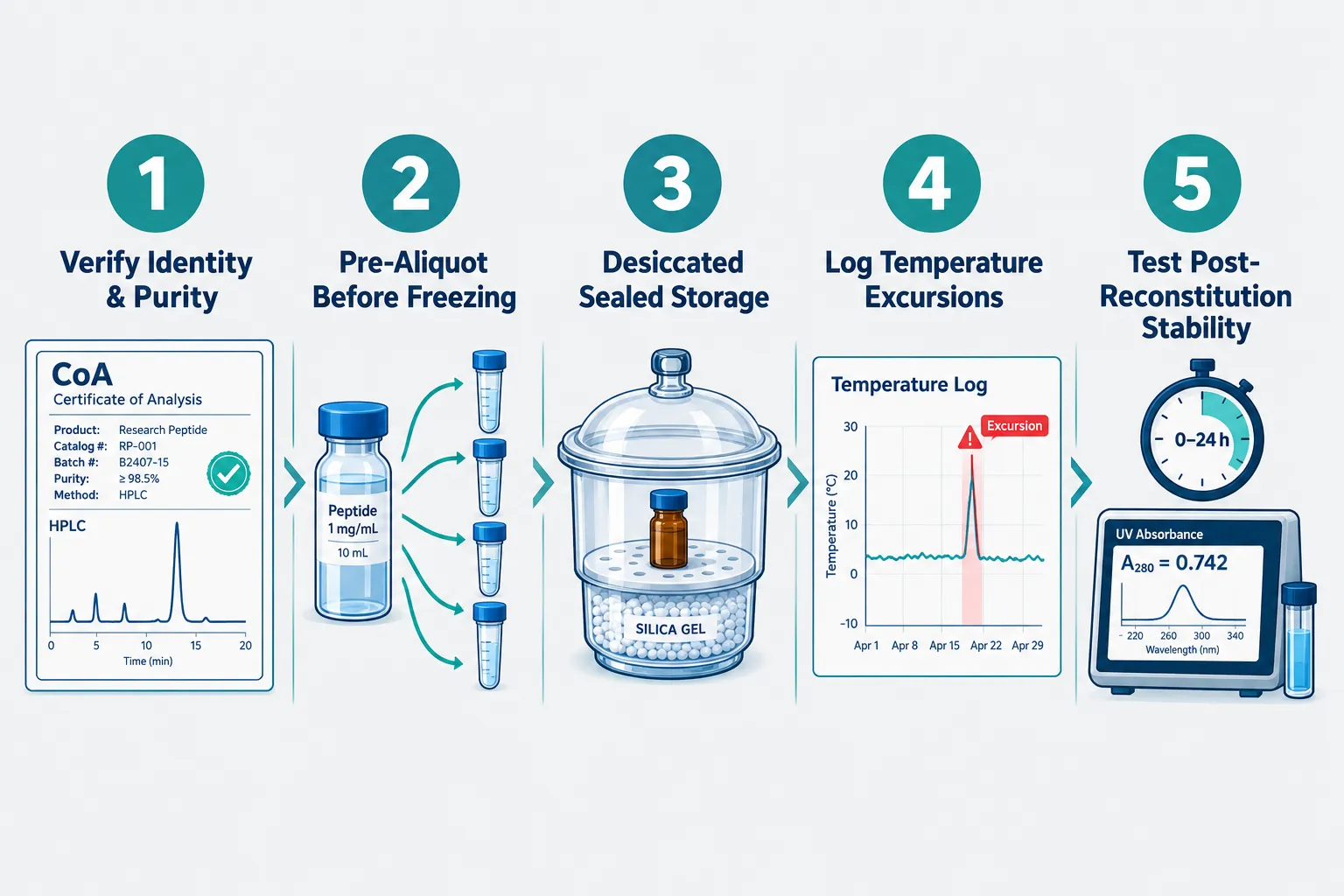
The following checklist consolidates regulatory guidance and practical supplier recommendations into a format applicable to lyophilized, liquid, and intranasal materials.

Step 1, Verify Identity and Purity Before Storage

Never store a peptide without confirming its certificate of analysis (CoA). Key data points to verify:

Parameter Minimum Standard
Purity (HPLC) ≥95% for most research uses
Molecular weight (MS) Matches theoretical sequence mass
Sequence confirmation Amino acid analysis or MS/MS
Counterion content Noted (TFA vs. acetate affects solubility)

For metabolic research peptides, resources like the GLP-1 peptide buy generational research concepts and sourcing notes page illustrate how purity documentation shapes downstream sourcing decisions.

Step 2, Match Temperature to Formulation and Sequence

  • Lyophilized powder: -20°C (standard); -80°C for sequences with Cys, Met, or Trp residues or any history of oxidation issues.
  • Liquid solution (short-term): 2-8°C, light-protected, oxygen-limited buffer, maximum one to two weeks.
  • Liquid solution (long-term): -20°C to -80°C in pre-aliquoted single-use volumes.
  • Intranasal formulations: follow in-vitro stability data; generally 2-8°C for finished formulations, with dedicated stability endpoints in simulated nasal fluid.

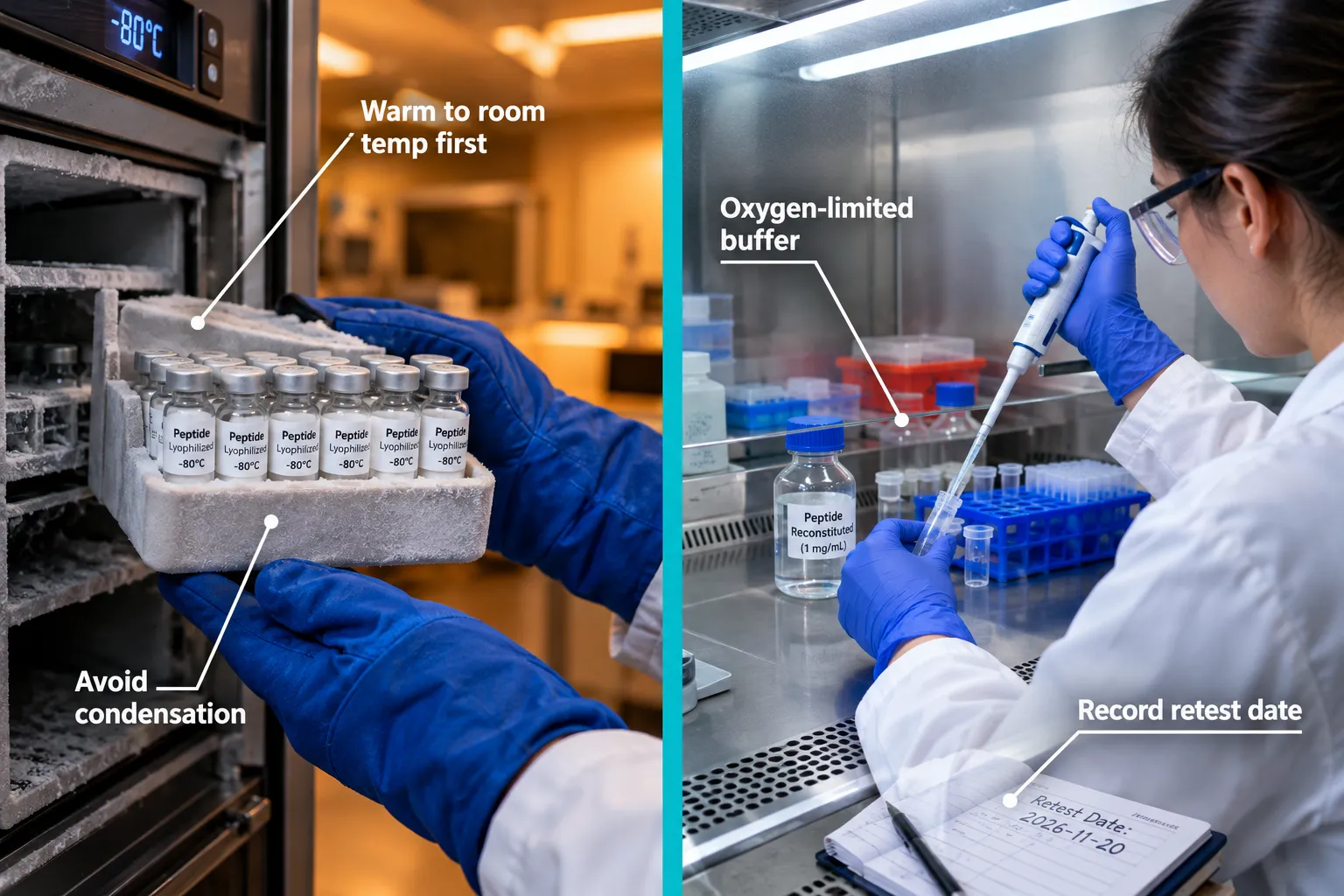
Peptides with deliquescent residues (Asp, Glu, Lys, Arg, His) must be kept away from humidity at every stage, including during weighing and reconstitution. Vials should be warmed to room temperature while sealed before opening to prevent condensation on the powder.

Step 3, Control Container, Closure and Headspace

  • Use amber glass vials or opaque polypropylene tubes rated for the storage temperature.
  • Backfill with dry inert gas (argon or nitrogen) before sealing to limit oxidative degradation.
  • Include silica gel desiccant in the outer packaging, not inside the vial.
  • For copper-containing peptides such as GHK-Cu, container material matters; the GHK-Cu peptide purchase copper peptide research sourcing guide addresses metal-specific handling considerations.

Step 4, Pre-Aliquot to Limit Freeze, Thaw Cycles

A single vial of lyophilized peptide should be reconstituted into the smallest volume that covers a defined experimental series, then immediately divided into single-use aliquots. Label each aliquot with:

  • Peptide name and lot number
  • Reconstitution date and solvent used
  • Concentration
  • Assigned retest date
  • Freeze, thaw cycle count (max two to three recommended)

Step 5, Document Temperature Excursions and Retest Dates

Regulatory frameworks built around ICH Q1 and Q6B principles require that retest periods be formally justified by stability data. Research labs should mirror this approach with basic temperature logging. A simple freezer log noting any excursion above -15°C, even brief, allows researchers to flag compromised batches before they corrupt an experiment. For peptides with mitochondrial research applications, stable lot-to-lot consistency is especially critical; see SS-31 mitochondrial research themes for context on how stability affects mechanistic interpretation.


Post-Reconstitution Stability and Sequence-Specific Risk Flags
Post-Reconstitution Stability and Sequence-Specific Risk Flags

Post-reconstitution stability is where most research-grade peptide losses occur undetected. A peptide that was 98% pure at lyophilization may fall below 90% after two weeks in aqueous buffer at 4°C, particularly if:

  • Oxygen is present in the vial headspace (Cys, Met, Trp oxidation)
  • pH drifts above 7.5 (accelerates Asn deamidation and Asp hydrolysis)
  • Light exposure is not controlled (aromatic residue photodegradation)
  • Repeated warming introduces thermal stress cycles

For research teams working with novel dual- or triple-agonist compounds, stability considerations compound quickly. The BPC-157 core peptides documentation first research guide and the GLP-3 for sale triple agonist research planning and catalog navigation guide both highlight how formulation decisions interact with experimental design.

A practical post-reconstitution stability checklist should include:

  1. Baseline HPLC purity reading on day zero.
  2. Repeat purity check at the planned end of use (e.g., day seven or day fourteen).
  3. Visual inspection for turbidity or particulate formation (early aggregation signal).
  4. pH confirmation if the peptide is buffer-sensitive.
  5. Discard and re-aliquot if purity drops more than two percentage points or if any turbidity appears.

Conclusion

Research-Use Peptide Storage and Stability: A Quality-Control Checklist for Lyophilized, Liquid, and Intranasal Materials is not a peripheral concern, it is a foundational variable in experimental reproducibility. The actionable steps are clear:

  • Confirm identity and purity via CoA before any storage decision.
  • Default to lyophilized format stored at -20°C or -80°C in sealed, desiccated, inert-gas-backfilled containers.
  • Aliquot all solutions before freezing; never exceed three freeze, thaw cycles.
  • Apply sequence-specific risk flags for oxidation-prone (Cys, Met, Trp) and hygroscopic (Asp, Glu, Lys, Arg, His) residues.
  • Log temperature excursions, reconstitution dates, and retest deadlines for every lot.
  • For intranasal materials, complete in-vitro enzymatic stability testing before finalizing storage parameters.

Researchers who treat storage as a documented scientific variable, not an afterthought, produce more reliable data, reduce waste, and maintain the integrity of every downstream assay.

https://www.puretestedpeptides.com/wp-content/uploads/2026/10/research-use-peptide-storage-and-stability-a-quality-control-checklist-for-lyoph.webp 1024 1536 https://www.puretestedpeptides.com/wp-content/uploads/2026/01/buy-peptides-online.jpg 2026-10-20 13:03:582026-10-20 13:03:58Research-Use Peptide Storage and Stability: A Quality-Control Checklist for Lyophilized, Liquid, and Intranasal Materials
×

Helpful Links

  • My account
  • Cart
  • Checkout
  • Refund and Returns Policy
  • Privacy Policy
  • SMS Privacy Policy
  • Login
  • My Account
  • Logout

USA Made Lab Tested Peptides

All products are sold for research, laboratory, or analytical purposes only, and are not for human consumption


Pure Tested Peptides is a chemical supplier. Pure Tested Peptides is not a compounding / chemical compounding facility as defined under 503A of the Federal Food, Drug, and Cosmetic act. Pure Tested Peptides is not an outsourcing facility as defined under 503B of the Federal Food, Drug, and Cosmetic act.

The statements made within this website have not been evaluated by the US Food and Drug Administration. The products we offer are not intended to diagnose, treat, cure or prevent any disease.

Human/Animal Consumption Prohibited. Laboratory/In-Vitro Experimental Use Only

Scroll to top Scroll to top Scroll to top