

Research-Use Peptide Storage and Stability: A Quality-Control Checklist for Lyophilized, Liquid, and Intranasal Materials
A single temperature excursion, a freezer door left ajar overnight, can reduce a research-grade peptide's effective purity faster than months of routine use. Yet storage failures remain one of the most underreported sources of experimental variability in peptide research. This guide provides a practical framework for Research-Use Peptide Storage and Stability: A Quality-Control Checklist for Lyophilized, Liquid, and Intranasal Materials, targeting researchers who need to compare materials across identity, purity, aliquoting strategy, container, closure integrity, freeze, thaw exposure, and post-reconstitution stability.
Key Takeaways
- Lyophilized peptides stored at -20°C or below in sealed, desiccated containers can remain stable for two to five years; liquid solutions degrade far faster and require aliquoting.
- Sequence-specific liabilities, oxidation-prone Cys/Met/Trp residues, hygroscopic Asp/Glu/Lys/Arg/His residues, and deamidation-prone Asn, demand tailored storage conditions beyond generic guidelines.
- Intranasal peptide materials face unique enzymatic and mucosal degradation risks that require in-vitro stability studies in simulated nasal fluid before formulation.
- A written QC checklist that documents identity verification, storage temperature logs, retest dates, and freeze, thaw cycle counts is as important as the storage conditions themselves.
- Regulatory frameworks (ICH Q1, Q5, Q6B) increasingly shape expectations for research-grade peptide stability programs, not just clinical drug substances.
Understanding Why Peptide Formulation Type Determines Storage Strategy
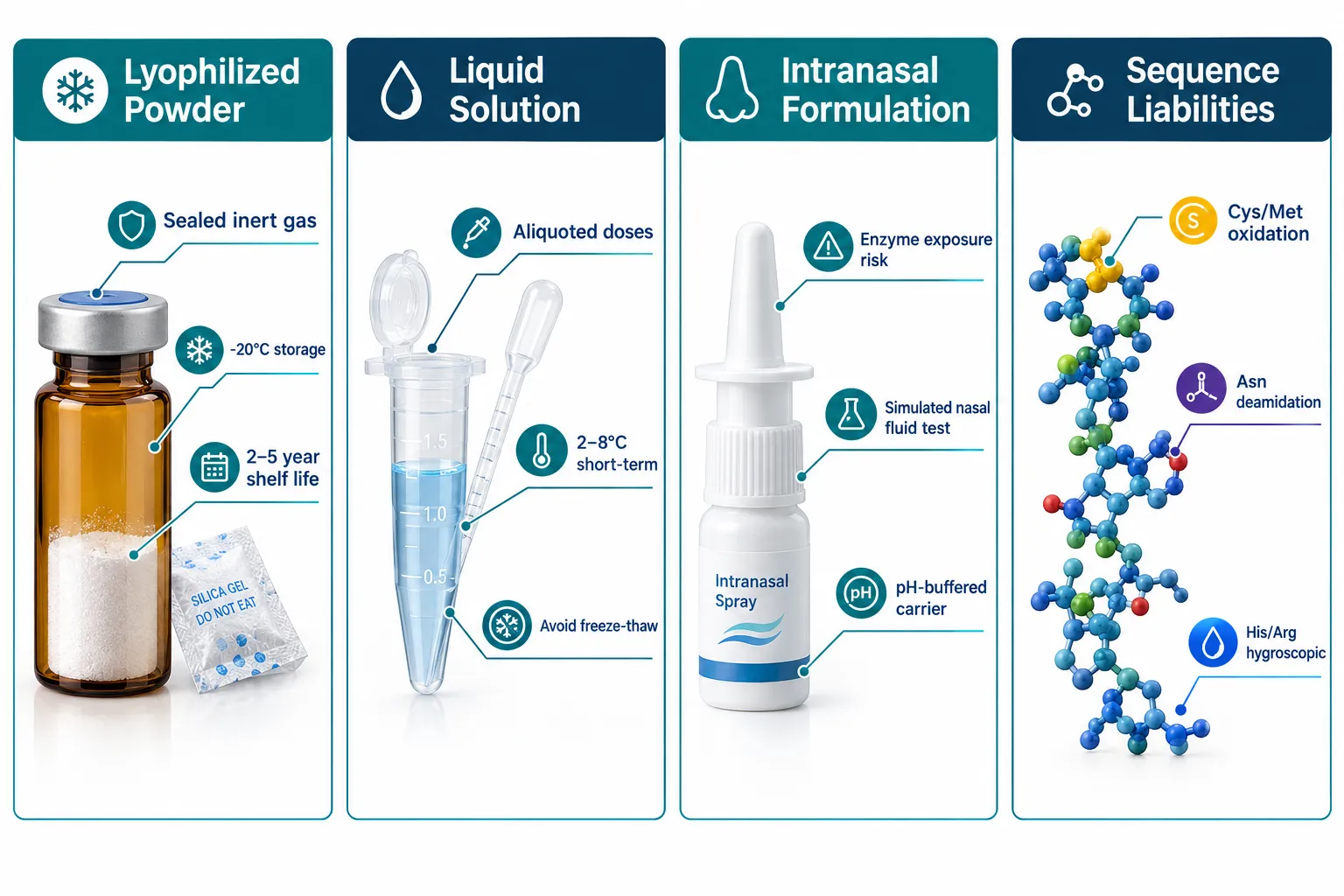
Peptides are chemically diverse, relatively small molecules, but they are far more labile than small-molecule drugs. Their amino acid sequences create unique degradation profiles: oxidation, deamidation, hydrolysis, aggregation, and disulfide scrambling can each erode purity without any visible change in a vial's appearance.
The formulation type is the first variable any QC checklist must address.
Lyophilized (freeze-dried) powders are the gold standard for research storage. Removing water dramatically slows hydrolytic degradation. Stored at -20°C in sealed, amber vials with a desiccant, most high-purity lyophilized peptides remain usable for two to three years, and well-characterized sequences often exceed five years under ideal conditions. For detailed storage and traceability notes on a specific peptide, the AOD 9604 sale research method notes on storage and traceability page offers a useful model.
Liquid solutions are inherently less stable. Once reconstituted, most peptides in aqueous buffer should be stored at 2-8°C and used within days to weeks, or aliquoted into single-use volumes and frozen at -20°C or -80°C. Repeated freeze, thaw cycles introduce mechanical stress, concentration gradients, and oxidation events that progressively degrade the compound.
Intranasal formulations carry additional complexity. Nasal mucosa contains peptidases and nucleases. Any peptide intended for intranasal research must be evaluated for enzymatic stability in simulated nasal fluid and tissue homogenates, and formulation strategies, permeation enhancers, enzyme inhibitors, pH-buffered carriers, must be validated before storage parameters can be finalized.
"Storage format is not just a logistics decision; it is a scientific variable that directly affects the data quality of every downstream experiment."
A QC Checklist for Research-Use Peptide Storage and Stability Across All Three Material Types
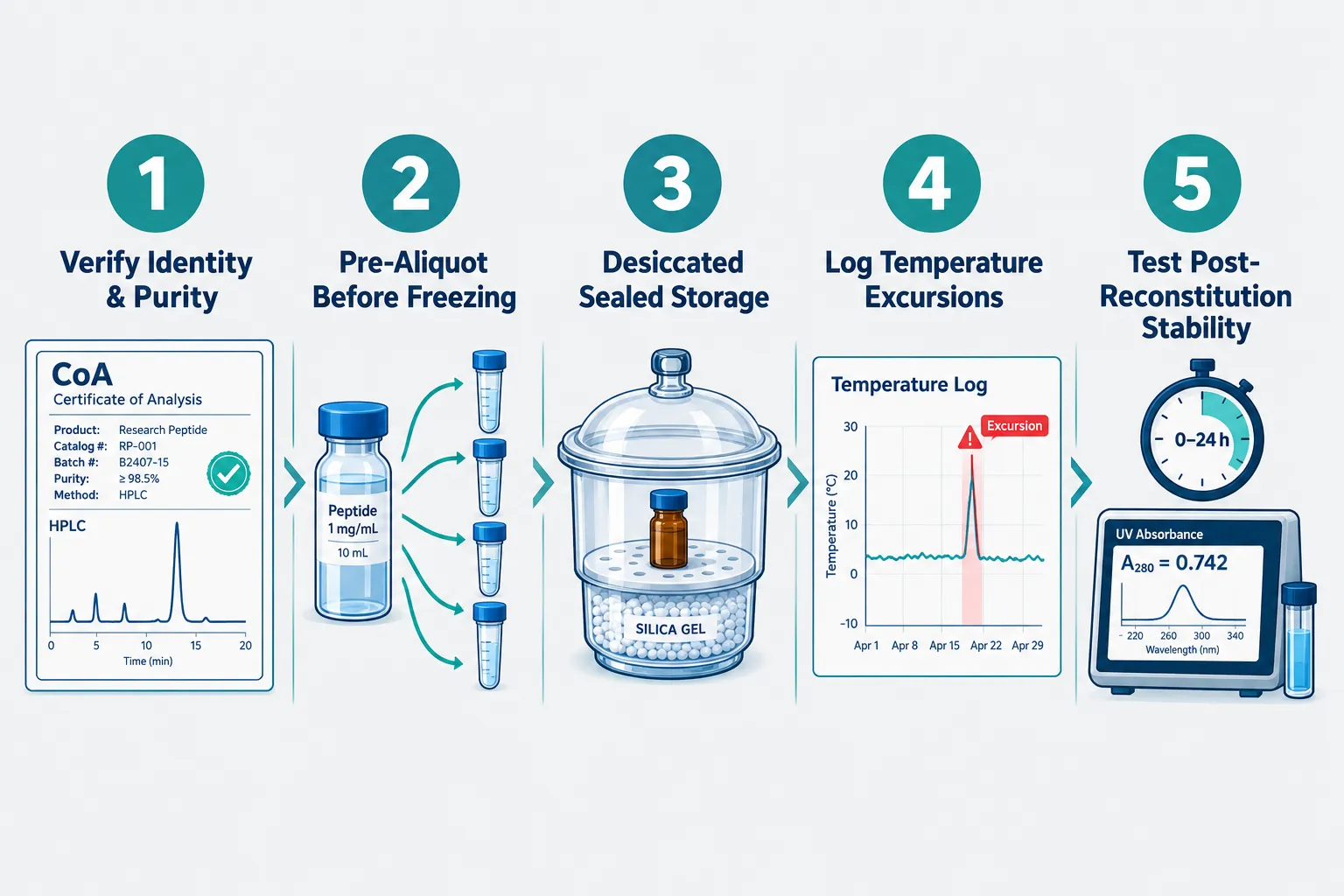
The following checklist consolidates regulatory guidance and practical supplier recommendations into a format applicable to lyophilized, liquid, and intranasal materials.
Step 1, Verify Identity and Purity Before Storage
Never store a peptide without confirming its certificate of analysis (CoA). Key data points to verify:
| Parameter | Minimum Standard |
|---|---|
| Purity (HPLC) | ≥95% for most research uses |
| Molecular weight (MS) | Matches theoretical sequence mass |
| Sequence confirmation | Amino acid analysis or MS/MS |
| Counterion content | Noted (TFA vs. acetate affects solubility) |
For metabolic research peptides, resources like the GLP-1 peptide buy generational research concepts and sourcing notes page illustrate how purity documentation shapes downstream sourcing decisions.
Step 2, Match Temperature to Formulation and Sequence
- Lyophilized powder: -20°C (standard); -80°C for sequences with Cys, Met, or Trp residues or any history of oxidation issues.
- Liquid solution (short-term): 2-8°C, light-protected, oxygen-limited buffer, maximum one to two weeks.
- Liquid solution (long-term): -20°C to -80°C in pre-aliquoted single-use volumes.
- Intranasal formulations: follow in-vitro stability data; generally 2-8°C for finished formulations, with dedicated stability endpoints in simulated nasal fluid.
Peptides with deliquescent residues (Asp, Glu, Lys, Arg, His) must be kept away from humidity at every stage, including during weighing and reconstitution. Vials should be warmed to room temperature while sealed before opening to prevent condensation on the powder.
Step 3, Control Container, Closure and Headspace
- Use amber glass vials or opaque polypropylene tubes rated for the storage temperature.
- Backfill with dry inert gas (argon or nitrogen) before sealing to limit oxidative degradation.
- Include silica gel desiccant in the outer packaging, not inside the vial.
- For copper-containing peptides such as GHK-Cu, container material matters; the GHK-Cu peptide purchase copper peptide research sourcing guide addresses metal-specific handling considerations.
Step 4, Pre-Aliquot to Limit Freeze, Thaw Cycles
A single vial of lyophilized peptide should be reconstituted into the smallest volume that covers a defined experimental series, then immediately divided into single-use aliquots. Label each aliquot with:
- Peptide name and lot number
- Reconstitution date and solvent used
- Concentration
- Assigned retest date
- Freeze, thaw cycle count (max two to three recommended)
Step 5, Document Temperature Excursions and Retest Dates
Regulatory frameworks built around ICH Q1 and Q6B principles require that retest periods be formally justified by stability data. Research labs should mirror this approach with basic temperature logging. A simple freezer log noting any excursion above -15°C, even brief, allows researchers to flag compromised batches before they corrupt an experiment. For peptides with mitochondrial research applications, stable lot-to-lot consistency is especially critical; see SS-31 mitochondrial research themes for context on how stability affects mechanistic interpretation.
Post-Reconstitution Stability and Sequence-Specific Risk Flags
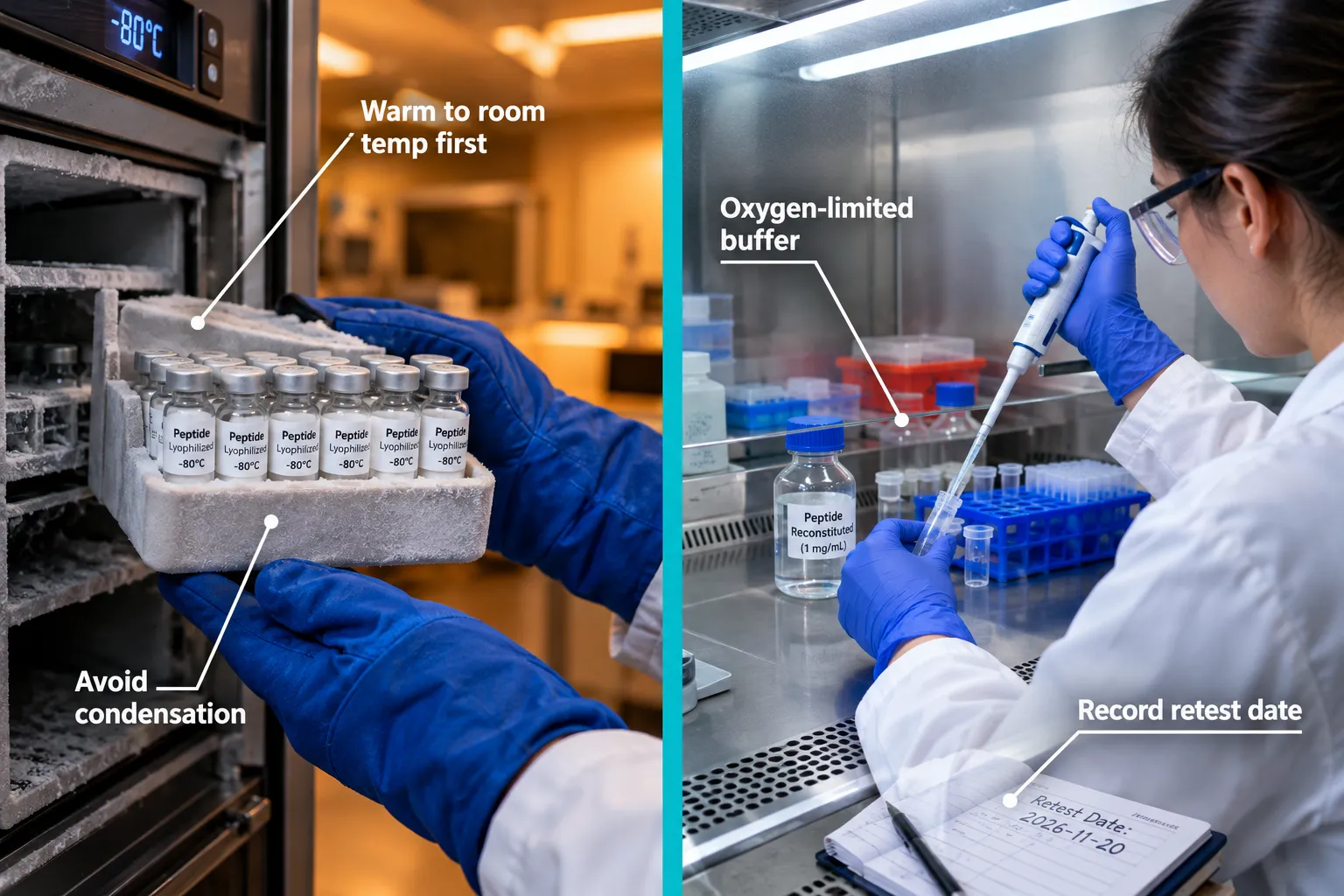
Post-reconstitution stability is where most research-grade peptide losses occur undetected. A peptide that was 98% pure at lyophilization may fall below 90% after two weeks in aqueous buffer at 4°C, particularly if:
- Oxygen is present in the vial headspace (Cys, Met, Trp oxidation)
- pH drifts above 7.5 (accelerates Asn deamidation and Asp hydrolysis)
- Light exposure is not controlled (aromatic residue photodegradation)
- Repeated warming introduces thermal stress cycles
For research teams working with novel dual- or triple-agonist compounds, stability considerations compound quickly. The BPC-157 core peptides documentation first research guide and the GLP-3 for sale triple agonist research planning and catalog navigation guide both highlight how formulation decisions interact with experimental design.
A practical post-reconstitution stability checklist should include:
- Baseline HPLC purity reading on day zero.
- Repeat purity check at the planned end of use (e.g., day seven or day fourteen).
- Visual inspection for turbidity or particulate formation (early aggregation signal).
- pH confirmation if the peptide is buffer-sensitive.
- Discard and re-aliquot if purity drops more than two percentage points or if any turbidity appears.
Conclusion
Research-Use Peptide Storage and Stability: A Quality-Control Checklist for Lyophilized, Liquid, and Intranasal Materials is not a peripheral concern, it is a foundational variable in experimental reproducibility. The actionable steps are clear:
- Confirm identity and purity via CoA before any storage decision.
- Default to lyophilized format stored at -20°C or -80°C in sealed, desiccated, inert-gas-backfilled containers.
- Aliquot all solutions before freezing; never exceed three freeze, thaw cycles.
- Apply sequence-specific risk flags for oxidation-prone (Cys, Met, Trp) and hygroscopic (Asp, Glu, Lys, Arg, His) residues.
- Log temperature excursions, reconstitution dates, and retest deadlines for every lot.
- For intranasal materials, complete in-vitro enzymatic stability testing before finalizing storage parameters.
Researchers who treat storage as a documented scientific variable, not an afterthought, produce more reliable data, reduce waste, and maintain the integrity of every downstream assay.


Leave a Reply
Want to join the discussion?Feel free to contribute!