Call or Text 727-513-9780
  • Shopping Cart Shopping Cart
    0Shopping Cart
Pure Tested Peptides | America's most trusted Peptides for sale online
  • Peptides for sale
    • Oral Peptides for sale
      • Peptide Capsules for sale
      • BPC 157 Capsules 1000mcg
      • SLU-PP-332 Capsules | 1000 mcg
      • 5-Amino-1MQ 50mg Capsules
      • Tesofensine 500mcg
    • All Peptides for sale
    • Peptide Sprays
      • BPC 157 Nasal Spray Kit
      • BPC-157 TB500 Nasal Spray Kit
      • Semax Nasal Spray 10mg
      • Selank – Nasal Spray Kit – 10mg
      • Epithalon 50MG Nasal Spray Kit
      • Ipamorelin 10mg Nasal Spray
      • Klow Nasal Spray (BPC-157 + TB-500 + GHK-Cu + KPV) | 80mg
      • Hulk Nasal Spray Tesa / Ipa Blend 6/3 MG
      • Klow Nasal Spray
      • NAD + 500 mg Nasal Spray
      • PT-141 Nasal Spray Kit
    • GHRH Peptides
      • Ipa Peptides
      • CJC-1295 Peptides
        • CJC-1295 with DAC 5 mg
        • CJC-1295 without DAC 5 mg
        • CJC-1295 Ipa 10mg
      • Tesa Peptides
        • Tesa Peptide
        • Tesa 20 mg
    • GHK-Cu Peptides
      • All GHK-Cu Peptides
      • GHK-Cu 100mg
      • KLOW Peptide Blend – Buy KLOW blend online
    • BPC Peptides
      • All BPC Peptides
      • BPC-157
      • BPC-157 TB-500
      • BPC 157 capsules 1000mcg
    • SLU-PP-332 Peptides
      • All SLU-PP-332 Peptides
      • SLU-PP-332 5mg
    • GLP3 Peptides
    • PT-141 Peptides
      • PT-141 Peptides for sale
      • PT-141 10mg
      • PT-141 Nasal Spray
    • CAG Peptides
      • Lipo-C Peptide Blend
      • CAG 5mg
      • CAG 10mg
    • MOTS-C Peptides
      • MOTS-C Peptides for sale
      • MOTS-c peptide
      • MOTS-c 10mg *6 pack*
    • 5 Amino 1MQ Peptides
      • 5 Amino 1MQ Peptides for sale
      • 5-Amino-1MQ 50mg Capsules
      • 5-Amino-1MQ 5mg
    • Epithalon Peptides
      • Epithalon Peptides for sale
      • Epithalon 10mg
      • Epithalon 50mg
  • Shop
    • GLPs
      • 5-Amino-1MQ 50mg Capsules
      • 5-Amino-1MQ 5mg
      • L-Carnitine 500mg/ml
      • Tesofensine 500mcg
      • SLU-PP-332 5mg
      • MOTS-c 10mg *6 pack*
    • Epithalon & BPC Peptides
      • Epithalon 10mg
      • Epithalon 50mg
      • BPC-157
      • BPC 157 capsules 1000mcg
      • BPC-157 TB-500
      • BPC-157 TB500 Nasal Spray Kit
      • BPC 157 Nasal Spray Kit
    • BPC TB-500 & NAD+ Peptides
      • NAD+ 500 mg
      • KLOW Peptide Blend – Buy KLOW blend online
      • GLOW Peptide Blend
      • TB 500 5mg
      • BPC 157 capsules 1000mcg – Supplement
      • BPC 157 Nasal Spray Kit
      • BPC-157
      • BPC-157 TB500 Nasal Spray Kit
      • BPC-157 TB-500
      • BPC 157 capsules 1000mcg
    • LL-37 Peptide
      • LL-37 10 mg
    • MOTS-C & Selank
      • MOTS-c peptide
      • Selank 10mg
    • GHK Peptides
      • GHK-Cu 100mg
      • GLOW Peptide Blend
      • KLOW Peptide Blend – Buy KLOW blend online
  • COAs
  • Wholesale
    • Wholesale Peptides for sale
  • PTP FAQ
  • Affiliates
    • Selank Peptide: Advanced Pharmacological Mechanisms Underlying Its Anxiolytic and Nootropic Effects in Research
      • 5-Amino-1MQ Peptide: Detailed Mechanisms of NNMT Inhibition and Its Impact on Cellular Metabolism Research
        • MOTS-C Peptide: Unraveling Its Role in Mitochondrial Dynamics and Energy Metabolism Research
          • Epithalon Peptide and Telomerase Regulation: Investigating Its Impact on Cellular Senescence and Lifespan Research Models
            • GLP2-T vs GLP2 Tirz Peptide: Understanding the Naming, Mechanistic Nuances, and Research Implications for Gut Health
      • Peptides and Polypeptides in Modern Pharmacology: What Research on Metoprolol, Prednisone, and Amlodipine Reveals
        • Polypeptide Peptides vs NSAIDs: What Naproxen and Diclofenac Teach Tissue-Repair Researchers About BPC‑157 and TB‑500
          • Peptides and Polypeptides in Endocrine Pharmacology: How GLP-1, GLP-2, and GLP-3 Retatrutide Differ From Classic Drugs Like Prednisone and Amlodipine
          • 5‑Amino‑1MQ Peptide and NNMT Inhibition: How It Compares With Statins Like Atorvastatin in Adipose and Lipid Metabolism Research
      • Enclomiphene, Estrogen Receptor Signaling, and Luteinizing Phase Biology: What Hormone Researchers Should Measure
        • Mesenchymal Stem Cells, BPC‑157, and GHK‑Cu: How Tissue Repair Peptides Compare With Classic NSAIDs Like Naproxen in Injury Models
          • Peptide Calculator Use Cases Beyond Growth Hormone: Working Through GLP‑3 Retatrutide, MOTS‑c, and BPC‑157 Research Dosing
        • Polypeptide Peptides in Endocrine and Metabolic Pharmacology: Lessons From Amlodipine, Prednisone, and Metoprolol
        • Peptides Calculator for Advanced Blends: Worked Examples for Tesamorelin, CJC‑1295, and Ipamorelin Stacks
          • Peptides and Polypeptides in Human Physiology: How Molecular Size Shapes Research Applications
            • Selank Peptide: Advanced Pharmacological Mechanisms Underlying Its Anxiolytic and Nootropic Effects in Research
          • 5-Amino-1MQ Peptide: Detailed Mechanisms of NNMT Inhibition and Its Impact on Cellular Metabolism Research
            • MOTS-C Peptide: Unraveling Its Role in Mitochondrial Dynamics and Energy Metabolism Research
              • Epithalon Peptide and Telomerase Regulation: Investigating Its Impact on Cellular Senescence and Lifespan Research Models
                • GLP2-T vs GLP2 Tirz Peptide: Understanding the Naming, Mechanistic Nuances, and Research Implications for Gut Health
                  • Peptides and Polypeptides in Endocrine Pharmacology: How GLP-1, GLP-2, and GLP-3 Retatrutide Differ From Classic Drugs Like Prednisone and Amlodipine
                    • Polypeptide Peptides vs NSAIDs: What Naproxen and Diclofenac Teach Tissue-Repair Researchers About BPC‑157 and TB‑500
                      • Peptides and Polypeptides in Modern Pharmacology: What Research on Metoprolol, Prednisone, and Amlodipine Reveals
                        • 5‑Amino‑1MQ Peptide and NNMT Inhibition: How It Compares With Statins Like Atorvastatin in Adipose and Lipid Metabolism Research
                        • Enclomiphene, Estrogen Receptor Signaling, and Luteinizing Phase Biology: What Hormone Researchers Should Measure
                        • Mesenchymal Stem Cells, BPC‑157, and GHK‑Cu: How Tissue Repair Peptides Compare With Classic NSAIDs Like Naproxen in Injury Models
                        • Peptide Calculator Use Cases Beyond Growth Hormone: Working Through GLP‑3 Retatrutide, MOTS‑c, and BPC‑157 Research Dosing
                        • Polypeptide Peptides in Endocrine and Metabolic Pharmacology: Lessons From Amlodipine, Prednisone, and Metoprolol
                        • Peptides Calculator for Advanced Blends: Worked Examples for Tesamorelin, CJC‑1295, and Ipamorelin Stacks
                        • Peptides and Polypeptides in Human Physiology: How Molecular Size Shapes Research Applications
                        • Selank Peptide: Advanced Pharmacological Mechanisms Underlying Its Anxiolytic and Nootropic Effects in Research
                        • MOTS-C Peptide: Unraveling Its Role in Mitochondrial Dynamics and Energy Metabolism Research
                        • Peptides and Polypeptides in Modern Pharmacology: What Research on Metoprolol, Prednisone, and Amlodipine Reveals
                        • Peptides and Polypeptides in Endocrine Pharmacology: How GLP-1, GLP-2, and GLP-3 Retatrutide Differ From Classic Drugs Like Prednisone and Amlodipine
                        • 5-Amino-1MQ Peptide: Detailed Mechanisms of NNMT Inhibition and Its Impact on Cellular Metabolism Research
                        • Mesenchymal Stem Cells, BPC‑157, and GHK‑Cu: How Tissue Repair Peptides Compare With Classic NSAIDs Like Naproxen in Injury Models
                        • Peptide Calculator Use Cases Beyond Growth Hormone: Working Through GLP‑3 Retatrutide, MOTS‑c, and BPC‑157 Research Dosing
                        • GLP2-T vs GLP2 Tirz Peptide: Understanding the Naming, Mechanistic Nuances, and Research Implications for Gut Health
                        • Polypeptide Peptides in Endocrine and Metabolic Pharmacology: Lessons From Amlodipine, Prednisone, and Metoprolol
                        • Polypeptide Peptides vs NSAIDs: What Naproxen and Diclofenac Teach Tissue-Repair Researchers About BPC‑157 and TB‑500
                        • Peptides and Polypeptides in Human Physiology: How Molecular Size Shapes Research Applications
                        • Peptides Calculator for Advanced Blends: Worked Examples for Tesamorelin, CJC‑1295, and Ipamorelin Stacks
                        • 5‑Amino‑1MQ Peptide and NNMT Inhibition: How It Compares With Statins Like Atorvastatin in Adipose and Lipid Metabolism Research
                        • Enclomiphene, Estrogen Receptor Signaling, and Luteinizing Phase Biology: What Hormone Researchers Should Measure
                        • Epithalon Peptide and Telomerase Regulation: Investigating Its Impact on Cellular Senescence and Lifespan Research Models
                        • Best research protocol Klow blend
                        • best time to take BPC-157
                        • best time to take DSIP (Delta Sleep Inducing Peptide)
                        • best time to take CJC-1295
                        • best time to take AOD-9604
                        • best time to take Follistatin 344
                        • best time to take Ipamorelin
                        • best time to take MK-677 (Ibutamoren)
                        • best time to take Ligandrol (LGD-4033) — research compound
                        • best time to take Ostarine (MK-2866) — research compound
                        • best time to take GHK-CU
                        • best time to take TB-500
                        • best time to take MOTS-c
                        • best time to take Semax
                        • best time to take RAD-140 (Testolone) — research compound
                        • best time to take Thymosin Alpha-1
                        • best time to take PEG-MGF
                        • Biolife Plasma, Octapharma Plasma, and Research Peptides: How Plasma Donation Labs Differ From Peptide Suppliers
                        • best time to take YK-11 — research compound
                        • best time to take PT-141 (Bremelanotide)
                        • Best research protocol Klow blend
                        • 5-Amino-1MQ and MOTS-C Synergy: Metabolic Signaling, Mitochondria, and Research Design
                        • BPC-157 and TB-500: Investigating Their Combined Effects on Angiogenesis and Cellular Migration in Tissue Repair Models
                        • BPC-157 Peptide: Gut Barrier Function, Inflammation, and Tissue-Recovery Research
                        • 5‑Amino‑1MQ and MOTS‑c Synergy in Metabolic Research: Designing NNMT and Mitochondrial Biogenesis Stacks
                        • CJC-1295 with DAC vs. Without DAC: Half-Life, Release Kinetics, and Research Implications
                        • CJC‑1295 with DAC vs. Without DAC: Expanding on Half‑Life Differences Using Tesamorelin and Ipamorelin Blend Case Studies
                        • Collagen Biology and Copper‑Binding Peptides: How GHK‑Cu, Glow Blend, and Klow Blend Interact with Skin and Connective Tissue
                        • Collagen Biology and Regenerative Peptides: How GHK‑Cu, Glow Blend, and Klow Blend Affect Extracellular Matrix Research
                    • DNA, Telomeres, and Longevity Peptides: Positioning Epithalon and MOTS‑c in Genetic Aging Research
                      • Enclomiphene Citrate: serm Mechanism, Testosterone Research, and Stack Compatibility
                        • Enclomiphene vs Enclomiphene Citrate: Formulation, Bioavailability, and Research Distinctions
                        • Epithalon Peptide Research: Telomerase Activation, Aging, and Pineal Gland Function
                        • Estrogen Receptor Signaling and Enclomiphene: How Selective Modulators Compare with Classic Polypeptide Hormones
                        • GHK-Cu Peptide: Advanced Mechanisms in Extracellular Matrix Remodeling and Wound Healing Research
                        • GHK-Cu Peptide: Collagen Synthesis, Wound Repair, and Skin-Barrier Research Models
                        • GLP-1 vs GLP-3 vs GLP-2: Peptide Classification and Research Applications
                        • GLP-2 Peptide Research Guide: Gut Barrier Function, Nutrient Absorption, and Intestinal Recovery Models
                        • GLP-3 Retatrutide vs. GLP-1 Drugs: What Triple-Agonist Biology Changes in Research Models
                        • Ipamorelin and Tesamorelin Combination: Synergistic GH Secretagogue Research and Dosing Protocols
                        • GLP2 Tirz Peptide: What It Is, Why the Name Exists, and How Researchers Should Interpret It
                        • Klow Blend Peptide Nasal Spray: What the Formulation Is Trying to Do in Cognitive Research
                        • Mitochondria, NNMT Inhibition, and Peptide Modulators: Where MOTS‑c and 5‑Amino‑1MQ Fit in Cellular Energy Research
                        • MOTS-c Peptide: Mitochondrial Function, Energy Metabolism, and What Researchers Measure
                        • MOTS-c vs. 5-Amino-1MQ: Which Metabolic Research Questions Each Compound Actually Answers
                        • Nasal Spray Peptides: Bioavailability, Administration, and Semax/Selank Research Applications
                        • PT-141 Peptide Research: Mechanism of Action and Melanocortin Receptor Signaling
                        • Retatrutide for Research: Mechanism, Structure, and GLP-1/GLP-3 Dual Action
                        • Retatrutide for Obesity and Type 2 Diabetes: What the Latest Trial Data Suggest
                        • Tesofensine Peptide Research: Mechanism, Appetite Suppression, and Neuropeptide Y Pathways
  • Contact
    • Contact Customer Service
    • Text Customer Support
  • About US
  • Shop all peptides
  • Affiliate Program
    • Affiliate Signup
  • Login / Register Login / Register Page Link Login / Register Page Link
  • Click to open the search input field Click to open the search input field Search
  • Menu Menu

Tag Archive for: inflammatory cytokines

Prednisone and Peptide Immunomodulation: How Classic Steroids Compare With BPC-157, GHK-Cu, and GLP-Class Peptides in Inflammatory Research

Prednisone and Peptide Immunomodulation: How Classic Steroids Compare With BPC-157, GHK-Cu, and GLP-Class Peptides in Inflammatory Research

September 20, 2026/0 Comments/in Uncategorized/by

More than 30 million prescriptions for oral corticosteroids are written annually in the United States alone, yet a growing body of bench research is asking whether peptide-based compounds might one day complement or refine how science approaches inflammatory signaling. The field of prednisone and peptide immunomodulation: how classic steroids compare with BPC-157, GHK-Cu, and GLP-class peptides in inflammatory research sits at an important crossroads between established pharmacology and early-stage discovery science.

This article examines the mechanistic differences between glucocorticoid immunosuppression and peptide-mediated tissue modulation, strictly within the context of preclinical and translational research models.

Key Takeaways

  • Prednisone is a well-characterized glucocorticoid with a defined mechanism, extensive clinical data, and regulatory approval for dozens of inflammatory conditions.
  • BPC-157 shows consistent anti-inflammatory signals in animal models but has zero completed, peer-reviewed human efficacy trials as of 2026.
  • GHK-Cu demonstrates immunomodulatory activity in zebrafish and mouse models, with no human randomized trial data for inflammatory indications.
  • GLP-class peptides intersect metabolic and inflammatory pathways in emerging research, representing a distinct mechanistic category from classical steroids.
  • Evidence gaps between preclinical promise and clinical validation remain the defining challenge across all peptide candidates reviewed here.

How Prednisone Suppresses Inflammation: The Glucocorticoid Benchmark
How Prednisone Suppresses Inflammation: The Glucocorticoid Benchmark

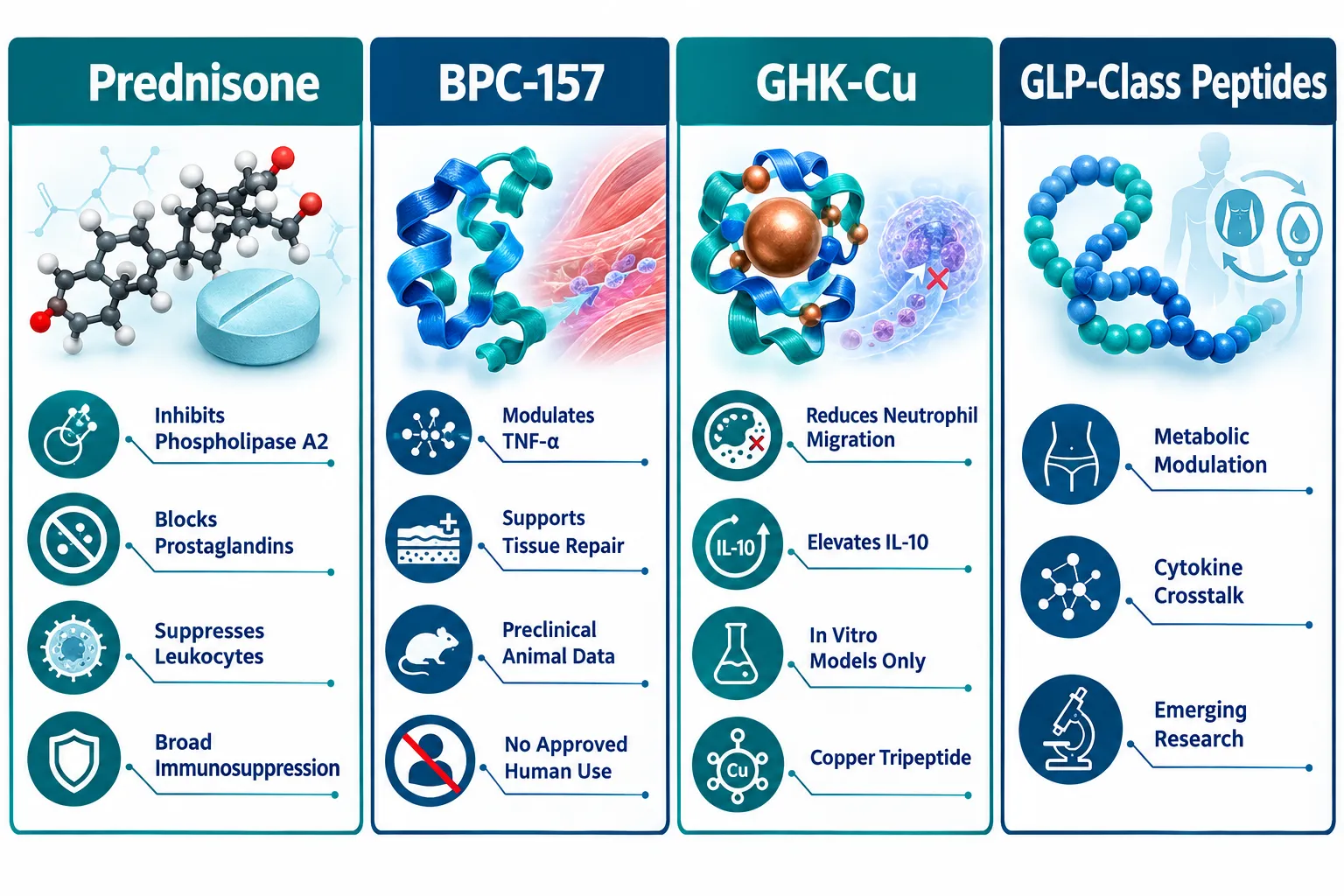
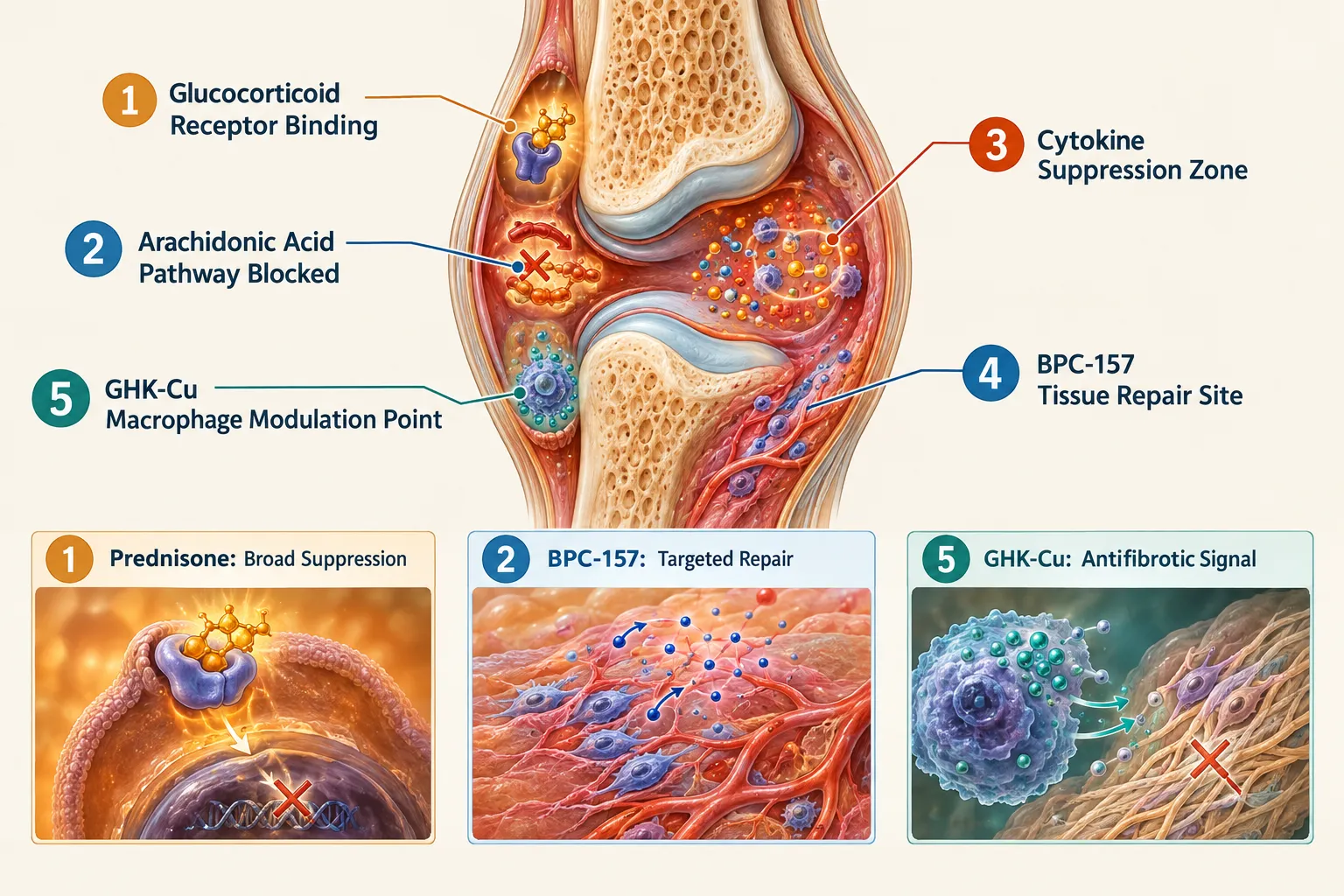
Prednisone functions as a prodrug, converting to prednisolone in the liver before exerting its effects. As a prototypical glucocorticoid, it suppresses inflammation through several well-documented pathways. It inhibits phospholipase A2, blocking the release of arachidonic acid and thereby reducing downstream production of both prostaglandins and leukotrienes. It also suppresses polymorphonuclear leukocyte migration and reverses increased capillary permeability, two hallmarks of acute tissue inflammation.

These mechanisms are broad by design. Prednisone does not selectively target one cytokine or one tissue type; it modulates the inflammatory response systemically. A 2025 translational analysis published in Theranostics added important nuance: RNA-sequencing data showed that prednisolone was most effective at reducing brain inflammatory signaling pathways in a CNS inflammation model, while prednisone itself had no significant effect on inflammation-related signaling in that specific tissue context. This finding underscores that even within the glucocorticoid class, tissue-specific immunomodulation varies considerably.

What makes prednisone the benchmark for comparison?

  • Decades of pharmacokinetic and pharmacodynamic data
  • Defined dose-response relationships across multiple inflammatory conditions
  • Established risk-benefit frameworks including adrenal suppression, bone density effects, and metabolic consequences
  • Regulatory approval and clinical guideline integration worldwide

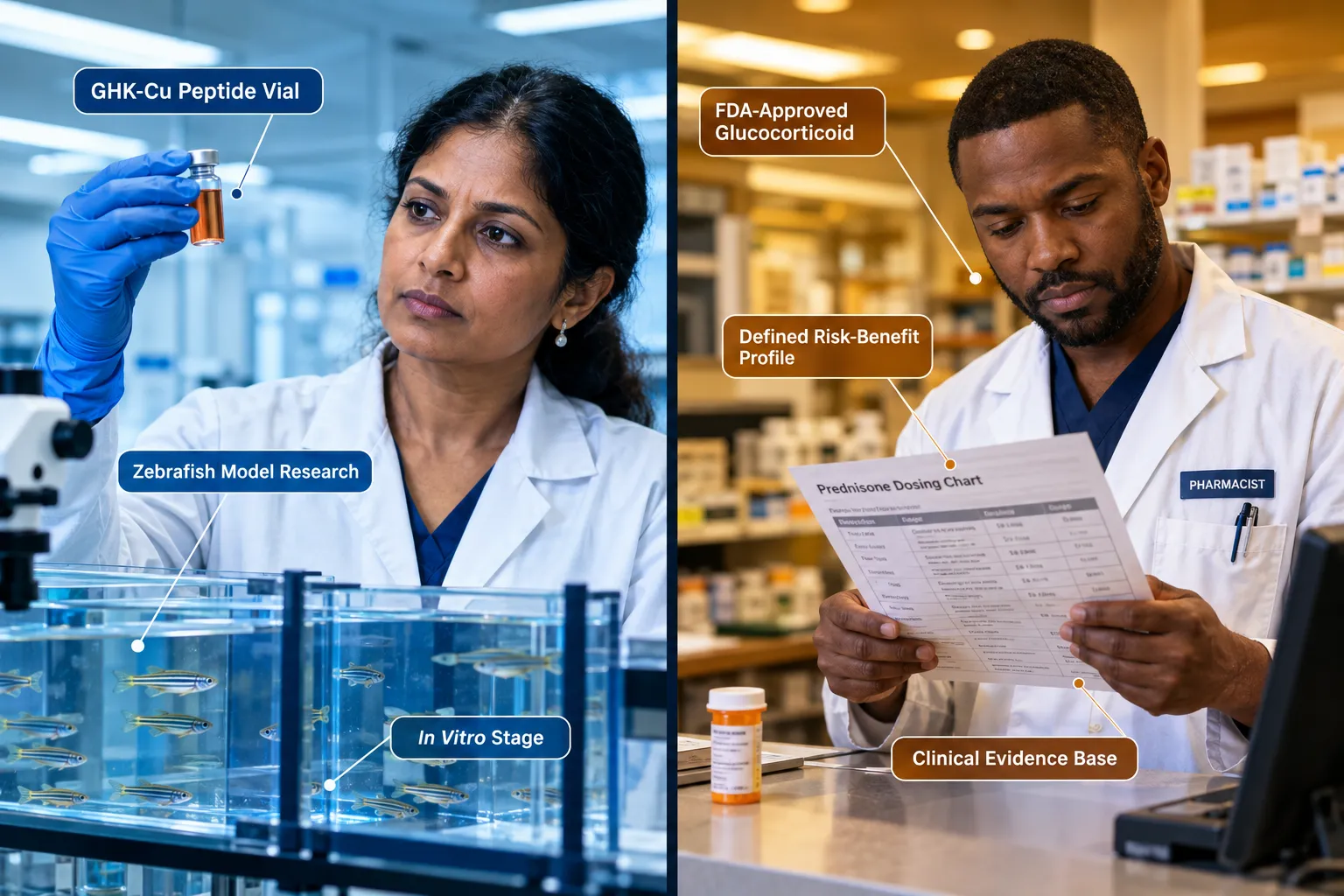
This depth of evidence is precisely what makes it a useful comparator when evaluating emerging peptide candidates.

BPC-157 and GHK-Cu: Preclinical Signals and Evidence Gaps
BPC-157 and GHK-Cu: Preclinical Signals and Evidence Gaps

BPC-157: Tissue Repair Peptide With a Thin Human Evidence Base

BPC-157 is a synthetic 15-amino-acid peptide derived from a protein found in gastric juice. In preclinical models, it has demonstrated the ability to significantly decrease pro-inflammatory cytokines including TNF-α, IL-6, and IFN-γ, while also supporting tissue repair across musculoskeletal, gastrointestinal, and neurological animal models. More than 100 animal studies have explored its properties.

However, the human evidence picture is starkly different. A 2025 systematic review synthesized 36 studies, 35 of which were animal studies and one was an uncontrolled human chart review, and found zero completed controlled human efficacy trials. Available human data consist of three small pilot studies covering intra-articular knee pain, interstitial cystitis, and an intravenous safety and pharmacokinetics study in two healthy adults at doses up to 20 mg. These studies primarily demonstrate short-term tolerability rather than proven efficacy.

The most notable human signal comes from an unpublished Croatian Phase II study in 53 adults with mild-to-moderate ulcerative colitis. A 40 mL enema containing 80 mg BPC-157 once daily for 14 days reportedly yielded 38% clinical remission at week 4 versus 13% with placebo. Because the full study report, statistical analysis plan, and longer-term follow-up data were never published, regulators classify this evidence as "very low certainty." BPC-157 currently holds no FDA approval for any indication and no publicly listed IND authorization for inflammation. Researchers interested in peptide dosing protocols should note that optimal dosing, systemic adverse effects, and comparative effectiveness versus glucocorticoids remain undefined in humans.

One active development is a 120-patient Phase 2 double-blind, placebo-controlled study of injectable BPC-157 for grade II hamstring strain, but no efficacy outcomes have been reported publicly as of mid-2026.

GHK-Cu: Copper Tripeptide With Antifibrotic and Anti-Inflammatory Signals

GHK-Cu (glycine-histidine-lysine copper) offers a mechanistically distinct profile. A 2026 zebrafish larvae model of chemically induced inflammation showed that GHK-Cu reduced both neutrophil and macrophage migration, lowered pro-inflammatory cytokines, and increased the anti-inflammatory cytokine IL-10. A 2024 mouse model of silicosis found that GHK-Cu attenuated lung inflammation and fibrosis, identifying peroxiredoxin-6 (PRDX6) as a molecular binding target, with no significant systemic toxicity at tested doses.

Researchers exploring GHK-Cu peptides for sale for laboratory use should understand that current evidence remains restricted to animal and in vitro models. No human randomized trials or dose-finding studies exist for inflammatory indications.

GLP-Class Peptides and the Broader Landscape of Peptide Immunomodulation
GLP-Class Peptides and the Broader Landscape of Peptide Immunomodulation

GLP-class peptides represent a distinct mechanistic category within the broader field of prednisone and peptide immunomodulation: how classic steroids compare with BPC-157, GHK-Cu, and GLP-class peptides in inflammatory research. Originally characterized for their metabolic roles in glucose homeostasis and satiety signaling, GLP-class compounds are now being studied for their intersection with inflammatory cytokine networks. Research models suggest that GLP receptor activation can modulate macrophage polarization and reduce systemic inflammatory markers, creating a potential bridge between metabolic and immune regulation.

Those following developments in this space can explore research-grade options such as GLP-3 peptide for sale or the GLP-3R 10mg peptide GA10 for laboratory investigation. Additional GLP-class compounds are catalogued under GLP-3 peptides for sale for researchers tracking this category.

Research Perspective: The mechanistic gap between glucocorticoid broad-spectrum immunosuppression and peptide-targeted tissue modulation is not simply a matter of potency, it reflects fundamentally different biological strategies. Steroids suppress; some peptides appear to redirect or repair.

Comparing the Evidence Tiers

Compound Primary Mechanism Human Trial Data Regulatory Status
Prednisone Phospholipase A2 inhibition, broad immunosuppression Extensive RCT database FDA-approved, multiple indications
BPC-157 Cytokine modulation, tissue repair 3 pilot studies, no efficacy RCTs No approval, experimental
GHK-Cu Neutrophil/macrophage modulation, antifibrotic None (animal/in vitro only) No approval, research stage
GLP-class Metabolic-immune crosstalk Metabolic indications only Approved for metabolic use; inflammatory use experimental

For researchers sourcing compounds across multiple peptide categories, working with a best peptide supplier that provides verified purity documentation is essential for maintaining experimental integrity.

Conclusion

The comparison at the heart of prednisone and peptide immunomodulation: how classic steroids compare with BPC-157, GHK-Cu, and GLP-class peptides in inflammatory research reveals a fundamental asymmetry in the evidence base. Prednisone operates within a thoroughly characterized pharmacological framework built over decades of clinical research. BPC-157 and GHK-Cu show genuine mechanistic interest in preclinical models, but neither has cleared the threshold of controlled human efficacy data. GLP-class peptides occupy a third lane, metabolically validated but with inflammatory applications still in early research phases.

Actionable next steps for researchers and science communicators:

  • Treat BPC-157 and GHK-Cu findings as hypothesis-generating, not practice-defining, until controlled human trials are completed and published.
  • Monitor the ClinicalTrials.gov registry for emerging Phase 2 and Phase 3 peptide trials that may shift the evidence landscape in the next three to five years.
  • When sourcing research-grade peptides, prioritize suppliers with third-party purity verification and transparent certificates of analysis.
  • Recognize that mechanistic novelty in animal models does not translate automatically to clinical equivalence with established agents like prednisone.

The science is moving, but the evidence must lead.

https://www.puretestedpeptides.com/wp-content/uploads/2026/09/prednisone-and-peptide-immunomodulation-how-classic-steroids-compare-with-bpc-15.webp 1024 1536 https://www.puretestedpeptides.com/wp-content/uploads/2026/01/buy-peptides-online.jpg 2026-09-20 13:06:152026-09-20 13:06:15Prednisone and Peptide Immunomodulation: How Classic Steroids Compare With BPC-157, GHK-Cu, and GLP-Class Peptides in Inflammatory Research
×

Helpful Links

  • My account
  • Cart
  • Checkout
  • Refund and Returns Policy
  • Privacy Policy
  • SMS Privacy Policy
  • Login
  • My Account
  • Logout

USA Made Lab Tested Peptides

All products are sold for research, laboratory, or analytical purposes only, and are not for human consumption


Pure Tested Peptides is a chemical supplier. Pure Tested Peptides is not a compounding / chemical compounding facility as defined under 503A of the Federal Food, Drug, and Cosmetic act. Pure Tested Peptides is not an outsourcing facility as defined under 503B of the Federal Food, Drug, and Cosmetic act.

The statements made within this website have not been evaluated by the US Food and Drug Administration. The products we offer are not intended to diagnose, treat, cure or prevent any disease.

Human/Animal Consumption Prohibited. Laboratory/In-Vitro Experimental Use Only

Scroll to top Scroll to top Scroll to top