Call or Text 727-513-9780
  • Shopping Cart Shopping Cart
    0Shopping Cart
Pure Tested Peptides | America's most trusted Peptides for sale online
  • Peptides for sale
    • Oral Peptides for sale
      • Peptide Capsules for sale
      • BPC 157 Capsules 1000mcg
      • SLU-PP-332 Capsules | 1000 mcg
      • 5-Amino-1MQ 50mg Capsules
      • Tesofensine 500mcg
    • All Peptides for sale
    • Peptide Sprays
      • BPC 157 Nasal Spray Kit
      • BPC-157 TB500 Nasal Spray Kit
      • Semax Nasal Spray 10mg
      • Selank – Nasal Spray Kit – 10mg
      • Epithalon 50MG Nasal Spray Kit
      • Ipamorelin 10mg Nasal Spray
      • Klow Nasal Spray (BPC-157 + TB-500 + GHK-Cu + KPV) | 80mg
      • Hulk Nasal Spray Tesa / Ipa Blend 6/3 MG
      • Klow Nasal Spray
      • NAD + 500 mg Nasal Spray
      • PT-141 Nasal Spray Kit
    • GHRH Peptides
      • Ipa Peptides
      • CJC-1295 Peptides
        • CJC-1295 with DAC 5 mg
        • CJC-1295 without DAC 5 mg
        • CJC-1295 Ipa 10mg
      • Tesa Peptides
        • Tesa Peptide
        • Tesa 20 mg
    • GHK-Cu Peptides
      • All GHK-Cu Peptides
      • GHK-Cu 100mg
      • KLOW Peptide Blend – Buy KLOW blend online
    • BPC Peptides
      • All BPC Peptides
      • BPC-157
      • BPC-157 TB-500
      • BPC 157 capsules 1000mcg
    • SLU-PP-332 Peptides
      • All SLU-PP-332 Peptides
      • SLU-PP-332 5mg
    • GLP3 Peptides
    • PT-141 Peptides
      • PT-141 Peptides for sale
      • PT-141 10mg
      • PT-141 Nasal Spray
    • CAG Peptides
      • Lipo-C Peptide Blend
      • CAG 5mg
      • CAG 10mg
    • MOTS-C Peptides
      • MOTS-C Peptides for sale
      • MOTS-c peptide
      • MOTS-c 10mg *6 pack*
    • 5 Amino 1MQ Peptides
      • 5 Amino 1MQ Peptides for sale
      • 5-Amino-1MQ 50mg Capsules
      • 5-Amino-1MQ 5mg
    • Epithalon Peptides
      • Epithalon Peptides for sale
      • Epithalon 10mg
      • Epithalon 50mg
  • Shop
    • GLPs
      • 5-Amino-1MQ 50mg Capsules
      • 5-Amino-1MQ 5mg
      • L-Carnitine 500mg/ml
      • Tesofensine 500mcg
      • SLU-PP-332 5mg
      • MOTS-c 10mg *6 pack*
    • Epithalon & BPC Peptides
      • Epithalon 10mg
      • Epithalon 50mg
      • BPC-157
      • BPC 157 capsules 1000mcg
      • BPC-157 TB-500
      • BPC-157 TB500 Nasal Spray Kit
      • BPC 157 Nasal Spray Kit
    • BPC TB-500 & NAD+ Peptides
      • NAD+ 500 mg
      • KLOW Peptide Blend – Buy KLOW blend online
      • GLOW Peptide Blend
      • TB 500 5mg
      • BPC 157 capsules 1000mcg – Supplement
      • BPC 157 Nasal Spray Kit
      • BPC-157
      • BPC-157 TB500 Nasal Spray Kit
      • BPC-157 TB-500
      • BPC 157 capsules 1000mcg
    • LL-37 Peptide
      • LL-37 10 mg
    • MOTS-C & Selank
      • MOTS-c peptide
      • Selank 10mg
    • GHK Peptides
      • GHK-Cu 100mg
      • GLOW Peptide Blend
      • KLOW Peptide Blend – Buy KLOW blend online
  • COAs
  • Wholesale
    • Wholesale Peptides for sale
  • PTP FAQ
  • Affiliates
    • Selank Peptide: Advanced Pharmacological Mechanisms Underlying Its Anxiolytic and Nootropic Effects in Research
      • 5-Amino-1MQ Peptide: Detailed Mechanisms of NNMT Inhibition and Its Impact on Cellular Metabolism Research
        • MOTS-C Peptide: Unraveling Its Role in Mitochondrial Dynamics and Energy Metabolism Research
          • Epithalon Peptide and Telomerase Regulation: Investigating Its Impact on Cellular Senescence and Lifespan Research Models
            • GLP2-T vs GLP2 Tirz Peptide: Understanding the Naming, Mechanistic Nuances, and Research Implications for Gut Health
      • Peptides and Polypeptides in Modern Pharmacology: What Research on Metoprolol, Prednisone, and Amlodipine Reveals
        • Polypeptide Peptides vs NSAIDs: What Naproxen and Diclofenac Teach Tissue-Repair Researchers About BPC‑157 and TB‑500
          • Peptides and Polypeptides in Endocrine Pharmacology: How GLP-1, GLP-2, and GLP-3 Retatrutide Differ From Classic Drugs Like Prednisone and Amlodipine
          • 5‑Amino‑1MQ Peptide and NNMT Inhibition: How It Compares With Statins Like Atorvastatin in Adipose and Lipid Metabolism Research
      • Enclomiphene, Estrogen Receptor Signaling, and Luteinizing Phase Biology: What Hormone Researchers Should Measure
        • Mesenchymal Stem Cells, BPC‑157, and GHK‑Cu: How Tissue Repair Peptides Compare With Classic NSAIDs Like Naproxen in Injury Models
          • Peptide Calculator Use Cases Beyond Growth Hormone: Working Through GLP‑3 Retatrutide, MOTS‑c, and BPC‑157 Research Dosing
        • Polypeptide Peptides in Endocrine and Metabolic Pharmacology: Lessons From Amlodipine, Prednisone, and Metoprolol
        • Peptides Calculator for Advanced Blends: Worked Examples for Tesamorelin, CJC‑1295, and Ipamorelin Stacks
          • Peptides and Polypeptides in Human Physiology: How Molecular Size Shapes Research Applications
            • Selank Peptide: Advanced Pharmacological Mechanisms Underlying Its Anxiolytic and Nootropic Effects in Research
          • 5-Amino-1MQ Peptide: Detailed Mechanisms of NNMT Inhibition and Its Impact on Cellular Metabolism Research
            • MOTS-C Peptide: Unraveling Its Role in Mitochondrial Dynamics and Energy Metabolism Research
              • Epithalon Peptide and Telomerase Regulation: Investigating Its Impact on Cellular Senescence and Lifespan Research Models
                • GLP2-T vs GLP2 Tirz Peptide: Understanding the Naming, Mechanistic Nuances, and Research Implications for Gut Health
                  • Peptides and Polypeptides in Endocrine Pharmacology: How GLP-1, GLP-2, and GLP-3 Retatrutide Differ From Classic Drugs Like Prednisone and Amlodipine
                    • Polypeptide Peptides vs NSAIDs: What Naproxen and Diclofenac Teach Tissue-Repair Researchers About BPC‑157 and TB‑500
                      • Peptides and Polypeptides in Modern Pharmacology: What Research on Metoprolol, Prednisone, and Amlodipine Reveals
                        • 5‑Amino‑1MQ Peptide and NNMT Inhibition: How It Compares With Statins Like Atorvastatin in Adipose and Lipid Metabolism Research
                        • Enclomiphene, Estrogen Receptor Signaling, and Luteinizing Phase Biology: What Hormone Researchers Should Measure
                        • Mesenchymal Stem Cells, BPC‑157, and GHK‑Cu: How Tissue Repair Peptides Compare With Classic NSAIDs Like Naproxen in Injury Models
                        • Peptide Calculator Use Cases Beyond Growth Hormone: Working Through GLP‑3 Retatrutide, MOTS‑c, and BPC‑157 Research Dosing
                        • Polypeptide Peptides in Endocrine and Metabolic Pharmacology: Lessons From Amlodipine, Prednisone, and Metoprolol
                        • Peptides Calculator for Advanced Blends: Worked Examples for Tesamorelin, CJC‑1295, and Ipamorelin Stacks
                        • Peptides and Polypeptides in Human Physiology: How Molecular Size Shapes Research Applications
                        • Selank Peptide: Advanced Pharmacological Mechanisms Underlying Its Anxiolytic and Nootropic Effects in Research
                        • MOTS-C Peptide: Unraveling Its Role in Mitochondrial Dynamics and Energy Metabolism Research
                        • Peptides and Polypeptides in Modern Pharmacology: What Research on Metoprolol, Prednisone, and Amlodipine Reveals
                        • Peptides and Polypeptides in Endocrine Pharmacology: How GLP-1, GLP-2, and GLP-3 Retatrutide Differ From Classic Drugs Like Prednisone and Amlodipine
                        • 5-Amino-1MQ Peptide: Detailed Mechanisms of NNMT Inhibition and Its Impact on Cellular Metabolism Research
                        • Mesenchymal Stem Cells, BPC‑157, and GHK‑Cu: How Tissue Repair Peptides Compare With Classic NSAIDs Like Naproxen in Injury Models
                        • Peptide Calculator Use Cases Beyond Growth Hormone: Working Through GLP‑3 Retatrutide, MOTS‑c, and BPC‑157 Research Dosing
                        • GLP2-T vs GLP2 Tirz Peptide: Understanding the Naming, Mechanistic Nuances, and Research Implications for Gut Health
                        • Polypeptide Peptides in Endocrine and Metabolic Pharmacology: Lessons From Amlodipine, Prednisone, and Metoprolol
                        • Polypeptide Peptides vs NSAIDs: What Naproxen and Diclofenac Teach Tissue-Repair Researchers About BPC‑157 and TB‑500
                        • Peptides and Polypeptides in Human Physiology: How Molecular Size Shapes Research Applications
                        • Peptides Calculator for Advanced Blends: Worked Examples for Tesamorelin, CJC‑1295, and Ipamorelin Stacks
                        • 5‑Amino‑1MQ Peptide and NNMT Inhibition: How It Compares With Statins Like Atorvastatin in Adipose and Lipid Metabolism Research
                        • Enclomiphene, Estrogen Receptor Signaling, and Luteinizing Phase Biology: What Hormone Researchers Should Measure
                        • Epithalon Peptide and Telomerase Regulation: Investigating Its Impact on Cellular Senescence and Lifespan Research Models
                        • Best research protocol Klow blend
                        • best time to take BPC-157
                        • best time to take DSIP (Delta Sleep Inducing Peptide)
                        • best time to take CJC-1295
                        • best time to take AOD-9604
                        • best time to take Follistatin 344
                        • best time to take Ipamorelin
                        • best time to take MK-677 (Ibutamoren)
                        • best time to take Ligandrol (LGD-4033) — research compound
                        • best time to take Ostarine (MK-2866) — research compound
                        • best time to take GHK-CU
                        • best time to take TB-500
                        • best time to take MOTS-c
                        • best time to take Semax
                        • best time to take RAD-140 (Testolone) — research compound
                        • best time to take Thymosin Alpha-1
                        • best time to take PEG-MGF
                        • Biolife Plasma, Octapharma Plasma, and Research Peptides: How Plasma Donation Labs Differ From Peptide Suppliers
                        • best time to take YK-11 — research compound
                        • best time to take PT-141 (Bremelanotide)
                        • Best research protocol Klow blend
                        • 5-Amino-1MQ and MOTS-C Synergy: Metabolic Signaling, Mitochondria, and Research Design
                        • BPC-157 and TB-500: Investigating Their Combined Effects on Angiogenesis and Cellular Migration in Tissue Repair Models
                        • BPC-157 Peptide: Gut Barrier Function, Inflammation, and Tissue-Recovery Research
                        • 5‑Amino‑1MQ and MOTS‑c Synergy in Metabolic Research: Designing NNMT and Mitochondrial Biogenesis Stacks
                        • CJC-1295 with DAC vs. Without DAC: Half-Life, Release Kinetics, and Research Implications
                        • CJC‑1295 with DAC vs. Without DAC: Expanding on Half‑Life Differences Using Tesamorelin and Ipamorelin Blend Case Studies
                        • Collagen Biology and Copper‑Binding Peptides: How GHK‑Cu, Glow Blend, and Klow Blend Interact with Skin and Connective Tissue
                        • Collagen Biology and Regenerative Peptides: How GHK‑Cu, Glow Blend, and Klow Blend Affect Extracellular Matrix Research
                    • DNA, Telomeres, and Longevity Peptides: Positioning Epithalon and MOTS‑c in Genetic Aging Research
                      • Enclomiphene Citrate: serm Mechanism, Testosterone Research, and Stack Compatibility
                        • Enclomiphene vs Enclomiphene Citrate: Formulation, Bioavailability, and Research Distinctions
                        • Epithalon Peptide Research: Telomerase Activation, Aging, and Pineal Gland Function
                        • Estrogen Receptor Signaling and Enclomiphene: How Selective Modulators Compare with Classic Polypeptide Hormones
                        • GHK-Cu Peptide: Advanced Mechanisms in Extracellular Matrix Remodeling and Wound Healing Research
                        • GHK-Cu Peptide: Collagen Synthesis, Wound Repair, and Skin-Barrier Research Models
                        • GLP-1 vs GLP-3 vs GLP-2: Peptide Classification and Research Applications
                        • GLP-2 Peptide Research Guide: Gut Barrier Function, Nutrient Absorption, and Intestinal Recovery Models
                        • GLP-3 Retatrutide vs. GLP-1 Drugs: What Triple-Agonist Biology Changes in Research Models
                        • Ipamorelin and Tesamorelin Combination: Synergistic GH Secretagogue Research and Dosing Protocols
                        • GLP2 Tirz Peptide: What It Is, Why the Name Exists, and How Researchers Should Interpret It
                        • Klow Blend Peptide Nasal Spray: What the Formulation Is Trying to Do in Cognitive Research
                        • Mitochondria, NNMT Inhibition, and Peptide Modulators: Where MOTS‑c and 5‑Amino‑1MQ Fit in Cellular Energy Research
                        • MOTS-c Peptide: Mitochondrial Function, Energy Metabolism, and What Researchers Measure
                        • MOTS-c vs. 5-Amino-1MQ: Which Metabolic Research Questions Each Compound Actually Answers
                        • Nasal Spray Peptides: Bioavailability, Administration, and Semax/Selank Research Applications
                        • PT-141 Peptide Research: Mechanism of Action and Melanocortin Receptor Signaling
                        • Retatrutide for Research: Mechanism, Structure, and GLP-1/GLP-3 Dual Action
                        • Retatrutide for Obesity and Type 2 Diabetes: What the Latest Trial Data Suggest
                        • Tesofensine Peptide Research: Mechanism, Appetite Suppression, and Neuropeptide Y Pathways
  • Contact
    • Contact Customer Service
    • Text Customer Support
  • About US
  • Shop all peptides
  • Affiliate Program
    • Affiliate Signup
  • Login / Register Login / Register Page Link Login / Register Page Link
  • Click to open the search input field Click to open the search input field Search
  • Menu Menu

Tag Archive for: intestinal permeability endpoints

Omeprazole, Famotidine, and GLP-2-T Research: Controlling Gastric-Acid Variables in Intestinal Models

Omeprazole, Famotidine, and GLP-2-T Research: Controlling Gastric-Acid Variables in Intestinal Models

October 2, 2026/0 Comments/in Uncategorized/by

Gastric acid suppression is one of the most frequently overlooked confounders in intestinal peptide research, yet pH shifts as small as one unit can alter epithelial permeability, reshape the luminal microbiome, and mask or amplify the very signals a study is designed to measure. When the research involves a novel compound like GLP-2-T alongside established acid modulators, the stakes for rigorous variable control become even higher. This article examines how omeprazole, famotidine, and GLP-2-T research intersects in the context of controlling gastric-acid variables in intestinal models, and what investigators must document to produce reproducible, interpretable data.

Key Takeaways

  • Omeprazole (PPI) and famotidine (H2RA) suppress gastric acid through distinct mechanisms, producing different pH profiles, microbiome effects, and experimental confounders.
  • Acid suppression alone can accelerate mucosal repair, meaning it must be treated as an active variable, not a neutral background condition, in intestinal models.
  • GLP-2-T is positioned as a downstream effector of mucosal physiology; its readouts are directly influenced by the acid environment established before or during exposure.
  • Combination "pH clamp" regimens using both drug classes can stabilize luminal pH rapidly, but they introduce additive microbiome disruption that requires dedicated endpoint tracking.
  • Endpoint selection, particularly tight-junction integrity, transepithelial resistance, and microbial diversity indices, must be pre-specified with acid exposure conditions fully recorded.

Why Acid Suppression Becomes a Study Confounder
Why Acid Suppression Becomes a Study Confounder

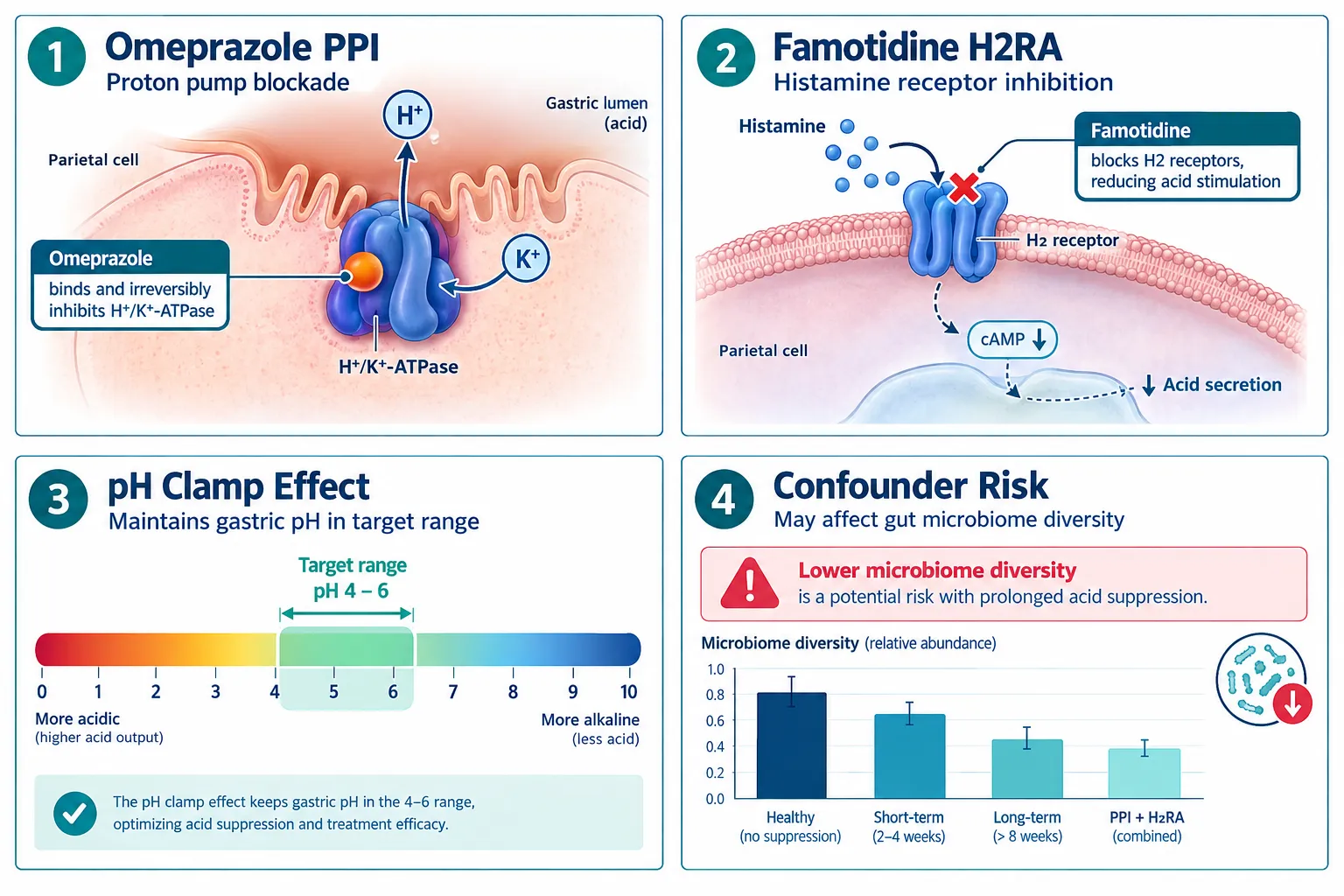
Omeprazole is a proton pump inhibitor (PPI). It irreversibly blocks the H+/K+-ATPase enzyme on gastric parietal cells, producing sustained acid suppression that persists well beyond the compound's plasma half-life. Famotidine is an H2 receptor antagonist (H2RA). It competes with histamine at the H2 receptor, producing faster but more transient pH elevation. These two mechanisms matter enormously for experimental design because they create different temporal pH profiles inside any intestinal model system.

Key pharmacodynamic differences:

Feature Omeprazole (PPI) Famotidine (H2RA)
Onset of action 1-4 hours 30-60 minutes
Duration of effect 24-72 hours 6-12 hours
pH ceiling Higher, more sustained Moderate, variable
Microbiome impact Greater oral-to-gut bacterial shift Lower, more localized
Reversibility Irreversible (enzyme turnover needed) Reversible, competitive

When either agent is present in a model without being explicitly recorded as an independent variable, it can independently accelerate gastric wound repair, alter tight-junction protein expression, and change luminal bacterial composition. Research using stress-ulcer and mucosal-injury models has confirmed that acid suppression is a dominant variable, not a passive background condition.

"Acid suppression is not a neutral scaffold. It is an active intervention that reshapes the biological terrain on which every other compound must act."

For investigators exploring GLP peptides for research purposes, this means the acid environment must be treated with the same rigor as the peptide dose itself.


GLP-2-T in Intestinal Models: Where Acid Control Intersects
GLP-2-T in Intestinal Models: Where Acid Control Intersects

GLP-2 (glucagon-like peptide-2) is a 33-amino-acid hormone secreted by intestinal L-cells. Its primary roles include promoting mucosal growth, reducing intestinal permeability, and modulating gastric acid secretion itself, making it uniquely entangled with the acid variables described above. Clinical GLP-2 analogs such as teduglutide have established this peptide class as a benchmark for intestinal trophic research.

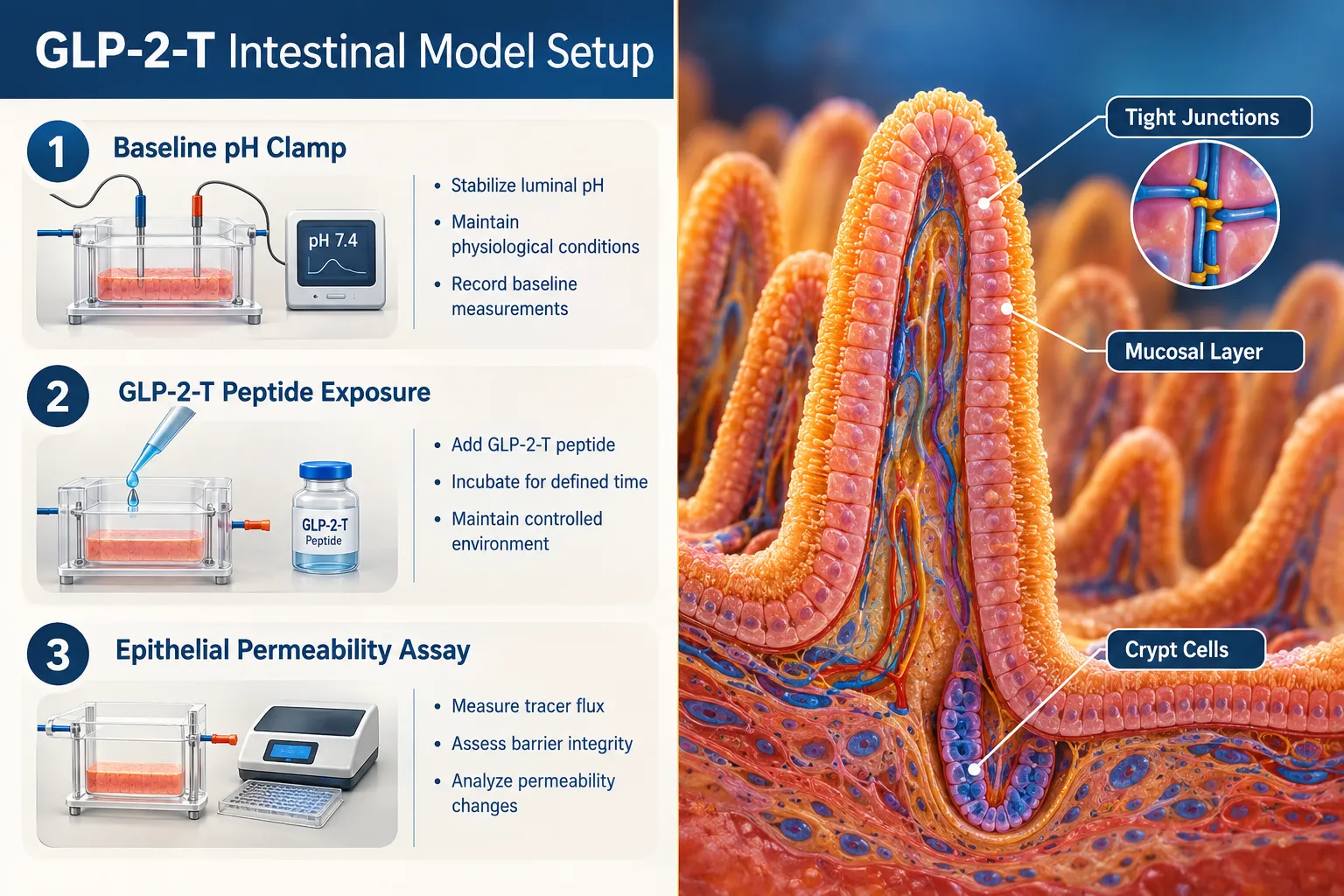
GLP-2-T refers to a research-stage analog designed to engage GLP-2 receptors with modified pharmacokinetics or receptor selectivity. Because GLP-2-T is predicted to act downstream of the acid environment, the luminal pH at the time of peptide exposure directly conditions the model's response. Specifically:

  • Epithelial permeability endpoints (transepithelial electrical resistance, FITC-dextran flux) are sensitive to baseline pH; an uncontrolled acid shift can mimic or cancel GLP-2-T's barrier-tightening effects.
  • Mucosal proliferation markers (crypt cell mitosis, villus height) respond to both acid suppression and GLP-2R activation, creating overlapping signal if both variables are active simultaneously.
  • Microbiome diversity indices are altered by PPIs more profoundly than H2RAs; since GLP-2-T research often includes microbiome endpoints, the choice between omeprazole and famotidine is not interchangeable.

For context on related peptide mechanisms, the comparison of LL-37 versus SS-31 peptide benefits illustrates how overlapping biological targets demand careful endpoint separation, a principle that applies directly here.

Researchers exploring GLP-3 Reta compounds will recognize that the same acid-variable logic governs any GLP-family peptide study conducted in an intestinal model system.


Experimental Workflow: Recording and Controlling Acid Variables
Experimental Workflow: Recording and Controlling Acid Variables

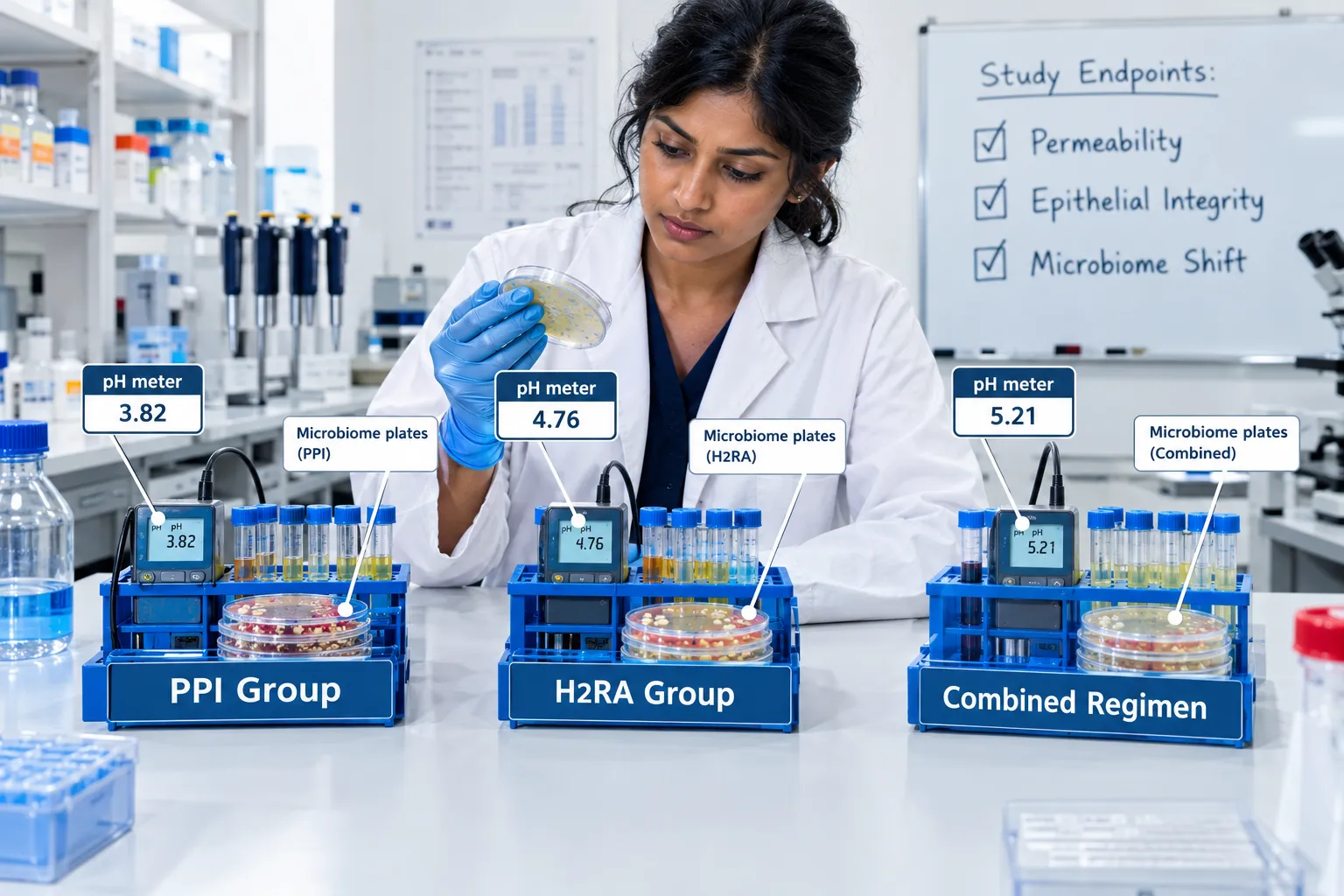
Controlling gastric-acid variables in intestinal models requires a structured approach to both pre-treatment conditions and endpoint documentation. The following workflow reflects current preclinical best practice when coupling acid suppression with GLP-2 or GLP-2-T exposure.

Step-by-step acid control protocol:

  1. Define the pH target range before any peptide is introduced. Most intestinal epithelial models require a luminal pH between 4.5 and 6.5 for physiologically relevant responses.
  2. Select the acid suppressor based on study duration. Use famotidine for short-window experiments (under 12 hours) where reversibility is needed. Use omeprazole for sustained pH clamping over multi-day models.
  3. Consider combination regimens cautiously. Omeprazole-plus-famotidine combinations can achieve rapid, stable pH clamping, useful for acute injury models, but they amplify microbiome disruption and must be documented as a compound intervention, not a single variable.
  4. Record acid exposure as an independent variable in all statistical models. Do not treat it as a preprocessing step.
  5. Pre-specify microbiome endpoints separately from epithelial endpoints. PPI-driven oral-to-gut bacterial translocation can confound 16S rRNA diversity data if not controlled with a matched acid-suppression arm.
  6. Introduce GLP-2-T only after pH stabilization is confirmed. Introducing the peptide during an acid transient will produce unreliable permeability and proliferation data.

Endpoints requiring dedicated acid controls:

  • Tight-junction protein expression (claudin-1, occludin, ZO-1)
  • Transepithelial electrical resistance (TEER)
  • Villus-to-crypt ratio
  • Mucosal cytokine profiles (IL-6, TNF-alpha)
  • Microbial alpha- and beta-diversity indices

For researchers interested in how mitochondrial peptides interact with similar tissue-integrity endpoints, the work on SS-31 mitochondrial research and wound healing models provides useful methodological parallels for endpoint separation strategies.

Choosing Between PPIs and H2RAs for GLP-2-T Studies

The choice is not merely pharmacological, it is experimental design. PPIs offer superior pH stability for multi-day intestinal organoid or ex-vivo tissue models, but their microbiome effects introduce a confounder that is difficult to isolate. H2RAs preserve a more physiological luminal bacterial environment at the cost of pH variability. Neither is universally superior; the correct choice depends on which endpoints are primary.

For GLP-1 Reta research contexts, where metabolic and mucosal endpoints often overlap, this trade-off is especially consequential and should be addressed explicitly in the methods section of any publication or report.


Conclusion

Omeprazole, famotidine, and GLP-2-T research demands that controlling gastric-acid variables in intestinal models be treated as a first-order experimental priority, not an afterthought. The core actionable steps are clear: select the acid suppressor that matches study duration and microbiome sensitivity requirements, document pH exposure as an independent variable in every statistical model, stabilize luminal pH before introducing GLP-2-T, and pre-specify epithelial permeability and microbiome endpoints with matched acid-control arms.

Investigators should also cross-reference their endpoint selection against established peptide research frameworks, including VEGF upregulation studies and wound healing compound models, where overlapping biological targets have required similar variable-isolation strategies. As GLP-2-T research matures in 2026, the quality of acid-variable documentation will likely become a primary criterion for peer review and reproducibility assessment.

https://www.puretestedpeptides.com/wp-content/uploads/2026/10/omeprazole-famotidine-and-glp-2-t-research-controlling-gastric-acid-variables-in.webp 1024 1536 https://www.puretestedpeptides.com/wp-content/uploads/2026/01/buy-peptides-online.jpg 2026-10-02 13:04:042026-10-02 13:04:04Omeprazole, Famotidine, and GLP-2-T Research: Controlling Gastric-Acid Variables in Intestinal Models
×

Helpful Links

  • My account
  • Cart
  • Checkout
  • Refund and Returns Policy
  • Privacy Policy
  • SMS Privacy Policy
  • Login
  • My Account
  • Logout

USA Made Lab Tested Peptides

All products are sold for research, laboratory, or analytical purposes only, and are not for human consumption


Pure Tested Peptides is a chemical supplier. Pure Tested Peptides is not a compounding / chemical compounding facility as defined under 503A of the Federal Food, Drug, and Cosmetic act. Pure Tested Peptides is not an outsourcing facility as defined under 503B of the Federal Food, Drug, and Cosmetic act.

The statements made within this website have not been evaluated by the US Food and Drug Administration. The products we offer are not intended to diagnose, treat, cure or prevent any disease.

Human/Animal Consumption Prohibited. Laboratory/In-Vitro Experimental Use Only

Scroll to top Scroll to top Scroll to top