Call or Text 727-513-9780
  • Shopping Cart Shopping Cart
    0Shopping Cart
Pure Tested Peptides | America's most trusted Peptides for sale online
  • Peptides for sale
    • Oral Peptides for sale
      • Peptide Capsules for sale
      • BPC 157 Capsules 1000mcg
      • SLU-PP-332 Capsules | 1000 mcg
      • 5-Amino-1MQ 50mg Capsules
      • Tesofensine 500mcg
    • All Peptides for sale
    • Peptide Sprays
      • BPC 157 Nasal Spray Kit
      • BPC-157 TB500 Nasal Spray Kit
      • Semax Nasal Spray 10mg
      • Selank – Nasal Spray Kit – 10mg
      • Epithalon 50MG Nasal Spray Kit
      • Ipamorelin 10mg Nasal Spray
      • Klow Nasal Spray (BPC-157 + TB-500 + GHK-Cu + KPV) | 80mg
      • Hulk Nasal Spray Tesa / Ipa Blend 6/3 MG
      • Klow Nasal Spray
      • NAD + 500 mg Nasal Spray
      • PT-141 Nasal Spray Kit
    • GHRH Peptides
      • Ipa Peptides
      • CJC-1295 Peptides
        • CJC-1295 with DAC 5 mg
        • CJC-1295 without DAC 5 mg
        • CJC-1295 Ipa 10mg
      • Tesa Peptides
        • Tesa Peptide
        • Tesa 20 mg
    • GHK-Cu Peptides
      • All GHK-Cu Peptides
      • GHK-Cu 100mg
      • KLOW Peptide Blend – Buy KLOW blend online
    • BPC Peptides
      • All BPC Peptides
      • BPC-157
      • BPC-157 TB-500
      • BPC 157 capsules 1000mcg
    • SLU-PP-332 Peptides
      • All SLU-PP-332 Peptides
      • SLU-PP-332 5mg
    • GLP3 Peptides
    • PT-141 Peptides
      • PT-141 Peptides for sale
      • PT-141 10mg
      • PT-141 Nasal Spray
    • CAG Peptides
      • Lipo-C Peptide Blend
      • CAG 5mg
      • CAG 10mg
    • MOTS-C Peptides
      • MOTS-C Peptides for sale
      • MOTS-c peptide
      • MOTS-c 10mg *6 pack*
    • 5 Amino 1MQ Peptides
      • 5 Amino 1MQ Peptides for sale
      • 5-Amino-1MQ 50mg Capsules
      • 5-Amino-1MQ 5mg
    • Epithalon Peptides
      • Epithalon Peptides for sale
      • Epithalon 10mg
      • Epithalon 50mg
  • Shop
    • GLPs
      • 5-Amino-1MQ 50mg Capsules
      • 5-Amino-1MQ 5mg
      • L-Carnitine 500mg/ml
      • Tesofensine 500mcg
      • SLU-PP-332 5mg
      • MOTS-c 10mg *6 pack*
    • Epithalon & BPC Peptides
      • Epithalon 10mg
      • Epithalon 50mg
      • BPC-157
      • BPC 157 capsules 1000mcg
      • BPC-157 TB-500
      • BPC-157 TB500 Nasal Spray Kit
      • BPC 157 Nasal Spray Kit
    • BPC TB-500 & NAD+ Peptides
      • NAD+ 500 mg
      • KLOW Peptide Blend – Buy KLOW blend online
      • GLOW Peptide Blend
      • TB 500 5mg
      • BPC 157 capsules 1000mcg – Supplement
      • BPC 157 Nasal Spray Kit
      • BPC-157
      • BPC-157 TB500 Nasal Spray Kit
      • BPC-157 TB-500
      • BPC 157 capsules 1000mcg
    • LL-37 Peptide
      • LL-37 10 mg
    • MOTS-C & Selank
      • MOTS-c peptide
      • Selank 10mg
    • GHK Peptides
      • GHK-Cu 100mg
      • GLOW Peptide Blend
      • KLOW Peptide Blend – Buy KLOW blend online
  • COAs
  • Wholesale
    • Wholesale Peptides for sale
  • PTP FAQ
  • Affiliates
    • Selank Peptide: Advanced Pharmacological Mechanisms Underlying Its Anxiolytic and Nootropic Effects in Research
      • 5-Amino-1MQ Peptide: Detailed Mechanisms of NNMT Inhibition and Its Impact on Cellular Metabolism Research
        • MOTS-C Peptide: Unraveling Its Role in Mitochondrial Dynamics and Energy Metabolism Research
          • Epithalon Peptide and Telomerase Regulation: Investigating Its Impact on Cellular Senescence and Lifespan Research Models
            • GLP2-T vs GLP2 Tirz Peptide: Understanding the Naming, Mechanistic Nuances, and Research Implications for Gut Health
      • Peptides and Polypeptides in Modern Pharmacology: What Research on Metoprolol, Prednisone, and Amlodipine Reveals
        • Polypeptide Peptides vs NSAIDs: What Naproxen and Diclofenac Teach Tissue-Repair Researchers About BPC‑157 and TB‑500
          • Peptides and Polypeptides in Endocrine Pharmacology: How GLP-1, GLP-2, and GLP-3 Retatrutide Differ From Classic Drugs Like Prednisone and Amlodipine
          • 5‑Amino‑1MQ Peptide and NNMT Inhibition: How It Compares With Statins Like Atorvastatin in Adipose and Lipid Metabolism Research
      • Enclomiphene, Estrogen Receptor Signaling, and Luteinizing Phase Biology: What Hormone Researchers Should Measure
        • Mesenchymal Stem Cells, BPC‑157, and GHK‑Cu: How Tissue Repair Peptides Compare With Classic NSAIDs Like Naproxen in Injury Models
          • Peptide Calculator Use Cases Beyond Growth Hormone: Working Through GLP‑3 Retatrutide, MOTS‑c, and BPC‑157 Research Dosing
        • Polypeptide Peptides in Endocrine and Metabolic Pharmacology: Lessons From Amlodipine, Prednisone, and Metoprolol
        • Peptides Calculator for Advanced Blends: Worked Examples for Tesamorelin, CJC‑1295, and Ipamorelin Stacks
          • Peptides and Polypeptides in Human Physiology: How Molecular Size Shapes Research Applications
            • Selank Peptide: Advanced Pharmacological Mechanisms Underlying Its Anxiolytic and Nootropic Effects in Research
          • 5-Amino-1MQ Peptide: Detailed Mechanisms of NNMT Inhibition and Its Impact on Cellular Metabolism Research
            • MOTS-C Peptide: Unraveling Its Role in Mitochondrial Dynamics and Energy Metabolism Research
              • Epithalon Peptide and Telomerase Regulation: Investigating Its Impact on Cellular Senescence and Lifespan Research Models
                • GLP2-T vs GLP2 Tirz Peptide: Understanding the Naming, Mechanistic Nuances, and Research Implications for Gut Health
                  • Peptides and Polypeptides in Endocrine Pharmacology: How GLP-1, GLP-2, and GLP-3 Retatrutide Differ From Classic Drugs Like Prednisone and Amlodipine
                    • Polypeptide Peptides vs NSAIDs: What Naproxen and Diclofenac Teach Tissue-Repair Researchers About BPC‑157 and TB‑500
                      • Peptides and Polypeptides in Modern Pharmacology: What Research on Metoprolol, Prednisone, and Amlodipine Reveals
                        • 5‑Amino‑1MQ Peptide and NNMT Inhibition: How It Compares With Statins Like Atorvastatin in Adipose and Lipid Metabolism Research
                        • Enclomiphene, Estrogen Receptor Signaling, and Luteinizing Phase Biology: What Hormone Researchers Should Measure
                        • Mesenchymal Stem Cells, BPC‑157, and GHK‑Cu: How Tissue Repair Peptides Compare With Classic NSAIDs Like Naproxen in Injury Models
                        • Peptide Calculator Use Cases Beyond Growth Hormone: Working Through GLP‑3 Retatrutide, MOTS‑c, and BPC‑157 Research Dosing
                        • Polypeptide Peptides in Endocrine and Metabolic Pharmacology: Lessons From Amlodipine, Prednisone, and Metoprolol
                        • Peptides Calculator for Advanced Blends: Worked Examples for Tesamorelin, CJC‑1295, and Ipamorelin Stacks
                        • Peptides and Polypeptides in Human Physiology: How Molecular Size Shapes Research Applications
                        • Selank Peptide: Advanced Pharmacological Mechanisms Underlying Its Anxiolytic and Nootropic Effects in Research
                        • MOTS-C Peptide: Unraveling Its Role in Mitochondrial Dynamics and Energy Metabolism Research
                        • Peptides and Polypeptides in Modern Pharmacology: What Research on Metoprolol, Prednisone, and Amlodipine Reveals
                        • Peptides and Polypeptides in Endocrine Pharmacology: How GLP-1, GLP-2, and GLP-3 Retatrutide Differ From Classic Drugs Like Prednisone and Amlodipine
                        • 5-Amino-1MQ Peptide: Detailed Mechanisms of NNMT Inhibition and Its Impact on Cellular Metabolism Research
                        • Mesenchymal Stem Cells, BPC‑157, and GHK‑Cu: How Tissue Repair Peptides Compare With Classic NSAIDs Like Naproxen in Injury Models
                        • Peptide Calculator Use Cases Beyond Growth Hormone: Working Through GLP‑3 Retatrutide, MOTS‑c, and BPC‑157 Research Dosing
                        • GLP2-T vs GLP2 Tirz Peptide: Understanding the Naming, Mechanistic Nuances, and Research Implications for Gut Health
                        • Polypeptide Peptides in Endocrine and Metabolic Pharmacology: Lessons From Amlodipine, Prednisone, and Metoprolol
                        • Polypeptide Peptides vs NSAIDs: What Naproxen and Diclofenac Teach Tissue-Repair Researchers About BPC‑157 and TB‑500
                        • Peptides and Polypeptides in Human Physiology: How Molecular Size Shapes Research Applications
                        • Peptides Calculator for Advanced Blends: Worked Examples for Tesamorelin, CJC‑1295, and Ipamorelin Stacks
                        • 5‑Amino‑1MQ Peptide and NNMT Inhibition: How It Compares With Statins Like Atorvastatin in Adipose and Lipid Metabolism Research
                        • Enclomiphene, Estrogen Receptor Signaling, and Luteinizing Phase Biology: What Hormone Researchers Should Measure
                        • Epithalon Peptide and Telomerase Regulation: Investigating Its Impact on Cellular Senescence and Lifespan Research Models
                        • Best research protocol Klow blend
                        • best time to take BPC-157
                        • best time to take DSIP (Delta Sleep Inducing Peptide)
                        • best time to take CJC-1295
                        • best time to take AOD-9604
                        • best time to take Follistatin 344
                        • best time to take Ipamorelin
                        • best time to take MK-677 (Ibutamoren)
                        • best time to take Ligandrol (LGD-4033) — research compound
                        • best time to take Ostarine (MK-2866) — research compound
                        • best time to take GHK-CU
                        • best time to take TB-500
                        • best time to take MOTS-c
                        • best time to take Semax
                        • best time to take RAD-140 (Testolone) — research compound
                        • best time to take Thymosin Alpha-1
                        • best time to take PEG-MGF
                        • Biolife Plasma, Octapharma Plasma, and Research Peptides: How Plasma Donation Labs Differ From Peptide Suppliers
                        • best time to take YK-11 — research compound
                        • best time to take PT-141 (Bremelanotide)
                        • Best research protocol Klow blend
                        • 5-Amino-1MQ and MOTS-C Synergy: Metabolic Signaling, Mitochondria, and Research Design
                        • BPC-157 and TB-500: Investigating Their Combined Effects on Angiogenesis and Cellular Migration in Tissue Repair Models
                        • BPC-157 Peptide: Gut Barrier Function, Inflammation, and Tissue-Recovery Research
                        • 5‑Amino‑1MQ and MOTS‑c Synergy in Metabolic Research: Designing NNMT and Mitochondrial Biogenesis Stacks
                        • CJC-1295 with DAC vs. Without DAC: Half-Life, Release Kinetics, and Research Implications
                        • CJC‑1295 with DAC vs. Without DAC: Expanding on Half‑Life Differences Using Tesamorelin and Ipamorelin Blend Case Studies
                        • Collagen Biology and Copper‑Binding Peptides: How GHK‑Cu, Glow Blend, and Klow Blend Interact with Skin and Connective Tissue
                        • Collagen Biology and Regenerative Peptides: How GHK‑Cu, Glow Blend, and Klow Blend Affect Extracellular Matrix Research
                    • DNA, Telomeres, and Longevity Peptides: Positioning Epithalon and MOTS‑c in Genetic Aging Research
                      • Enclomiphene Citrate: serm Mechanism, Testosterone Research, and Stack Compatibility
                        • Enclomiphene vs Enclomiphene Citrate: Formulation, Bioavailability, and Research Distinctions
                        • Epithalon Peptide Research: Telomerase Activation, Aging, and Pineal Gland Function
                        • Estrogen Receptor Signaling and Enclomiphene: How Selective Modulators Compare with Classic Polypeptide Hormones
                        • GHK-Cu Peptide: Advanced Mechanisms in Extracellular Matrix Remodeling and Wound Healing Research
                        • GHK-Cu Peptide: Collagen Synthesis, Wound Repair, and Skin-Barrier Research Models
                        • GLP-1 vs GLP-3 vs GLP-2: Peptide Classification and Research Applications
                        • GLP-2 Peptide Research Guide: Gut Barrier Function, Nutrient Absorption, and Intestinal Recovery Models
                        • GLP-3 Retatrutide vs. GLP-1 Drugs: What Triple-Agonist Biology Changes in Research Models
                        • Ipamorelin and Tesamorelin Combination: Synergistic GH Secretagogue Research and Dosing Protocols
                        • GLP2 Tirz Peptide: What It Is, Why the Name Exists, and How Researchers Should Interpret It
                        • Klow Blend Peptide Nasal Spray: What the Formulation Is Trying to Do in Cognitive Research
                        • Mitochondria, NNMT Inhibition, and Peptide Modulators: Where MOTS‑c and 5‑Amino‑1MQ Fit in Cellular Energy Research
                        • MOTS-c Peptide: Mitochondrial Function, Energy Metabolism, and What Researchers Measure
                        • MOTS-c vs. 5-Amino-1MQ: Which Metabolic Research Questions Each Compound Actually Answers
                        • Nasal Spray Peptides: Bioavailability, Administration, and Semax/Selank Research Applications
                        • PT-141 Peptide Research: Mechanism of Action and Melanocortin Receptor Signaling
                        • Retatrutide for Research: Mechanism, Structure, and GLP-1/GLP-3 Dual Action
                        • Retatrutide for Obesity and Type 2 Diabetes: What the Latest Trial Data Suggest
                        • Tesofensine Peptide Research: Mechanism, Appetite Suppression, and Neuropeptide Y Pathways
  • Contact
    • Contact Customer Service
    • Text Customer Support
  • About US
  • Shop all peptides
  • Affiliate Program
    • Affiliate Signup
  • Login / Register Login / Register Page Link Login / Register Page Link
  • Click to open the search input field Click to open the search input field Search
  • Menu Menu

Tag Archive for: leptin ghrelin sleep

Trazodone and Peptide Appetite Studies: Separating Sedation, Sleep, Food Intake, and Metabolic Signaling

Trazodone and Peptide Appetite Studies: Separating Sedation, Sleep, Food Intake, and Metabolic Signaling

October 25, 2026/0 Comments/in Uncategorized/by

{"cover":"Professional landscape format (1536×1024) hero image with bold text overlay 'Trazodone and Peptide Appetite Studies' in crisp white sans-serif on a deep semi-transparent navy overlay panel, centered with 8% safe margins from every edge. Background: editorial close-up of a scientific laboratory bench featuring a molecular structure model, peptide vials, and a sleep EEG readout printout side by side under cool white studio lighting. Teal and navy color palette. Magazine cover aesthetic, editorial quality, no price tables, no checkmarks.","content":["Annotated mechanism-of-action diagram, landscape format (1536×1024), illustrating the pharmacological separation between trazodone sedation and appetite peptide signaling. Four labeled zones arranged left to right: Zone 1 labeled 'H1 Receptor Blockade / Sedation', Zone 2 labeled 'Serotonin Reuptake Inhibition', Zone 3 labeled 'Sleep Architecture Shift', Zone 4 labeled 'Indirect Ghrelin / Leptin Effect'. Callout lines point from each zone to a central trazodone molecule illustration. Teal, white, and charcoal palette. Clinical infographic style, editorial medical-guide polish, no pricing content.","Split-screen landscape format (1536×1024) comparing two research study design scenarios side by side. Left panel labeled 'Confounded Design' shows a simplified timeline bar where sedation, reduced activity, and decreased food intake overlap with a red warning callout reading 'Sedation Mimics Treatment Effect'. Right panel labeled 'Controlled Design' shows a parallel timeline with separate measurement tracks for sleep quality, appetite peptides (ghrelin, leptin, GLP-1), and caloric intake, each with distinct color-coded arrows and short callout labels. Clean white background, blue and amber palette, numbered step annotations, editorial scientific illustration style.","Isometric illustration landscape format (1536×1024) depicting the metabolic signaling cascade relevant to sleep-peptide interactions in appetite research. Central visual: a stylized brain emitting sleep-wave arcs that connect downward to two labeled peptide nodes, 'Ghrelin (rises with poor sleep)' on the left and 'Leptin (falls with poor sleep)' on the right. A third node at the bottom is labeled 'GLP-1 / Incretin Axis' with a dashed arrow from a peptide vial icon representing retatrutide research context. Small annotation bubbles indicate 'Trazodone: indirect pathway only'. Warm amber and deep teal gradient background, clean isometric vector style, editorial quality."]
Professional landscape hero image () with a reading "Trazodone and Peptide Appetite Studies". CRITICAL TYPOGRAPHY RULES:

Fewer than 10 controlled human studies have directly measured how trazodone affects appetite-regulating peptides such as ghrelin, leptin, or GLP-1, yet the drug is prescribed to millions for sleep. That gap creates a real methodological hazard for researchers studying appetite compounds like retatrutide or tesofensine alongside trazodone: sedation and sleep changes can quietly masquerade as treatment effects.

Understanding trazodone and peptide appetite studies, separating sedation, sleep, food intake, and metabolic signaling, is essential for any team designing or interpreting trials where multiple variables converge on eating behavior.

Key Takeaways

  • Trazodone is considered largely weight-neutral; appetite reduction is an infrequent, tolerability-driven side effect, not a therapeutic mechanism.
  • Sedation and decreased appetite are independent adverse effects, but both can distort food-intake endpoints in appetite peptide research.
  • Sleep normalization caused by trazodone may indirectly shift ghrelin and leptin levels, creating confounded metabolic readouts.
  • No robust human studies directly measure trazodone's impact on GLP-1, insulin, or ghrelin under controlled feeding conditions as of 2026.
  • Researchers using appetite-active compounds alongside trazodone must build in sleep-quality and sedation controls to isolate true peptide effects.

How Trazodone Works and Why It Matters for Appetite Research

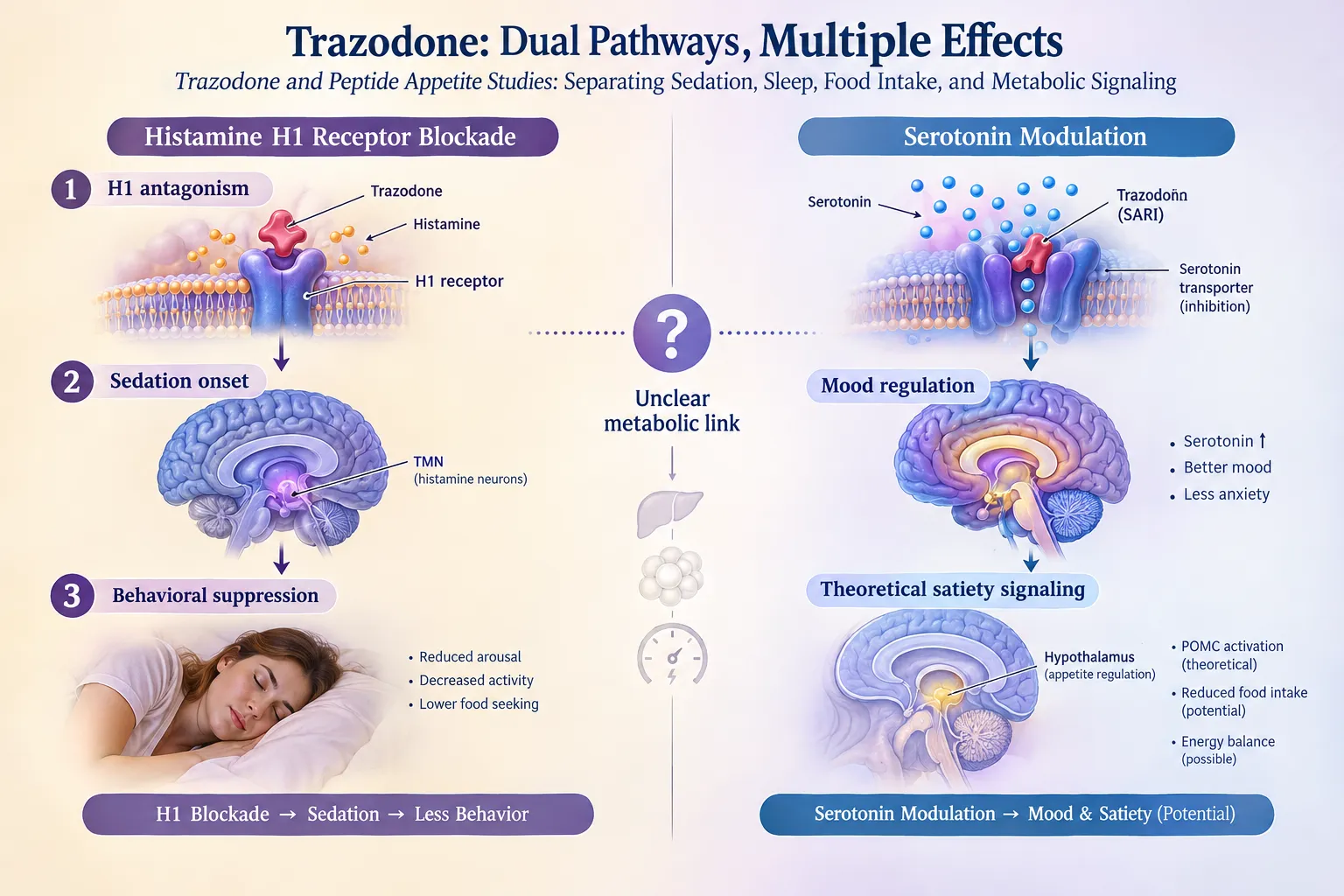
Trazodone is a serotonin antagonist and reuptake inhibitor (SARI). Its two most clinically relevant properties are histamine H1 receptor blockade, which drives sedation, and serotonin modulation, which influences mood and, theoretically, satiety signaling. Current regulatory labeling and clinical guidance consistently classify trazodone as weight-neutral, with appetite changes listed as infrequent. Expert summaries of antidepressant-related metabolic disturbances place trazodone among the lowest-risk agents for weight gain, some data even suggest a marginal lean toward weight loss.
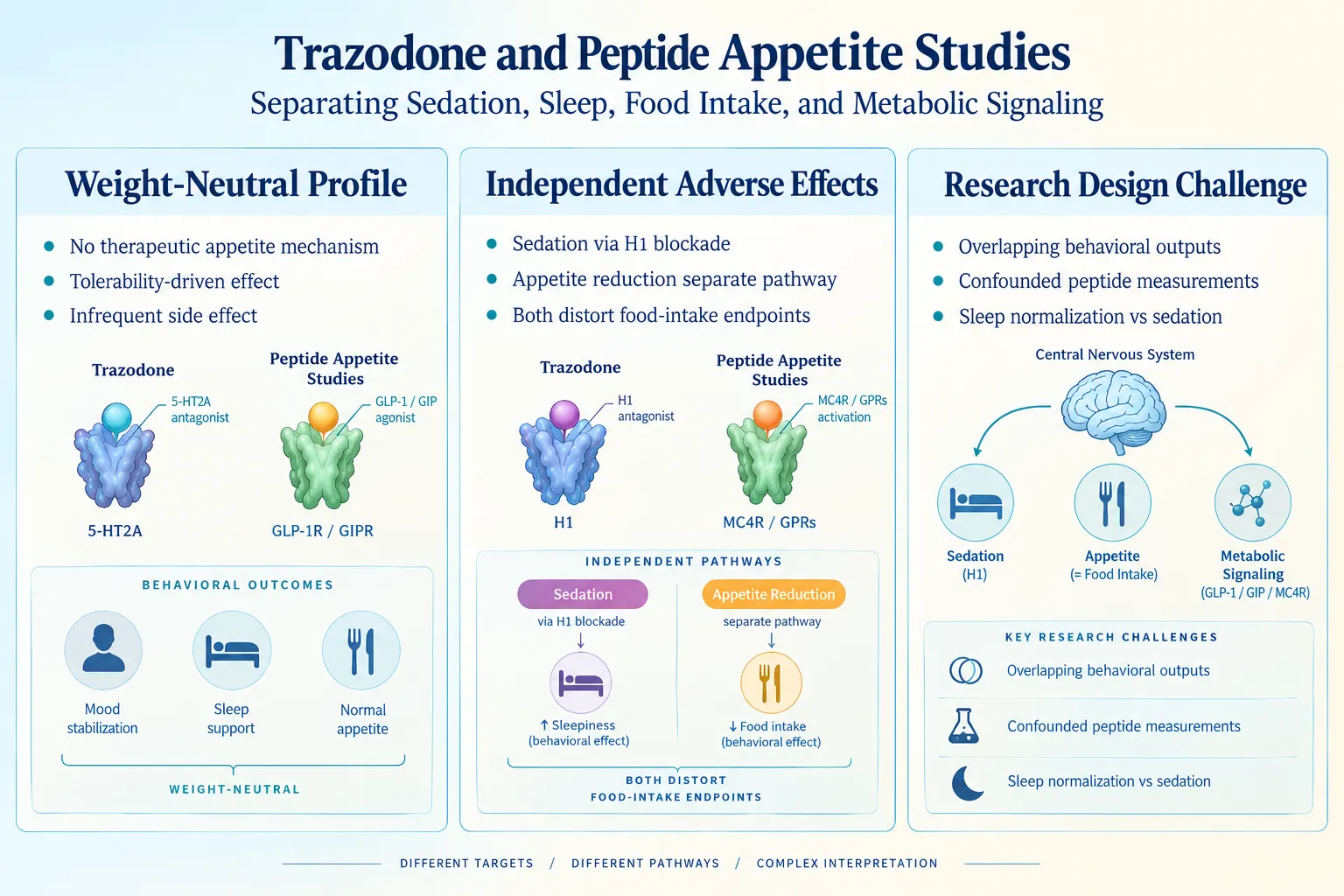
How Trazodone Works and Why It Matters for Appetite Research

For peptide appetite studies, this creates a subtle problem. A participant taking trazodone for insomnia may eat less not because a study compound is working, but because they are sedated, less physically active, or simply less motivated to prepare meals. These behavioral suppressors of caloric intake look identical to a genuine peptide-driven reduction in hunger on a food diary or calorie-count endpoint.

Key pharmacological actions relevant to appetite research:

Mechanism Direct Effect Potential Appetite Impact
H1 blockade Sedation, drowsiness Reduced meal frequency
Serotonin reuptake inhibition Mood stabilization Modest satiety modulation
Alpha-1 adrenergic blockade Orthostatic effects Nausea, indirect intake reduction
Prolactin elevation Hormonal shift Minor; not clinically quantified

Study Design Flaws: When Sedation Mimics Treatment in Trazodone and Peptide Appetite Studies

The central methodology challenge in trazodone and peptide appetite studies, separating sedation, sleep, food intake, and metabolic signaling, is that sedation and appetite suppression share overlapping behavioral outputs. When researchers pair trazodone with compounds targeting the incretin axis, such as GLP-3R peptide research variants, the sedation signal can inflate apparent efficacy on intake endpoints.

Three specific confounds deserve attention:

  1. Reduced locomotor activity. Sedated subjects move less, burn fewer calories, and may underreport hunger because they are asleep or low-arousal during typical meal windows.
  2. Nausea overlap. Both trazodone and GLP-1-class peptides can produce nausea. Without separate adverse-event tracking, nausea-driven intake reduction is falsely attributed to appetite peptide activity.
  3. Sleep improvement altering baseline peptides. Short sleep is well-established to reduce leptin and elevate ghrelin, increasing hunger. If trazodone normalizes sleep architecture, it will partially reverse that pattern, lowering ghrelin and raising leptin, independently of any metabolic compound under study.
Study Design Flaws: When Sedation Mimics Treatment in Trazodone and Peptide Appetite Studies

"The most likely pathway by which trazodone touches metabolic peptides is indirect, through sleep normalization rather than direct receptor-level appetite signaling."

Researchers using GLP-3R 30mg peptide formulations in combination protocols must account for baseline sleep quality in both arms of a study. Omitting actigraphy or validated sleep-quality instruments leaves an uncontrolled variable that can shift ghrelin readouts by 15-20% between groups without any pharmacological intervention from the study compound.

For reference standards in peptide work, ensuring compound identity is foundational; resources on Bachem and reference standards for peptide benchmarks outline why purity verification precedes any mechanistic interpretation.


Metabolic Signaling Gaps and the Path Forward

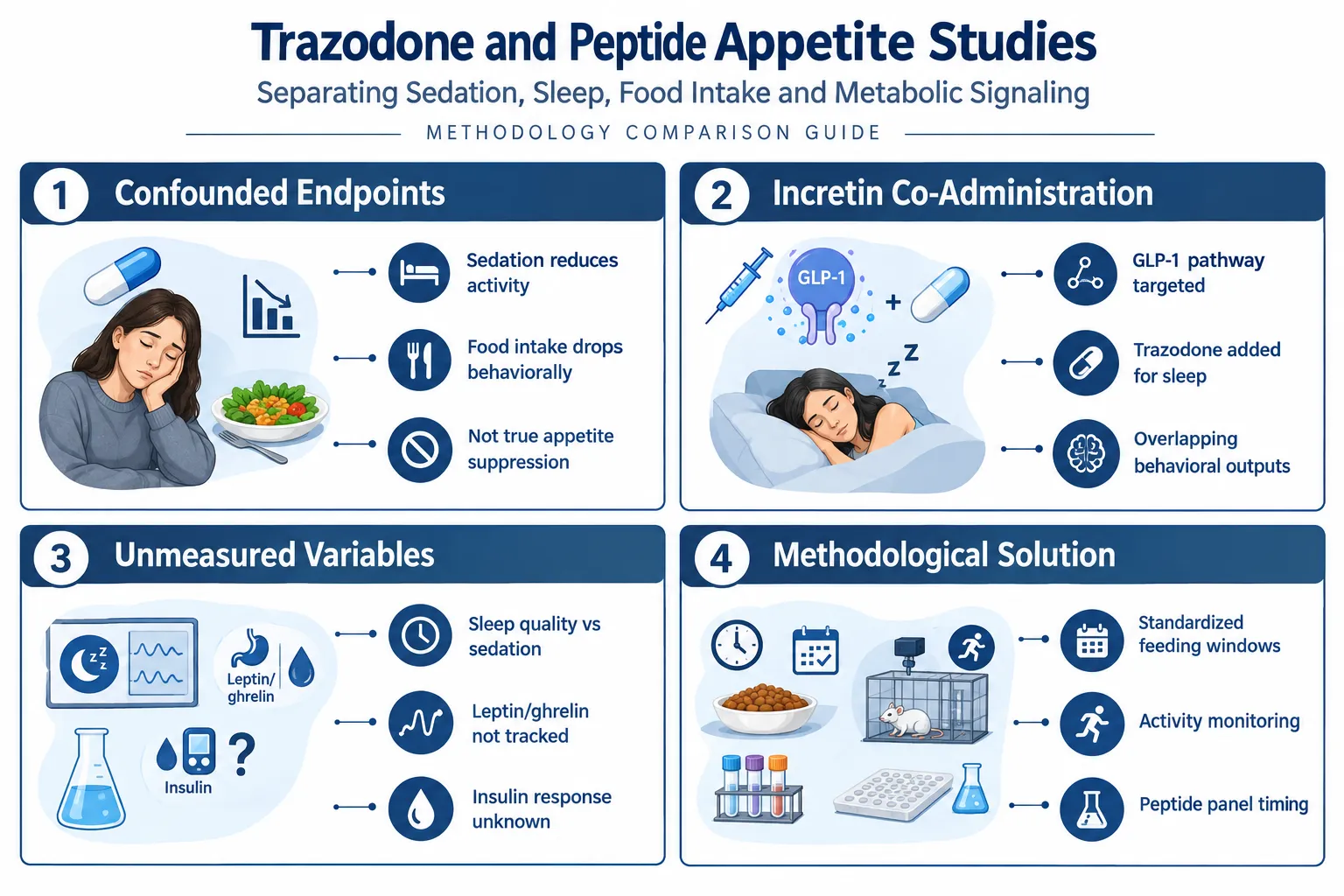
The honest summary of the literature in 2026 is blunt: virtually no controlled human trials have isolated trazodone's effects on leptin, ghrelin, insulin, or GLP-1 under standardized feeding conditions. That is a significant data gap given how commonly trazodone co-prescriptions appear in populations enrolled in metabolic and weight-loss studies.
Metabolic Signaling Gaps and the Path Forward

What researchers do know supports a working model with three tiers:

  • Tier 1, Confirmed: Trazodone causes sedation and, independently, infrequent appetite decrease as a tolerability side effect.
  • Tier 2, Mechanistically plausible: Sleep normalization from trazodone secondarily shifts ghrelin and leptin in a hunger-reducing direction.
  • Tier 3, Speculative: Any direct trazodone effect on GLP-1 secretion, insulin sensitivity, or peptide YY is uncharacterized and should not be assumed.

This tiered model has direct implications for trials pairing trazodone with compounds such as retatrutide. Researchers can explore RETA GLP-3 peptide options alongside proper methodological controls, but must treat trazodone-related sleep changes as a covariate, not a neutral background variable.

Quality controls matter equally on the peptide side. Reviewing PT-141 peptide for sale research context and QA controls illustrates how rigorous sourcing and purity documentation protect the integrity of any appetite-related protocol. Similarly, understanding peptide half-life is critical when scheduling blood draws to capture peptide-level appetite signals at biologically meaningful timepoints.

Recommended methodological safeguards:

  • Include validated sleep instruments (Pittsburgh Sleep Quality Index or actigraphy) as a covariate in all food-intake analyses.
  • Track sedation scores separately from hunger/satiety visual analog scales.
  • Distinguish nausea-driven intake reduction from appetite peptide-driven satiety using biomarker panels (fasting ghrelin, postprandial GLP-1, leptin).
  • Use matched-sedation control arms when trazodone is a concomitant medication, not just a placebo-vs-treatment design.
  • Report trazodone dose and timing relative to both sleep and meal windows in all study disclosures.

Conclusion

The intersection of trazodone and peptide appetite studies demands sharper methodological discipline than most current protocols provide. Trazodone is weight-neutral and lacks a direct, characterized pathway to the appetite peptides that drive hunger and satiety. However, its sedating properties and its capacity to normalize sleep architecture mean it can shift caloric intake and peptide baselines through indirect routes that look like pharmacological efficacy in a poorly controlled trial.

Actionable steps for researchers and study designers:

  • Map trazodone's sedation burden quantitatively before treating food-intake data as a clean endpoint.
  • Treat sleep quality as a primary covariate, not a footnote, in any metabolic peptide trial.
  • Recognize the current data gap and design studies that specifically measure ghrelin, leptin, and GLP-1 when trazodone is a concomitant or active comparator.
  • Consult reference-standard documentation and GLP peptide sourcing resources to ensure compound integrity before drawing mechanistic conclusions.

Future research will most productively focus on trazodone's role in metabolic health through the sleep-normalization pathway, not as a direct appetite modulator. Getting that framing right protects both the scientific validity of appetite peptide trials and the clinical relevance of their findings.

https://www.puretestedpeptides.com/wp-content/uploads/2026/10/trazodone-and-peptide-appetite-studies-separating-sedation-sleep-food-intake-and.webp 1024 1536 https://www.puretestedpeptides.com/wp-content/uploads/2026/01/buy-peptides-online.jpg 2026-10-25 13:03:282026-10-25 13:03:28Trazodone and Peptide Appetite Studies: Separating Sedation, Sleep, Food Intake, and Metabolic Signaling
×

Helpful Links

  • My account
  • Cart
  • Checkout
  • Refund and Returns Policy
  • Privacy Policy
  • SMS Privacy Policy
  • Login
  • My Account
  • Logout

USA Made Lab Tested Peptides

All products are sold for research, laboratory, or analytical purposes only, and are not for human consumption


Pure Tested Peptides is a chemical supplier. Pure Tested Peptides is not a compounding / chemical compounding facility as defined under 503A of the Federal Food, Drug, and Cosmetic act. Pure Tested Peptides is not an outsourcing facility as defined under 503B of the Federal Food, Drug, and Cosmetic act.

The statements made within this website have not been evaluated by the US Food and Drug Administration. The products we offer are not intended to diagnose, treat, cure or prevent any disease.

Human/Animal Consumption Prohibited. Laboratory/In-Vitro Experimental Use Only

Scroll to top Scroll to top Scroll to top