

Best Research-Grade Nasal Spray Peptides: Comparing Excipient Disclosure, Deposition, Stability, and Documentation
Fewer than one in ten research peptide vendors publicly disclose the full excipient composition of their nasal spray formulations, yet that single data point now separates credible research-grade products from everything else on the market. For researchers evaluating Semax, Selank, and related intranasal peptide products, the ability to compare excipient disclosure, deposition engineering, stability platforms, and documentation quality is no longer optional. It is the evaluation framework itself.
This guide to the best research-grade nasal spray peptides: comparing excipient disclosure, deposition, stability, and documentation is built for buyers who prioritize formulation transparency and analytical rigor over unsupported efficacy claims.
Key Takeaways
- Purity thresholds for research-grade nasal peptide sprays are converging at 99% or higher, verified by finished-product certificates of analysis.
- Excipient disclosure, naming every carrier, buffer, preservative, and permeation enhancer, is now the primary differentiator between top-tier and average vendors.
- Cyclodextrin-surfactant inclusion complexes have become the leading stability platform for fragile intranasal peptides in 2026.
- Alkylsaccharides and mucoadhesive agents are now considered standard-of-care for improving nasal peptide deposition and residence time.
- Documentation quality is converging on pharmaceutical-style standards: dose per actuation, total peptide content, carrier system, and analytical method must all appear on the product COA.
Why Excipient Disclosure Defines the Best Research-Grade Nasal Spray Peptides
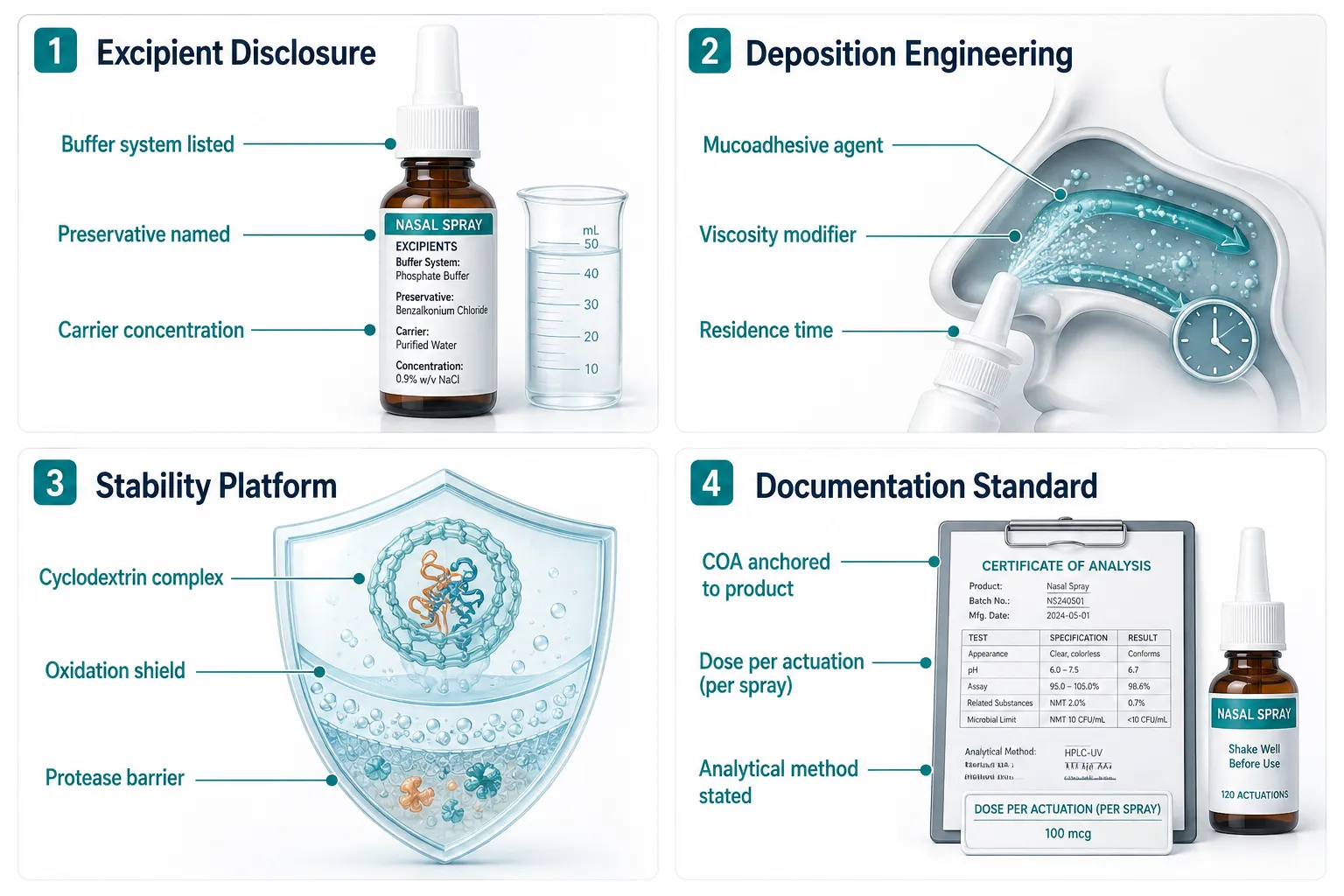
Excipients are the non-active ingredients that surround, stabilize, and deliver a peptide to its target tissue. In a nasal spray, they determine how much peptide reaches the olfactory epithelium, how long it stays there, and whether it degrades before absorption. Despite this importance, many vendors list only the active peptide on their product pages.
The best-documented commercial research sprays now routinely publish:
- Buffer system identity and concentration (e.g., phosphate-buffered saline at physiological pH)
- Preservative type (benzalkonium chloride or phenylethyl alcohol, with concentration)
- Permeation enhancer class (alkylsaccharides such as dodecyl maltoside are widely cited as state-of-the-art)
- Mucoadhesive or viscosity-modifying agent (hydroxypropyl methylcellulose or carbomer grades)
- Tonicity agent (sodium chloride, mannitol)
A carrier system built on an isotonic buffered aqueous base plus a preservative plus a permeation/mucoadhesive system has become the consistent template across leading formulations. When a vendor omits any of these components from their published documentation, a researcher cannot independently assess safety, compatibility, or reproducibility.
For researchers exploring nasal Semax spray options, demanding this level of disclosure is the first and most important step before any purchase decision.
"Excipient transparency is not a regulatory nicety, it is the minimum data needed to assess whether a formulation is fit for research use."
Deposition and Stability: The Formulation Science Behind Top-Tier Sprays
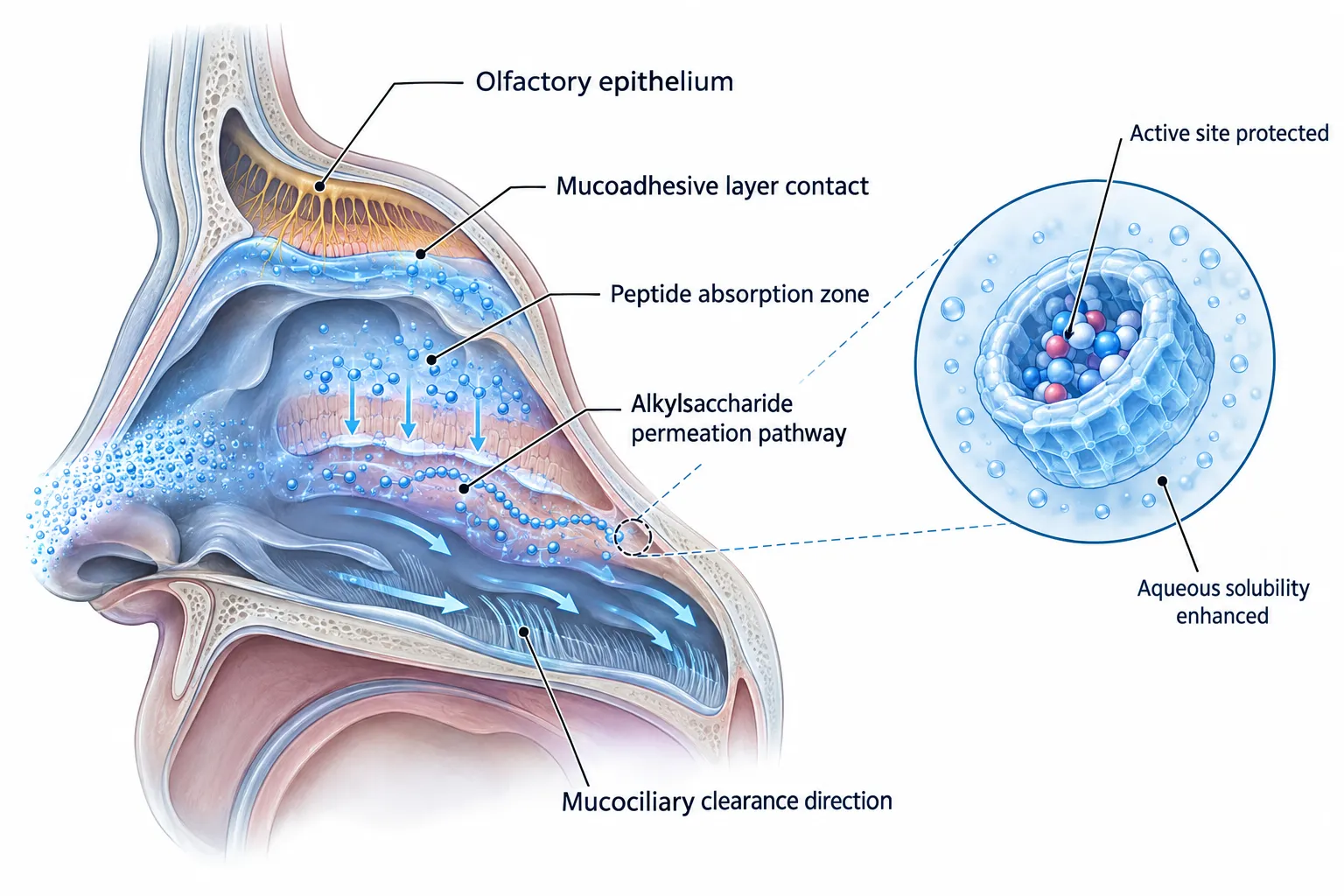
Engineering Deposition and Residence Time
Nasal peptide delivery faces a fundamental challenge: mucociliary clearance removes deposited material from the nasal cavity within 15 to 30 minutes. Larger or more fragile peptides, including neuropeptides like Semax and Selank, require active formulation strategies to extend contact time with absorptive epithelium.
Mucoadhesive excipients such as chitosan, carbomers, and cellulose derivatives physically bind to the mucosal surface, slowing clearance. Viscosity modifiers increase the thickness of the spray film, reducing runoff. Together, these agents extend the window during which a peptide can be absorbed.
Alkylsaccharides work differently. They transiently loosen tight junctions between epithelial cells without causing lasting damage, allowing larger peptide molecules to cross the mucosal barrier more efficiently. Their inclusion in a formulation is now a meaningful quality signal for researchers evaluating lab-tested peptides in nasal spray format.
Stability Platforms for Fragile Peptides
Peptide degradation in aqueous nasal spray solutions occurs through two primary routes: enzymatic cleavage by nasal proteases and oxidative attack on susceptible amino acid residues. Both routes reduce effective dose and introduce unknown degradation products.
Cyclodextrin-surfactant inclusion complexes have emerged as the leading solution in 2026. In these systems, the peptide is encapsulated within a cyclodextrin cavity, which:
- Shields the active site from protease access
- Reduces oxidative exposure
- Improves aqueous solubility for poorly soluble peptides
- Maintains structural integrity through the spray actuation process
This approach is now referenced as the top-tier formulation strategy for fragile peptides. Researchers reviewing products like those discussed in the GLP-3 peptide signaling pathway context will recognize similar stability logic applied across peptide classes.
For a broader foundation on peptide structure and delivery mechanisms, the Peptides 101 for research-use only buyers guide provides essential background.
Documentation Standards: What Separates Research-Grade From Everything Else
What a Pharmaceutical-Style COA Must Include
Quality documentation expectations for research nasal peptide sprays are converging on pharmaceutical standards. A certificate of analysis anchored to the finished nasal spray product, not just the raw peptide bulk, must include:
| Documentation Element | Minimum Standard |
|---|---|
| Peptide identity | Mass spectrometry or HPLC confirmation |
| Purity | 99% or higher by HPLC |
| Dose per actuation | Stated in micrograms, verified by assay |
| Total peptide content | Per bottle, confirmed analytically |
| Carrier system | All excipients named with concentrations |
| Analytical method | Method name and detection limit stated |
| Sterility / endotoxin | LAL test result or equivalent |
A COA that covers only the raw peptide powder is insufficient for nasal spray research. The finished formulation introduces new variables, pH shifts, excipient interactions, spray dynamics, that must be independently confirmed.
Vendor Transparency as a Proxy for Quality
A small number of research vendors currently stand out for comprehensive transparency. The signals to look for include:
- Third-party testing by an ISO-accredited laboratory
- Batch-specific COAs downloadable at point of purchase
- Excipient list published on the product page, not just on request
- Dose-per-actuation data confirmed by finished-product assay
Researchers evaluating documentation for peptides like BPC-157 can use the BPC-157 core peptides documentation-first research guide as a benchmark for what rigorous documentation looks like across peptide categories. Similarly, the SS-31 mechanism and research guide demonstrates how top vendors handle analytical disclosure for complex peptide products.
Industry analysis consistently points to one direction: future best-in-class research nasal peptide sprays will increasingly resemble regulated pharmaceutical nasal products in their excipient control and data packages. Vendors who are not moving toward that standard now are falling behind.
Conclusion
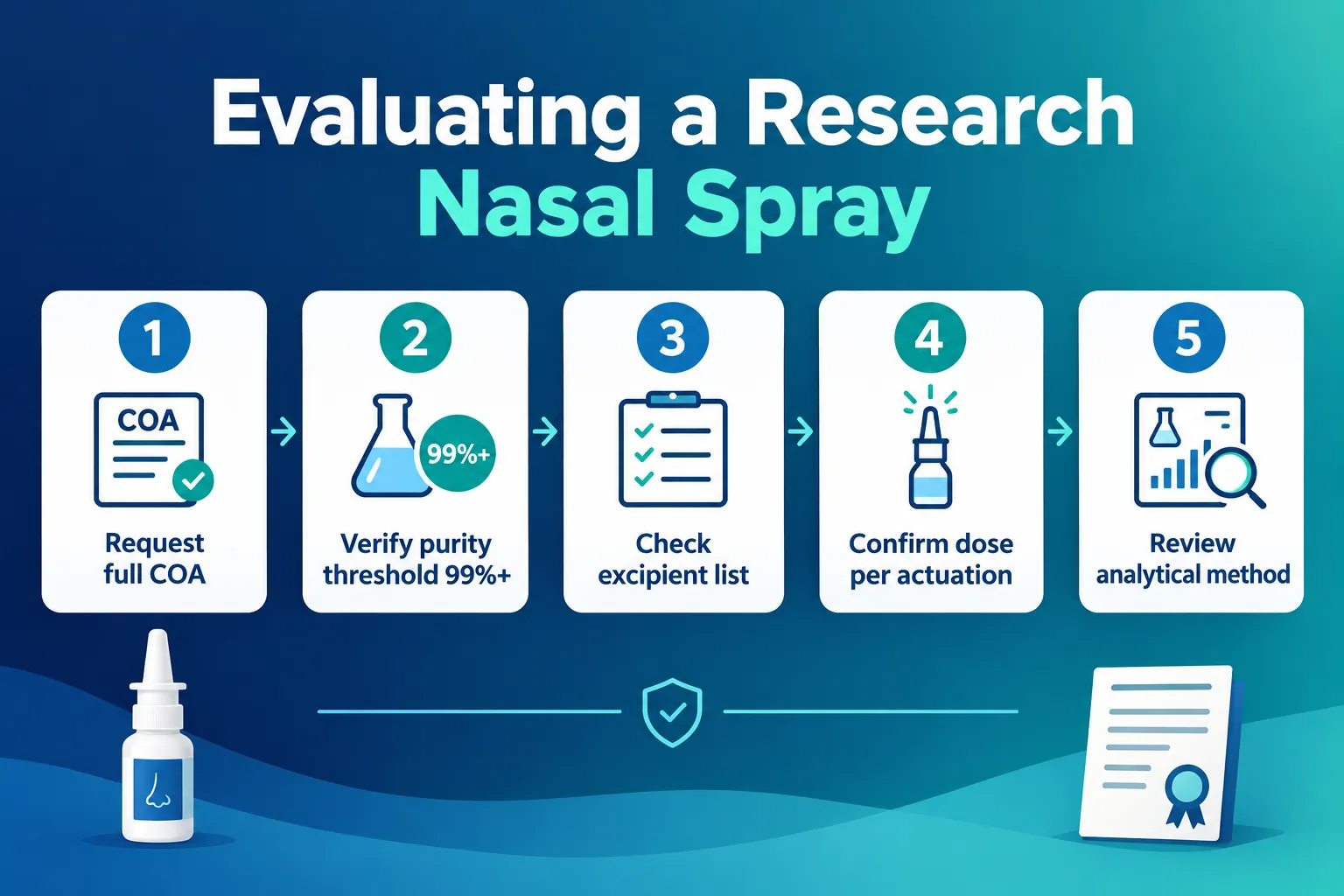
Evaluating the best research-grade nasal spray peptides: comparing excipient disclosure, deposition, stability, and documentation requires a structured framework rather than reliance on marketing claims. The actionable steps are clear:
- Demand a finished-product COA, not a raw peptide certificate, before purchasing any nasal spray for research use.
- Verify the excipient list includes buffer, preservative, permeation enhancer, and mucoadhesive agent with concentrations.
- Confirm purity at 99% or higher by HPLC, with the analytical method named.
- Check for dose-per-actuation data confirmed by assay, not estimated from fill volume.
- Prioritize vendors using cyclodextrin inclusion complexes for fragile neuropeptides like Semax and Selank.
Formulation transparency is not a premium feature, it is the baseline for responsible research procurement in 2026. Any vendor unwilling to publish this information is not meeting the standard that the research community now expects.