Call or Text 727-513-9780
  • Shopping Cart Shopping Cart
    0Shopping Cart
Pure Tested Peptides | America's most trusted Peptides for sale online
  • Peptides for sale
    • Oral Peptides for sale
      • Peptide Capsules for sale
      • BPC 157 Capsules 1000mcg
      • SLU-PP-332 Capsules | 1000 mcg
      • 5-Amino-1MQ 50mg Capsules
      • Tesofensine 500mcg
    • All Peptides for sale
    • Peptide Sprays
      • BPC 157 Nasal Spray Kit
      • BPC-157 TB500 Nasal Spray Kit
      • Semax Nasal Spray 10mg
      • Selank – Nasal Spray Kit – 10mg
      • Epithalon 50MG Nasal Spray Kit
      • Ipamorelin 10mg Nasal Spray
      • Klow Nasal Spray (BPC-157 + TB-500 + GHK-Cu + KPV) | 80mg
      • Hulk Nasal Spray Tesa / Ipa Blend 6/3 MG
      • Klow Nasal Spray
      • NAD + 500 mg Nasal Spray
      • PT-141 Nasal Spray Kit
    • GHRH Peptides
      • Ipa Peptides
      • CJC-1295 Peptides
        • CJC-1295 with DAC 5 mg
        • CJC-1295 without DAC 5 mg
        • CJC-1295 Ipa 10mg
      • Tesa Peptides
        • Tesa Peptide
        • Tesa 20 mg
    • GHK-Cu Peptides
      • All GHK-Cu Peptides
      • GHK-Cu 100mg
      • KLOW Peptide Blend – Buy KLOW blend online
    • BPC Peptides
      • All BPC Peptides
      • BPC-157
      • BPC-157 TB-500
      • BPC 157 capsules 1000mcg
    • SLU-PP-332 Peptides
      • All SLU-PP-332 Peptides
      • SLU-PP-332 5mg
    • GLP3 Peptides
    • PT-141 Peptides
      • PT-141 Peptides for sale
      • PT-141 10mg
      • PT-141 Nasal Spray
    • CAG Peptides
      • Lipo-C Peptide Blend
      • CAG 5mg
      • CAG 10mg
    • MOTS-C Peptides
      • MOTS-C Peptides for sale
      • MOTS-c peptide
      • MOTS-c 10mg *6 pack*
    • 5 Amino 1MQ Peptides
      • 5 Amino 1MQ Peptides for sale
      • 5-Amino-1MQ 50mg Capsules
      • 5-Amino-1MQ 5mg
    • Epithalon Peptides
      • Epithalon Peptides for sale
      • Epithalon 10mg
      • Epithalon 50mg
  • Shop
    • GLPs
      • 5-Amino-1MQ 50mg Capsules
      • 5-Amino-1MQ 5mg
      • L-Carnitine 500mg/ml
      • Tesofensine 500mcg
      • SLU-PP-332 5mg
      • MOTS-c 10mg *6 pack*
    • Epithalon & BPC Peptides
      • Epithalon 10mg
      • Epithalon 50mg
      • BPC-157
      • BPC 157 capsules 1000mcg
      • BPC-157 TB-500
      • BPC-157 TB500 Nasal Spray Kit
      • BPC 157 Nasal Spray Kit
    • BPC TB-500 & NAD+ Peptides
      • NAD+ 500 mg
      • KLOW Peptide Blend – Buy KLOW blend online
      • GLOW Peptide Blend
      • TB 500 5mg
      • BPC 157 capsules 1000mcg – Supplement
      • BPC 157 Nasal Spray Kit
      • BPC-157
      • BPC-157 TB500 Nasal Spray Kit
      • BPC-157 TB-500
      • BPC 157 capsules 1000mcg
    • LL-37 Peptide
      • LL-37 10 mg
    • MOTS-C & Selank
      • MOTS-c peptide
      • Selank 10mg
    • GHK Peptides
      • GHK-Cu 100mg
      • GLOW Peptide Blend
      • KLOW Peptide Blend – Buy KLOW blend online
  • COAs
  • Wholesale
    • Wholesale Peptides for sale
  • PTP FAQ
  • Affiliates
    • Selank Peptide: Advanced Pharmacological Mechanisms Underlying Its Anxiolytic and Nootropic Effects in Research
      • 5-Amino-1MQ Peptide: Detailed Mechanisms of NNMT Inhibition and Its Impact on Cellular Metabolism Research
        • MOTS-C Peptide: Unraveling Its Role in Mitochondrial Dynamics and Energy Metabolism Research
          • Epithalon Peptide and Telomerase Regulation: Investigating Its Impact on Cellular Senescence and Lifespan Research Models
            • GLP2-T vs GLP2 Tirz Peptide: Understanding the Naming, Mechanistic Nuances, and Research Implications for Gut Health
      • Peptides and Polypeptides in Modern Pharmacology: What Research on Metoprolol, Prednisone, and Amlodipine Reveals
        • Polypeptide Peptides vs NSAIDs: What Naproxen and Diclofenac Teach Tissue-Repair Researchers About BPC‑157 and TB‑500
          • Peptides and Polypeptides in Endocrine Pharmacology: How GLP-1, GLP-2, and GLP-3 Retatrutide Differ From Classic Drugs Like Prednisone and Amlodipine
          • 5‑Amino‑1MQ Peptide and NNMT Inhibition: How It Compares With Statins Like Atorvastatin in Adipose and Lipid Metabolism Research
      • Enclomiphene, Estrogen Receptor Signaling, and Luteinizing Phase Biology: What Hormone Researchers Should Measure
        • Mesenchymal Stem Cells, BPC‑157, and GHK‑Cu: How Tissue Repair Peptides Compare With Classic NSAIDs Like Naproxen in Injury Models
          • Peptide Calculator Use Cases Beyond Growth Hormone: Working Through GLP‑3 Retatrutide, MOTS‑c, and BPC‑157 Research Dosing
        • Polypeptide Peptides in Endocrine and Metabolic Pharmacology: Lessons From Amlodipine, Prednisone, and Metoprolol
        • Peptides Calculator for Advanced Blends: Worked Examples for Tesamorelin, CJC‑1295, and Ipamorelin Stacks
          • Peptides and Polypeptides in Human Physiology: How Molecular Size Shapes Research Applications
            • Selank Peptide: Advanced Pharmacological Mechanisms Underlying Its Anxiolytic and Nootropic Effects in Research
          • 5-Amino-1MQ Peptide: Detailed Mechanisms of NNMT Inhibition and Its Impact on Cellular Metabolism Research
            • MOTS-C Peptide: Unraveling Its Role in Mitochondrial Dynamics and Energy Metabolism Research
              • Epithalon Peptide and Telomerase Regulation: Investigating Its Impact on Cellular Senescence and Lifespan Research Models
                • GLP2-T vs GLP2 Tirz Peptide: Understanding the Naming, Mechanistic Nuances, and Research Implications for Gut Health
                  • Peptides and Polypeptides in Endocrine Pharmacology: How GLP-1, GLP-2, and GLP-3 Retatrutide Differ From Classic Drugs Like Prednisone and Amlodipine
                    • Polypeptide Peptides vs NSAIDs: What Naproxen and Diclofenac Teach Tissue-Repair Researchers About BPC‑157 and TB‑500
                      • Peptides and Polypeptides in Modern Pharmacology: What Research on Metoprolol, Prednisone, and Amlodipine Reveals
                        • 5‑Amino‑1MQ Peptide and NNMT Inhibition: How It Compares With Statins Like Atorvastatin in Adipose and Lipid Metabolism Research
                        • Enclomiphene, Estrogen Receptor Signaling, and Luteinizing Phase Biology: What Hormone Researchers Should Measure
                        • Mesenchymal Stem Cells, BPC‑157, and GHK‑Cu: How Tissue Repair Peptides Compare With Classic NSAIDs Like Naproxen in Injury Models
                        • Peptide Calculator Use Cases Beyond Growth Hormone: Working Through GLP‑3 Retatrutide, MOTS‑c, and BPC‑157 Research Dosing
                        • Polypeptide Peptides in Endocrine and Metabolic Pharmacology: Lessons From Amlodipine, Prednisone, and Metoprolol
                        • Peptides Calculator for Advanced Blends: Worked Examples for Tesamorelin, CJC‑1295, and Ipamorelin Stacks
                        • Peptides and Polypeptides in Human Physiology: How Molecular Size Shapes Research Applications
                        • Selank Peptide: Advanced Pharmacological Mechanisms Underlying Its Anxiolytic and Nootropic Effects in Research
                        • MOTS-C Peptide: Unraveling Its Role in Mitochondrial Dynamics and Energy Metabolism Research
                        • Peptides and Polypeptides in Modern Pharmacology: What Research on Metoprolol, Prednisone, and Amlodipine Reveals
                        • Peptides and Polypeptides in Endocrine Pharmacology: How GLP-1, GLP-2, and GLP-3 Retatrutide Differ From Classic Drugs Like Prednisone and Amlodipine
                        • 5-Amino-1MQ Peptide: Detailed Mechanisms of NNMT Inhibition and Its Impact on Cellular Metabolism Research
                        • Mesenchymal Stem Cells, BPC‑157, and GHK‑Cu: How Tissue Repair Peptides Compare With Classic NSAIDs Like Naproxen in Injury Models
                        • Peptide Calculator Use Cases Beyond Growth Hormone: Working Through GLP‑3 Retatrutide, MOTS‑c, and BPC‑157 Research Dosing
                        • GLP2-T vs GLP2 Tirz Peptide: Understanding the Naming, Mechanistic Nuances, and Research Implications for Gut Health
                        • Polypeptide Peptides in Endocrine and Metabolic Pharmacology: Lessons From Amlodipine, Prednisone, and Metoprolol
                        • Polypeptide Peptides vs NSAIDs: What Naproxen and Diclofenac Teach Tissue-Repair Researchers About BPC‑157 and TB‑500
                        • Peptides and Polypeptides in Human Physiology: How Molecular Size Shapes Research Applications
                        • Peptides Calculator for Advanced Blends: Worked Examples for Tesamorelin, CJC‑1295, and Ipamorelin Stacks
                        • 5‑Amino‑1MQ Peptide and NNMT Inhibition: How It Compares With Statins Like Atorvastatin in Adipose and Lipid Metabolism Research
                        • Enclomiphene, Estrogen Receptor Signaling, and Luteinizing Phase Biology: What Hormone Researchers Should Measure
                        • Epithalon Peptide and Telomerase Regulation: Investigating Its Impact on Cellular Senescence and Lifespan Research Models
                        • Best research protocol Klow blend
                        • best time to take BPC-157
                        • best time to take DSIP (Delta Sleep Inducing Peptide)
                        • best time to take CJC-1295
                        • best time to take AOD-9604
                        • best time to take Follistatin 344
                        • best time to take Ipamorelin
                        • best time to take MK-677 (Ibutamoren)
                        • best time to take Ligandrol (LGD-4033) — research compound
                        • best time to take Ostarine (MK-2866) — research compound
                        • best time to take GHK-CU
                        • best time to take TB-500
                        • best time to take MOTS-c
                        • best time to take Semax
                        • best time to take RAD-140 (Testolone) — research compound
                        • best time to take Thymosin Alpha-1
                        • best time to take PEG-MGF
                        • Biolife Plasma, Octapharma Plasma, and Research Peptides: How Plasma Donation Labs Differ From Peptide Suppliers
                        • best time to take YK-11 — research compound
                        • best time to take PT-141 (Bremelanotide)
                        • Best research protocol Klow blend
                        • 5-Amino-1MQ and MOTS-C Synergy: Metabolic Signaling, Mitochondria, and Research Design
                        • BPC-157 and TB-500: Investigating Their Combined Effects on Angiogenesis and Cellular Migration in Tissue Repair Models
                        • BPC-157 Peptide: Gut Barrier Function, Inflammation, and Tissue-Recovery Research
                        • 5‑Amino‑1MQ and MOTS‑c Synergy in Metabolic Research: Designing NNMT and Mitochondrial Biogenesis Stacks
                        • CJC-1295 with DAC vs. Without DAC: Half-Life, Release Kinetics, and Research Implications
                        • CJC‑1295 with DAC vs. Without DAC: Expanding on Half‑Life Differences Using Tesamorelin and Ipamorelin Blend Case Studies
                        • Collagen Biology and Copper‑Binding Peptides: How GHK‑Cu, Glow Blend, and Klow Blend Interact with Skin and Connective Tissue
                        • Collagen Biology and Regenerative Peptides: How GHK‑Cu, Glow Blend, and Klow Blend Affect Extracellular Matrix Research
                    • DNA, Telomeres, and Longevity Peptides: Positioning Epithalon and MOTS‑c in Genetic Aging Research
                      • Enclomiphene Citrate: serm Mechanism, Testosterone Research, and Stack Compatibility
                        • Enclomiphene vs Enclomiphene Citrate: Formulation, Bioavailability, and Research Distinctions
                        • Epithalon Peptide Research: Telomerase Activation, Aging, and Pineal Gland Function
                        • Estrogen Receptor Signaling and Enclomiphene: How Selective Modulators Compare with Classic Polypeptide Hormones
                        • GHK-Cu Peptide: Advanced Mechanisms in Extracellular Matrix Remodeling and Wound Healing Research
                        • GHK-Cu Peptide: Collagen Synthesis, Wound Repair, and Skin-Barrier Research Models
                        • GLP-1 vs GLP-3 vs GLP-2: Peptide Classification and Research Applications
                        • GLP-2 Peptide Research Guide: Gut Barrier Function, Nutrient Absorption, and Intestinal Recovery Models
                        • GLP-3 Retatrutide vs. GLP-1 Drugs: What Triple-Agonist Biology Changes in Research Models
                        • Ipamorelin and Tesamorelin Combination: Synergistic GH Secretagogue Research and Dosing Protocols
                        • GLP2 Tirz Peptide: What It Is, Why the Name Exists, and How Researchers Should Interpret It
                        • Klow Blend Peptide Nasal Spray: What the Formulation Is Trying to Do in Cognitive Research
                        • Mitochondria, NNMT Inhibition, and Peptide Modulators: Where MOTS‑c and 5‑Amino‑1MQ Fit in Cellular Energy Research
                        • MOTS-c Peptide: Mitochondrial Function, Energy Metabolism, and What Researchers Measure
                        • MOTS-c vs. 5-Amino-1MQ: Which Metabolic Research Questions Each Compound Actually Answers
                        • Nasal Spray Peptides: Bioavailability, Administration, and Semax/Selank Research Applications
                        • PT-141 Peptide Research: Mechanism of Action and Melanocortin Receptor Signaling
                        • Retatrutide for Research: Mechanism, Structure, and GLP-1/GLP-3 Dual Action
                        • Retatrutide for Obesity and Type 2 Diabetes: What the Latest Trial Data Suggest
                        • Tesofensine Peptide Research: Mechanism, Appetite Suppression, and Neuropeptide Y Pathways
  • Contact
    • Contact Customer Service
    • Text Customer Support
  • About US
  • Shop all peptides
  • Affiliate Program
    • Affiliate Signup
  • Login / Register Login / Register Page Link Login / Register Page Link
  • Click to open the search input field Click to open the search input field Search
  • Menu Menu

Tag Archive for: osmolality nasal formulation

Nasal Peptide Vehicle Controls: Comparing PBS, Osmolality, pH, and Deposition in Semax, Selank, and Klow Studies

Nasal Peptide Vehicle Controls: Comparing PBS, Osmolality, pH, and Deposition in Semax, Selank, and Klow Studies

October 26, 2026/0 Comments/in Uncategorized/by

{"cover":"Professional landscape format (1536×1024) hero image with bold text overlay 'Nasal Peptide Vehicle Controls' in crisp white sans-serif centered on a deep teal semi-transparent overlay panel, 8% safe margins from every edge. Background: sharp editorial laboratory scene showing glass vials of clear nasal spray solutions, a pH meter probe submerged in blue-tinted buffer, and a cross-section anatomical illustration of a human nasal cavity faintly visible behind. Cool teal and navy palette, clinical magazine aesthetic, high contrast, editorial quality.","content":["Annotated four-panel comparison infographic (1536×1024) on a clean white background with teal-and-slate palette: Panel 1 labeled 'PBS pH 7.0-7.4' showing a buffer flask with callout arrows to 'Phosphate ions', 'Isotonic 290 mOsm', 'Brain bioavailability'; Panel 2 labeled 'Bacteriostatic Water' with callout lines to '0.9% Benzyl Alcohol', 'pH 4.5-7.0', 'Multi-dose safe'; Panel 3 labeled 'Saline 0.9%' with callouts 'pH 5.0-7.0', 'Single-use risk', 'No preservative'; Panel 4 labeled 'Purified Water + Methylparaben' with callouts 'Official Semax vehicle', 'Registered formula', 'No PBS'. Thin dividing lines, short bold panel headings, clean medical-guide typography, editorial polish.", "Numbered step-by-step flow diagram (1536×1024) on a cool grey gradient background showing the journey of a nasal peptide from formulation to brain delivery: Step 1 'Vehicle Selection', vial icon with label 'pH 5.5-6.5 target'; Step 2 'Osmolality Check', scale icon labeled '290-500 mOsm/kg'; Step 3 'Device Plume', spray nozzle icon labeled 'Droplet size controls deposition'; Step 4 'Nasal Epithelium Contact', cross-section nasal anatomy icon labeled 'Olfactory vs respiratory region'; Step 5 'Nose-to-Brain Uptake', brain icon labeled 'Peptide bioavailability'. Arrows connecting each step, slate-blue and amber accent colors, crisp sans-serif labels 1-5 words each, all inside 5% safe margin, medical infographic quality.", "Split-screen editorial comparison image (1536×1024): left half shows close-up of a Semax nasal drop vial with a handwritten label reading 'Methylparaben + Purified Water' on a sterile white lab bench, soft studio lighting; right half shows a Selank lyophilized peptide vial being reconstituted with a syringe into isotonic saline, amber-lit clinical bench. A vertical dividing line with small callout labels: left side 'Registered Semax Formula', right side 'Research Selank Vehicle'. High-contrast editorial photography style, teal accent on divider, sharp depth of field, magazine-quality composition."]
Professional landscape hero image () with a reading "Nasal Peptide Vehicle Controls". CRITICAL TYPOGRAPHY RULES: render the

Fewer than one in ten researchers who reconstitute intranasal peptides stop to calculate the osmolality of their chosen vehicle, yet that single variable can shift nasal epithelium integrity, drug permeation rate, and assay reproducibility in ways that dwarf the effect of dose adjustments. Understanding nasal peptide vehicle controls, comparing PBS, osmolality, pH, and deposition in Semax, Selank, and Klow studies, is not a formulation footnote. It is the foundation on which every valid result is built.

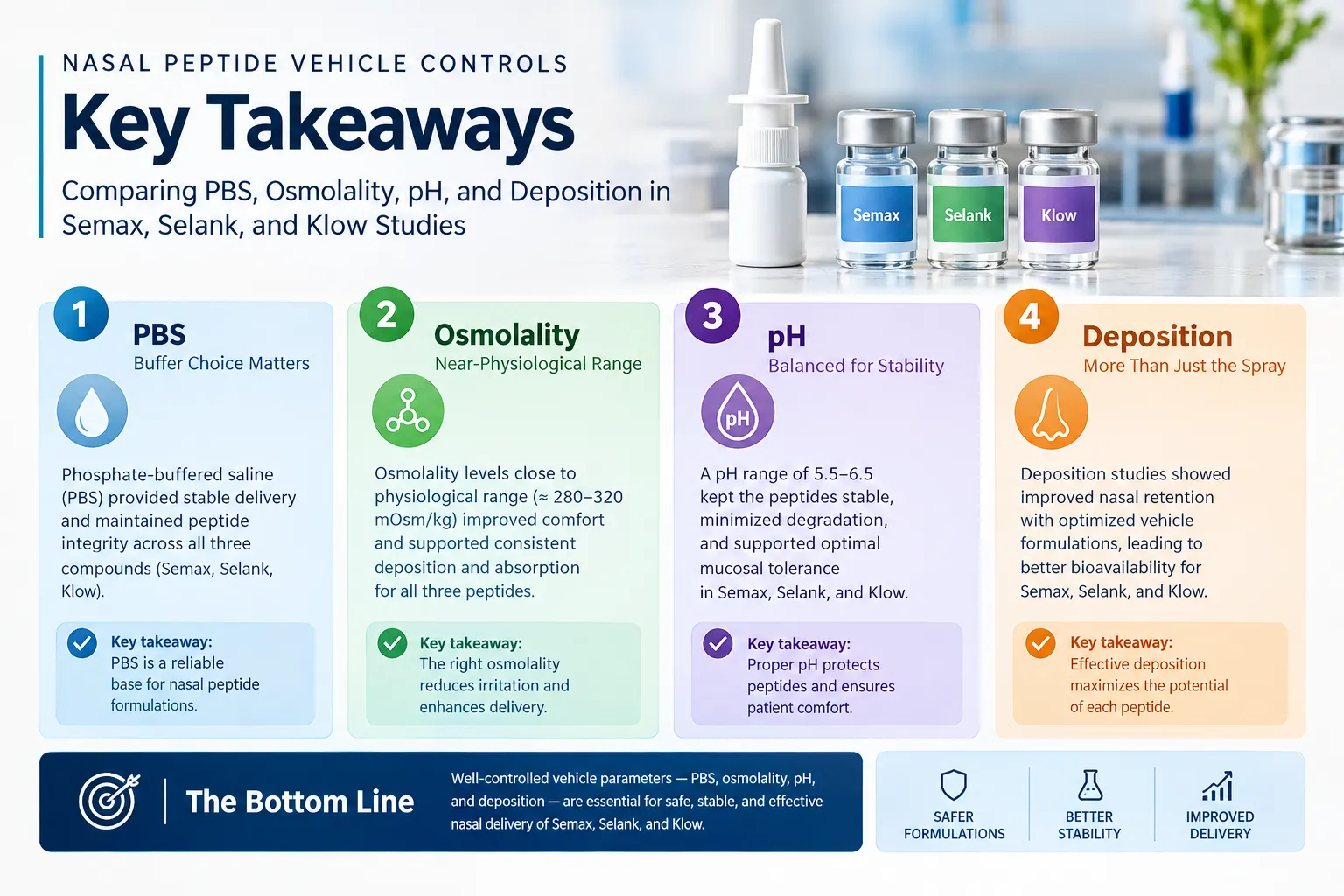
Key Takeaways

  • The nasal epithelium tolerates pH 5.5-6.5 and osmolality of 290-500 mOsm/kg; values outside these ranges alter permeation and cause local harm.
  • Registered Semax drops use methylparaben in purified water, no PBS, no saline, while research Selank protocols favor sterile 0.9% saline or bacteriostatic water depending on single versus multi-dose use.
  • Bacteriostatic water (0.9% benzyl alcohol) is the most cited multi-dose vehicle for intranasal peptide research; normal saline is reserved for single-use applications.
  • PBS appears mainly in formal nose-to-brain pharmacology studies rather than in practitioner or user protocols; it offers pH stability near 7.4 but sits above the ideal nasal epithelium pH window.
  • Device plume characteristics and vehicle viscosity directly control where a peptide deposits, olfactory versus respiratory epithelium, which determines brain bioavailability.

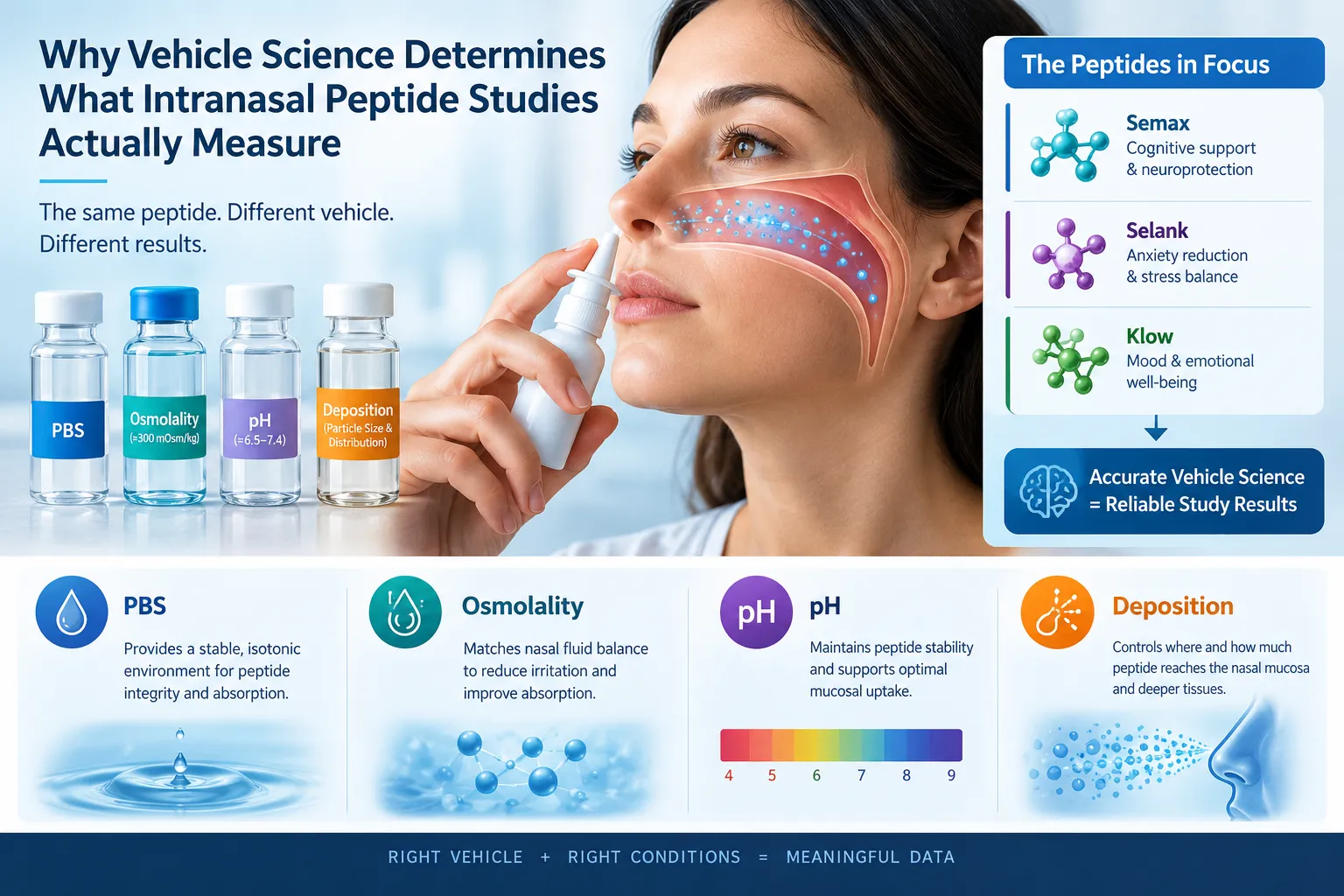
Why Vehicle Science Determines What Intranasal Peptide Studies Actually Measure

Simply dissolving a lyophilized peptide in plain water and calling it a nasal formulation is a methodological error, not a shortcut. Professional formulation of peptides for intranasal delivery requires active control of sterility, pH, osmolality, preservative strategy, and peptide stability. Each of these factors interacts with the nasal epithelium and, ultimately, with how much active peptide reaches its target tissue.
Why Vehicle Science Determines What Intranasal Peptide Studies Actually Measure

The nasal cavity is not a passive conduit. Its surface pH sits between 5.5 and 6.5 under healthy conditions. A vehicle with pH above or below this window stresses the epithelium, risks adverse local effects, and changes the ionization state of the peptide being delivered. Osmolality adds another layer: a nasal solution should fall between 290 and 500 mOsm/kg. Hypotonic solutions can damage ciliated cells through osmotic stress, while severely hypertonic vehicles provoke mucosal irritation and accelerated mucociliary clearance, both of which reduce effective peptide contact time.

Key vehicle properties to control:

Property Target Range Risk if Out of Range
pH 5.5-6.5 Epithelial damage, altered permeation
Osmolality 290-500 mOsm/kg Cellular osmotic stress, poor tolerability
Preservative Species- and dose-dependent Microbial growth or peptide degradation
Viscosity Moderate Alters droplet size and deposition site

Benzalkonium chloride, a preservative common in nasal sprays, is generally discouraged for short peptides such as Semax nasal spray formulations because it can interact adversely with small peptide structures. Methylparaben, by contrast, appears in the officially registered Russian Semax 0.1% drops alongside purified water, without PBS or saline, demonstrating that the choice of preservative is as deliberate as the choice of buffer.


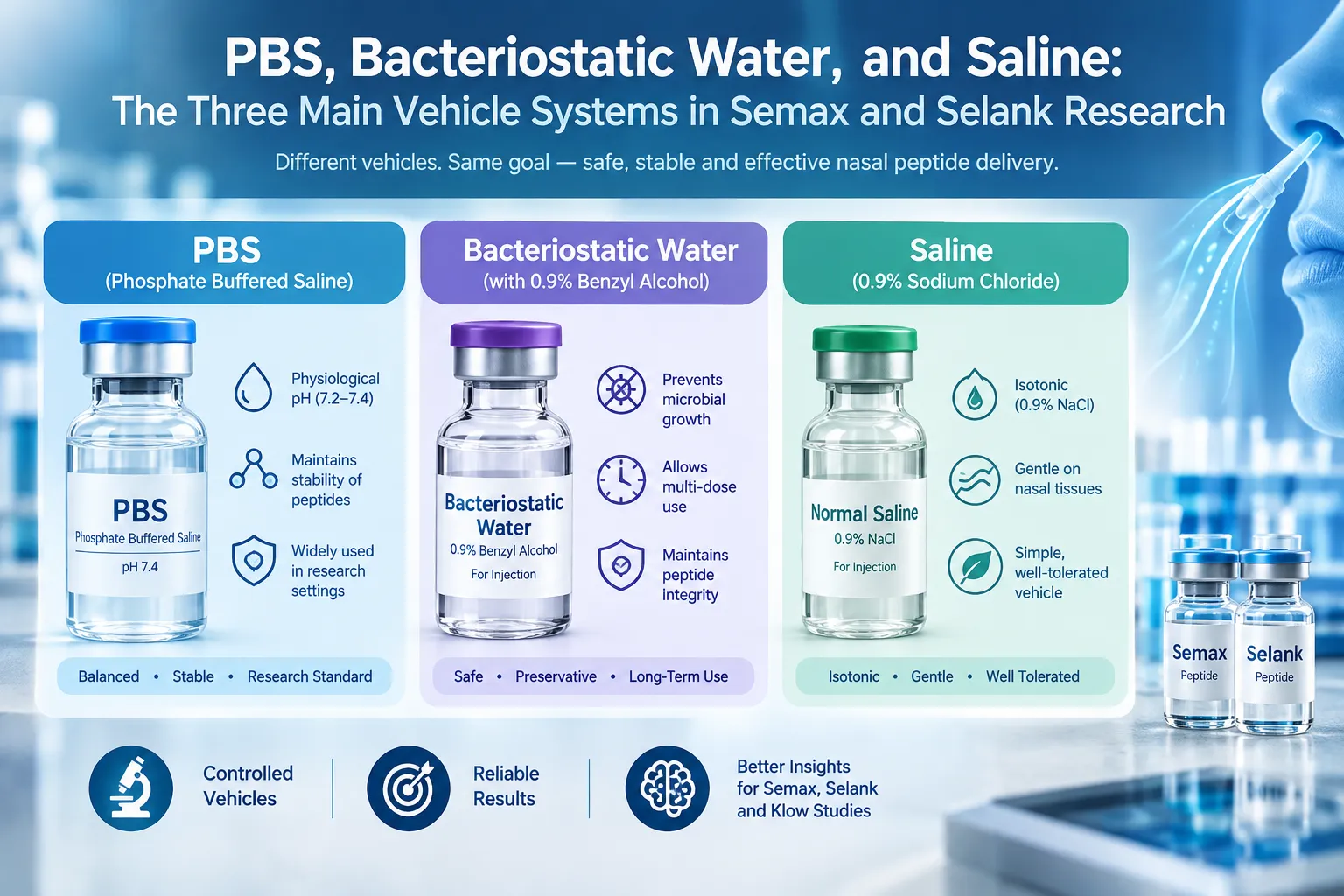
PBS, Bacteriostatic Water, and Saline: The Three Main Vehicle Systems in Semax and Selank Research

The registered 0.15% Selank medicinal product uses approximately 1.10 mg/mL of the peptide dissolved in purified water with methylparaben. This is the commercially validated benchmark. Research and compounding settings frequently diverge from that benchmark, which is where vehicle choice becomes a source of variability.
PBS, Bacteriostatic Water, and Saline: The Three Main Vehicle Systems in Semax and Selank Research

Phosphate-buffered saline (PBS) at pH 7.0-7.4 appears most often in formal nose-to-brain (N2B) delivery studies because it stabilizes pH across a wide concentration range and improves brain bioavailability data reproducibility. Its drawback is that pH 7.4 sits slightly above the ideal nasal mucosal window of 5.5-6.5, meaning it is better suited to controlled single-session research than to chronic self-administration.

Bacteriostatic water containing 0.9% benzyl alcohol carries a pH of roughly 4.5-7.0 and is the most commonly recommended vehicle for multi-dose intranasal peptide preparations. The benzyl alcohol provides antimicrobial protection that allows a single reconstituted vial to be used across multiple days without sterility compromise. This directly matches the practical need of researchers running multi-day dosing protocols with lab tested peptides.

Sterile 0.9% saline sits at pH 5.0-7.0 and is isotonic by definition, making it well-tolerated acutely. Its limitation is the absence of a preservative. Once opened and reconstituted, a saline-based peptide solution offers no antimicrobial barrier, making it suitable only for immediate, single-use application. Using saline for a multi-day protocol introduces contamination risk that could confound results and harm users.

"The lack of a universally accepted protocol means each research or compounding setting must validate its own vehicle system, buffer, preservative, and pH, before drawing conclusions from intranasal peptide data."

There is currently no universal scientific consensus specifying exact solvent volume, buffer composition, or preservative system for Selank or Semax nasal preparations outside official registered products. This is not a regulatory gap to ignore; it is a design variable that every study must declare and control.

Regarding "Klow" studies specifically: no widely indexed peer-reviewed literature or supplier documentation from 2023-2026 describes a defined Klow intranasal vehicle protocol with explicit PBS, osmolality, or pH controls. Researchers encountering Klow references should treat vehicle parameters as uncharacterized until primary source documentation is located.


Deposition, Device Performance, and Nose-to-Brain Bioavailability

Vehicle composition does not just affect peptide stability in the vial, it governs where the peptide lands inside the nasal cavity and therefore which epithelial pathway it uses. Formulators actively tune viscosity, pH, osmolality, and device plume geometry to direct deposition toward either the olfactory epithelium (favoring direct nose-to-brain transport) or the respiratory epithelium (favoring systemic absorption).
Deposition, Device Performance, and Nose-to-Brain Bioavailability

Lower-viscosity solutions produce finer droplets that travel further into the posterior nasal cavity, increasing olfactory contact. Higher-viscosity vehicles deposit earlier in the anterior region, extending mucosal contact time but reducing olfactory targeting. Delivery devices matter equally: spray pump geometry, actuation force, and nozzle angle all interact with vehicle viscosity to produce a specific plume that either reaches or misses the olfactory cleft.

For researchers working with peptides and nasal delivery formats or comparing vehicles across peptide classes, these design interactions mean that two studies using the same peptide at the same nominal dose can produce incomparable bioavailability data if their vehicles differ in viscosity or pH.

Practical deposition considerations:

  • Target olfactory epithelium for direct brain uptake; use lower-viscosity, fine-mist devices.
  • Target respiratory epithelium for systemic exposure; anterior deposition with moderate viscosity.
  • Isotonic vehicles (290-310 mOsm/kg) are essential for chronic-use protocols to preserve ciliary function.
  • Never substitute hypotonic vehicles in repeated-dose designs.

Both Semax and Selank are most stable in mildly acidic to neutral pH ranges, which aligns well with the physiological nasal window of 5.5-6.5. This means that bacteriostatic water, with its pH of approximately 4.5-7.0, can satisfy both peptide stability requirements and mucosal tolerability simultaneously, provided the final reconstituted solution is confirmed to land within the acceptable range. Consulting a peptides doctor near me before beginning intranasal peptide protocols is advisable for anyone moving beyond strictly controlled laboratory settings.


Conclusion

Nasal peptide vehicle controls, comparing PBS, osmolality, pH, and deposition in Semax, Selank, and Klow studies, reveal that the vehicle is not inert background chemistry. It is an active experimental variable. The actionable steps for any researcher or formulator are clear:

  1. Confirm pH of the reconstituted solution falls within 5.5-6.5 before each use.
  2. Calculate osmolality and target 290-500 mOsm/kg; avoid hypotonic preparations entirely.
  3. Select preservative strategy based on use pattern: bacteriostatic water for multi-day protocols, sterile saline only for single-use administration.
  4. Document vehicle composition in full, buffer species, concentration, preservative, and measured pH, as part of any study report or compounding record.
  5. Match device to vehicle viscosity and intended deposition target (olfactory versus respiratory epithelium).

Standardizing these parameters does not complicate research, it makes results comparable, reproducible, and defensible. Any claim about Semax, Selank, or related intranasal peptide effects is only as strong as the vehicle control behind it.

https://www.puretestedpeptides.com/wp-content/uploads/2026/10/nasal-peptide-vehicle-controls-comparing-pbs-osmolality-ph-and-deposition-in-sem.webp 1024 1536 https://www.puretestedpeptides.com/wp-content/uploads/2026/01/buy-peptides-online.jpg 2026-10-26 13:05:002026-10-26 13:05:00Nasal Peptide Vehicle Controls: Comparing PBS, Osmolality, pH, and Deposition in Semax, Selank, and Klow Studies
×

Helpful Links

  • My account
  • Cart
  • Checkout
  • Refund and Returns Policy
  • Privacy Policy
  • SMS Privacy Policy
  • Login
  • My Account
  • Logout

USA Made Lab Tested Peptides

All products are sold for research, laboratory, or analytical purposes only, and are not for human consumption


Pure Tested Peptides is a chemical supplier. Pure Tested Peptides is not a compounding / chemical compounding facility as defined under 503A of the Federal Food, Drug, and Cosmetic act. Pure Tested Peptides is not an outsourcing facility as defined under 503B of the Federal Food, Drug, and Cosmetic act.

The statements made within this website have not been evaluated by the US Food and Drug Administration. The products we offer are not intended to diagnose, treat, cure or prevent any disease.

Human/Animal Consumption Prohibited. Laboratory/In-Vitro Experimental Use Only

Scroll to top Scroll to top Scroll to top