

Where to Buy Research-Grade Enclomiphene and Enclomiphene Citrate: serm Formulation, COA Standards, and Peptide-Adjunct Study Design
{"cover":"Professional landscape format (1536×1024) hero image with bold text overlay 'Where to Buy Research-Grade Enclomiphene' (≤42 chars) in crisp white bold sans-serif centered on a deep navy semi-transparent overlay panel, 8% safe margins from every edge, no character touches the edge. Background: bright laboratory setting with glass vials of white crystalline powder, a printed Certificate of Analysis document, and molecular structure diagrams on a lightbox panel. Cool clinical lighting, teal and navy color palette, editorial pharmaceutical research magazine aesthetic, high contrast, sharp focus.","content":["Four-panel labelled infographic diagram (1536×1024) illustrating serm formulation science for enclomiphene and enclomiphene citrate. Panel 1 labeled 'Trans-Isomer Structure' shows a molecular ball-and-stick model with callout lines to 'Enclomiphene (trans)' and 'Zuclomiphene (cis)'. Panel 2 labeled 'Receptor Binding Sites' shows a stylized hypothalamic-pituitary axis diagram with arrows labeled 'LH Release' and 'FSH Release'. Panel 3 labeled 'Capsule Formulation' shows a 12.5mg capsule with callout 'CAS 15690-57-0'. Panel 4 labeled 'Research Use Only' shows a lab bottle with disclaimer label. Clean white background, teal-and-navy palette, thin callout lines, editorial medical-guide polish, no pricing text.","Annotated documentary-style editorial photograph (1536×1024) of a laboratory bench with a printed Certificate of Analysis document as the focal centerpiece, surrounded by HPLC chromatogram printouts and a batch identifier label. Four callout lines with short labels: 'Identity Testing', 'Purity Percentage', 'Batch Number', 'Lot Date Stamp'. Bright studio overhead lighting, cool white and steel-grey tones, shallow depth of field on the COA document, crisp clinical research atmosphere, magazine-quality editorial photography, no dollar amounts or pricing grids.","Numbered step-by-step flow diagram (1536×1024) illustrating a peptide-adjunct study design pairing enclomiphene with GH-axis and GLP-class peptides. Five horizontal steps connected by arrows: Step 1 'Select serm Compound' with icon of capsule vial; Step 2 'Choose Peptide Adjunct' with icons for GH peptide and GLP peptide; Step 3 'Verify COA Documents' with checklist icon; Step 4 'Define Endpoints' with graph icon labeled 'Testosterone, LH, FSH'; Step 5 'Order from Verified Vendor' with shield icon labeled 'Research Use Only'. Deep teal background with white and gold text labels, clean sans-serif typography, bold step numbers, editorial research-design infographic style, no pricing tables."]
Fewer than one in ten research buyers who source enclomiphene citrate for laboratory use ever request a full Certificate of Analysis before placing an order, yet COA quality is the single most important variable separating useful research-grade material from unreliable stock. For investigators planning studies around this selective estrogen receptor modulator (serm), understanding where to buy research-grade enclomiphene and enclomiphene citrate, how formulations differ, and how this compound fits into peptide-adjunct study designs is essential groundwork before any order is placed.
Key Takeaways
- Enclomiphene is the trans-isomer of clomiphene and acts as a serm at hypothalamic and pituitary estrogen receptors, increasing LH, FSH, and endogenous testosterone in research models.
- Research-grade enclomiphene citrate carries no FDA-approved indication as of 2026; all sourcing is strictly for laboratory use.
- A valid COA for enclomiphene should include identity testing, purity data, batch number, lot date, and CAS number 15690-57-0.
- Vendor reputation and third-party COA documentation are the two most critical evaluation criteria when comparing suppliers.
- Enclomiphene is increasingly paired with GH-axis peptides and GLP-class compounds in combination study designs, requiring careful formulation compatibility planning.
Understanding Enclomiphene and Enclomiphene Citrate as Research serms
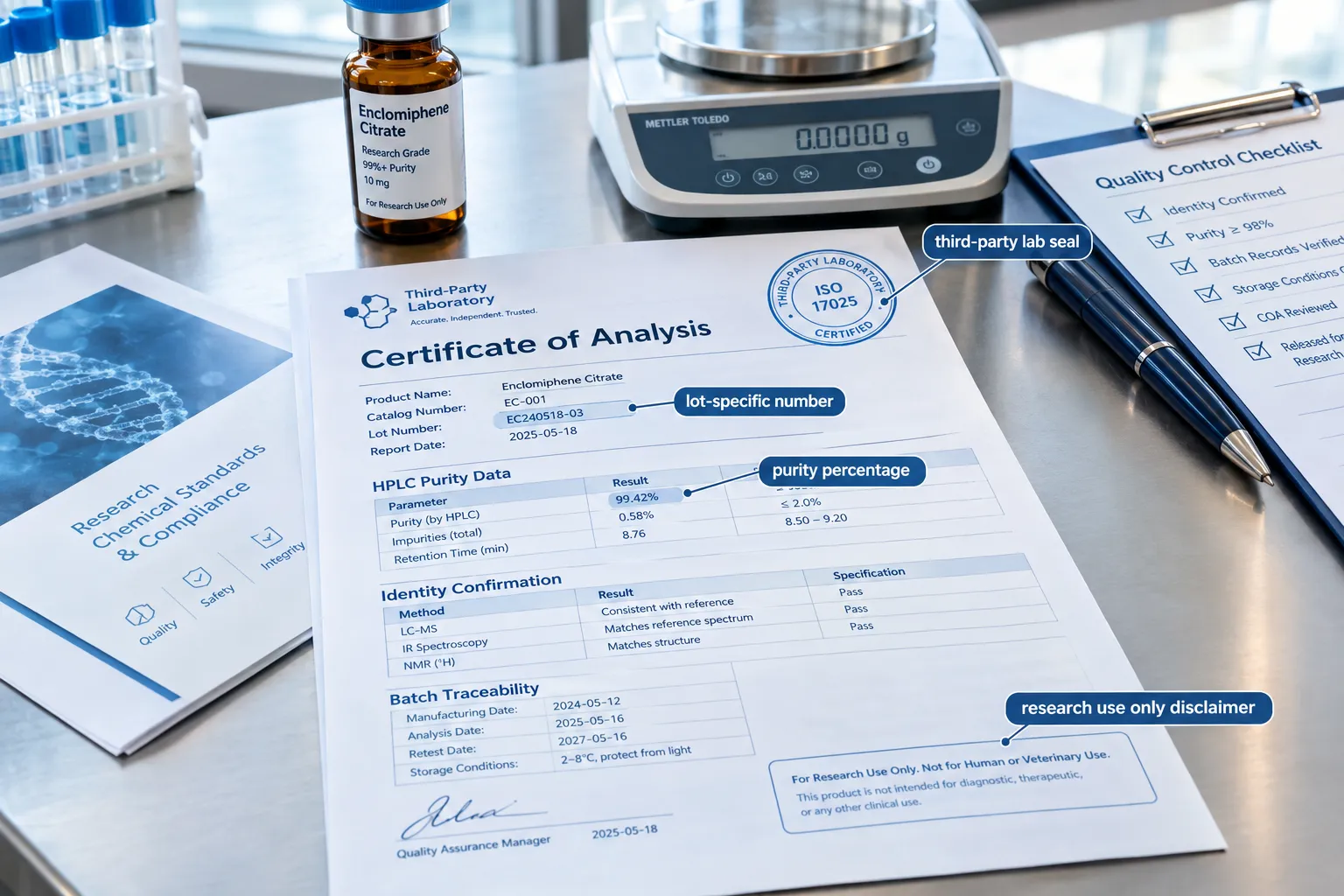
Enclomiphene is the trans-isomer of clomiphene, while zuclomiphene is the cis-isomer. Together they make up racemic clomiphene citrate, but enclomiphene is the pharmacologically dominant component at hypothalamic and pituitary estrogen receptors. By occupying those receptors, enclomiphene reduces negative feedback on gonadotropin-releasing hormone, which in turn raises luteinizing hormone (LH) and follicle-stimulating hormone (FSH), and ultimately increases endogenous testosterone production.
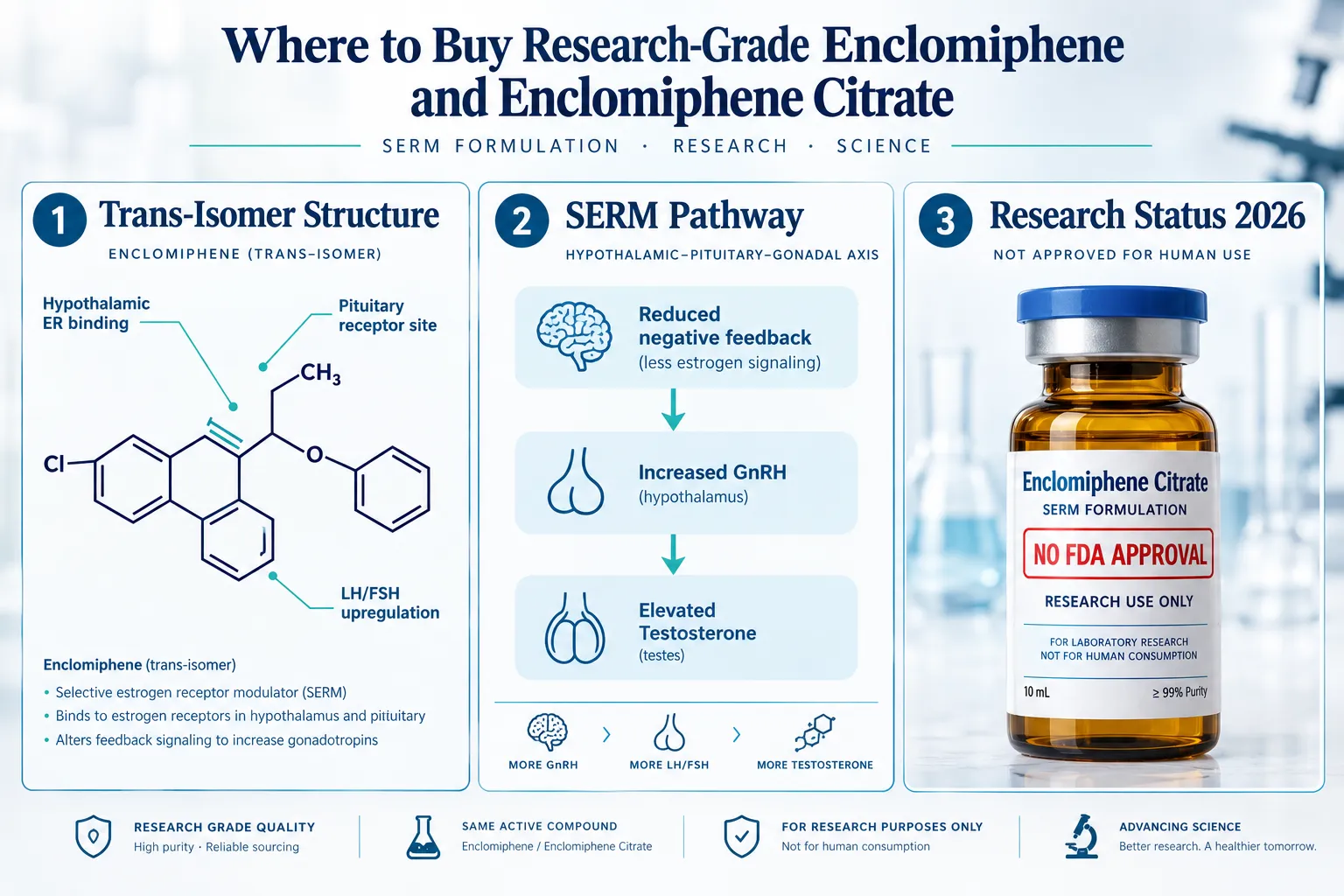
A 2025 systematic review and meta-analysis covering ten randomized controlled trials and 819 patients found that serm therapy with clomiphene or enclomiphene raised total testosterone by a mean of 273.76 ng/dL versus placebo (95% CI 191.87-355.66). Separate Phase II and Phase III trial data in overweight men with baseline testosterone at or below 300 ng/dL showed mean testosterone rising from approximately 205 ng/dL to 413-446 ng/dL at 16 weeks, while sperm concentration was maintained. These outcomes position enclomiphene as a research tool of genuine interest in the study of secondary hypogonadism and HPG-axis modulation.
Researchers comparing the two salt forms should note that enclomiphene free base and enclomiphene citrate differ in molecular weight and solubility. The citrate salt (CAS 15690-57-0) is the form most commonly listed by research-grade suppliers and the form used in the clinical dose-escalation studies that evaluated 12.5 mg once daily with up-titration to 25 mg. For a detailed side-by-side analysis of how these two forms behave in lab planning contexts, see where researchers compare enclomiphene vs enclomiphene citrate in lab use planning.
Important regulatory note: As of April 2026, enclomiphene has no FDA-approved indication. A prior New Drug Application received a Complete Response Letter in 2015, with the agency requesting additional Phase 3 studies that were never completed. No new NDA or ANDA has been filed since. All procurement and use is therefore strictly for laboratory research purposes.
COA Standards: What Research Buyers Must Demand
When evaluating where to buy research-grade enclomiphene and enclomiphene citrate, the Certificate of Analysis is the non-negotiable starting point. A COA is only as useful as its content, and the research community has seen a wide range in quality, from detailed third-party HPLC reports to single-page documents with no analytical data at all.
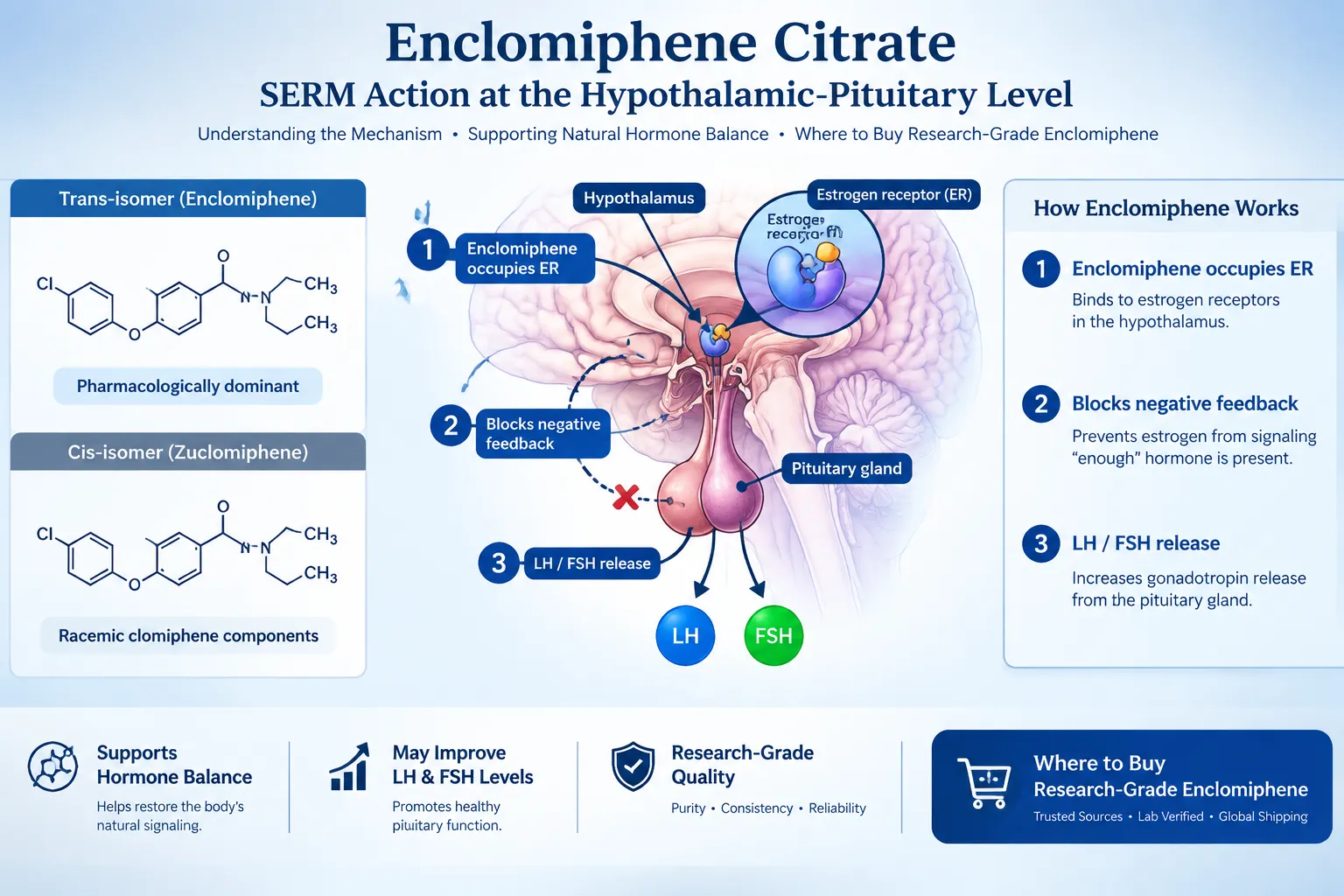
A research-grade COA for enclomiphene citrate should include:
| COA Element | What to Look For |
|---|---|
| Identity confirmation | Matches CAS 15690-57-0 and "trans-clomiphene citrate" |
| Purity percentage | Typically reported via HPLC; look for 98%+ |
| Batch/lot number | Unique identifier traceable to production records |
| Lot date | Production and expiry or retest date |
| Analytical method | HPLC, NMR, or mass spectrometry noted |
| Third-party testing | Independent lab name and accreditation noted |
A mid-2026 vendor comparison tracking EU suppliers of enclomiphene found significant disparity: one vendor rated poorly because its COA came from a third party without clear methodology, and another rated even lower because no COA information was publicly accessible at all. This illustrates that vendor reputation and documentation transparency must be evaluated together, not separately.
Buyers should also verify that the supplier explicitly labels enclomiphene as "for research use only" and not for diagnostic or therapeutic application. Reputable vendors group enclomiphene with other selective modulators in research-only catalogs and provide downloadable COA documents linked to specific lot numbers. Publicly accessible lot-specific COA pages, such as those listing identity, purity, and a linked lab-results document, represent the current industry standard that serious buyers should insist upon. One starting point for sourcing verified serm material is the serm 10mg product page, which reflects the kind of labeled research-grade documentation structure buyers should expect.
Peptide-Adjunct Study Design: Pairing Enclomiphene With GH-Axis and GLP-Class Compounds
The most sophisticated question facing researchers sourcing enclomiphene in 2026 is not simply where to buy research-grade enclomiphene and enclomiphene citrate, but how to integrate it into multi-compound study designs alongside peptide hormones. This is where formulation compatibility, endpoint selection, and vendor breadth all converge.
Enclomiphene's mechanism operates at the HPG axis, while growth hormone-releasing peptides such as tesa and ipamorelin act at the GH axis. These are parallel but non-overlapping pathways, which makes them scientifically compatible in combination designs. Researchers studying body composition, metabolic function, or hormonal interplay may find value in pairing enclomiphene with GH-secretagogues. For context on how GH-releasing peptides function mechanistically, see tesa and ipamorelin peptides: mechanism, synergy, and growth hormone research design.
GLP-class peptides introduce a separate dimension. Because enclomiphene modulates estrogen receptor signaling and GLP compounds act on incretin receptors, researchers exploring metabolic endpoints may design studies that track testosterone, LH, FSH, insulin sensitivity, and body composition simultaneously. Understanding how serms interface with polypeptide hormones and GLP-class compounds at the receptor level is foundational to this design work, see estrogen receptors and enclomiphene: how serm research interfaces with polypeptide hormones and GLP-class peptides.
Key design considerations for combination studies:
- Formulation compatibility: Enclomiphene citrate capsules (typically 12.5 mg or 25 mg) are orally administered; most GH-axis peptides are reconstituted for injection. Separate administration routes reduce interaction risk.
- Endpoint alignment: Define whether primary endpoints are endocrine (testosterone, LH, FSH), metabolic (insulin sensitivity, body composition), or both.
- Vendor breadth: Sourcing enclomiphene and peptide adjuncts from a single supplier with consistent COA standards simplifies documentation and batch traceability.
- Storage compatibility: Enclomiphene citrate is stored at room temperature away from moisture; most peptides require refrigeration or freezing. Separate storage protocols must be planned.
For researchers exploring how molecular size and peptide class shape experimental design more broadly, peptides and polypeptides in modern research: how molecular size shapes function, stability, and experimental design provides useful structural context.
When metabolic pathways are a secondary endpoint, pairing enclomiphene with compounds studied for NAD+ and mitochondrial function adds another layer of complexity. Resources such as 5-Amino-1MQ peptide: how researchers frame NAD+ and metabolic pathway questions illustrate how small-molecule adjuncts are framed in multi-pathway designs.
Conclusion
Sourcing research-grade enclomiphene and enclomiphene citrate in 2026 demands more than finding a supplier with inventory. The actionable steps are clear: demand a lot-specific COA that includes identity confirmation, HPLC purity data, batch traceability, and an explicit "research use only" designation. Evaluate vendor reputation independently of price, and treat the absence of third-party analytical documentation as a disqualifying factor. When building peptide-adjunct study designs, map the mechanistic pathways of each compound before ordering, enclomiphene's HPG-axis activity is scientifically compatible with GH-axis peptides and GLP-class compounds, but only a well-structured protocol will yield interpretable data. Researchers who invest time in vendor evaluation and study design before procurement will consistently produce more reliable, reproducible results than those who treat sourcing as an afterthought.