Call or Text 727-513-9780
  • Shopping Cart Shopping Cart
    0Shopping Cart
Pure Tested Peptides | America's most trusted Peptides for sale online
  • Peptides for sale
    • Oral Peptides for sale
      • Peptide Capsules for sale
      • BPC 157 Capsules 1000mcg
      • SLU-PP-332 Capsules | 1000 mcg
      • 5-Amino-1MQ 50mg Capsules
      • Tesofensine 500mcg
    • All Peptides for sale
    • Peptide Sprays
      • BPC 157 Nasal Spray Kit
      • BPC-157 TB500 Nasal Spray Kit
      • Semax Nasal Spray 10mg
      • Selank – Nasal Spray Kit – 10mg
      • Epithalon 50MG Nasal Spray Kit
      • Ipamorelin 10mg Nasal Spray
      • Klow Nasal Spray (BPC-157 + TB-500 + GHK-Cu + KPV) | 80mg
      • Hulk Nasal Spray Tesa / Ipa Blend 6/3 MG
      • Klow Nasal Spray
      • NAD + 500 mg Nasal Spray
      • PT-141 Nasal Spray Kit
    • GHRH Peptides
      • Ipa Peptides
      • CJC-1295 Peptides
        • CJC-1295 with DAC 5 mg
        • CJC-1295 without DAC 5 mg
        • CJC-1295 Ipa 10mg
      • Tesa Peptides
        • Tesa Peptide
        • Tesa 20 mg
    • GHK-Cu Peptides
      • All GHK-Cu Peptides
      • GHK-Cu 100mg
      • KLOW Peptide Blend – Buy KLOW blend online
    • BPC Peptides
      • All BPC Peptides
      • BPC-157
      • BPC-157 TB-500
      • BPC 157 capsules 1000mcg
    • SLU-PP-332 Peptides
      • All SLU-PP-332 Peptides
      • SLU-PP-332 5mg
    • GLP3 Peptides
      • GLP3-R
      • GLP3-R CAG 10mg
      • GLP3-R 20mg
    • PT-141 Peptides
      • PT-141 Peptides for sale
      • PT-141 10mg
      • PT-141 Nasal Spray
    • CAG Peptides
      • Lipo-C Peptide Blend
      • CAG 5mg
      • CAG 10mg
    • MOTS-C Peptides
      • MOTS-C Peptides for sale
      • MOTS-c peptide
      • MOTS-c 10mg *6 pack*
    • 5 Amino 1MQ Peptides
      • 5 Amino 1MQ Peptides for sale
      • 5-Amino-1MQ 50mg Capsules
      • 5-Amino-1MQ 5mg
    • Epithalon Peptides
      • Epithalon Peptides for sale
      • Epithalon 10mg
      • Epithalon 50mg
  • Shop
    • GLPs
      • 5-Amino-1MQ 50mg Capsules
      • 5-Amino-1MQ 5mg
      • GLP3-Reta
      • L-Carnitine 500mg/ml
      • Tesofensine 500mcg
      • SLU-PP-332 5mg
      • MOTS-c 10mg *6 pack*
    • Epithalon & BPC Peptides
      • Epithalon 10mg
      • Epithalon 50mg
      • BPC-157
      • BPC 157 capsules 1000mcg
      • BPC-157 TB-500
      • BPC-157 TB500 Nasal Spray Kit
      • BPC 157 Nasal Spray Kit
    • BPC TB-500 & NAD+ Peptides
      • NAD+ 500 mg
      • KLOW Peptide Blend – Buy KLOW blend online
      • GLOW Peptide Blend
      • TB 500 5mg
      • BPC 157 capsules 1000mcg – Supplement
      • BPC 157 Nasal Spray Kit
      • BPC-157
      • BPC-157 TB500 Nasal Spray Kit
      • BPC-157 TB-500
      • BPC 157 capsules 1000mcg
    • LL-37 Peptide
      • LL-37 10 mg
    • MOTS-C & Selank
      • MOTS-c peptide
      • Selank 10mg
    • GHK Peptides
      • GHK-Cu 100mg
      • GLOW Peptide Blend
      • KLOW Peptide Blend – Buy KLOW blend online
  • COAs
  • Wholesale
    • Wholesale Peptides for sale
  • PTP FAQ
  • Affiliates
    • Selank Peptide: Advanced Pharmacological Mechanisms Underlying Its Anxiolytic and Nootropic Effects in Research
      • 5-Amino-1MQ Peptide: Detailed Mechanisms of NNMT Inhibition and Its Impact on Cellular Metabolism Research
        • MOTS-C Peptide: Unraveling Its Role in Mitochondrial Dynamics and Energy Metabolism Research
          • Epithalon Peptide and Telomerase Regulation: Investigating Its Impact on Cellular Senescence and Lifespan Research Models
            • GLP2-T vs GLP2 Tirz Peptide: Understanding the Naming, Mechanistic Nuances, and Research Implications for Gut Health
      • Peptides and Polypeptides in Modern Pharmacology: What Research on Metoprolol, Prednisone, and Amlodipine Reveals
        • Polypeptide Peptides vs NSAIDs: What Naproxen and Diclofenac Teach Tissue-Repair Researchers About BPC‑157 and TB‑500
          • Peptides and Polypeptides in Endocrine Pharmacology: How GLP-1, GLP-2, and GLP-3 Retatrutide Differ From Classic Drugs Like Prednisone and Amlodipine
          • 5‑Amino‑1MQ Peptide and NNMT Inhibition: How It Compares With Statins Like Atorvastatin in Adipose and Lipid Metabolism Research
      • Enclomiphene, Estrogen Receptor Signaling, and Luteinizing Phase Biology: What Hormone Researchers Should Measure
        • Mesenchymal Stem Cells, BPC‑157, and GHK‑Cu: How Tissue Repair Peptides Compare With Classic NSAIDs Like Naproxen in Injury Models
          • Peptide Calculator Use Cases Beyond Growth Hormone: Working Through GLP‑3 Retatrutide, MOTS‑c, and BPC‑157 Research Dosing
        • Polypeptide Peptides in Endocrine and Metabolic Pharmacology: Lessons From Amlodipine, Prednisone, and Metoprolol
        • Peptides Calculator for Advanced Blends: Worked Examples for Tesamorelin, CJC‑1295, and Ipamorelin Stacks
          • Peptides and Polypeptides in Human Physiology: How Molecular Size Shapes Research Applications
            • Selank Peptide: Advanced Pharmacological Mechanisms Underlying Its Anxiolytic and Nootropic Effects in Research
          • 5-Amino-1MQ Peptide: Detailed Mechanisms of NNMT Inhibition and Its Impact on Cellular Metabolism Research
            • MOTS-C Peptide: Unraveling Its Role in Mitochondrial Dynamics and Energy Metabolism Research
              • Epithalon Peptide and Telomerase Regulation: Investigating Its Impact on Cellular Senescence and Lifespan Research Models
                • GLP2-T vs GLP2 Tirz Peptide: Understanding the Naming, Mechanistic Nuances, and Research Implications for Gut Health
                  • Peptides and Polypeptides in Endocrine Pharmacology: How GLP-1, GLP-2, and GLP-3 Retatrutide Differ From Classic Drugs Like Prednisone and Amlodipine
                    • Polypeptide Peptides vs NSAIDs: What Naproxen and Diclofenac Teach Tissue-Repair Researchers About BPC‑157 and TB‑500
                      • Peptides and Polypeptides in Modern Pharmacology: What Research on Metoprolol, Prednisone, and Amlodipine Reveals
                        • 5‑Amino‑1MQ Peptide and NNMT Inhibition: How It Compares With Statins Like Atorvastatin in Adipose and Lipid Metabolism Research
                        • Enclomiphene, Estrogen Receptor Signaling, and Luteinizing Phase Biology: What Hormone Researchers Should Measure
                        • Mesenchymal Stem Cells, BPC‑157, and GHK‑Cu: How Tissue Repair Peptides Compare With Classic NSAIDs Like Naproxen in Injury Models
                        • Peptide Calculator Use Cases Beyond Growth Hormone: Working Through GLP‑3 Retatrutide, MOTS‑c, and BPC‑157 Research Dosing
                        • Polypeptide Peptides in Endocrine and Metabolic Pharmacology: Lessons From Amlodipine, Prednisone, and Metoprolol
                        • Peptides Calculator for Advanced Blends: Worked Examples for Tesamorelin, CJC‑1295, and Ipamorelin Stacks
                        • Peptides and Polypeptides in Human Physiology: How Molecular Size Shapes Research Applications
                        • Selank Peptide: Advanced Pharmacological Mechanisms Underlying Its Anxiolytic and Nootropic Effects in Research
                        • MOTS-C Peptide: Unraveling Its Role in Mitochondrial Dynamics and Energy Metabolism Research
                        • Peptides and Polypeptides in Modern Pharmacology: What Research on Metoprolol, Prednisone, and Amlodipine Reveals
                        • Peptides and Polypeptides in Endocrine Pharmacology: How GLP-1, GLP-2, and GLP-3 Retatrutide Differ From Classic Drugs Like Prednisone and Amlodipine
                        • 5-Amino-1MQ Peptide: Detailed Mechanisms of NNMT Inhibition and Its Impact on Cellular Metabolism Research
                        • Mesenchymal Stem Cells, BPC‑157, and GHK‑Cu: How Tissue Repair Peptides Compare With Classic NSAIDs Like Naproxen in Injury Models
                        • Peptide Calculator Use Cases Beyond Growth Hormone: Working Through GLP‑3 Retatrutide, MOTS‑c, and BPC‑157 Research Dosing
                        • GLP2-T vs GLP2 Tirz Peptide: Understanding the Naming, Mechanistic Nuances, and Research Implications for Gut Health
                        • Polypeptide Peptides in Endocrine and Metabolic Pharmacology: Lessons From Amlodipine, Prednisone, and Metoprolol
                        • Polypeptide Peptides vs NSAIDs: What Naproxen and Diclofenac Teach Tissue-Repair Researchers About BPC‑157 and TB‑500
                        • Peptides and Polypeptides in Human Physiology: How Molecular Size Shapes Research Applications
                        • Peptides Calculator for Advanced Blends: Worked Examples for Tesamorelin, CJC‑1295, and Ipamorelin Stacks
                        • 5‑Amino‑1MQ Peptide and NNMT Inhibition: How It Compares With Statins Like Atorvastatin in Adipose and Lipid Metabolism Research
                        • Enclomiphene, Estrogen Receptor Signaling, and Luteinizing Phase Biology: What Hormone Researchers Should Measure
                        • Epithalon Peptide and Telomerase Regulation: Investigating Its Impact on Cellular Senescence and Lifespan Research Models
                        • Best research protocol Klow blend
                        • best time to take BPC-157
                        • best time to take DSIP (Delta Sleep Inducing Peptide)
                        • best time to take CJC-1295
                        • best time to take AOD-9604
                        • best time to take Follistatin 344
                        • best time to take Ipamorelin
                        • best time to take MK-677 (Ibutamoren)
                        • best time to take Ligandrol (LGD-4033) — research compound
                        • best time to take Ostarine (MK-2866) — research compound
                        • best time to take GHK-CU
                        • best time to take TB-500
                        • best time to take MOTS-c
                        • best time to take Semax
                        • best time to take RAD-140 (Testolone) — research compound
                        • best time to take Thymosin Alpha-1
                        • best time to take PEG-MGF
                        • Biolife Plasma, Octapharma Plasma, and Research Peptides: How Plasma Donation Labs Differ From Peptide Suppliers
                        • best time to take YK-11 — research compound
                        • best time to take PT-141 (Bremelanotide)
                        • Best research protocol Klow blend
                        • 5-Amino-1MQ and MOTS-C Synergy: Metabolic Signaling, Mitochondria, and Research Design
                        • BPC-157 and TB-500: Investigating Their Combined Effects on Angiogenesis and Cellular Migration in Tissue Repair Models
                        • BPC-157 Peptide: Gut Barrier Function, Inflammation, and Tissue-Recovery Research
                        • 5‑Amino‑1MQ and MOTS‑c Synergy in Metabolic Research: Designing NNMT and Mitochondrial Biogenesis Stacks
                        • CJC-1295 with DAC vs. Without DAC: Half-Life, Release Kinetics, and Research Implications
                        • CJC‑1295 with DAC vs. Without DAC: Expanding on Half‑Life Differences Using Tesamorelin and Ipamorelin Blend Case Studies
                        • Collagen Biology and Copper‑Binding Peptides: How GHK‑Cu, Glow Blend, and Klow Blend Interact with Skin and Connective Tissue
                        • Collagen Biology and Regenerative Peptides: How GHK‑Cu, Glow Blend, and Klow Blend Affect Extracellular Matrix Research
                    • DNA, Telomeres, and Longevity Peptides: Positioning Epithalon and MOTS‑c in Genetic Aging Research
                      • Enclomiphene Citrate: serm Mechanism, Testosterone Research, and Stack Compatibility
                        • Enclomiphene vs Enclomiphene Citrate: Formulation, Bioavailability, and Research Distinctions
                        • Epithalon Peptide Research: Telomerase Activation, Aging, and Pineal Gland Function
                        • Estrogen Receptor Signaling and Enclomiphene: How Selective Modulators Compare with Classic Polypeptide Hormones
                        • GHK-Cu Peptide: Advanced Mechanisms in Extracellular Matrix Remodeling and Wound Healing Research
                        • GHK-Cu Peptide: Collagen Synthesis, Wound Repair, and Skin-Barrier Research Models
                        • GLP-1 vs GLP-3 vs GLP-2: Peptide Classification and Research Applications
                        • GLP-2 Peptide Research Guide: Gut Barrier Function, Nutrient Absorption, and Intestinal Recovery Models
                        • GLP-3 Retatrutide vs. GLP-1 Drugs: What Triple-Agonist Biology Changes in Research Models
                        • Ipamorelin and Tesamorelin Combination: Synergistic GH Secretagogue Research and Dosing Protocols
                        • GLP2 Tirz Peptide: What It Is, Why the Name Exists, and How Researchers Should Interpret It
                        • Klow Blend Peptide Nasal Spray: What the Formulation Is Trying to Do in Cognitive Research
                        • Mitochondria, NNMT Inhibition, and Peptide Modulators: Where MOTS‑c and 5‑Amino‑1MQ Fit in Cellular Energy Research
                        • MOTS-c Peptide: Mitochondrial Function, Energy Metabolism, and What Researchers Measure
                        • MOTS-c vs. 5-Amino-1MQ: Which Metabolic Research Questions Each Compound Actually Answers
                        • Nasal Spray Peptides: Bioavailability, Administration, and Semax/Selank Research Applications
                        • PT-141 Peptide Research: Mechanism of Action and Melanocortin Receptor Signaling
                        • Retatrutide for Research: Mechanism, Structure, and GLP-1/GLP-3 Dual Action
                        • Retatrutide for Obesity and Type 2 Diabetes: What the Latest Trial Data Suggest
                        • Tesofensine Peptide Research: Mechanism, Appetite Suppression, and Neuropeptide Y Pathways
  • Contact
    • Contact Customer Service
    • Text Customer Support
  • About US
  • Shop all peptides
  • Affiliate Program
    • Affiliate Signup
  • Login / Register Login / Register Page Link Login / Register Page Link
  • Click to open the search input field Click to open the search input field Search
  • Menu Menu
Estrogen Receptors and Enclomiphene: How serm Research Interfaces With Polypeptide Hormones and GLP‑Class Peptides

Estrogen Receptors and Enclomiphene: How serm Research Interfaces With Polypeptide Hormones and GLP‑Class Peptides

August 28, 2026/0 Comments/in Uncategorized/by

Fewer than 15% of men diagnosed with functional hypogonadism in 2026 are offered non-testosterone pharmacological alternatives, yet enclomiphene citrate, a selective estrogen receptor modulator (serm), has quietly accumulated a substantial research record that intersects with some of the most active areas in peptide science. Understanding estrogen receptors and enclomiphene, and how serm research interfaces with polypeptide hormones and GLP-class peptides, is no longer a niche academic exercise. It is a practical framework for clinicians, researchers, and informed patients navigating a rapidly expanding hormonal-optimization landscape.

Key Takeaways

  • Enclomiphene blocks hypothalamic estrogen receptors to amplify GnRH, LH, and FSH output, preserving endogenous testosterone production.
  • Emerging evidence points to a bidirectional crosstalk between estrogen receptor signaling and GLP-1 class peptide pathways, particularly in the arcuate nucleus.
  • Polypeptide hormones such as GHRH analogues and GLP-class peptides operate through distinct receptor families but share downstream metabolic overlap with serm-driven hormonal cascades.
  • As of 2026, enclomiphene remains off-label for male hypogonadism in most jurisdictions, while GLP-1 receptor agonists hold broad regulatory approval.
  • Purity and third-party verification of research peptides are critical variables when studying these interactions at the lab level.

How Enclomiphene Targets Estrogen Receptors

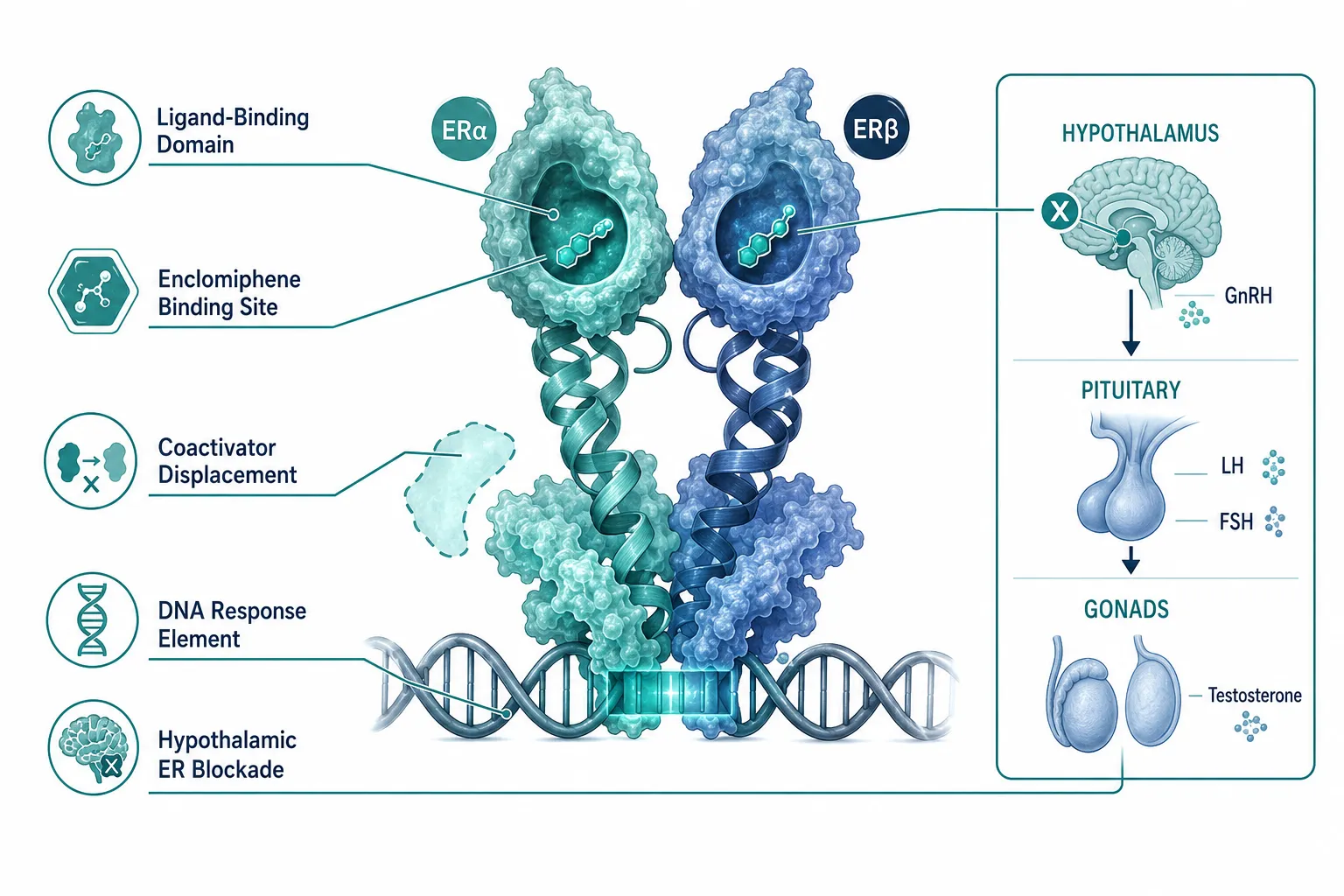
Enclomiphene is the trans-isomer of clomiphene citrate. While clomiphene contains both the zuclomiphene (cis) and enclomiphene (trans) isomers, the trans form carries most of the receptor-antagonist activity at the hypothalamic level. It binds competitively to estrogen receptor alpha (ERa) and estrogen receptor beta (ERb) in the hypothalamus and pituitary, blocking the negative feedback that estradiol normally exerts on gonadotropin-releasing hormone (GnRH) pulsatility.
How Enclomiphene Targets Estrogen Receptors

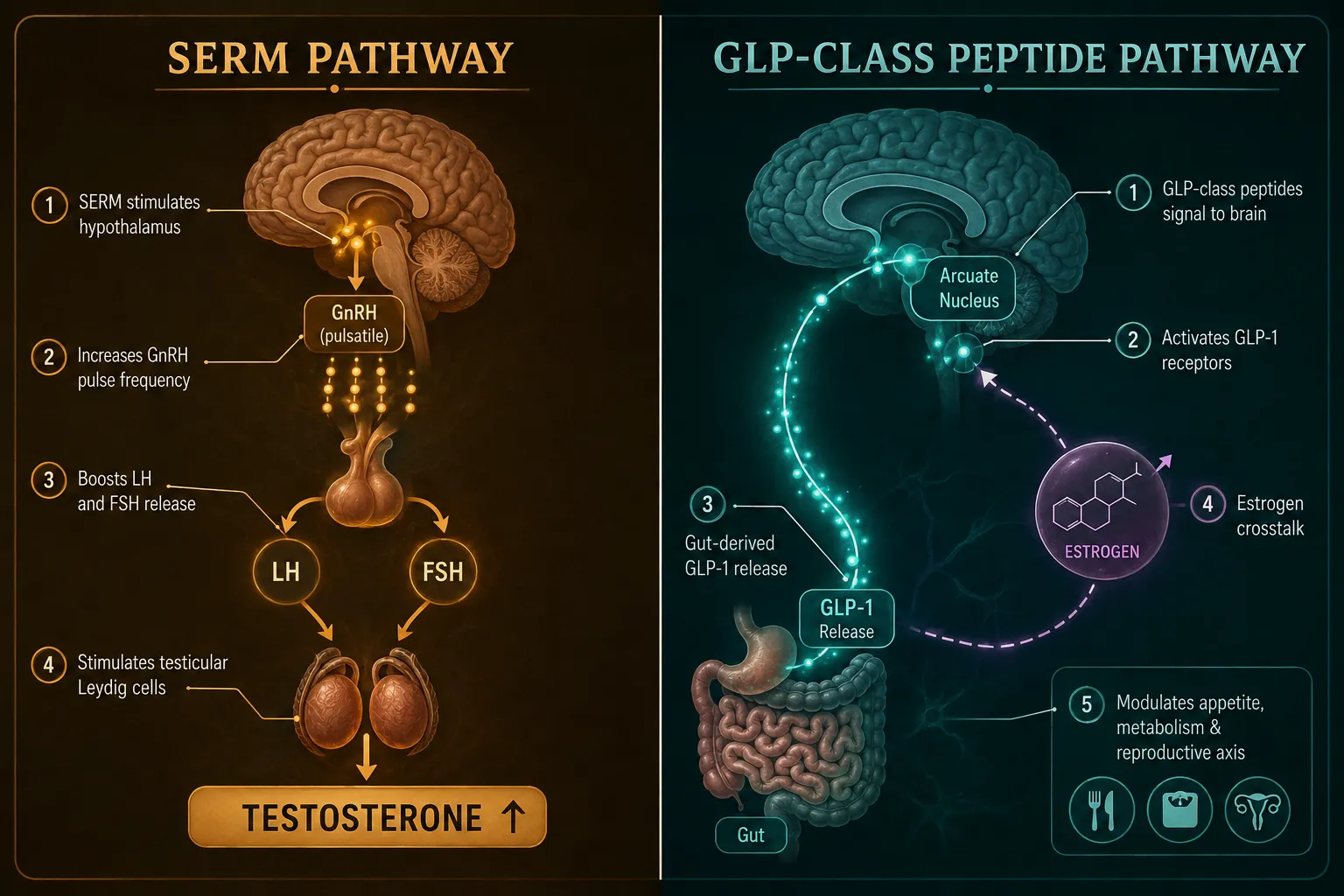
The result is a measurable increase in GnRH pulse frequency, which drives luteinizing hormone (LH) and follicle-stimulating hormone (FSH) secretion from the anterior pituitary. Elevated LH then stimulates Leydig cell testosterone synthesis in the testes. This mechanism is fundamentally different from exogenous testosterone replacement, which suppresses the hypothalamic-pituitary-gonadal (HPG) axis through negative feedback. Enclomiphene preserves, and actively stimulates, endogenous production.

Key receptor pharmacology points:

  • ERa blockade in the hypothalamus is the primary driver of GnRH disinhibition
  • ERb activity in peripheral tissues influences mood, bone density, and cardiovascular tone
  • Enclomiphene's selectivity profile differs from tamoxifen and raloxifene, making direct class comparisons imprecise

A 2025 systematic review comparing enclomiphene to testosterone replacement in male functional hypogonadism found that enclomiphene produced comparable testosterone normalization while maintaining sperm production, a clinically significant advantage for men of reproductive age.

serm Research Interfaces With Polypeptide Hormones: The HPG-Peptide Connection

The phrase "estrogen receptors and enclomiphene: how serm research interfaces with polypeptide hormones and GLP-class peptides" captures a genuinely complex biological intersection. The HPG axis does not operate in isolation. It is modulated by a network of polypeptide signals, including growth hormone-releasing hormone (GHRH), kisspeptin, and GLP-1 receptor agonists.
serm Research Interfaces With Polypeptide Hormones: The HPG-Peptide Connection

GHRH analogues and the serm context

GHRH analogues such as sermorelin and CJC-1295 stimulate growth hormone (GH) release from the anterior pituitary through GHRH receptor activation. Research into sermorelin and ipamorelin CJC-1295 combinations has shown that GH secretion interacts with sex hormone-binding globulin (SHBG) levels, indirectly influencing free testosterone availability. When enclomiphene raises total testosterone, the concurrent use of GHRH analogues may alter SHBG dynamics, creating a meaningful lab-level variable.

For researchers exploring IPA sermorelin stack protocols, understanding how estrogen receptor modulation affects the downstream hormonal environment is essential for interpreting assay results accurately.

GLP-1 class peptides: the emerging crosstalk

GLP-1 receptor agonists, originally developed for glycemic control, have revealed unexpected neuroendocrine activity. GLP-1 receptors are expressed in the arcuate nucleus of the hypothalamus, a region dense with kisspeptin neurons that directly regulate GnRH pulsatility. Estrogen receptors are co-expressed in the same neuronal populations.

"The arcuate nucleus functions as a convergence point where estrogen signaling, GLP-1 receptor activation, and kisspeptin-driven GnRH control interact in ways that current research is only beginning to map."

This means that a serm like enclomiphene, acting on hypothalamic ERa, may have functional crosstalk with GLP-1 receptor signaling in the same anatomical region. Researchers working with GLP-1 peptides in metabolic or neuroendocrine models should account for this overlap when designing experiments that also involve ER-modulating compounds.

The GLP-2 peptide class, while primarily intestinotrophic, also shows central nervous system expression patterns that warrant attention in multi-peptide research designs.

Research Trajectory and Practical Positioning in 2026

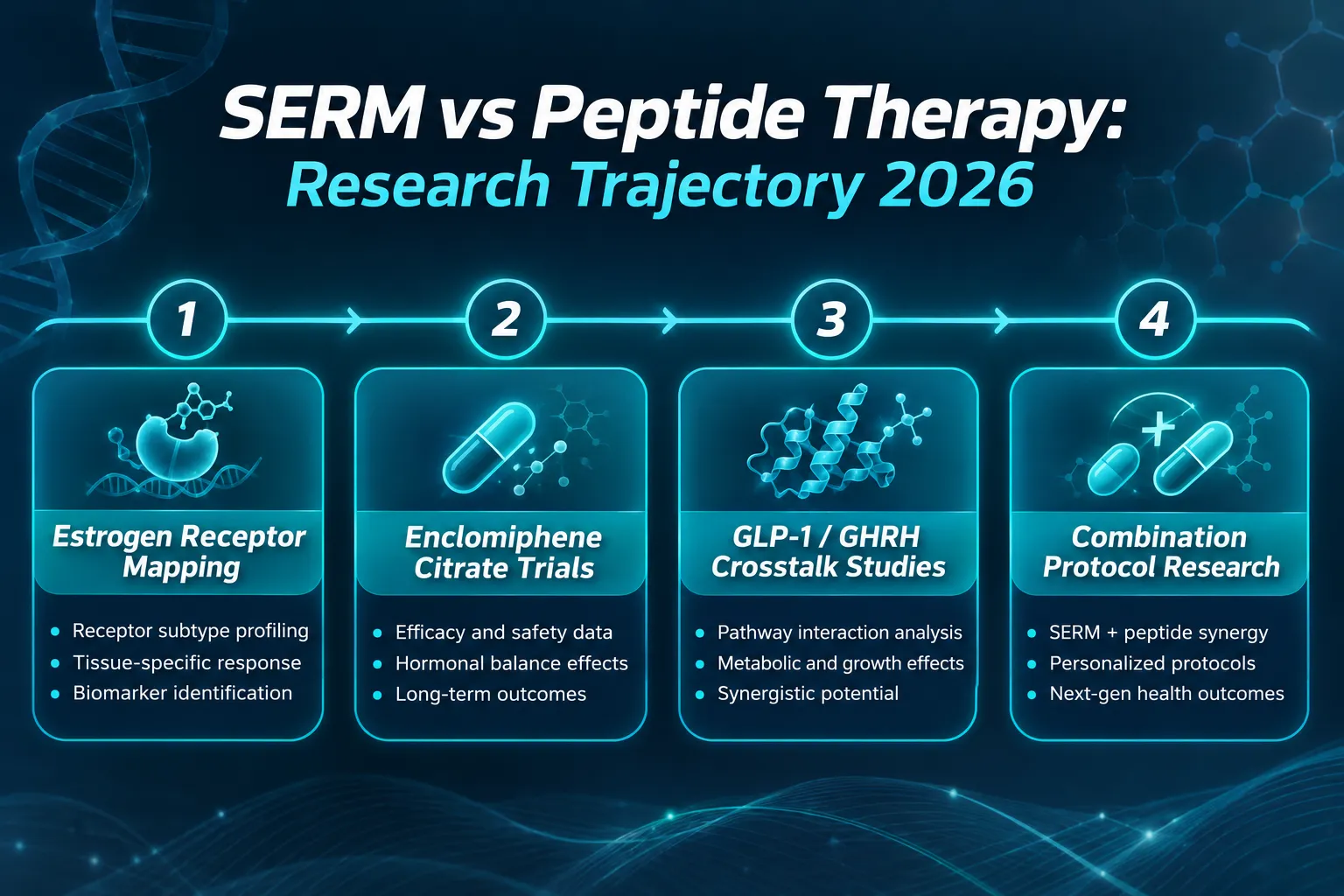
As of 2026, the regulatory landscape remains fragmented. Enclomiphene holds no major market authorization specifically for male hypogonadism in the United States or European Union, though off-label prescribing is common in men's health clinics. GLP-1 receptor agonists, by contrast, carry broad approvals for type 2 diabetes and obesity management, with ongoing trials in cardiovascular and neurodegenerative indications.
Research Trajectory and Practical Positioning in 2026

Positioning comparison at a glance:

Factor Enclomiphene (serm) GLP-1 Class Peptides
Primary target Hypothalamic ERa/ERb GLP-1 receptor (gut, brain)
Regulatory status (2026) Off-label (most jurisdictions) Approved (metabolic indications)
HPG axis effect Stimulatory (raises LH, FSH, T) Indirect (arcuate nucleus crosstalk)
Fertility preservation Yes Not established
Research peptide purity needs High High

For lab-level studies examining these interactions, sourcing lab tested peptides with verified purity documentation is non-negotiable. Contaminants or isomeric impurities can confound receptor-binding assays and produce misleading downstream hormone data.

Researchers interested in the growth hormone axis should also review tesa peptide benefits data, as tesa's effects on visceral fat and IGF-1 levels create additional metabolic variables relevant to any multi-compound hormonal study design.

Forward-looking analyst perspective (speculative): The most likely near-term research direction involves combination protocols that pair serm-driven HPG axis stimulation with GLP-1 receptor agonism to address both hypogonadism and metabolic syndrome simultaneously. This is not yet supported by randomized controlled trial data, but mechanistic rationale is strong enough to justify structured pilot studies.

Conclusion

Estrogen receptors and enclomiphene represent a well-characterized pharmacological axis. How serm research interfaces with polypeptide hormones and GLP-class peptides is a newer and more complex question, one that demands rigorous methodology, verified reagents, and a clear understanding of the convergent biology at the hypothalamic level.

Actionable next steps for researchers and clinicians:

  1. Map estrogen receptor expression alongside GLP-1 receptor distribution in any neuroendocrine study design that involves enclomiphene or related serms.
  2. Account for SHBG dynamics when combining GHRH analogues with serm protocols, as free hormone availability will shift.
  3. Use only third-party verified, lab tested peptides to eliminate purity as a confounding variable.
  4. Monitor the regulatory environment closely, enclomiphene's off-label status may shift as trial data accumulates through 2026 and beyond.
  5. Treat GLP-1 and serm crosstalk findings as hypothesis-generating until controlled trial data is available.

The intersection of serm pharmacology and peptide hormone research is not a fringe topic. It is where the next generation of hormonal optimization protocols will be built.

Tags: enclomiphene, enclomiphene citrate, estrogen receptors, ghrh analogues, glp-1 peptides, hypothalamic hpg axis, polypeptide hormones, serm research
https://www.puretestedpeptides.com/wp-content/uploads/2026/08/estrogen-receptors-and-enclomiphene-how-serm-research-interfaces-with-polypeptid.webp 1024 1536 https://www.puretestedpeptides.com/wp-content/uploads/2026/01/buy-peptides-online.jpg 2026-08-28 13:05:392026-08-28 13:05:39Estrogen Receptors and Enclomiphene: How serm Research Interfaces With Polypeptide Hormones and GLP‑Class Peptides
You might also like
Enclomiphene in Male Endocrine Research: LH, FSH, and Testosterone Signaling Without Clomiphene’s Mixed Isomers Enclomiphene in Male Endocrine Research: LH, FSH, and Testosterone Signaling Without Clomiphene’s Mixed Isomers
Enclomiphene vs Enclomiphene Citrate: How Labs Choose Between Research Formulations and Vendors Enclomiphene vs Enclomiphene Citrate: How Labs Choose Between Research Formulations and Vendors
Enclomiphene Citrate: Understanding Its Selective Estrogen Receptor Modulation (serm) and Research Uses Enclomiphene Citrate: Understanding Its Selective Estrogen Receptor Modulation (serm) and Research Uses
Enclomiphene and the Luteinizing Phase: Modeling Male Reproductive Hormone Fluctuations in Endocrine Research Enclomiphene and the Luteinizing Phase: Modeling Male Reproductive Hormone Fluctuations in Endocrine Research
Understanding Polypeptide Peptides: Mechanism of Action in Research Applications Understanding Polypeptide Peptides: Mechanism of Action in Research Applications
Peptides and Polypeptides in Endocrine Pharmacology: How Enclomiphene Interfaces With Estrogen Receptor Biology Peptides and Polypeptides in Endocrine Pharmacology: How Enclomiphene Interfaces With Estrogen Receptor Biology
Retatrutide Phase 3 and Beyond: What Ongoing Obesity Trials Mean for Research Readers Retatrutide Phase 3 and Beyond: What Ongoing Obesity Trials Mean for Research Readers
Where Researchers Compare Enclomiphene vs Enclomiphene Citrate in Lab-Use Planning Where Researchers Compare Enclomiphene vs Enclomiphene Citrate in Lab-Use Planning
0 replies

Leave a Reply

Want to join the discussion?
Feel free to contribute!

Leave a Reply Cancel reply

Your email address will not be published. Required fields are marked *

×

Helpful Links

  • My account
  • Cart
  • Checkout
  • Refund and Returns Policy
  • Privacy Policy
  • SMS Privacy Policy
  • Login
  • My Account
  • Logout

USA Made Lab Tested Peptides

All products are sold for research, laboratory, or analytical purposes only, and are not for human consumption


Pure Tested Peptides is a chemical supplier. Pure Tested Peptides is not a compounding / chemical compounding facility as defined under 503A of the Federal Food, Drug, and Cosmetic act. Pure Tested Peptides is not an outsourcing facility as defined under 503B of the Federal Food, Drug, and Cosmetic act.

The statements made within this website have not been evaluated by the US Food and Drug Administration. The products we offer are not intended to diagnose, treat, cure or prevent any disease.

Human/Animal Consumption Prohibited. Laboratory/In-Vitro Experimental Use Only

Link to: GLP Peptides vs Traditional Small‑Molecule Metabolic Drugs: Where GLP‑3 Retatrutide, GLP‑2‑T, and Tesofensine Fit in Cardiometabolic Research Link to: GLP Peptides vs Traditional Small‑Molecule Metabolic Drugs: Where GLP‑3 Retatrutide, GLP‑2‑T, and Tesofensine Fit in Cardiometabolic Research GLP Peptides vs Traditional Small‑Molecule Metabolic Drugs: Where GLP‑3...GLP Peptides vs Traditional Small‑Molecule Metabolic Drugs: Where GLP‑3 Retatrutide, GLP‑2‑T, and Tesofensine Fit in Cardiometabolic Research Link to: Peptides vs Classic NSAIDs: How BPC‑157 and TB‑500 Compare With Naproxen and Diclofenac in Injury Research Models Link to: Peptides vs Classic NSAIDs: How BPC‑157 and TB‑500 Compare With Naproxen and Diclofenac in Injury Research Models Peptides vs Classic NSAIDs: How BPC‑157 and TB‑500 Compare With Naproxen and Diclofenac in Injury Research ModelsPeptides vs Classic NSAIDs: How BPC‑157 and TB‑500 Compare With Naproxen...
Scroll to top Scroll to top Scroll to top