Call or Text 727-513-9780
  • Shopping Cart Shopping Cart
    0Shopping Cart
Pure Tested Peptides | America's most trusted Peptides for sale online
  • Peptides for sale
    • Oral Peptides for sale
      • Peptide Capsules for sale
      • BPC 157 Capsules 1000mcg
      • SLU-PP-332 Capsules | 1000 mcg
      • 5-Amino-1MQ 50mg Capsules
      • Tesofensine 500mcg
    • All Peptides for sale
    • Peptide Sprays
      • BPC 157 Nasal Spray Kit
      • BPC-157 TB500 Nasal Spray Kit
      • Semax Nasal Spray 10mg
      • Selank – Nasal Spray Kit – 10mg
      • Epithalon 50MG Nasal Spray Kit
      • Ipamorelin 10mg Nasal Spray
      • Klow Nasal Spray (BPC-157 + TB-500 + GHK-Cu + KPV) | 80mg
      • Hulk Nasal Spray Tesa / Ipa Blend 6/3 MG
      • Klow Nasal Spray
      • NAD + 500 mg Nasal Spray
      • PT-141 Nasal Spray Kit
    • GHRH Peptides
      • Ipa Peptides
      • CJC-1295 Peptides
        • CJC-1295 with DAC 5 mg
        • CJC-1295 without DAC 5 mg
        • CJC-1295 Ipa 10mg
      • Tesa Peptides
        • Tesa Peptide
        • Tesa 20 mg
    • GHK-Cu Peptides
      • All GHK-Cu Peptides
      • GHK-Cu 100mg
      • KLOW Peptide Blend – Buy KLOW blend online
    • BPC Peptides
      • All BPC Peptides
      • BPC-157
      • BPC-157 TB-500
      • BPC 157 capsules 1000mcg
    • SLU-PP-332 Peptides
      • All SLU-PP-332 Peptides
      • SLU-PP-332 5mg
    • GLP3 Peptides
    • PT-141 Peptides
      • PT-141 Peptides for sale
      • PT-141 10mg
      • PT-141 Nasal Spray
    • CAG Peptides
      • Lipo-C Peptide Blend
      • CAG 5mg
      • CAG 10mg
    • MOTS-C Peptides
      • MOTS-C Peptides for sale
      • MOTS-c peptide
      • MOTS-c 10mg *6 pack*
    • 5 Amino 1MQ Peptides
      • 5 Amino 1MQ Peptides for sale
      • 5-Amino-1MQ 50mg Capsules
      • 5-Amino-1MQ 5mg
    • Epithalon Peptides
      • Epithalon Peptides for sale
      • Epithalon 10mg
      • Epithalon 50mg
  • Shop
    • GLPs
      • 5-Amino-1MQ 50mg Capsules
      • 5-Amino-1MQ 5mg
      • L-Carnitine 500mg/ml
      • Tesofensine 500mcg
      • SLU-PP-332 5mg
      • MOTS-c 10mg *6 pack*
    • Epithalon & BPC Peptides
      • Epithalon 10mg
      • Epithalon 50mg
      • BPC-157
      • BPC 157 capsules 1000mcg
      • BPC-157 TB-500
      • BPC-157 TB500 Nasal Spray Kit
      • BPC 157 Nasal Spray Kit
    • BPC TB-500 & NAD+ Peptides
      • NAD+ 500 mg
      • KLOW Peptide Blend – Buy KLOW blend online
      • GLOW Peptide Blend
      • TB 500 5mg
      • BPC 157 capsules 1000mcg – Supplement
      • BPC 157 Nasal Spray Kit
      • BPC-157
      • BPC-157 TB500 Nasal Spray Kit
      • BPC-157 TB-500
      • BPC 157 capsules 1000mcg
    • LL-37 Peptide
      • LL-37 10 mg
    • MOTS-C & Selank
      • MOTS-c peptide
      • Selank 10mg
    • GHK Peptides
      • GHK-Cu 100mg
      • GLOW Peptide Blend
      • KLOW Peptide Blend – Buy KLOW blend online
  • COAs
  • Wholesale
    • Wholesale Peptides for sale
  • PTP FAQ
  • Affiliates
    • Selank Peptide: Advanced Pharmacological Mechanisms Underlying Its Anxiolytic and Nootropic Effects in Research
      • 5-Amino-1MQ Peptide: Detailed Mechanisms of NNMT Inhibition and Its Impact on Cellular Metabolism Research
        • MOTS-C Peptide: Unraveling Its Role in Mitochondrial Dynamics and Energy Metabolism Research
          • Epithalon Peptide and Telomerase Regulation: Investigating Its Impact on Cellular Senescence and Lifespan Research Models
            • GLP2-T vs GLP2 Tirz Peptide: Understanding the Naming, Mechanistic Nuances, and Research Implications for Gut Health
      • Peptides and Polypeptides in Modern Pharmacology: What Research on Metoprolol, Prednisone, and Amlodipine Reveals
        • Polypeptide Peptides vs NSAIDs: What Naproxen and Diclofenac Teach Tissue-Repair Researchers About BPC‑157 and TB‑500
          • Peptides and Polypeptides in Endocrine Pharmacology: How GLP-1, GLP-2, and GLP-3 Retatrutide Differ From Classic Drugs Like Prednisone and Amlodipine
          • 5‑Amino‑1MQ Peptide and NNMT Inhibition: How It Compares With Statins Like Atorvastatin in Adipose and Lipid Metabolism Research
      • Enclomiphene, Estrogen Receptor Signaling, and Luteinizing Phase Biology: What Hormone Researchers Should Measure
        • Mesenchymal Stem Cells, BPC‑157, and GHK‑Cu: How Tissue Repair Peptides Compare With Classic NSAIDs Like Naproxen in Injury Models
          • Peptide Calculator Use Cases Beyond Growth Hormone: Working Through GLP‑3 Retatrutide, MOTS‑c, and BPC‑157 Research Dosing
        • Polypeptide Peptides in Endocrine and Metabolic Pharmacology: Lessons From Amlodipine, Prednisone, and Metoprolol
        • Peptides Calculator for Advanced Blends: Worked Examples for Tesamorelin, CJC‑1295, and Ipamorelin Stacks
          • Peptides and Polypeptides in Human Physiology: How Molecular Size Shapes Research Applications
            • Selank Peptide: Advanced Pharmacological Mechanisms Underlying Its Anxiolytic and Nootropic Effects in Research
          • 5-Amino-1MQ Peptide: Detailed Mechanisms of NNMT Inhibition and Its Impact on Cellular Metabolism Research
            • MOTS-C Peptide: Unraveling Its Role in Mitochondrial Dynamics and Energy Metabolism Research
              • Epithalon Peptide and Telomerase Regulation: Investigating Its Impact on Cellular Senescence and Lifespan Research Models
                • GLP2-T vs GLP2 Tirz Peptide: Understanding the Naming, Mechanistic Nuances, and Research Implications for Gut Health
                  • Peptides and Polypeptides in Endocrine Pharmacology: How GLP-1, GLP-2, and GLP-3 Retatrutide Differ From Classic Drugs Like Prednisone and Amlodipine
                    • Polypeptide Peptides vs NSAIDs: What Naproxen and Diclofenac Teach Tissue-Repair Researchers About BPC‑157 and TB‑500
                      • Peptides and Polypeptides in Modern Pharmacology: What Research on Metoprolol, Prednisone, and Amlodipine Reveals
                        • 5‑Amino‑1MQ Peptide and NNMT Inhibition: How It Compares With Statins Like Atorvastatin in Adipose and Lipid Metabolism Research
                        • Enclomiphene, Estrogen Receptor Signaling, and Luteinizing Phase Biology: What Hormone Researchers Should Measure
                        • Mesenchymal Stem Cells, BPC‑157, and GHK‑Cu: How Tissue Repair Peptides Compare With Classic NSAIDs Like Naproxen in Injury Models
                        • Peptide Calculator Use Cases Beyond Growth Hormone: Working Through GLP‑3 Retatrutide, MOTS‑c, and BPC‑157 Research Dosing
                        • Polypeptide Peptides in Endocrine and Metabolic Pharmacology: Lessons From Amlodipine, Prednisone, and Metoprolol
                        • Peptides Calculator for Advanced Blends: Worked Examples for Tesamorelin, CJC‑1295, and Ipamorelin Stacks
                        • Peptides and Polypeptides in Human Physiology: How Molecular Size Shapes Research Applications
                        • Selank Peptide: Advanced Pharmacological Mechanisms Underlying Its Anxiolytic and Nootropic Effects in Research
                        • MOTS-C Peptide: Unraveling Its Role in Mitochondrial Dynamics and Energy Metabolism Research
                        • Peptides and Polypeptides in Modern Pharmacology: What Research on Metoprolol, Prednisone, and Amlodipine Reveals
                        • Peptides and Polypeptides in Endocrine Pharmacology: How GLP-1, GLP-2, and GLP-3 Retatrutide Differ From Classic Drugs Like Prednisone and Amlodipine
                        • 5-Amino-1MQ Peptide: Detailed Mechanisms of NNMT Inhibition and Its Impact on Cellular Metabolism Research
                        • Mesenchymal Stem Cells, BPC‑157, and GHK‑Cu: How Tissue Repair Peptides Compare With Classic NSAIDs Like Naproxen in Injury Models
                        • Peptide Calculator Use Cases Beyond Growth Hormone: Working Through GLP‑3 Retatrutide, MOTS‑c, and BPC‑157 Research Dosing
                        • GLP2-T vs GLP2 Tirz Peptide: Understanding the Naming, Mechanistic Nuances, and Research Implications for Gut Health
                        • Polypeptide Peptides in Endocrine and Metabolic Pharmacology: Lessons From Amlodipine, Prednisone, and Metoprolol
                        • Polypeptide Peptides vs NSAIDs: What Naproxen and Diclofenac Teach Tissue-Repair Researchers About BPC‑157 and TB‑500
                        • Peptides and Polypeptides in Human Physiology: How Molecular Size Shapes Research Applications
                        • Peptides Calculator for Advanced Blends: Worked Examples for Tesamorelin, CJC‑1295, and Ipamorelin Stacks
                        • 5‑Amino‑1MQ Peptide and NNMT Inhibition: How It Compares With Statins Like Atorvastatin in Adipose and Lipid Metabolism Research
                        • Enclomiphene, Estrogen Receptor Signaling, and Luteinizing Phase Biology: What Hormone Researchers Should Measure
                        • Epithalon Peptide and Telomerase Regulation: Investigating Its Impact on Cellular Senescence and Lifespan Research Models
                        • Best research protocol Klow blend
                        • best time to take BPC-157
                        • best time to take DSIP (Delta Sleep Inducing Peptide)
                        • best time to take CJC-1295
                        • best time to take AOD-9604
                        • best time to take Follistatin 344
                        • best time to take Ipamorelin
                        • best time to take MK-677 (Ibutamoren)
                        • best time to take Ligandrol (LGD-4033) — research compound
                        • best time to take Ostarine (MK-2866) — research compound
                        • best time to take GHK-CU
                        • best time to take TB-500
                        • best time to take MOTS-c
                        • best time to take Semax
                        • best time to take RAD-140 (Testolone) — research compound
                        • best time to take Thymosin Alpha-1
                        • best time to take PEG-MGF
                        • Biolife Plasma, Octapharma Plasma, and Research Peptides: How Plasma Donation Labs Differ From Peptide Suppliers
                        • best time to take YK-11 — research compound
                        • best time to take PT-141 (Bremelanotide)
                        • Best research protocol Klow blend
                        • 5-Amino-1MQ and MOTS-C Synergy: Metabolic Signaling, Mitochondria, and Research Design
                        • BPC-157 and TB-500: Investigating Their Combined Effects on Angiogenesis and Cellular Migration in Tissue Repair Models
                        • BPC-157 Peptide: Gut Barrier Function, Inflammation, and Tissue-Recovery Research
                        • 5‑Amino‑1MQ and MOTS‑c Synergy in Metabolic Research: Designing NNMT and Mitochondrial Biogenesis Stacks
                        • CJC-1295 with DAC vs. Without DAC: Half-Life, Release Kinetics, and Research Implications
                        • CJC‑1295 with DAC vs. Without DAC: Expanding on Half‑Life Differences Using Tesamorelin and Ipamorelin Blend Case Studies
                        • Collagen Biology and Copper‑Binding Peptides: How GHK‑Cu, Glow Blend, and Klow Blend Interact with Skin and Connective Tissue
                        • Collagen Biology and Regenerative Peptides: How GHK‑Cu, Glow Blend, and Klow Blend Affect Extracellular Matrix Research
                    • DNA, Telomeres, and Longevity Peptides: Positioning Epithalon and MOTS‑c in Genetic Aging Research
                      • Enclomiphene Citrate: serm Mechanism, Testosterone Research, and Stack Compatibility
                        • Enclomiphene vs Enclomiphene Citrate: Formulation, Bioavailability, and Research Distinctions
                        • Epithalon Peptide Research: Telomerase Activation, Aging, and Pineal Gland Function
                        • Estrogen Receptor Signaling and Enclomiphene: How Selective Modulators Compare with Classic Polypeptide Hormones
                        • GHK-Cu Peptide: Advanced Mechanisms in Extracellular Matrix Remodeling and Wound Healing Research
                        • GHK-Cu Peptide: Collagen Synthesis, Wound Repair, and Skin-Barrier Research Models
                        • GLP-1 vs GLP-3 vs GLP-2: Peptide Classification and Research Applications
                        • GLP-2 Peptide Research Guide: Gut Barrier Function, Nutrient Absorption, and Intestinal Recovery Models
                        • GLP-3 Retatrutide vs. GLP-1 Drugs: What Triple-Agonist Biology Changes in Research Models
                        • Ipamorelin and Tesamorelin Combination: Synergistic GH Secretagogue Research and Dosing Protocols
                        • GLP2 Tirz Peptide: What It Is, Why the Name Exists, and How Researchers Should Interpret It
                        • Klow Blend Peptide Nasal Spray: What the Formulation Is Trying to Do in Cognitive Research
                        • Mitochondria, NNMT Inhibition, and Peptide Modulators: Where MOTS‑c and 5‑Amino‑1MQ Fit in Cellular Energy Research
                        • MOTS-c Peptide: Mitochondrial Function, Energy Metabolism, and What Researchers Measure
                        • MOTS-c vs. 5-Amino-1MQ: Which Metabolic Research Questions Each Compound Actually Answers
                        • Nasal Spray Peptides: Bioavailability, Administration, and Semax/Selank Research Applications
                        • PT-141 Peptide Research: Mechanism of Action and Melanocortin Receptor Signaling
                        • Retatrutide for Research: Mechanism, Structure, and GLP-1/GLP-3 Dual Action
                        • Retatrutide for Obesity and Type 2 Diabetes: What the Latest Trial Data Suggest
                        • Tesofensine Peptide Research: Mechanism, Appetite Suppression, and Neuropeptide Y Pathways
  • Contact
    • Contact Customer Service
    • Text Customer Support
  • About US
  • Shop all peptides
  • Affiliate Program
    • Affiliate Signup
  • Login / Register Login / Register Page Link Login / Register Page Link
  • Click to open the search input field Click to open the search input field Search
  • Menu Menu

Tag Archive for: peptide coa audit

Research-Use Peptide Reviews: How to Audit Product Claims for BPC-157, TB-500, GHK-Cu, and Glow Blends

Research-Use Peptide Reviews: How to Audit Product Claims for BPC-157, TB-500, GHK-Cu, and Glow Blends

November 4, 2026/0 Comments/in Uncategorized/by

Only 30% of research peptide vendors tested in independent audits between 2023 and 2025 supplied products that matched both the labeled identity and stated purity. That gap between claim and reality makes reading a product page, or a glowing user review, a genuinely risky exercise. This guide on Research-Use Peptide Reviews: How to Audit Product Claims for BPC-157, TB-500, GHK-Cu, and Glow Blends walks through a structured method for separating credible data from marketing fiction, covering single agents and multi-peptide blends alike.

Key Takeaways

  • A Certificate of Analysis (COA) is only as reliable as the lab that issued it and the assay used to generate it.
  • BPC-157 and TB-500 have no approved human clinical trials and carry specific regulatory and anti-doping risks in 2026.
  • GHK-Cu has a narrow but real topical evidence base; injectable claims are largely extrapolated.
  • Multi-peptide "glow blends" almost never have blend-level clinical data, making individual-ingredient studies a poor substitute.
  • Matching a product claim to the specific assay type, species, and dose used in the source study is the single most useful audit step.

Understanding the Evidence Base Before Reading Any Review
Understanding the Evidence Base Before Reading Any Review

Before evaluating what a review says about a peptide, it helps to know what the underlying science actually supports. Each compound in this space sits at a different point on the evidence spectrum, and conflating them is the most common error in vendor marketing and user testimonials alike.

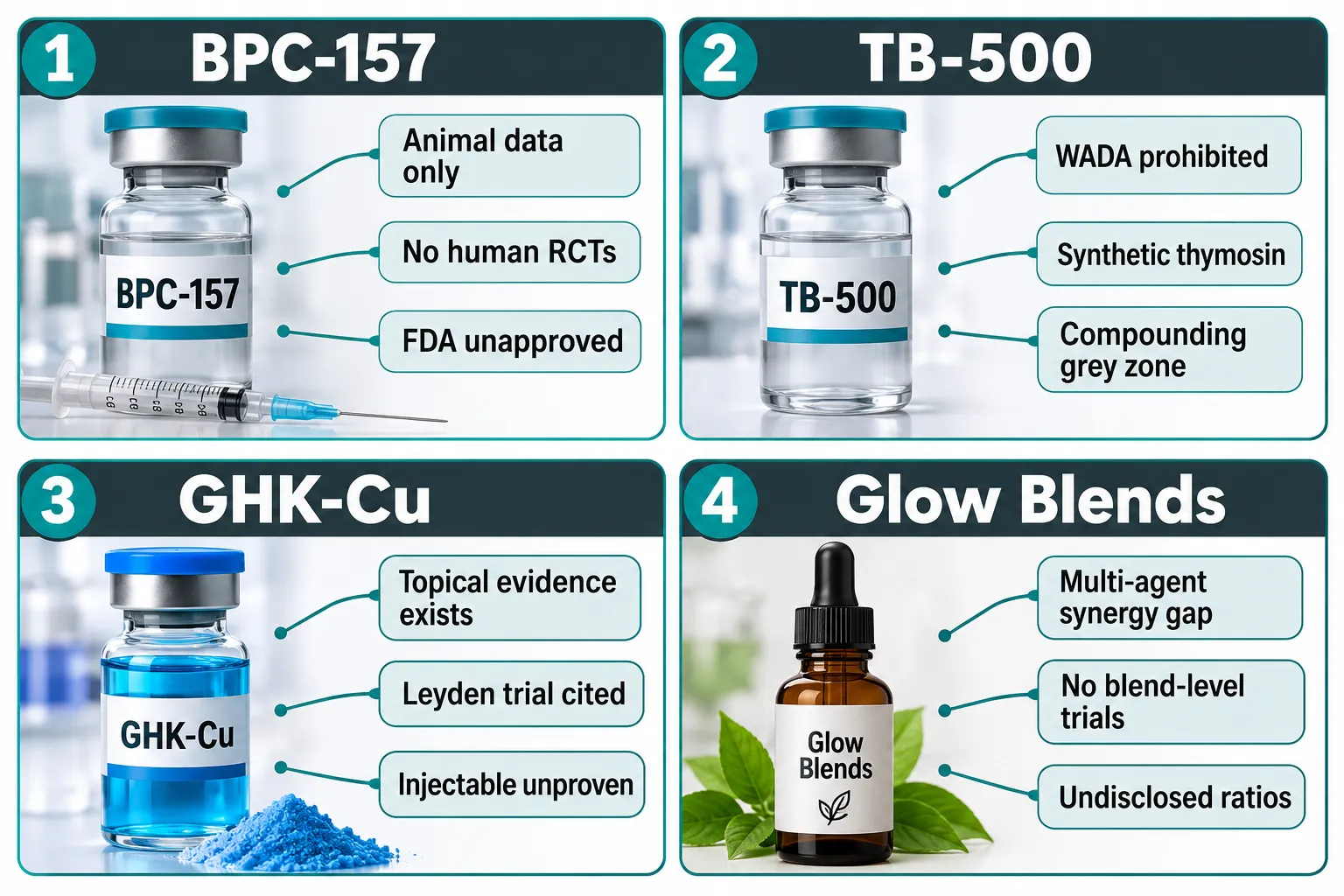
BPC-157 (body protection compound 157) has an extensive preclinical literature. Rodent studies show tissue-healing and gastroprotective effects. No peer-reviewed randomized controlled trials in humans have been published as of 2026. The FDA has not approved BPC-157 for any indication, and it remains on the agency's list of compounds for which compounding is not permitted without specific authorization. WADA does not currently list BPC-157 on its prohibited list, but that status is under active review.

TB-500 is a synthetic analog of thymosin beta-4. Like BPC-157, its evidence base is almost entirely animal and in-vitro. WADA explicitly prohibits thymosin beta-4 and its analogs, making TB-500 a banned substance in competitive sport. Under 2026 HHS guidance on enforcement discretion, it remains in a regulatory grey zone for compounders, meaning legitimate research use requires careful legal framing and appropriate disclaimers.

GHK-Cu (copper peptide) is the outlier. A published, peer-reviewed facial-cream trial, often called the Leyden study, demonstrated measurable improvements in skin parameters with topical application. That is a meaningful data point. It is not, however, evidence for injectables, systemic anti-aging effects, or the wound-healing benefits frequently promoted in vendor copy. The topical-to-injectable extrapolation is a significant logical leap, and regulators in several jurisdictions began scrutinizing injectable GHK-Cu marketing claims in late 2026.

Key distinction: A study that supports a mechanism is not the same as a study that supports a product claim. Audit every review against this filter first.

For context on how rigorous reference standards factor into compound verification, see this overview of Bachem and reference standards for building robust peptide benchmarks.


A Six-Step Audit Framework for Research-Use Peptide Reviews
A Six-Step Audit Framework for Research-Use Peptide Reviews

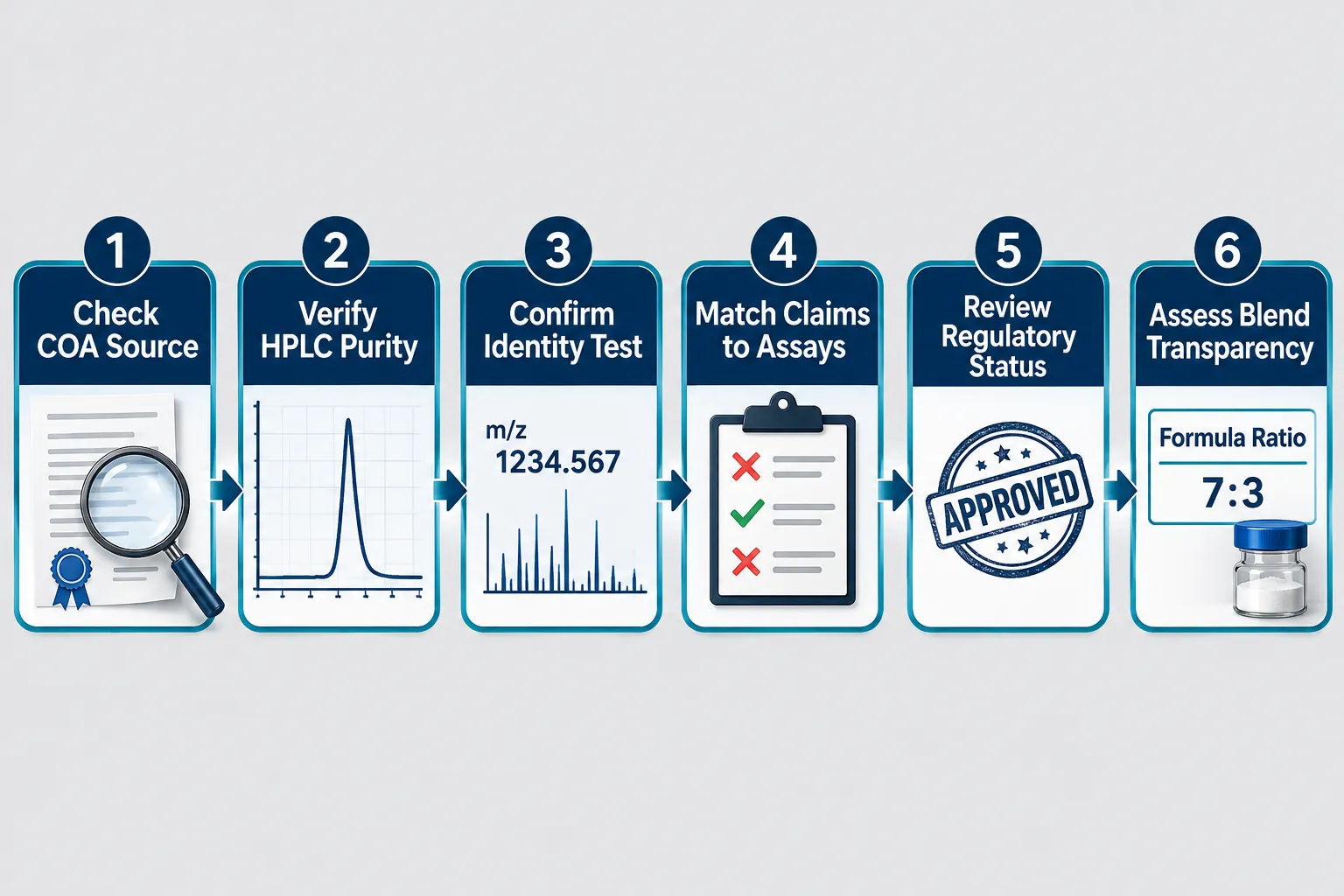
Applying a consistent checklist to any research-use peptide review, whether from a vendor page, a forum post, or an aggregator site, quickly separates credible assessments from anecdote dressed as evidence.

Step 1: Demand a Third-Party COA, Not an In-House Document

A Certificate of Analysis generated by the selling vendor carries an obvious conflict of interest. The COA should come from an accredited independent laboratory. Check that the lab name is searchable, the report date matches the batch, and the document includes a unique lot number.

Step 2: Check the Assay Type Against the Claim

Assay What It Confirms What It Does Not Confirm
HPLC Purity percentage Correct amino acid sequence
Mass spectrometry Molecular identity Biological activity
Endotoxin test Sterility safety Efficacy

A product can pass purity testing at 99% and still be the wrong peptide. Identity confirmation via mass spectrometry is non-negotiable for injectable research compounds.

Step 3: Map Claims to the Actual Study Population

When a vendor cites a study, verify: Was it in rodents or humans? What was the route of administration? What was the dose? A rat-model study on subcutaneous BPC-157 does not validate a topical cream claim, and a topical GHK-Cu study does not validate an intravenous protocol.

Step 4: Evaluate Regulatory and Anti-Doping Risk Statements

Legitimate research-use vendors make explicit, accurate statements about regulatory status. Red flags include: no disclaimer at all, language implying FDA approval, or the absence of WADA prohibition notices on TB-500 products. For researchers interested in related compounds navigating similar regulatory considerations, the SS-31 10mg research peptide considerations page offers a useful parallel framework.

Step 5: Scrutinize User Review Language

User reviews for research peptides frequently describe personal health outcomes. Under current US law, this constitutes an efficacy claim if it appears on a commercial platform and the vendor amplifies it. Reviews using clinical language ("healed my tendon," "restored hair density") without research framing are a compliance signal worth noting. Comparable context appears in the tesa peptide benefits discussion, which demonstrates how to present mechanistic information responsibly.

Step 6: Cross-Reference with Anti-Doping Databases

For TB-500, WADA's current prohibited list is the starting point. Any review that omits this information for a sports-active audience is incomplete at best and misleading at worst.


Auditing Multi-Peptide "Glow Blends", A Higher Standard Required

Multi-peptide cosmetic blends, often marketed with terms like "glow blend," "skin stack," or "repair complex", present additional audit challenges. Research-use peptide reviews for blends require a fundamentally different lens than single-agent reviews.

The core problem: No blend-level clinical trial exists for any commercially available peptide combination product as of 2026. Vendors assemble ingredients with individual study support and imply synergy without demonstrating it. This is not a minor gap, peptide interactions can be additive, neutral, or antagonistic depending on concentration and delivery vehicle.

What to look for in a credible blend review:

  • Disclosure of individual peptide concentrations per dose
  • Separate COA entries for each active ingredient
  • Explicit acknowledgment that blend-level data does not exist
  • Avoidance of phrases like "clinically proven formula" when only isolated ingredients have been studied

Common design flaws in blend trials cited by vendors:

  1. No control group or placebo arm
  2. Participant self-selection bias
  3. Outcome measures that are subjective (self-rated skin texture)
  4. Confounding co-interventions (concurrent skincare regimen not controlled)

Researchers exploring other compound categories with similar complexity, such as GLP-related peptides, will recognize these same issues in blend formulations. The GLP-3 peptide signaling pathway article illustrates how even well-characterized peptide mechanisms require careful interpretation before extrapolating to formulated products.

For aging-support research contexts, aging support peptide categories provide a useful reference for understanding how compounds are categorized without overstating their clinical status.


Conclusion

Research-use peptide reviews are only useful when read alongside hard documentation: verified third-party COAs with identity confirmation, honest regulatory status disclosures, and a clear match between cited evidence and the actual claim being made. BPC-157 and TB-500 sit firmly in preclinical territory, with significant regulatory and anti-doping implications. GHK-Cu has limited but real topical data that vendors routinely overextend. Multi-peptide glow blends require the strictest scrutiny of all, because blend-level evidence simply does not exist.

Actionable next steps for anyone auditing research-use peptide reviews:

  1. Download the COA before reading the review, let the documentation set the baseline.
  2. Identify the assay type and confirm it includes both purity and identity testing.
  3. Pull the cited study and check species, route, and dose against the product claim.
  4. Search WADA's current prohibited list for any compound before use in sport contexts.
  5. For blends, demand per-ingredient concentration disclosure as a minimum requirement.

Applying this framework consistently transforms a landscape of promotional noise into something researchable and actionable.

https://www.puretestedpeptides.com/wp-content/uploads/2026/11/research-use-peptide-reviews-how-to-audit-product-claims-for-bpc-157-tb-500-ghk.webp 1024 1536 https://www.puretestedpeptides.com/wp-content/uploads/2026/01/buy-peptides-online.jpg 2026-11-04 14:05:472026-11-04 14:05:47Research-Use Peptide Reviews: How to Audit Product Claims for BPC-157, TB-500, GHK-Cu, and Glow Blends
×

Helpful Links

  • My account
  • Cart
  • Checkout
  • Refund and Returns Policy
  • Privacy Policy
  • SMS Privacy Policy
  • Login
  • My Account
  • Logout

USA Made Lab Tested Peptides

All products are sold for research, laboratory, or analytical purposes only, and are not for human consumption


Pure Tested Peptides is a chemical supplier. Pure Tested Peptides is not a compounding / chemical compounding facility as defined under 503A of the Federal Food, Drug, and Cosmetic act. Pure Tested Peptides is not an outsourcing facility as defined under 503B of the Federal Food, Drug, and Cosmetic act.

The statements made within this website have not been evaluated by the US Food and Drug Administration. The products we offer are not intended to diagnose, treat, cure or prevent any disease.

Human/Animal Consumption Prohibited. Laboratory/In-Vitro Experimental Use Only

Scroll to top Scroll to top Scroll to top