

Best Nasal Spray Peptides for Research: How to Compare Semax, Selank, and Klow Documentation Without Ranking by Marketing Claims
Fewer than 15% of research peptide suppliers publish a complete Certificate of Analysis alongside every product batch — yet marketing copy across the category routinely uses phrases like "clinically proven" and "top-rated." That gap between documentation and promotion is exactly where a researcher can get misled. Applying the best nasal spray peptides for research framework means setting aside supplier rankings built on testimonials and instead scoring each compound — Semax, Selank, and Klow — against verifiable technical criteria: concentration, excipients, container closure, deposition mechanics, stability data, and analytical documentation.
Key Takeaways
- Regulatory status differs sharply across the three compounds: Semax holds Russian approval, Selank lost its FDA 503A standing in April 2026, and Klow is positioned as research-only with no clinical approval in any jurisdiction.
- A rigorous comparison rubric focuses on six criteria — concentration, excipients, container closure, nasal deposition, stability, and third-party analytical documentation — not on vendor star ratings.
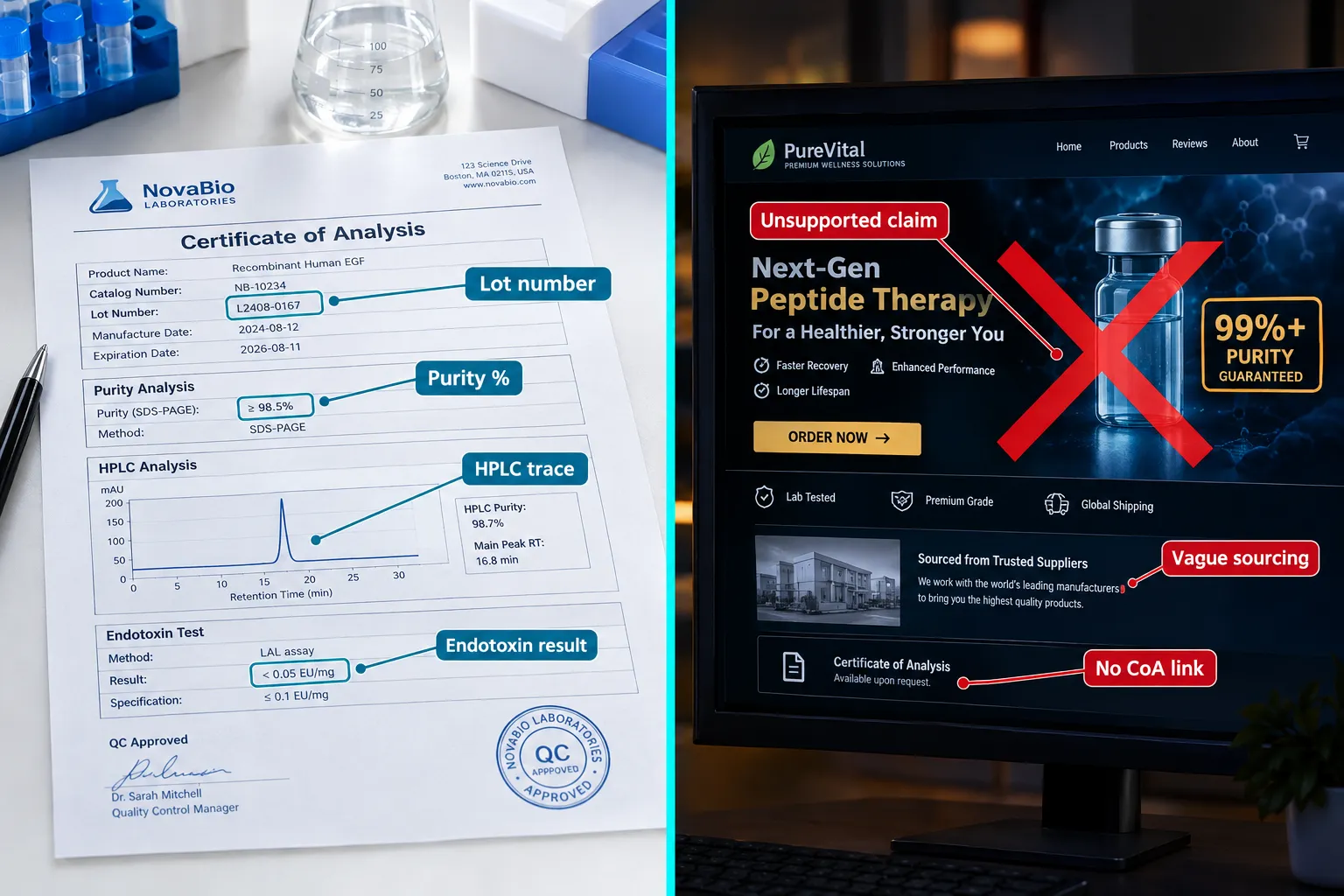
- Purity documentation (HPLC trace, endotoxin result, lot number) is the single most important document a research buyer can request before procurement.
- Marketing language such as "best" or "most effective" carries no regulatory or scientific weight without supporting peer-reviewed evidence and current CoA data.
- All three compounds are restricted to research use in the United States, Australia, and most other Western markets as of 2026.
Understanding Regulatory Context Before Comparing Any Nasal Peptide
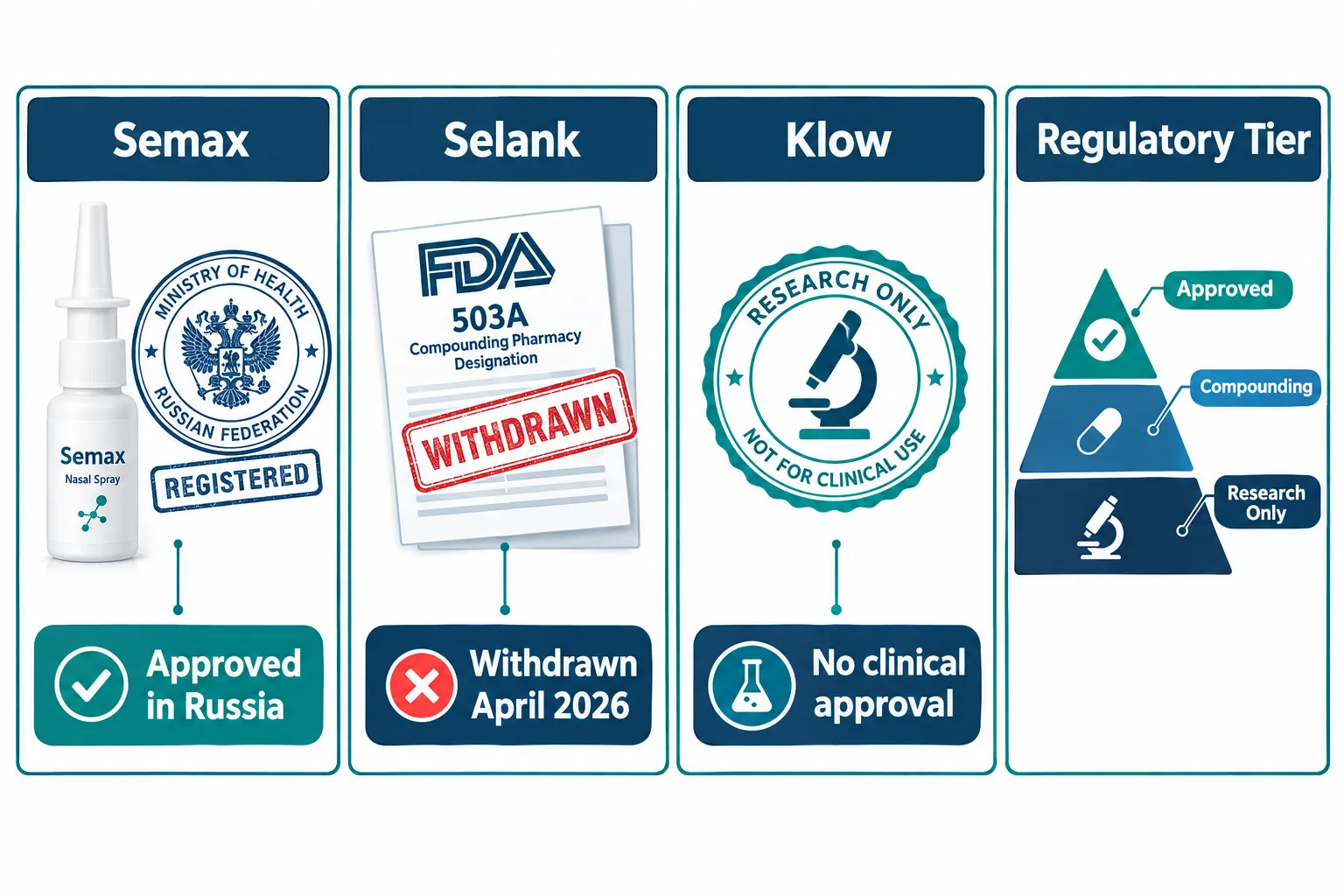
Regulatory status is the first filter in any honest evaluation of nasal spray peptides for research. Semax — a synthetic analogue of ACTH(4-7) — has been a registered pharmaceutical in Russia since the 1990s, where it is approved for neurological indications. That registration provides a reference formulation and published pharmacopeial standards, which gives researchers a meaningful baseline for comparing supplier documentation.
Selank, a heptapeptide derived from tuftsin, had been nominated to the FDA's 503A bulk drug substance list, which would have allowed licensed compounding pharmacies to prepare it. That nomination was withdrawn in April 2026, removing Selank from the compounding pathway in the United States. Researchers sourcing Selank after that date must treat it as a strictly research-grade material with no compounding legal pathway.
Klow is a newer nasal spray formulation combining peptide actives and is positioned exclusively as a research compound. It carries no clinical approval in any jurisdiction. Its documentation package therefore rests entirely on the supplier's own analytical testing rather than any pharmacopeial standard.
Key principle: A compound's regulatory tier determines which documentation standards apply. Approved drugs have pharmacopeial benchmarks. Research-only compounds have only what the supplier chooses to publish.
For broader context on how research-use peptides are categorized structurally and mechanistically, the Peptides 101 for Research-Use Only Buyers guide provides a useful foundation before diving into compound-specific comparisons.
The Six-Criteria Rubric for Comparing Nasal Spray Peptide Documentation
When the goal is comparing best nasal spray peptides for research without relying on marketing claims, a structured rubric replaces opinion. The six criteria below apply equally to Semax, Selank, and Klow.
1. Concentration and Dose Accuracy
Semax nasal sprays in the Russian reference market are formulated at 0.1% and 1% concentrations, delivering approximately 50-100 mcg per actuation. A supplier's stated concentration should be verifiable against an HPLC quantification report — not just a label claim. Selank is typically formulated at 0.15% in the Russian reference product. Klow formulations vary by supplier and lack a pharmacopeial anchor, making third-party quantification non-negotiable.
What to request: An HPLC or LC-MS/MS quantification report with lot number matching the product shipped.
2. Excipient Transparency
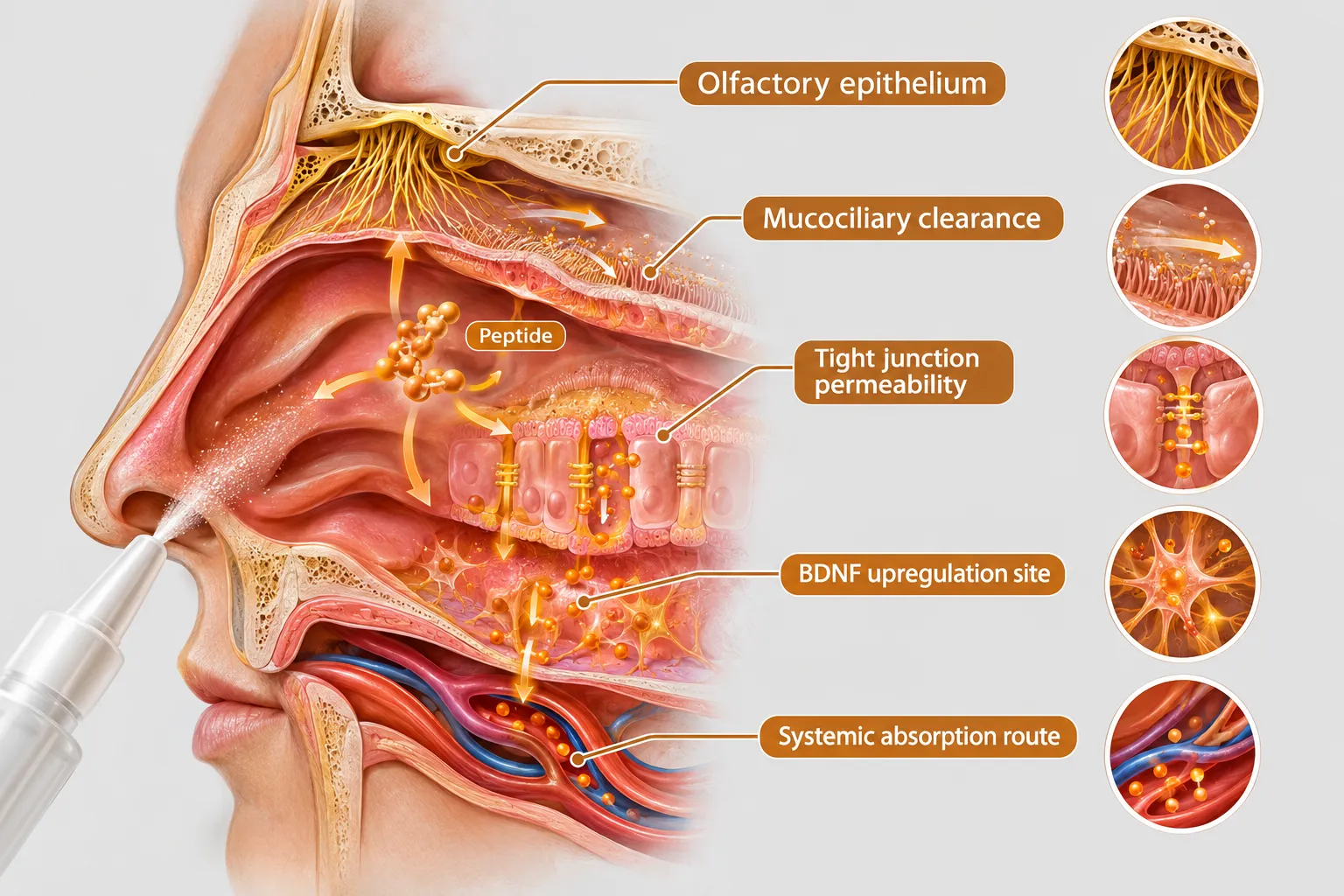
Nasal formulations require preservatives, tonicity agents, and sometimes permeation enhancers. Common excipients include benzalkonium chloride (BZK) as a preservative and sodium chloride for tonicity. BZK at high concentrations can impair mucociliary function — a documented concern in chronic nasal drug delivery. Researchers should request a full excipient list and compare it against the reference formulation where one exists.
3. Container Closure Integrity
A nasal spray's delivery device affects both sterility and dose consistency. Multi-dose pump systems require validated actuator stroke volumes. Single-use unit-dose formats eliminate preservative concerns but raise cost and waste issues. Suppliers should provide container closure integrity testing (CCIT) data or at minimum a statement of compliance with USP standards.
4. Nasal Deposition and Droplet Size
Droplet size (measured as D50 in microns) determines where in the nasal cavity a spray deposits. Particles in the 10-100 micron range deposit in the nasal turbinates; smaller particles risk pulmonary deposition. Reputable suppliers provide laser diffraction data. This criterion is rarely addressed in marketing copy but is critical for research reproducibility.
5. Stability and Storage Data
Peptides degrade through hydrolysis, oxidation, and aggregation. A complete stability package includes accelerated stability data (typically 40 degrees C / 75% RH for six months) and real-time data at the recommended storage temperature. Semax has published stability references in the Russian pharmacopeia. Selank and Klow suppliers must generate their own data. Absence of stability documentation is a significant red flag.
6. Analytical Documentation Package
This is the single most important criterion. A complete package includes:
| Document | Minimum Requirement |
|---|---|
| Certificate of Analysis (CoA) | Lot-specific, signed, dated |
| HPLC purity trace | Greater than 98% purity threshold |
| Endotoxin test | LAL method, result in EU/mL |
| Sterility or bioburden test | USP or EP method |
| Mass spectrometry confirmation | Molecular weight match |
Researchers evaluating Semax peptide sources should request all five documents before procurement. The same standard applies to Selank; guidance on where to buy Selank nasal spray from verified suppliers can help narrow the field to those who publish documentation.
Applying the Rubric: Semax vs. Selank vs. Klow Without Marketing Bias
Running all three compounds through the six-criteria rubric reveals meaningful differences that marketing language obscures.
Semax scores highest on regulatory anchor because its Russian-approved reference product provides concentration standards and stability benchmarks. Researchers can compare a supplier's CoA directly against the pharmacopeial specification. The July 2026 FDA advisory committee vote on Semax's 503A nomination — which did not result in approval — means U.S. researchers must still treat it as a research-only material, but the existence of a reference standard remains a documentation advantage.
Selank has a comparable Russian reference product at 0.15%, giving it a similar concentration anchor. However, the April 2026 withdrawal from the FDA 503A list removed the U.S. compounding pathway, and fewer suppliers have invested in full analytical packages for Selank compared to Semax. Researchers should weight the analytical documentation criterion more heavily when sourcing Selank.
Klow lacks any pharmacopeial reference, making supplier-generated documentation the only available standard. This is not disqualifying for research purposes, but it raises the bar for what a supplier must provide. A Klow supplier that publishes lot-specific HPLC, endotoxin, and mass spec data is more credible than one relying on general batch certificates.
For researchers also evaluating other peptide formats, reviewing SS-31 research peptide considerations offers a parallel example of how documentation standards apply across different compound classes. Similarly, the IPA Sermorelin stack research page demonstrates how stacked peptide formulations introduce additional documentation complexity.
The bottom line on marketing claims: Phrases like "best nasal spray peptide" or "most effective for cognitive support" are not documentation. They are positioning statements. A supplier who leads with those phrases and buries or omits the CoA is inverting the priority order that research integrity requires.
Conclusion
Comparing Semax, Selank, and Klow without ranking by marketing claims requires replacing subjective language with a six-point documentation rubric. Researchers should request lot-specific CoAs, HPLC purity traces, endotoxin results, mass spectrometry confirmation, stability data, and container closure information before making any procurement decision. Regulatory context matters: Semax carries a Russian pharmacopeial anchor, Selank lost its U.S. compounding pathway in April 2026, and Klow is research-only with no external standard. None of the three compounds is approved for human use in the United States or Australia as of 2026.
Actionable next steps for researchers in 2026:
- Build a documentation checklist using the six criteria above and send it to every prospective supplier before ordering.
- Reject any supplier who cannot provide a lot-matched CoA with HPLC trace and endotoxin result.
- Cross-reference the stated concentration against the Russian reference product specification where one exists.
- Review stability data and confirm storage requirements match your laboratory's capabilities.
- Treat all three compounds as research-use only and comply with applicable institutional and jurisdictional regulations.