Call or Text 727-513-9780
  • Shopping Cart Shopping Cart
    0Shopping Cart
Pure Tested Peptides | America's most trusted Peptides for sale online
  • Peptides for sale
    • Oral Peptides for sale
      • Peptide Capsules for sale
      • BPC 157 Capsules 1000mcg
      • SLU-PP-332 Capsules | 1000 mcg
      • 5-Amino-1MQ 50mg Capsules
      • Tesofensine 500mcg
    • All Peptides for sale
    • Peptide Sprays
      • BPC 157 Nasal Spray Kit
      • BPC-157 TB500 Nasal Spray Kit
      • Semax Nasal Spray 10mg
      • Selank – Nasal Spray Kit – 10mg
      • Epithalon 50MG Nasal Spray Kit
      • Ipamorelin 10mg Nasal Spray
      • Klow Nasal Spray (BPC-157 + TB-500 + GHK-Cu + KPV) | 80mg
      • Hulk Nasal Spray Tesa / Ipa Blend 6/3 MG
      • Klow Nasal Spray
      • NAD + 500 mg Nasal Spray
      • PT-141 Nasal Spray Kit
    • GHRH Peptides
      • Ipa Peptides
      • CJC-1295 Peptides
        • CJC-1295 with DAC 5 mg
        • CJC-1295 without DAC 5 mg
        • CJC-1295 Ipa 10mg
      • Tesa Peptides
        • Tesa Peptide
        • Tesa 20 mg
    • GHK-Cu Peptides
      • All GHK-Cu Peptides
      • GHK-Cu 100mg
      • KLOW Peptide Blend – Buy KLOW blend online
    • BPC Peptides
      • All BPC Peptides
      • BPC-157
      • BPC-157 TB-500
      • BPC 157 capsules 1000mcg
    • SLU-PP-332 Peptides
      • All SLU-PP-332 Peptides
      • SLU-PP-332 5mg
    • GLP3 Peptides
      • GLP3-R
      • GLP3-R CAG 10mg
      • GLP3-R 20mg
    • PT-141 Peptides
      • PT-141 Peptides for sale
      • PT-141 10mg
      • PT-141 Nasal Spray
    • CAG Peptides
      • Lipo-C Peptide Blend
      • CAG 5mg
      • CAG 10mg
    • MOTS-C Peptides
      • MOTS-C Peptides for sale
      • MOTS-c peptide
      • MOTS-c 10mg *6 pack*
    • 5 Amino 1MQ Peptides
      • 5 Amino 1MQ Peptides for sale
      • 5-Amino-1MQ 50mg Capsules
      • 5-Amino-1MQ 5mg
    • Epithalon Peptides
      • Epithalon Peptides for sale
      • Epithalon 10mg
      • Epithalon 50mg
  • Shop
    • GLPs
      • 5-Amino-1MQ 50mg Capsules
      • 5-Amino-1MQ 5mg
      • GLP3-Reta
      • L-Carnitine 500mg/ml
      • Tesofensine 500mcg
      • SLU-PP-332 5mg
      • MOTS-c 10mg *6 pack*
    • Epithalon & BPC Peptides
      • Epithalon 10mg
      • Epithalon 50mg
      • BPC-157
      • BPC 157 capsules 1000mcg
      • BPC-157 TB-500
      • BPC-157 TB500 Nasal Spray Kit
      • BPC 157 Nasal Spray Kit
    • BPC TB-500 & NAD+ Peptides
      • NAD+ 500 mg
      • KLOW Peptide Blend – Buy KLOW blend online
      • GLOW Peptide Blend
      • TB 500 5mg
      • BPC 157 capsules 1000mcg – Supplement
      • BPC 157 Nasal Spray Kit
      • BPC-157
      • BPC-157 TB500 Nasal Spray Kit
      • BPC-157 TB-500
      • BPC 157 capsules 1000mcg
    • LL-37 Peptide
      • LL-37 10 mg
    • MOTS-C & Selank
      • MOTS-c peptide
      • Selank 10mg
    • GHK Peptides
      • GHK-Cu 100mg
      • GLOW Peptide Blend
      • KLOW Peptide Blend – Buy KLOW blend online
  • COAs
  • Wholesale
    • Wholesale Peptides for sale
  • PTP FAQ
  • Affiliates
    • Selank Peptide: Advanced Pharmacological Mechanisms Underlying Its Anxiolytic and Nootropic Effects in Research
      • 5-Amino-1MQ Peptide: Detailed Mechanisms of NNMT Inhibition and Its Impact on Cellular Metabolism Research
        • MOTS-C Peptide: Unraveling Its Role in Mitochondrial Dynamics and Energy Metabolism Research
          • Epithalon Peptide and Telomerase Regulation: Investigating Its Impact on Cellular Senescence and Lifespan Research Models
            • GLP2-T vs GLP2 Tirz Peptide: Understanding the Naming, Mechanistic Nuances, and Research Implications for Gut Health
      • Peptides and Polypeptides in Modern Pharmacology: What Research on Metoprolol, Prednisone, and Amlodipine Reveals
        • Polypeptide Peptides vs NSAIDs: What Naproxen and Diclofenac Teach Tissue-Repair Researchers About BPC‑157 and TB‑500
          • Peptides and Polypeptides in Endocrine Pharmacology: How GLP-1, GLP-2, and GLP-3 Retatrutide Differ From Classic Drugs Like Prednisone and Amlodipine
          • 5‑Amino‑1MQ Peptide and NNMT Inhibition: How It Compares With Statins Like Atorvastatin in Adipose and Lipid Metabolism Research
      • Enclomiphene, Estrogen Receptor Signaling, and Luteinizing Phase Biology: What Hormone Researchers Should Measure
        • Mesenchymal Stem Cells, BPC‑157, and GHK‑Cu: How Tissue Repair Peptides Compare With Classic NSAIDs Like Naproxen in Injury Models
          • Peptide Calculator Use Cases Beyond Growth Hormone: Working Through GLP‑3 Retatrutide, MOTS‑c, and BPC‑157 Research Dosing
        • Polypeptide Peptides in Endocrine and Metabolic Pharmacology: Lessons From Amlodipine, Prednisone, and Metoprolol
        • Peptides Calculator for Advanced Blends: Worked Examples for Tesamorelin, CJC‑1295, and Ipamorelin Stacks
          • Peptides and Polypeptides in Human Physiology: How Molecular Size Shapes Research Applications
            • Selank Peptide: Advanced Pharmacological Mechanisms Underlying Its Anxiolytic and Nootropic Effects in Research
          • 5-Amino-1MQ Peptide: Detailed Mechanisms of NNMT Inhibition and Its Impact on Cellular Metabolism Research
            • MOTS-C Peptide: Unraveling Its Role in Mitochondrial Dynamics and Energy Metabolism Research
              • Epithalon Peptide and Telomerase Regulation: Investigating Its Impact on Cellular Senescence and Lifespan Research Models
                • GLP2-T vs GLP2 Tirz Peptide: Understanding the Naming, Mechanistic Nuances, and Research Implications for Gut Health
                  • Peptides and Polypeptides in Endocrine Pharmacology: How GLP-1, GLP-2, and GLP-3 Retatrutide Differ From Classic Drugs Like Prednisone and Amlodipine
                    • Polypeptide Peptides vs NSAIDs: What Naproxen and Diclofenac Teach Tissue-Repair Researchers About BPC‑157 and TB‑500
                      • Peptides and Polypeptides in Modern Pharmacology: What Research on Metoprolol, Prednisone, and Amlodipine Reveals
                        • 5‑Amino‑1MQ Peptide and NNMT Inhibition: How It Compares With Statins Like Atorvastatin in Adipose and Lipid Metabolism Research
                        • Enclomiphene, Estrogen Receptor Signaling, and Luteinizing Phase Biology: What Hormone Researchers Should Measure
                        • Mesenchymal Stem Cells, BPC‑157, and GHK‑Cu: How Tissue Repair Peptides Compare With Classic NSAIDs Like Naproxen in Injury Models
                        • Peptide Calculator Use Cases Beyond Growth Hormone: Working Through GLP‑3 Retatrutide, MOTS‑c, and BPC‑157 Research Dosing
                        • Polypeptide Peptides in Endocrine and Metabolic Pharmacology: Lessons From Amlodipine, Prednisone, and Metoprolol
                        • Peptides Calculator for Advanced Blends: Worked Examples for Tesamorelin, CJC‑1295, and Ipamorelin Stacks
                        • Peptides and Polypeptides in Human Physiology: How Molecular Size Shapes Research Applications
                        • Selank Peptide: Advanced Pharmacological Mechanisms Underlying Its Anxiolytic and Nootropic Effects in Research
                        • MOTS-C Peptide: Unraveling Its Role in Mitochondrial Dynamics and Energy Metabolism Research
                        • Peptides and Polypeptides in Modern Pharmacology: What Research on Metoprolol, Prednisone, and Amlodipine Reveals
                        • Peptides and Polypeptides in Endocrine Pharmacology: How GLP-1, GLP-2, and GLP-3 Retatrutide Differ From Classic Drugs Like Prednisone and Amlodipine
                        • 5-Amino-1MQ Peptide: Detailed Mechanisms of NNMT Inhibition and Its Impact on Cellular Metabolism Research
                        • Mesenchymal Stem Cells, BPC‑157, and GHK‑Cu: How Tissue Repair Peptides Compare With Classic NSAIDs Like Naproxen in Injury Models
                        • Peptide Calculator Use Cases Beyond Growth Hormone: Working Through GLP‑3 Retatrutide, MOTS‑c, and BPC‑157 Research Dosing
                        • GLP2-T vs GLP2 Tirz Peptide: Understanding the Naming, Mechanistic Nuances, and Research Implications for Gut Health
                        • Polypeptide Peptides in Endocrine and Metabolic Pharmacology: Lessons From Amlodipine, Prednisone, and Metoprolol
                        • Polypeptide Peptides vs NSAIDs: What Naproxen and Diclofenac Teach Tissue-Repair Researchers About BPC‑157 and TB‑500
                        • Peptides and Polypeptides in Human Physiology: How Molecular Size Shapes Research Applications
                        • Peptides Calculator for Advanced Blends: Worked Examples for Tesamorelin, CJC‑1295, and Ipamorelin Stacks
                        • 5‑Amino‑1MQ Peptide and NNMT Inhibition: How It Compares With Statins Like Atorvastatin in Adipose and Lipid Metabolism Research
                        • Enclomiphene, Estrogen Receptor Signaling, and Luteinizing Phase Biology: What Hormone Researchers Should Measure
                        • Epithalon Peptide and Telomerase Regulation: Investigating Its Impact on Cellular Senescence and Lifespan Research Models
                        • Best research protocol Klow blend
                        • best time to take BPC-157
                        • best time to take DSIP (Delta Sleep Inducing Peptide)
                        • best time to take CJC-1295
                        • best time to take AOD-9604
                        • best time to take Follistatin 344
                        • best time to take Ipamorelin
                        • best time to take MK-677 (Ibutamoren)
                        • best time to take Ligandrol (LGD-4033) — research compound
                        • best time to take Ostarine (MK-2866) — research compound
                        • best time to take GHK-CU
                        • best time to take TB-500
                        • best time to take MOTS-c
                        • best time to take Semax
                        • best time to take RAD-140 (Testolone) — research compound
                        • best time to take Thymosin Alpha-1
                        • best time to take PEG-MGF
                        • Biolife Plasma, Octapharma Plasma, and Research Peptides: How Plasma Donation Labs Differ From Peptide Suppliers
                        • best time to take YK-11 — research compound
                        • best time to take PT-141 (Bremelanotide)
                        • Best research protocol Klow blend
                        • 5-Amino-1MQ and MOTS-C Synergy: Metabolic Signaling, Mitochondria, and Research Design
                        • BPC-157 and TB-500: Investigating Their Combined Effects on Angiogenesis and Cellular Migration in Tissue Repair Models
                        • BPC-157 Peptide: Gut Barrier Function, Inflammation, and Tissue-Recovery Research
                        • 5‑Amino‑1MQ and MOTS‑c Synergy in Metabolic Research: Designing NNMT and Mitochondrial Biogenesis Stacks
                        • CJC-1295 with DAC vs. Without DAC: Half-Life, Release Kinetics, and Research Implications
                        • CJC‑1295 with DAC vs. Without DAC: Expanding on Half‑Life Differences Using Tesamorelin and Ipamorelin Blend Case Studies
                        • Collagen Biology and Copper‑Binding Peptides: How GHK‑Cu, Glow Blend, and Klow Blend Interact with Skin and Connective Tissue
                        • Collagen Biology and Regenerative Peptides: How GHK‑Cu, Glow Blend, and Klow Blend Affect Extracellular Matrix Research
                    • DNA, Telomeres, and Longevity Peptides: Positioning Epithalon and MOTS‑c in Genetic Aging Research
                      • Enclomiphene Citrate: serm Mechanism, Testosterone Research, and Stack Compatibility
                        • Enclomiphene vs Enclomiphene Citrate: Formulation, Bioavailability, and Research Distinctions
                        • Epithalon Peptide Research: Telomerase Activation, Aging, and Pineal Gland Function
                        • Estrogen Receptor Signaling and Enclomiphene: How Selective Modulators Compare with Classic Polypeptide Hormones
                        • GHK-Cu Peptide: Advanced Mechanisms in Extracellular Matrix Remodeling and Wound Healing Research
                        • GHK-Cu Peptide: Collagen Synthesis, Wound Repair, and Skin-Barrier Research Models
                        • GLP-1 vs GLP-3 vs GLP-2: Peptide Classification and Research Applications
                        • GLP-2 Peptide Research Guide: Gut Barrier Function, Nutrient Absorption, and Intestinal Recovery Models
                        • GLP-3 Retatrutide vs. GLP-1 Drugs: What Triple-Agonist Biology Changes in Research Models
                        • Ipamorelin and Tesamorelin Combination: Synergistic GH Secretagogue Research and Dosing Protocols
                        • GLP2 Tirz Peptide: What It Is, Why the Name Exists, and How Researchers Should Interpret It
                        • Klow Blend Peptide Nasal Spray: What the Formulation Is Trying to Do in Cognitive Research
                        • Mitochondria, NNMT Inhibition, and Peptide Modulators: Where MOTS‑c and 5‑Amino‑1MQ Fit in Cellular Energy Research
                        • MOTS-c Peptide: Mitochondrial Function, Energy Metabolism, and What Researchers Measure
                        • MOTS-c vs. 5-Amino-1MQ: Which Metabolic Research Questions Each Compound Actually Answers
                        • Nasal Spray Peptides: Bioavailability, Administration, and Semax/Selank Research Applications
                        • PT-141 Peptide Research: Mechanism of Action and Melanocortin Receptor Signaling
                        • Retatrutide for Research: Mechanism, Structure, and GLP-1/GLP-3 Dual Action
                        • Retatrutide for Obesity and Type 2 Diabetes: What the Latest Trial Data Suggest
                        • Tesofensine Peptide Research: Mechanism, Appetite Suppression, and Neuropeptide Y Pathways
  • Contact
    • Contact Customer Service
    • Text Customer Support
  • About US
  • Shop all peptides
  • Affiliate Program
    • Affiliate Signup
  • Login / Register Login / Register Page Link Login / Register Page Link
  • Click to open the search input field Click to open the search input field Search
  • Menu Menu

Tag Archive for: peptide formulation stability

Nasal Spray Peptides: How Delivery Route Changes Bioavailability for Semax, Selank, and Klow Blend

Nasal Spray Peptides: How Delivery Route Changes Bioavailability for Semax, Selank, and Klow Blend

August 11, 2026/0 Comments/in Uncategorized/by

Oral peptide administration loses most of its active compound before it ever reaches systemic circulation, degradation by gastrointestinal enzymes and first-pass liver metabolism can strip bioavailability to single-digit percentages. That pharmacokinetic reality is precisely why researchers studying cognitive and anxiolytic peptides have turned their attention to the intranasal route. Understanding Nasal Spray Peptides: How Delivery Route Changes Bioavailability for Semax, Selank, and Klow Blend is not simply a product-format question. It is a formulation science question, one that touches mucosal transport biology, peptide stability, and the structural properties that determine whether a compound reaches its target tissue intact.
Professional () hero image with (≤42 chars): 'Nasal Spray Peptides: Bioavailability' in crisp white centered on a deep navy

Key Takeaways

  • Intranasal delivery bypasses gastrointestinal degradation and first-pass liver metabolism, dramatically improving bioavailability for short-chain peptides.
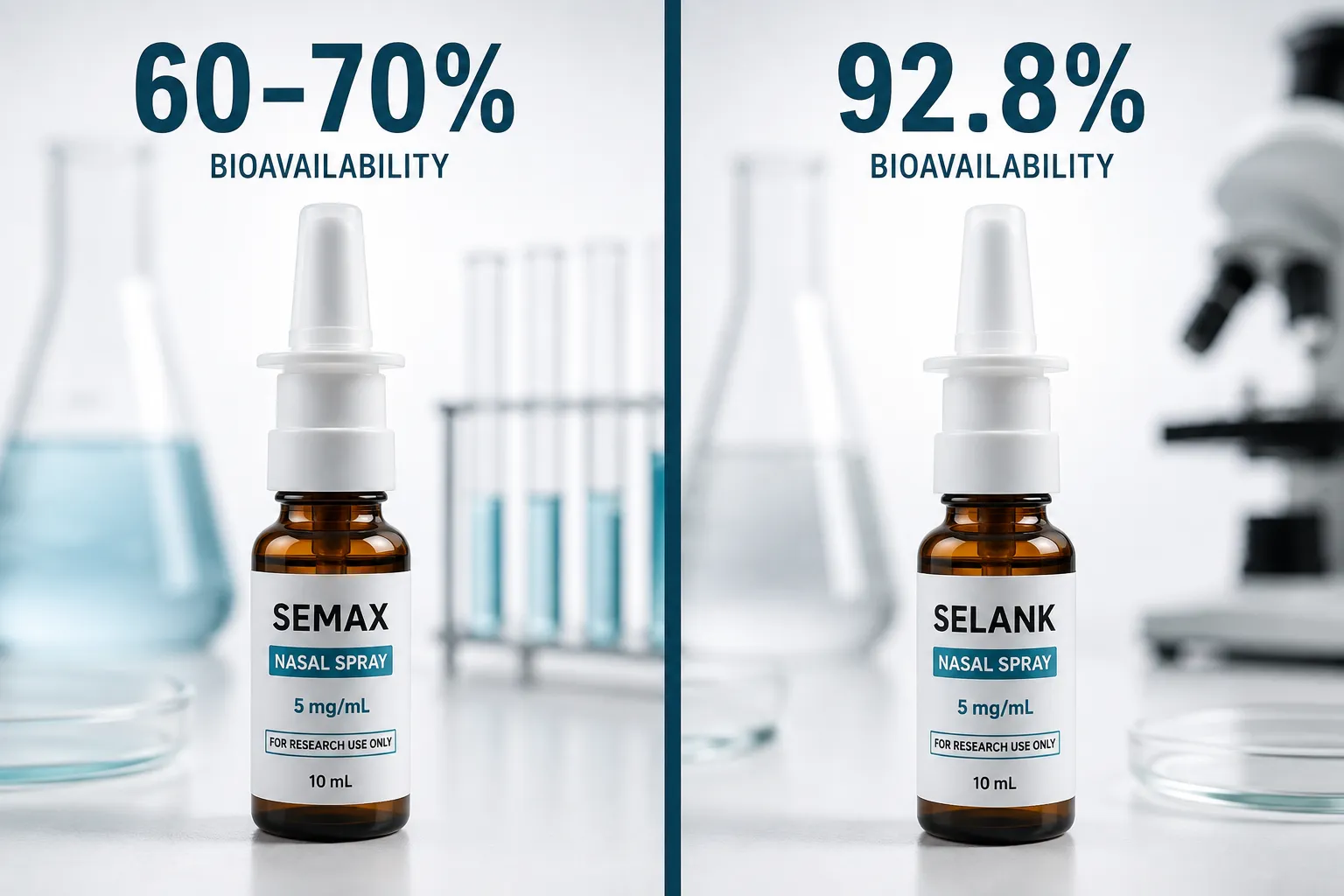
  • Selank achieves approximately 92.8% intranasal bioavailability, while Semax reaches roughly 60-70%, making both strong candidates for nasal spray formulation.
  • The nasal mucosa provides direct olfactory and trigeminal nerve pathways that allow certain peptides to reach the central nervous system rapidly.
  • Peptide molecular weight, charge, and enzymatic stability all influence how well a compound survives mucosal transit.
  • Blend formulations like Klow combine complementary peptides whose individual absorption profiles must be matched carefully to avoid delivery mismatches.

Why the Nasal Route Matters for Peptide Research

Peptides are fragile molecules. Most are chains of fewer than 50 amino acids, and their biological activity depends on maintaining that chain's precise three-dimensional shape. The gastrointestinal tract is hostile to that structure, proteases cleave peptide bonds aggressively, and even compounds that survive digestion face hepatic extraction before entering systemic blood flow.

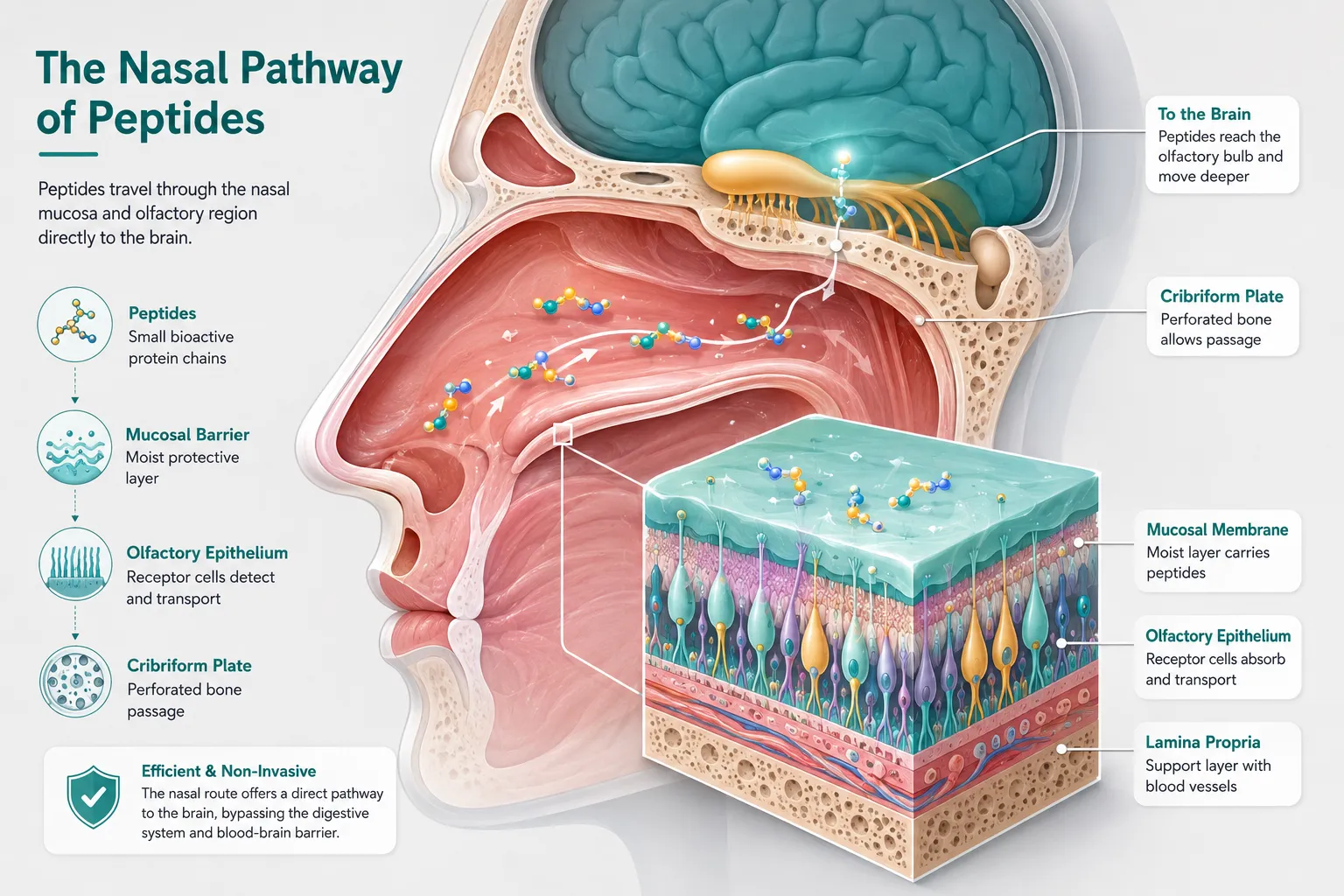
The nasal mucosa presents a fundamentally different environment. The epithelial surface of the nasal cavity is thin, highly vascularized, and equipped with transport mechanisms that favor rapid absorption of small hydrophilic molecules. For peptides in the 500-2,000 dalton molecular weight range, paracellular and transcellular transport across nasal epithelium can deliver meaningful plasma concentrations within minutes of administration.

Beyond systemic absorption, the nasal route offers a second pathway that is uniquely relevant to cognitive and anxiolytic research: direct nose-to-brain transport. The olfactory epithelium sits at the roof of the nasal cavity, separated from the brain only by the cribriform plate. Peptides deposited in this region can travel along olfactory nerve axons and trigeminal nerve branches, bypassing the blood-brain barrier and arriving in cerebrospinal fluid or brain parenchyma without first entering peripheral circulation. This pathway is particularly relevant for compounds whose targets are central nervous system receptors.

For a deeper look at how peptide structure governs these transport dynamics, the polypeptide peptides explained guide covering structure, function, and research applications provides useful foundational context.
Why the Nasal Route Matters for Peptide Research

Semax and Selank: Comparing Intranasal Bioavailability

Semax: Structure, Stability, and Absorption

Semax is a synthetic heptapeptide derived from the adrenocorticotropic hormone (ACTH) fragment 4-7, with a Pro-Gly-Pro extension that confers resistance to enzymatic degradation. That structural modification is not incidental, it is a deliberate formulation decision that directly improves nasal mucosal survival time. Intranasal bioavailability for Semax is estimated at approximately 60-70%, a figure that reflects both its moderate lipophilicity and its relative stability against nasal mucosal peptidases.

Semax's primary research interest centers on neurotrophic and neuroprotective effects, including modulation of brain-derived neurotrophic factor (BDNF) expression. The nose-to-brain pathway is therefore not just a convenience, it is mechanistically aligned with the compound's proposed targets.

Selank: Higher Bioavailability, Anxiolytic Profile

Selank is a synthetic analog of the endogenous tetrapeptide tuftsin, extended with a stabilizing Gly-Pro-Pro sequence. This modification substantially reduces enzymatic breakdown at the nasal mucosa. A 2026 comparative review reports intranasal bioavailability for Selank at approximately 92.8%, markedly higher than Semax and among the highest reported for any peptide administered by this route.

The anxiolytic and GABAergic activity attributed to Selank in preclinical models makes central nervous system delivery particularly important. Its high mucosal bioavailability, combined with olfactory transport potential, positions intranasal administration as the most pharmacokinetically efficient route for research purposes.

Peptide Molecular Weight Intranasal Bioavailability Primary Research Focus
Semax ~863 Da ~60-70% Neuroprotection, BDNF modulation
Selank ~751 Da ~92.8% Anxiolytic, GABAergic activity

The contrast between these two compounds illustrates a core principle: bioavailability is not a fixed property of intranasal delivery in general, it is a property of each specific peptide's interaction with nasal tissue.

For context on how peptide safety profiles relate to immunological pathways, the article on complement-dependent cytotoxicity and peptide safety covering BPC-157, GHK-Cu, and nasal spray peptides is worth reviewing alongside absorption data.
Selank: Higher Bioavailability, Anxiolytic Profile

Formulating Blend Products: The Klow Challenge

What Makes a Blend Different from a Single Peptide

The Klow blend combines multiple peptide components into a single nasal spray formulation. From a formulation science standpoint, this introduces complexity that single-peptide products do not face. Each component in a blend carries its own:

  • Optimal pH range for stability
  • Enzymatic susceptibility profile at the nasal mucosa
  • Absorption rate and peak plasma timing
  • Potential for intermolecular interaction with co-formulated peptides

When two peptides with significantly different absorption rates are combined, one may reach target tissue well before the other, reducing any intended synergistic effect. Formulators must therefore consider whether the blend's components are pharmacokinetically compatible, not just chemically stable in the same solution.

Stability Considerations for Nasal Spray Formulations

Peptide stability in aqueous nasal spray solutions is governed by several variables: pH (typically 4.5-6.5 for nasal formulations), preservative choice, osmolality, and storage temperature. Lyophilized peptides reconstituted immediately before use generally show superior stability to pre-dissolved solutions stored over time.

For blend formulations, excipient selection becomes more complex. Absorption enhancers such as cyclodextrins or chitosan can improve mucosal permeation for lower-bioavailability components, but they may also alter the absorption kinetics of already high-bioavailability peptides like Selank, potentially creating a mismatch.

The Glow Peptide Blend Benefits resource offers a useful parallel example of how multi-peptide blends are approached from a formulation and research perspective.

Stability Considerations for Nasal Spray Formulations

Practical Implications for Researchers

Understanding Nasal Spray Peptides: How Delivery Route Changes Bioavailability for Semax, Selank, and Klow Blend has direct implications for experimental design. Researchers using these compounds should account for:

  • Dose calculation based on bioavailability, not nominal amount, a 500 mcg nominal dose of Semax delivers a meaningfully different absorbed quantity than the same nominal dose of Selank
  • Administration site within the nasal cavity, posterior, superior deposition favors olfactory transport; anterior deposition favors systemic vascular absorption
  • Spray device characteristics, droplet size, spray angle, and actuation volume all affect where the compound deposits and how much reaches the mucosa versus drains to the throat

For researchers interested in how other peptide delivery mechanisms compare, the complete guide to peptide mechanisms covering GLP-1, GLP-3, and growth hormone peptides provides broader mechanistic context.

Additionally, the peptides vs classic small-molecule drugs comparison helps frame why peptide-specific delivery considerations differ fundamentally from those applied to conventional pharmaceuticals.

Conclusion

The intranasal route is not simply a convenient alternative to injection, it is a biologically distinct delivery pathway with its own absorption mechanisms, stability challenges, and CNS-access advantages. For Semax, Selank, and blend formulations like Klow, understanding how delivery route changes bioavailability is foundational to designing valid research protocols and interpreting results accurately.

Actionable next steps for researchers:

  1. Verify the bioavailability data specific to each peptide in your blend before calculating working doses.
  2. Review formulation stability data, particularly for reconstituted aqueous solutions stored beyond 24 hours.
  3. Standardize administration technique, spray angle, head position, and volume per actuation, to reduce inter-experiment variability.
  4. Consult peptide-specific pharmacokinetic literature when combining compounds with different absorption rates in a single formulation.

Delivery route is a formulation variable, not a footnote. Treating it with the same rigor applied to dose selection and purity testing will improve the reliability of any intranasal peptide research program.

https://www.puretestedpeptides.com/wp-content/uploads/2026/08/nasal-spray-peptides-how-delivery-route-changes-bioavailability-for-semax-selank.webp 1024 1536 https://www.puretestedpeptides.com/wp-content/uploads/2026/01/buy-peptides-online.jpg 2026-08-11 13:05:062026-08-11 13:05:06Nasal Spray Peptides: How Delivery Route Changes Bioavailability for Semax, Selank, and Klow Blend
×

Helpful Links

  • My account
  • Cart
  • Checkout
  • Refund and Returns Policy
  • Privacy Policy
  • SMS Privacy Policy
  • Login
  • My Account
  • Logout

USA Made Lab Tested Peptides

All products are sold for research, laboratory, or analytical purposes only, and are not for human consumption


Pure Tested Peptides is a chemical supplier. Pure Tested Peptides is not a compounding / chemical compounding facility as defined under 503A of the Federal Food, Drug, and Cosmetic act. Pure Tested Peptides is not an outsourcing facility as defined under 503B of the Federal Food, Drug, and Cosmetic act.

The statements made within this website have not been evaluated by the US Food and Drug Administration. The products we offer are not intended to diagnose, treat, cure or prevent any disease.

Human/Animal Consumption Prohibited. Laboratory/In-Vitro Experimental Use Only

Scroll to top Scroll to top Scroll to top