

CJC-1295 With DAC vs Without DAC: Mechanism, Duration, and Research Design Differences
A single molecular attachment, a drug affinity complex, or DAC, separates two peptides that share a name but behave in fundamentally different ways inside a biological system. Understanding the CJC-1295 with DAC vs without DAC mechanism, duration, and research design differences is not a matter of splitting hairs; it determines whether a study captures sustained growth hormone (GH) elevation or episodic GH pulses, and whether dosing happens once a week or three times a day.
Key Takeaways
- CJC-1295 with DAC covalently binds serum albumin via a maleimide-lysine conjugate, creating a circulating depot with a half-life of 5.8 to 8.1 days.
- CJC-1295 without DAC, more accurately called Modified GRF 1-29, resists DPP-IV degradation but clears within 30 to 120 minutes, producing short GH pulses.
- With DAC produces sustained GH and IGF-1 elevation; without DAC mimics physiologic pulsatile secretion.
- Dosing frequency differs dramatically: once or twice weekly for the DAC form versus one to three times daily for the no-DAC form.
- Research design must align with the pharmacokinetic profile of whichever form is selected; the two are not interchangeable in study protocols.
The Core Structural Difference: Albumin Binding vs DPP-IV Resistance
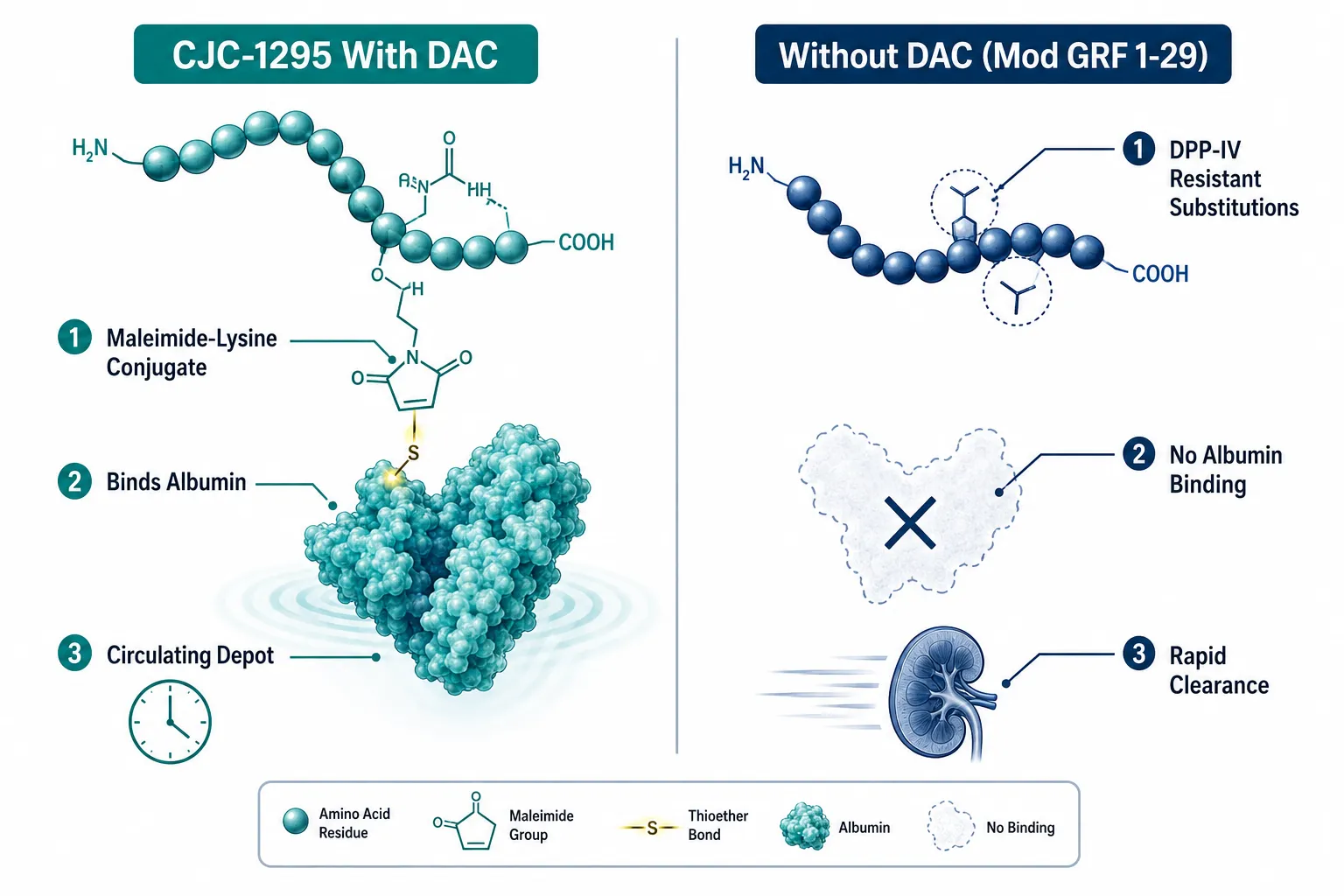
The CJC-1295 with DAC vs without DAC distinction begins at the molecular level. CJC-1295 with DAC incorporates a lysine-linked maleimidopropionic acid group at position 30. This chemical handle covalently attaches to serum albumin once the peptide enters circulation. Albumin is the most abundant plasma protein in the body, and by hitching to it, the peptide essentially becomes part of a large, slowly cleared macromolecule. The result is a circulating depot that releases active peptide gradually over days rather than hours.
CJC-1295 without DAC, the compound more precisely termed Modified GRF 1-29, takes a different approach to stability. It uses four strategic amino acid substitutions to resist cleavage by dipeptidyl peptidase-IV (DPP-IV), the enzyme that rapidly degrades native growth hormone-releasing hormone (GHRH). There is no albumin-binding group. The peptide remains free in plasma, acts quickly at the pituitary, and clears within 30 to 120 minutes.
In plain terms:
- With DAC = albumin-bound, extended-release GHRH analog
- Without DAC = short-acting, DPP-IV-resistant GHRH analog
This structural difference is the single most important concept when evaluating research that involves either compound. For a broader look at how peptide structure governs function, the overview of polypeptide peptides explained: structure, function, and research applications provides useful context.
Half-Life and Duration: Minutes vs Days
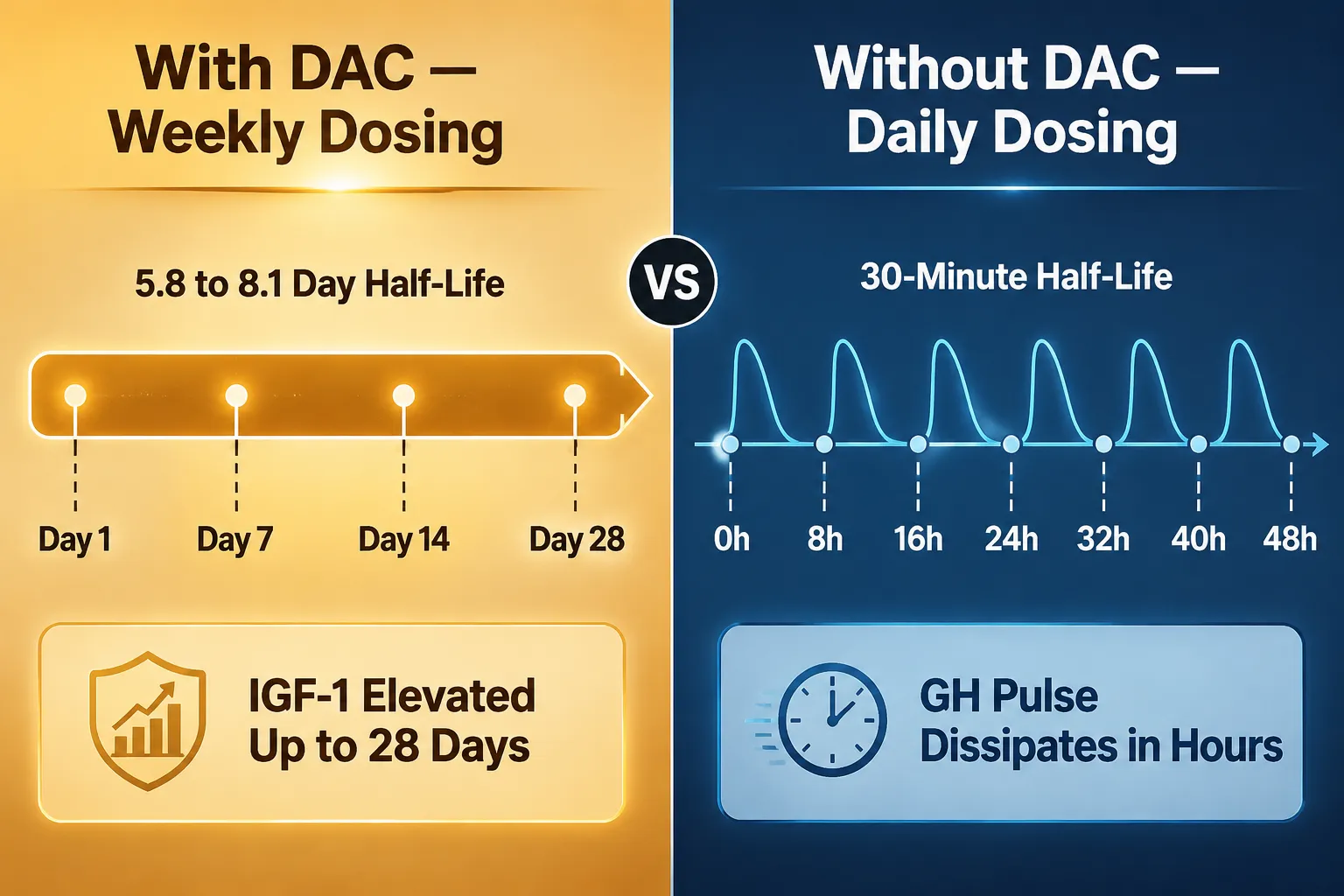
The pharmacokinetic gap between these two forms is striking. Phase 2 data on CJC-1295 with DAC in approximately 65 adults established a half-life of 5.8 to 8.1 days. After multiple doses, IGF-1 levels remained elevated above baseline for up to 28 days. Mean plasma GH showed two- to tenfold increases persisting for six days or more after a single injection. This is not a transient spike, it is a prolonged hormonal shift.
CJC-1295 without DAC tells a very different story. Its half-life sits around 30 minutes, occasionally extended to 30 to 120 minutes depending on the measurement methodology. GH pulses rise sharply after injection and return toward baseline within hours, leaving no lasting depot activity.
Dosing frequency follows directly from half-life:
| Form | Half-Life | Typical Research Dosing |
|---|---|---|
| CJC-1295 with DAC | 5.8 to 8.1 days | Once or twice weekly |
| CJC-1295 without DAC (Mod GRF 1-29) | 30 to 120 minutes | 1 to 3 times daily |
Researchers studying combination protocols, for example, pairing a GHRH analog with a ghrelin mimetic, should review how these compounds are combined in products like the CJC-1295 IPA 10mg formulation, or in multi-compound blends such as the Tesamorelin AOD9604 CJC1295 Ipamorelin 12mg protocol. For a broader comparison of GHRH-axis peptides, the article on Tesamorelin and Ipamorelin peptides: mechanism, synergy, and growth hormone research design is also worth consulting.
Research Design Implications of CJC-1295 With DAC vs Without DAC
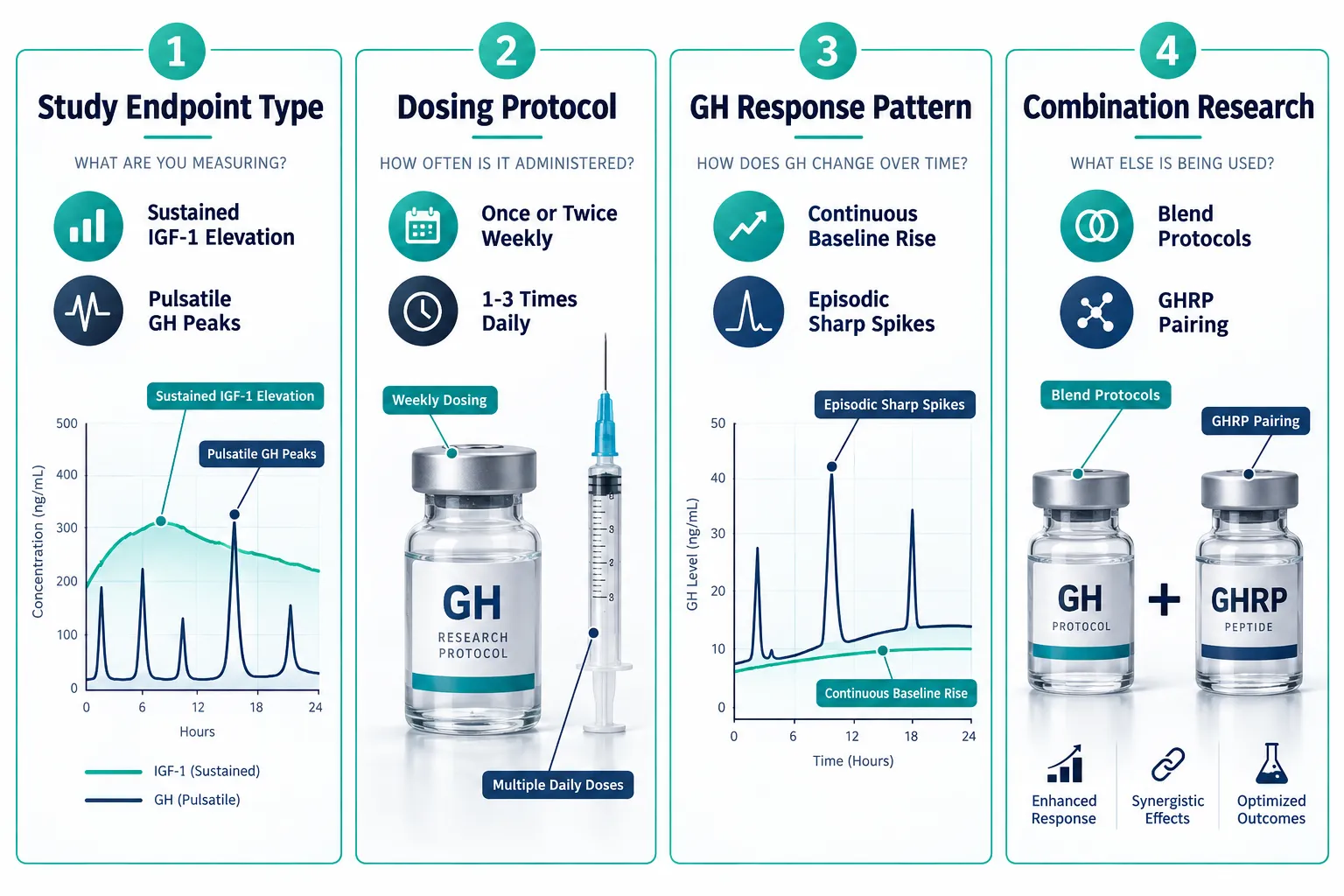
Selecting between these two forms is a research design decision, not simply a dosing preference. The CJC-1295 with DAC vs without DAC mechanism, duration, and research design differences translate directly into how endpoints are measured, how frequently samples are collected, and what kind of GH-axis activity the study is actually designed to observe.
When studying sustained IGF-1 elevation:
The with-DAC form is appropriate. Its long half-life means fewer injections, simpler dosing schedules, and a more stable hormonal environment during the observation window. Researchers can track IGF-1 over days or weeks without daily interventions.
When studying pulsatile GH dynamics:
The no-DAC form is the better fit. Its short action window allows researchers to time injections precisely and observe discrete GH pulses. This is useful when the research question involves mimicking natural secretion patterns or assessing acute pituitary responsiveness.
Additional design considerations:
- Washout periods differ substantially. The DAC form may require weeks of washout; the no-DAC form clears within hours.
- Combination protocols involving a GHRP (such as Ipamorelin) are common with the no-DAC form, since both compounds share a short-acting, pulse-oriented profile. Researchers can explore Sermorelin Ipamorelin CJC1295 combination designs for reference.
- Endpoint timing must account for the GH response curve. Sampling 24 hours post-injection is meaningful for the DAC form but largely irrelevant for the no-DAC form.
- Blinding and control arms are easier to manage with the weekly-dosed DAC form in longer studies, since compliance and administration frequency are reduced.
For researchers interested in how metabolic peptides fit into broader study frameworks, the top 5 research peptides for metabolic health: an updated buyer's guide offers comparative context across multiple compound classes.
Conclusion
The CJC-1295 with DAC vs without DAC mechanism, duration, and research design differences are not trivial. They represent two distinct pharmacological tools built on the same GHRH backbone but optimized for entirely different applications. The DAC form, with its albumin-binding mechanism and multi-day half-life, is suited to studies targeting sustained GH and IGF-1 elevation. The no-DAC form, with its rapid clearance and pulsatile GH output, fits studies that require episodic, physiologically patterned hormone responses.
Actionable next steps for researchers:
- Define the primary endpoint first, sustained IGF-1 elevation or pulsatile GH dynamics, before selecting a form.
- Build washout periods and sampling schedules around the specific half-life of the chosen compound.
- Review existing combination protocols (GHRH plus GHRP) to determine whether the dosing frequencies of all compounds in the design are compatible.
- Source compounds with verified purity and documentation, since structural integrity is essential when the entire mechanistic distinction rests on a single molecular group.
Matching the compound to the research question is the foundation of valid, reproducible GH-axis research in 2026.