Call or Text 727-513-9780
  • Shopping Cart Shopping Cart
    0Shopping Cart
Pure Tested Peptides | America's most trusted Peptides for sale online
  • Peptides for sale
    • Oral Peptides for sale
      • Peptide Capsules for sale
      • BPC 157 Capsules 1000mcg
      • SLU-PP-332 Capsules | 1000 mcg
      • 5-Amino-1MQ 50mg Capsules
      • Tesofensine 500mcg
    • All Peptides for sale
    • Peptide Sprays
      • BPC 157 Nasal Spray Kit
      • BPC-157 TB500 Nasal Spray Kit
      • Semax Nasal Spray 10mg
      • Selank – Nasal Spray Kit – 10mg
      • Epithalon 50MG Nasal Spray Kit
      • Ipamorelin 10mg Nasal Spray
      • Klow Nasal Spray (BPC-157 + TB-500 + GHK-Cu + KPV) | 80mg
      • Hulk Nasal Spray Tesa / Ipa Blend 6/3 MG
      • Klow Nasal Spray
      • NAD + 500 mg Nasal Spray
      • PT-141 Nasal Spray Kit
    • GHRH Peptides
      • Ipa Peptides
      • CJC-1295 Peptides
        • CJC-1295 with DAC 5 mg
        • CJC-1295 without DAC 5 mg
        • CJC-1295 Ipa 10mg
      • Tesa Peptides
        • Tesa Peptide
        • Tesa 20 mg
    • GHK-Cu Peptides
      • All GHK-Cu Peptides
      • GHK-Cu 100mg
      • KLOW Peptide Blend – Buy KLOW blend online
    • BPC Peptides
      • All BPC Peptides
      • BPC-157
      • BPC-157 TB-500
      • BPC 157 capsules 1000mcg
    • SLU-PP-332 Peptides
      • All SLU-PP-332 Peptides
      • SLU-PP-332 5mg
    • GLP3 Peptides
    • PT-141 Peptides
      • PT-141 Peptides for sale
      • PT-141 10mg
      • PT-141 Nasal Spray
    • CAG Peptides
      • Lipo-C Peptide Blend
      • CAG 5mg
      • CAG 10mg
    • MOTS-C Peptides
      • MOTS-C Peptides for sale
      • MOTS-c peptide
      • MOTS-c 10mg *6 pack*
    • 5 Amino 1MQ Peptides
      • 5 Amino 1MQ Peptides for sale
      • 5-Amino-1MQ 50mg Capsules
      • 5-Amino-1MQ 5mg
    • Epithalon Peptides
      • Epithalon Peptides for sale
      • Epithalon 10mg
      • Epithalon 50mg
  • Shop
    • GLPs
      • 5-Amino-1MQ 50mg Capsules
      • 5-Amino-1MQ 5mg
      • L-Carnitine 500mg/ml
      • Tesofensine 500mcg
      • SLU-PP-332 5mg
      • MOTS-c 10mg *6 pack*
    • Epithalon & BPC Peptides
      • Epithalon 10mg
      • Epithalon 50mg
      • BPC-157
      • BPC 157 capsules 1000mcg
      • BPC-157 TB-500
      • BPC-157 TB500 Nasal Spray Kit
      • BPC 157 Nasal Spray Kit
    • BPC TB-500 & NAD+ Peptides
      • NAD+ 500 mg
      • KLOW Peptide Blend – Buy KLOW blend online
      • GLOW Peptide Blend
      • TB 500 5mg
      • BPC 157 capsules 1000mcg – Supplement
      • BPC 157 Nasal Spray Kit
      • BPC-157
      • BPC-157 TB500 Nasal Spray Kit
      • BPC-157 TB-500
      • BPC 157 capsules 1000mcg
    • LL-37 Peptide
      • LL-37 10 mg
    • MOTS-C & Selank
      • MOTS-c peptide
      • Selank 10mg
    • GHK Peptides
      • GHK-Cu 100mg
      • GLOW Peptide Blend
      • KLOW Peptide Blend – Buy KLOW blend online
  • COAs
  • Wholesale
    • Wholesale Peptides for sale
  • PTP FAQ
  • Affiliates
    • Selank Peptide: Advanced Pharmacological Mechanisms Underlying Its Anxiolytic and Nootropic Effects in Research
      • 5-Amino-1MQ Peptide: Detailed Mechanisms of NNMT Inhibition and Its Impact on Cellular Metabolism Research
        • MOTS-C Peptide: Unraveling Its Role in Mitochondrial Dynamics and Energy Metabolism Research
          • Epithalon Peptide and Telomerase Regulation: Investigating Its Impact on Cellular Senescence and Lifespan Research Models
            • GLP2-T vs GLP2 Tirz Peptide: Understanding the Naming, Mechanistic Nuances, and Research Implications for Gut Health
      • Peptides and Polypeptides in Modern Pharmacology: What Research on Metoprolol, Prednisone, and Amlodipine Reveals
        • Polypeptide Peptides vs NSAIDs: What Naproxen and Diclofenac Teach Tissue-Repair Researchers About BPC‑157 and TB‑500
          • Peptides and Polypeptides in Endocrine Pharmacology: How GLP-1, GLP-2, and GLP-3 Retatrutide Differ From Classic Drugs Like Prednisone and Amlodipine
          • 5‑Amino‑1MQ Peptide and NNMT Inhibition: How It Compares With Statins Like Atorvastatin in Adipose and Lipid Metabolism Research
      • Enclomiphene, Estrogen Receptor Signaling, and Luteinizing Phase Biology: What Hormone Researchers Should Measure
        • Mesenchymal Stem Cells, BPC‑157, and GHK‑Cu: How Tissue Repair Peptides Compare With Classic NSAIDs Like Naproxen in Injury Models
          • Peptide Calculator Use Cases Beyond Growth Hormone: Working Through GLP‑3 Retatrutide, MOTS‑c, and BPC‑157 Research Dosing
        • Polypeptide Peptides in Endocrine and Metabolic Pharmacology: Lessons From Amlodipine, Prednisone, and Metoprolol
        • Peptides Calculator for Advanced Blends: Worked Examples for Tesamorelin, CJC‑1295, and Ipamorelin Stacks
          • Peptides and Polypeptides in Human Physiology: How Molecular Size Shapes Research Applications
            • Selank Peptide: Advanced Pharmacological Mechanisms Underlying Its Anxiolytic and Nootropic Effects in Research
          • 5-Amino-1MQ Peptide: Detailed Mechanisms of NNMT Inhibition and Its Impact on Cellular Metabolism Research
            • MOTS-C Peptide: Unraveling Its Role in Mitochondrial Dynamics and Energy Metabolism Research
              • Epithalon Peptide and Telomerase Regulation: Investigating Its Impact on Cellular Senescence and Lifespan Research Models
                • GLP2-T vs GLP2 Tirz Peptide: Understanding the Naming, Mechanistic Nuances, and Research Implications for Gut Health
                  • Peptides and Polypeptides in Endocrine Pharmacology: How GLP-1, GLP-2, and GLP-3 Retatrutide Differ From Classic Drugs Like Prednisone and Amlodipine
                    • Polypeptide Peptides vs NSAIDs: What Naproxen and Diclofenac Teach Tissue-Repair Researchers About BPC‑157 and TB‑500
                      • Peptides and Polypeptides in Modern Pharmacology: What Research on Metoprolol, Prednisone, and Amlodipine Reveals
                        • 5‑Amino‑1MQ Peptide and NNMT Inhibition: How It Compares With Statins Like Atorvastatin in Adipose and Lipid Metabolism Research
                        • Enclomiphene, Estrogen Receptor Signaling, and Luteinizing Phase Biology: What Hormone Researchers Should Measure
                        • Mesenchymal Stem Cells, BPC‑157, and GHK‑Cu: How Tissue Repair Peptides Compare With Classic NSAIDs Like Naproxen in Injury Models
                        • Peptide Calculator Use Cases Beyond Growth Hormone: Working Through GLP‑3 Retatrutide, MOTS‑c, and BPC‑157 Research Dosing
                        • Polypeptide Peptides in Endocrine and Metabolic Pharmacology: Lessons From Amlodipine, Prednisone, and Metoprolol
                        • Peptides Calculator for Advanced Blends: Worked Examples for Tesamorelin, CJC‑1295, and Ipamorelin Stacks
                        • Peptides and Polypeptides in Human Physiology: How Molecular Size Shapes Research Applications
                        • Selank Peptide: Advanced Pharmacological Mechanisms Underlying Its Anxiolytic and Nootropic Effects in Research
                        • MOTS-C Peptide: Unraveling Its Role in Mitochondrial Dynamics and Energy Metabolism Research
                        • Peptides and Polypeptides in Modern Pharmacology: What Research on Metoprolol, Prednisone, and Amlodipine Reveals
                        • Peptides and Polypeptides in Endocrine Pharmacology: How GLP-1, GLP-2, and GLP-3 Retatrutide Differ From Classic Drugs Like Prednisone and Amlodipine
                        • 5-Amino-1MQ Peptide: Detailed Mechanisms of NNMT Inhibition and Its Impact on Cellular Metabolism Research
                        • Mesenchymal Stem Cells, BPC‑157, and GHK‑Cu: How Tissue Repair Peptides Compare With Classic NSAIDs Like Naproxen in Injury Models
                        • Peptide Calculator Use Cases Beyond Growth Hormone: Working Through GLP‑3 Retatrutide, MOTS‑c, and BPC‑157 Research Dosing
                        • GLP2-T vs GLP2 Tirz Peptide: Understanding the Naming, Mechanistic Nuances, and Research Implications for Gut Health
                        • Polypeptide Peptides in Endocrine and Metabolic Pharmacology: Lessons From Amlodipine, Prednisone, and Metoprolol
                        • Polypeptide Peptides vs NSAIDs: What Naproxen and Diclofenac Teach Tissue-Repair Researchers About BPC‑157 and TB‑500
                        • Peptides and Polypeptides in Human Physiology: How Molecular Size Shapes Research Applications
                        • Peptides Calculator for Advanced Blends: Worked Examples for Tesamorelin, CJC‑1295, and Ipamorelin Stacks
                        • 5‑Amino‑1MQ Peptide and NNMT Inhibition: How It Compares With Statins Like Atorvastatin in Adipose and Lipid Metabolism Research
                        • Enclomiphene, Estrogen Receptor Signaling, and Luteinizing Phase Biology: What Hormone Researchers Should Measure
                        • Epithalon Peptide and Telomerase Regulation: Investigating Its Impact on Cellular Senescence and Lifespan Research Models
                        • Best research protocol Klow blend
                        • best time to take BPC-157
                        • best time to take DSIP (Delta Sleep Inducing Peptide)
                        • best time to take CJC-1295
                        • best time to take AOD-9604
                        • best time to take Follistatin 344
                        • best time to take Ipamorelin
                        • best time to take MK-677 (Ibutamoren)
                        • best time to take Ligandrol (LGD-4033) — research compound
                        • best time to take Ostarine (MK-2866) — research compound
                        • best time to take GHK-CU
                        • best time to take TB-500
                        • best time to take MOTS-c
                        • best time to take Semax
                        • best time to take RAD-140 (Testolone) — research compound
                        • best time to take Thymosin Alpha-1
                        • best time to take PEG-MGF
                        • Biolife Plasma, Octapharma Plasma, and Research Peptides: How Plasma Donation Labs Differ From Peptide Suppliers
                        • best time to take YK-11 — research compound
                        • best time to take PT-141 (Bremelanotide)
                        • Best research protocol Klow blend
                        • 5-Amino-1MQ and MOTS-C Synergy: Metabolic Signaling, Mitochondria, and Research Design
                        • BPC-157 and TB-500: Investigating Their Combined Effects on Angiogenesis and Cellular Migration in Tissue Repair Models
                        • BPC-157 Peptide: Gut Barrier Function, Inflammation, and Tissue-Recovery Research
                        • 5‑Amino‑1MQ and MOTS‑c Synergy in Metabolic Research: Designing NNMT and Mitochondrial Biogenesis Stacks
                        • CJC-1295 with DAC vs. Without DAC: Half-Life, Release Kinetics, and Research Implications
                        • CJC‑1295 with DAC vs. Without DAC: Expanding on Half‑Life Differences Using Tesamorelin and Ipamorelin Blend Case Studies
                        • Collagen Biology and Copper‑Binding Peptides: How GHK‑Cu, Glow Blend, and Klow Blend Interact with Skin and Connective Tissue
                        • Collagen Biology and Regenerative Peptides: How GHK‑Cu, Glow Blend, and Klow Blend Affect Extracellular Matrix Research
                    • DNA, Telomeres, and Longevity Peptides: Positioning Epithalon and MOTS‑c in Genetic Aging Research
                      • Enclomiphene Citrate: serm Mechanism, Testosterone Research, and Stack Compatibility
                        • Enclomiphene vs Enclomiphene Citrate: Formulation, Bioavailability, and Research Distinctions
                        • Epithalon Peptide Research: Telomerase Activation, Aging, and Pineal Gland Function
                        • Estrogen Receptor Signaling and Enclomiphene: How Selective Modulators Compare with Classic Polypeptide Hormones
                        • GHK-Cu Peptide: Advanced Mechanisms in Extracellular Matrix Remodeling and Wound Healing Research
                        • GHK-Cu Peptide: Collagen Synthesis, Wound Repair, and Skin-Barrier Research Models
                        • GLP-1 vs GLP-3 vs GLP-2: Peptide Classification and Research Applications
                        • GLP-2 Peptide Research Guide: Gut Barrier Function, Nutrient Absorption, and Intestinal Recovery Models
                        • GLP-3 Retatrutide vs. GLP-1 Drugs: What Triple-Agonist Biology Changes in Research Models
                        • Ipamorelin and Tesamorelin Combination: Synergistic GH Secretagogue Research and Dosing Protocols
                        • GLP2 Tirz Peptide: What It Is, Why the Name Exists, and How Researchers Should Interpret It
                        • Klow Blend Peptide Nasal Spray: What the Formulation Is Trying to Do in Cognitive Research
                        • Mitochondria, NNMT Inhibition, and Peptide Modulators: Where MOTS‑c and 5‑Amino‑1MQ Fit in Cellular Energy Research
                        • MOTS-c Peptide: Mitochondrial Function, Energy Metabolism, and What Researchers Measure
                        • MOTS-c vs. 5-Amino-1MQ: Which Metabolic Research Questions Each Compound Actually Answers
                        • Nasal Spray Peptides: Bioavailability, Administration, and Semax/Selank Research Applications
                        • PT-141 Peptide Research: Mechanism of Action and Melanocortin Receptor Signaling
                        • Retatrutide for Research: Mechanism, Structure, and GLP-1/GLP-3 Dual Action
                        • Retatrutide for Obesity and Type 2 Diabetes: What the Latest Trial Data Suggest
                        • Tesofensine Peptide Research: Mechanism, Appetite Suppression, and Neuropeptide Y Pathways
  • Contact
    • Contact Customer Service
    • Text Customer Support
  • About US
  • Shop all peptides
  • Affiliate Program
    • Affiliate Signup
  • Login / Register Login / Register Page Link Login / Register Page Link
  • Click to open the search input field Click to open the search input field Search
  • Menu Menu

Tag Archive for: qivive

Biologically Effective Dose in Peptide Experiments: Translating Nominal Concentration Into Exposure and Response

Biologically Effective Dose in Peptide Experiments: Translating Nominal Concentration Into Exposure and Response

September 27, 2026/0 Comments/in Uncategorized/by

Fewer than one in five in vitro peptide studies formally account for the gap between the concentration written on a vial label and the concentration that actually reaches a cellular receptor. That gap is not a minor rounding error. It can span an order of magnitude, and it is the central problem that the concept of biologically effective dose in peptide experiments: translating nominal concentration into exposure and response is designed to solve.

Nominal concentration, administered amount, molar concentration, exposure duration, and observed biological response are five distinct measurements. Treating them as interchangeable is one of the most common sources of irreproducible results in peptide research.

Key Takeaways

  • Nominal concentration is a calculated convenience metric, not a direct measure of what reaches the target site.
  • Protein binding, plastic adsorption, and cell-surface interactions can dramatically reduce the bioavailable fraction of a peptide in an assay.
  • The freely dissolved concentration (C_free) in the medium is a far better proxy for biologically effective dose than the nominal value.
  • Mass-balance and PBPK models can translate nominal doses into target-site exposure estimates when direct measurement is unavailable.
  • Exposure duration and time-dependent concentration profiles matter as much as peak concentration for predicting biological response.

Why Nominal Concentration Is Not the Same as Biologically Effective Dose
Why Nominal Concentration Is Not the Same as Biologically Effective Dose

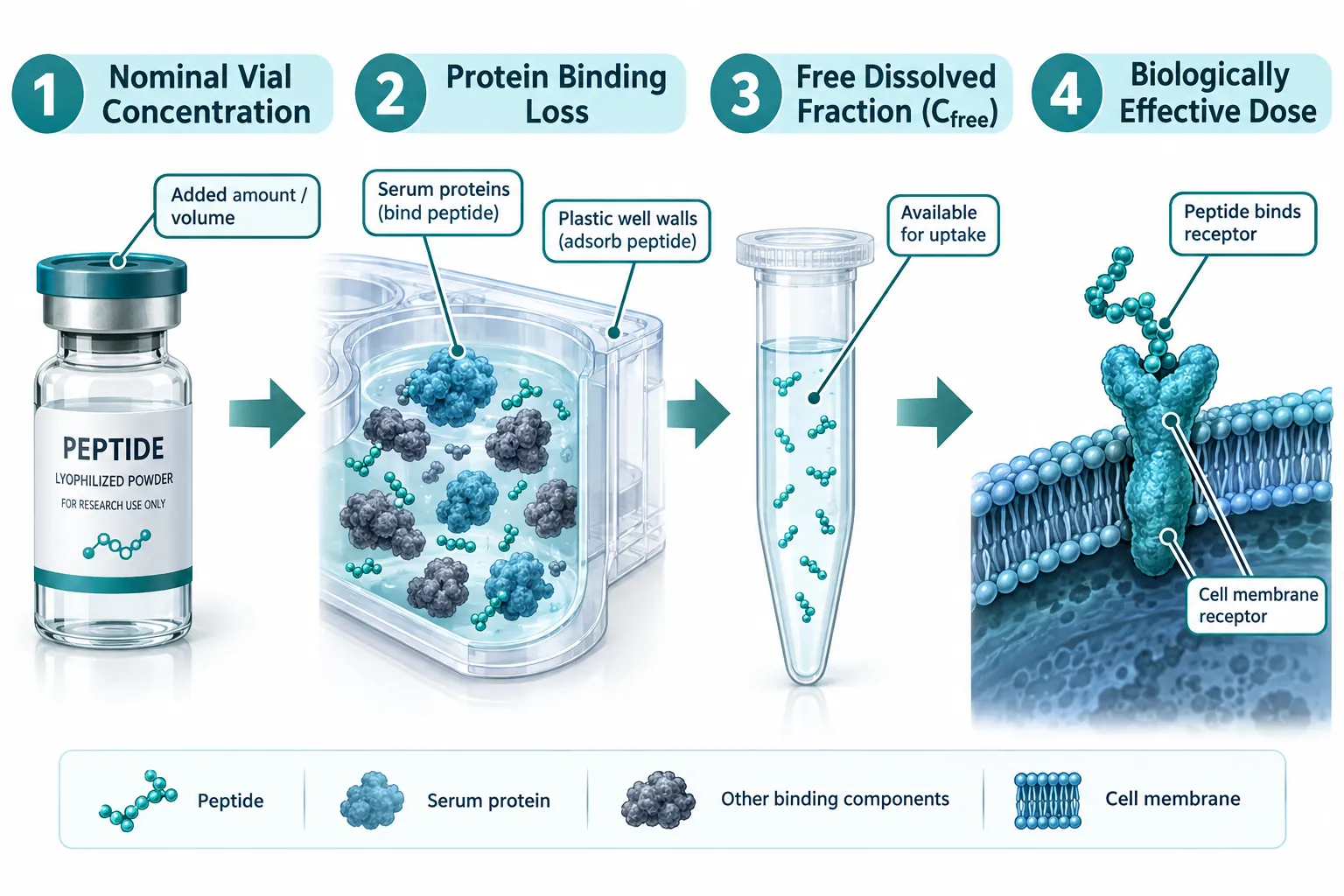
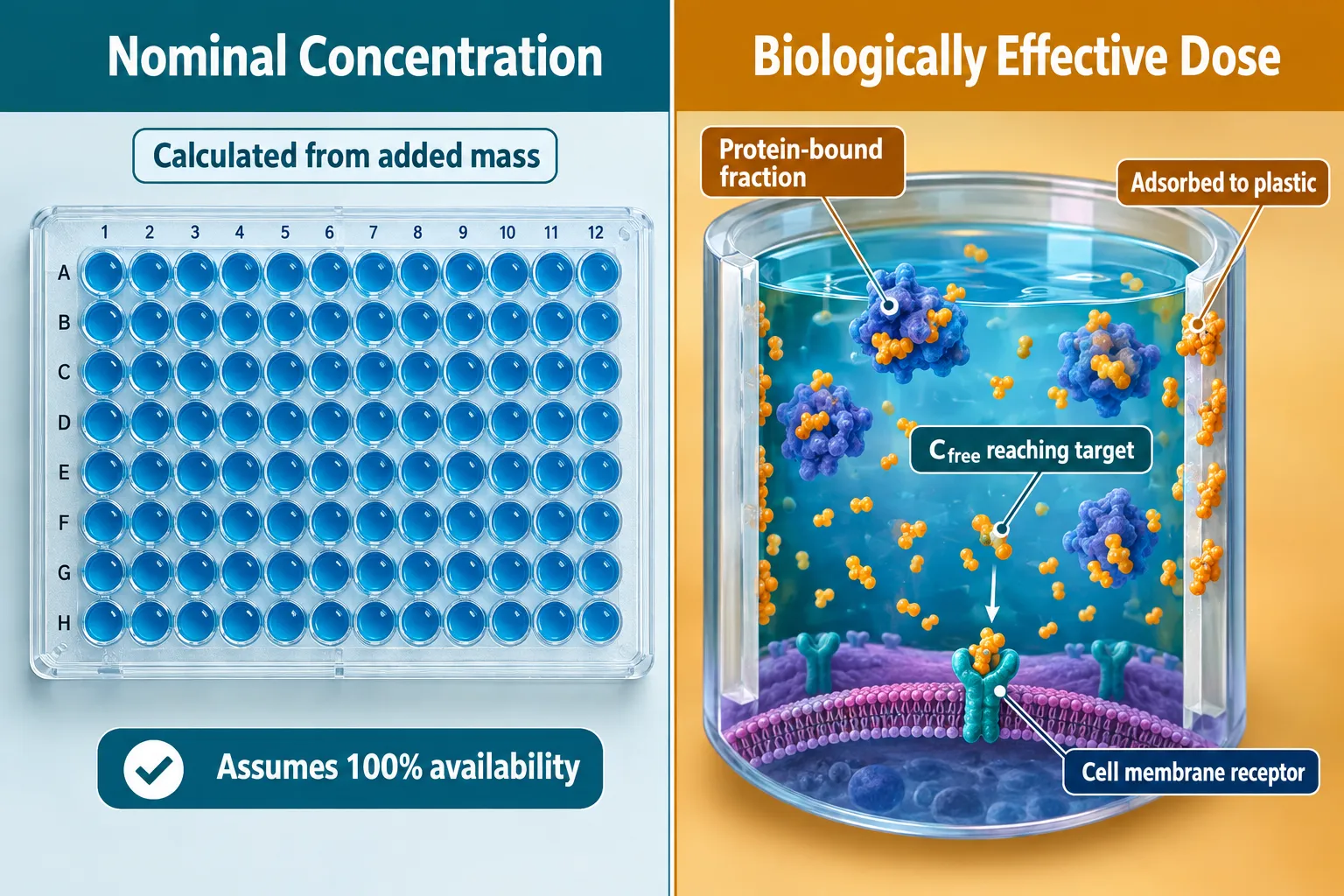
When a researcher dissolves a peptide in cell culture medium and records "100 nM," that number describes what was added to the well, not what is available to the cell. Regulatory and scientific guidance is explicit: biologically effective dose (BED) is the amount of a compound at the organ, cell, or macromolecular target that is available to interact and cause a biological effect.

Several physical and chemical processes erode the nominal concentration before any peptide molecule encounters a receptor:

  • Serum protein binding – A significant fraction of added peptide binds to albumin and other serum proteins, removing it from the freely dissolved pool.
  • Plastic adsorption – Polystyrene plates and tubing can adsorb hydrophobic or amphipathic peptides, reducing the medium concentration over time.
  • Cell-surface sequestration – Cationic peptides, including mitochondria-targeted sequences like those found in SS31 peptide research, can associate with negatively charged membrane phospholipids before reaching their intended intracellular target.
  • Evaporation and degradation – Volatile solvents and enzymatic cleavage further reduce the effective concentration during extended incubations.

The result is that nominal concentration systematically overestimates in vitro potency relative to free concentration. Studies comparing dose-response curves built on nominal versus free concentrations consistently show that free concentration yields more consistent results across assay conditions and better predicts in vivo response.

"The freely dissolved, unbound concentration in the medium is generally a better proxy for biologically effective dose than the nominal concentration added to the well."

For peptides like those explored in peptide dosing research, this distinction has direct consequences for how minimum effective doses and therapeutic windows are interpreted.


A Framework for Translating Nominal Concentration Into Exposure and Response
A Framework for Translating Nominal Concentration Into Exposure and Response

Understanding the problem is only the first step. A practical framework for biologically effective dose in peptide experiments: translating nominal concentration into exposure and response involves a hierarchy of dose metrics, each closer to the actual site of action.

The Dose Metric Hierarchy

Dose Metric Definition Proximity to BED
Nominal concentration Added mass divided by medium volume Lowest
Loaded/released dose Amount released from formulation or carrier Moderate
C_free (freely dissolved) Unbound concentration in aqueous medium High
Cell-associated concentration Peptide measured in or on cells Very high
Target-site concentration Concentration at receptor or organelle Highest (true BED)

When direct measurement of C_free or cell-associated concentrations is unavailable, current scientific guidance requires that researchers either use dynamic mass-balance models or explicitly characterize the uncertainty introduced by relying on nominal values.

Applying Mass-Balance Models

Dynamic dosimetry models estimate medium and intracellular BED from a peptide's physicochemical properties: molecular weight, log P, protein binding fraction, and assay geometry. These in silico approaches allow researchers to predict how much active peptide remains in solution over time, accounting for partitioning into plastics and proteins.

For peptides such as those studied in GLP-3 peptide research or RETA peptide experiments, where receptor binding kinetics are central to the dose-response relationship, these corrections can shift the apparent EC50 substantially.

Time-Dependent Exposure Matters

A single nominal concentration value collapses a dynamic process into a static number. Quantitative in vitro-to-in vivo extrapolation (QIVIVE) frameworks emphasize that time-dependent concentration-response relationships are more informative than simple endpoint measurements. A peptide that degrades rapidly in serum may produce a high C_free spike followed by near-zero exposure, a profile that a nominal 100 nM label cannot describe.


Practical Steps for Implementing Biologically Effective Dose in Peptide Experiments
Practical Steps for Implementing Biologically Effective Dose in Peptide Experiments

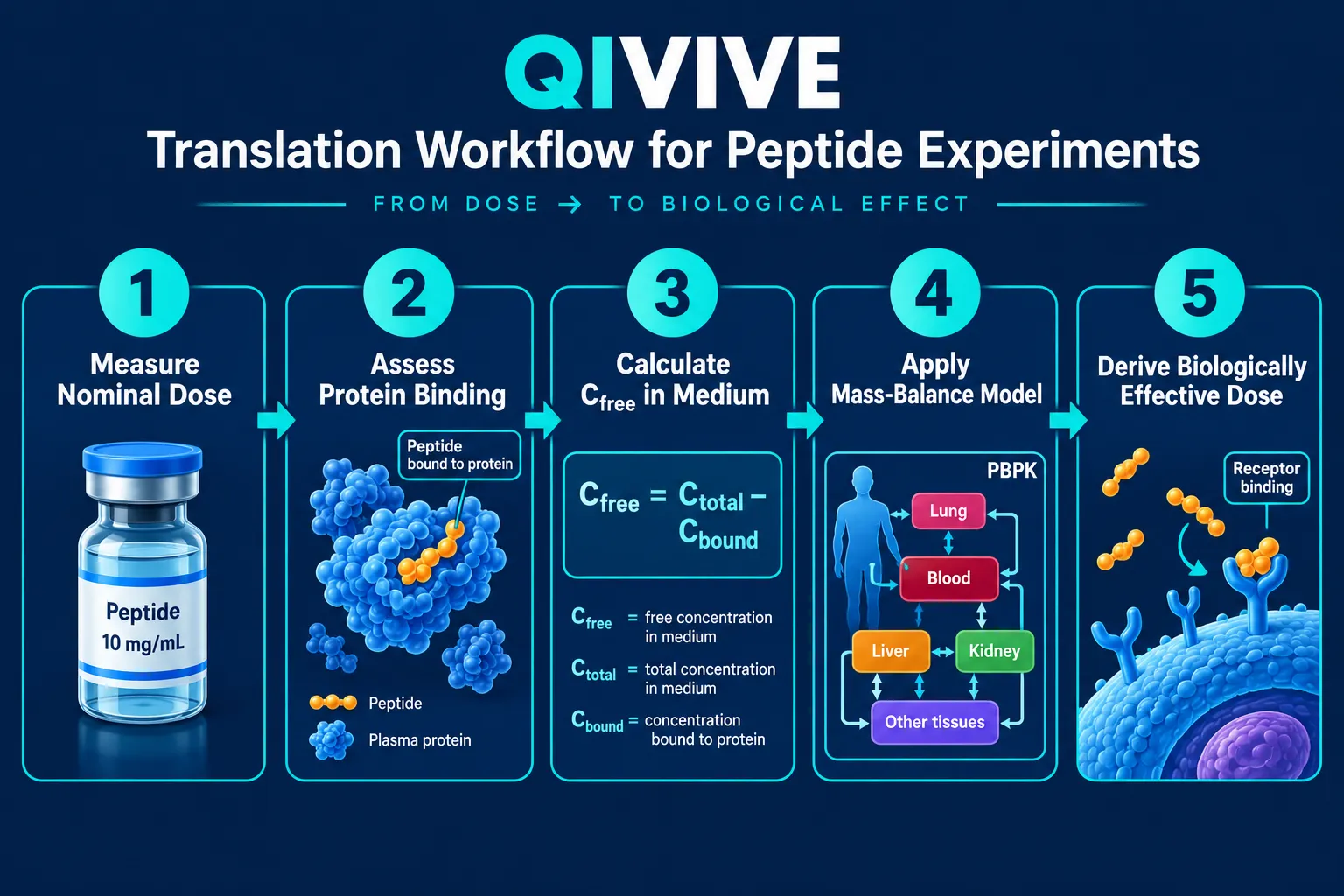
Translating biologically effective dose in peptide experiments: translating nominal concentration into exposure and response from a theoretical concept into laboratory practice involves concrete, sequential actions.

Step 1 – Characterize protein binding. Use equilibrium dialysis or rapid equilibrium dialysis (RED) assay to determine the unbound fraction in the specific medium formulation used. Serum percentage matters: a 10% FBS medium and a 1% FBS medium will yield very different C_free values for the same nominal dose.

Step 2 – Assess plastic adsorption. Measure peptide recovery from wells at multiple time points. Significant losses over 24-48 hours signal adsorption, particularly relevant for amphipathic or cationic sequences.

Step 3 – Apply a mass-balance correction. Use the measured binding and adsorption data to calculate C_free at each time point. For complex peptides, consider PBPK-informed models.

Step 4 – Build time-resolved concentration-response curves. Plot response against C_free at the relevant time point, not against nominal concentration at time zero. This approach aligns with QIVIVE best practices and improves cross-study comparability.

Step 5 – Report both metrics. Publish nominal concentration alongside the calculated or measured C_free and any BED estimate. This supports reproducibility and allows other researchers to apply corrections for their own assay conditions.

For researchers working with mitochondria-targeted peptides, the synergy of LL-37 and SS31 provides a relevant case study in how membrane partitioning can dramatically alter the effective intracellular dose relative to the nominal medium concentration. Similarly, resources on tesa peptide benefits illustrate how administered dose and tissue-level exposure diverge in in vivo settings, reinforcing the same principle at a different scale.

When nominal doses are the only available metric, current guidance treats them as a starting point that requires explicit uncertainty characterization, not as a reliable proxy for BED.


Conclusion

The vial concentration is where a peptide experiment begins, not where it ends. Nominal concentration, administered amount, molar concentration, exposure duration, and biological response each occupy a distinct position in the chain of events between a researcher's bench and a cell's receptor. Conflating them produces dose-response curves that cannot be reproduced, translated to in vivo settings, or compared across laboratories.

Actionable next steps for researchers in 2026:

  1. Measure protein binding and plastic adsorption for every new peptide-assay combination before interpreting dose-response data.
  2. Report C_free alongside nominal concentration in all publications and internal records.
  3. Apply mass-balance or PBPK corrections when direct measurement is impractical.
  4. Build time-resolved exposure profiles rather than relying on single-timepoint nominal values.
  5. Treat nominal concentration as a convenience metric with documented uncertainty, not as a synonym for biologically effective dose.

Adopting these practices moves peptide research closer to the standard that regulators and leading toxicology groups now expect: dose-response relationships grounded in actual exposure at the target site.

https://www.puretestedpeptides.com/wp-content/uploads/2026/09/biologically-effective-dose-in-peptide-experiments-translating-nominal-concentra.webp 1024 1536 https://www.puretestedpeptides.com/wp-content/uploads/2026/01/buy-peptides-online.jpg 2026-09-27 13:03:402026-09-27 13:03:40Biologically Effective Dose in Peptide Experiments: Translating Nominal Concentration Into Exposure and Response
×

Helpful Links

  • My account
  • Cart
  • Checkout
  • Refund and Returns Policy
  • Privacy Policy
  • SMS Privacy Policy
  • Login
  • My Account
  • Logout

USA Made Lab Tested Peptides

All products are sold for research, laboratory, or analytical purposes only, and are not for human consumption


Pure Tested Peptides is a chemical supplier. Pure Tested Peptides is not a compounding / chemical compounding facility as defined under 503A of the Federal Food, Drug, and Cosmetic act. Pure Tested Peptides is not an outsourcing facility as defined under 503B of the Federal Food, Drug, and Cosmetic act.

The statements made within this website have not been evaluated by the US Food and Drug Administration. The products we offer are not intended to diagnose, treat, cure or prevent any disease.

Human/Animal Consumption Prohibited. Laboratory/In-Vitro Experimental Use Only

Scroll to top Scroll to top Scroll to top