Klow Blend Peptide: Investigating Its Unique Formulation and Research Applications for Wellness Studies
Multi-peptide blends represent one of the fastest-growing categories in preclinical research supply, yet few formulations have attracted as much focused attention as the Klow Blend. Researchers exploring Klow Blend Peptide: Investigating Its Unique Formulation and Research Applications for Wellness Studies will find a compound designed around four complementary biological targets, each chosen to address distinct mechanisms relevant to recovery, regeneration, and metabolic function. Understanding what makes this blend structurally distinct is the first step toward designing rigorous, well-controlled wellness studies.
Key Takeaways
- Klow Blend Peptide combines multiple research-grade peptide components in a standardized ratio targeting four complementary biological pathways.
- Each component has individual preclinical evidence, but blend-level data remains an active area of investigation.
- The formulation is classified strictly for research use only and is not approved for human therapeutic application.
- Purity verification and documented sourcing are critical quality benchmarks when selecting a supply for laboratory work.
- Wellness and recovery studies represent the primary theoretical research applications, with cognitive and regenerative contexts emerging as secondary areas of interest.
Understanding the Klow Blend Peptide Formulation
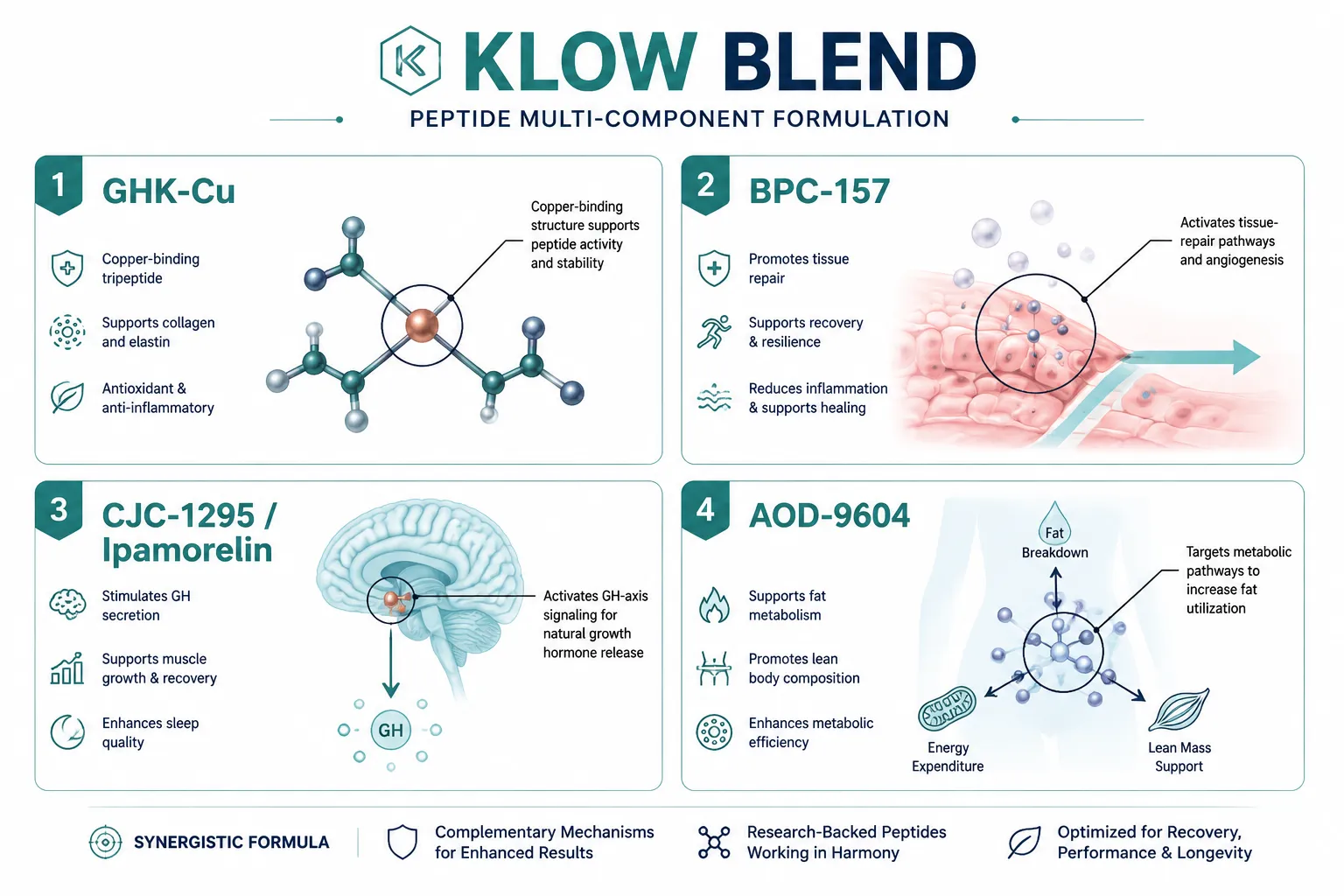
The defining feature of Klow Blend Peptide: Investigating Its Unique Formulation and Research Applications for Wellness Studies lies in its multi-component architecture. Rather than isolating a single peptide, the formulation combines several well-characterized sequences into a fixed, standardized ratio. This approach is grounded in the hypothesis that complementary mechanisms may produce more robust research outcomes than any single agent studied in isolation.
The core components typically associated with this blend include:
| Component | Primary Research Target | Mechanism of Interest |
|---|---|---|
| GHK-Cu | Tissue remodeling | Copper-dependent collagen signaling |
| BPC-157 | Gut-brain axis, repair | Angiogenic and cytoprotective pathways |
| CJC-1295 / Ipamorelin | Growth hormone axis | GHRH receptor agonism |
| AOD-9604 | Metabolic regulation | Lipolytic peptide fragment activity |
Each of these components carries a body of preclinical literature supporting its individual mechanism. For researchers already familiar with BPC-157 core peptides documentation or the GHK-Cu peptide sourcing landscape, the Klow Blend will feel like a logical extension of existing multi-target research frameworks.
The critical distinction here is the blend-level data gap. While individual component evidence is substantial, peer-reviewed data on the specific combination used in Klow Blend remains limited. This makes it an active and genuinely open research question rather than a settled matter.
"The scientific value of a multi-peptide blend lies not just in its components, but in whether the combined formulation produces effects that exceed or differ from those of each agent alone."
Research-Grade Manufacturing and Quality Standards
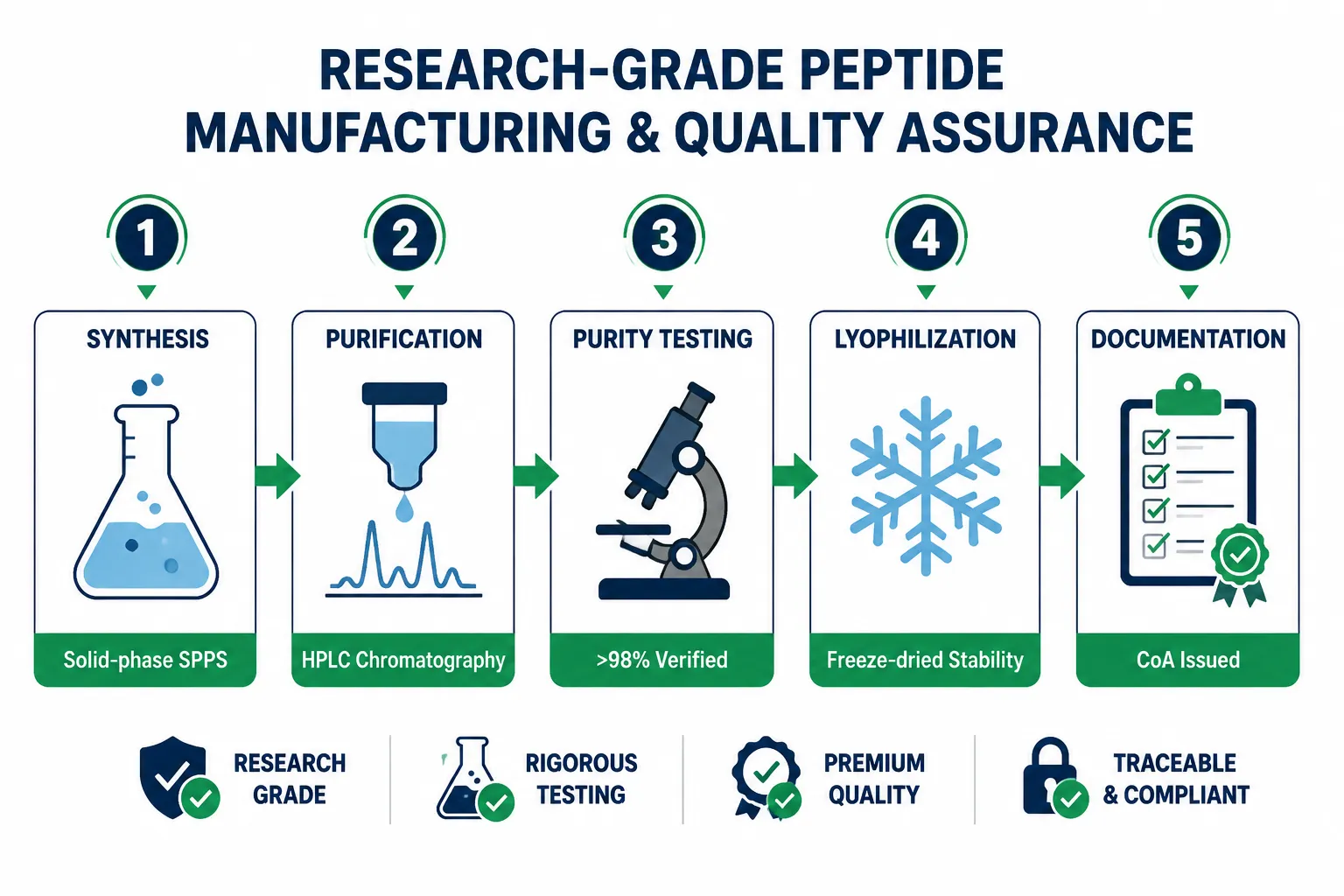
For any wellness study to produce credible, reproducible results, the quality of the research compound is non-negotiable. Klow Blend Peptide: Investigating Its Unique Formulation and Research Applications for Wellness Studies is manufactured under research-grade protocols that prioritize purity verification, batch consistency, and full documentation.
Key quality benchmarks researchers should confirm before procurement include:
- Purity threshold: Reputable suppliers target greater than 98% purity, verified via high-performance liquid chromatography (HPLC).
- Certificate of Analysis (CoA): Each batch should carry a third-party CoA confirming identity, purity, and absence of contaminants.
- Lyophilized format: Freeze-dried presentation extends stability and simplifies controlled reconstitution for laboratory protocols.
- Standardized ratio: The fixed component ratio ensures inter-experiment consistency, a requirement for meaningful comparative data.
Researchers sourcing multi-component blends should also review peptide supplier comparisons to evaluate documentation standards across vendors. Those specifically seeking the Klow formulation can explore where to buy Klow peptide for verified supply options.
Regulatory context is equally important. Klow Blend is classified strictly as a research compound. It carries no approval for human therapeutic use, clinical administration, or veterinary application. All procurement and use must remain within an institutional research framework, subject to applicable regulations.
Research Applications for Wellness and Recovery Studies

The theoretical research applications of Klow Blend Peptide: Investigating Its Unique Formulation and Research Applications for Wellness Studies span several domains that align with current priorities in preclinical wellness science.
Recovery and regenerative research represents the most prominent application area. The combination of tissue-repair mechanisms from BPC-157-class peptides with growth hormone axis modulation from CJC-1295/Ipamorelin creates a theoretical framework for studying accelerated recovery markers in preclinical models. Researchers working with similar growth hormone-axis blends may find the Tesamorelin/CJC-1295/Ipamorelin 12mg blend documentation a useful methodological reference.
Metabolic wellness studies represent a secondary application, driven by the AOD-9604 component's established research profile in lipid metabolism models. Parallel interest in GLP-1 pathway research has expanded the broader metabolic peptide field considerably, and researchers can review GLP-1 peptide research resources for comparative context.
Aesthetic and skin biology research is a third emerging area, anchored by the GHK-Cu component's well-documented role in collagen synthesis and dermal remodeling studies.
Potential wellness study design considerations include:
- Establishing clear biomarker endpoints before initiating protocols.
- Running single-component controls alongside the blend to isolate synergistic effects.
- Documenting reconstitution procedures precisely to ensure dose consistency.
- Applying appropriate institutional review and ethical oversight for all preclinical work.
For researchers also investigating mitochondrial protection pathways alongside recovery endpoints, reviewing SS-31 peptide research resources may complement a Klow Blend study design.
Conclusion
The Klow Blend represents a genuinely interesting subject for preclinical wellness research in 2026, precisely because it sits at the intersection of several well-supported individual mechanisms that have not yet been fully characterized as a combined formulation. The blend-level data gap is not a weakness; it is the research opportunity.
Actionable next steps for researchers:
- Confirm supplier documentation standards, including HPLC purity data and batch-specific CoA, before procurement.
- Design single-component control arms alongside blend protocols to generate meaningful mechanistic data.
- Align all research activities with institutional compliance requirements and applicable regulatory frameworks.
- Monitor the growing ecosystem of blend-level guides and updated supplier documentation as this field matures through 2026 and beyond.
Rigorous, well-documented study design will determine whether Klow Blend Peptide fulfills its theoretical promise across recovery, metabolic, and regenerative wellness applications.