

What Is the GLP-2-T Peptide? Research Context, Target Biology, and Why It Is Confused With GLP-2
Fewer than a dozen peer-reviewed papers use the exact term "GLP-2-T," yet the phrase appears regularly in supplier catalogs, researcher forums, and database searches, often pointing to entirely different compounds. That naming gap creates real problems in the lab. Understanding what is the GLP-2-T peptide, its research context, target biology, and why it is confused with GLP-2 is not just a matter of semantics. It directly affects which reagent a researcher orders, which receptor assay they design, and how they interpret published data.
Key Takeaways
- GLP-2-T is a non-standardized shorthand, not an official IUPAC or INN-designated peptide name.
- The "T" suffix most commonly denotes a truncated or modified form of glucagon-like peptide-2, though some vendors use it to reference a tagged or conjugated analog.
- Native GLP-2 acts primarily on the GLP-2 receptor (GLP2R) in intestinal epithelial cells; any truncated variant may exhibit altered receptor affinity or bioactivity.
- Confusion between GLP-2 and GLP-2-T is driven by inconsistent vendor nomenclature, abbreviated database entries, and overlapping search intent.
- Researchers should verify sequence, purity, and receptor-binding data before sourcing any compound labeled "GLP-2-T."
The Naming Problem: Why "GLP-2-T" Creates Confusion in Research
The glucagon-like peptide family is already crowded. GLP-1, GLP-2, GLP-3, oxyntomodulin, and glicentin all derive from the same proglucagon precursor gene. When a suffix like "-T" is appended without a published consensus definition, the result is predictable ambiguity.
Three common interpretations of "GLP-2-T" in the literature and vendor space:
| Interpretation | What It Means | Where It Appears |
|---|---|---|
| Truncated GLP-2 | A shorter amino acid sequence, often missing C-terminal residues | Biochemistry catalogs, assay kits |
| Tagged GLP-2 | GLP-2 conjugated to a fluorescent tag or biotin | Immunology reagent suppliers |
| Typographic shorthand | A vendor-specific abbreviation with no defined structure | Product pages, informal databases |
This ambiguity is not unique to GLP-2-T. Researchers navigating the GLP family regularly encounter similar issues, as detailed in the article on what is GLP3 peptide and how researchers distinguish it from retatrutide.
"A peptide name without a confirmed sequence is a hypothesis, not a reagent."
The practical consequence: a researcher searching for GLP-2-T in a supplier database may receive a truncated 30-residue analog, a fully tagged 33-residue conjugate, or, in some cases, standard GLP-2 mislabeled due to a catalog error.
What Is the GLP-2-T Peptide? Target Biology and Receptor Context
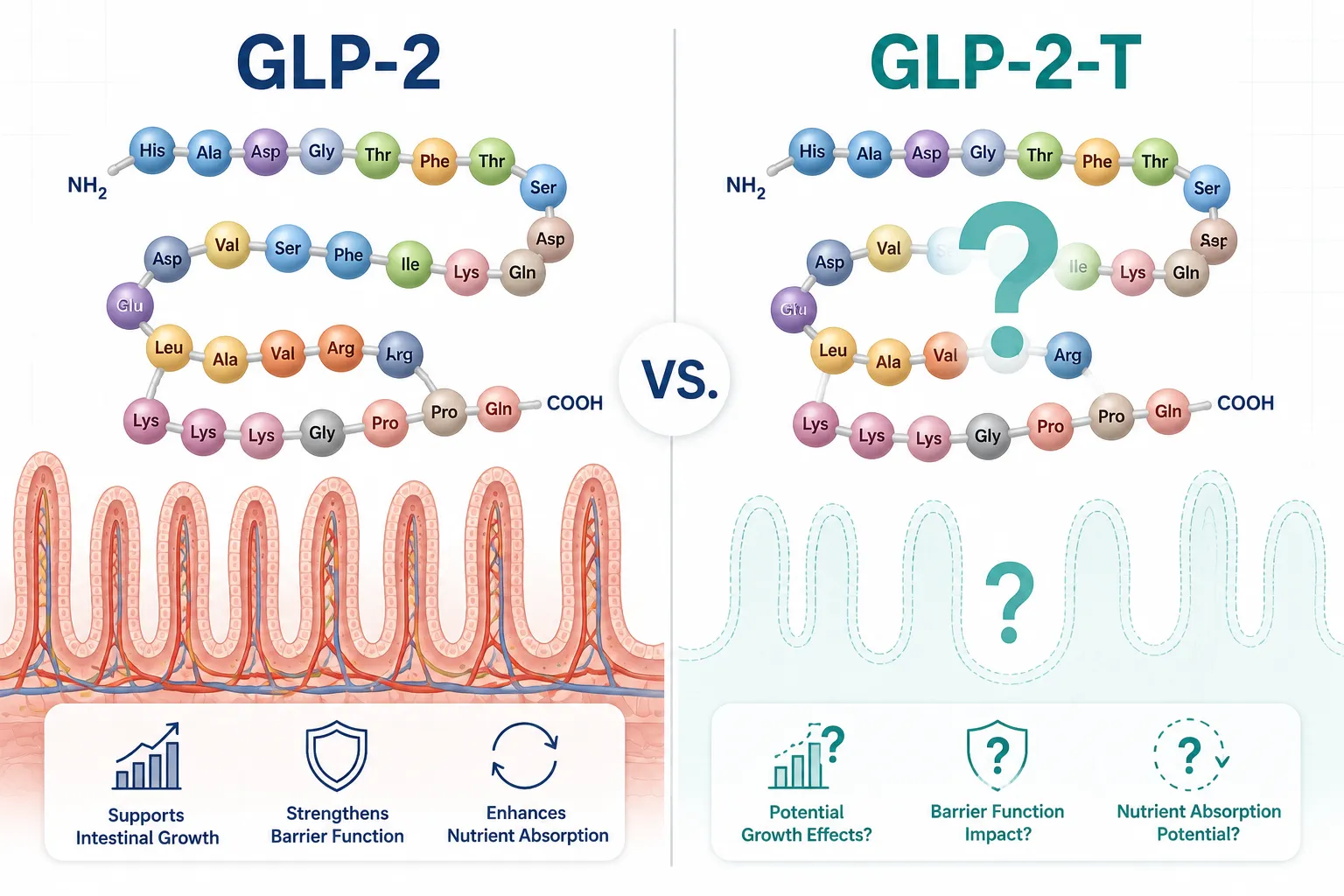
To understand what is the GLP-2-T peptide in terms of target biology, it helps to start with the parent molecule.
Native GLP-2: A Brief Profile
Native GLP-2 is a 33-amino acid peptide secreted by intestinal L-cells in response to nutrient intake. Its primary receptor, GLP2R, is expressed predominantly in:
- Intestinal epithelial cells (enterocytes, goblet cells)
- Enteric neurons
- Subpopulations of hypothalamic neurons
Activation of GLP2R promotes intestinal epithelial proliferation, reduces apoptosis, enhances nutrient absorption, and supports mucosal barrier integrity. These properties have made GLP-2 analogs, most notably teduglutide, a focus of short bowel syndrome research.
How Truncation Changes the Biology
When the "T" in GLP-2-T refers to a truncated form, the functional implications are significant. The N-terminal dipeptide His-Ala is critical for GLP2R binding. Removing even two residues from the N-terminus can convert a full agonist into a partial agonist or antagonist in cell-based assays.
Key structural-activity considerations for truncated GLP-2 variants:
- N-terminal truncation typically reduces receptor binding affinity and agonist potency.
- C-terminal truncation may affect proteolytic stability without necessarily eliminating receptor engagement.
- Mid-sequence deletions are rare in the literature but appear in some synthetic analog studies.
Researchers working with metabolic peptides should cross-reference findings against top research peptides for metabolic health to contextualize GLP-2-T within the broader metabolic peptide landscape.
Why GLP-2-T Is Confused With GLP-2: Search Intent and Product Context


Understanding what is the GLP-2-T peptide and why it is confused with GLP-2 requires looking at both the scientific and commercial environments where these terms circulate.
Search Intent Overlap
Users searching "GLP-2-T peptide" typically fall into one of three intent categories:
- Researchers seeking a specific truncated analog for receptor antagonism studies.
- Procurement staff cross-referencing catalog numbers and mistaking abbreviated entries.
- Students or early-career scientists who encountered the term in a secondary source without a primary citation.
Each group needs different information, yet all three land on the same search results, often product pages that do not clarify the structural distinction.
Vendor Nomenclature as a Source of Confusion
Peptide suppliers frequently use shorthand codes to differentiate product variants. A catalog may list:
- GLP-2 (1-33), the full native sequence
- GLP-2 (3-33), a truncated form sometimes labeled GLP-2-T
- GLP-2-NH2, a C-terminally amidated form
Without reading the full product specification, "GLP-2-T" and "GLP-2" appear interchangeable. This is compounded by the fact that database aggregators sometimes strip suffixes during indexing.
For researchers who rely on reference standards to confirm compound identity, the resource on building robust peptide benchmarks with Bachem and reference standards provides practical guidance on verification workflows.
The Polypeptide Classification Layer
Adding another layer of complexity, GLP-2 and its variants are polypeptides derived from a larger precursor. Researchers unfamiliar with this classification sometimes conflate the parent proglucagon-derived peptides. A broader overview of polypeptide peptides from collagen and hormones to advanced research compounds helps place GLP-2-T within the correct structural family.
Practical Steps for Researchers Encountering "GLP-2-T"
When a protocol, catalog, or paper references GLP-2-T, the following verification steps reduce the risk of sourcing the wrong compound:
- Request the full amino acid sequence from the supplier, do not rely on the product name alone.
- Check the molecular weight against published GLP-2 variants; a truncated form will have a measurably lower MW.
- Confirm receptor binding data, does the supplier provide GLP2R binding affinity (IC50 or Ki) for the specific lot?
- Review the original citation if the term appears in a paper; trace it to the primary sequence data.
- Use mass spectrometry confirmation for high-stakes assays where sequence identity is critical.
Complement-dependent safety and immunological considerations also apply when working with novel peptide analogs. The article on complement-dependent cytotoxicity and peptide safety offers relevant immunology context for labs handling modified peptides.
Conclusion
The term "GLP-2-T" sits at the intersection of incomplete nomenclature, vendor shorthand, and genuine scientific interest in GLP-2 analogs. What is the GLP-2-T peptide in research context ultimately depends on the source using the term, it may describe a truncated sequence with altered GLP2R affinity, a tagged conjugate for imaging assays, or simply a mislabeled version of native GLP-2.
Actionable next steps for researchers in 2026:
- Always obtain a certificate of analysis with full sequence data before ordering any compound labeled "GLP-2-T."
- Cross-reference with primary literature using the exact sequence, not the product name.
- Consult resources on what are polypeptide peptides and advanced research compounds to build foundational knowledge of the GLP family.
- Report any supplier nomenclature discrepancies to institutional procurement to prevent repeated errors across research groups.
Clarity in peptide nomenclature is not administrative overhead, it is the foundation of reproducible science.