Call or Text 727-513-9780
  • Shopping Cart Shopping Cart
    0Shopping Cart
Pure Tested Peptides | America's most trusted Peptides for sale online
  • Peptides for sale
    • Oral Peptides for sale
      • Peptide Capsules for sale
      • BPC 157 Capsules 1000mcg
      • SLU-PP-332 Capsules | 1000 mcg
      • 5-Amino-1MQ 50mg Capsules
      • Tesofensine 500mcg
    • All Peptides for sale
    • Peptide Sprays
      • BPC 157 Nasal Spray Kit
      • BPC-157 TB500 Nasal Spray Kit
      • Semax Nasal Spray 10mg
      • Selank – Nasal Spray Kit – 10mg
      • Epithalon 50MG Nasal Spray Kit
      • Ipamorelin 10mg Nasal Spray
      • Klow Nasal Spray (BPC-157 + TB-500 + GHK-Cu + KPV) | 80mg
      • Hulk Nasal Spray Tesa / Ipa Blend 6/3 MG
      • Klow Nasal Spray
      • NAD + 500 mg Nasal Spray
      • PT-141 Nasal Spray Kit
    • GHRH Peptides
      • Ipa Peptides
      • CJC-1295 Peptides
        • CJC-1295 with DAC 5 mg
        • CJC-1295 without DAC 5 mg
        • CJC-1295 Ipa 10mg
      • Tesa Peptides
        • Tesa Peptide
        • Tesa 20 mg
    • GHK-Cu Peptides
      • All GHK-Cu Peptides
      • GHK-Cu 100mg
      • KLOW Peptide Blend – Buy KLOW blend online
    • BPC Peptides
      • All BPC Peptides
      • BPC-157
      • BPC-157 TB-500
      • BPC 157 capsules 1000mcg
    • SLU-PP-332 Peptides
      • All SLU-PP-332 Peptides
      • SLU-PP-332 5mg
    • GLP3 Peptides
    • PT-141 Peptides
      • PT-141 Peptides for sale
      • PT-141 10mg
      • PT-141 Nasal Spray
    • CAG Peptides
      • Lipo-C Peptide Blend
      • CAG 5mg
      • CAG 10mg
    • MOTS-C Peptides
      • MOTS-C Peptides for sale
      • MOTS-c peptide
      • MOTS-c 10mg *6 pack*
    • 5 Amino 1MQ Peptides
      • 5 Amino 1MQ Peptides for sale
      • 5-Amino-1MQ 50mg Capsules
      • 5-Amino-1MQ 5mg
    • Epithalon Peptides
      • Epithalon Peptides for sale
      • Epithalon 10mg
      • Epithalon 50mg
  • Shop
    • GLPs
      • 5-Amino-1MQ 50mg Capsules
      • 5-Amino-1MQ 5mg
      • L-Carnitine 500mg/ml
      • Tesofensine 500mcg
      • SLU-PP-332 5mg
      • MOTS-c 10mg *6 pack*
    • Epithalon & BPC Peptides
      • Epithalon 10mg
      • Epithalon 50mg
      • BPC-157
      • BPC 157 capsules 1000mcg
      • BPC-157 TB-500
      • BPC-157 TB500 Nasal Spray Kit
      • BPC 157 Nasal Spray Kit
    • BPC TB-500 & NAD+ Peptides
      • NAD+ 500 mg
      • KLOW Peptide Blend – Buy KLOW blend online
      • GLOW Peptide Blend
      • TB 500 5mg
      • BPC 157 capsules 1000mcg – Supplement
      • BPC 157 Nasal Spray Kit
      • BPC-157
      • BPC-157 TB500 Nasal Spray Kit
      • BPC-157 TB-500
      • BPC 157 capsules 1000mcg
    • LL-37 Peptide
      • LL-37 10 mg
    • MOTS-C & Selank
      • MOTS-c peptide
      • Selank 10mg
    • GHK Peptides
      • GHK-Cu 100mg
      • GLOW Peptide Blend
      • KLOW Peptide Blend – Buy KLOW blend online
  • COAs
  • Wholesale
    • Wholesale Peptides for sale
  • PTP FAQ
  • Affiliates
    • Selank Peptide: Advanced Pharmacological Mechanisms Underlying Its Anxiolytic and Nootropic Effects in Research
      • 5-Amino-1MQ Peptide: Detailed Mechanisms of NNMT Inhibition and Its Impact on Cellular Metabolism Research
        • MOTS-C Peptide: Unraveling Its Role in Mitochondrial Dynamics and Energy Metabolism Research
          • Epithalon Peptide and Telomerase Regulation: Investigating Its Impact on Cellular Senescence and Lifespan Research Models
            • GLP2-T vs GLP2 Tirz Peptide: Understanding the Naming, Mechanistic Nuances, and Research Implications for Gut Health
      • Peptides and Polypeptides in Modern Pharmacology: What Research on Metoprolol, Prednisone, and Amlodipine Reveals
        • Polypeptide Peptides vs NSAIDs: What Naproxen and Diclofenac Teach Tissue-Repair Researchers About BPC‑157 and TB‑500
          • Peptides and Polypeptides in Endocrine Pharmacology: How GLP-1, GLP-2, and GLP-3 Retatrutide Differ From Classic Drugs Like Prednisone and Amlodipine
          • 5‑Amino‑1MQ Peptide and NNMT Inhibition: How It Compares With Statins Like Atorvastatin in Adipose and Lipid Metabolism Research
      • Enclomiphene, Estrogen Receptor Signaling, and Luteinizing Phase Biology: What Hormone Researchers Should Measure
        • Mesenchymal Stem Cells, BPC‑157, and GHK‑Cu: How Tissue Repair Peptides Compare With Classic NSAIDs Like Naproxen in Injury Models
          • Peptide Calculator Use Cases Beyond Growth Hormone: Working Through GLP‑3 Retatrutide, MOTS‑c, and BPC‑157 Research Dosing
        • Polypeptide Peptides in Endocrine and Metabolic Pharmacology: Lessons From Amlodipine, Prednisone, and Metoprolol
        • Peptides Calculator for Advanced Blends: Worked Examples for Tesamorelin, CJC‑1295, and Ipamorelin Stacks
          • Peptides and Polypeptides in Human Physiology: How Molecular Size Shapes Research Applications
            • Selank Peptide: Advanced Pharmacological Mechanisms Underlying Its Anxiolytic and Nootropic Effects in Research
          • 5-Amino-1MQ Peptide: Detailed Mechanisms of NNMT Inhibition and Its Impact on Cellular Metabolism Research
            • MOTS-C Peptide: Unraveling Its Role in Mitochondrial Dynamics and Energy Metabolism Research
              • Epithalon Peptide and Telomerase Regulation: Investigating Its Impact on Cellular Senescence and Lifespan Research Models
                • GLP2-T vs GLP2 Tirz Peptide: Understanding the Naming, Mechanistic Nuances, and Research Implications for Gut Health
                  • Peptides and Polypeptides in Endocrine Pharmacology: How GLP-1, GLP-2, and GLP-3 Retatrutide Differ From Classic Drugs Like Prednisone and Amlodipine
                    • Polypeptide Peptides vs NSAIDs: What Naproxen and Diclofenac Teach Tissue-Repair Researchers About BPC‑157 and TB‑500
                      • Peptides and Polypeptides in Modern Pharmacology: What Research on Metoprolol, Prednisone, and Amlodipine Reveals
                        • 5‑Amino‑1MQ Peptide and NNMT Inhibition: How It Compares With Statins Like Atorvastatin in Adipose and Lipid Metabolism Research
                        • Enclomiphene, Estrogen Receptor Signaling, and Luteinizing Phase Biology: What Hormone Researchers Should Measure
                        • Mesenchymal Stem Cells, BPC‑157, and GHK‑Cu: How Tissue Repair Peptides Compare With Classic NSAIDs Like Naproxen in Injury Models
                        • Peptide Calculator Use Cases Beyond Growth Hormone: Working Through GLP‑3 Retatrutide, MOTS‑c, and BPC‑157 Research Dosing
                        • Polypeptide Peptides in Endocrine and Metabolic Pharmacology: Lessons From Amlodipine, Prednisone, and Metoprolol
                        • Peptides Calculator for Advanced Blends: Worked Examples for Tesamorelin, CJC‑1295, and Ipamorelin Stacks
                        • Peptides and Polypeptides in Human Physiology: How Molecular Size Shapes Research Applications
                        • Selank Peptide: Advanced Pharmacological Mechanisms Underlying Its Anxiolytic and Nootropic Effects in Research
                        • MOTS-C Peptide: Unraveling Its Role in Mitochondrial Dynamics and Energy Metabolism Research
                        • Peptides and Polypeptides in Modern Pharmacology: What Research on Metoprolol, Prednisone, and Amlodipine Reveals
                        • Peptides and Polypeptides in Endocrine Pharmacology: How GLP-1, GLP-2, and GLP-3 Retatrutide Differ From Classic Drugs Like Prednisone and Amlodipine
                        • 5-Amino-1MQ Peptide: Detailed Mechanisms of NNMT Inhibition and Its Impact on Cellular Metabolism Research
                        • Mesenchymal Stem Cells, BPC‑157, and GHK‑Cu: How Tissue Repair Peptides Compare With Classic NSAIDs Like Naproxen in Injury Models
                        • Peptide Calculator Use Cases Beyond Growth Hormone: Working Through GLP‑3 Retatrutide, MOTS‑c, and BPC‑157 Research Dosing
                        • GLP2-T vs GLP2 Tirz Peptide: Understanding the Naming, Mechanistic Nuances, and Research Implications for Gut Health
                        • Polypeptide Peptides in Endocrine and Metabolic Pharmacology: Lessons From Amlodipine, Prednisone, and Metoprolol
                        • Polypeptide Peptides vs NSAIDs: What Naproxen and Diclofenac Teach Tissue-Repair Researchers About BPC‑157 and TB‑500
                        • Peptides and Polypeptides in Human Physiology: How Molecular Size Shapes Research Applications
                        • Peptides Calculator for Advanced Blends: Worked Examples for Tesamorelin, CJC‑1295, and Ipamorelin Stacks
                        • 5‑Amino‑1MQ Peptide and NNMT Inhibition: How It Compares With Statins Like Atorvastatin in Adipose and Lipid Metabolism Research
                        • Enclomiphene, Estrogen Receptor Signaling, and Luteinizing Phase Biology: What Hormone Researchers Should Measure
                        • Epithalon Peptide and Telomerase Regulation: Investigating Its Impact on Cellular Senescence and Lifespan Research Models
                        • Best research protocol Klow blend
                        • best time to take BPC-157
                        • best time to take DSIP (Delta Sleep Inducing Peptide)
                        • best time to take CJC-1295
                        • best time to take AOD-9604
                        • best time to take Follistatin 344
                        • best time to take Ipamorelin
                        • best time to take MK-677 (Ibutamoren)
                        • best time to take Ligandrol (LGD-4033) — research compound
                        • best time to take Ostarine (MK-2866) — research compound
                        • best time to take GHK-CU
                        • best time to take TB-500
                        • best time to take MOTS-c
                        • best time to take Semax
                        • best time to take RAD-140 (Testolone) — research compound
                        • best time to take Thymosin Alpha-1
                        • best time to take PEG-MGF
                        • Biolife Plasma, Octapharma Plasma, and Research Peptides: How Plasma Donation Labs Differ From Peptide Suppliers
                        • best time to take YK-11 — research compound
                        • best time to take PT-141 (Bremelanotide)
                        • Best research protocol Klow blend
                        • 5-Amino-1MQ and MOTS-C Synergy: Metabolic Signaling, Mitochondria, and Research Design
                        • BPC-157 and TB-500: Investigating Their Combined Effects on Angiogenesis and Cellular Migration in Tissue Repair Models
                        • BPC-157 Peptide: Gut Barrier Function, Inflammation, and Tissue-Recovery Research
                        • 5‑Amino‑1MQ and MOTS‑c Synergy in Metabolic Research: Designing NNMT and Mitochondrial Biogenesis Stacks
                        • CJC-1295 with DAC vs. Without DAC: Half-Life, Release Kinetics, and Research Implications
                        • CJC‑1295 with DAC vs. Without DAC: Expanding on Half‑Life Differences Using Tesamorelin and Ipamorelin Blend Case Studies
                        • Collagen Biology and Copper‑Binding Peptides: How GHK‑Cu, Glow Blend, and Klow Blend Interact with Skin and Connective Tissue
                        • Collagen Biology and Regenerative Peptides: How GHK‑Cu, Glow Blend, and Klow Blend Affect Extracellular Matrix Research
                    • DNA, Telomeres, and Longevity Peptides: Positioning Epithalon and MOTS‑c in Genetic Aging Research
                      • Enclomiphene Citrate: serm Mechanism, Testosterone Research, and Stack Compatibility
                        • Enclomiphene vs Enclomiphene Citrate: Formulation, Bioavailability, and Research Distinctions
                        • Epithalon Peptide Research: Telomerase Activation, Aging, and Pineal Gland Function
                        • Estrogen Receptor Signaling and Enclomiphene: How Selective Modulators Compare with Classic Polypeptide Hormones
                        • GHK-Cu Peptide: Advanced Mechanisms in Extracellular Matrix Remodeling and Wound Healing Research
                        • GHK-Cu Peptide: Collagen Synthesis, Wound Repair, and Skin-Barrier Research Models
                        • GLP-1 vs GLP-3 vs GLP-2: Peptide Classification and Research Applications
                        • GLP-2 Peptide Research Guide: Gut Barrier Function, Nutrient Absorption, and Intestinal Recovery Models
                        • GLP-3 Retatrutide vs. GLP-1 Drugs: What Triple-Agonist Biology Changes in Research Models
                        • Ipamorelin and Tesamorelin Combination: Synergistic GH Secretagogue Research and Dosing Protocols
                        • GLP2 Tirz Peptide: What It Is, Why the Name Exists, and How Researchers Should Interpret It
                        • Klow Blend Peptide Nasal Spray: What the Formulation Is Trying to Do in Cognitive Research
                        • Mitochondria, NNMT Inhibition, and Peptide Modulators: Where MOTS‑c and 5‑Amino‑1MQ Fit in Cellular Energy Research
                        • MOTS-c Peptide: Mitochondrial Function, Energy Metabolism, and What Researchers Measure
                        • MOTS-c vs. 5-Amino-1MQ: Which Metabolic Research Questions Each Compound Actually Answers
                        • Nasal Spray Peptides: Bioavailability, Administration, and Semax/Selank Research Applications
                        • PT-141 Peptide Research: Mechanism of Action and Melanocortin Receptor Signaling
                        • Retatrutide for Research: Mechanism, Structure, and GLP-1/GLP-3 Dual Action
                        • Retatrutide for Obesity and Type 2 Diabetes: What the Latest Trial Data Suggest
                        • Tesofensine Peptide Research: Mechanism, Appetite Suppression, and Neuropeptide Y Pathways
  • Contact
    • Contact Customer Service
    • Text Customer Support
  • About US
  • Shop all peptides
  • Affiliate Program
    • Affiliate Signup
  • Login / Register Login / Register Page Link Login / Register Page Link
  • Click to open the search input field Click to open the search input field Search
  • Menu Menu

Tag Archive for: research use only

Klow Blend in 2026: What Researchers Should Verify When a Proprietary Nasal Stack Has No Standard Regulatory Classification

Klow Blend in 2026: What Researchers Should Verify When a Proprietary Nasal Stack Has No Standard Regulatory Classification

November 2, 2026/0 Comments/in Uncategorized/by

Fewer than a handful of multi-peptide nasal stacks circulating in research circles in 2026 lack even a basic pharmacopoeial monograph, and Klow Blend is squarely among them. That absence of standardized classification is not a minor administrative detail. It changes every step of responsible sourcing, verification, and oversight. Understanding the full scope of Klow Blend in 2026: what researchers should verify when a proprietary nasal stack has no standard regulatory classification is the starting point for any credible research protocol.

Key Takeaways

  • Klow Blend is a four-peptide proprietary formulation with no standardized regulatory classification as of 2026.
  • Every batch must be treated as unique; a Certificate of Analysis (CoA) is the minimum verification tool.
  • Nasal spray versions of Klow share the same unclassified status and introduce additional route-specific stability risks.
  • No published controlled trials of the Klow Blend exist, making independent third-party testing essential.
  • Institutional oversight must default to general Research Use Only (RUO) and peptide handling policies.

Why No Standard Classification Changes Everything

Klow Blend is a four-peptide stack. Because no regulatory body has issued a product-specific monograph or classification framework for it, no single official standard governs identity, purity, or allowable impurities across batches. That matters practically: a researcher who relies on the product name alone as a proxy for composition is working without a reference point.

This situation is not unique to Klow. Similar challenges arise with other multi-component research peptides. What makes Klow particularly worth examining is the growing market attention it has received in 2026, which increases the risk that researchers may import assumptions about standardization that simply do not apply. The core principle holds: when a product has no regulatory classification, the CoA becomes the de facto specification document, and it must be evaluated accordingly.

Key questions every researcher should ask before beginning work:

  • Has the vendor provided a CoA generated by an independent, identifiable third-party laboratory?
  • Does the CoA name all four peptide components with individual purity values?
  • Does the CoA include microbial and endotoxin results, not just chemical identity?
  • Can the lot number on the CoA be matched character-for-character to the lot number on the physical vial or device?

For a broader understanding of what robust documentation looks like for comparable multi-component research peptides, the guide on building robust peptide benchmarks with Bachem and reference standards provides a useful reference framework.


The Nasal Spray Format Adds a Second Verification Layer

Nasal spray versions of Klow mirror the vial composition in terms of active components, but they do not escape the unclassified status. They add a distinct set of verification requirements on top of the baseline CoA audit.
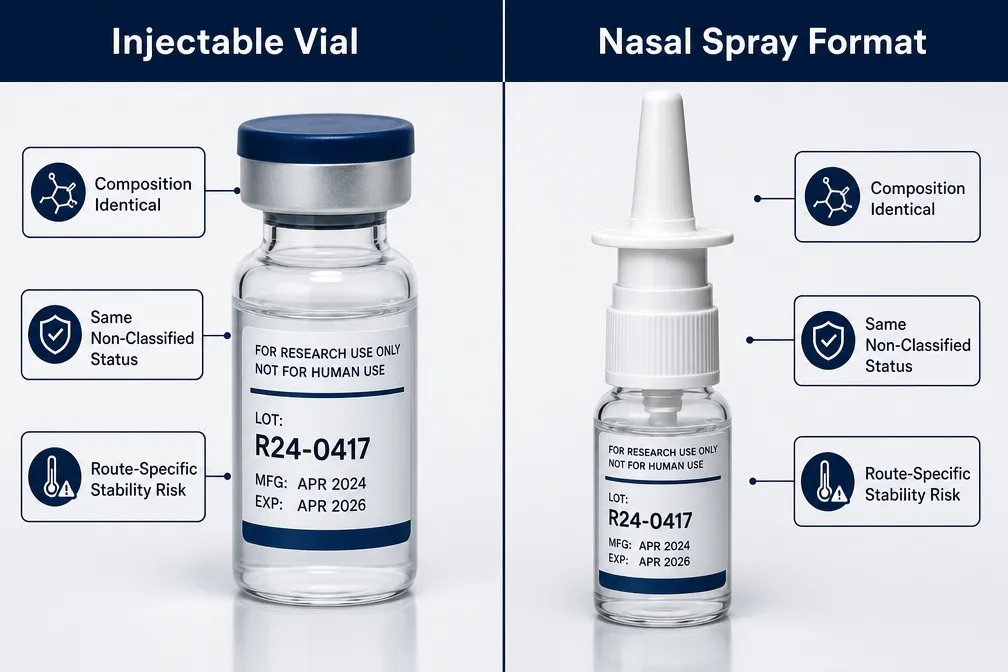
The Nasal Spray Format Adds a Second Verification Layer

Route-specific considerations include:

Verification Area Injectable Vial Nasal Spray Format
Composition identity Required Required
Microbial testing Required Required + nasal-specific limits
Excipient disclosure Important Critical (preservatives, pH adjusters)
Stability data Standard Route-specific (osmolarity, viscosity)
Sterility status Required Required

The delivery route directly affects how each component behaves. Without published controlled trial data, none exists for the Klow Blend as of late 2026, researchers cannot rely on cross-format extrapolation. A CoA that is adequate for a vial is not automatically adequate for a nasal spray. Researchers working with intranasal formats should also review the considerations outlined for GLP-3 nasal spray research as a parallel verification model.

"Treating each Klow batch as unique is not overcaution, it is the minimum standard when no official specification document exists."


Institutional Oversight and Independent Audit Requirements

When a product lacks a product-specific regulatory classification, institutional review boards and ethics committees must work from general RUO policies and broad peptide handling frameworks. This is not a gap that individual researchers can close on their own; it requires institutional acknowledgment that the product sits outside standard classification systems.

Independent CoA audits in 2026 have identified recurring gaps across proprietary nasal stack documentation:

  • Missing microbial data: Many vendor-issued CoAs include HPLC purity data but omit microbial and endotoxin results entirely.
  • Unverifiable laboratories: Some documents list a testing facility name with no contact information, accreditation number, or verifiable web presence.
  • Lot number mismatches: The lot number on the shipping label or physical vial does not match the lot number on the accompanying CoA, a clear traceability failure.
  • Aggregate versus individual purity: A single "overall purity" figure conceals whether each of the four peptide components meets specification independently.

For researchers evaluating sourcing transparency across related research peptides, the methodology detailed in where to buy research-grade Glow Blend peptide and evaluating purity applies directly to the Klow context. Similarly, the sourcing audit process described for PT-141 peptide research context, QA and controls demonstrates how lot traceability should be documented.

Researchers sourcing multi-component stacks should also cross-reference broader market guidance. The GLP-3 triple agonist research planning and catalog navigation guide and the AOD 9604 research method notes on storage and traceability both illustrate how traceability standards should be applied to unclassified proprietary blends.

A minimum acceptable CoA for a four-peptide blend in 2026 should contain:

  1. Individual identity confirmation for each peptide (mass spectrometry or HPLC with reference standard comparison)
  2. Individual purity percentage per component
  3. Residual solvent analysis
  4. Microbial count and endotoxin results
  5. Testing laboratory name, accreditation status, and contact details
  6. Lot number that matches the physical product exactly

Self-reported user experiences, which have proliferated around Klow products in 2026, do not substitute for any of the above. Expert analysis consistently cautions against over-interpreting anecdotal accounts as evidence of composition, potency, or safety for research purposes.


Conclusion

The growing research interest in Klow Blend in 2026 makes it more important, not less, to understand exactly what researchers should verify when a proprietary nasal stack has no standard regulatory classification. The absence of a monograph shifts the entire verification burden onto the researcher. Every batch is unique until proven otherwise by an independent, fully documented CoA. Nasal spray formats carry an additional layer of route-specific validation requirements that injectable CoAs do not automatically satisfy. Institutional oversight must operate under general RUO and peptide policies, with no product-specific rules to fall back on.

Actionable next steps for researchers:

  • Obtain and audit the full CoA before accepting any Klow Blend batch, injectable or nasal.
  • Confirm the testing laboratory is independently verifiable and accredited.
  • Match lot numbers on documentation to physical product before logging the batch into any research record.
  • Flag any CoA that presents aggregate purity only, lacks microbial data, or lists an unverifiable lab.
  • Consult institutional ethics and compliance offices to ensure general RUO policies are applied consistently to Klow and comparable unclassified stacks.
https://www.puretestedpeptides.com/wp-content/uploads/2026/11/klow-blend-in-2026-what-researchers-should-verify-when-a-proprietary-nasal-stack.webp 672 1008 https://www.puretestedpeptides.com/wp-content/uploads/2026/01/buy-peptides-online.jpg 2026-11-02 14:30:062026-11-02 14:30:06Klow Blend in 2026: What Researchers Should Verify When a Proprietary Nasal Stack Has No Standard Regulatory Classification

Tag Archive for: research use only

How Safe Are Mail‑Order Research Peptides? Evidence Gaps, Regulatory Gray Zones, and Risk‑Mitigation for Labs

How Safe Are Mail‑Order Research Peptides? Evidence Gaps, Regulatory Gray Zones, and Risk‑Mitigation for Labs

June 11, 2026/0 Comments/by Pure Tested

A February 2025 FDA warning letter to a major online peptide vendor confirmed what regulators had long suspected: "For Research Use Only" labels do not shield sellers — or buyers — from enforcement when products are clearly marketed for human use. That single enforcement action crystallized a debate that has grown louder as the peptide market expands rapidly in 2026.

Understanding how safe are mail-order research peptides, evidence gaps, regulatory gray zones, and risk-mitigation for labs is no longer optional for serious researchers. The stakes — legal, scientific, and physiological — demand a clear-eyed look at what the evidence actually shows.

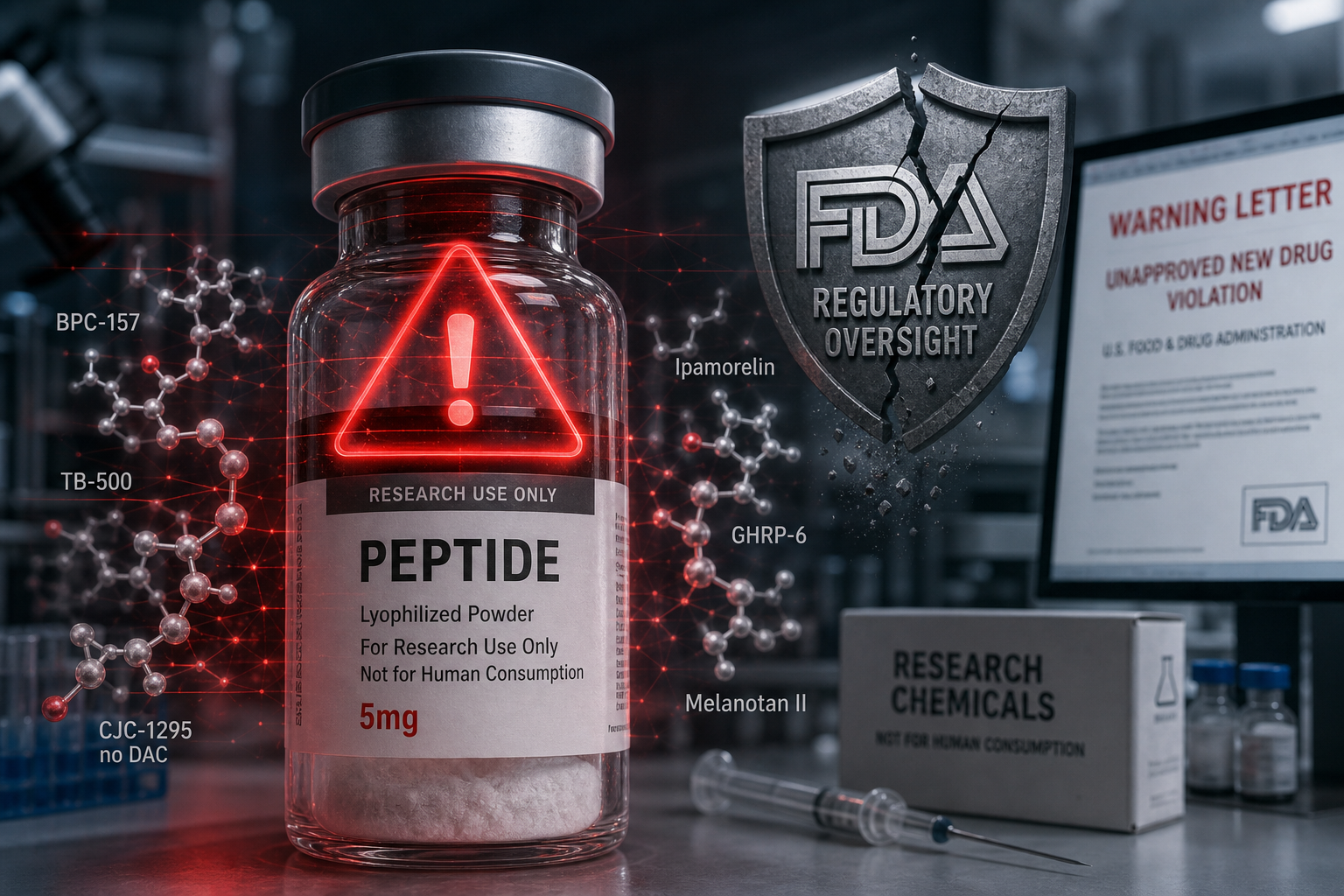
Detailed () editorial illustration showing a magnified view of a peptide vial with a glowing red warning symbol overlaid,

Key Takeaways

  • The FDA classifies peptides with biological activity as drugs; "research use only" labeling does not create a legal exemption for human consumption.
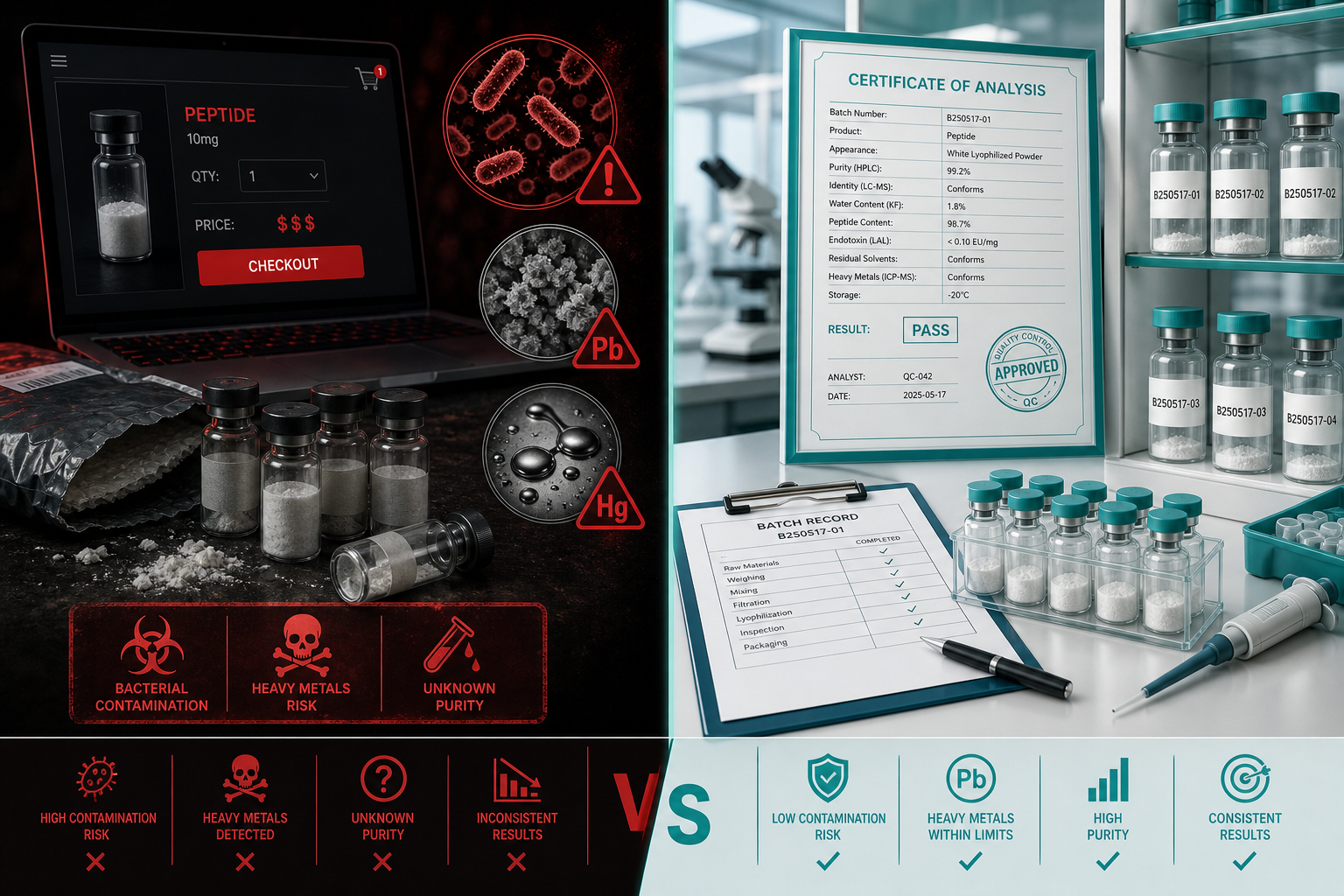
  • Unverified peptide suppliers carry documented risks including bacterial contamination, heavy metal presence, and incorrect potency.
  • The American Peptide Research Alliance reported two adverse events linked to unlicensed vendors in early 2026, with investigations ongoing.
  • Certificates of Analysis (COAs), batch traceability, and cold-chain compliance are the minimum quality benchmarks for legitimate lab sourcing.
  • Legal, prescription-based compounding pathways exist for clinical contexts and represent the gold standard for human-use peptides.

The Regulatory Gray Zone: What "Research Use Only" Actually Means

The phrase "For Research Use Only" (RUO) appears on thousands of peptide product pages, but its legal weight is far weaker than most buyers assume. Under U.S. law, any compound with biological activity intended for human use qualifies as a drug — regardless of how it is labeled. The FDA evaluates actual intent and use, not packaging language.

When a vendor's website includes testimonials, dosing guides, or health benefit claims alongside an RUO disclaimer, regulators treat the disclaimer as void. Marketing language that implies human health outcomes can trigger enforcement actions and has done so repeatedly. Vendors who operate in this space are not protected by a "research chemical" carve-out because no such exemption exists in federal statute.

For buyers, individual possession for genuine laboratory research has not historically been a primary enforcement target. However, that tolerance is not a legal right — it is an unenforced gray area that can shift with regulatory priorities. Labs that source peptides for in-vitro or animal studies should document their research purpose clearly and maintain records accordingly.

Researchers exploring compounds like GLP-1 peptides or AOD-9604 will find that sourcing documentation matters as much as the science itself.


Evidence Gaps and Safety Concerns With Unregulated Suppliers

Evidence Gaps and Safety Concerns With Unregulated Suppliers

Asking how safe are mail-order research peptides requires confronting uncomfortable data gaps. Because unregulated peptide vendors operate outside pharmaceutical manufacturing standards, independent quality data is scarce. What exists is not reassuring.

Documented risks from unverified sources include:

  • Bacterial and fungal contamination from non-sterile synthesis environments
  • Heavy metal residues from uncontrolled reagents
  • Incorrect peptide sequences or truncated chains
  • Mislabeled concentrations leading to unknown potency
  • Degraded product from improper cold-chain handling during shipping

The American Peptide Research Alliance issued a safety alert in March 2026 reporting two adverse events tied to products from unlicensed vendors. Investigations remain ongoing, but the alert underscores that the risk is not theoretical.

"Absence of a Certificate of Analysis is not a minor oversight — it is a fundamental indicator that manufacturing standards were not followed."

For labs researching mitochondrial compounds such as SS-31 peptides or MOTS-c, purity is a scientific necessity, not just a compliance checkbox. Contaminated or mislabeled compounds corrupt experimental results and make data unreproducible.

Red flags when evaluating a peptide supplier:

Warning Sign What It Suggests
No COA or outdated COA No independent purity verification
Price significantly below market Cost-cutting in synthesis or testing
No batch or lot number No traceability if contamination occurs
Health benefit claims on product pages Likely FDA enforcement risk
No cold-chain shipping options Degradation during transit

Risk-Mitigation for Labs: Practical Sourcing Standards

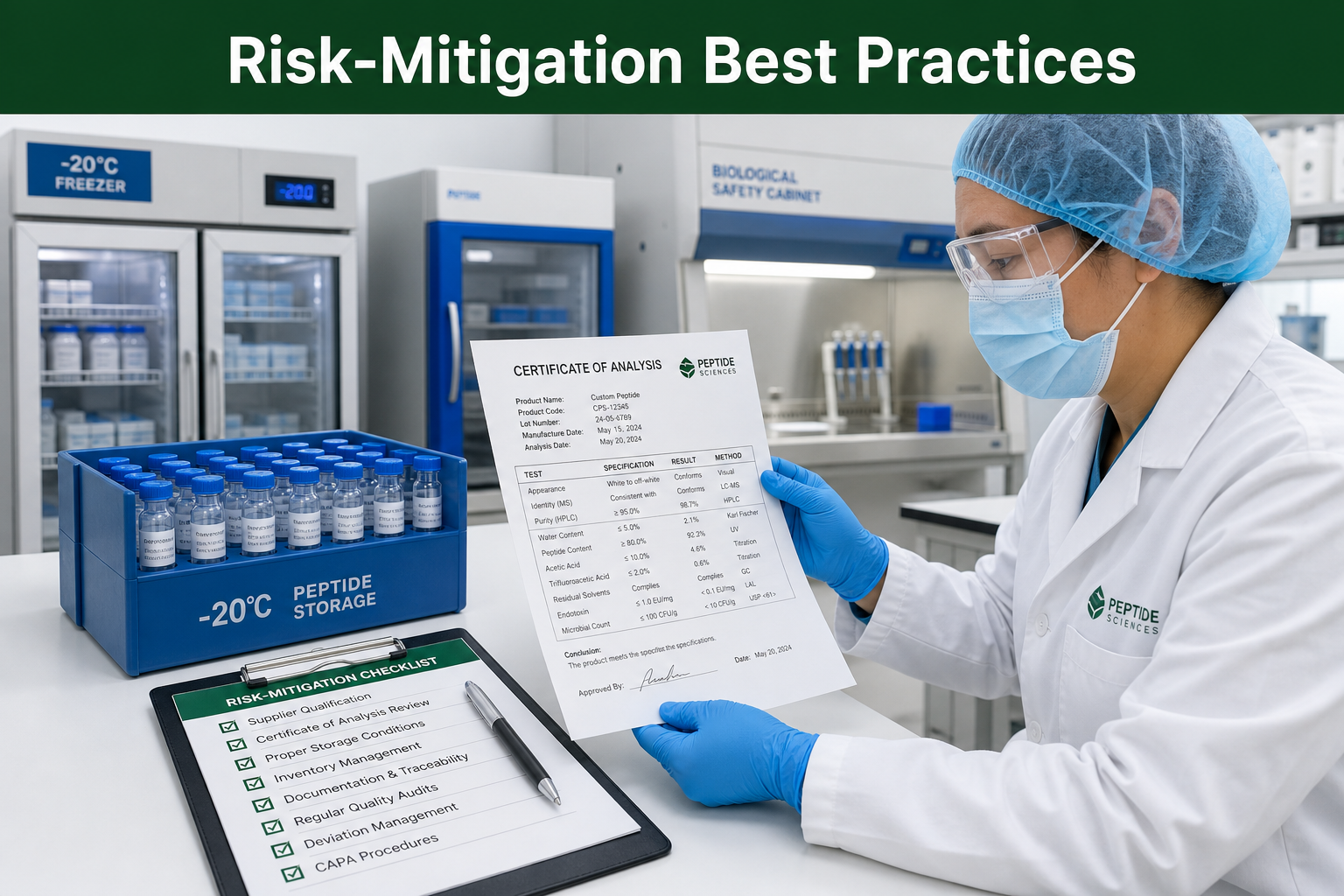
Addressing how safe are mail-order research peptides, evidence gaps, regulatory gray zones, and risk-mitigation for labs ultimately comes down to sourcing discipline. The following standards represent current best practice for legitimate research environments.

Minimum sourcing requirements:

  1. Third-party COA — Verify purity, sequence confirmation, and residual solvent levels from an independent laboratory, not just the vendor's internal testing.
  2. Batch traceability — Every vial should carry a lot number traceable to a specific synthesis run and test report.
  3. Cold-chain compliance — Lyophilized peptides require refrigerated or frozen shipping. Avoid vendors who ship at ambient temperature without insulation.
  4. No human-use marketing — Vendors making health claims are operating outside regulatory boundaries, which signals broader quality control problems.
  5. Transparent manufacturing disclosures — Reputable suppliers disclose synthesis method, facility standards, and sterility testing.

For labs working with compounds like BPC-157, GHK-Cu, or LL-37, these standards are non-negotiable for data integrity.

When human use is the clinical goal, the legally sound pathway is a patient-specific prescription filled by a 503A-licensed compounding pharmacy. This route ensures regulatory compliance, pharmaceutical-grade quality, and prescriber accountability — none of which exist in the unregulated market.

Researchers can also review innovative peptide delivery systems to understand how formulation choices affect both stability and research validity.

Risk-Mitigation for Labs: Practical Sourcing Standards


Conclusion

The peptide research market in 2026 is expanding faster than the regulatory infrastructure designed to govern it. That gap creates real risk — for lab data quality, for legal compliance, and for public safety when products migrate from "research" to human use without oversight.

Actionable next steps for labs and researchers:

  • Audit current suppliers against the COA, batch traceability, and cold-chain checklist above before the next order.
  • Document the research purpose for every peptide purchase and retain records.
  • Reject any vendor whose product pages include dosing guidance, testimonials, or health outcome claims.
  • For any human-use application, engage a licensed prescriber and 503A compounding pharmacy — not an online vendor.
  • Stay current with FDA enforcement actions, which signal which compounds and vendor practices are under active scrutiny.

The science behind peptide research is genuinely compelling. Protecting that science — and the people conducting it — requires sourcing standards that match the seriousness of the work.

https://www.puretestedpeptides.com/wp-content/uploads/2026/06/How-Safe-Are-Mail‑Order-Research-Peptides-Evidence-Gaps-Regulatory-Gray-Zones-and-Risk‑Mitigation-for-Labs.png 1024 1536 Pure Tested https://www.puretestedpeptides.com/wp-content/uploads/2026/01/buy-peptides-online.jpg Pure Tested2026-06-11 13:06:492026-11-22 02:17:45How Safe Are Mail‑Order Research Peptides? Evidence Gaps, Regulatory Gray Zones, and Risk‑Mitigation for Labs
×

Helpful Links

  • My account
  • Cart
  • Checkout
  • Refund and Returns Policy
  • Privacy Policy
  • SMS Privacy Policy
  • Login
  • My Account
  • Logout
  • About
  • Contact
  • COA / Lab Testing
  • Shipping Policy
  • Terms and Conditions
  • Research Use Disclaimer

USA Made Lab Tested Peptides

All products are sold for research, laboratory, or analytical purposes only, and are not for human consumption


Pure Tested Peptides is a chemical supplier. Pure Tested Peptides is not a compounding / chemical compounding facility as defined under 503A of the Federal Food, Drug, and Cosmetic act. Pure Tested Peptides is not an outsourcing facility as defined under 503B of the Federal Food, Drug, and Cosmetic act.

The statements made within this website have not been evaluated by the US Food and Drug Administration. The products we offer are not intended to diagnose, treat, cure or prevent any disease.

Human/Animal Consumption Prohibited. Laboratory/In-Vitro Experimental Use Only

Scroll to top Scroll to top Scroll to top