

Mitochondria, Adenosine Triphosphate, and Metabolic Peptides: How MOTS-c and 5-Amino-1MQ Are Used to Probe Cellular Energy
Every heartbeat, muscle contraction, and neuron firing depends on a single molecule: adenosine triphosphate (ATP). The human body recycles its own body weight in ATP every single day, a staggering metabolic feat orchestrated almost entirely inside the mitochondria. Understanding how researchers interrogate that process is where Mitochondria, Adenosine Triphosphate, and Metabolic Peptides: How MOTS-c and 5-Amino-1MQ Are Used to Probe Cellular Energy becomes one of the most compelling frontiers in modern cell biology.
Two research compounds, MOTS-c and 5-Amino-1MQ, have emerged as precision tools for dissecting ATP production, sirtuin signaling, and metabolic flexibility at the molecular level. Their stories begin in the mitochondria itself.
Key Takeaways
- Mitochondria generate ATP through the electron transport chain and ATP synthase, and disruptions to this process underlie many metabolic diseases.
- MOTS-c is a 16-amino-acid peptide encoded directly in mitochondrial DNA that regulates nuclear gene expression and metabolic homeostasis.
- 5-Amino-1MQ selectively inhibits the enzyme NNMT, raising NAD+ levels and shifting methyl donor pools to influence cellular energy output.
- Both compounds are used in preclinical research to probe ATP handling, insulin sensitivity, and mitochondrial respiration.
- As of 2026, human trials for MOTS-c remain in early stages; all current data derive from preclinical and observational studies.
The Mitochondria-ATP Axis: Textbook Biology Meets Research Reality
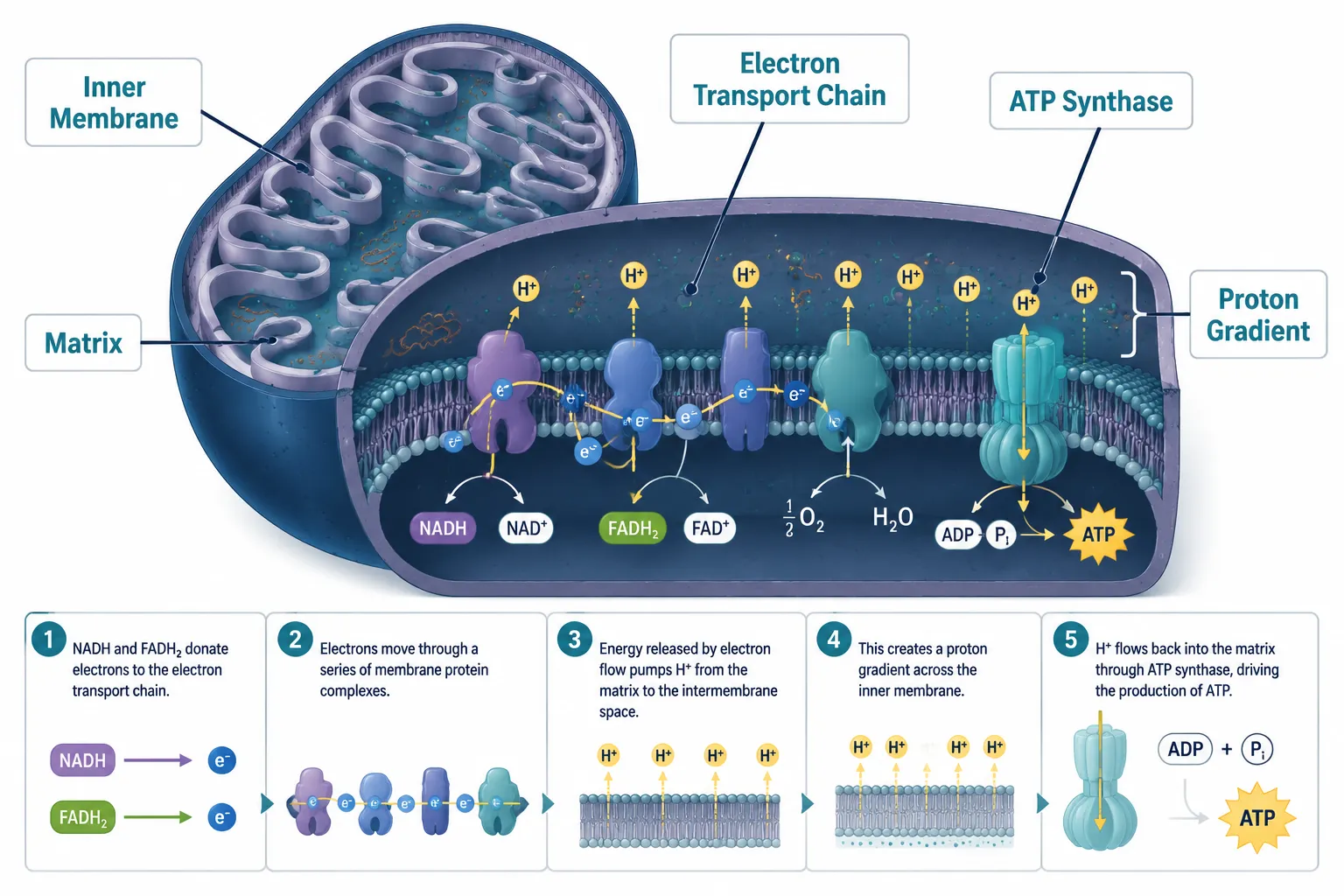
Mitochondria are double-membraned organelles that convert nutrients into usable chemical energy. The process, oxidative phosphorylation, runs along the inner mitochondrial membrane, where protein complexes (I through V) pass electrons down an electrochemical gradient. Complex V, ATP synthase, captures that gradient and phosphorylates ADP into ATP.
This system is efficient but fragile. Oxidative stress, aging, and metabolic overload can impair electron flow, reduce ATP yield, and generate excess reactive oxygen species (ROS). Those disruptions are not merely academic, they appear in the pathophysiology of type 2 diabetes, obesity, cardiovascular disease, and accelerated aging.
Researchers need tools that can probe this system without simply destroying it. That is precisely where metabolic peptides enter the picture.
"The mitochondria do not just produce energy, they signal the rest of the cell about the metabolic state of the organism. Peptides that originate inside mitochondria carry that message in a uniquely authoritative language."
MOTS-c: A Mitochondrial-Encoded Peptide That Speaks to the Nucleus
What Is MOTS-c and Where Does It Come From
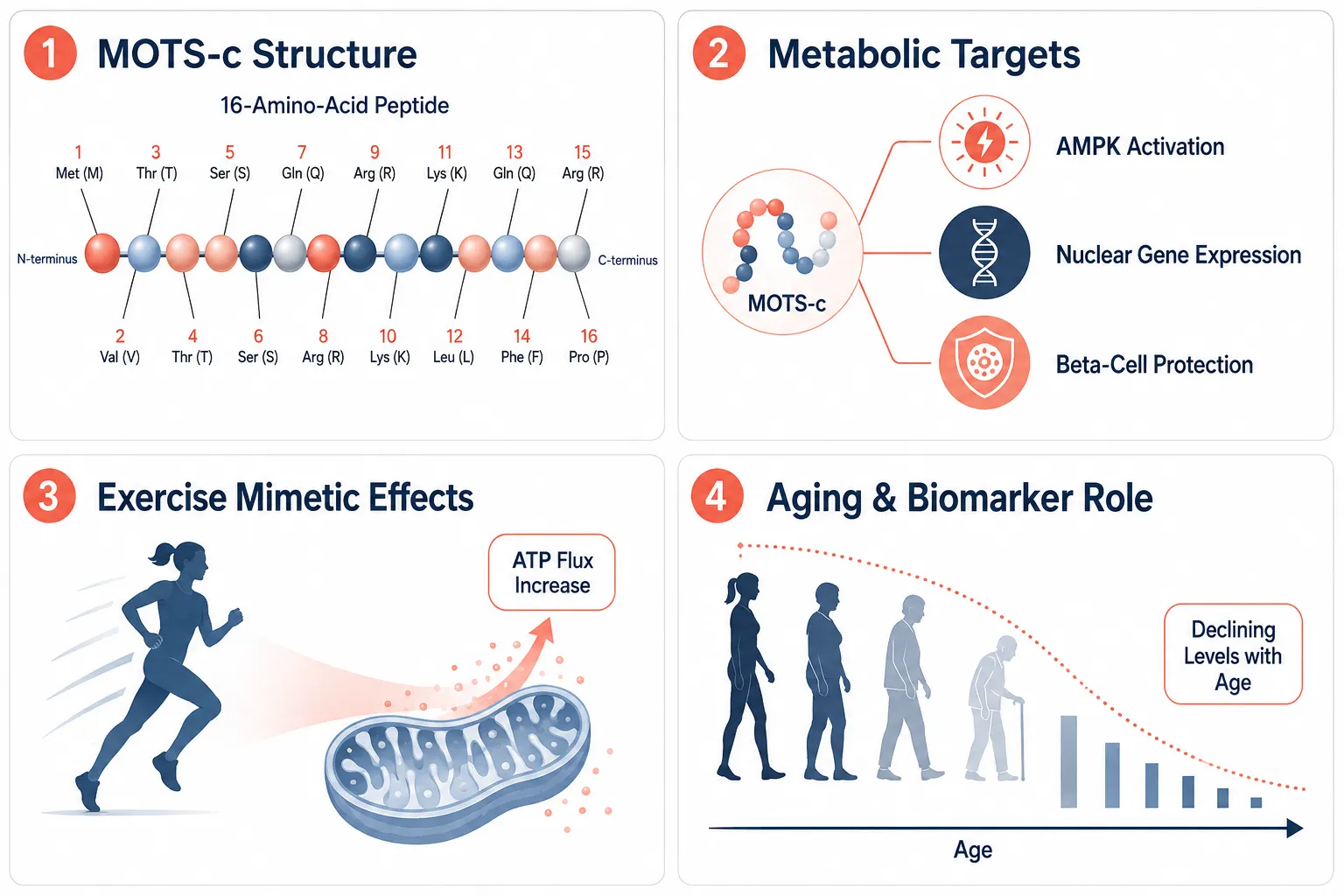
MOTS-c (Mitochondrial Open Reading Frame of the 12S rRNA type-c) is a 16-amino-acid peptide encoded not in nuclear DNA but in mitochondrial DNA, a distinction that makes it biologically unusual. Most signaling peptides are products of nuclear gene expression. MOTS-c is one of a small class of mitochondrial-derived peptides (MDPs) that travel from the organelle to the nucleus to regulate gene transcription.
Researchers studying Mitochondria, Adenosine Triphosphate, and Metabolic Peptides: How MOTS-c and 5-Amino-1MQ Are Used to Probe Cellular Energy use MOTS-c to answer a specific question: how does the mitochondria communicate its energy status to the rest of the cell?
Key findings from recent research include:
- AMPK activation: MOTS-c activates AMP-activated protein kinase, a master energy sensor that promotes glucose uptake and fatty acid oxidation.
- Nuclear translocation: Under metabolic stress, MOTS-c moves into the nucleus and modulates gene expression related to stress response and metabolism.
- Exercise-mimetic properties: Circulating MOTS-c levels rise with physical activity, and exogenous MOTS-c replicates some metabolic benefits of exercise in preclinical models.
- Aging biomarker: MOTS-c levels decline with age and are measurably lower in individuals with obesity, suggesting a role in age-related metabolic decline.
- Host defense: A 2026 finding classifies MOTS-c as a mitochondrial-encoded host defense peptide (HDP), broadening its known biological roles beyond metabolism.
A 2025 Nature-published study linked declining MOTS-c levels to pancreatic beta-cell senescence, connecting mitochondrial peptide signaling directly to diabetes pathology. A separate 2025 cardiac study demonstrated that MOTS-c influences mitochondrial respiration and ATP handling in heart tissue, reinforcing its relevance to energy metabolism research.
For researchers exploring SS31 and MOTS-c together, the combination offers complementary angles on mitochondrial function, one peptide targeting membrane integrity, the other targeting signaling output.
5-Amino-1MQ: Targeting NAD+ to Manipulate Energy Metabolism
How NNMT Inhibition Reshapes Cellular Energy
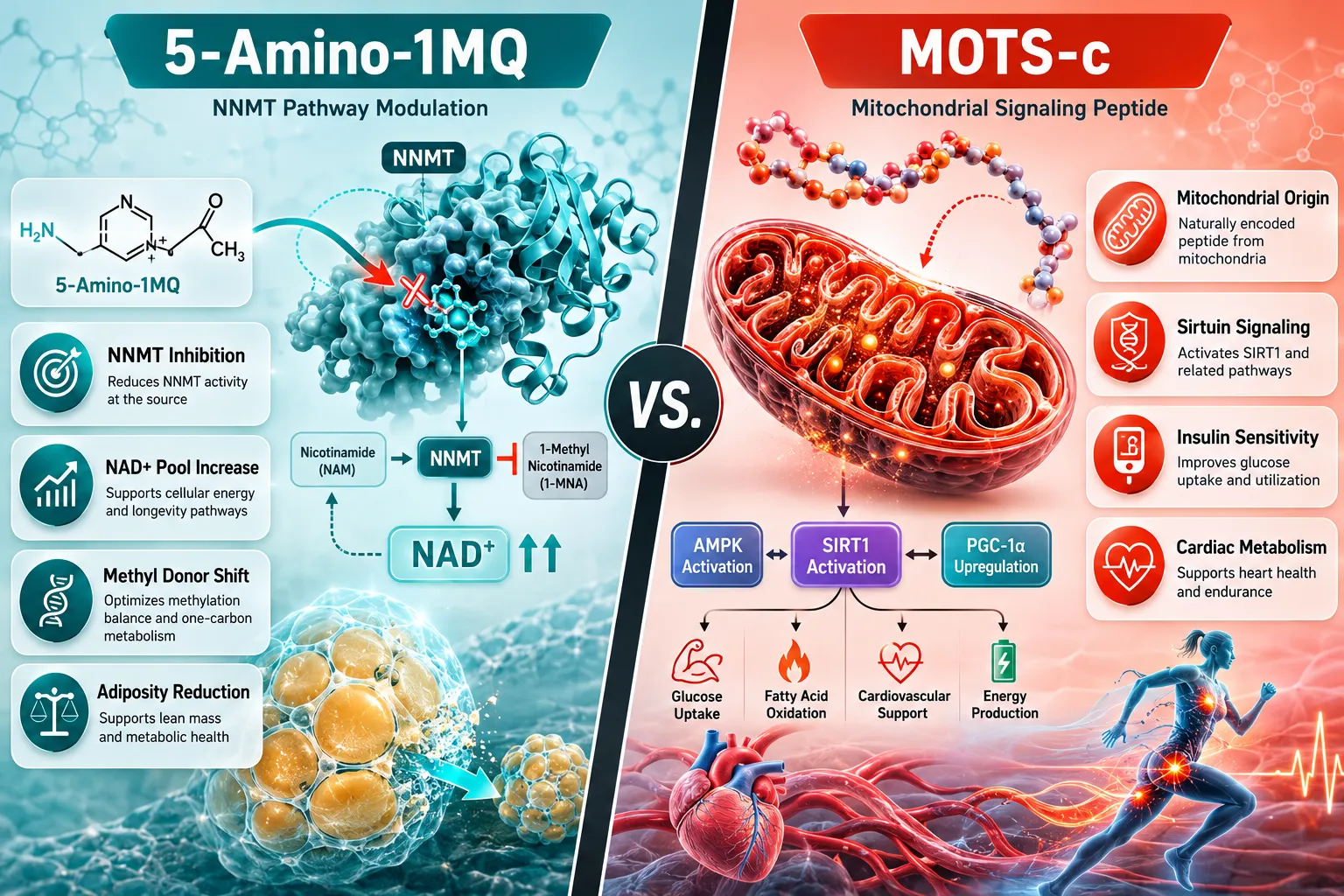
5-Amino-1MQ is a small-molecule compound that selectively inhibits nicotinamide N-methyltransferase (NNMT), an enzyme that consumes SAM (S-adenosylmethionine) to methylate nicotinamide. When NNMT is active, it drains both the NAD+ precursor pool and the methyl donor pool simultaneously, a metabolic double cost.
By blocking NNMT, 5-Amino-1MQ produces measurable downstream effects:
| Effect | Mechanism |
|---|---|
| Increased NAD+ availability | Less nicotinamide diverted to methylation |
| Elevated SAM levels | Methyl donors redirected to other pathways |
| Sirtuin activation | Higher NAD+ fuels SIRT1 and SIRT3 activity |
| Reduced adiposity | Preclinical models show fat mass reduction |
| Improved insulin sensitivity | Linked to restored mitochondrial efficiency |
Sirtuins, particularly SIRT1 and SIRT3, are NAD+-dependent deacetylases that regulate mitochondrial biogenesis, fatty acid oxidation, and ATP efficiency. When 5-Amino-1MQ raises NAD+ levels, it effectively turns up the volume on sirtuin signaling, giving researchers a controlled way to study how NAD+ abundance shapes energy output.
Preclinical data from 2024 to 2026 show that 5-Amino-1MQ reduces adiposity and improves energy expenditure in diet-induced obesity models, with effects appearing in both muscle and adipose tissue, two key sites of mitochondrial ATP turnover.
This makes 5-Amino-1MQ a valuable complement to peptide-based tools. While signaling peptides like MOTS-c act through receptor and transcription pathways, 5-Amino-1MQ acts through cofactor availability, offering a distinct mechanistic lever.
Connecting Both Tools to the Broader Research Framework
Studying Mitochondria, Adenosine Triphosphate, and Metabolic Peptides: How MOTS-c and 5-Amino-1MQ Are Used to Probe Cellular Energy requires understanding that no single compound tells the whole story.
Researchers often pair these tools with other mitochondria-focused compounds. The SS-31 mitochondrial peptide stabilizes cardiolipin on the inner mitochondrial membrane, preserving the architecture that makes efficient ATP synthesis possible. Detailed considerations around SS-31 10mg research peptide use highlight how dosing and purity standards matter in mitochondrial studies. For those sourcing compounds, lab tested peptides provide the verified purity that rigorous cellular energy research demands.
As of mid-2026, MOTS-c remains under investigation in early human trials, with no approved therapeutic applications. All metabolic and longevity data remain preclinical or observational. Researchers and institutions working with these compounds must operate within applicable regulatory frameworks.
Conclusion
The mitochondria-ATP axis is not just textbook cell biology, it is the foundation of metabolic health, aging, and disease. MOTS-c and 5-Amino-1MQ represent two distinct but complementary strategies for probing that foundation: one through mitochondrial-encoded peptide signaling, the other through NAD+ and methyl pool manipulation.
Actionable next steps for researchers:
- Review current preclinical literature on MOTS-c's role in beta-cell senescence and cardiac ATP handling before designing metabolic studies.
- Consider pairing MOTS-c with NAD+-modulating compounds like 5-Amino-1MQ to capture both signaling and cofactor dimensions of mitochondrial energy output.
- Source only lab tested peptides with verified purity documentation to ensure experimental reproducibility.
- Monitor the evolving regulatory status of MOTS-c human trials as 2026 data emerge.
The cell's energy story is written in mitochondria. These peptides are helping researchers read it with unprecedented precision.