Call or Text 727-513-9780
  • Shopping Cart Shopping Cart
    0Shopping Cart
Pure Tested Peptides | America's most trusted Peptides for sale online
  • Peptides for sale
    • Oral Peptides for sale
      • Peptide Capsules for sale
      • BPC 157 Capsules 1000mcg
      • SLU-PP-332 Capsules | 1000 mcg
      • 5-Amino-1MQ 50mg Capsules
      • Tesofensine 500mcg
    • All Peptides for sale
    • Peptide Sprays
      • BPC 157 Nasal Spray Kit
      • BPC-157 TB500 Nasal Spray Kit
      • Semax Nasal Spray 10mg
      • Selank – Nasal Spray Kit – 10mg
      • Epithalon 50MG Nasal Spray Kit
      • Ipamorelin 10mg Nasal Spray
      • Klow Nasal Spray (BPC-157 + TB-500 + GHK-Cu + KPV) | 80mg
      • Hulk Nasal Spray Tesa / Ipa Blend 6/3 MG
      • Klow Nasal Spray
      • NAD + 500 mg Nasal Spray
      • PT-141 Nasal Spray Kit
    • GHRH Peptides
      • Ipa Peptides
      • CJC-1295 Peptides
        • CJC-1295 with DAC 5 mg
        • CJC-1295 without DAC 5 mg
        • CJC-1295 Ipa 10mg
      • Tesa Peptides
        • Tesa Peptide
        • Tesa 20 mg
    • GHK-Cu Peptides
      • All GHK-Cu Peptides
      • GHK-Cu 100mg
      • KLOW Peptide Blend – Buy KLOW blend online
    • BPC Peptides
      • All BPC Peptides
      • BPC-157
      • BPC-157 TB-500
      • BPC 157 capsules 1000mcg
    • SLU-PP-332 Peptides
      • All SLU-PP-332 Peptides
      • SLU-PP-332 5mg
    • GLP3 Peptides
    • PT-141 Peptides
      • PT-141 Peptides for sale
      • PT-141 10mg
      • PT-141 Nasal Spray
    • CAG Peptides
      • Lipo-C Peptide Blend
      • CAG 5mg
      • CAG 10mg
    • MOTS-C Peptides
      • MOTS-C Peptides for sale
      • MOTS-c peptide
      • MOTS-c 10mg *6 pack*
    • 5 Amino 1MQ Peptides
      • 5 Amino 1MQ Peptides for sale
      • 5-Amino-1MQ 50mg Capsules
      • 5-Amino-1MQ 5mg
    • Epithalon Peptides
      • Epithalon Peptides for sale
      • Epithalon 10mg
      • Epithalon 50mg
  • Shop
    • GLPs
      • 5-Amino-1MQ 50mg Capsules
      • 5-Amino-1MQ 5mg
      • L-Carnitine 500mg/ml
      • Tesofensine 500mcg
      • SLU-PP-332 5mg
      • MOTS-c 10mg *6 pack*
    • Epithalon & BPC Peptides
      • Epithalon 10mg
      • Epithalon 50mg
      • BPC-157
      • BPC 157 capsules 1000mcg
      • BPC-157 TB-500
      • BPC-157 TB500 Nasal Spray Kit
      • BPC 157 Nasal Spray Kit
    • BPC TB-500 & NAD+ Peptides
      • NAD+ 500 mg
      • KLOW Peptide Blend – Buy KLOW blend online
      • GLOW Peptide Blend
      • TB 500 5mg
      • BPC 157 capsules 1000mcg – Supplement
      • BPC 157 Nasal Spray Kit
      • BPC-157
      • BPC-157 TB500 Nasal Spray Kit
      • BPC-157 TB-500
      • BPC 157 capsules 1000mcg
    • LL-37 Peptide
      • LL-37 10 mg
    • MOTS-C & Selank
      • MOTS-c peptide
      • Selank 10mg
    • GHK Peptides
      • GHK-Cu 100mg
      • GLOW Peptide Blend
      • KLOW Peptide Blend – Buy KLOW blend online
  • COAs
  • Wholesale
    • Wholesale Peptides for sale
  • PTP FAQ
  • Affiliates
    • Selank Peptide: Advanced Pharmacological Mechanisms Underlying Its Anxiolytic and Nootropic Effects in Research
      • 5-Amino-1MQ Peptide: Detailed Mechanisms of NNMT Inhibition and Its Impact on Cellular Metabolism Research
        • MOTS-C Peptide: Unraveling Its Role in Mitochondrial Dynamics and Energy Metabolism Research
          • Epithalon Peptide and Telomerase Regulation: Investigating Its Impact on Cellular Senescence and Lifespan Research Models
            • GLP2-T vs GLP2 Tirz Peptide: Understanding the Naming, Mechanistic Nuances, and Research Implications for Gut Health
      • Peptides and Polypeptides in Modern Pharmacology: What Research on Metoprolol, Prednisone, and Amlodipine Reveals
        • Polypeptide Peptides vs NSAIDs: What Naproxen and Diclofenac Teach Tissue-Repair Researchers About BPC‑157 and TB‑500
          • Peptides and Polypeptides in Endocrine Pharmacology: How GLP-1, GLP-2, and GLP-3 Retatrutide Differ From Classic Drugs Like Prednisone and Amlodipine
          • 5‑Amino‑1MQ Peptide and NNMT Inhibition: How It Compares With Statins Like Atorvastatin in Adipose and Lipid Metabolism Research
      • Enclomiphene, Estrogen Receptor Signaling, and Luteinizing Phase Biology: What Hormone Researchers Should Measure
        • Mesenchymal Stem Cells, BPC‑157, and GHK‑Cu: How Tissue Repair Peptides Compare With Classic NSAIDs Like Naproxen in Injury Models
          • Peptide Calculator Use Cases Beyond Growth Hormone: Working Through GLP‑3 Retatrutide, MOTS‑c, and BPC‑157 Research Dosing
        • Polypeptide Peptides in Endocrine and Metabolic Pharmacology: Lessons From Amlodipine, Prednisone, and Metoprolol
        • Peptides Calculator for Advanced Blends: Worked Examples for Tesamorelin, CJC‑1295, and Ipamorelin Stacks
          • Peptides and Polypeptides in Human Physiology: How Molecular Size Shapes Research Applications
            • Selank Peptide: Advanced Pharmacological Mechanisms Underlying Its Anxiolytic and Nootropic Effects in Research
          • 5-Amino-1MQ Peptide: Detailed Mechanisms of NNMT Inhibition and Its Impact on Cellular Metabolism Research
            • MOTS-C Peptide: Unraveling Its Role in Mitochondrial Dynamics and Energy Metabolism Research
              • Epithalon Peptide and Telomerase Regulation: Investigating Its Impact on Cellular Senescence and Lifespan Research Models
                • GLP2-T vs GLP2 Tirz Peptide: Understanding the Naming, Mechanistic Nuances, and Research Implications for Gut Health
                  • Peptides and Polypeptides in Endocrine Pharmacology: How GLP-1, GLP-2, and GLP-3 Retatrutide Differ From Classic Drugs Like Prednisone and Amlodipine
                    • Polypeptide Peptides vs NSAIDs: What Naproxen and Diclofenac Teach Tissue-Repair Researchers About BPC‑157 and TB‑500
                      • Peptides and Polypeptides in Modern Pharmacology: What Research on Metoprolol, Prednisone, and Amlodipine Reveals
                        • 5‑Amino‑1MQ Peptide and NNMT Inhibition: How It Compares With Statins Like Atorvastatin in Adipose and Lipid Metabolism Research
                        • Enclomiphene, Estrogen Receptor Signaling, and Luteinizing Phase Biology: What Hormone Researchers Should Measure
                        • Mesenchymal Stem Cells, BPC‑157, and GHK‑Cu: How Tissue Repair Peptides Compare With Classic NSAIDs Like Naproxen in Injury Models
                        • Peptide Calculator Use Cases Beyond Growth Hormone: Working Through GLP‑3 Retatrutide, MOTS‑c, and BPC‑157 Research Dosing
                        • Polypeptide Peptides in Endocrine and Metabolic Pharmacology: Lessons From Amlodipine, Prednisone, and Metoprolol
                        • Peptides Calculator for Advanced Blends: Worked Examples for Tesamorelin, CJC‑1295, and Ipamorelin Stacks
                        • Peptides and Polypeptides in Human Physiology: How Molecular Size Shapes Research Applications
                        • Selank Peptide: Advanced Pharmacological Mechanisms Underlying Its Anxiolytic and Nootropic Effects in Research
                        • MOTS-C Peptide: Unraveling Its Role in Mitochondrial Dynamics and Energy Metabolism Research
                        • Peptides and Polypeptides in Modern Pharmacology: What Research on Metoprolol, Prednisone, and Amlodipine Reveals
                        • Peptides and Polypeptides in Endocrine Pharmacology: How GLP-1, GLP-2, and GLP-3 Retatrutide Differ From Classic Drugs Like Prednisone and Amlodipine
                        • 5-Amino-1MQ Peptide: Detailed Mechanisms of NNMT Inhibition and Its Impact on Cellular Metabolism Research
                        • Mesenchymal Stem Cells, BPC‑157, and GHK‑Cu: How Tissue Repair Peptides Compare With Classic NSAIDs Like Naproxen in Injury Models
                        • Peptide Calculator Use Cases Beyond Growth Hormone: Working Through GLP‑3 Retatrutide, MOTS‑c, and BPC‑157 Research Dosing
                        • GLP2-T vs GLP2 Tirz Peptide: Understanding the Naming, Mechanistic Nuances, and Research Implications for Gut Health
                        • Polypeptide Peptides in Endocrine and Metabolic Pharmacology: Lessons From Amlodipine, Prednisone, and Metoprolol
                        • Polypeptide Peptides vs NSAIDs: What Naproxen and Diclofenac Teach Tissue-Repair Researchers About BPC‑157 and TB‑500
                        • Peptides and Polypeptides in Human Physiology: How Molecular Size Shapes Research Applications
                        • Peptides Calculator for Advanced Blends: Worked Examples for Tesamorelin, CJC‑1295, and Ipamorelin Stacks
                        • 5‑Amino‑1MQ Peptide and NNMT Inhibition: How It Compares With Statins Like Atorvastatin in Adipose and Lipid Metabolism Research
                        • Enclomiphene, Estrogen Receptor Signaling, and Luteinizing Phase Biology: What Hormone Researchers Should Measure
                        • Epithalon Peptide and Telomerase Regulation: Investigating Its Impact on Cellular Senescence and Lifespan Research Models
                        • Best research protocol Klow blend
                        • best time to take BPC-157
                        • best time to take DSIP (Delta Sleep Inducing Peptide)
                        • best time to take CJC-1295
                        • best time to take AOD-9604
                        • best time to take Follistatin 344
                        • best time to take Ipamorelin
                        • best time to take MK-677 (Ibutamoren)
                        • best time to take Ligandrol (LGD-4033) — research compound
                        • best time to take Ostarine (MK-2866) — research compound
                        • best time to take GHK-CU
                        • best time to take TB-500
                        • best time to take MOTS-c
                        • best time to take Semax
                        • best time to take RAD-140 (Testolone) — research compound
                        • best time to take Thymosin Alpha-1
                        • best time to take PEG-MGF
                        • Biolife Plasma, Octapharma Plasma, and Research Peptides: How Plasma Donation Labs Differ From Peptide Suppliers
                        • best time to take YK-11 — research compound
                        • best time to take PT-141 (Bremelanotide)
                        • Best research protocol Klow blend
                        • 5-Amino-1MQ and MOTS-C Synergy: Metabolic Signaling, Mitochondria, and Research Design
                        • BPC-157 and TB-500: Investigating Their Combined Effects on Angiogenesis and Cellular Migration in Tissue Repair Models
                        • BPC-157 Peptide: Gut Barrier Function, Inflammation, and Tissue-Recovery Research
                        • 5‑Amino‑1MQ and MOTS‑c Synergy in Metabolic Research: Designing NNMT and Mitochondrial Biogenesis Stacks
                        • CJC-1295 with DAC vs. Without DAC: Half-Life, Release Kinetics, and Research Implications
                        • CJC‑1295 with DAC vs. Without DAC: Expanding on Half‑Life Differences Using Tesamorelin and Ipamorelin Blend Case Studies
                        • Collagen Biology and Copper‑Binding Peptides: How GHK‑Cu, Glow Blend, and Klow Blend Interact with Skin and Connective Tissue
                        • Collagen Biology and Regenerative Peptides: How GHK‑Cu, Glow Blend, and Klow Blend Affect Extracellular Matrix Research
                    • DNA, Telomeres, and Longevity Peptides: Positioning Epithalon and MOTS‑c in Genetic Aging Research
                      • Enclomiphene Citrate: serm Mechanism, Testosterone Research, and Stack Compatibility
                        • Enclomiphene vs Enclomiphene Citrate: Formulation, Bioavailability, and Research Distinctions
                        • Epithalon Peptide Research: Telomerase Activation, Aging, and Pineal Gland Function
                        • Estrogen Receptor Signaling and Enclomiphene: How Selective Modulators Compare with Classic Polypeptide Hormones
                        • GHK-Cu Peptide: Advanced Mechanisms in Extracellular Matrix Remodeling and Wound Healing Research
                        • GHK-Cu Peptide: Collagen Synthesis, Wound Repair, and Skin-Barrier Research Models
                        • GLP-1 vs GLP-3 vs GLP-2: Peptide Classification and Research Applications
                        • GLP-2 Peptide Research Guide: Gut Barrier Function, Nutrient Absorption, and Intestinal Recovery Models
                        • GLP-3 Retatrutide vs. GLP-1 Drugs: What Triple-Agonist Biology Changes in Research Models
                        • Ipamorelin and Tesamorelin Combination: Synergistic GH Secretagogue Research and Dosing Protocols
                        • GLP2 Tirz Peptide: What It Is, Why the Name Exists, and How Researchers Should Interpret It
                        • Klow Blend Peptide Nasal Spray: What the Formulation Is Trying to Do in Cognitive Research
                        • Mitochondria, NNMT Inhibition, and Peptide Modulators: Where MOTS‑c and 5‑Amino‑1MQ Fit in Cellular Energy Research
                        • MOTS-c Peptide: Mitochondrial Function, Energy Metabolism, and What Researchers Measure
                        • MOTS-c vs. 5-Amino-1MQ: Which Metabolic Research Questions Each Compound Actually Answers
                        • Nasal Spray Peptides: Bioavailability, Administration, and Semax/Selank Research Applications
                        • PT-141 Peptide Research: Mechanism of Action and Melanocortin Receptor Signaling
                        • Retatrutide for Research: Mechanism, Structure, and GLP-1/GLP-3 Dual Action
                        • Retatrutide for Obesity and Type 2 Diabetes: What the Latest Trial Data Suggest
                        • Tesofensine Peptide Research: Mechanism, Appetite Suppression, and Neuropeptide Y Pathways
  • Contact
    • Contact Customer Service
    • Text Customer Support
  • About US
  • Shop all peptides
  • Affiliate Program
    • Affiliate Signup
  • Login / Register Login / Register Page Link Login / Register Page Link
  • Click to open the search input field Click to open the search input field Search
  • Menu Menu

Tag Archive for: skeletal muscle regeneration

MOTS-c and Slupp332 in Skeletal-Muscle Regeneration Models: Mitochondrial Flux, AMPK Readouts, and Fiber-Type Controls

MOTS-c and Slupp332 in Skeletal-Muscle Regeneration Models: Mitochondrial Flux, AMPK Readouts, and Fiber-Type Controls

October 23, 2026/0 Comments/in Uncategorized/by

Skeletal muscle accounts for roughly 40% of human body mass, yet its regenerative capacity declines sharply with age, a process tightly linked to deteriorating mitochondrial function. The emerging research on MOTS-c and Slupp332 in skeletal-muscle regeneration models: mitochondrial flux, AMPK readouts, and fiber-type controls places two distinct but potentially complementary compounds at the center of that biology. Understanding what each peptide does, how energy-sensing pathways translate their activity into measurable outputs, and what the current preclinical evidence actually shows is essential for researchers designing credible muscle-regeneration studies in 2026.

Key Takeaways

  • MOTS-c is a mitochondria-derived peptide that activates AMPK, suppresses mTORC1, and upregulates PGC-1alpha to influence energy metabolism and muscle resilience.
  • Slupp332 acts as a selective PPAR-delta agonist, driving oxidative gene programs associated with slow-twitch, fatigue-resistant fiber profiles.
  • Mitochondrial flux, measured as oxygen consumption rate and spare respiratory capacity, is a primary functional readout in regeneration models using these compounds.
  • Fiber-type correlations currently reflect observational data rather than confirmed direct causation in most published models.
  • Rigorous vehicle controls, matched dosing windows, and validated AMPK phosphorylation assays are non-negotiable for reproducible results.

Mechanisms Behind MOTS-c in Skeletal-Muscle Regeneration Models

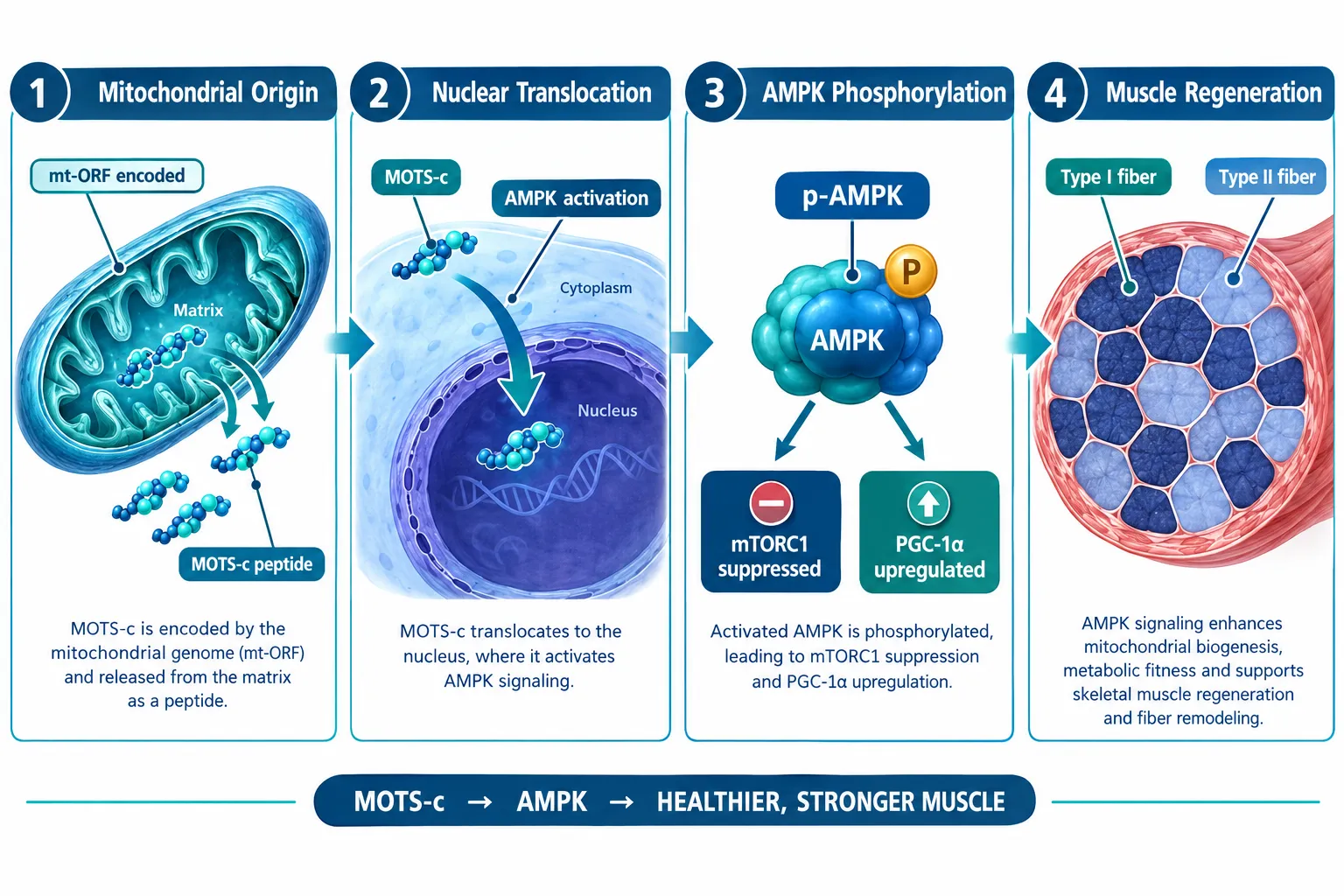
MOTS-c (mitochondrial open reading frame of the 12S ribosomal RNA type-c) is a 16-amino-acid peptide encoded within the mitochondrial genome. Its origin is unusual: unlike nuclear-encoded myokines, MOTS-c is produced inside the organelle itself, giving it a direct link to mitochondrial stress states. When mitochondrial function is strained, by exercise, nutrient scarcity, or cellular aging, MOTS-c is secreted into the cytoplasm and, critically, can translocate into the nucleus to modulate gene expression.
Mechanisms Behind MOTS-c in Skeletal-Muscle Regeneration Models

In skeletal muscle, the signaling cascade proceeds roughly as follows:

  1. Mitochondrial stress triggers MOTS-c release into the cytoplasm.
  2. MOTS-c activates AMP-activated protein kinase (AMPK), the master cellular energy sensor.
  3. Phosphorylated AMPK suppresses mTORC1, reducing anabolic overhead during recovery phases.
  4. Simultaneously, AMPK upregulates PGC-1alpha, the transcriptional coactivator governing mitochondrial biogenesis and oxidative metabolism.

Endurance-training studies in humans confirm that exercise-induced MOTS-c secretion from skeletal muscle correlates with the magnitude and duration of the AMPK, PGC-1alpha response. This positions MOTS-c not merely as a biomarker but as an active regulator of the metabolic adaptations researchers want to capture in regeneration models. Contextual factors, including age, baseline mitochondrial density, and training status, significantly modulate MOTS-c plasma levels, which has meaningful implications for experimental design.

For researchers exploring related mitochondrial peptide biology, the Mots C Elamipretide overview provides a useful comparative reference. Additional context on overlapping mitochondrial signaling compounds can be found in SS-31 mitochondrial research themes.


AMPK Readouts and Mitochondrial Flux: Interpreting Experimental Data

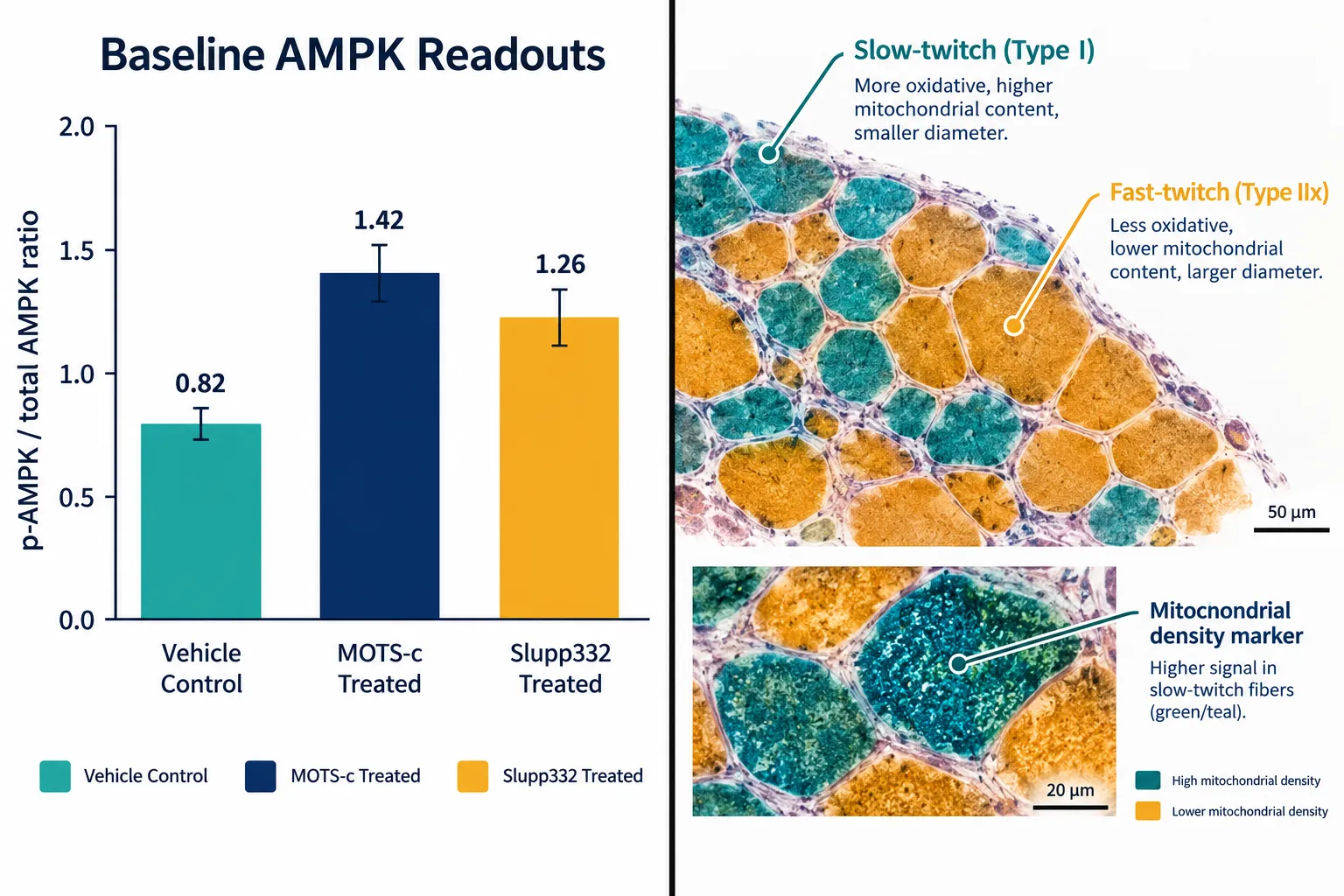
Quantifying AMPK activity and mitochondrial flux correctly is where many regeneration studies introduce avoidable error. The table below summarizes the primary assay categories used alongside MOTS-c and Slupp332 research protocols.

Readout Category Assay Method Key Metric
AMPK activation Western blot (p-AMPK / total AMPK) Phosphorylation ratio
Mitochondrial flux Seahorse XF respirometry OCR, spare respiratory capacity
PGC-1alpha expression RT-qPCR / immunofluorescence mRNA and protein levels
Fiber-type composition Immunohistochemistry (MHC isoforms) Type I / IIa / IIx ratio
Glucose metabolism Isotope tracing (U-13C-glucose) Lactate-to-pyruvate flux

Slupp332 approaches muscle fiber biology from a different angle. As a selective PPAR-delta (peroxisome proliferator-activated receptor delta) agonist, it activates oxidative gene programs independently of acute AMPK phosphorylation. PPAR-delta drives expression of genes associated with fatty acid oxidation, mitochondrial biogenesis, and slow-twitch muscle fiber identity, which is why fiber-type composition often appears as a secondary endpoint in Slupp332 protocols.

"The distinction between AMPK-mediated flux and PPAR-delta-driven transcription is not trivial, these are parallel but non-identical routes to oxidative remodeling, and conflating them leads to misattributed results."

When running both compounds in the same model, researchers must use phospho-AMPK western blots as the primary MOTS-c readout and separate PPAR-delta target gene panels (CPTIA, UQCRB, PDK4) for Slupp332. Oxygen consumption rate (OCR) measured via Seahorse respirometry provides a common functional endpoint that reflects the combined oxidative output.
AMPK Readouts and Mitochondrial Flux: Interpreting Experimental Data

Cardiac remodeling models have served as useful analogs here, AMPK activation patterns in cardiomyocytes under stress closely mirror those seen in regenerating skeletal muscle satellite cells, providing cross-tissue validation logic for AMPK-dependent signaling. For related mitochondrial research considerations, the SS-31 10mg research peptide considerations article outlines practical experimental parameters that translate well to multi-peptide muscle protocols.


Fiber-Type Controls and Regeneration Timing in Preclinical Models

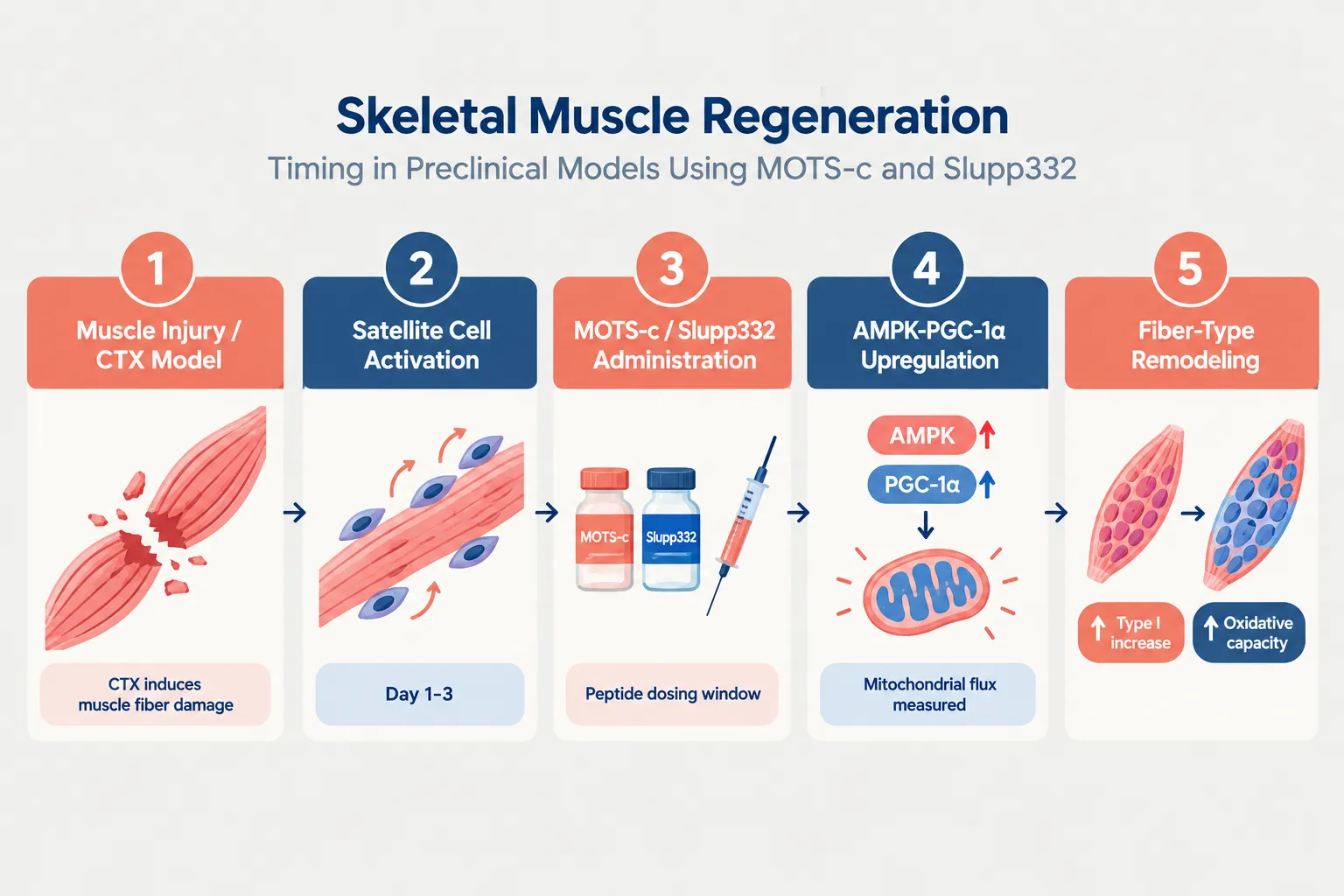
The fiber-type angle in research on MOTS-c and Slupp332 in skeletal-muscle regeneration models deserves careful framing. Current data show correlational shifts, increased Type I (slow-oxidative) fiber markers following treatment, rather than confirmed causal reprogramming. The cardiotoxin (CTX) injury model remains the standard for inducing synchronized regeneration in rodent muscle, providing clean timing windows for peptide administration.
Fiber-Type Controls and Regeneration Timing in Preclinical Models

Critical design considerations for fiber-type and regeneration protocols:

  • Vehicle controls must match solvent composition exactly, both MOTS-c (typically saline) and Slupp332 (often DMSO-based vehicles) require separate matched controls to isolate compound-specific effects.
  • Dosing window matters enormously. MOTS-c shows greatest AMPK phosphorylation when administered during the proliferative phase (Day 2-5 post-CTX), while Slupp332's transcriptional effects on fiber-type markers become measurable in the differentiation phase (Day 5-14).
  • Age-matched cohorts are essential. MOTS-c circulating levels decline with age, meaning young-adult controls will show different baseline AMPK responsiveness than aged muscle models studying sarcopenia-relevant endpoints.
  • Nuclear translocation assays (fractionation western blot or proximity ligation assay) should be included when MOTS-c gene-regulatory effects are a primary hypothesis, as cytoplasmic AMPK activation and nuclear AMPK-driven transcription represent distinct mechanistic layers.

Neuropathic pain and spinal-cord repair models have independently validated AMPK-driven stress resilience pathways that overlap with skeletal-muscle regeneration logic, broadening the interpretive framework for MOTS-c AMPK readouts beyond pure muscle biology.

Research teams sourcing compounds for controlled preclinical work should prioritize purity-verified material. Reviewing lab tested peptides options and related SS-31 mechanism and research resources can help establish a baseline for sourcing standards applicable to MOTS-c studies.


Conclusion

Research on MOTS-c and Slupp332 in skeletal-muscle regeneration models: mitochondrial flux, AMPK readouts, and fiber-type controls is producing increasingly granular mechanistic data, but translating that data into reliable results demands methodological discipline. The actionable next steps for researchers are clear:

  • Standardize AMPK readouts with validated p-AMPK / total AMPK western blot ratios rather than relying solely on downstream markers.
  • Use Seahorse respirometry to capture oxygen consumption rate as a functional complement to gene expression data.
  • Design separate vehicle controls for MOTS-c and Slupp332 given their different solvent requirements.
  • Select dosing windows aligned to the proliferative versus differentiation phases of the CTX regeneration timeline.
  • Interpret fiber-type data as correlational until mechanistic causation studies using fiber-type-specific knockouts are completed.

The intersection of mitochondria-derived signaling peptides and PPAR-delta pharmacology offers a compelling experimental framework for next-generation muscle-regeneration research in 2026 and beyond.

https://www.puretestedpeptides.com/wp-content/uploads/2026/10/mots-c-and-slupp332-in-skeletal-muscle-regeneration-models-mitochondrial-flux-am.webp 1024 1536 https://www.puretestedpeptides.com/wp-content/uploads/2026/01/buy-peptides-online.jpg 2026-10-23 13:04:372026-10-23 13:04:37MOTS-c and Slupp332 in Skeletal-Muscle Regeneration Models: Mitochondrial Flux, AMPK Readouts, and Fiber-Type Controls
×

Helpful Links

  • My account
  • Cart
  • Checkout
  • Refund and Returns Policy
  • Privacy Policy
  • SMS Privacy Policy
  • Login
  • My Account
  • Logout

USA Made Lab Tested Peptides

All products are sold for research, laboratory, or analytical purposes only, and are not for human consumption


Pure Tested Peptides is a chemical supplier. Pure Tested Peptides is not a compounding / chemical compounding facility as defined under 503A of the Federal Food, Drug, and Cosmetic act. Pure Tested Peptides is not an outsourcing facility as defined under 503B of the Federal Food, Drug, and Cosmetic act.

The statements made within this website have not been evaluated by the US Food and Drug Administration. The products we offer are not intended to diagnose, treat, cure or prevent any disease.

Human/Animal Consumption Prohibited. Laboratory/In-Vitro Experimental Use Only

Scroll to top Scroll to top Scroll to top