Call or Text 727-513-9780
  • Shopping Cart Shopping Cart
    0Shopping Cart
Pure Tested Peptides | America's most trusted Peptides for sale online
  • Peptides for sale
    • Oral Peptides for sale
      • Peptide Capsules for sale
      • BPC 157 Capsules 1000mcg
      • SLU-PP-332 Capsules | 1000 mcg
      • 5-Amino-1MQ 50mg Capsules
      • Tesofensine 500mcg
    • All Peptides for sale
    • Peptide Sprays
      • BPC 157 Nasal Spray Kit
      • BPC-157 TB500 Nasal Spray Kit
      • Semax Nasal Spray 10mg
      • Selank – Nasal Spray Kit – 10mg
      • Epithalon 50MG Nasal Spray Kit
      • Ipamorelin 10mg Nasal Spray
      • Klow Nasal Spray (BPC-157 + TB-500 + GHK-Cu + KPV) | 80mg
      • Hulk Nasal Spray Tesa / Ipa Blend 6/3 MG
      • Klow Nasal Spray
      • NAD + 500 mg Nasal Spray
      • PT-141 Nasal Spray Kit
    • GHRH Peptides
      • Ipa Peptides
      • CJC-1295 Peptides
        • CJC-1295 with DAC 5 mg
        • CJC-1295 without DAC 5 mg
        • CJC-1295 Ipa 10mg
      • Tesa Peptides
        • Tesa Peptide
        • Tesa 20 mg
    • GHK-Cu Peptides
      • All GHK-Cu Peptides
      • GHK-Cu 100mg
      • KLOW Peptide Blend – Buy KLOW blend online
    • BPC Peptides
      • All BPC Peptides
      • BPC-157
      • BPC-157 TB-500
      • BPC 157 capsules 1000mcg
    • SLU-PP-332 Peptides
      • All SLU-PP-332 Peptides
      • SLU-PP-332 5mg
    • GLP3 Peptides
    • PT-141 Peptides
      • PT-141 Peptides for sale
      • PT-141 10mg
      • PT-141 Nasal Spray
    • CAG Peptides
      • Lipo-C Peptide Blend
      • CAG 5mg
      • CAG 10mg
    • MOTS-C Peptides
      • MOTS-C Peptides for sale
      • MOTS-c peptide
      • MOTS-c 10mg *6 pack*
    • 5 Amino 1MQ Peptides
      • 5 Amino 1MQ Peptides for sale
      • 5-Amino-1MQ 50mg Capsules
      • 5-Amino-1MQ 5mg
    • Epithalon Peptides
      • Epithalon Peptides for sale
      • Epithalon 10mg
      • Epithalon 50mg
  • Shop
    • GLPs
      • 5-Amino-1MQ 50mg Capsules
      • 5-Amino-1MQ 5mg
      • L-Carnitine 500mg/ml
      • Tesofensine 500mcg
      • SLU-PP-332 5mg
      • MOTS-c 10mg *6 pack*
    • Epithalon & BPC Peptides
      • Epithalon 10mg
      • Epithalon 50mg
      • BPC-157
      • BPC 157 capsules 1000mcg
      • BPC-157 TB-500
      • BPC-157 TB500 Nasal Spray Kit
      • BPC 157 Nasal Spray Kit
    • BPC TB-500 & NAD+ Peptides
      • NAD+ 500 mg
      • KLOW Peptide Blend – Buy KLOW blend online
      • GLOW Peptide Blend
      • TB 500 5mg
      • BPC 157 capsules 1000mcg – Supplement
      • BPC 157 Nasal Spray Kit
      • BPC-157
      • BPC-157 TB500 Nasal Spray Kit
      • BPC-157 TB-500
      • BPC 157 capsules 1000mcg
    • LL-37 Peptide
      • LL-37 10 mg
    • MOTS-C & Selank
      • MOTS-c peptide
      • Selank 10mg
    • GHK Peptides
      • GHK-Cu 100mg
      • GLOW Peptide Blend
      • KLOW Peptide Blend – Buy KLOW blend online
  • COAs
  • Wholesale
    • Wholesale Peptides for sale
  • PTP FAQ
  • Affiliates
    • Selank Peptide: Advanced Pharmacological Mechanisms Underlying Its Anxiolytic and Nootropic Effects in Research
      • 5-Amino-1MQ Peptide: Detailed Mechanisms of NNMT Inhibition and Its Impact on Cellular Metabolism Research
        • MOTS-C Peptide: Unraveling Its Role in Mitochondrial Dynamics and Energy Metabolism Research
          • Epithalon Peptide and Telomerase Regulation: Investigating Its Impact on Cellular Senescence and Lifespan Research Models
            • GLP2-T vs GLP2 Tirz Peptide: Understanding the Naming, Mechanistic Nuances, and Research Implications for Gut Health
      • Peptides and Polypeptides in Modern Pharmacology: What Research on Metoprolol, Prednisone, and Amlodipine Reveals
        • Polypeptide Peptides vs NSAIDs: What Naproxen and Diclofenac Teach Tissue-Repair Researchers About BPC‑157 and TB‑500
          • Peptides and Polypeptides in Endocrine Pharmacology: How GLP-1, GLP-2, and GLP-3 Retatrutide Differ From Classic Drugs Like Prednisone and Amlodipine
          • 5‑Amino‑1MQ Peptide and NNMT Inhibition: How It Compares With Statins Like Atorvastatin in Adipose and Lipid Metabolism Research
      • Enclomiphene, Estrogen Receptor Signaling, and Luteinizing Phase Biology: What Hormone Researchers Should Measure
        • Mesenchymal Stem Cells, BPC‑157, and GHK‑Cu: How Tissue Repair Peptides Compare With Classic NSAIDs Like Naproxen in Injury Models
          • Peptide Calculator Use Cases Beyond Growth Hormone: Working Through GLP‑3 Retatrutide, MOTS‑c, and BPC‑157 Research Dosing
        • Polypeptide Peptides in Endocrine and Metabolic Pharmacology: Lessons From Amlodipine, Prednisone, and Metoprolol
        • Peptides Calculator for Advanced Blends: Worked Examples for Tesamorelin, CJC‑1295, and Ipamorelin Stacks
          • Peptides and Polypeptides in Human Physiology: How Molecular Size Shapes Research Applications
            • Selank Peptide: Advanced Pharmacological Mechanisms Underlying Its Anxiolytic and Nootropic Effects in Research
          • 5-Amino-1MQ Peptide: Detailed Mechanisms of NNMT Inhibition and Its Impact on Cellular Metabolism Research
            • MOTS-C Peptide: Unraveling Its Role in Mitochondrial Dynamics and Energy Metabolism Research
              • Epithalon Peptide and Telomerase Regulation: Investigating Its Impact on Cellular Senescence and Lifespan Research Models
                • GLP2-T vs GLP2 Tirz Peptide: Understanding the Naming, Mechanistic Nuances, and Research Implications for Gut Health
                  • Peptides and Polypeptides in Endocrine Pharmacology: How GLP-1, GLP-2, and GLP-3 Retatrutide Differ From Classic Drugs Like Prednisone and Amlodipine
                    • Polypeptide Peptides vs NSAIDs: What Naproxen and Diclofenac Teach Tissue-Repair Researchers About BPC‑157 and TB‑500
                      • Peptides and Polypeptides in Modern Pharmacology: What Research on Metoprolol, Prednisone, and Amlodipine Reveals
                        • 5‑Amino‑1MQ Peptide and NNMT Inhibition: How It Compares With Statins Like Atorvastatin in Adipose and Lipid Metabolism Research
                        • Enclomiphene, Estrogen Receptor Signaling, and Luteinizing Phase Biology: What Hormone Researchers Should Measure
                        • Mesenchymal Stem Cells, BPC‑157, and GHK‑Cu: How Tissue Repair Peptides Compare With Classic NSAIDs Like Naproxen in Injury Models
                        • Peptide Calculator Use Cases Beyond Growth Hormone: Working Through GLP‑3 Retatrutide, MOTS‑c, and BPC‑157 Research Dosing
                        • Polypeptide Peptides in Endocrine and Metabolic Pharmacology: Lessons From Amlodipine, Prednisone, and Metoprolol
                        • Peptides Calculator for Advanced Blends: Worked Examples for Tesamorelin, CJC‑1295, and Ipamorelin Stacks
                        • Peptides and Polypeptides in Human Physiology: How Molecular Size Shapes Research Applications
                        • Selank Peptide: Advanced Pharmacological Mechanisms Underlying Its Anxiolytic and Nootropic Effects in Research
                        • MOTS-C Peptide: Unraveling Its Role in Mitochondrial Dynamics and Energy Metabolism Research
                        • Peptides and Polypeptides in Modern Pharmacology: What Research on Metoprolol, Prednisone, and Amlodipine Reveals
                        • Peptides and Polypeptides in Endocrine Pharmacology: How GLP-1, GLP-2, and GLP-3 Retatrutide Differ From Classic Drugs Like Prednisone and Amlodipine
                        • 5-Amino-1MQ Peptide: Detailed Mechanisms of NNMT Inhibition and Its Impact on Cellular Metabolism Research
                        • Mesenchymal Stem Cells, BPC‑157, and GHK‑Cu: How Tissue Repair Peptides Compare With Classic NSAIDs Like Naproxen in Injury Models
                        • Peptide Calculator Use Cases Beyond Growth Hormone: Working Through GLP‑3 Retatrutide, MOTS‑c, and BPC‑157 Research Dosing
                        • GLP2-T vs GLP2 Tirz Peptide: Understanding the Naming, Mechanistic Nuances, and Research Implications for Gut Health
                        • Polypeptide Peptides in Endocrine and Metabolic Pharmacology: Lessons From Amlodipine, Prednisone, and Metoprolol
                        • Polypeptide Peptides vs NSAIDs: What Naproxen and Diclofenac Teach Tissue-Repair Researchers About BPC‑157 and TB‑500
                        • Peptides and Polypeptides in Human Physiology: How Molecular Size Shapes Research Applications
                        • Peptides Calculator for Advanced Blends: Worked Examples for Tesamorelin, CJC‑1295, and Ipamorelin Stacks
                        • 5‑Amino‑1MQ Peptide and NNMT Inhibition: How It Compares With Statins Like Atorvastatin in Adipose and Lipid Metabolism Research
                        • Enclomiphene, Estrogen Receptor Signaling, and Luteinizing Phase Biology: What Hormone Researchers Should Measure
                        • Epithalon Peptide and Telomerase Regulation: Investigating Its Impact on Cellular Senescence and Lifespan Research Models
                        • Best research protocol Klow blend
                        • best time to take BPC-157
                        • best time to take DSIP (Delta Sleep Inducing Peptide)
                        • best time to take CJC-1295
                        • best time to take AOD-9604
                        • best time to take Follistatin 344
                        • best time to take Ipamorelin
                        • best time to take MK-677 (Ibutamoren)
                        • best time to take Ligandrol (LGD-4033) — research compound
                        • best time to take Ostarine (MK-2866) — research compound
                        • best time to take GHK-CU
                        • best time to take TB-500
                        • best time to take MOTS-c
                        • best time to take Semax
                        • best time to take RAD-140 (Testolone) — research compound
                        • best time to take Thymosin Alpha-1
                        • best time to take PEG-MGF
                        • Biolife Plasma, Octapharma Plasma, and Research Peptides: How Plasma Donation Labs Differ From Peptide Suppliers
                        • best time to take YK-11 — research compound
                        • best time to take PT-141 (Bremelanotide)
                        • Best research protocol Klow blend
                        • 5-Amino-1MQ and MOTS-C Synergy: Metabolic Signaling, Mitochondria, and Research Design
                        • BPC-157 and TB-500: Investigating Their Combined Effects on Angiogenesis and Cellular Migration in Tissue Repair Models
                        • BPC-157 Peptide: Gut Barrier Function, Inflammation, and Tissue-Recovery Research
                        • 5‑Amino‑1MQ and MOTS‑c Synergy in Metabolic Research: Designing NNMT and Mitochondrial Biogenesis Stacks
                        • CJC-1295 with DAC vs. Without DAC: Half-Life, Release Kinetics, and Research Implications
                        • CJC‑1295 with DAC vs. Without DAC: Expanding on Half‑Life Differences Using Tesamorelin and Ipamorelin Blend Case Studies
                        • Collagen Biology and Copper‑Binding Peptides: How GHK‑Cu, Glow Blend, and Klow Blend Interact with Skin and Connective Tissue
                        • Collagen Biology and Regenerative Peptides: How GHK‑Cu, Glow Blend, and Klow Blend Affect Extracellular Matrix Research
                    • DNA, Telomeres, and Longevity Peptides: Positioning Epithalon and MOTS‑c in Genetic Aging Research
                      • Enclomiphene Citrate: serm Mechanism, Testosterone Research, and Stack Compatibility
                        • Enclomiphene vs Enclomiphene Citrate: Formulation, Bioavailability, and Research Distinctions
                        • Epithalon Peptide Research: Telomerase Activation, Aging, and Pineal Gland Function
                        • Estrogen Receptor Signaling and Enclomiphene: How Selective Modulators Compare with Classic Polypeptide Hormones
                        • GHK-Cu Peptide: Advanced Mechanisms in Extracellular Matrix Remodeling and Wound Healing Research
                        • GHK-Cu Peptide: Collagen Synthesis, Wound Repair, and Skin-Barrier Research Models
                        • GLP-1 vs GLP-3 vs GLP-2: Peptide Classification and Research Applications
                        • GLP-2 Peptide Research Guide: Gut Barrier Function, Nutrient Absorption, and Intestinal Recovery Models
                        • GLP-3 Retatrutide vs. GLP-1 Drugs: What Triple-Agonist Biology Changes in Research Models
                        • Ipamorelin and Tesamorelin Combination: Synergistic GH Secretagogue Research and Dosing Protocols
                        • GLP2 Tirz Peptide: What It Is, Why the Name Exists, and How Researchers Should Interpret It
                        • Klow Blend Peptide Nasal Spray: What the Formulation Is Trying to Do in Cognitive Research
                        • Mitochondria, NNMT Inhibition, and Peptide Modulators: Where MOTS‑c and 5‑Amino‑1MQ Fit in Cellular Energy Research
                        • MOTS-c Peptide: Mitochondrial Function, Energy Metabolism, and What Researchers Measure
                        • MOTS-c vs. 5-Amino-1MQ: Which Metabolic Research Questions Each Compound Actually Answers
                        • Nasal Spray Peptides: Bioavailability, Administration, and Semax/Selank Research Applications
                        • PT-141 Peptide Research: Mechanism of Action and Melanocortin Receptor Signaling
                        • Retatrutide for Research: Mechanism, Structure, and GLP-1/GLP-3 Dual Action
                        • Retatrutide for Obesity and Type 2 Diabetes: What the Latest Trial Data Suggest
                        • Tesofensine Peptide Research: Mechanism, Appetite Suppression, and Neuropeptide Y Pathways
  • Contact
    • Contact Customer Service
    • Text Customer Support
  • About US
  • Shop all peptides
  • Affiliate Program
    • Affiliate Signup
  • Login / Register Login / Register Page Link Login / Register Page Link
  • Click to open the search input field Click to open the search input field Search
  • Menu Menu

Tag Archive for: steroid confounders

Prednisone and Peptide Research Models: Separating Glucocorticoid Metabolic Effects From Tissue-Repair Signals

Prednisone and Peptide Research Models: Separating Glucocorticoid Metabolic Effects From Tissue-Repair Signals

October 4, 2026/0 Comments/in Uncategorized/by

Fewer than 15% of preclinical peptide studies formally account for background glucocorticoid exposure in their control arms, yet prednisone alone can shift glucose metabolism, body composition, and wound-healing readouts enough to invalidate a comparison. Understanding how to work with that interference is now a core competency in regenerative peptide research.

This article examines how prednisone and peptide research models interact, and provides a practical framework for deciding when steroid exposure should function as a control variable, an exclusion criterion, or a stratification factor.

Key Takeaways

  • Prednisone exerts distinct metabolic effects (glucose dysregulation, lipid remodeling, muscle catabolism) that are mechanistically separate from its acute tissue-repair actions.
  • Peptide-based regenerative agents operate on slower, anabolic timelines, making direct head-to-head comparisons with glucocorticoids methodologically complex.
  • Pulsed or intermittent prednisone dosing can produce beneficial mitochondrial and sarcolemmal repair effects that overlap with peptide endpoints.
  • Researchers must classify steroid exposure as a control, exclusion criterion, or stratification variable before designing outcome readouts.
  • No Phase III trials currently pair peptides directly with long-term corticosteroid protocols, leaving a significant evidence gap.

How Prednisone Reshapes the Metabolic Landscape

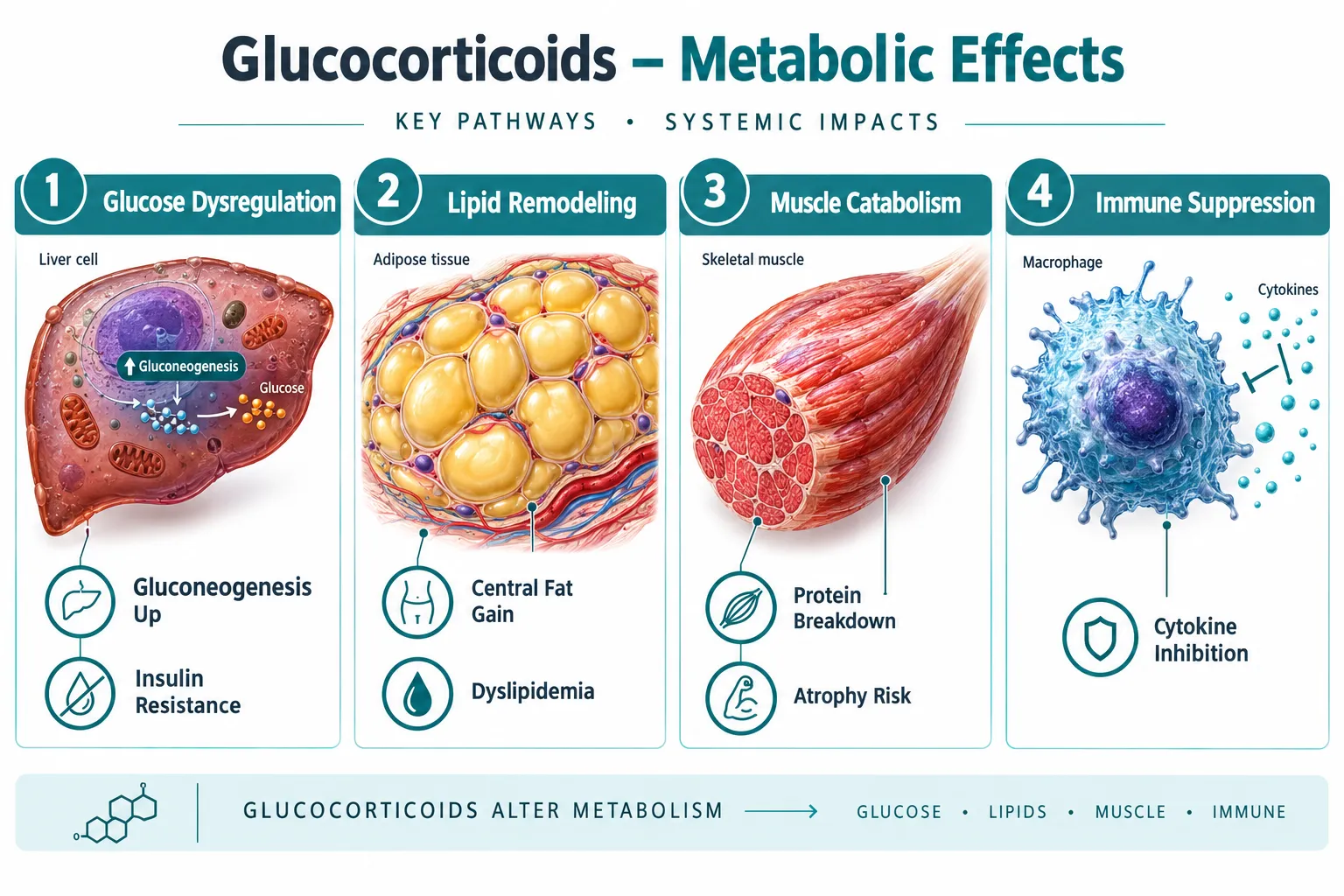
Prednisone and peptide research models: separating glucocorticoid metabolic effects from tissue-repair signals begins with understanding what prednisone actually does to baseline physiology. Prednisone is a synthetic glucocorticoid that binds glucocorticoid receptors across virtually every tissue type. Its systemic metabolic profile is dominated by three well-documented disruptions.
How Prednisone Reshapes the Metabolic Landscape

1. Glucose and Insulin Metabolism
Prednisone stimulates hepatic gluconeogenesis and reduces peripheral insulin sensitivity. Even short-term use preferentially disrupts glucose metabolism before significant muscle protein changes appear. This matters enormously for any peptide study that uses fasting glucose, HOMA-IR, or glycemic variability as an outcome measure.

2. Lipid Remodeling and Body Composition
Prolonged prednisone use drives central adiposity and dyslipidemia. Importantly, research on intermittent weekly prednisone dosing shows sex-specific lipid remodeling in skeletal muscle, a finding that introduces a sex-as-biological-variable confound if not stratified properly.

3. Muscle Catabolism vs. Repair Duality
This is where the picture becomes nuanced. Chronic high-dose prednisone is catabolic to muscle. Yet pulsed glucocorticoid protocols in dystrophic muscle models have demonstrated enhanced physical performance through nutrient-utilization and repair pathways. Circadian timing of intermittent prednisone pulses has been shown to modulate mitochondrial remodeling, suggesting that dose, timing, and frequency determine whether the net effect is catabolic or restorative.

"The same compound that degrades muscle under chronic dosing can enhance sarcolemmal repair via annexin-mediated pathways under pulsed protocols, a distinction that most research designs fail to capture."

This duality means that labeling prednisone exposure simply as "harmful background noise" in a peptide study is an oversimplification that can distort results in either direction.


Tissue-Repair Signals: Where Peptides Operate Differently

To build a sound comparative framework, researchers must map where peptide mechanisms diverge from glucocorticoid mechanisms. For a broader foundation on peptide structure and receptor pharmacology, the Peptides 101 for Research-Use Only Buyers guide provides essential context.
Tissue-Repair Signals: Where Peptides Operate Differently

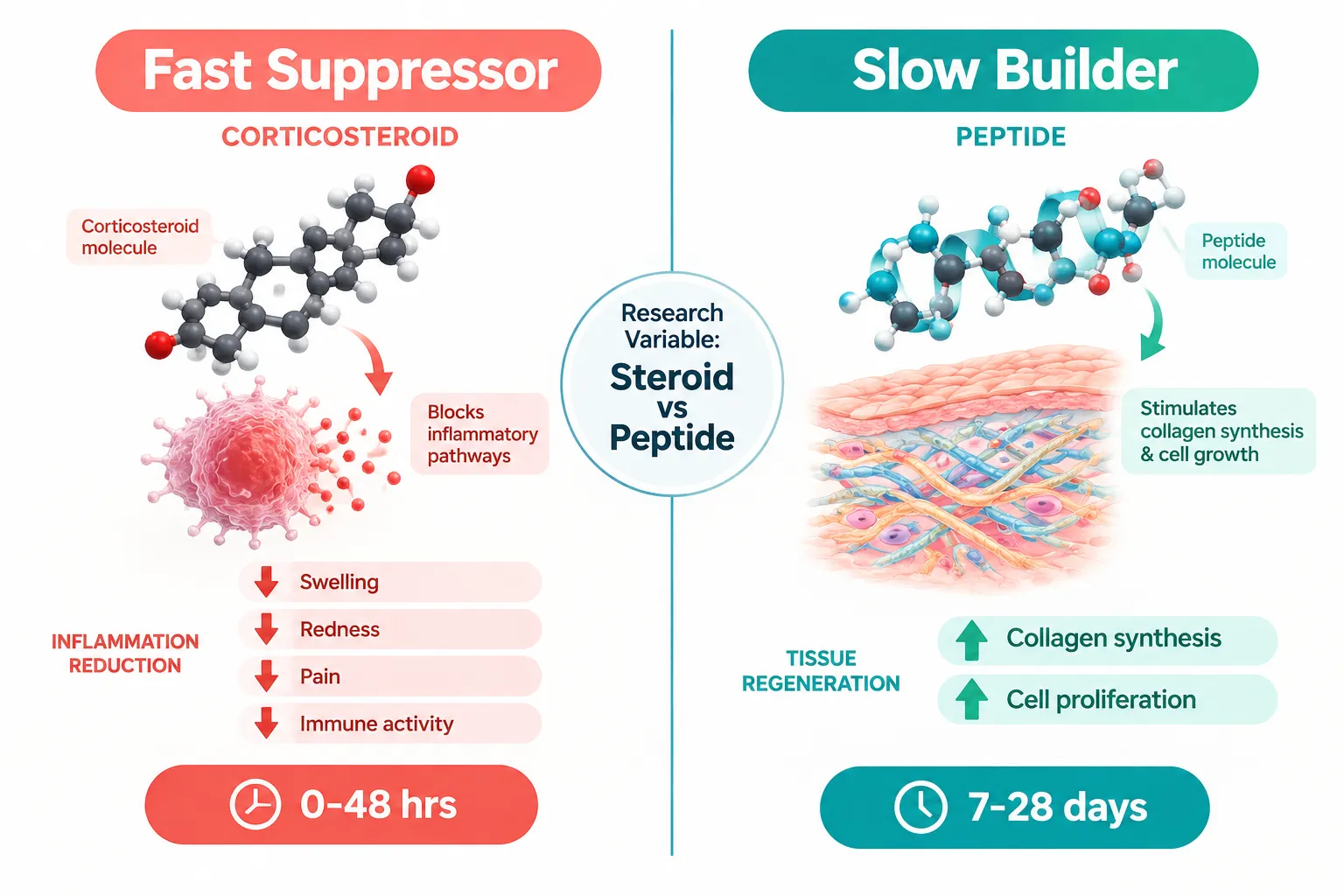
Corticosteroids act as fast suppressors: they reduce inflammatory cytokines within hours, providing rapid symptom relief. Clinical rheumatology data from 2026 confirm that prednisone reliably improves symptoms but impairs longer-term tissue healing when used continuously.

Peptides, by contrast, function as slow builders. They tend to stimulate collagen synthesis, cell proliferation, and mitochondrial biogenesis over days to weeks. Compounds such as GHK-Cu peptide have been studied for fibroblast activation and extracellular matrix remodeling, while SS-31 peptide research focuses on mitochondrial membrane stabilization, a mechanism directly relevant to steroid-induced mitochondrial disruption. For deeper reading on mitochondrial targets, SS-31 mitochondrial research offers a useful reference point.

Feature Prednisone (Pulsed) Peptide Agents
Onset of action Hours Days to weeks
Primary target Immune/inflammatory signaling Structural and metabolic repair
Mitochondrial effect Remodeling (timing-dependent) Biogenesis support
Glucose impact Dysregulation (dose-dependent) Neutral to beneficial
Evidence base Extensive Phase III data Preclinical/early Phase I-II

Peptide-based regenerative therapies remain insufficiently validated compared to glucocorticoids in head-to-head trials. No Phase III study currently pairs a peptide protocol directly with long-term corticosteroid therapy, which makes the need for rigorous study design even more critical.


A Framework for Handling Steroid Exposure in Peptide Research Models

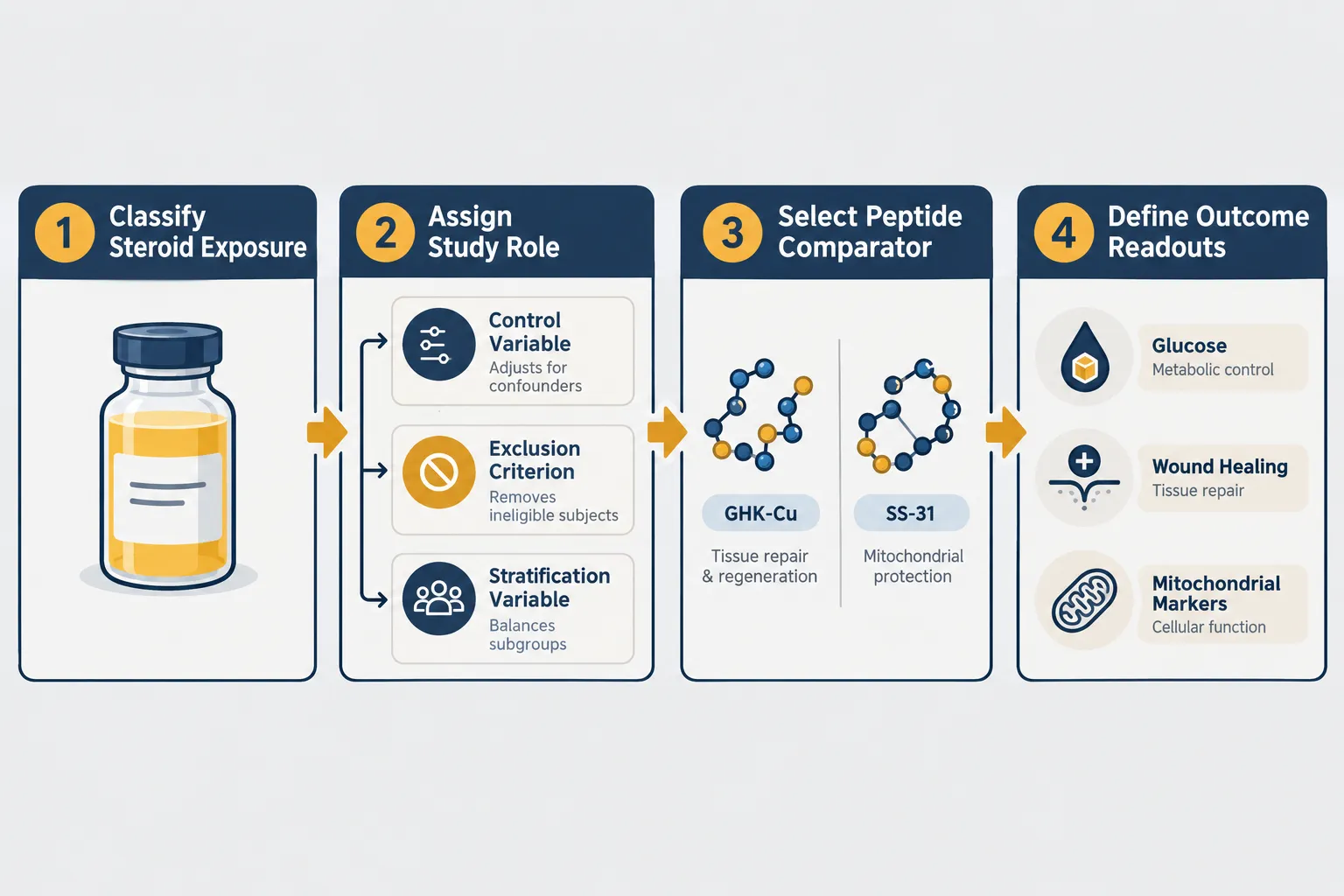
Applying the lens of prednisone and peptide research models: separating glucocorticoid metabolic effects from tissue-repair signals to study design requires a deliberate classification step before any outcome readout is chosen.
A Framework for Handling Steroid Exposure in Peptide Research Models

Researchers should ask three questions about any subject or model with prednisone exposure:

Step 1, Classify the exposure type
Is the steroid use chronic (daily, systemic), intermittent (weekly pulse), or acute (single-dose)? Each produces a different metabolic fingerprint. Intermittent once-weekly prednisone has been shown to improve ATP levels, NAD+ availability, and endurance in aged skeletal muscle, outcomes that directly overlap with peptide endpoints. Treating all steroid exposure as equivalent will produce noise, not signal.

Step 2, Assign a study role

  • Control variable: Include steroid-exposed and steroid-naive arms, measure the exposure quantitatively, and model it as a covariate. This is appropriate when excluding steroid users would make recruitment impossible.
  • Exclusion criterion: Remove subjects with any current or recent steroid use when the primary endpoint is glucose metabolism or wound healing, because prednisone's effects on those readouts are too large to model reliably.
  • Stratification variable: Randomize within steroid-exposed and steroid-naive strata when the research question specifically asks how a peptide performs in a glucocorticoid-rich environment.

Step 3, Select peptide comparators with mechanistic logic
Choose peptides whose mechanisms are least likely to be masked or amplified by glucocorticoid background. For metabolic endpoints, compounds such as MOTS-C peptide, which targets mitochondrial AMPK pathways, may show cleaner signal separation from prednisone's glucose effects than growth-hormone-releasing peptides. For tissue-repair endpoints, Thymosin Alpha 4 peptide research offers a comparator that operates through actin cytoskeletal and immune-modulation pathways distinct from glucocorticoid receptor signaling.

Dose-dependent and tissue-specific adverse metabolic effects from prednisone further underscore why a single classification rule cannot apply across all study types. A low-dose pulse in muscle tissue is not the same biological event as a high-dose chronic regimen in adipose tissue.


Conclusion

Prednisone and peptide research models: separating glucocorticoid metabolic effects from tissue-repair signals is not merely a methodological nicety, it is a prerequisite for generating reproducible data. The metabolic disruptions prednisone introduces (glucose dysregulation, lipid remodeling, context-dependent muscle effects) operate on different timescales and through different receptors than the anabolic, repair-oriented signals that most peptides are designed to amplify.

Actionable next steps for researchers in 2026:

  • Audit existing datasets for undocumented steroid co-exposure before pooling results.
  • Pre-register the steroid classification decision (control, exclusion, or stratification) in study protocols.
  • Prioritize mechanistic alignment when selecting peptide comparators, match the peptide's primary pathway to an endpoint that prednisone does not dominate.
  • Monitor both glucose and mitochondrial markers simultaneously to distinguish metabolic interference from genuine tissue-repair signal.
  • Follow emerging pulsed-dosing literature closely, as intermittent prednisone protocols may eventually serve as a validated adjunct rather than a pure confounder in select repair models.

The field will only move forward when steroid exposure is treated with the same rigor applied to any other pharmacological variable in the experimental design.

https://www.puretestedpeptides.com/wp-content/uploads/2026/10/prednisone-and-peptide-research-models-separating-glucocorticoid-metabolic-effec.webp 1024 1536 https://www.puretestedpeptides.com/wp-content/uploads/2026/01/buy-peptides-online.jpg 2026-10-04 13:04:262026-10-04 13:04:26Prednisone and Peptide Research Models: Separating Glucocorticoid Metabolic Effects From Tissue-Repair Signals
×

Helpful Links

  • My account
  • Cart
  • Checkout
  • Refund and Returns Policy
  • Privacy Policy
  • SMS Privacy Policy
  • Login
  • My Account
  • Logout

USA Made Lab Tested Peptides

All products are sold for research, laboratory, or analytical purposes only, and are not for human consumption


Pure Tested Peptides is a chemical supplier. Pure Tested Peptides is not a compounding / chemical compounding facility as defined under 503A of the Federal Food, Drug, and Cosmetic act. Pure Tested Peptides is not an outsourcing facility as defined under 503B of the Federal Food, Drug, and Cosmetic act.

The statements made within this website have not been evaluated by the US Food and Drug Administration. The products we offer are not intended to diagnose, treat, cure or prevent any disease.

Human/Animal Consumption Prohibited. Laboratory/In-Vitro Experimental Use Only

Scroll to top Scroll to top Scroll to top