Call or Text 727-513-9780
  • Shopping Cart Shopping Cart
    0Shopping Cart
Pure Tested Peptides | America's most trusted Peptides for sale online
  • Peptides for sale
    • Oral Peptides for sale
      • Peptide Capsules for sale
      • BPC 157 Capsules 1000mcg
      • SLU-PP-332 Capsules | 1000 mcg
      • 5-Amino-1MQ 50mg Capsules
      • Tesofensine 500mcg
    • All Peptides for sale
    • Peptide Sprays
      • BPC 157 Nasal Spray Kit
      • BPC-157 TB500 Nasal Spray Kit
      • Semax Nasal Spray 10mg
      • Selank – Nasal Spray Kit – 10mg
      • Epithalon 50MG Nasal Spray Kit
      • Ipamorelin 10mg Nasal Spray
      • Klow Nasal Spray (BPC-157 + TB-500 + GHK-Cu + KPV) | 80mg
      • Hulk Nasal Spray Tesa / Ipa Blend 6/3 MG
      • Klow Nasal Spray
      • NAD + 500 mg Nasal Spray
      • PT-141 Nasal Spray Kit
    • GHRH Peptides
      • Ipa Peptides
      • CJC-1295 Peptides
        • CJC-1295 with DAC 5 mg
        • CJC-1295 without DAC 5 mg
        • CJC-1295 Ipa 10mg
      • Tesa Peptides
        • Tesa Peptide
        • Tesa 20 mg
    • GHK-Cu Peptides
      • All GHK-Cu Peptides
      • GHK-Cu 100mg
      • KLOW Peptide Blend – Buy KLOW blend online
    • BPC Peptides
      • All BPC Peptides
      • BPC-157
      • BPC-157 TB-500
      • BPC 157 capsules 1000mcg
    • SLU-PP-332 Peptides
      • All SLU-PP-332 Peptides
      • SLU-PP-332 5mg
    • GLP3 Peptides
    • PT-141 Peptides
      • PT-141 Peptides for sale
      • PT-141 10mg
      • PT-141 Nasal Spray
    • CAG Peptides
      • Lipo-C Peptide Blend
      • CAG 5mg
      • CAG 10mg
    • MOTS-C Peptides
      • MOTS-C Peptides for sale
      • MOTS-c peptide
      • MOTS-c 10mg *6 pack*
    • 5 Amino 1MQ Peptides
      • 5 Amino 1MQ Peptides for sale
      • 5-Amino-1MQ 50mg Capsules
      • 5-Amino-1MQ 5mg
    • Epithalon Peptides
      • Epithalon Peptides for sale
      • Epithalon 10mg
      • Epithalon 50mg
  • Shop
    • GLPs
      • 5-Amino-1MQ 50mg Capsules
      • 5-Amino-1MQ 5mg
      • L-Carnitine 500mg/ml
      • Tesofensine 500mcg
      • SLU-PP-332 5mg
      • MOTS-c 10mg *6 pack*
    • Epithalon & BPC Peptides
      • Epithalon 10mg
      • Epithalon 50mg
      • BPC-157
      • BPC 157 capsules 1000mcg
      • BPC-157 TB-500
      • BPC-157 TB500 Nasal Spray Kit
      • BPC 157 Nasal Spray Kit
    • BPC TB-500 & NAD+ Peptides
      • NAD+ 500 mg
      • KLOW Peptide Blend – Buy KLOW blend online
      • GLOW Peptide Blend
      • TB 500 5mg
      • BPC 157 capsules 1000mcg – Supplement
      • BPC 157 Nasal Spray Kit
      • BPC-157
      • BPC-157 TB500 Nasal Spray Kit
      • BPC-157 TB-500
      • BPC 157 capsules 1000mcg
    • LL-37 Peptide
      • LL-37 10 mg
    • MOTS-C & Selank
      • MOTS-c peptide
      • Selank 10mg
    • GHK Peptides
      • GHK-Cu 100mg
      • GLOW Peptide Blend
      • KLOW Peptide Blend – Buy KLOW blend online
  • COAs
  • Wholesale
    • Wholesale Peptides for sale
  • PTP FAQ
  • Affiliates
    • Selank Peptide: Advanced Pharmacological Mechanisms Underlying Its Anxiolytic and Nootropic Effects in Research
      • 5-Amino-1MQ Peptide: Detailed Mechanisms of NNMT Inhibition and Its Impact on Cellular Metabolism Research
        • MOTS-C Peptide: Unraveling Its Role in Mitochondrial Dynamics and Energy Metabolism Research
          • Epithalon Peptide and Telomerase Regulation: Investigating Its Impact on Cellular Senescence and Lifespan Research Models
            • GLP2-T vs GLP2 Tirz Peptide: Understanding the Naming, Mechanistic Nuances, and Research Implications for Gut Health
      • Peptides and Polypeptides in Modern Pharmacology: What Research on Metoprolol, Prednisone, and Amlodipine Reveals
        • Polypeptide Peptides vs NSAIDs: What Naproxen and Diclofenac Teach Tissue-Repair Researchers About BPC‑157 and TB‑500
          • Peptides and Polypeptides in Endocrine Pharmacology: How GLP-1, GLP-2, and GLP-3 Retatrutide Differ From Classic Drugs Like Prednisone and Amlodipine
          • 5‑Amino‑1MQ Peptide and NNMT Inhibition: How It Compares With Statins Like Atorvastatin in Adipose and Lipid Metabolism Research
      • Enclomiphene, Estrogen Receptor Signaling, and Luteinizing Phase Biology: What Hormone Researchers Should Measure
        • Mesenchymal Stem Cells, BPC‑157, and GHK‑Cu: How Tissue Repair Peptides Compare With Classic NSAIDs Like Naproxen in Injury Models
          • Peptide Calculator Use Cases Beyond Growth Hormone: Working Through GLP‑3 Retatrutide, MOTS‑c, and BPC‑157 Research Dosing
        • Polypeptide Peptides in Endocrine and Metabolic Pharmacology: Lessons From Amlodipine, Prednisone, and Metoprolol
        • Peptides Calculator for Advanced Blends: Worked Examples for Tesamorelin, CJC‑1295, and Ipamorelin Stacks
          • Peptides and Polypeptides in Human Physiology: How Molecular Size Shapes Research Applications
            • Selank Peptide: Advanced Pharmacological Mechanisms Underlying Its Anxiolytic and Nootropic Effects in Research
          • 5-Amino-1MQ Peptide: Detailed Mechanisms of NNMT Inhibition and Its Impact on Cellular Metabolism Research
            • MOTS-C Peptide: Unraveling Its Role in Mitochondrial Dynamics and Energy Metabolism Research
              • Epithalon Peptide and Telomerase Regulation: Investigating Its Impact on Cellular Senescence and Lifespan Research Models
                • GLP2-T vs GLP2 Tirz Peptide: Understanding the Naming, Mechanistic Nuances, and Research Implications for Gut Health
                  • Peptides and Polypeptides in Endocrine Pharmacology: How GLP-1, GLP-2, and GLP-3 Retatrutide Differ From Classic Drugs Like Prednisone and Amlodipine
                    • Polypeptide Peptides vs NSAIDs: What Naproxen and Diclofenac Teach Tissue-Repair Researchers About BPC‑157 and TB‑500
                      • Peptides and Polypeptides in Modern Pharmacology: What Research on Metoprolol, Prednisone, and Amlodipine Reveals
                        • 5‑Amino‑1MQ Peptide and NNMT Inhibition: How It Compares With Statins Like Atorvastatin in Adipose and Lipid Metabolism Research
                        • Enclomiphene, Estrogen Receptor Signaling, and Luteinizing Phase Biology: What Hormone Researchers Should Measure
                        • Mesenchymal Stem Cells, BPC‑157, and GHK‑Cu: How Tissue Repair Peptides Compare With Classic NSAIDs Like Naproxen in Injury Models
                        • Peptide Calculator Use Cases Beyond Growth Hormone: Working Through GLP‑3 Retatrutide, MOTS‑c, and BPC‑157 Research Dosing
                        • Polypeptide Peptides in Endocrine and Metabolic Pharmacology: Lessons From Amlodipine, Prednisone, and Metoprolol
                        • Peptides Calculator for Advanced Blends: Worked Examples for Tesamorelin, CJC‑1295, and Ipamorelin Stacks
                        • Peptides and Polypeptides in Human Physiology: How Molecular Size Shapes Research Applications
                        • Selank Peptide: Advanced Pharmacological Mechanisms Underlying Its Anxiolytic and Nootropic Effects in Research
                        • MOTS-C Peptide: Unraveling Its Role in Mitochondrial Dynamics and Energy Metabolism Research
                        • Peptides and Polypeptides in Modern Pharmacology: What Research on Metoprolol, Prednisone, and Amlodipine Reveals
                        • Peptides and Polypeptides in Endocrine Pharmacology: How GLP-1, GLP-2, and GLP-3 Retatrutide Differ From Classic Drugs Like Prednisone and Amlodipine
                        • 5-Amino-1MQ Peptide: Detailed Mechanisms of NNMT Inhibition and Its Impact on Cellular Metabolism Research
                        • Mesenchymal Stem Cells, BPC‑157, and GHK‑Cu: How Tissue Repair Peptides Compare With Classic NSAIDs Like Naproxen in Injury Models
                        • Peptide Calculator Use Cases Beyond Growth Hormone: Working Through GLP‑3 Retatrutide, MOTS‑c, and BPC‑157 Research Dosing
                        • GLP2-T vs GLP2 Tirz Peptide: Understanding the Naming, Mechanistic Nuances, and Research Implications for Gut Health
                        • Polypeptide Peptides in Endocrine and Metabolic Pharmacology: Lessons From Amlodipine, Prednisone, and Metoprolol
                        • Polypeptide Peptides vs NSAIDs: What Naproxen and Diclofenac Teach Tissue-Repair Researchers About BPC‑157 and TB‑500
                        • Peptides and Polypeptides in Human Physiology: How Molecular Size Shapes Research Applications
                        • Peptides Calculator for Advanced Blends: Worked Examples for Tesamorelin, CJC‑1295, and Ipamorelin Stacks
                        • 5‑Amino‑1MQ Peptide and NNMT Inhibition: How It Compares With Statins Like Atorvastatin in Adipose and Lipid Metabolism Research
                        • Enclomiphene, Estrogen Receptor Signaling, and Luteinizing Phase Biology: What Hormone Researchers Should Measure
                        • Epithalon Peptide and Telomerase Regulation: Investigating Its Impact on Cellular Senescence and Lifespan Research Models
                        • Best research protocol Klow blend
                        • best time to take BPC-157
                        • best time to take DSIP (Delta Sleep Inducing Peptide)
                        • best time to take CJC-1295
                        • best time to take AOD-9604
                        • best time to take Follistatin 344
                        • best time to take Ipamorelin
                        • best time to take MK-677 (Ibutamoren)
                        • best time to take Ligandrol (LGD-4033) — research compound
                        • best time to take Ostarine (MK-2866) — research compound
                        • best time to take GHK-CU
                        • best time to take TB-500
                        • best time to take MOTS-c
                        • best time to take Semax
                        • best time to take RAD-140 (Testolone) — research compound
                        • best time to take Thymosin Alpha-1
                        • best time to take PEG-MGF
                        • Biolife Plasma, Octapharma Plasma, and Research Peptides: How Plasma Donation Labs Differ From Peptide Suppliers
                        • best time to take YK-11 — research compound
                        • best time to take PT-141 (Bremelanotide)
                        • Best research protocol Klow blend
                        • 5-Amino-1MQ and MOTS-C Synergy: Metabolic Signaling, Mitochondria, and Research Design
                        • BPC-157 and TB-500: Investigating Their Combined Effects on Angiogenesis and Cellular Migration in Tissue Repair Models
                        • BPC-157 Peptide: Gut Barrier Function, Inflammation, and Tissue-Recovery Research
                        • 5‑Amino‑1MQ and MOTS‑c Synergy in Metabolic Research: Designing NNMT and Mitochondrial Biogenesis Stacks
                        • CJC-1295 with DAC vs. Without DAC: Half-Life, Release Kinetics, and Research Implications
                        • CJC‑1295 with DAC vs. Without DAC: Expanding on Half‑Life Differences Using Tesamorelin and Ipamorelin Blend Case Studies
                        • Collagen Biology and Copper‑Binding Peptides: How GHK‑Cu, Glow Blend, and Klow Blend Interact with Skin and Connective Tissue
                        • Collagen Biology and Regenerative Peptides: How GHK‑Cu, Glow Blend, and Klow Blend Affect Extracellular Matrix Research
                    • DNA, Telomeres, and Longevity Peptides: Positioning Epithalon and MOTS‑c in Genetic Aging Research
                      • Enclomiphene Citrate: serm Mechanism, Testosterone Research, and Stack Compatibility
                        • Enclomiphene vs Enclomiphene Citrate: Formulation, Bioavailability, and Research Distinctions
                        • Epithalon Peptide Research: Telomerase Activation, Aging, and Pineal Gland Function
                        • Estrogen Receptor Signaling and Enclomiphene: How Selective Modulators Compare with Classic Polypeptide Hormones
                        • GHK-Cu Peptide: Advanced Mechanisms in Extracellular Matrix Remodeling and Wound Healing Research
                        • GHK-Cu Peptide: Collagen Synthesis, Wound Repair, and Skin-Barrier Research Models
                        • GLP-1 vs GLP-3 vs GLP-2: Peptide Classification and Research Applications
                        • GLP-2 Peptide Research Guide: Gut Barrier Function, Nutrient Absorption, and Intestinal Recovery Models
                        • GLP-3 Retatrutide vs. GLP-1 Drugs: What Triple-Agonist Biology Changes in Research Models
                        • Ipamorelin and Tesamorelin Combination: Synergistic GH Secretagogue Research and Dosing Protocols
                        • GLP2 Tirz Peptide: What It Is, Why the Name Exists, and How Researchers Should Interpret It
                        • Klow Blend Peptide Nasal Spray: What the Formulation Is Trying to Do in Cognitive Research
                        • Mitochondria, NNMT Inhibition, and Peptide Modulators: Where MOTS‑c and 5‑Amino‑1MQ Fit in Cellular Energy Research
                        • MOTS-c Peptide: Mitochondrial Function, Energy Metabolism, and What Researchers Measure
                        • MOTS-c vs. 5-Amino-1MQ: Which Metabolic Research Questions Each Compound Actually Answers
                        • Nasal Spray Peptides: Bioavailability, Administration, and Semax/Selank Research Applications
                        • PT-141 Peptide Research: Mechanism of Action and Melanocortin Receptor Signaling
                        • Retatrutide for Research: Mechanism, Structure, and GLP-1/GLP-3 Dual Action
                        • Retatrutide for Obesity and Type 2 Diabetes: What the Latest Trial Data Suggest
                        • Tesofensine Peptide Research: Mechanism, Appetite Suppression, and Neuropeptide Y Pathways
  • Contact
    • Contact Customer Service
    • Text Customer Support
  • About US
  • Shop all peptides
  • Affiliate Program
    • Affiliate Signup
  • Login / Register Login / Register Page Link Login / Register Page Link
  • Click to open the search input field Click to open the search input field Search
  • Menu Menu

Tag Archive for: trap assay

Epithalon, Telomerase, and Senescence Assays: Choosing qPCR, Telomere-Length, and Senescence-Associated Readouts

Epithalon, Telomerase, and Senescence Assays: Choosing qPCR, Telomere-Length, and Senescence-Associated Readouts

September 27, 2026/0 Comments/in Uncategorized/by

,

Professional () hero image with 'Epithalon, Telomerase, and Senescence' in crisp white modern on a deep navy

Fewer than 5% of published peptide-aging studies correctly distinguish between telomerase activity, average telomere length, and telomere distribution, yet each endpoint tells a fundamentally different biological story. When studying Epithalon, Telomerase, and Senescence Assays: Choosing qPCR, Telomere-Length, and Senescence-Associated Readouts is not a matter of preference; it is a matter of endpoint validity. Selecting the wrong assay can produce data that looks compelling but answers the wrong question entirely.

Key Takeaways

  • Telomerase activity, average telomere length, and telomere distribution are distinct endpoints that require different assay platforms.
  • Epithalon's documented effects on telomerase are primarily from in vitro cell-culture models; direct human extrapolation remains premature as of 2026.
  • qPCR-based telomere length measurement is cost-effective but reports only a relative average; Flow-FISH and TRF provide distribution and absolute sizing.
  • Senescence-associated readouts (SA-beta-gal, p21, p16, SASP panels) must complement telomere assays to confirm biological aging phenotypes.
  • Assay choice should be driven by the specific research question, not by convenience or cost alone.

Understanding What Each Endpoint Actually Measures
Understanding What Each Endpoint Actually Measures

Before selecting any platform, researchers must clarify which biological event they want to capture. The four major endpoints in Epithalon, Telomerase, and Senescence Assays: Choosing qPCR, Telomere-Length, and Senescence-Associated Readouts work are not interchangeable.

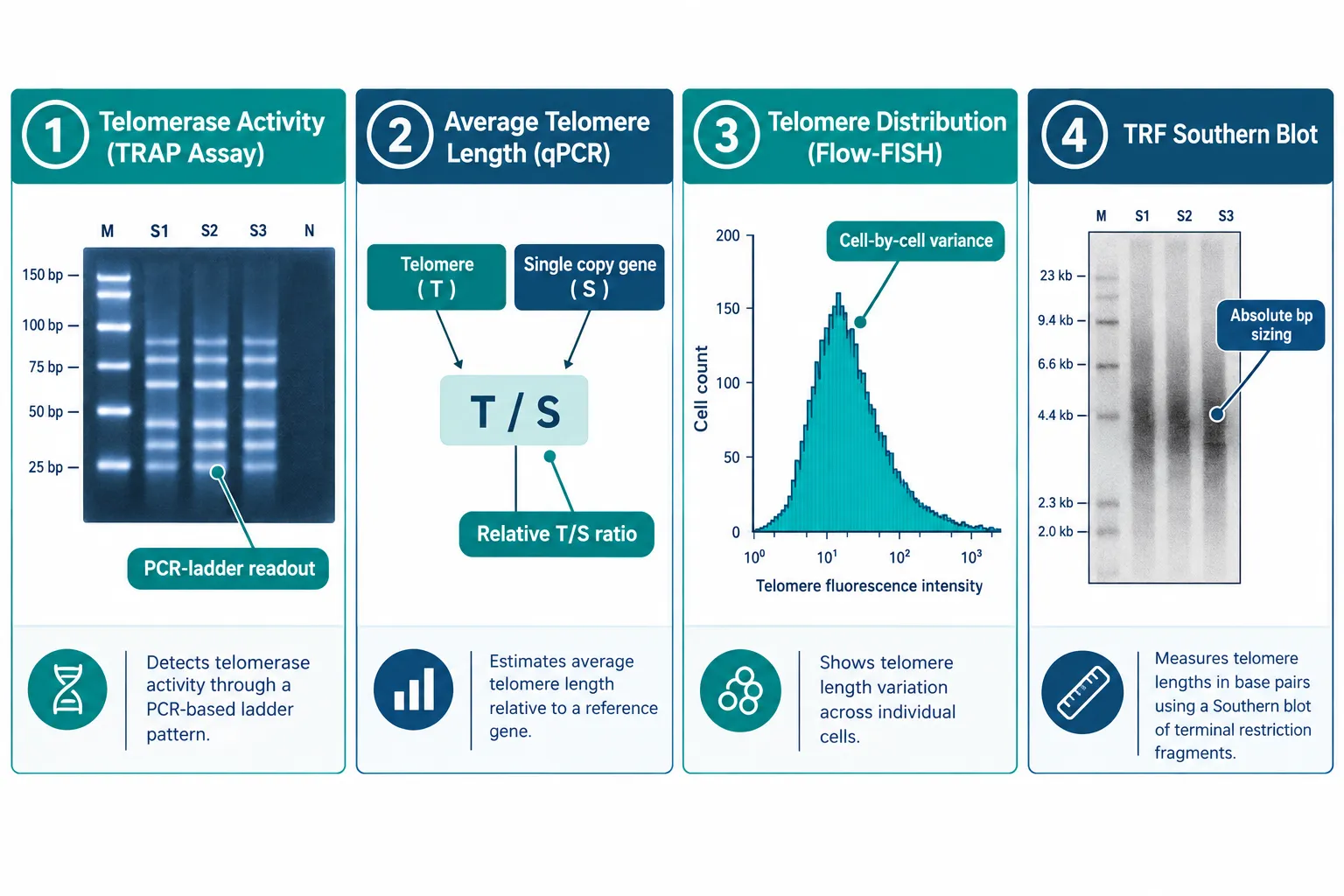
Telomerase Activity measures the enzymatic capacity of the telomerase complex to extend telomere repeats. The gold-standard method is the Telomeric Repeat Amplification Protocol (TRAP assay), which generates a PCR ladder pattern scored by gel densitometry or fluorescence. A positive TRAP result confirms the enzyme is functional, it says nothing about whether telomeres have actually lengthened.

Average Telomere Length captures the mean repeat-count across all chromosomes in a cell population. Quantitative PCR (qPCR) reports this as a T/S ratio, telomere signal normalized to a single-copy reference gene. This is the most scalable method but collapses the entire distribution into one number.

Telomere Length Distribution reveals cell-to-cell and chromosome-to-chromosome variance. Flow-FISH (fluorescence in situ hybridization combined with flow cytometry) and Q-FISH on metaphase spreads provide this granular view. Critically, a cell population with a normal average T/S ratio can still harbor a subset of critically short telomeres driving senescence, information invisible to qPCR alone.

Terminal Restriction Fragment (TRF) Southern Blot remains the reference method for absolute base-pair sizing. It is low-throughput and requires large DNA inputs, but it anchors other assays to a concrete molecular ruler.

Assay Endpoint Throughput Key Limitation
TRAP Telomerase activity Medium Does not measure length
qPCR (T/S ratio) Average telomere length High Relative, not absolute
Flow-FISH Length distribution Medium Requires fresh cells
TRF Southern Blot Absolute length (bp) Low High DNA input needed
Q-FISH Chromosome-specific length Low Labor-intensive

Epithalon's Documented Effects and Assay-Selection Implications
Epithalon's Documented Effects and Assay-Selection Implications

Epithalon (Ala-Glu-Asp-Gly) is a synthetic tetrapeptide studied for its capacity to upregulate telomerase expression in human cell lines. Independent work from Brunel University and subsequent 2026 corrections to earlier datasets confirm that Epithalon can increase TERT (telomerase reverse transcriptase) mRNA levels and TRAP-positive activity in cultured cells. Bovine oocyte maturation studies published in 2025 further demonstrated telomerase activation in a reproductive biology context.

However, a 2026 systematic review concluded that the strongest evidence remains confined to cell culture. Dosing parameters used in vitro do not translate directly to in vivo concentrations, and no peer-reviewed human clinical trial has yet validated the telomere-lengthening claims circulating in popular media.

What this means for assay design:

  • If the goal is to confirm Epithalon's mechanism, a TRAP assay is the correct first-line tool, it directly measures the enzymatic output the peptide is claimed to stimulate.
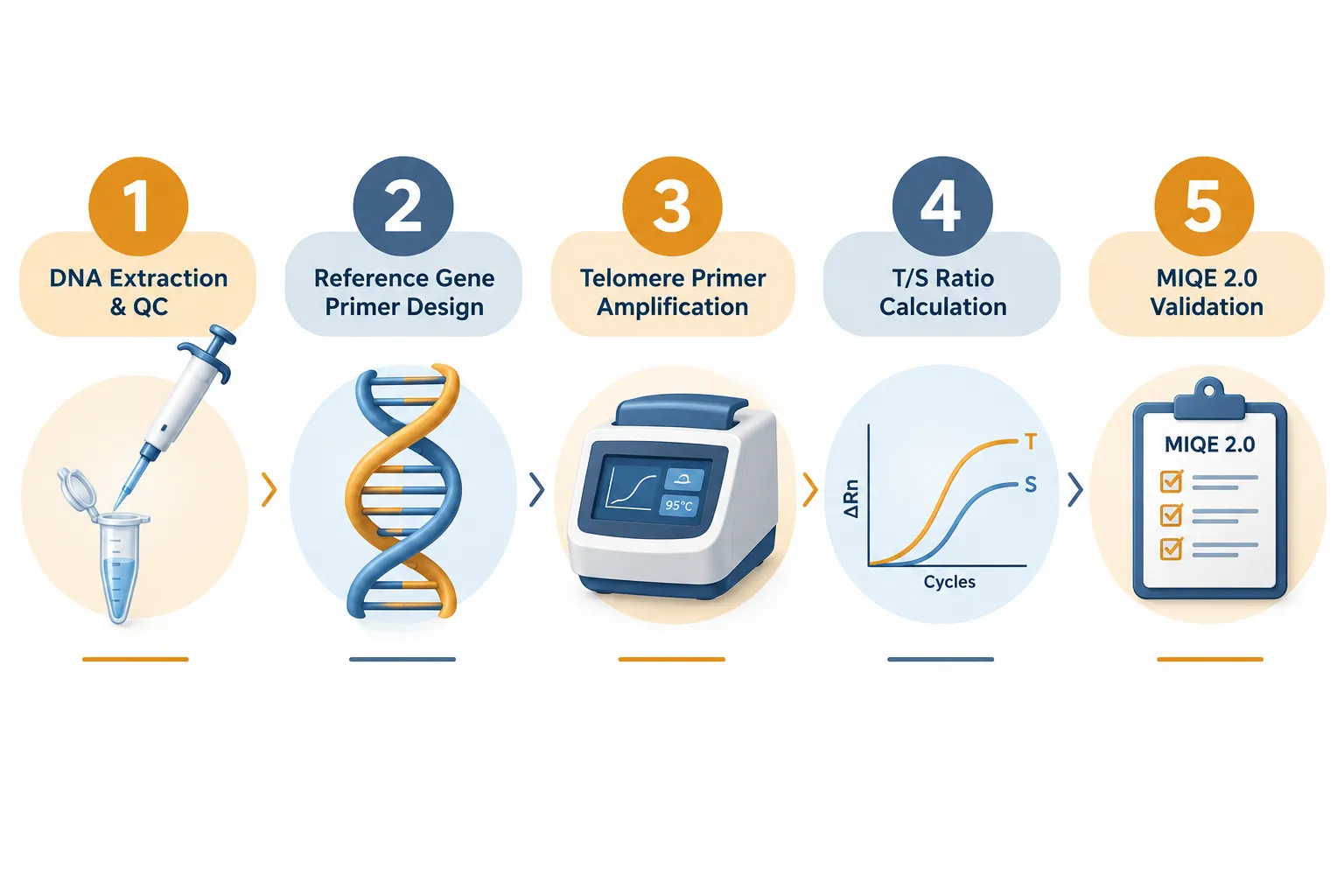
  • If the goal is to detect downstream telomere elongation, qPCR T/S ratio is appropriate for screening, but positive findings must be confirmed by TRF or Flow-FISH before any mechanistic claim is made.
  • Cell-line studies should report passage number, serum conditions, and peptide concentration with full MIQE 2.0 compliance to allow cross-study comparison.

Researchers interested in related peptides that interact with cellular repair pathways, such as those exploring GHK-Cu peptide for sale options or wound healing peptide research, face similar endpoint-selection challenges when designing aging-biology experiments.

"Telomerase activation and telomere elongation are sequential, not synonymous. Reporting one without the other is an incomplete experiment."


Senescence-Associated Readouts: Completing the Picture

Senescence-Associated Readouts: Completing the Picture

Telomere data alone cannot confirm cellular senescence or its reversal. Senescence-Associated Secretory Phenotype (SASP) markers and classical senescence biomarkers must be layered in to validate any aging-biology claim.

Core senescence readouts to pair with telomere assays:

  • SA-beta-galactosidase (SA-beta-gal): Histochemical staining at pH 6.0; the most widely used senescence marker. Simple but not exclusive to senescence.
  • p21 (CDKN1A) and p16 (CDKN2A): Cyclin-dependent kinase inhibitors upregulated in senescent cells. Measured by Western blot or RT-qPCR. p16 is particularly stable and less influenced by acute stress responses.
  • SASP cytokine panels: IL-6, IL-8, MMP-3, and GDF-15 are frequently elevated. Multiplex ELISA or Luminex platforms allow simultaneous quantification.
  • Gamma-H2AX foci: Marks DNA double-strand breaks, including those at dysfunctional telomeres. Immunofluorescence co-localization with telomere probes (TIF assay) directly links telomere dysfunction to DNA damage signaling.

Combining these with telomere and telomerase readouts creates a multi-dimensional senescence profile. For example, a cell population showing elevated TRAP activity, stable T/S ratio, reduced p16, and decreased SA-beta-gal staining would provide much stronger evidence of senescence reversal than any single marker alone.

Researchers working with mitochondria-targeted peptides such as SS-31 Elamipretide or studying synergy of LL-37 and SS-31 in aging models should apply the same multi-endpoint logic when designing senescence assay panels.

For those sourcing research-grade compounds, verified suppliers offering NAD 500 and related longevity compounds alongside peptides provide a useful reference point for quality benchmarks.


Practical Assay-Selection Framework

Choosing between platforms for Epithalon, Telomerase, and Senescence Assays: Choosing qPCR, Telomere-Length, and Senescence-Associated Readouts projects should follow a tiered logic:

  1. Define the primary question first. Is the study asking whether Epithalon activates telomerase (use TRAP), changes average length (use qPCR), or alters the proportion of senescent cells (use SA-beta-gal + p16)?
  2. Apply MIQE 2.0 standards for all qPCR work. The Telomere Research Network's 2026 absolute telomere length protocol provides an improved step-by-step method that reduces inter-laboratory variability significantly.
  3. Use at least two orthogonal assays. No single platform is sufficient for publication-quality senescence claims.
  4. Report raw Ct values and efficiency data. T/S ratios without amplification efficiency correction are not reproducible across laboratories.
  5. Acknowledge the translational gap explicitly. In vitro Epithalon findings cannot be applied to human dosing without pharmacokinetic bridging studies.

Conclusion

Rigorous research into Epithalon, Telomerase, and Senescence Assays: Choosing qPCR, Telomere-Length, and Senescence-Associated Readouts demands that investigators treat each endpoint as a distinct biological question. TRAP assays confirm enzymatic activity; qPCR T/S ratios screen for average length changes; Flow-FISH and TRF resolve distribution and absolute sizing; and SA-beta-gal, p16, and SASP panels confirm the senescence phenotype.

Actionable next steps for researchers in 2026:

  • Audit existing Epithalon datasets for MIQE 2.0 compliance before drawing mechanistic conclusions.
  • Add at least one senescence marker (p16 or SA-beta-gal) to any telomere-length study to contextualize findings biologically.
  • Pre-register assay selection criteria before data collection to prevent endpoint switching.
  • Treat all in vitro Epithalon findings as hypothesis-generating, not clinically prescriptive, until controlled human studies are available.

The field will advance faster when endpoint selection is treated as a scientific decision, not an afterthought.

https://www.puretestedpeptides.com/wp-content/uploads/2026/09/epithalon-telomerase-and-senescence-assays-choosing-qpcr-telomere-length-and-sen.webp 1024 1536 https://www.puretestedpeptides.com/wp-content/uploads/2026/01/buy-peptides-online.jpg 2026-09-27 13:03:452026-09-27 13:03:45Epithalon, Telomerase, and Senescence Assays: Choosing qPCR, Telomere-Length, and Senescence-Associated Readouts
×

Helpful Links

  • My account
  • Cart
  • Checkout
  • Refund and Returns Policy
  • Privacy Policy
  • SMS Privacy Policy
  • Login
  • My Account
  • Logout

USA Made Lab Tested Peptides

All products are sold for research, laboratory, or analytical purposes only, and are not for human consumption


Pure Tested Peptides is a chemical supplier. Pure Tested Peptides is not a compounding / chemical compounding facility as defined under 503A of the Federal Food, Drug, and Cosmetic act. Pure Tested Peptides is not an outsourcing facility as defined under 503B of the Federal Food, Drug, and Cosmetic act.

The statements made within this website have not been evaluated by the US Food and Drug Administration. The products we offer are not intended to diagnose, treat, cure or prevent any disease.

Human/Animal Consumption Prohibited. Laboratory/In-Vitro Experimental Use Only

Scroll to top Scroll to top Scroll to top