Call or Text 727-513-9780
  • Shopping Cart Shopping Cart
    0Shopping Cart
Pure Tested Peptides | America's most trusted Peptides for sale online
  • Peptides for sale
    • Oral Peptides for sale
      • Peptide Capsules for sale
      • BPC 157 Capsules 1000mcg
      • SLU-PP-332 Capsules | 1000 mcg
      • 5-Amino-1MQ 50mg Capsules
      • Tesofensine 500mcg
    • All Peptides for sale
    • Peptide Sprays
      • BPC 157 Nasal Spray Kit
      • BPC-157 TB500 Nasal Spray Kit
      • Semax Nasal Spray 10mg
      • Selank – Nasal Spray Kit – 10mg
      • Epithalon 50MG Nasal Spray Kit
      • Ipamorelin 10mg Nasal Spray
      • Klow Nasal Spray (BPC-157 + TB-500 + GHK-Cu + KPV) | 80mg
      • Hulk Nasal Spray Tesa / Ipa Blend 6/3 MG
      • Klow Nasal Spray
      • NAD + 500 mg Nasal Spray
      • PT-141 Nasal Spray Kit
    • GHRH Peptides
      • Ipa Peptides
      • CJC-1295 Peptides
        • CJC-1295 with DAC 5 mg
        • CJC-1295 without DAC 5 mg
        • CJC-1295 Ipa 10mg
      • Tesa Peptides
        • Tesa Peptide
        • Tesa 20 mg
    • GHK-Cu Peptides
      • All GHK-Cu Peptides
      • GHK-Cu 100mg
      • KLOW Peptide Blend – Buy KLOW blend online
    • BPC Peptides
      • All BPC Peptides
      • BPC-157
      • BPC-157 TB-500
      • BPC 157 capsules 1000mcg
    • SLU-PP-332 Peptides
      • All SLU-PP-332 Peptides
      • SLU-PP-332 5mg
    • GLP3 Peptides
    • PT-141 Peptides
      • PT-141 Peptides for sale
      • PT-141 10mg
      • PT-141 Nasal Spray
    • CAG Peptides
      • Lipo-C Peptide Blend
      • CAG 5mg
      • CAG 10mg
    • MOTS-C Peptides
      • MOTS-C Peptides for sale
      • MOTS-c peptide
      • MOTS-c 10mg *6 pack*
    • 5 Amino 1MQ Peptides
      • 5 Amino 1MQ Peptides for sale
      • 5-Amino-1MQ 50mg Capsules
      • 5-Amino-1MQ 5mg
    • Epithalon Peptides
      • Epithalon Peptides for sale
      • Epithalon 10mg
      • Epithalon 50mg
  • Shop
    • GLPs
      • 5-Amino-1MQ 50mg Capsules
      • 5-Amino-1MQ 5mg
      • L-Carnitine 500mg/ml
      • Tesofensine 500mcg
      • SLU-PP-332 5mg
      • MOTS-c 10mg *6 pack*
    • Epithalon & BPC Peptides
      • Epithalon 10mg
      • Epithalon 50mg
      • BPC-157
      • BPC 157 capsules 1000mcg
      • BPC-157 TB-500
      • BPC-157 TB500 Nasal Spray Kit
      • BPC 157 Nasal Spray Kit
    • BPC TB-500 & NAD+ Peptides
      • NAD+ 500 mg
      • KLOW Peptide Blend – Buy KLOW blend online
      • GLOW Peptide Blend
      • TB 500 5mg
      • BPC 157 capsules 1000mcg – Supplement
      • BPC 157 Nasal Spray Kit
      • BPC-157
      • BPC-157 TB500 Nasal Spray Kit
      • BPC-157 TB-500
      • BPC 157 capsules 1000mcg
    • LL-37 Peptide
      • LL-37 10 mg
    • MOTS-C & Selank
      • MOTS-c peptide
      • Selank 10mg
    • GHK Peptides
      • GHK-Cu 100mg
      • GLOW Peptide Blend
      • KLOW Peptide Blend – Buy KLOW blend online
  • COAs
  • Wholesale
    • Wholesale Peptides for sale
  • PTP FAQ
  • Affiliates
    • Selank Peptide: Advanced Pharmacological Mechanisms Underlying Its Anxiolytic and Nootropic Effects in Research
      • 5-Amino-1MQ Peptide: Detailed Mechanisms of NNMT Inhibition and Its Impact on Cellular Metabolism Research
        • MOTS-C Peptide: Unraveling Its Role in Mitochondrial Dynamics and Energy Metabolism Research
          • Epithalon Peptide and Telomerase Regulation: Investigating Its Impact on Cellular Senescence and Lifespan Research Models
            • GLP2-T vs GLP2 Tirz Peptide: Understanding the Naming, Mechanistic Nuances, and Research Implications for Gut Health
      • Peptides and Polypeptides in Modern Pharmacology: What Research on Metoprolol, Prednisone, and Amlodipine Reveals
        • Polypeptide Peptides vs NSAIDs: What Naproxen and Diclofenac Teach Tissue-Repair Researchers About BPC‑157 and TB‑500
          • Peptides and Polypeptides in Endocrine Pharmacology: How GLP-1, GLP-2, and GLP-3 Retatrutide Differ From Classic Drugs Like Prednisone and Amlodipine
          • 5‑Amino‑1MQ Peptide and NNMT Inhibition: How It Compares With Statins Like Atorvastatin in Adipose and Lipid Metabolism Research
      • Enclomiphene, Estrogen Receptor Signaling, and Luteinizing Phase Biology: What Hormone Researchers Should Measure
        • Mesenchymal Stem Cells, BPC‑157, and GHK‑Cu: How Tissue Repair Peptides Compare With Classic NSAIDs Like Naproxen in Injury Models
          • Peptide Calculator Use Cases Beyond Growth Hormone: Working Through GLP‑3 Retatrutide, MOTS‑c, and BPC‑157 Research Dosing
        • Polypeptide Peptides in Endocrine and Metabolic Pharmacology: Lessons From Amlodipine, Prednisone, and Metoprolol
        • Peptides Calculator for Advanced Blends: Worked Examples for Tesamorelin, CJC‑1295, and Ipamorelin Stacks
          • Peptides and Polypeptides in Human Physiology: How Molecular Size Shapes Research Applications
            • Selank Peptide: Advanced Pharmacological Mechanisms Underlying Its Anxiolytic and Nootropic Effects in Research
          • 5-Amino-1MQ Peptide: Detailed Mechanisms of NNMT Inhibition and Its Impact on Cellular Metabolism Research
            • MOTS-C Peptide: Unraveling Its Role in Mitochondrial Dynamics and Energy Metabolism Research
              • Epithalon Peptide and Telomerase Regulation: Investigating Its Impact on Cellular Senescence and Lifespan Research Models
                • GLP2-T vs GLP2 Tirz Peptide: Understanding the Naming, Mechanistic Nuances, and Research Implications for Gut Health
                  • Peptides and Polypeptides in Endocrine Pharmacology: How GLP-1, GLP-2, and GLP-3 Retatrutide Differ From Classic Drugs Like Prednisone and Amlodipine
                    • Polypeptide Peptides vs NSAIDs: What Naproxen and Diclofenac Teach Tissue-Repair Researchers About BPC‑157 and TB‑500
                      • Peptides and Polypeptides in Modern Pharmacology: What Research on Metoprolol, Prednisone, and Amlodipine Reveals
                        • 5‑Amino‑1MQ Peptide and NNMT Inhibition: How It Compares With Statins Like Atorvastatin in Adipose and Lipid Metabolism Research
                        • Enclomiphene, Estrogen Receptor Signaling, and Luteinizing Phase Biology: What Hormone Researchers Should Measure
                        • Mesenchymal Stem Cells, BPC‑157, and GHK‑Cu: How Tissue Repair Peptides Compare With Classic NSAIDs Like Naproxen in Injury Models
                        • Peptide Calculator Use Cases Beyond Growth Hormone: Working Through GLP‑3 Retatrutide, MOTS‑c, and BPC‑157 Research Dosing
                        • Polypeptide Peptides in Endocrine and Metabolic Pharmacology: Lessons From Amlodipine, Prednisone, and Metoprolol
                        • Peptides Calculator for Advanced Blends: Worked Examples for Tesamorelin, CJC‑1295, and Ipamorelin Stacks
                        • Peptides and Polypeptides in Human Physiology: How Molecular Size Shapes Research Applications
                        • Selank Peptide: Advanced Pharmacological Mechanisms Underlying Its Anxiolytic and Nootropic Effects in Research
                        • MOTS-C Peptide: Unraveling Its Role in Mitochondrial Dynamics and Energy Metabolism Research
                        • Peptides and Polypeptides in Modern Pharmacology: What Research on Metoprolol, Prednisone, and Amlodipine Reveals
                        • Peptides and Polypeptides in Endocrine Pharmacology: How GLP-1, GLP-2, and GLP-3 Retatrutide Differ From Classic Drugs Like Prednisone and Amlodipine
                        • 5-Amino-1MQ Peptide: Detailed Mechanisms of NNMT Inhibition and Its Impact on Cellular Metabolism Research
                        • Mesenchymal Stem Cells, BPC‑157, and GHK‑Cu: How Tissue Repair Peptides Compare With Classic NSAIDs Like Naproxen in Injury Models
                        • Peptide Calculator Use Cases Beyond Growth Hormone: Working Through GLP‑3 Retatrutide, MOTS‑c, and BPC‑157 Research Dosing
                        • GLP2-T vs GLP2 Tirz Peptide: Understanding the Naming, Mechanistic Nuances, and Research Implications for Gut Health
                        • Polypeptide Peptides in Endocrine and Metabolic Pharmacology: Lessons From Amlodipine, Prednisone, and Metoprolol
                        • Polypeptide Peptides vs NSAIDs: What Naproxen and Diclofenac Teach Tissue-Repair Researchers About BPC‑157 and TB‑500
                        • Peptides and Polypeptides in Human Physiology: How Molecular Size Shapes Research Applications
                        • Peptides Calculator for Advanced Blends: Worked Examples for Tesamorelin, CJC‑1295, and Ipamorelin Stacks
                        • 5‑Amino‑1MQ Peptide and NNMT Inhibition: How It Compares With Statins Like Atorvastatin in Adipose and Lipid Metabolism Research
                        • Enclomiphene, Estrogen Receptor Signaling, and Luteinizing Phase Biology: What Hormone Researchers Should Measure
                        • Epithalon Peptide and Telomerase Regulation: Investigating Its Impact on Cellular Senescence and Lifespan Research Models
                        • Best research protocol Klow blend
                        • best time to take BPC-157
                        • best time to take DSIP (Delta Sleep Inducing Peptide)
                        • best time to take CJC-1295
                        • best time to take AOD-9604
                        • best time to take Follistatin 344
                        • best time to take Ipamorelin
                        • best time to take MK-677 (Ibutamoren)
                        • best time to take Ligandrol (LGD-4033) — research compound
                        • best time to take Ostarine (MK-2866) — research compound
                        • best time to take GHK-CU
                        • best time to take TB-500
                        • best time to take MOTS-c
                        • best time to take Semax
                        • best time to take RAD-140 (Testolone) — research compound
                        • best time to take Thymosin Alpha-1
                        • best time to take PEG-MGF
                        • Biolife Plasma, Octapharma Plasma, and Research Peptides: How Plasma Donation Labs Differ From Peptide Suppliers
                        • best time to take YK-11 — research compound
                        • best time to take PT-141 (Bremelanotide)
                        • Best research protocol Klow blend
                        • 5-Amino-1MQ and MOTS-C Synergy: Metabolic Signaling, Mitochondria, and Research Design
                        • BPC-157 and TB-500: Investigating Their Combined Effects on Angiogenesis and Cellular Migration in Tissue Repair Models
                        • BPC-157 Peptide: Gut Barrier Function, Inflammation, and Tissue-Recovery Research
                        • 5‑Amino‑1MQ and MOTS‑c Synergy in Metabolic Research: Designing NNMT and Mitochondrial Biogenesis Stacks
                        • CJC-1295 with DAC vs. Without DAC: Half-Life, Release Kinetics, and Research Implications
                        • CJC‑1295 with DAC vs. Without DAC: Expanding on Half‑Life Differences Using Tesamorelin and Ipamorelin Blend Case Studies
                        • Collagen Biology and Copper‑Binding Peptides: How GHK‑Cu, Glow Blend, and Klow Blend Interact with Skin and Connective Tissue
                        • Collagen Biology and Regenerative Peptides: How GHK‑Cu, Glow Blend, and Klow Blend Affect Extracellular Matrix Research
                    • DNA, Telomeres, and Longevity Peptides: Positioning Epithalon and MOTS‑c in Genetic Aging Research
                      • Enclomiphene Citrate: serm Mechanism, Testosterone Research, and Stack Compatibility
                        • Enclomiphene vs Enclomiphene Citrate: Formulation, Bioavailability, and Research Distinctions
                        • Epithalon Peptide Research: Telomerase Activation, Aging, and Pineal Gland Function
                        • Estrogen Receptor Signaling and Enclomiphene: How Selective Modulators Compare with Classic Polypeptide Hormones
                        • GHK-Cu Peptide: Advanced Mechanisms in Extracellular Matrix Remodeling and Wound Healing Research
                        • GHK-Cu Peptide: Collagen Synthesis, Wound Repair, and Skin-Barrier Research Models
                        • GLP-1 vs GLP-3 vs GLP-2: Peptide Classification and Research Applications
                        • GLP-2 Peptide Research Guide: Gut Barrier Function, Nutrient Absorption, and Intestinal Recovery Models
                        • GLP-3 Retatrutide vs. GLP-1 Drugs: What Triple-Agonist Biology Changes in Research Models
                        • Ipamorelin and Tesamorelin Combination: Synergistic GH Secretagogue Research and Dosing Protocols
                        • GLP2 Tirz Peptide: What It Is, Why the Name Exists, and How Researchers Should Interpret It
                        • Klow Blend Peptide Nasal Spray: What the Formulation Is Trying to Do in Cognitive Research
                        • Mitochondria, NNMT Inhibition, and Peptide Modulators: Where MOTS‑c and 5‑Amino‑1MQ Fit in Cellular Energy Research
                        • MOTS-c Peptide: Mitochondrial Function, Energy Metabolism, and What Researchers Measure
                        • MOTS-c vs. 5-Amino-1MQ: Which Metabolic Research Questions Each Compound Actually Answers
                        • Nasal Spray Peptides: Bioavailability, Administration, and Semax/Selank Research Applications
                        • PT-141 Peptide Research: Mechanism of Action and Melanocortin Receptor Signaling
                        • Retatrutide for Research: Mechanism, Structure, and GLP-1/GLP-3 Dual Action
                        • Retatrutide for Obesity and Type 2 Diabetes: What the Latest Trial Data Suggest
                        • Tesofensine Peptide Research: Mechanism, Appetite Suppression, and Neuropeptide Y Pathways
  • Contact
    • Contact Customer Service
    • Text Customer Support
  • About US
  • Shop all peptides
  • Affiliate Program
    • Affiliate Signup
  • Login / Register Login / Register Page Link Login / Register Page Link
  • Click to open the search input field Click to open the search input field Search
  • Menu Menu

Tag Archive for: zo-1 protein

GLP-2-T vs. GLP2 Tirz Peptide: Microvascular Permeability and Tight Junction Markers in Intestinal Epithelium Assays

GLP-2-T vs. GLP2 Tirz Peptide: Microvascular Permeability and Tight Junction Markers in Intestinal Epithelium Assays

October 30, 2026/0 Comments/in Uncategorized/by

Claudin-1 expression drops measurably within 48 hours of barrier disruption in Caco-2 monolayers, and which peptide analogue you apply next determines whether that loss is reversed or compounded. Research comparing GLP-2-T vs. GLP2 Tirz Peptide: Microvascular Permeability and Tight Junction Markers in Intestinal Epithelium Assays is now a sharply focused frontier in gastrointestinal peptide biology, driven by the need to distinguish single-axis GLP-2 receptor agonists from dual- or multi-receptor analogues that borrow structural motifs from tirzepatide-class molecules.

Key Takeaways

  • GLP-2 and its analogues reduce intestinal permeability by directly upregulating tight junction proteins, especially Claudin-1 and ZO-1.
  • GLP-2-T refers most plausibly to a GLP-2-type analogue with extended half-life, while GLP2 Tirz designates a dual-action construct pairing GLP-2 receptor activity with a secondary receptor target.
  • Claudin-1 and ZO-1 expression differences between these two compound classes appear in preclinical epithelial assays within days of treatment.
  • Microvascular permeability effects are largely indirect, mediated through VIP signaling, nitric oxide, and improved mucosal perfusion rather than direct endothelial action.
  • Assay selection, TEER measurement, fluorescent dextran flux, and immunostaining, critically shapes how barrier outcomes are interpreted across compound classes.

Understanding the Two Compound Classes
Understanding the Two Compound Classes

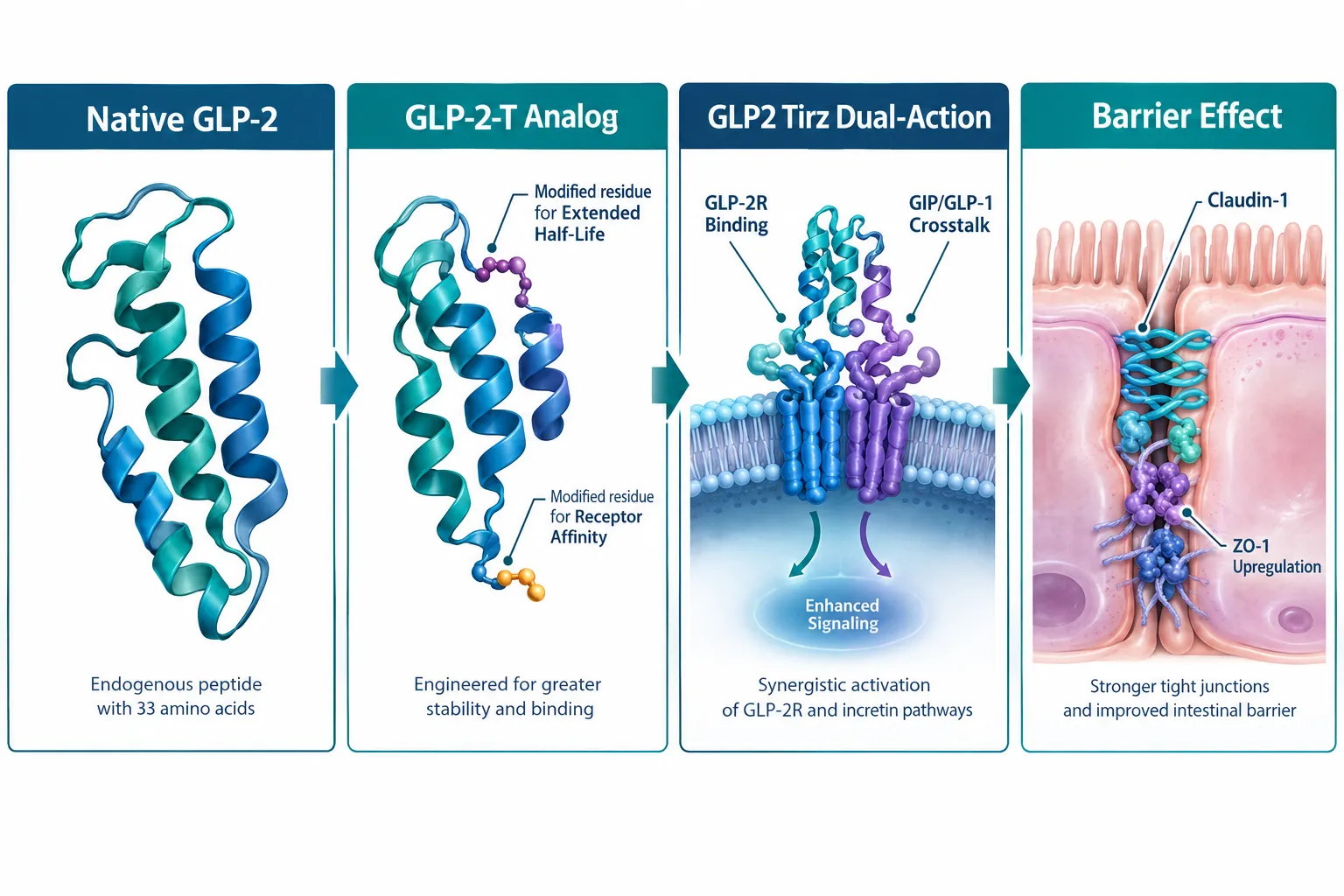
Before interpreting any assay data, the naming conventions must be precise. GLP-2-T most plausibly refers to a GLP-2-type analogue, a modified peptide based on the native 33-amino-acid glucagon-like peptide-2 sequence, engineered for extended half-life and improved receptor affinity. Teduglutide ([hGly²]GLP-2), the approved analogue used in short bowel syndrome, is the closest validated reference point for this category. Its substitution at position 2 protects against dipeptidyl peptidase-4 cleavage, extending its biological action and making it the template against which newer constructs are compared.

GLP2 Tirz peptide, by contrast, draws structural inspiration from dual-receptor agonist architectures. The tirzepatide scaffold demonstrated that a single peptide chain can engage two receptors simultaneously, in tirzepatide's case, GIP-R and GLP-1R, through a balanced dual-agonist design. Applying that logic to GLP-2 biology produces a compound that couples GLP-2 receptor (GLP-2R) agonism with activity at a secondary receptor, most often GLP-1R or GIP-R, to produce additive or synergistic intestinal barrier effects. This is categorically different from the single-axis GLP-2-T construct.

"The distinction between a pure GLP-2R agonist and a dual-action construct is not academic, it predicts entirely different tight junction protein expression profiles in epithelial monolayer assays."

Those interested in related receptor-targeting peptide research may also find value in reviewing GLP-3R peptide research and the GLP-3 R 30mg peptide product category, which explores adjacent incretin-family receptor biology.


Claudin-1 and ZO-1 Expression: What Assays Reveal
Claudin-1 and ZO-1 Expression: What Assays Reveal

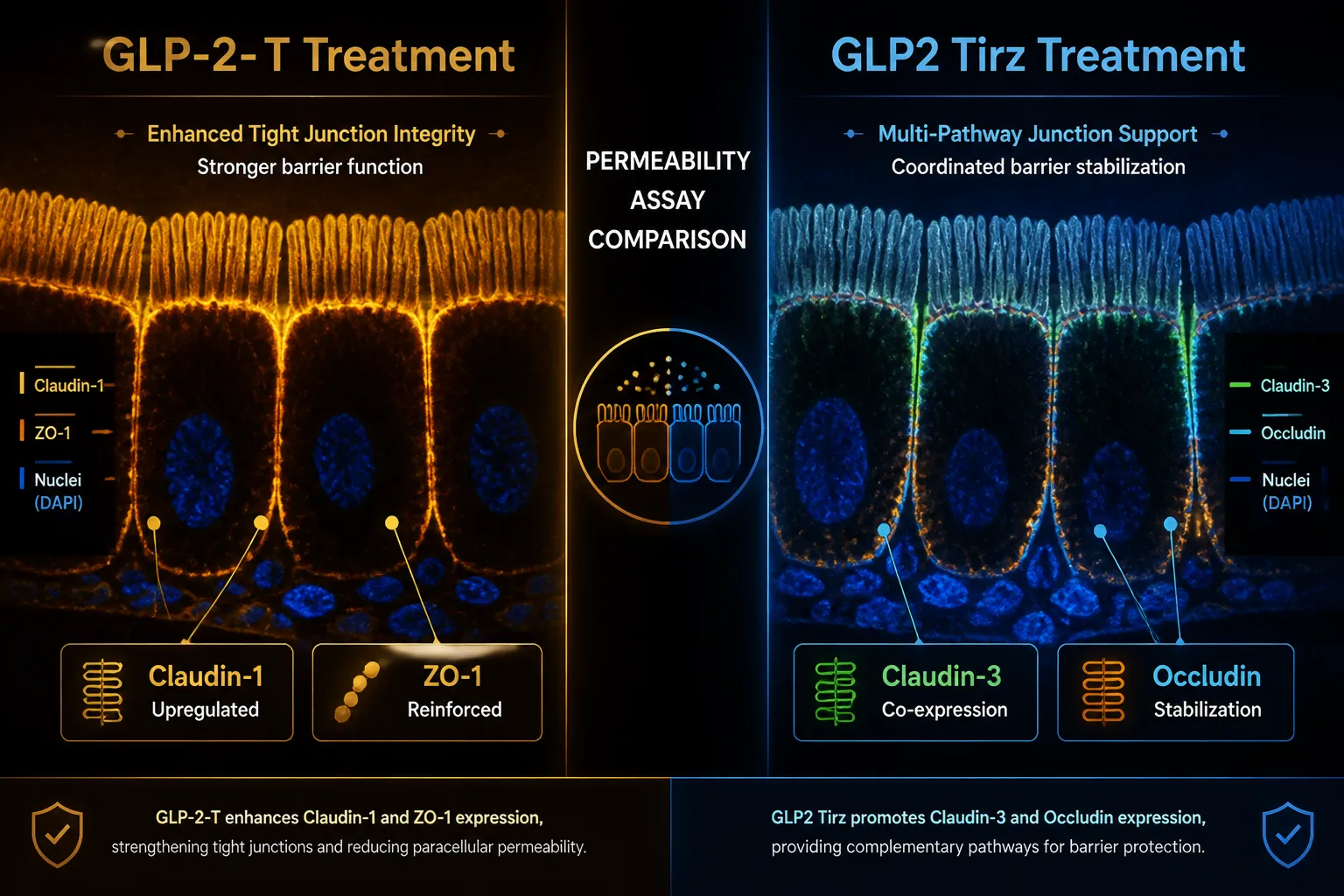
The most informative tight junction markers in intestinal epithelium assays fall into two functional groups: structural scaffolding proteins (ZO-1, ZO-2) and strand-forming transmembrane proteins (claudins, occludin). In GLP-2-T vs. GLP2 Tirz Peptide: Microvascular Permeability and Tight Junction Markers in Intestinal Epithelium Assays research, Claudin-1 and ZO-1 emerge as the most discriminating endpoints.

GLP-2-T treatment in preclinical models consistently raises Claudin-1 and occludin expression while reinforcing ZO-1 localization at the apical junction complex. Administration in non-obese diabetic mouse models reduced intestinal permeability within days, confirming a direct regulatory effect on existing tight junctions rather than a delayed consequence of mucosal expansion. This is a critical distinction: the barrier benefit precedes, and is separable from, the intestinotrophic (crypt-cell proliferative) growth effects.

GLP2 Tirz constructs, through their secondary receptor engagement, appear to add Claudin-3 co-expression and broader occludin stabilization to the profile. When both arms of the dual agonist are active, the downstream signaling cascade engages both cAMP-driven GLP-2R pathways and additional kinase cascades from the secondary receptor, producing a wider expression signature across the claudin family.

Marker GLP-2-T Response GLP2 Tirz Response
Claudin-1 Strong upregulation Moderate-to-strong upregulation
ZO-1 Apical reinforcement Apical reinforcement + lateral spread
Claudin-3 Minimal change Notable increase
Occludin Moderate increase Moderate-to-high increase
E-cadherin Stable Stable or slight increase

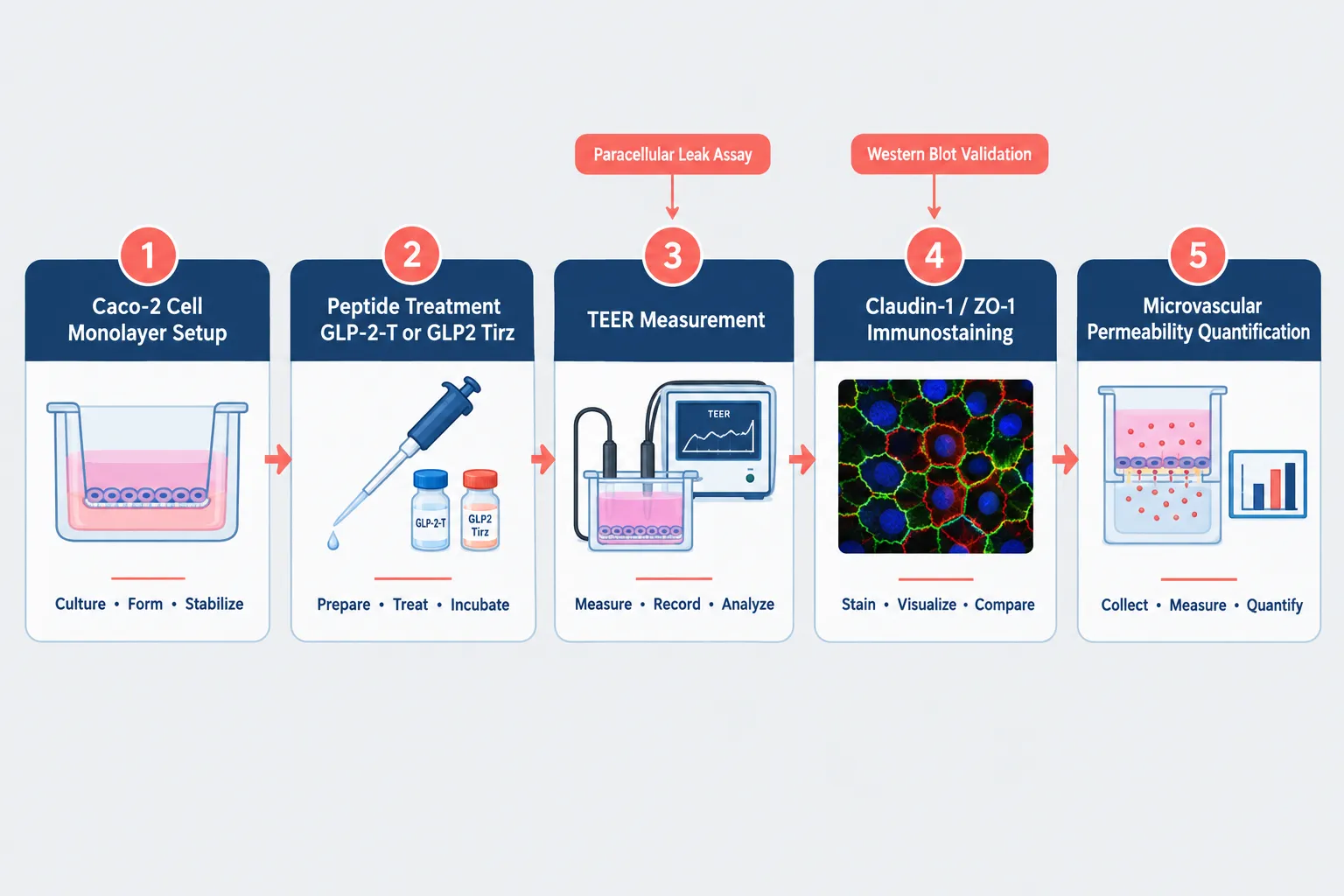
Assay platforms matter here. Transepithelial electrical resistance (TEER) measures global barrier tightness but cannot distinguish which claudin subtype is driving recovery. Fluorescent dextran flux assays quantify paracellular leak more precisely. Western blot and immunofluorescence of Claudin-1 and ZO-1 remain the gold standard for mechanistic comparison. Researchers procuring lab-tested peptides for these assays should confirm certificate-of-analysis data before running tight junction expression studies.


Microvascular Permeability: Indirect but Real
Microvascular Permeability: Indirect but Real

A common misreading of GLP-2 biology is that its barrier effects are purely epithelial. In reality, GLP-2R is not expressed on mature enterocytes. GLP-2's action on the epithelium is indirect, mediated through submucosal enteric neurons that release vasoactive intestinal polypeptide (VIP) and nitric oxide. This signaling cascade improves mucosal blood flow, reduces inflammatory cytokine load, and creates the permissive environment in which tight junction proteins are upregulated.

For microvascular permeability specifically, GLP-2R agonism increases intestinal blood flow and reduces endothelial stress, effects that are implicit in the assay readouts but rarely measured as discrete capillary leak endpoints. Explicit human microvascular permeability data, such as direct capillary leak quantification, remain limited compared to the robust epithelial barrier datasets.

The GLP2 Tirz dual-action profile may offer advantages here. If the secondary receptor target has independent anti-inflammatory or vasodilatory activity, it could amplify the VIP-nitric oxide cascade, improving microvascular support to the mucosa beyond what GLP-2-T achieves alone. This hypothesis is testable in vascular co-culture models pairing endothelial monolayers with intestinal epithelium, a newer assay format gaining traction in 2026 research pipelines.

Researchers examining adjacent peptide tools for barrier and vascular work may find the mitochondrial-protective peptide SS31 relevant, given its role in reducing oxidative stress in endothelial and epithelial tissues. Additionally, those exploring multi-peptide approaches might review GLP-3 peptide sourcing as a complementary incretin-family comparison point. For growth hormone axis interactions with intestinal biology, Tesamorelin peptide benefits may also provide useful mechanistic context.


Conclusion

The comparison of GLP-2-T vs. GLP2 Tirz Peptide: Microvascular Permeability and Tight Junction Markers in Intestinal Epithelium Assays distills to a straightforward principle: single-axis GLP-2R agonism (GLP-2-T) produces a focused Claudin-1 and ZO-1 response via the VIP-nitric oxide pathway, while dual-action GLP2 Tirz constructs extend that profile to Claudin-3 and broader occludin stabilization through secondary receptor engagement.

Actionable next steps for researchers:

  • Use TEER as a primary screen, then confirm with Claudin-1 immunofluorescence and ZO-1 Western blot for mechanistic resolution.
  • Include vascular co-culture models to capture microvascular permeability changes that TEER alone misses.
  • Source peptides with verified certificates of analysis, purity directly impacts tight junction assay reproducibility.
  • Design time-course experiments starting at 24 hours post-treatment to capture the direct tight junction effect before intestinotrophic growth confounds the data.
  • Consider GLP2 Tirz constructs when a wider claudin expression profile or additive anti-inflammatory effect is the research goal; use GLP-2-T analogues when selectivity and mechanistic clarity are the priority.

As 2026 assay platforms grow more sophisticated, the discriminating power between these two compound classes will sharpen, making precise sourcing, rigorous assay design, and clear nomenclature more important than ever.

https://www.puretestedpeptides.com/wp-content/uploads/2026/10/glp-2-t-vs-glp2-tirz-peptide-microvascular-permeability-and-tight-junction-marke.webp 1024 1536 https://www.puretestedpeptides.com/wp-content/uploads/2026/01/buy-peptides-online.jpg 2026-10-30 13:06:112026-10-30 13:06:11GLP-2-T vs. GLP2 Tirz Peptide: Microvascular Permeability and Tight Junction Markers in Intestinal Epithelium Assays
×

Helpful Links

  • My account
  • Cart
  • Checkout
  • Refund and Returns Policy
  • Privacy Policy
  • SMS Privacy Policy
  • Login
  • My Account
  • Logout

USA Made Lab Tested Peptides

All products are sold for research, laboratory, or analytical purposes only, and are not for human consumption


Pure Tested Peptides is a chemical supplier. Pure Tested Peptides is not a compounding / chemical compounding facility as defined under 503A of the Federal Food, Drug, and Cosmetic act. Pure Tested Peptides is not an outsourcing facility as defined under 503B of the Federal Food, Drug, and Cosmetic act.

The statements made within this website have not been evaluated by the US Food and Drug Administration. The products we offer are not intended to diagnose, treat, cure or prevent any disease.

Human/Animal Consumption Prohibited. Laboratory/In-Vitro Experimental Use Only

Scroll to top Scroll to top Scroll to top