

Telomeres shorten with every cell division, and that progressive erosion sits at the heart of biological aging. Among the compounds drawing serious attention in longevity research, few are as structurally simple yet mechanistically compelling as Epithalon. The science of Epithalon peptide: investigating telomere dynamics and cellular senescence in research has accelerated considerably in recent years, with in-vitro findings pointing to measurable telomere elongation and selective effects on telomerase activity that distinguish this tetrapeptide from broader anti-aging compounds.
Key Takeaways
- Epithalon is a synthetic tetrapeptide (Ala-Glu-Asp-Gly) derived from the pineal gland bioregulator Epithalamin.
- Research models show approximately 33% average telomere elongation in human somatic cells treated with Epithalon in vitro.
- Epithalon appears to upregulate telomerase activity in normal cells while demonstrating distinct, divergent behavior in cancer cell lines.
- Cellular senescence markers decrease in Epithalon-treated cells, suggesting a mechanistic link between telomere maintenance and reduced senescent phenotype.
- All findings discussed here are from preclinical research contexts; Epithalon is not approved for human therapeutic use.
What Is Epithalon and How Does It Work at the Molecular Level
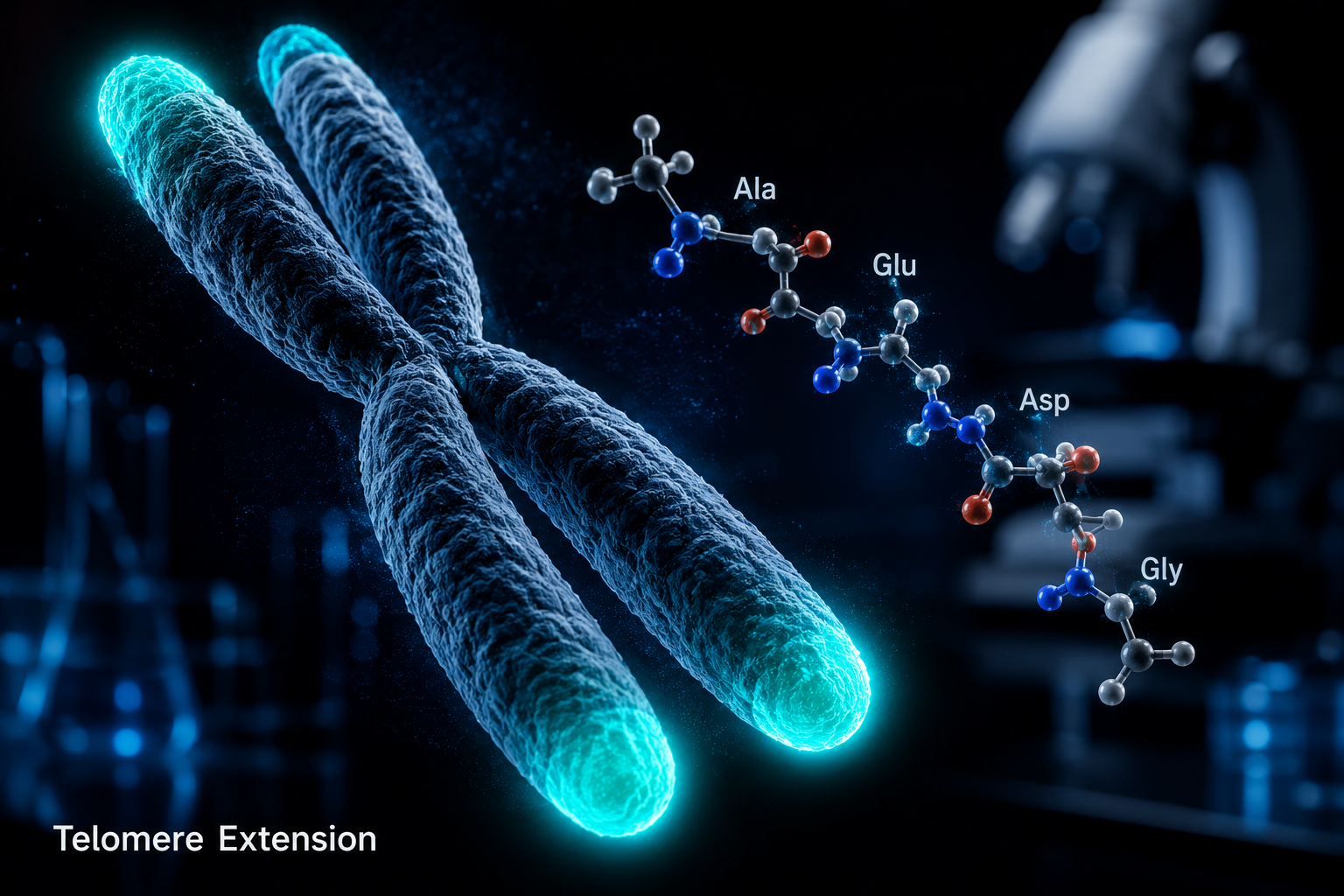
Epithalon is a synthetic tetrapeptide composed of four amino acids: alanine, glutamic acid, aspartic acid, and glycine (Ala-Glu-Asp-Gly). It was first developed from research on Epithalamin, a polypeptide extract isolated from bovine pineal gland tissue. The synthetic version was designed to preserve the core bioregulatory properties of the natural extract in a more stable, reproducible form.
At the molecular level, Epithalon's primary mechanism of interest involves telomerase activation. Telomerase is a ribonucleoprotein enzyme responsible for adding repetitive nucleotide sequences (TTAGGG in humans) back onto telomere ends after cell division. In most adult somatic cells, telomerase expression is low or absent, which means telomeres shorten progressively, a process linked to cellular senescence and age-related tissue decline.
Epithalon research suggests the peptide can upregulate the catalytic subunit of telomerase (hTERT), effectively restoring partial telomerase activity in cells where it has been silenced. This mechanism is distinct from simply slowing telomere attrition; it represents an active restoration pathway.
"Telomere elongation of approximately 33% in human somatic cells treated with Epithalon in vitro represents one of the more striking findings in peptide-based longevity research to date."
Researchers exploring simple peptides in cellular biology have noted that short-chain peptides like Epithalon can interact with chromatin-level regulatory processes, influencing gene expression patterns well beyond their apparent structural simplicity.
Telomere Dynamics and Cellular Senescence: What Research Models Reveal
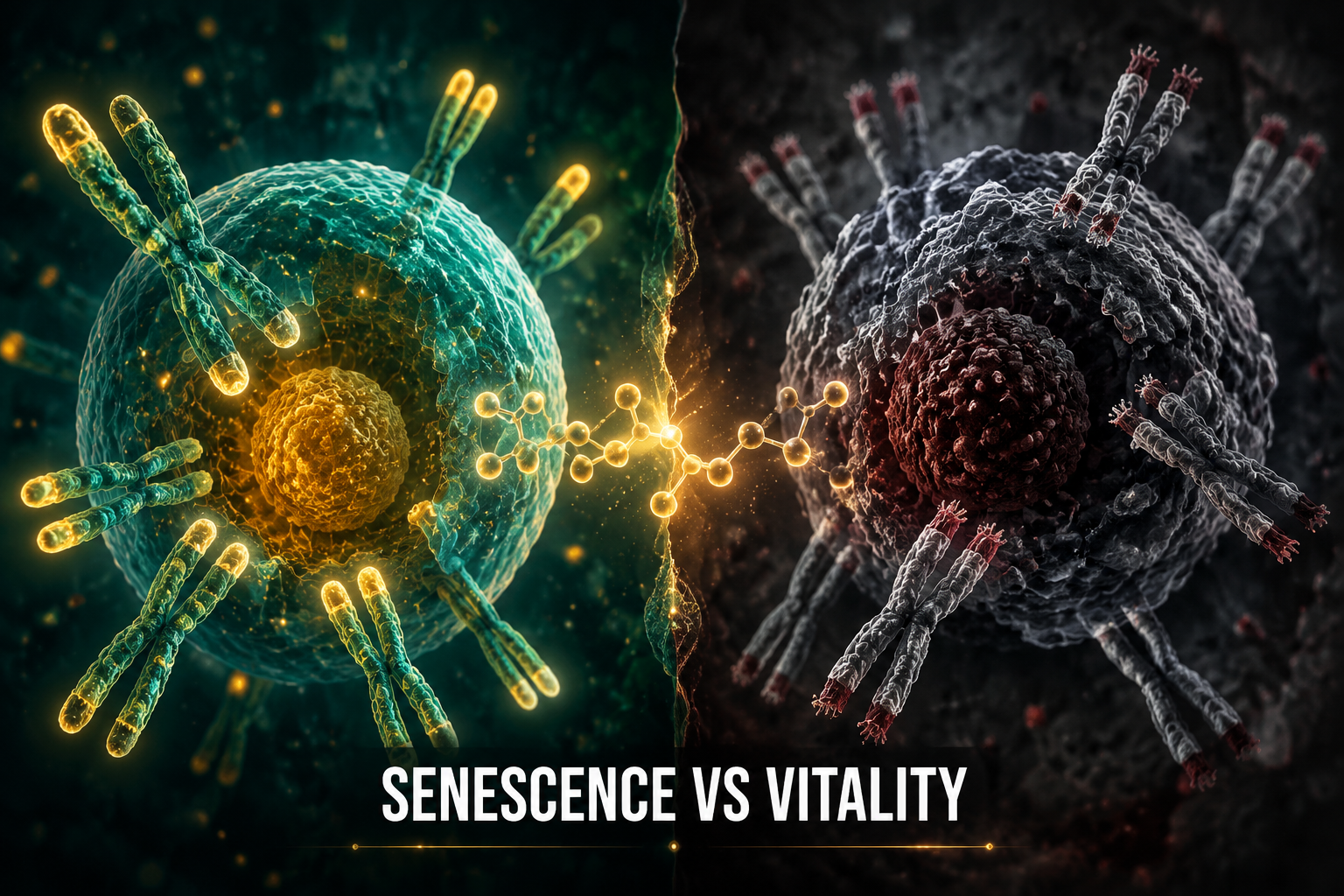
The science of Epithalon peptide: investigating telomere dynamics and cellular senescence in research has been advanced significantly by controlled in-vitro studies. A notable study from Brunel University London examined Epithalon's effects across both normal human somatic cell lines and cancer cell lines, yielding a critical mechanistic insight: Epithalon does not behave uniformly across cell types.
In normal somatic cells, the peptide promoted robust telomere extension and reduced the expression of senescence-associated secretory phenotype (SASP) markers, the inflammatory signals that senescent cells release to damage surrounding tissue. This reduction in SASP activity is significant because chronic low-grade inflammation driven by senescent cells is now considered a major driver of age-related pathology.
In cancer cell lines, however, Epithalon demonstrated a distinctly different profile. Rather than promoting growth through telomere extension, the peptide appeared to engage alternative pathways, suggesting a degree of cell-context selectivity that researchers consider mechanistically important.
| Research Observation | Normal Somatic Cells | Cancer Cell Lines |
|---|---|---|
| Telomere elongation | Significant (~33% avg.) | Distinct/divergent |
| Telomerase upregulation | Observed | Different pathway |
| Senescence markers | Reduced | Variable |
This selectivity aligns with broader findings in thymalin and thymus bioregulation research, where bioregulatory peptides from similar origins demonstrate tissue-specific and context-dependent effects rather than blunt, systemic activation.
Researchers also studying MOTS-c mitochondrial dynamics have noted that cellular aging involves parallel tracks, mitochondrial dysfunction and telomere erosion, and that compounds addressing one pathway may synergize with those addressing the other.
Implications for Longevity Research Models in 2026

The science of Epithalon peptide: investigating telomere dynamics and cellular senescence in research continues to inform how longevity scientists design experimental models. Several implications stand out for researchers working in this space.
1. Epigenetic Interaction
Beyond telomerase, Epithalon may interact with histone acetylation patterns, influencing gene expression in ways that parallel its telomere effects. This positions it as a potential epigenetic modulator, not merely a telomere-length compound.
2. Pineal and Circadian Connections
Epithalon's origin in pineal gland research connects it to melatonin regulation and circadian rhythm biology. Some research models explore whether disrupted circadian signaling accelerates telomere attrition, and whether Epithalon's effects are partly mediated through this axis.
3. Peptide Combination Research
Researchers are increasingly examining Epithalon alongside other bioregulatory compounds. Studies on SS-31 mitochondrial dynamics and GHK-Cu suggest that multi-pathway approaches to cellular aging may produce additive effects in preclinical models.
4. Research-Grade Purity Standards
For any in-vitro or preclinical work involving Epithalon, compound purity is a non-negotiable variable. Researchers sourcing materials should consult quality testing protocols to ensure results are reproducible and not confounded by impurities. Those seeking the compound directly can review the Epithalon research peptide page for specifications.
Parallel work in peptide blends for research has expanded the toolkit available to scientists studying multi-target cellular aging models, making 2026 a particularly active period for this field.
Conclusion
The evidence emerging from in-vitro research on Epithalon paints a compelling picture of a structurally simple peptide with mechanistically sophisticated effects on telomere biology and cellular senescence. The approximately 33% telomere elongation observed in human somatic cells, combined with reduced senescence markers and the cell-context selectivity seen across normal versus cancer cell lines, makes Epithalon a high-priority subject for ongoing longevity research.
Actionable next steps for researchers:
- Review the latest in-vitro data from Brunel University London and 2025-2026 overview literature before designing Epithalon-based experimental protocols.
- Prioritize research-grade, purity-verified Epithalon to ensure data integrity.
- Consider multi-pathway experimental designs that pair Epithalon with mitochondria-targeting peptides for broader cellular aging models.
- Track SASP marker panels alongside telomere length assays to capture the full senescence-related phenotype.
All findings discussed here are from preclinical research contexts. Epithalon is not approved for human therapeutic use and is available strictly for laboratory research purposes.
Leave a Reply
Want to join the discussion?Feel free to contribute!